Bali is one of the world’s most popular destinations for international travelers, attracting millions of visitors every year for holidays, family trips, business activities, long-term stays, and investment.
But before booking your flight to Bali, one important question needs to be answered:
Do you need a visa to enter Bali?
The answer depends on your nationality, purpose of travel, length of stay, and the type of activities you plan to undertake in Indonesia.
Although travelers commonly search for terms such as “Bali Visa” or “Visa Bali,” Bali does not have a separate immigration visa system from Indonesia. Bali is part of Indonesia, so foreign nationals enter Bali under Indonesia’s immigration and visa regulations.
Depending on your nationality and travel purpose, you may be eligible for visa-free entry, a Visa on Arrival (VOA), an electronic Visa on Arrival (e-VOA), a tourist visa, a multiple-entry visa, or another Indonesian visa or stay permit.
This complete Bali Visa guide explains the main visa options available to international travelers in 2026, including Bali Visa requirements, Visa on Arrival, e-VOA, tourist visas, visa extensions, entry requirements, and longer-term options for people who want to live, work, study, or invest in Bali.
All information in this guide is based on Indonesian immigration and Bali government information available as of August 15, 2026. Because immigration regulations can change, travelers should always verify the latest requirements before departure.
What Visa Do I Need for Bali?
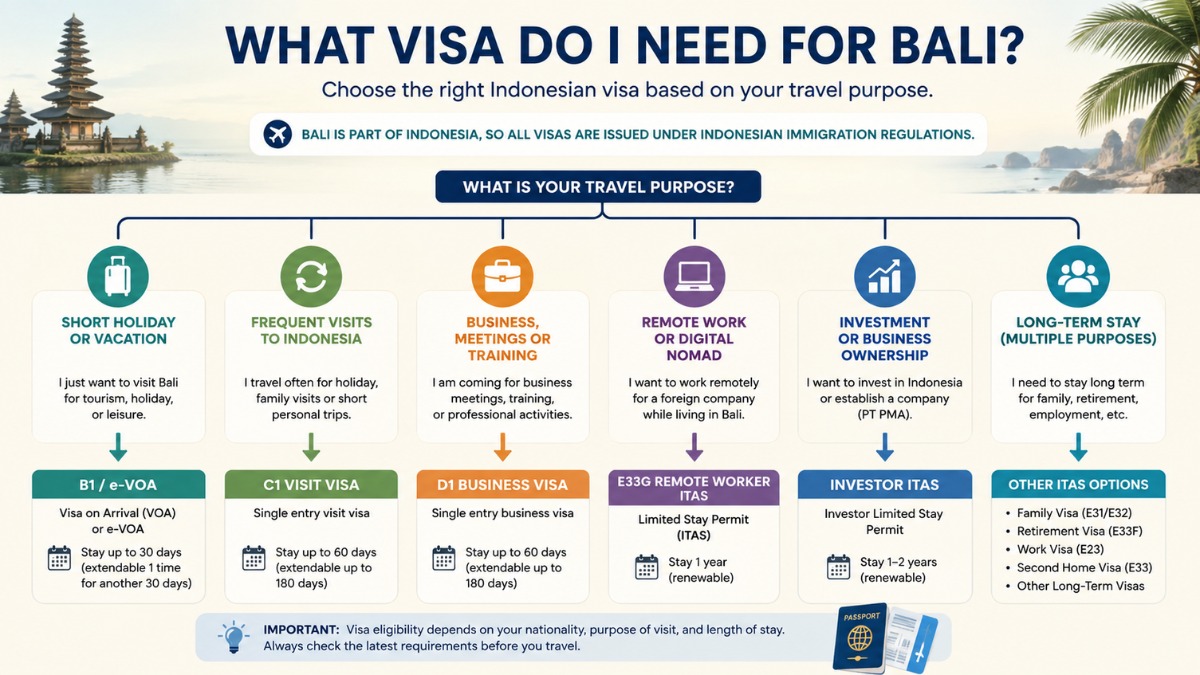
The visa you need for Bali depends primarily on your nationality, purpose of travel, and how long you intend to stay in Indonesia.
For a short holiday, eligible travelers may enter Bali using visa-free entry or a Visa on Arrival (VOA), depending on their nationality.
Travelers who want to stay longer may need an appropriate Indonesian visitor visa, while people planning to work, invest, study, join family members, or establish a business in Indonesia will generally need a visa or stay permit specifically designed for that purpose.
There is therefore no single “Bali Visa” that applies to every traveler.
Instead, you should choose the Indonesian visa or immigration status that matches your travel purpose.
Quick Bali Visa Guide
| Your Purpose | Possible Immigration Option |
| Short tourist trip | Visa-Free Entry or B1 Visa on Arrival, depending on nationality |
| Tourist stay longer than the initial short-stay period | Appropriate Indonesian visitor visa |
| Frequent visits to Indonesia | Multiple-entry visa, if eligible |
| Business meetings or permitted business activities | Appropriate business/visitor visa |
| Pre-investment activities | D12 Pre-Investment Visa |
| Investing in an Indonesian company | Investor-related immigration status |
| Working for an Indonesian company | Appropriate Work ITAS |
| Remote work under an eligible category | Remote Worker ITAS |
| Family-based residence | Family-related visa/stay permit |
| Long-term residence | Appropriate ITAS/ITAP category |
Important: Visa eligibility, permitted activities, duration of stay, and extension rules depend on the specific immigration category and the applicant’s circumstances.
Bali Visa Requirements 2026
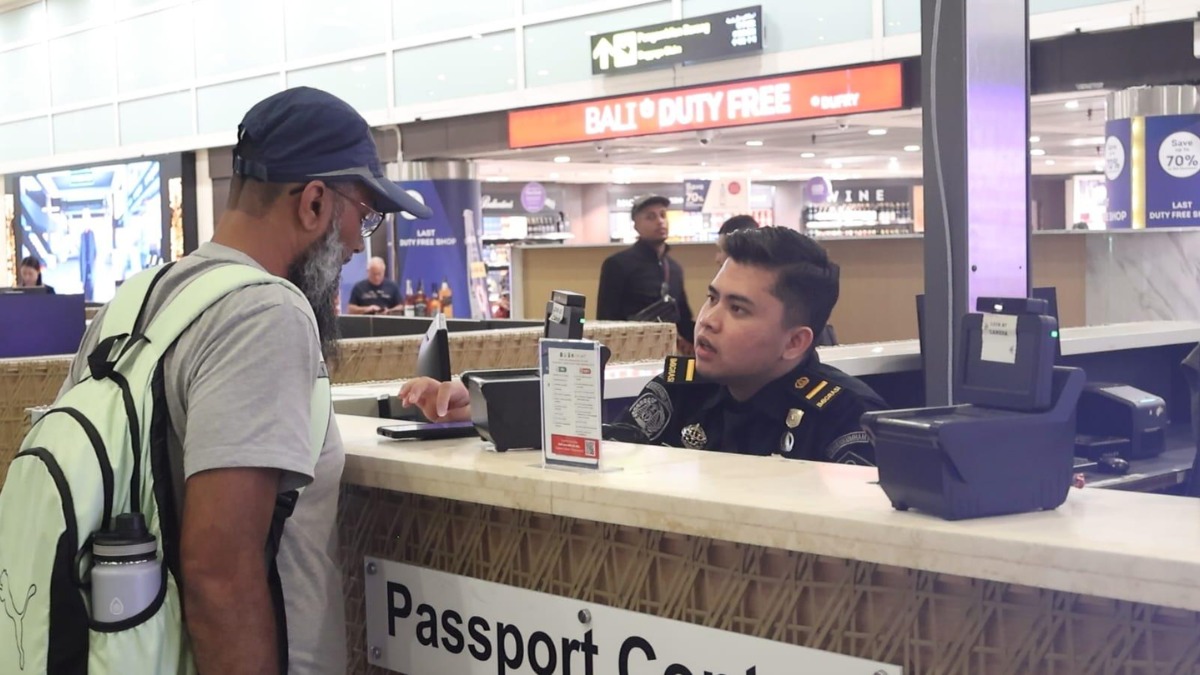
Bali Visa requirements depend on the specific Indonesian visa or entry facility you use.
There is no single document checklist that applies to every foreign traveler entering Bali.
However, travelers should generally be prepared to meet the following requirements before departure.
1. Valid Passport
Your passport must meet the minimum validity requirement applicable to your visa or entry facility.
For example, the official Indonesian e-VOA information requires a passport with at least six months of validity from the date of arrival in Indonesia.
2. Appropriate Visa or Entry Facility
Before traveling, determine whether your nationality qualifies for visa-free entry, Visa on Arrival, e-VOA, or another Indonesian visa category.
Do not assume that every foreign passport has the same entry requirements.
Some nationalities may also be subject to additional immigration clearance requirements before the applicable Indonesian visa can be issued. If your nationality is covered by Indonesia’s Calling Visa rules, see our Calling Visa Indonesia guide for the current requirements, application process, processing time, and applicable costs.
3. Return or Onward Ticket
Depending on the immigration category, travelers may be required to present an onward or return ticket when entering Indonesia.
Travelers should therefore have evidence of onward travel available when required by their visa or entry conditions.
The official B1/e-VOA information lists an outbound transportation ticket among the documents that may need to be presented at the immigration checkpoint.
4. All Indonesia Arrival Card
International travelers entering Indonesia are required to complete the All Indonesia arrival declaration.
The declaration integrates immigration, customs, health, and quarantine information into one arrival system.
The form can be completed online within three days before arrival in Indonesia.
The Indonesian government made All Indonesia the mandatory arrival declaration system for international arrivals from October 1, 2025. The official system currently states that an arrival card submission is required.
5. Bali Foreign Tourist Levy
International tourists visiting Bali are also subject to the Bali Foreign Tourist Levy.
The current levy is IDR 150,000 per international tourist and is separate from any Indonesian visa or immigration fee.
The levy is paid once during the trip and can be paid through the official Love Bali system.
The Indonesian visa or immigration fee depends on the visa category, while Bali’s Foreign Tourist Levy is a separate IDR 150,000 charge.
Bali Visa Options
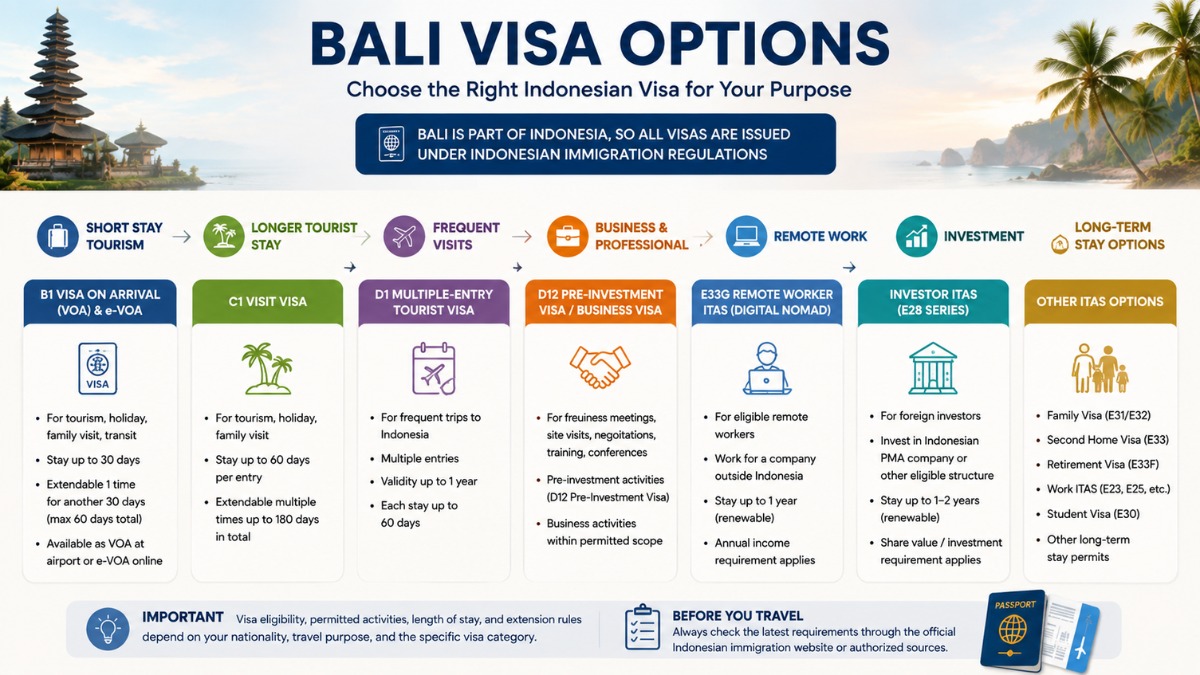
Choosing the right Bali Visa depends on why you are traveling to Indonesia, how long you plan to stay, and whether you need to enter Indonesia more than once.
There is no single visa that is suitable for every visitor to Bali. Indonesia offers different visa and immigration categories for tourism, business activities, investment, remote work, employment, family purposes, and other long-term stays.
For travelers planning a short holiday, a Visa on Arrival or an appropriate tourist visa may be sufficient. Travelers who expect to visit Indonesia frequently may prefer a multiple-entry visa, while people planning to live, work, invest, or establish a business in Bali may need a longer-term visa or stay permit.
The following overview can help you identify which Indonesian immigration option may be most appropriate for your trip to Bali.
Bali Visa Options at a Glance
| Visa / Immigration Option | Best For | Entry Type | General Stay / Validity |
| Visa-Free Entry | Eligible nationalities visiting Indonesia for permitted short-term purposes | Single entry | Depends on the applicable visa-free facility |
| B1 Visa on Arrival (VOA) | Short tourism and eligible short visits | Single entry | Up to 30 days initially; extendable subject to applicable rules |
| C1 Tourist Visa | Travelers who want a longer tourist stay | Single entry | Up to 60 days initially; extendable |
| D1 Tourist Visa | Frequent travelers visiting Indonesia for tourism | Multiple entry | Up to 60 days per arrival |
| D12 Pre-Investment Visa | Foreigners exploring investment opportunities before establishing an investment structure | Multiple entry | Depends on the visa granted |
| Investor ITAS | Eligible foreign investors and shareholders | Multiple entry | Subject to the applicable ITAS category |
| Remote Worker ITAS (E33G) | Eligible remote workers working for overseas companies | Multiple entry | Subject to the applicable ITAS category |
| Work ITAS | Foreign professionals legally working in Indonesia | Multiple entry | Subject to the applicable work-related immigration category |
Important: The table above is a practical overview, not a substitute for checking the specific eligibility requirements for your nationality and intended activities. Indonesian immigration categories, fees, permitted activities, and requirements can change.
The official Indonesian immigration system currently lists B1, C1, D1 and other visa categories separately, so travelers should select the category that matches their actual purpose of travel.
1. B1 Visa on Arrival (VOA)
The B1 Visa on Arrival is one of the most commonly used options for international tourists visiting Bali for a short holiday.
The B1 visa allows an eligible foreign national to enter Indonesia for tourism and other permitted activities under the visa category.
The initial stay is up to 30 days. The stay can generally be extended once for another 30 days, subject to the applicable immigration requirements.
The current government fee for the B1 Visa on Arrival is IDR 500,000.
The official Indonesian e-Visa system confirms the B1/VOA fee of IDR 500,000 and an initial stay of up to 30 days, with the possibility of an extension for another 30 days.
Best for:
- Short Bali holidays
- First-time visitors
- Travelers who do not need a long stay
- Eligible nationalities that can obtain VOA/e-VOA
2. C1 Tourist Visa
The C1 Tourist Visa is designed for foreign nationals who want to visit Indonesia for tourism and stay longer than the initial period available under a Visa on Arrival.
The C1 is a single-entry visitor visa. The initial stay is up to 60 days from the date of arrival, and the stay may be extended in accordance with the applicable immigration regulations.
This option can be particularly useful for travelers planning an extended Bali holiday or a longer stay in Indonesia without entering under a multiple-entry visa.
The official immigration information confirms that C1 is a single-entry tourist visa with an initial stay of up to 60 days, and that the stay can be extended.
Best for:
- Long vacations in Bali
- Travelers staying up to several months through extensions
- Visitors who want more time than the standard VOA period
3. D1 Multiple-Entry Tourist Visa
The D1 Visa is a multiple-entry tourist visa designed for foreign nationals who expect to visit Indonesia repeatedly.
Unlike a single-entry tourist visa, the D1 allows eligible travelers to enter Indonesia multiple times during the validity of the visa.
The permitted stay can be up to 60 days for each arrival, subject to the conditions of the visa granted.
Indonesia’s Directorate General of Immigration identifies D1 as a multiple-entry tourist visa with a maximum stay of up to 60 days per arrival.
Best for:
- Frequent Bali travelers
- People who regularly travel between Indonesia and other countries
- International travelers who do not want to apply for a new single-entry visa for every trip
4. D12 Pre-Investment Visa
Foreign nationals who are considering investing or establishing a business in Indonesia may require an immigration category that allows them to conduct permitted pre-investment activities.
The D12 Pre-Investment Visa is designed for eligible foreign nationals who are exploring investment opportunities in Indonesia before establishing or expanding their investment structure.
This can be particularly relevant for foreign entrepreneurs considering Bali as a location for a business, property-related investment, hospitality project, or other permitted investment activities.
The exact permitted activities, validity, stay period, and requirements depend on the applicable D12 visa provisions.
5. Investor ITAS
Foreign nationals who have an eligible investment relationship with an Indonesian company may qualify for an Investor ITAS.
This immigration status is designed for eligible investors who meet the applicable investment, corporate, and immigration requirements.
For foreign entrepreneurs establishing or investing in a PT PMA in Bali, an Investor ITAS may provide a suitable long-term immigration pathway, subject to eligibility.
6. Remote Worker ITAS
Indonesia also provides immigration options for eligible foreign nationals who work remotely for companies or businesses outside Indonesia.
For eligible remote workers, the Remote Worker ITAS (E33G) may provide a longer-term immigration option compared with short-term tourist visas.
This category is particularly relevant to foreign nationals who want to live in Bali while continuing their professional activities for an overseas employer or business, subject to the specific requirements of the visa category.
7. Work ITAS
Foreign nationals who intend to work for an Indonesian company generally need an immigration status that specifically permits the intended employment activities.
A tourist visa, Visa on Arrival, or other visitor category should not be treated as a general work permit.
Foreign professionals planning to work in Bali should therefore review the appropriate employment and immigration requirements before beginning work in Indonesia.
Which Bali Visa Is Best for You?
The best Bali Visa depends on your travel purpose.
If you are visiting Bali for a short holiday, a B1 Visa on Arrival may be sufficient if you are eligible.
If you want to stay longer for tourism, a C1 Tourist Visa may be more suitable.
If you travel to Indonesia frequently, a D1 Multiple-Entry Tourist Visa may provide greater flexibility.
If you are exploring investment opportunities, the D12 Pre-Investment Visa may be more appropriate.
If you are already an eligible investor in an Indonesian company, an Investor ITAS may provide a more suitable long-term immigration pathway.
Remote workers and foreign employees should use the immigration category designed for their respective activities rather than relying on a tourist visa.
Bali Visa on Arrival (VOA)

The Bali Visa on Arrival (VOA) is one of the most popular immigration options for international travelers visiting Bali for a short stay.
The B1 Visa on Arrival is an Indonesian visa used by eligible foreign nationals entering Bali and other parts of Indonesia. It is commonly referred to as the “Bali Visa on Arrival” because Bali is one of Indonesia’s most popular international destinations.
The B1 Visa on Arrival allows eligible foreign nationals to enter Indonesia for tourism and certain other permitted activities. It is available for a single entry and provides an initial stay of up to 30 days.
The stay can generally be extended once for another 30 days, allowing a total stay of up to 60 days, subject to the applicable immigration requirements.
Who Can Get a Bali Visa on Arrival?
The B1 Visa on Arrival is available only to nationals of countries included in Indonesia’s current Visa on Arrival eligibility list.
The eligibility list can change as Indonesian immigration policies are updated, so travelers should check the latest official list before booking their trip or flying to Bali.
As of the latest information available for this guide, the official immigration authorities list a broad range of eligible nationalities, including travelers from countries such as Australia, the United States, the United Kingdom, India, China, Japan, South Korea, Singapore, Malaysia, New Zealand, and many European countries.
Important:
Do not rely on an old Bali Visa or Indonesia Visa list found on another website.
Visa eligibility is determined by Indonesian immigration regulations and may change. Always verify your nationality against the latest official immigration information before traveling.
How Much Does a Bali Visa on Arrival Cost?
The current government fee for the B1 Visa on Arrival is IDR 500,000 per person.
The same government fee applies to the electronic Visa on Arrival (e-VOA).
This immigration fee is separate from Bali’s Foreign Tourist Levy, which is currently IDR 150,000 per international tourist.
How Long Can I Stay in Bali With a VOA?
The initial B1 Visa on Arrival allows a stay of up to 30 days from the date of arrival in Indonesia.
The stay can be extended once for another 30 days.
This means an eligible traveler can generally stay for up to 60 days in total under the B1 VOA, provided the extension is properly obtained before the initial stay expires.
Can I Extend My Bali Visa on Arrival?
Yes.
The B1 Visa on Arrival can generally be extended once for an additional 30 days.
For travelers holding an electronic Visa on Arrival, the extension can be completed online through the official immigration e-Visa system.
Holders of a non-electronic VOA can extend their stay through the immigration office responsible for their place of residence in Indonesia.
Travelers should not wait until their permitted stay has expired before arranging an extension.
What Documents Do I Need for a Bali VOA?
Travelers applying for a B1 Visa on Arrival should generally be prepared to present:
- A valid passport with at least six months of remaining validity.
- A return or onward ticket when required.
- Payment of the applicable VOA fee.
- Any other documents required by Indonesian immigration based on the traveler’s circumstances.
Where Can I Get a Bali Visa on Arrival?
Eligible travelers can obtain a VOA when arriving through designated Indonesian immigration checkpoints.
For travelers flying directly to Bali, Ngurah Rai International Airport is the main international entry point.
The electronic Visa on Arrival (e-VOA) can also be obtained before traveling through the official Indonesian immigration e-Visa system, allowing eligible travelers to arrange their visa before departure.
Bali VOA vs Bali e-VOA
The B1 VOA and B1 e-VOA are essentially the same immigration category, but the application process is different.
With a traditional VOA, an eligible traveler obtains the visa upon arrival at a designated Indonesian immigration checkpoint.
With an e-VOA, the traveler applies and pays online before traveling to Indonesia. For many international travelers, applying for an e-VOA before departure can make the arrival process more convenient because the visa has already been issued before they reach the immigration checkpoint.
Quick Comparison
| Feature | Bali VOA | Bali e-VOA |
| Visa Category | B1 | B1 |
| Entry | Single entry | Single entry |
| Initial Stay | Up to 30 days | Up to 30 days |
| Extension | Once, up to another 30 days | Once, up to another 30 days |
| Government Fee | IDR 500,000 | IDR 500,000 |
| Application | Upon arrival | Online before travel |
| Sponsor | Not required | Not required |
The government fee and stay conditions are based on the current B1 immigration provisions.
Which Is Better: VOA or e-VOA?
For travelers who want a simple arrival process, the e-VOA can be more convenient because the visa is arranged before departure.
The traditional VOA may be suitable for travelers who prefer to obtain their visa after arriving in Indonesia.
However, travelers should make sure they are eligible for the B1 category and use the correct official application channel.
Important: Don’t Confuse VOA With a Work Visa
A Bali Visa on Arrival is not a general work permit.
Travelers using a B1 VOA should only conduct activities permitted under the visa category.
If your purpose is to work for an Indonesian company, conduct activities requiring a different immigration status, establish an investment, or live in Indonesia long term, you should select an immigration category appropriate to that purpose.
Bali e-VOA
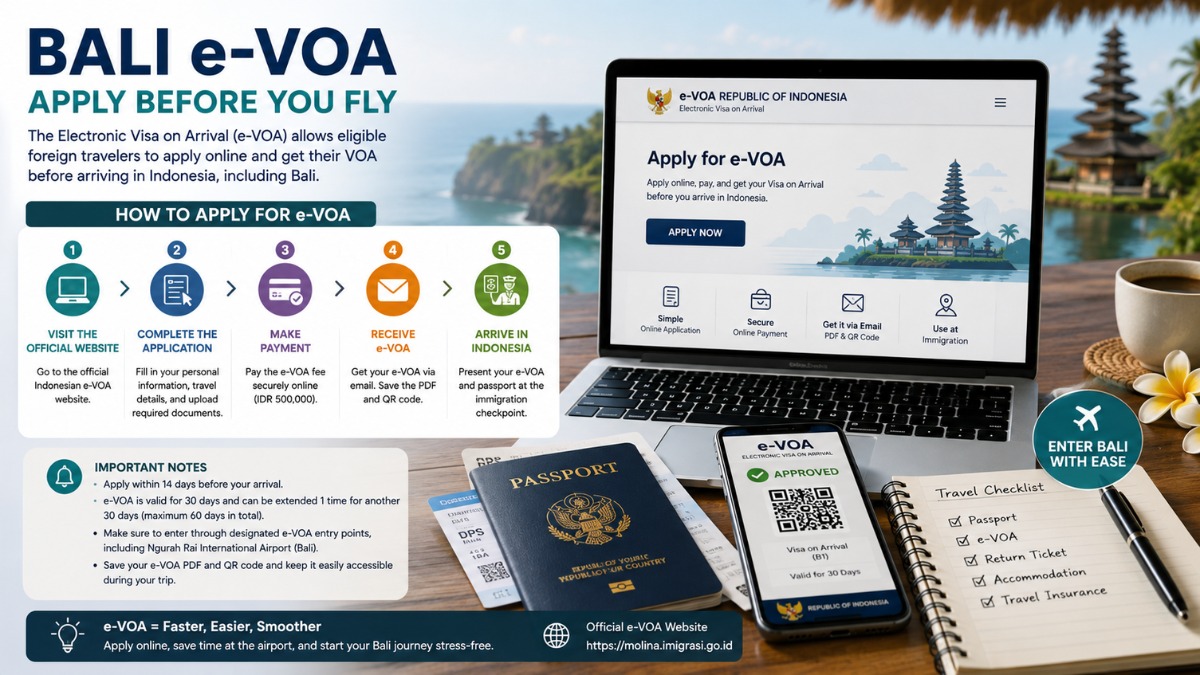
The Bali e-VOA (Electronic Visa on Arrival) is the online version of Indonesia’s Visa on Arrival facility. It allows eligible travelers to apply and pay for their B1 Visa on Arrival before traveling to Indonesia.
For international travelers flying to Bali, applying for an e-VOA before departure can be more convenient than waiting to purchase a VOA after landing at Ngurah Rai International Airport.
The e-VOA is still an Indonesian immigration visa, not a separate Bali visa. However, “Bali e-VOA” is a common search term used by international travelers planning to visit Bali.
Who Can Apply for a Bali e-VOA?
The e-VOA is available to foreign nationals whose nationality is eligible for Indonesia’s Visa on Arrival facility.
Before applying, travelers should check the latest official list of eligible nationalities because Indonesia’s immigration rules and nationality lists may be updated.
Being able to travel to Bali does not automatically mean that every traveler is eligible for an e-VOA. Your passport nationality and the purpose of your visit must match the applicable immigration requirements.
How to Apply for a Bali e-VOA
Eligible travelers can apply for an e-VOA online before traveling to Indonesia.
The general process is:
- Access the official Indonesian e-Visa website.
- Create an account or log in to the applicable immigration system.
- Select the appropriate Visa on Arrival category.
- Enter your personal information exactly as it appears in your passport.
- Upload the required documents.
- Provide your travel information and accommodation details when requested.
- Complete the online payment.
- Wait for the e-VOA to be issued.
- Download and keep a copy of the approved e-VOA for your journey to Indonesia.
“The current immigration SOP states that the e-VOA application involves entering personal information according to the passport, uploading the passport, photograph and return/onward ticket, and paying the applicable immigration fee.”
What Documents Do I Need for a Bali e-VOA?
The standard e-VOA requirements include:
- A valid passport with at least six months of remaining validity.
- A return or onward ticket.
- A recent passport photograph where required by the application system.
- A valid payment method for the immigration fee.
Applicants should make sure that all information entered into the application exactly matches the information shown in their passport.
“Official Indonesian immigration information confirms the six-month passport validity and return/onward ticket requirements for e-VOA applications.”
How Much Does Bali e-VOA Cost?
The current government fee for the B1 Visa on Arrival, including the electronic Visa on Arrival, is IDR 500,000.
This is an Indonesian immigration fee and is separate from Bali’s Foreign Tourist Levy of IDR 150,000 per international tourist.
Any payment or service charges shown by a payment provider should not be confused with the official immigration fee.
“The official immigration information currently lists the B1 VOA fee at IDR 500,000. Bali’s separate Foreign Tourist Levy is currently IDR 150,000.”
When Should I Apply for a Bali e-VOA?
Travelers should apply sufficiently in advance of their trip rather than waiting until the last moment.
The important point is that an e-VOA must be obtained through the official immigration system before traveling if you intend to use the electronic facility.
Travelers should also check the visa’s validity or “must be used before” date shown on the issued document and make sure the passport information matches the application.
“The official e-VOA document warns that the processed e-VOA information cannot be changed and that the details must match the valid passport; an incorrect match can invalidate the e-VOA.”
How Long Can I Stay in Bali With an e-VOA?
A B1 e-VOA provides an initial stay of up to 30 days.
Eligible holders can generally extend the stay once for another 30 days, subject to the applicable immigration requirements.
If you intend to remain in Indonesia for longer than the permitted period, you should arrange the appropriate extension or immigration status before your current stay expires.
Can I Extend My Bali e-VOA Online?
Yes.
The electronic Visa on Arrival can be extended through the Indonesian immigration system, subject to the applicable requirements.
This is one of the practical advantages of the e-VOA compared with obtaining a traditional VOA after arrival.
Travelers should start the extension process before their current permitted stay expires.
What Happens When I Arrive in Bali With an e-VOA?
After arriving at Ngurah Rai International Airport, travelers proceed through immigration using the passport associated with their e-VOA.
Because the visa has already been obtained and paid for online, e-VOA holders do not need to queue at the VOA payment counter.
The immigration officer will still conduct the normal immigration examination and has the authority to determine whether the traveler may enter Indonesia.
Common Bali e-VOA Mistakes to Avoid
- Entering Passport Information Incorrectly
Your name, passport number, date of birth, nationality, and other personal information should match your passport exactly. Even a small discrepancy can cause problems with the issued e-VOA. - Using an Expired or Replaced Passport
The e-VOA is linked to the passport information used during the application.
If you have received a new passport, make sure you apply using the passport you will actually use to enter Indonesia. - Applying Through an Unofficial Website
Travelers should use the official Indonesian immigration e-Visa platform rather than relying on websites that present themselves as government immigration websites.
Third-party websites may charge additional service fees and are not necessarily the official immigration authority. - Forgetting the Return or Onward Ticket
An onward or return ticket may be required during the immigration process, so travelers should keep the relevant evidence available. - Assuming the e-VOA Allows Employment
The B1 e-VOA is not a general work visa.
If your purpose is employment in Indonesia, you need to obtain the appropriate immigration and work authorization before undertaking employment activities.
The official e-VOA information states that the B1 e-VOA is for permitted activities such as tourism, government visits, business meetings, purchasing goods and transit; work and study require the appropriate e-Visa category instead.
Bali e-VOA vs VOA: Which Is Better?
Both options provide access to the same B1 Visa on Arrival category, but the application process is different.
The traditional VOA is obtained after arriving at a designated Indonesian immigration checkpoint.
The e-VOA is obtained online before departure.
For travelers flying to Bali, the e-VOA can be more convenient because the visa has already been arranged before reaching Ngurah Rai International Airport.
However, travelers should always use the official immigration system and confirm their eligibility before applying.
Quick Comparison
| Feature | VOA | e-VOA |
| Visa Category | B1 | B1 |
| Application | Upon arrival | Online before departure |
| Initial Stay | Up to 30 days | Up to 30 days |
| Extension | Once, subject to rules | Once, subject to rules |
| Government Fee | IDR 500,000 | IDR 500,000 |
| Bali Entry | Ngurah Rai and designated checkpoints | Ngurah Rai and designated checkpoints |
| Best For | Travelers who prefer arrival processing | Travelers who want to arrange the visa before flying |
Bali Visa for Different Nationalities
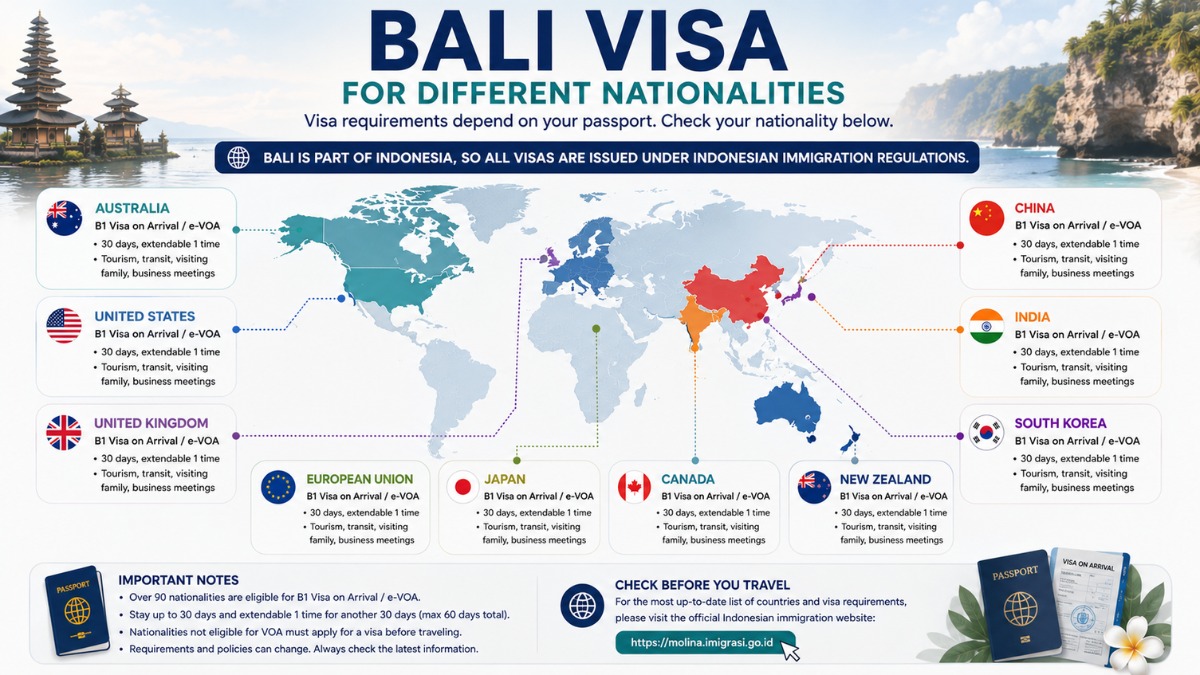
Bali welcomes travelers from around the world, but Indonesian visa requirements are not identical for every nationality.
Your passport determines which Indonesian immigration facility may be available to you, such as visa-free entry, Visa on Arrival (VOA), e-VOA, or another Indonesian visa category.
This is why travelers searching for terms such as “Bali Visa for Australians,” “Bali Visa for Americans,” or “Bali Visa for UK citizens” may receive different answers depending on their nationality.
The most important rule is to check the immigration requirements that apply specifically to the passport you will use to enter Indonesia.
“The current immigration information lists 97 nationalities eligible for VOA, including Australia, the United States, the United Kingdom, India, China, Japan, South Korea, Singapore, New Zealand, and many European countries.”
Bali Visa for Australian Citizens
Australian citizens are among the most important international visitor groups for Bali and Indonesia.
Australian passport holders are currently included in Indonesia’s Visa on Arrival eligibility list. This means eligible Australian travelers visiting Bali for permitted short-term purposes can generally use the B1 Visa on Arrival or e-VOA.
The B1 VOA provides an initial stay of up to 30 days and can generally be extended once for another 30 days, subject to the applicable immigration requirements.
Australians planning to stay longer, work, invest, or establish a business in Bali should consider an immigration category specifically designed for that purpose rather than relying on a tourist VOA.
Bali Visa for US Citizens
United States citizens are currently eligible for Indonesia’s Visa on Arrival facility.
US travelers visiting Bali for a short permitted visit can therefore generally obtain a B1 VOA upon arrival or apply for the corresponding e-VOA before traveling.
The standard B1 VOA provides an initial stay of up to 30 days, with one possible extension subject to the applicable requirements.
US citizens planning employment, investment, or a long-term stay should review the appropriate Indonesian visa or stay permit instead of using a tourist VOA for activities outside its permitted scope.
Bali Visa for UK Citizens
British citizens are currently included in Indonesia’s Visa on Arrival eligibility list.
Eligible UK passport holders visiting Bali for tourism can generally use the B1 VOA or e-VOA, subject to the current immigration requirements.
Travelers who intend to remain in Indonesia for longer periods or undertake activities beyond ordinary tourism should select the immigration category that corresponds to their actual purpose of stay.
Bali Visa for Indian Citizens
Indian citizens are currently eligible for Indonesia’s Visa on Arrival facility.
Indian passport holders traveling to Bali for permitted short-term tourism can generally apply for a B1 VOA or e-VOA.
Because visa eligibility and permitted activities can change, Indian travelers should verify the current requirements before departure, particularly if they plan to stay longer than 30 days or have purposes other than tourism.
Bali Visa for Chinese Citizens
Chinese citizens are currently included in Indonesia’s Visa on Arrival eligibility list.
Eligible Chinese passport holders traveling to Bali for permitted tourism purposes can generally use the B1 VOA or e-VOA.
Travelers planning a longer stay, business activities, investment, or employment should review the appropriate visa category before traveling.
Bali Visa for European Citizens
Many European nationalities are currently eligible for Indonesia’s Visa on Arrival facility.
The current VOA list includes numerous European countries, including France, Germany, Italy, Spain, the Netherlands, Switzerland, Austria, Belgium, Portugal, Poland, Sweden, Norway, Denmark, Finland, Ireland, and others.
However, “European citizen” is not itself an immigration category. Eligibility is determined by the specific passport nationality.
European travelers should therefore check their individual nationality rather than assuming that every European passport has identical immigration treatment.
Bali Visa for Other Nationalities
Travelers from other countries may have different entry options depending on their nationality.
Some nationalities may qualify for visa-free entry, while others may qualify for VOA or e-VOA. Travelers who are not eligible for these facilities may need to obtain an appropriate Indonesian visa before departure.
Indonesia’s visa and nationality policies can change, so travelers should always check the latest official immigration information before making travel arrangements.
Important: Your Passport Matters
A common mistake among international travelers is assuming that everyone visiting Bali has the same visa requirements.
This is not the case.
Two travelers arriving on the same flight may have completely different immigration requirements because they hold different passports.
Before traveling, always check:
- Your passport nationality.
- Your purpose of travel.
- How long you intend to stay.
- Whether you need a visa before departure.
- Whether you qualify for VOA or e-VOA.
- Whether your planned activities are permitted under your visa.
- Any additional Indonesian entry requirements.
Bali Visa Eligibility Can Change
Indonesian immigration policies are subject to change.
Nationality lists, visa categories, fees, permitted activities, and entry requirements may be updated by the Indonesian government.
For this reason, information found in older Bali travel guides should not automatically be treated as current.
This guide is based on information available as of August 15, 2026, but travelers should verify the latest official requirements before departure.
Bali Visa for Long-Term Stay
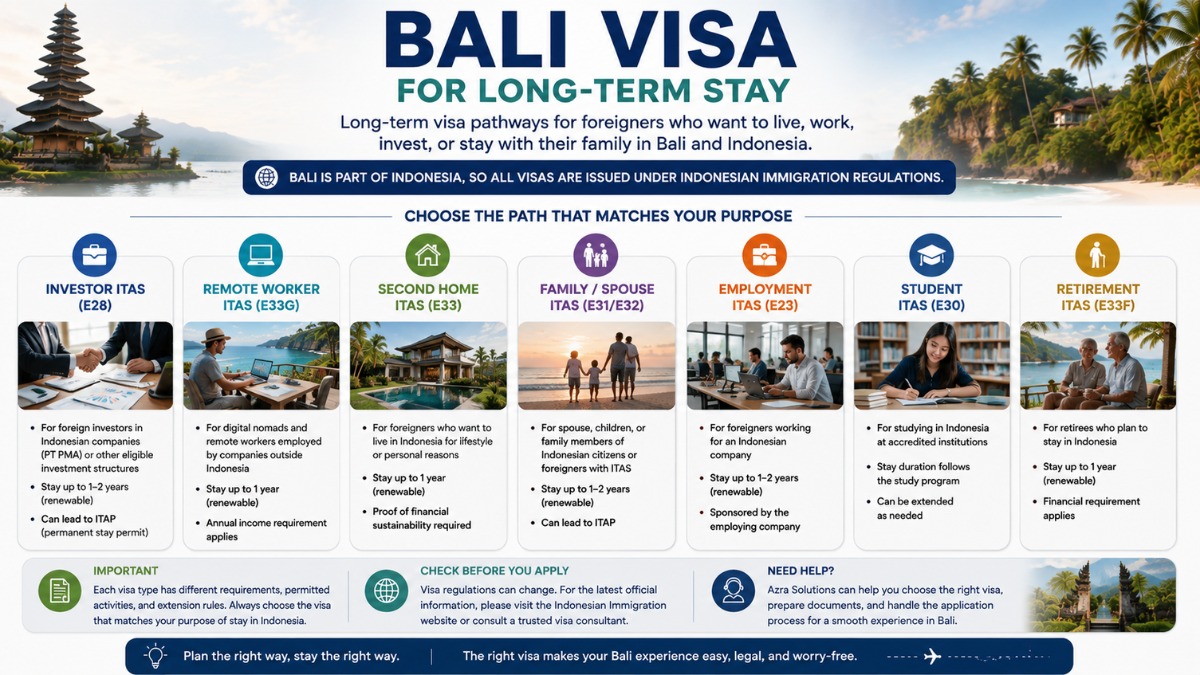
Bali is not only a destination for short holidays. Many foreign nationals want to stay in Bali for several months or even several years for remote work, investment, retirement, family reasons, or other long-term purposes.
For these travelers, a short-term Bali tourist visa may not be the most appropriate immigration solution.
Indonesia provides several visa and stay permit categories that can support longer stays, depending on the applicant’s purpose, nationality, financial circumstances, family situation, and intended activities in Indonesia.
The right long-term immigration option therefore depends on what you actually plan to do while living in Bali.
Long-Term Bali Visa Options
| Purpose | Possible Immigration Option | Suitable For |
| Long-term investment | Investor ITAS (E28) | Eligible foreign investors |
| Remote work | Remote Worker ITAS (E33G) | Eligible remote workers |
| Second-home lifestyle | Second Home ITAS (E33) | Foreign nationals meeting the applicable requirements |
| Retirement | Elderly/Retirement ITAS | Eligible foreign nationals meeting age and other requirements |
| Family residence | Family ITAS (E31) | Eligible family members |
| Employment | Work ITAS | Foreign nationals legally employed in Indonesia |
| Pre-investment | D12 Pre-Investment Visa | Foreign nationals exploring investment opportunities |
| Other purposes | Relevant Indonesian visa/stay permit | Depends on the applicant’s circumstances |
The current immigration visa list includes E28 investor categories, E31 family categories, E33 Second Home, E33G remote worker, E33F elderly, and various employment categories.
Investor ITAS for Bali
Foreign entrepreneurs and investors who establish or invest in an Indonesian company may be eligible for an Investor ITAS, subject to the applicable investment and immigration requirements.
The Investor ITAS is particularly relevant for foreign nationals who want to maintain a long-term presence in Bali while managing or overseeing an eligible investment in Indonesia.
For investors establishing a PT PMA in Bali, the Investor ITAS can form part of a broader business and immigration strategy.
However, the applicant must satisfy the applicable investment requirements, and the immigration category should accurately reflect the applicant’s actual role and activities.
“The current immigration information identifies E28 as the investor category, while official immigration guidance states that investor applications are tied to an active PMA corporation and applicable shareholding requirements.”
Remote Worker ITAS for Bali
Bali is one of the world’s most popular destinations for remote professionals.
Foreign nationals who work remotely for an overseas employer or business may be eligible for Indonesia’s Remote Worker ITAS (E33G), provided they meet the specific requirements of the category.
This option is different from simply entering Bali on a tourist visa and continuing to work remotely without checking whether the activity is permitted.
If you plan to live in Bali while continuing your professional activities for an overseas business, you should determine whether the Remote Worker ITAS is appropriate for your circumstances.
Second Home ITAS for Bali
Indonesia also provides a Second Home immigration pathway for eligible foreign nationals who want to establish a long-term residence in Indonesia.
The Second Home ITAS can be relevant to foreign nationals who have substantial financial resources and want to maintain a long-term lifestyle in Bali without relying on a tourist visa.
The Second Home category is different from the Investor ITAS. A foreign national should therefore not assume that purchasing or renting property automatically makes them eligible for an Investor ITAS or another residence permit.
The applicable financial, accommodation, and other requirements should be reviewed before choosing this category.
“The current immigration framework lists E33 Second Home as a limited-stay category, and current immigration information provides for Second Home ITAS periods of 5 or 10 years under the applicable rules.”
Retirement / Elderly Stay in Bali
Bali is also a popular destination for foreign retirees and older travelers seeking a long-term lifestyle in Indonesia.
Indonesia provides immigration categories for eligible elderly foreign nationals, subject to age, financial, accommodation, insurance, and other requirements.
The retirement or elderly immigration pathway is different from a tourist visa because it is specifically designed for eligible foreign nationals who intend to reside in Indonesia for a longer period.
Applicants should review the current requirements carefully because financial and accommodation conditions may apply.
Family ITAS for Bali
Foreign nationals who have qualifying family relationships may also be able to obtain a family-based immigration status for living in Indonesia.
Family-based categories can apply in situations such as joining an Indonesian spouse, joining a spouse who holds an Indonesian ITAS or ITAP, or other qualifying family relationships recognized under Indonesian immigration regulations.
This can be a more appropriate pathway than repeatedly using tourist visas when the applicant’s primary reason for staying in Bali is family residence.
Work ITAS for Bali
Foreign nationals who intend to work for an Indonesian company must use an immigration pathway appropriate for their employment activities.
A tourist visa or B1 Visa on Arrival should not be treated as a general authorization to work in Indonesia.
Indonesia currently provides several work-related visa categories depending on the foreign worker’s position and circumstances, including categories for directors, commissioners, executives, managers, supervisors, and other eligible foreign workers.
D12 Pre-Investment Visa for Bali
Not every foreign entrepreneur who comes to Bali is immediately ready to establish an Indonesian company.
Some investors first want to explore business opportunities, conduct due diligence, evaluate potential investments, or prepare for an investment structure.
For eligible applicants, the D12 Pre-Investment Visa can be relevant for permitted pre-investment activities.
This can be particularly useful for foreign entrepreneurs who want to evaluate Bali before committing to a longer-term investment structure such as a PT PMA and Investor ITAS.
How Long Can You Stay in Bali Long Term?
There is no single maximum stay period for everyone using a “long-term Bali Visa.”
The permitted stay depends on the specific immigration category.
For example, current Indonesian immigration provisions include ITAS categories with different initial periods and extension possibilities. Some categories can provide substantially longer residence periods than ordinary tourist visas.
This is why choosing the correct immigration category is more important than simply looking for a visa with the longest possible validity.
Can I Convert a Tourist Visa Into a Long-Term Stay Permit?
Sometimes, but not from every type of entry status.
Indonesian immigration regulations allow certain Visit Stay Permits (ITK) to be changed into an ITAS under eligible categories and procedures.
A Visa on Arrival does not automatically provide a pathway to an ITAS. However, certain eligible immigration pathways may allow a change of status under the applicable bridging visa mechanism. The eligibility and procedure depend on the specific ITAS category and the applicant’s circumstances.
Therefore, travelers should not assume that entering Bali on a VOA automatically gives them a pathway to convert into an ITAS.
Which Long-Term Bali Visa Is Right for You?
The best long-term immigration option depends on what you actually intend to do in Indonesia.
If you are investing in an Indonesian company, an Investor ITAS may be appropriate.
If you work remotely for an overseas business, the Remote Worker ITAS may be worth considering if you meet the requirements.
If your objective is a long-term lifestyle in Indonesia and you meet the applicable financial requirements, the Second Home pathway may be relevant.
If you are joining a qualifying family member, a Family ITAS may be the appropriate route.
If you intend to work for an Indonesian company, you should use the appropriate Work ITAS.
If you are still exploring investment opportunities, the D12 Pre-Investment Visa may be more appropriate than immediately applying for an Investor ITAS.
Bali Visa Extension
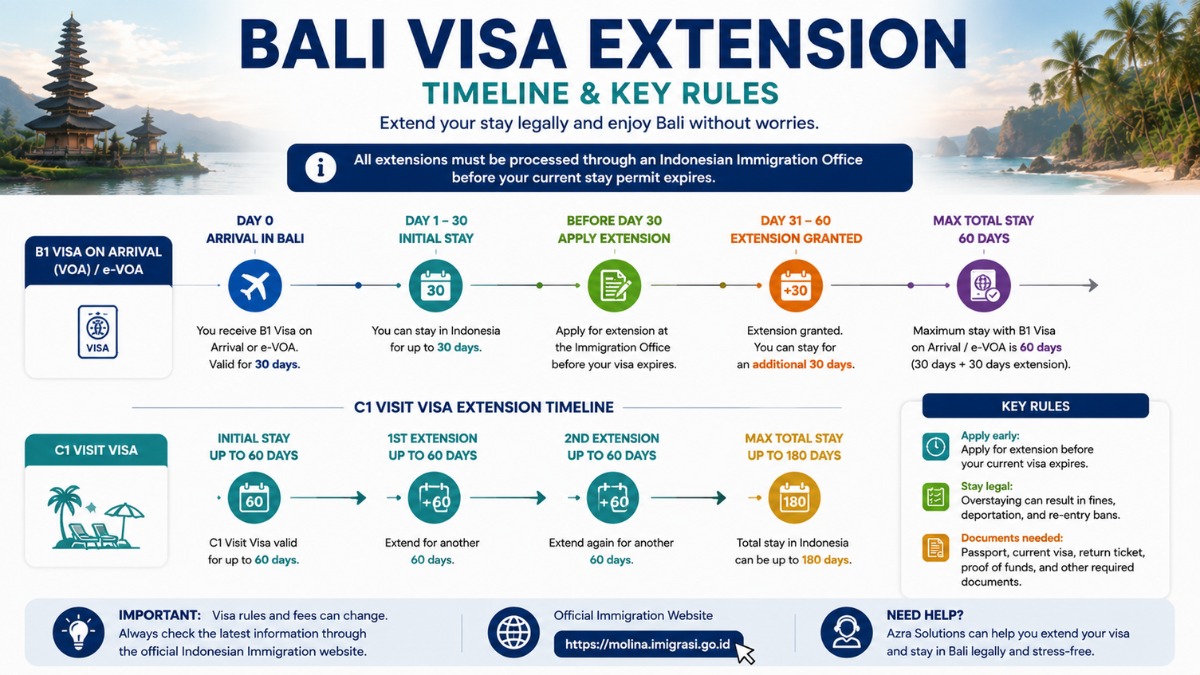
Many international travelers want to stay in Bali longer than originally planned. Fortunately, certain Indonesian visa and stay permit categories can be extended, allowing eligible foreign nationals to remain in Indonesia without leaving the country.
However, Bali does not have a separate visa extension system. Visa extensions in Bali are handled under Indonesia’s immigration regulations.
The extension process depends entirely on the type of Indonesian visa or stay permit you hold.
A B1 Visa on Arrival, a C1 Tourist Visa, an Investor ITAS, and other immigration categories do not necessarily follow the same extension rules.
Travelers should therefore identify their exact visa category before making an extension application.
Can I Extend My Bali Visa?
Yes, certain Indonesian visa categories can be extended while the foreign national is in Indonesia.
However, not every visa or entry facility can be extended, and the number of extensions, permitted stay, application deadline, required documents, and procedure depend on the specific immigration category.
For example, a B1 Visa on Arrival can generally be extended once for another 30 days, while a C1 Tourist Visa can be extended multiple times subject to its maximum permitted stay.
Long-term ITAS categories have separate extension procedures and requirements.
Bali Visa Extension Options
| Visa / Stay Permit | Can It Be Extended? | General Extension Rule |
| B1 Visa on Arrival | Yes | Once for another 30 days |
| B1 e-VOA | Yes | One additional 30-day period, subject to requirements |
| C1 Tourist Visa | Yes | Can be extended several times, up to 180 days total |
| D1 Multiple-Entry Tourist Visa | Depends on the permitted stay and visa conditions | Follow the specific visa conditions |
| D12 Pre-Investment Visa | Subject to the visa category | Follow applicable immigration rules |
| Investor ITAS | Yes, subject to requirements | Separate ITAS extension procedure |
| Remote Worker ITAS | Yes, subject to requirements | Separate ITAS extension procedure |
| Other ITAS categories | Generally subject to extension rules | Depends on the specific ITAS |
Important: This is a practical overview. The exact extension entitlement should always be checked against the specific visa or stay permit issued to the foreign national.
How to Extend a Bali Visa on Arrival
If you entered Indonesia using a B1 Visa on Arrival, you can generally extend your stay once for another 30 days.
The extension must be completed before your permitted stay expires.
The current immigration procedure allows eligible VOA holders to submit an extension through the applicable immigration system or through the immigration office responsible for their place of residence, depending on whether the VOA was issued electronically or at the point of arrival.
Travelers should not wait until the final day if they can reasonably complete the process earlier.
Bali VOA Extension Requirements
Foreign nationals applying for a VOA extension should generally prepare:
- A valid passport.
- The existing VOA or electronic VOA information.
- A return or onward ticket.
- The required immigration fee.
- Any additional documents requested by the immigration authority.
The immigration office may also require the applicant to complete identification, interview, photograph, or biometric procedures depending on the applicable process.
How Much Does a Bali Visa Extension Cost?
The government fee depends on the type of visa or stay permit being extended.
For a B1 Visa on Arrival extension, the current government fee is IDR 500,000 for the extension application.
Other visa categories, including C1 and ITAS categories, have different government fees.
Important: The government immigration fee is not necessarily the same as the total amount a traveler may pay when using a professional immigration consultant.
Consultant or agency service fees, if applicable, are separate from Indonesian government fees.
When Should I Apply for a Bali Visa Extension?
Do not wait until your permitted stay has expired.
For a VOA extension, the current immigration guidance allows the application to be submitted as early as 14 days before the stay expires and no later than the applicable deadline before the current stay ends.
For other visa categories, the permitted application window can be different.
The safest approach is to check the expiry date of your current immigration status and begin preparing the extension well before the deadline.
Can I Extend My C1 Tourist Visa?
Yes.
The C1 Tourist Visa is a single-entry visitor visa with an initial stay of up to 60 days.
According to the current official immigration information, the C1 stay can be extended several times, with a maximum total stay of up to 180 days.
The extension is processed through the applicable Indonesian immigration system by the sponsor or authorized party.
Can I Extend My Investor ITAS in Bali?
Yes, subject to the applicable requirements.
Investor ITAS holders must follow the specific ITAS extension procedure and continue to satisfy the requirements associated with their immigration category.
The extension process may involve updated corporate and investment documentation, depending on the type of Investor ITAS and the circumstances of the applicant.
Applicants should therefore prepare their corporate records well before the existing ITAS expires.
What Happens If I Miss the Extension Deadline?
Failing to extend your immigration status before it expires can result in an overstay.
Foreign nationals should never assume that an expired visa can simply be renewed after the expiry date without consequences.
Overstay can result in immigration fines and, depending on the circumstances and length of the overstay, more serious immigration consequences.
If you realize that your immigration status is about to expire, contact the relevant immigration office or qualified immigration professional immediately.
Can I Leave Bali and Come Back Instead of Extending?
Leaving Indonesia and returning does not automatically solve an immigration problem.
Whether you can legally re-enter Indonesia depends on the visa or immigration facility you hold, your nationality, the validity of your travel document, and the purpose of your next visit.
A traveler should not leave Indonesia simply to avoid an extension requirement without first determining whether they are eligible to re-enter under a new visa or entry facility.
For frequent travelers or people planning longer stays, a more appropriate multiple-entry visa or long-term immigration status may be a better solution.
Bali Visa Extension vs Applying for a New Visa
Whether you should extend your current visa or apply for a different visa depends on your travel plans.
If you only need a few additional weeks, extending an eligible visitor visa may be the simplest solution.
If you plan to stay in Bali for several months, travel repeatedly between Indonesia and other countries, work remotely, invest, or establish a business, a different immigration category may be more appropriate.
Choosing the correct immigration pathway can help you avoid repeatedly extending a visa that was never designed for your long-term purpose.
Quick Guide: Which Option Is Right for You?
| Your Situation | Possible Solution |
| Need another 30 days for tourism | B1 VOA Extension |
| Want up to 180 days for tourism | C1 Tourist Visa + Extensions |
| Visit Indonesia frequently | D1 Multiple-Entry Tourist Visa |
| Exploring investment opportunities | D12 Pre-Investment Visa |
| Already investing in Indonesia | Investor ITAS |
| Working remotely for an overseas business | Remote Worker ITAS (E33G) |
| Working for an Indonesian company | Work ITAS |
Bali Entry Requirements 2026
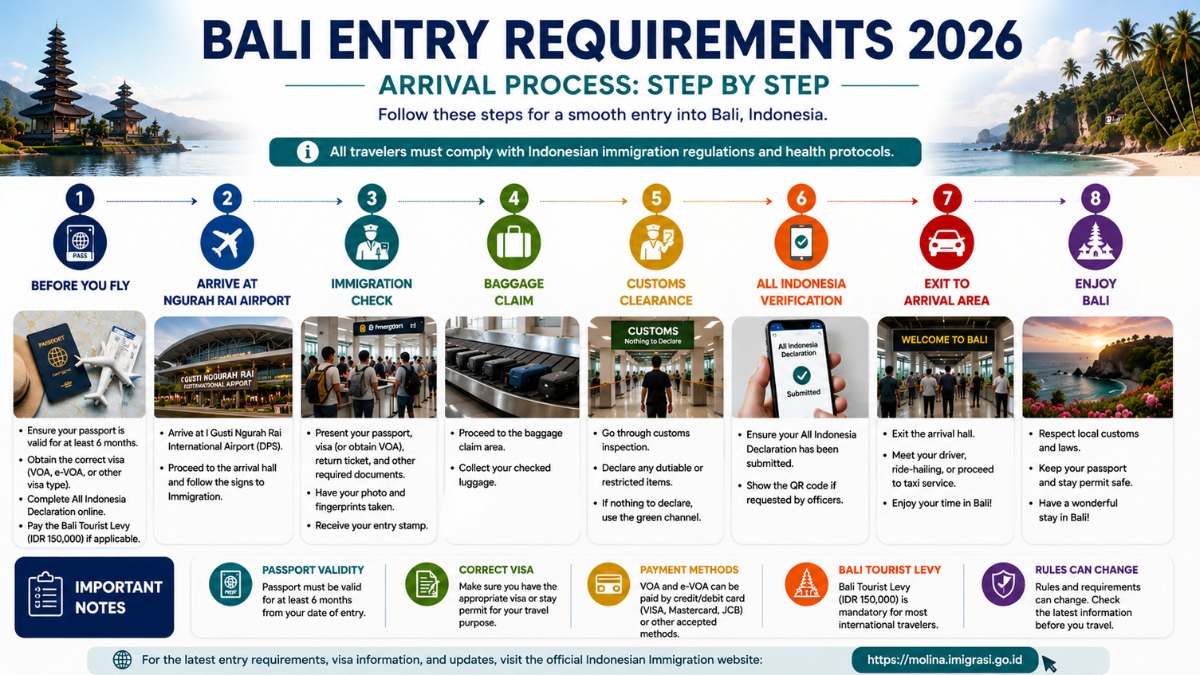
Having the correct Bali Visa is only one part of preparing for your trip to Indonesia.
International travelers should also make sure they meet Indonesia’s entry requirements before boarding their flight to Bali.
These requirements can include passport validity, the appropriate visa or visa-free facility, an onward or return ticket where applicable, the All Indonesia arrival declaration, customs requirements, and Bali’s Foreign Tourist Levy.
Because some of these requirements are separate from the visa itself, travelers should prepare for all of them before departure.
1. A Valid Passport
Your passport is the most important travel document for entering Bali.
The required remaining validity depends on the immigration category you are using. For many Indonesian visitor visa categories, a passport with at least six months of remaining validity is required.
Travelers should also make sure that the passport they use for their visa application is the same passport they present when entering Indonesia.
If you have recently renewed your passport, do not assume that a visa issued using your previous passport can automatically be used with the new one.
2. The Correct Visa or Entry Facility
Before traveling to Bali, you must determine which Indonesian immigration facility applies to your nationality and purpose of travel.
Depending on your circumstances, you may enter using:
- Visa-free entry, if your nationality is eligible.
- B1 Visa on Arrival.
- B1 e-VOA.
- A single-entry visitor visa such as C1.
- A multiple-entry visa such as D1.
- A long-term visa or ITAS for eligible purposes.
Do not assume that a visa that worked for a previous trip will automatically be appropriate for your next trip.
3. Return or Onward Ticket
Depending on your visa or entry facility, you may be required to show a return or onward ticket.
This is particularly important for travelers entering Indonesia using visitor or short-stay facilities.
An onward ticket can demonstrate that you have a planned departure from Indonesia within the permitted period of your immigration status.
Keep the ticket or booking confirmation accessible on your phone and, preferably, have a copy available offline.
4. Complete the All Indonesia Arrival Card
All international passengers arriving in Indonesia must complete the All Indonesia arrival declaration.
The system integrates several arrival declarations into one digital platform, including immigration, customs, health, and quarantine information.
The declaration can be completed online up to three days before your scheduled arrival in Indonesia.
After completing the declaration, travelers receive a QR code that can be presented during the arrival process.
5. Customs Declaration
The All Indonesia system also incorporates Indonesia’s Customs Declaration for passengers arriving by air and sea.
Travelers are required to declare goods they bring into Indonesia accurately.
This is particularly important if you are carrying restricted goods, large amounts of cash, electronic devices that require IMEI registration, or goods that may be subject to customs duties or other regulations.
Cash and Payment Instruments
If you carry cash or other payment instruments equivalent to IDR 100 million or more, you must declare them to Indonesian Customs.
Travelers should not assume that carrying a large amount of cash without declaration is permitted simply because the money is legally theirs.
6. Bali Foreign Tourist Levy
International tourists visiting Bali are subject to the Bali Foreign Tourist Levy.
The current levy is IDR 150,000 per foreign tourist.
This levy is separate from your Indonesian visa fee and is administered by the Bali Provincial Government.
The levy applies to foreign tourists entering Bali, including travelers who arrive in Bali directly from overseas or enter Bali through another part of Indonesia.
Important:
The Bali Tourist Levy is not a visa.
Paying the levy does not replace a visa, and having a valid Indonesian visa does not automatically mean the levy has been paid.
7. Follow Immigration Requirements at Ngurah Rai International Airport
When you arrive at Bali’s Ngurah Rai International Airport, you will still be subject to immigration inspection.
Having an approved visa does not automatically guarantee admission to Indonesia.
An Immigration Officer may verify your passport, visa, travel purpose, and other relevant information before allowing you to enter Indonesia.
Travelers should therefore ensure that the information in their visa application is accurate and consistent with their actual travel plans.
8. Keep Your Travel Documents Accessible
Before flying to Bali, keep the following documents easily accessible:
- Passport.
- Visa approval or e-VOA, if applicable.
- Return or onward ticket.
- Hotel or accommodation details.
- All Indonesia QR code.
- Bali Tourist Levy payment confirmation, if already paid.
- Supporting documents relevant to your purpose of travel.
Digital copies are useful, but travelers should also consider keeping important documents available offline in case they cannot access the internet immediately after landing.
Bali Entry Checklist 2026
| Before Flying to Bali | Status |
| Passport valid for the required period | ✅ |
| Correct Indonesian visa / entry facility | ✅ |
| Return or onward ticket, where applicable | ✅ |
| All Indonesia Arrival Declaration | ✅ |
| Customs Declaration | ✅ |
| Bali Foreign Tourist Levy | ✅ |
| Accommodation information | ✅ |
| Visa approval / e-VOA copy | ✅ |
What Should I Prepare Before Flying to Bali?
To make your arrival as smooth as possible, complete your immigration and arrival preparations before leaving your home country.
Ideally, you should:
- Check whether you need an Indonesian visa.
- Confirm that your passport meets the applicable validity requirement.
- Apply for an e-VOA or other visa in advance if appropriate.
- Prepare your return or onward ticket.
- Complete the All Indonesia arrival declaration within three days before arrival.
- Save the QR code generated by All Indonesia.
- Pay the Bali Foreign Tourist Levy when required.
- Keep your visa, passport, accommodation, and travel documents accessible.
- Make sure your intended activities are permitted under your visa.
- Check the latest official Indonesian immigration information before departure.
Bali Entry Requirements Can Change
Indonesia’s immigration, customs, health, and tourism requirements can change over time.
Travelers should therefore avoid relying solely on old blog posts, social media videos, or information published several years ago.
This guide reflects the information available as of August 15, 2026. However, travelers should verify the latest requirements through the official Indonesian immigration, customs, and Bali government platforms before traveling.
Bali Visa vs Indonesia Visa
When searching online, you will often see the terms “Bali Visa,” “Visa Bali,” and “Indonesia Visa” used interchangeably.
This can be confusing for first-time visitors.
The important thing to understand is that Bali is part of Indonesia, and immigration matters in Bali are governed by Indonesian immigration law.
There is therefore no separate “Bali Visa” issued by the Bali provincial government.
When travelers search for a Bali Visa, they are generally looking for an Indonesian visa or immigration facility that allows them to enter and stay in Bali.
For example, a traveler visiting Bali may use a B1 Visa on Arrival, e-VOA, C1 Tourist Visa, D1 Multiple-Entry Tourist Visa, or another Indonesian immigration category depending on their nationality and purpose of travel.
Is There a Separate Bali Visa?
No.
There is no standalone immigration visa issued specifically by Bali.
Bali is one of Indonesia’s provinces, so foreign nationals entering Bali are subject to the immigration regulations of the Republic of Indonesia.
The term “Bali Visa” is mainly used by travelers, tourism businesses, and search engines to describe an Indonesian visa used for traveling to Bali.
This distinction is important because the visa requirements are determined by Indonesian immigration authorities rather than by the Bali provincial government.
Why Do People Search for “Bali Visa”?
“Bali Visa” is one of the most common phrases used by international travelers because Bali is a globally recognized destination.
Someone searching for:
“Bali Visa”
“Visa Bali”
“Bali Visa Requirements”
or
“Bali Visa on Arrival”
is usually trying to understand what immigration permission they need to travel to Bali.
From a practical perspective, the traveler does not need to worry about applying for a separate Bali immigration visa.
Instead, they need to identify the correct Indonesian visa or entry facility for their nationality and purpose of travel.
Bali Visa vs Indonesia Visa: What’s the Difference?
| Feature | “Bali Visa” | Indonesia Visa |
| Official immigration term | No separate visa category | Yes |
| Issued by | Not a separate Bali authority | Indonesian Immigration |
| Geographic purpose | Commonly refers to travel to Bali | Applies throughout Indonesia, subject to visa conditions |
| Eligibility | Depends on the underlying Indonesian visa | Depends on nationality and visa category |
| Example | “Bali Visa on Arrival” | B1 Visa on Arrival |
| Extension | Depends on underlying visa | Depends on the specific visa category |
Can I Use My Bali Visa to Travel Around Indonesia?
Yes, provided that your Indonesian immigration status allows you to travel within Indonesia.
A foreign national who legally enters Indonesia through Bali does not normally become restricted to Bali simply because Bali was their arrival destination.
For example, a tourist who enters Indonesia through Ngurah Rai International Airport may generally travel to other destinations within Indonesia during the permitted period of stay, subject to the conditions of their immigration status.
This can include destinations such as Jakarta, Yogyakarta, Lombok, Labuan Bajo, Komodo, or other parts of Indonesia.
Important:
Your visa does not become a different visa when you travel from Bali to another Indonesian destination.
The underlying immigration permission remains an Indonesian immigration status.
Can I Enter Bali With an Indonesia Visa?
Yes.
If you hold a valid Indonesian visa that permits entry for your intended purpose, you can generally use it to enter Bali through an authorized immigration checkpoint.
The important factor is not whether the visa is called a “Bali Visa.”
The important factors are:
- Whether your nationality is eligible.
- Whether the visa is valid.
- Whether the visa permits entry through your intended checkpoint.
- Whether your purpose of travel matches the visa.
- Whether you satisfy the applicable entry requirements.
Does Bali Have Different Visa Requirements From Jakarta?
Generally, the underlying Indonesian visa requirements are not different simply because you are traveling to Bali instead of Jakarta.
Both Bali and Jakarta are part of Indonesia and operate under Indonesia’s national immigration framework.
However, travelers may encounter different practical arrangements at individual airports, immigration offices, or other entry points.
For example, Ngurah Rai International Airport has specific facilities and procedures for international arrivals because it is one of Indonesia’s major international gateways.
What If I Want to Live in Bali Long Term?
If your intention is to live in Bali for several months or years, you should not simply search for a “long-term Bali Visa.”
Instead, identify the reason you want to stay in Indonesia.
Your options may include:
- Investor ITAS for eligible investors.
- Remote Worker ITAS for eligible remote workers.
- Family ITAS for qualifying family relationships.
- Second Home ITAS for eligible applicants.
- Retirement or elderly immigration categories.
- Work ITAS for eligible foreign employees.
- Other Indonesian long-term immigration categories depending on your circumstances.
What If I Want to Invest in Bali?
If your purpose is to invest in Bali, a tourist visa should not automatically be treated as an investment or business immigration solution.
Foreign investors should first determine whether they are exploring an investment opportunity, establishing an Indonesian company, becoming a shareholder, or undertaking another permitted investment activity.
Depending on the circumstances, a D12 Pre-Investment Visa may be relevant during the investment exploration stage, while an Investor ITAS may be appropriate for an eligible investor who has established the required investment structure.
The Simple Rule to Remember
There is no separate Bali immigration visa. Your visa or stay permit is issued under Indonesian immigration rules and should match your nationality, purpose of travel, and intended length of stay.
“Bali Visa” is the phrase travelers commonly use when searching for the Indonesian visa they need to visit Bali.
The correct visa depends on your nationality, purpose of travel, and intended length of stay.
Can I Work in Bali With a Tourist Visa?
One of the most common questions asked by foreigners planning to stay in Bali is:
“Can I work in Bali with a tourist visa?”
The short answer is: generally, no.
A tourist visa or short-term visitor facility is designed for permitted visitor activities, such as tourism and other activities specifically allowed under the relevant visa category. It should not be treated as a general authorization to work for an Indonesian company, provide paid services in Indonesia, or receive employment income from an Indonesian individual or company.
If you intend to work in Bali, you need to determine whether your activities require a work-related visa and stay permit or another specific immigration category.
What Is Considered “Working” in Bali?
Working in Bali is not limited to having a traditional office job.
Depending on the circumstances, activities may include:
- Being employed by an Indonesian company.
- Providing professional services for an Indonesian client.
- Receiving payment from an Indonesian company or individual for work performed in Indonesia.
- Managing day-to-day operations of an Indonesian business in a capacity that requires work authorization.
- Performing paid professional activities in Indonesia.
- Carrying out activities that require a specific Indonesian work authorization.
The correct immigration treatment depends on the actual activity, the source of payment, the parties involved, and the applicable Indonesian immigration and employment regulations.
Can I Attend Business Meetings in Bali?
Yes, certain business-related activities may be permitted under specific visitor visa categories.
For example, the B1 Visa permits activities including attending meetings and certain business-related events, subject to the conditions of the visa.
However, attending a business meeting is not the same as being employed in Indonesia.
A foreign visitor may be able to attend a permitted meeting, conference, exhibition, or similar event without having the same immigration status required for employment.
The exact activity should always be checked against the permitted activities of the visa being used.
Can I Work Remotely From Bali?
This question requires more careful consideration.
Working remotely from Bali is not automatically the same as being employed by an Indonesian company.
Indonesia currently has a specific Remote Worker ITAS category, E33G, for eligible foreign nationals who work remotely.
The E33G category is therefore a more appropriate immigration pathway for eligible remote workers who intend to reside in Indonesia while working remotely under the conditions of that category.
Travelers should not assume that simply working for a foreign company automatically makes remote work permissible under every tourist or visitor visa.
Can I Work for an Indonesian Company With a Tourist Visa?
No.
If you are employed by an Indonesian company, you generally need an immigration status that specifically permits your employment activities.
A tourist visa, B1 Visa on Arrival, or another visitor facility should not be used as a substitute for the appropriate work-related immigration status.
Indonesia provides various work-related visa and ITAS categories depending on the position and nature of the employment.
What Visa Do I Need to Work in Bali?
There is no single “Bali Work Visa.”
Foreign nationals who want to work in Bali must use the Indonesian immigration category that corresponds to their employment and circumstances.
Depending on the position and employer, this can include work-related ITAS categories such as:
- E23 – Work in various professional sectors.
- E25 – Work as a commissioner or executive.
- E25B – Work as a director.
- Other specialized work-related ITAS categories.
The appropriate category depends on the actual position, employer, qualifications, and applicable immigration and employment requirements.
Can I Run My Own Business in Bali on a Tourist Visa?
This depends on what you mean by “run a business.”
Foreign nationals may undertake certain permitted business activities under visitor categories, such as attending meetings or exploring opportunities, where specifically allowed.
However, actively working in an Indonesian business, receiving employment income in Indonesia, or undertaking activities that require a specific work authorization is a different matter.
If your intention is to establish and operate an Indonesian company, you should first determine the appropriate corporate structure and immigration status.
For foreign investors, this may involve establishing a PT PMA and obtaining the appropriate investor or work-related immigration status depending on the investor’s actual role in the company.
Can I Freelance in Bali on a Tourist Visa?
Foreign freelancers should be particularly careful.
If you provide paid services while physically working in Indonesia, you should not automatically assume that a tourist visa permits the activity simply because your client is located outside Indonesia.
The legality of the activity depends on the nature of the work, the client, the source of payment, the immigration category, and other applicable Indonesian regulations.
If you intend to work remotely or provide professional services while residing in Bali, obtain professional advice on the immigration category that matches your actual circumstances before beginning the activity.
What Happens If I Work Without the Correct Immigration Status?
Foreign nationals who undertake activities outside the conditions of their immigration status may face immigration consequences.
Depending on the circumstances, violations can result in administrative immigration action, including cancellation of an immigration stay permit, deportation, or other measures provided under Indonesian law.
For this reason, it is much safer to determine the correct immigration status before starting work rather than trying to resolve an immigration problem after the activity has already begun.
Tourist Visa vs Work ITAS
| Activity | Tourist / Visitor Status | Work-Related ITAS |
| Tourism | ✅ | Not necessary |
| Holiday in Bali | ✅ | Not necessary |
| Attend permitted meetings | ✅ Depending on visa | ✅ |
| Attend permitted conferences/exhibitions | ✅ Depending on visa | ✅ |
| Employment by Indonesian company | ❌ | ✅ Subject to requirements |
| Receive Indonesian employment income | ❌ | ✅ Subject to requirements |
| Work as an Indonesian company director | ❌ Not automatically permitted | Appropriate work-related status required |
| Remote work under E33G | Not automatically covered | ✅ E33G if eligible |
| Paid professional activity in Indonesia | ❌ Generally not under tourist status | Appropriate category required |
The Important Difference: Visiting Bali vs Working in Bali
The key question is not simply whether you are physically located in Bali.
The important question is what you are actually doing while you are in Indonesia.
A foreign national can visit Bali for tourism, attend permitted meetings, or participate in other activities allowed by their visa without necessarily having a work permit.
But once the activity becomes employment or another activity requiring specific authorization, the appropriate immigration status becomes important.
If you are unsure, do not rely on the assumption that “I am working for a foreign company, so my tourist visa is automatically enough.”
Check the immigration category against your actual circumstances before starting the activity.
Bali Visa for Digital Nomads

Bali has become one of the world’s most popular destinations for digital nomads, remote professionals, entrepreneurs, and location-independent workers.
However, being able to work from a laptop while traveling in Bali does not automatically mean that every tourist visa allows you to work remotely.
Indonesia provides specific immigration options for eligible remote workers, while other visa categories are intended for tourism, business visits, investment, or other purposes.
For digital nomads, the most important question is therefore not simply “Do I need a Bali Digital Nomad Visa?”
The real question is:
Which Indonesian immigration category allows me to stay in Bali while carrying out my remote work legally?
Is There a Bali Digital Nomad Visa?
There is no separate visa issued by the Bali provincial government called a “Bali Digital Nomad Visa.”
Bali is part of Indonesia, so digital nomads are subject to Indonesian immigration regulations.
However, Indonesia currently has a specific Remote Worker ITAS category, E33G, designed for eligible foreign nationals who work remotely.
Because Bali is such a popular destination for remote professionals, the E33G is commonly referred to online as the “Bali Digital Nomad Visa” or “Indonesia Digital Nomad Visa.”
What Is the Indonesia Digital Nomad Visa (E33G)?
The E33G Remote Worker ITAS is an Indonesian limited-stay immigration category for eligible foreign nationals who work remotely.
It is designed for foreign professionals whose employment or professional relationship is with a business or employer outside Indonesia.
For an eligible applicant who wants to live in Bali while continuing to work remotely for an overseas company, E33G can provide a more appropriate long-term immigration pathway than repeatedly using a short-term tourist visa.
The E33G should not, however, be treated as a general work permit for employment by an Indonesian company.
Who Is the Bali Digital Nomad Visa For?
The E33G can be relevant to foreign nationals who:
- Work remotely for an overseas employer or company.
- Intend to live in Indonesia while continuing that remote employment.
- Meet the applicable income and employment requirements.
- Have the financial resources required under the immigration category.
- Intend to comply with the conditions of their Indonesian immigration status.
The category is therefore particularly relevant to employees who want to make Bali their temporary or longer-term base while remaining professionally connected to an overseas business.
Can I Work Remotely in Bali With a Tourist Visa?
You should not automatically assume that a tourist visa permits remote work simply because your employer is located outside Indonesia.
The fact that you receive your salary from a foreign company does not, by itself, determine your immigration status.
If you intend to reside in Bali while continuing to work remotely, you should review whether E33G or another appropriate immigration category applies to your circumstances.
E33G Requirements for Digital Nomads
Applicants for the E33G Remote Worker ITAS must meet the requirements established by Indonesian immigration.
The requirements can include:
- A valid passport.
- Evidence of employment or a work relationship with a company established outside Indonesia.
- An employment agreement or other acceptable proof of remote employment.
- Evidence of the required annual income.
- Proof of sufficient funds or financial capability where required.
- Other documents required by the Indonesian immigration system.
Because immigration requirements can be updated, applicants should always verify the latest document requirements before submitting an application.
How Much Income Do I Need for the E33G?
One of the most important requirements for the E33G is the applicant’s income.
Current immigration information specifies an annual income requirement of at least USD 60,000 for the Remote Worker category.
This is equivalent to approximately USD 5,000 per month.
Applicants should be prepared to provide documentation supporting the income declared in their application.
How Long Can Digital Nomads Stay in Bali With E33G?
The E33G is a long-term immigration option rather than a short tourist facility.
The permitted stay and validity depend on the E33G immigration status granted to the applicant and the applicable regulations at the time of application.
This makes E33G fundamentally different from a B1 Visa on Arrival, which is designed for short stays.
Applicants should always check the period granted on their immigration documents rather than relying solely on general information found online.
Can E33G Holders Travel In and Out of Indonesia?
The E33G is a limited-stay immigration category with multiple-entry functionality under the applicable conditions.
This can be particularly useful for digital nomads who want Bali to be their primary base while occasionally traveling to other countries.
However, travelers should always make sure their immigration status remains valid before leaving Indonesia and returning.
Can E33G Holders Work for an Indonesian Company?
No.
The E33G is intended for eligible remote workers working for an overseas employer or company.
It should not be used as a substitute for the appropriate Indonesian work authorization if the foreign national intends to work for an Indonesian company.
If you plan to accept employment from an Indonesian business, you should review the appropriate Work ITAS category instead.
Can I Freelance for Foreign Clients From Bali?
Digital nomads often work with multiple international clients rather than having one traditional employer.
Whether a particular freelance arrangement qualifies under E33G depends on the applicant’s actual professional relationship, documentation, income structure, and the requirements of the immigration category.
Applicants should therefore not assume that every freelance arrangement automatically qualifies for E33G.
If your income comes from multiple foreign clients rather than a single overseas employer, your specific circumstances should be reviewed before applying.
Can Digital Nomads Bring Their Family to Bali?
Depending on the circumstances, eligible family members may have their own Indonesian immigration pathways to accompany a foreign national residing in Indonesia.
However, family members do not automatically receive the same immigration status simply because the primary applicant holds an E33G.
Each family member’s eligibility should be assessed according to the applicable family immigration category.
E33G vs Tourist Visa for Digital Nomads
| Feature | Tourist / Visitor Visa | E33G Remote Worker ITAS |
| Main Purpose | Tourism / permitted visitor activities | Remote work |
| Long-Term Residence | Limited | Designed for longer stay |
| Remote Work | Not automatically permitted | Specifically designed for eligible remote workers |
| Overseas Employer | Not the determining factor | Core element of the category |
| Income Requirement | No E33G income threshold | USD 60,000 annual income requirement |
| Best For | Tourists | Eligible remote workers |
E33G vs Investor ITAS
Digital nomads sometimes confuse the Remote Worker ITAS with the Investor ITAS.
They are designed for different purposes.
The E33G is intended for eligible foreign nationals working remotely for an overseas business.
The Investor ITAS is intended for eligible foreign investors who meet the applicable investment and corporate requirements in Indonesia.
Therefore, someone working remotely for an overseas company should not establish a PT PMA solely because they believe an Investor ITAS is automatically the best solution.
The correct immigration category should reflect the person’s actual circumstances and activities.
Is Bali Still a Good Destination for Digital Nomads?
Bali remains highly attractive to remote professionals because of its international community, accommodation options, coworking infrastructure, lifestyle, connectivity, and established tourism ecosystem.
However, choosing Bali as a remote-work base should involve more than simply choosing a visa.
Digital nomads should also consider accommodation costs, internet reliability, healthcare, transportation, taxation, insurance, local regulations, and the legal conditions attached to their immigration status.
A good immigration strategy should therefore be part of a broader long-term relocation plan.
Important Tax Consideration for Digital Nomads
Immigration status and tax residency are not necessarily the same thing.
Obtaining an Indonesian immigration permit does not automatically answer every question regarding your Indonesian tax obligations.
A foreign national who spends significant time in Indonesia may need to consider Indonesian tax residency rules and the tax implications of their income.
Digital nomads planning to spend substantial periods in Bali should therefore consider obtaining professional tax advice in addition to immigration advice.
Who Should Consider E33G?
E33G may be worth considering if:
- You want to live in Bali for an extended period.
- You work for a company established outside Indonesia.
- Your employment can be documented.
- You meet the applicable income requirement.
- You want an immigration status specifically designed for remote work.
- You do not intend to work for an Indonesian company.
If these conditions do not describe your situation, another Indonesian visa or ITAS category may be more appropriate.
Who Should Not Use E33G?
E33G should not automatically be considered the right solution if your primary purpose is:
- Working for an Indonesian company.
- Establishing an Indonesian company and actively operating it.
- Investing in an Indonesian company.
- Taking a local employment position.
- Joining an Indonesian spouse or qualifying family member.
- Studying in Indonesia.
Different activities may require different immigration categories.
Bali Visa for Investors

Bali is not only a popular tourism destination. It is also an increasingly attractive market for foreign entrepreneurs and investors interested in hospitality, tourism, property-related businesses, technology, services, and other investment opportunities.
However, investing in Bali is very different from simply visiting Bali as a tourist.
A foreign investor needs to consider both the Indonesian investment structure and the appropriate immigration status.
There is no separate “Bali Investor Visa.” Foreign investors in Bali use Indonesian investor immigration categories that are administered under Indonesia’s national immigration system.
Depending on the investment structure and the investor’s circumstances, an appropriate investor visa or ITAS may provide a long-term immigration pathway for eligible foreign investors.
What Is the Bali Investor Visa?
The term “Bali Investor Visa” is commonly used by foreign investors searching for an immigration solution that allows them to live in Bali while maintaining an investment in Indonesia.
Officially, however, Indonesia uses investor visa and stay-permit categories rather than a separate Bali Investor Visa.
The appropriate category depends on the type of investment, the Indonesian company or investment structure involved, the investor’s role, and the applicable immigration requirements.
For investors establishing or investing in an Indonesian PMA company, the relevant investor immigration category can provide a pathway to obtain an Investor ITAS, subject to eligibility.
Who Can Apply for an Investor Visa in Bali?
An investor visa is not simply a visa that any foreigner can obtain by saying that they intend to invest in Bali.
The applicant must satisfy the requirements associated with the relevant investor category.
For the standard investor pathway associated with an Indonesian PMA company, the foreign investor must have an eligible investment relationship with the company and meet the applicable shareholding requirements.
The company itself must also have the appropriate PMA status and remain active in the Indonesian business system.
Investor Visa for a PT PMA in Bali
For many foreign entrepreneurs, the investor immigration pathway is connected to an Indonesian PT PMA.
A PT PMA is an Indonesian limited liability company with foreign investment participation.
If a foreign investor establishes or invests in a qualifying PT PMA in Bali, the company can form the corporate basis for an eligible Investor ITAS application.
The immigration status and the company structure are therefore closely connected, but they are not the same thing.
Establishing a PT PMA does not automatically mean that every shareholder receives an Investor ITAS. The individual investor must separately satisfy the applicable immigration requirements.
What Can an Investor Do With an Investor ITAS?
The Investor ITAS is designed to facilitate eligible investment-related activities in Indonesia.
Depending on the applicable investor category, an eligible investor may be able to conduct investment and business-related activities and, under the relevant rules, serve as a director or commissioner of the company in which the investment is made.
The current immigration information for E28A also allows eligible investors to bring qualifying family members and provides multiple-entry functionality while the re-entry permit remains valid.
Important distinction:
An Investor ITAS should not automatically be interpreted as a general work permit for any job in Indonesia.
The permitted activities are connected to the investment and the applicable investor category.
If an investor also intends to perform employment activities that fall outside the investor status, a separate work-related immigration and employment analysis may be required.
How Much Investment Is Required for a Bali Investor Visa?
One of the most important requirements for the standard investor pathway is the value of the foreign investor’s shares in the Indonesian company.
Current immigration guidance for the investor category associated with a PMA company requires the foreign investor to hold shares with a value of at least IDR 10 billion.
This is different from the company’s total investment value and should not be confused with the paid-up capital of the PT PMA.
The applicant’s personal shareholding requirement, the company’s investment value, and the company’s paid-up capital are separate concepts.
Can I Get an Investor Visa Without Establishing a Company?
Not every investor immigration category requires the same corporate structure.
Indonesia currently has several investor visa categories, including categories specifically designed for investors who do not establish a company, as well as specialized categories for certain investment structures.
For example, the current immigration classification includes E28C for foreign investment without establishing a company.
The appropriate category therefore depends on the type and location of the investment and the investor’s circumstances.
Can an Investor Live in Bali Long Term?
Yes, an eligible investor can use an Investor ITAS as a long-term immigration pathway, subject to the requirements and validity of the specific investor category granted.
Investor ITAS categories are different from short-term tourist visas because they are designed around longer-term residence and investment activities.
The permitted period depends on the specific investor category and the ITAS issued to the applicant.
Can an Investor Bring Family to Bali?
Eligible investors may be able to bring qualifying family members to Indonesia.
However, family members generally have their own immigration applications and must meet the applicable requirements.
The investor’s spouse or children should therefore not assume that they automatically receive the same Investor ITAS simply because the principal applicant has one.
Can an Investor Work in Bali?
An investor may conduct activities permitted under the relevant investor immigration category, but an Investor ITAS should not automatically be treated as unrestricted permission to perform every type of employment in Indonesia.
For example, the E28A investor category specifically provides for investment-related activities and certain roles within the invested company.
If the investor intends to undertake a separate employment position or activities outside the scope of the investor category, the appropriate work authorization should be reviewed.
Investor Visa vs Work ITAS
| Situation | Potential Immigration Route |
| Foreign investor meeting investor requirements | Investor ITAS |
| Investor also serving in an eligible company role | Investor category / applicable work category depending on circumstances |
| Foreign professional employed by an Indonesian company | Work ITAS |
| Foreign director under applicable employment category | E25B / relevant category |
| Foreign entrepreneur exploring investment before establishing structure | D12 Pre-Investment Visa |
Can I Buy Property in Bali and Get an Investor Visa?
Not automatically.
Buying or leasing property in Bali does not by itself make a foreign national eligible for an Investor ITAS.
Investor immigration status is connected to the qualifying investment structure and the requirements of the relevant investor category.
Property ownership, land rights, company investment, and immigration status are separate legal matters.
Foreign nationals considering property investment in Bali should therefore assess the land or property structure separately from their immigration strategy.
Bali Investor Visa vs Tourist Visa
| Feature | Tourist / Visitor Visa | Investor ITAS |
| Main Purpose | Tourism / permitted visitor activities | Investment |
| Long-Term Residence | Limited | Designed for eligible long-term investors |
| Investment Relationship | Not required | Required for applicable investor category |
| Indonesian Company | Not required | Required for certain investor categories |
| Investment Activities | Limited to permitted visitor activities | Investment-related activities |
| Family | Separate rules | Eligible family may have accompanying pathways |
| Multiple Entry | Depends on visa | Available subject to applicable re-entry permit |
How to Apply for an Investor Visa in Bali
The application process depends on the investor category.
For the standard PMA-related investor pathway, the process generally involves:
- Establishing or confirming the qualifying investment structure.
- Ensuring the Indonesian company has active PMA status where required.
- Confirming that the investor meets the applicable shareholding requirement.
- Preparing the company’s corporate and investment documents.
- Submitting the appropriate investor visa application.
- Obtaining the limited stay permit after the visa process is completed.
- Completing the required immigration formalities.
- Maintaining the investment and corporate structure throughout the validity of the immigration status.
Investor Visa Compliance Is Important
An Investor ITAS is not simply a residence card.
The foreign investor must continue to comply with the conditions attached to the immigration status and the underlying investment structure.
This is particularly important because Indonesian immigration authorities actively monitor foreign investment activities.
Foreign investors should ensure that their investment is genuine, their company remains active, and their immigration status accurately reflects their actual activities.
Which Investor Visa Is Right for Your Bali Investment?
The right investor immigration pathway depends on the structure of your investment.
If you are establishing or investing in a qualifying Indonesian PMA company, an appropriate PMA-related Investor ITAS may be relevant.
If you are investing without establishing an Indonesian company, another investor category may apply.
If you are establishing a branch or subsidiary of an overseas company, a specialized investor category may be relevant.
If you are still exploring opportunities before committing to an investment structure, the D12 Pre-Investment Visa may be more appropriate.
The key is to choose the immigration category based on the actual investment structure rather than simply looking for the longest visa available.
Frequently Asked Questions About Bali Visa
Do I need a visa to visit Bali?
Whether you need a visa depends on your nationality, purpose of travel, and length of stay.
Eligible travelers may enter Indonesia using visa-free entry, a B1 Visa on Arrival, e-VOA, or another Indonesian visa category.
Travelers who are not eligible for visa-free entry or VOA may need to obtain an appropriate Indonesian visa before traveling.
Because Bali is part of Indonesia, these are Indonesian immigration requirements rather than separate Bali visa requirements.
Is there a separate Bali Visa?
No.
Bali does not issue a separate immigration visa.
The term “Bali Visa” is commonly used by international travelers when searching for the Indonesian visa they need to visit Bali.
Your actual immigration status is issued under Indonesian immigration regulations.
What is the easiest Bali Visa for tourists?
For eligible nationalities visiting Bali for a short holiday, the B1 Visa on Arrival or electronic Visa on Arrival (e-VOA) is one of the most commonly used options.
The B1 provides an initial stay of up to 30 days and can generally be extended once for another 30 days.
The best option depends on your nationality and travel circumstances.
The current official immigration information confirms the B1’s 30-day initial stay and one possible extension.
How much does a Bali Visa cost?
There is no single “Bali Visa fee” because the cost depends on the Indonesian visa category.
For example, the current government fee for the B1 Visa on Arrival is IDR 500,000.
This is separate from Bali’s Foreign Tourist Levy, which is currently IDR 150,000 per foreign tourist.
Other Indonesian visa categories have different government fees.
How long can I stay in Bali with a Visa on Arrival?
The B1 Visa on Arrival provides an initial stay of up to 30 days.
It can generally be extended once for another 30 days, allowing a maximum total stay of up to 60 days under the B1 facility, subject to the applicable immigration requirements.
Can I extend my Bali Visa?
Some Indonesian visa categories can be extended, but the rules are different for each category.
For example, a B1 Visa on Arrival can generally be extended once.
A C1 Tourist Visa has a different extension mechanism and can be extended in accordance with its applicable maximum stay.
Long-term ITAS categories also have their own extension procedures.
Always check the exact visa category shown on your immigration document before planning an extension.
Can I apply for a Bali e-VOA before traveling?
Yes.
Eligible travelers can apply for the Indonesian electronic Visa on Arrival before traveling to Bali.
The e-VOA allows travelers to arrange the B1 Visa on Arrival online instead of waiting to obtain the VOA after arriving at an Indonesian immigration checkpoint.
Ngurah Rai International Airport in Bali is one of the designated entry points for e-VOA holders.
Do I need the All Indonesia Arrival Card to enter Bali?
Yes.
International travelers arriving in Indonesia should complete the All Indonesia arrival declaration before arrival.
The system integrates immigration, customs, health, and quarantine declarations into a single digital arrival process.
Travelers should complete the declaration within the applicable period before arrival and keep the generated QR code accessible during their journey.
Do I need to pay the Bali Tourist Levy?
Foreign tourists visiting Bali are subject to the Bali Foreign Tourist Levy.
The current levy is IDR 150,000 per foreign tourist.
It is separate from your Indonesian visa fee and is administered by the Bali Provincial Government.
The levy applies whether the foreign tourist enters Bali directly from overseas or travels to Bali through another part of Indonesia.
Can I work in Bali with a tourist visa?
Generally, no.
A tourist or visitor visa should not be treated as a general authorization to work in Indonesia.
If you intend to work for an Indonesian company or undertake activities that require work authorization, you should obtain the appropriate immigration status.
Indonesia has specific work-related visa and ITAS categories for eligible foreign workers.
Can I work remotely from Bali?
Indonesia currently has a specific Remote Worker ITAS category, E33G, for eligible foreign nationals who work remotely.
The E33G is designed for eligible remote workers connected to an overseas employer or business and is different from simply entering Bali as a tourist.
If you plan to live in Bali while working remotely, you should determine whether you meet the E33G requirements or whether another immigration category is more appropriate.
Can foreigners invest in Bali and obtain an Investor ITAS?
Eligible foreign investors may qualify for an Investor ITAS, but simply saying that you intend to invest in Bali is not enough.
The requirements depend on the specific investor category and investment structure.
For the PMA-related investor pathway, current Immigration guidance requires the foreign investor to have shares with a value of at least IDR 10 billion and the sponsoring PMA corporation to be active.
Can I buy property in Bali and get an Investor Visa?
Not automatically.
Property ownership, land rights, investment in an Indonesian company, and immigration status are separate legal matters.
Buying or leasing property in Bali does not automatically qualify a foreign national for an Investor ITAS.
Foreign investors should first determine the legal structure of the investment and then identify the immigration category that corresponds to their actual circumstances.
Can I stay in Bali long term?
Yes, but a short-term tourist visa may not be the appropriate solution for a long-term stay.
Indonesia provides different long-term immigration categories for eligible investors, remote workers, family members, elderly foreign nationals, Second Home applicants, employees, and other qualifying purposes.
The appropriate category depends on your reason for staying in Indonesia and the requirements you meet.
Can I change my tourist status to an ITAS?
It depends on the immigration status you entered Indonesia with and the category you are applying for.
Not every visitor status can be converted into an ITAS.
In particular, travelers should not assume that entering Indonesia using a Visa on Arrival or visa-free facility automatically gives them a pathway to change status to an ITAS.
The applicable immigration rules should be checked before relying on a change-of-status strategy.
Can I travel outside Indonesia and return using my Bali Visa?
It depends on the type of Indonesian visa or stay permit you hold.
A single-entry visa is generally used for one entry, while a multiple-entry visa allows eligible travelers to enter Indonesia repeatedly during the applicable validity period.
For long-term ITAS holders, the validity of the relevant re-entry permit is also important when leaving and returning to Indonesia.
Always check your immigration document before leaving Indonesia.
How long does a Bali Visa application take?
Processing time depends on the visa category, the completeness of the application, the applicant’s circumstances, and whether additional verification is required.
Some online visa applications may be processed relatively quickly, while more complex visa and stay-permit applications can require additional review.
Travelers should therefore avoid planning their trip around an assumed guaranteed processing time.
Can I apply for a Bali Visa myself?
Yes.
Many Indonesian visa categories can be applied for through the official Indonesian immigration e-Visa system.
However, more complex applications, particularly investor, work, family, or long-term stay applications, may involve additional documents, sponsors, corporate requirements, or immigration procedures.
Applicants who are unsure which category applies to them may benefit from professional immigration assistance.
Do I need a sponsor for a Bali Visa?
It depends on the visa category.
Some visa categories can be obtained without the same type of sponsor required for other Indonesian visa categories, while certain visitor, investor, employment, family, and other visas involve a sponsor or guarantor.
For example, the investor pathway requires a PMA-type sponsoring corporation under the current Immigration guidance.
The sponsor requirement should therefore be checked according to the exact visa category you are applying for.
What happens if my Bali Visa expires?
You should leave Indonesia or complete an eligible extension or immigration procedure before your permitted stay expires.
Remaining in Indonesia after your permitted stay has expired can result in an overstay and immigration penalties.
Do not wait until after your visa has expired to determine what your options are.
What is the best Bali Visa for me?
There is no single “best Bali Visa” for everyone.
The appropriate immigration option depends on your purpose:
Short holiday → B1 Visa on Arrival or another appropriate visitor facility.
Longer tourism → C1 Tourist Visa or another suitable visitor category.
Frequent visits → D1 Multiple-Entry Tourist Visa, if eligible.
Pre-investment activities → D12 Pre-Investment Visa.
Investment → Investor ITAS, if eligible.
Remote work → E33G Remote Worker ITAS, if eligible.
Employment in Indonesia → Appropriate Work ITAS.
Family residence → Relevant Family ITAS.
Long-term lifestyle → An appropriate long-term immigration category based on your circumstances.
A Final Reminder About Bali Visa Rules
Indonesian immigration regulations can change.
Visa categories, nationality eligibility, fees, permitted activities, stay periods, and entry requirements may be updated by the Indonesian government.
This guide is based on information available as of August 15, 2026.
Before traveling to Bali, always verify the latest requirements through the official Indonesian immigration system and relevant government authorities.
Conclusion
Bali is one of the world’s most popular destinations for international travelers, but choosing the right visa is an important part of planning your trip.
There is no separate immigration system called a “Bali Visa.” The immigration status you need is determined by Indonesian immigration regulations and depends on your nationality, purpose of travel, and intended length of stay.
For a short holiday, an eligible traveler may use a B1 Visa on Arrival, e-VOA, or another appropriate visitor visa.
For longer stays, Indonesia provides different immigration pathways for tourists, remote workers, investors, employees, families, retirees, and other eligible foreign nationals.
The most important thing is to choose an immigration category that matches what you actually intend to do in Indonesia.
Do not choose a visa simply because it is the easiest or cheapest option. A visa that is appropriate for a short holiday may not be appropriate if you plan to work, invest, establish a company, or live in Bali long term.
Indonesia’s immigration regulations and visa categories can also change. For this reason, always verify the latest requirements before traveling or submitting an application.
Bali Visa: Choose the Right Path
Whether you are planning a two-week holiday, spending several months in Bali, working remotely, investing in Indonesia, or making Bali your long-term home, the right immigration strategy can make your experience significantly easier.
Understanding the difference between a tourist visa, visitor visa, investor ITAS, Remote Worker ITAS, Work ITAS, and other Indonesian immigration categories can help you avoid unnecessary problems and make better decisions before you arrive.
Bali may be the destination you are searching for, but your immigration status is Indonesian.
Choose the right Indonesian visa for your Bali journey.
Need Help With Your Bali Visa?
Choosing the right Bali Visa can be confusing, especially when different visa categories have different requirements, permitted activities, stay periods, and extension rules.
At Azra Solutions, we help foreign nationals understand and navigate Indonesian immigration requirements for travel, business, investment, remote work, family residence, and long-term stays in Bali and across Indonesia.
Our team can assist you with:
- Tourist and Visitor Visas
- Visa on Arrival and e-VOA assistance
- Long-term ITAS applications
- Investor ITAS
- Remote Worker ITAS (E33G)
- Work-related immigration
- Family and spouse immigration
- PT PMA and investment-related immigration
- Visa extensions and immigration compliance
Not sure which visa is right for you? Tell us your nationality, purpose of travel, and how long you plan to stay in Bali. Our team can help you identify the immigration pathway that best matches your circumstances.