The Digital Nomad Visa Indonesia is commonly used to describe Indonesia’s E33G visa for eligible remote workers. Officially, E33G is a limited stay visa for remote workers that allows a foreign national to stay in Indonesia while performing duties for a company established outside Indonesia. The E33G route provides an initial stay of one year, does not require an Indonesian sponsor for the visa application, and can be extended subject to the applicable immigration rules.
This 2026 guide explains the E33G requirements, official government cost, stay period and extension rules, remote-work limitations, family options, application process, and how E33G compares with other Indonesian immigration routes.
1. What Is the Digital Nomad Visa Indonesia (E33G)?
Official E33G Name and Immigration Classification
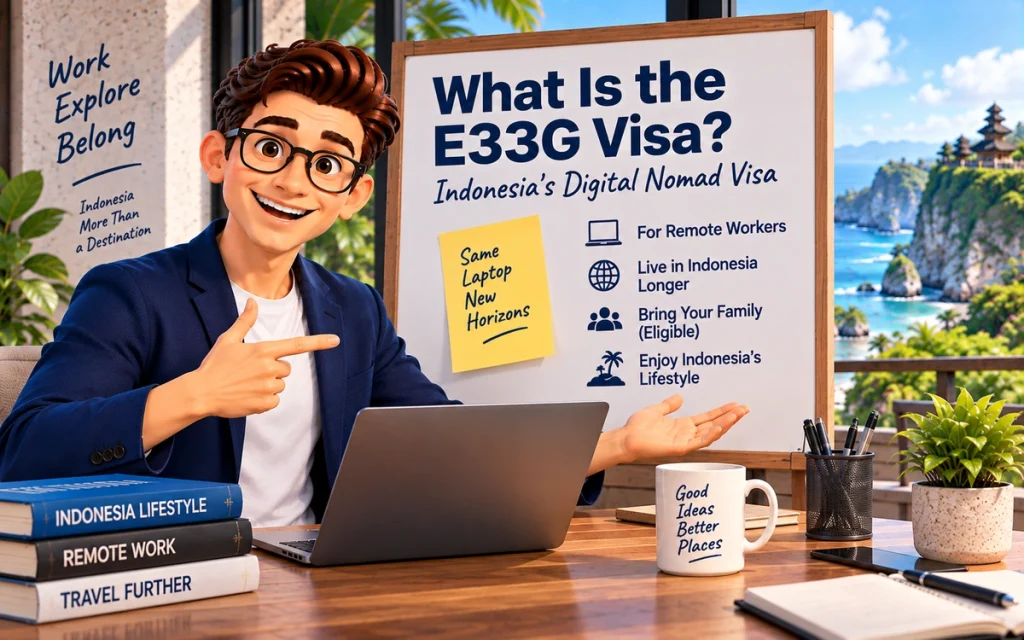
E33G is officially presented by Indonesia’s Directorate General of Immigration as the Visa Rumah Kedua Pekerja Jarak Jauh (Remote Worker Special Residency Visa). It is a limited stay visa that allows the holder to stay in Indonesia to carry out duties for a company outside Indonesia.
The term “Digital Nomad Visa Indonesia” is widely used in search and commercial content, but applicants should understand that E33G is the specific immigration category behind that search term.
Why E33G Is Commonly Called the Digital Nomad Visa
“Digital nomad visa” is a practical search term rather than the formal name applicants should rely on when checking legal requirements. “Remote Worker Visa Indonesia” is another useful description because it reflects the purpose of E33G more closely.
For an application, the important point is not the marketing label. It is whether the applicant’s work arrangement, income, documents, and intended activities match the E33G requirements.
What E33G Is Designed For
E33G is designed for a foreign national who will stay in Indonesia while performing duties for a company established outside Indonesia. The route is therefore fundamentally different from an Indonesian employment visa intended for employment by an Indonesian entity.
For broader information about Indonesia’s residence pathways, see Indonesia Residency.
“Planning to work remotely from Bali? Chat directly with our local visa consultants.”
2. Is E33G the Same as a Digital Nomad Visa or Remote Worker KITAS?
Digital Nomad Visa vs E33G
For search purposes, Digital Nomad Visa Indonesia and E33G are closely connected terms. E33G is the specific visa category applicants should use when checking the current Indonesian immigration requirements.
E33G Visa vs ITAS/KITAS
E33G is the visa category. ITAS is the limited stay permit associated with the stay in Indonesia. KITAS is a commonly used public and industry term for the limited stay permit/card. This distinction matters because visa validity and the length of the permitted stay are not the same thing.
Why People Call It “E33G KITAS”
Search results and immigration-service providers may use phrases such as “E33G KITAS” or “Digital Nomad KITAS.” These terms can help users find information, but the article should keep the official distinction clear: E33G is the visa route, while ITAS is the stay permit.
For the broader concept of KITAS in Indonesia, see Indonesia KITAS.
3. Who Can Apply for E33G?
Remote Employees of Foreign Companies
E33G is designed for applicants whose work is connected to a company established outside Indonesia. A genuine employment or work relationship with the foreign company is therefore a central part of the application.
Foreign Professionals Working Remotely
A remote professional may consider E33G when the person intends to live in Indonesia while continuing the qualifying work for the foreign company. The applicant must still satisfy the documentary and financial requirements.
Applicants Who Meet the Income Requirement
The current official E33G requirement includes evidence of salary or income of at least US$60,000 per year. Meeting the income threshold alone does not guarantee approval; the application must also satisfy the other requirements.
Who May Need a Different Visa
Applicants whose main activity is employment by an Indonesian company, investment in an Indonesian company, retirement, long-term second-home residence, or another activity with a different immigration purpose should assess the route that matches that purpose instead of assuming E33G covers every form of work or business.
4. E33G Visa Requirements
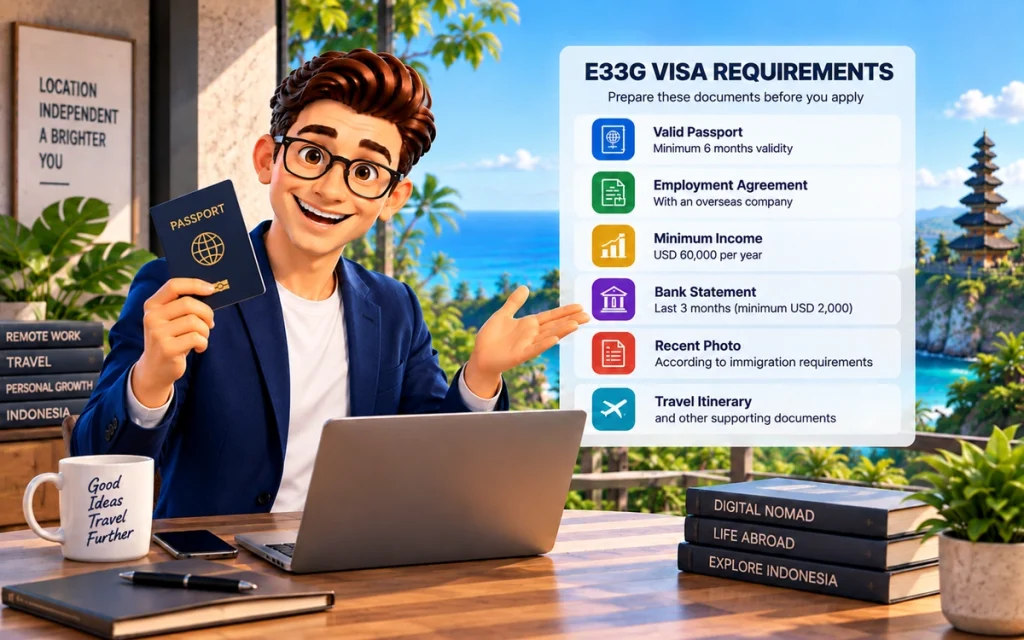
The following checklist reflects the current requirements published by Indonesia’s Directorate General of Immigration for E33G.
Passport Requirement
Applicants need a valid national passport that remains valid for at least six months before its expiry, as stated on the current official E33G page.
Minimum Annual Income: USD 60,000
E33G requires evidence of salary or income of at least US$60,000 per year.
Employment Agreement With a Foreign Company
Applicants must provide an employment agreement with a company established outside Indonesia.
Three-Month Bank Statement
The application requires a bank statement covering the most recent three months as evidence of living funds.
Minimum Bank Balance: USD 2,000
The published E33G requirement specifies a minimum balance of US$2,000 or the equivalent amount.
Recent Color Photograph
A recent color photograph is required.
CV and Travel History/Itinerary
The official checklist also includes a curriculum vitae and travel history or itinerary.
E33G Requirements at a Glance
| Requirement | What to Prepare |
| Passport | Valid national passport; minimum six months validity |
| Annual income | At least US$60,000 per year |
| Foreign employment | Employment agreement with a company established outside Indonesia |
| Bank statement | Most recent three months |
| Bank balance | At least US$2,000 or equivalent |
| Photograph | Recent color photograph |
| CV | Current curriculum vitae |
| Travel history | Travel history/itinerary |
5. How Much Does E33G Cost?
Official Government Fee
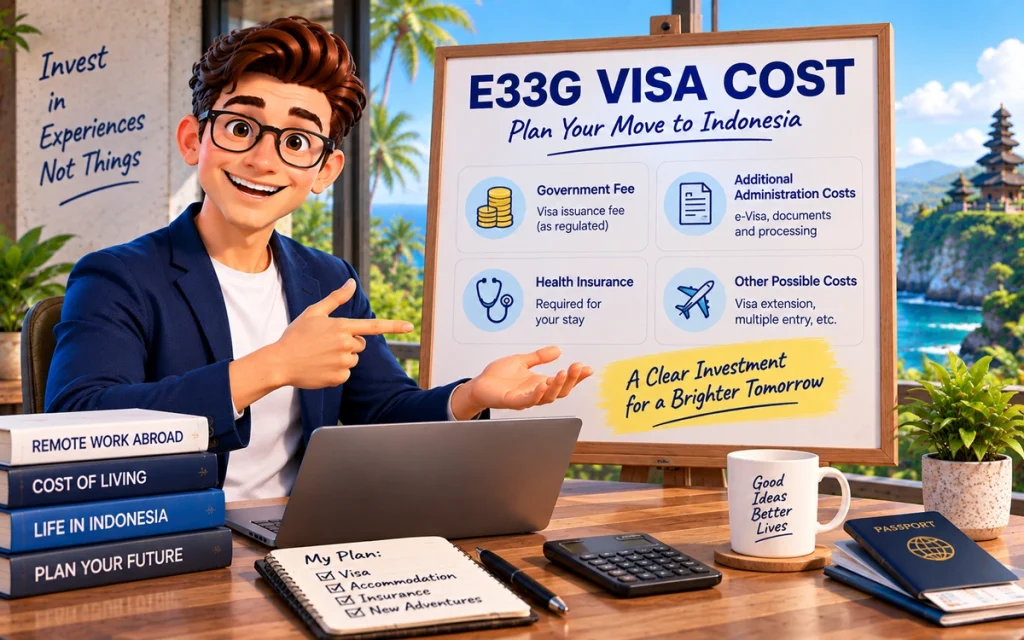
The current official Immigration page lists the one-year E33G package at IDR 7,000,000 in government immigration fees.
| Fee component | Amount |
| Limited Stay Visa | IDR 500,000 |
| Category II Visa Verification | IDR 2,000,000 |
| ITAS up to 1 year | IDR 3,000,000 |
| Re-entry Permit up to 1 year | IDR 1,500,000 |
| Total | IDR 7,000,000 |
Professional Immigration Assistance
Government fees are separate from professional immigration-assistance fees. If an applicant uses an immigration consultant or agency, the final service price can therefore be higher than the official PNBP amount.
Other Possible Expenses
Depending on the applicant’s situation, additional expenses can arise from document preparation, translations, travel, or other services. These should be treated separately from the official E33G immigration fee.
6. How Long Can You Stay and Can E33G Be Extended?
Initial E33G Stay: 1 Year
The current official E33G page provides an initial stay of one year. It also states that the stay permit can be extended online through evisa.imigrasi.go.id.
Can E33G Be Extended?
Yes. The official E33G page states that the stay permit associated with this visa can be extended, and the extension can be submitted online through the immigration eVisa system.
How Long Is Each Extension?
E33G is listed in the one-year ITAS category. The applicable extension rule provides that an ITAS extension may not exceed the period of the original grant. For E33G, this means an individual extension can be granted for no more than one year, subject to the applicable requirements.
Can You Extend E33G Without Leaving Indonesia?
An E33G holder does not need to leave Indonesia simply to submit an ITAS extension application. The official immigration service information provides an extension procedure in Indonesia. The application window for an ITAS of no more than one year starts 30 days before expiry and ends on the expiry date.
When Should You Apply for the Extension?
For an ITAS with a duration of no more than one year, the official Jakarta Central Immigration Office states that an extension application may be submitted no earlier than 30 days before the ITAS expires and no later than the expiry date. If the application and immigration payment are completed before expiry, completion after the expiry date is not treated as an overstay under the stated procedure.
Is There a Maximum Cumulative Stay?
Applicants should not rely on a generic maximum-stay number copied from another visa category. The current E33G-specific materials establish the one-year grant and the extension framework, but they should not be turned into an unsupported universal cumulative maximum for every E33G holder.
7. Can You Work Remotely Under E33G?

Working for a Foreign Company
This is the core purpose of E33G: staying in Indonesia while performing duties for a company established outside Indonesia.
Working Remotely From Bali or Other Parts of Indonesia
The E33G route is an Indonesian immigration route, not a Bali-only permit. Bali is a common destination for remote workers, but the immigration category applies to Indonesia generally. The official page also states that the holder may engage in tourism activities and visit friends or family while the re-entry permit remains valid.
Can You Work for an Indonesian Company?
E33G should not be treated as a general Indonesian employment permit. Its stated purpose is work for a company established outside Indonesia. If the proposed employment is with an Indonesian company, the applicant should assess the appropriate work-related immigration route instead.
Can You Work for Indonesian Clients?
Applicants should be careful here. E33G is not a blanket authorization for every form of local commercial activity. The official rules prohibit work inconsistent with the stay permit and restrict the sale of goods or services except where required in the permitted work.
Can You Freelance?
A person should not assume that the label “freelancer” automatically fits E33G. The underlying work arrangement and whether it matches the E33G purpose must be assessed.
Can You Sell Goods or Services?
The official E33G page states that holders may not sell goods or services except where such activity is required in their work. This is an important restriction and is one reason E33G should not be presented as a general business license.
When Do You Need a Different Immigration Route?
If your primary objective is Indonesian employment, operating an Indonesian investment company, or conducting a business activity outside the E33G purpose, assess a visa or stay-permit category designed for that activity.
8. Is E33G a KITAS? Understanding E33G, ITAS and KITAS
E33G Is the Visa Category
E33G identifies the visa route.
ITAS Is the Stay Permit
ITAS is the limited stay permit that allows the foreign national to remain in Indonesia for the authorized period.
Why “E33G KITAS” Appears in Search Results
“E33G KITAS” is widely used in online searches and by immigration-service providers because KITAS is a familiar term for Indonesia’s limited stay residence documentation. For legal explanations, however, it is clearer to distinguish the E33G visa from the ITAS.
Which Term Should Applicants Use?
When searching for requirements, applicants can use Digital Nomad Visa Indonesia, E33G Visa Indonesia, Remote Worker Visa Indonesia, or E33G KITAS. When reviewing official rules, the E33G classification and the corresponding ITAS rules are the key references.
9. E33G and Indonesian Tax Considerations
Immigration Status Is Not the Same as Tax Residency
An immigration visa and a person’s tax position are different legal questions. Holding E33G should not be treated as a complete determination of an individual’s Indonesian tax obligations.
Is Foreign Income Automatically Tax-Free?
No blanket statement should be made that foreign income is automatically tax-free simply because the employer is outside Indonesia. Tax treatment depends on the applicable tax rules and the individual’s circumstances.
Why Personal Circumstances Matter
Factors such as residence, income, source rules, and the person’s broader tax circumstances can affect the analysis. The immigration approval itself is not a substitute for tax advice.
When Should You Obtain Tax Advice?
If your stay in Indonesia, income structure, or employment arrangement creates tax questions, obtain advice from a qualified Indonesian tax professional before relying on a tax conclusion.
10. Can Your Spouse and Children Join You?
Can Your Spouse Join You?
An E33G holder may have eligible family members join through the appropriate family-based immigration categories. Family members do not automatically receive the principal applicant’s E33G visa.
Can Your Biological Children Join You?
Eligible biological children can use the applicable family route. Current immigration classification includes E31E for a biological child under 18 who is unmarried and joins a parent holding ITAS or ITAP.
Do Family Members Get E33G?
No. The family member’s application is based on the relevant family immigration category rather than automatically duplicating the principal applicant’s E33G.
Separate Applications and Documents
Each family member must meet the requirements applicable to their own immigration category. Applicants should prepare relationship and identity documents in addition to the documents required for the relevant family route.
Family Members and Their Own Stay Permits
The appropriate family category determines the family member’s immigration status and permitted stay. For a broader explanation of family immigration, see
Indonesia Family Visa. For longer-term family residence, see Family KITAP.
11. How to Apply for E33G

Prepare Your Documents
Prepare the passport, financial evidence, foreign-company employment agreement, photograph, CV, travel history or itinerary, and other required electronic documents.
Submit the E33G Application
The official E33G process uses an account on evisa.imigrasi.go.id. The applicant submits the required electronic documents through the immigration system.
Pay the Immigration Fees
Pay the applicable immigration fees shown by the official system.
Immigration Verification
Immigration checks document completeness, payment, applicant profile and the application before approval or refusal.
Receive the E-Visa
If approved, the visa is issued electronically. The E33G visa is valid for 90 days from issuance for entry; visa validity is different from the length of stay. The official processing time is five working days after payment is received.
Enter Indonesia
The applicant must enter Indonesia within the visa validity period.
Complete the Stay Permit Process
The official E33G information states that the ITAS and re-entry permit are issued automatically after the foreign national is permitted to enter by an immigration officer at the checkpoint.
Keep Your Re-Entry Permit Valid
E33G also provides the ability to enter and leave Indonesia while the re-entry permit remains valid.
12. E33G Document Checklist
Before submitting an E33G application, prepare the following core documents:
- Valid national passport with the required remaining validity
- Three-month bank statement
- Evidence of at least US$2,000 in available funds as required
- Evidence of salary or income of at least US$60,000 per year
- Employment agreement with a company established outside Indonesia
- Recent color photograph
- Current CV
- Travel history or itinerary
- Any additional supporting documents requested during the application or verification process
Document requirements can be subject to immigration verification. Applicants should always check the current official E33G page and the eVisa system at the time of application.
13. E33G vs Other Indonesia Visa Options
The correct visa depends on the applicant’s purpose in Indonesia. The table below is a neutral overview rather than a ranking. It is a high-level comparison; each route has its own detailed eligibility and activity rules.
| Route | Main Purpose | Typical Situation |
| E33G | Remote work for a company outside Indonesia | Foreign remote worker |
| D12 | Pre-investment/business exploration | Person assessing an Indonesian investment or business opportunity |
| Investor KITAS | Investment-related residence | Foreign investor meeting the applicable investment requirements |
| Second Home | Longer-term residence under the second-home route | Qualified foreign resident seeking the E33 route |
| Retirement | Retirement residence | Eligible retiree meeting the relevant retirement requirements |
For long-term residence context, see
Indonesia KITAP and Retirement Visa where relevant.
14. E33G vs Second Home Visa
E33G and the Second Home route can serve very different immigration purposes. E33G is specifically built around remote work for a company outside Indonesia, while the Second Home route is a separate long-term residence category with its own financial and activity requirements.
When comparing the two, review purpose, permitted activities, duration, financial commitments, family planning, and whether your primary reason for residence is remote employment or another long-term residence objective.
See
Second Home Visa Indonesia for the dedicated guide.
15. E33G vs Investor KITAS
E33G and Investor KITAS should not be treated as interchangeable. E33G is designed around remote work for a foreign company. Investor KITAS is an investment-related residence route with its own investment and company requirements.
If your objective is to invest in or participate in an Indonesian company, review the investor route rather than assuming that E33G provides the same rights.
See
Investor KITAS and Investor KITAP for longer-term investor residence information.
16. E33G vs D12
D12 and E33G address different immigration purposes. E33G is the remote-worker route for qualifying work connected to a foreign company. D12 is used for pre-investment activities and should be assessed when the applicant’s purpose is exploring or preparing an Indonesian investment rather than simply working remotely for an overseas employer.
For a detailed comparison of the two routes, see
Remote Work in Indonesia: D12 vs E33G.
17. Common E33G Mistakes
Confusing E33G With a Generic Work KITAS
E33G is not a general Indonesian employment permit.
Assuming Foreign Income Automatically Means Tax-Free
Immigration status does not by itself determine tax treatment.
Assuming E33G Allows Work for Indonesian Businesses
The official purpose is remote work for a company outside Indonesia.
Using Outdated Income or Financial Requirements
Use the current official E33G requirements rather than old articles.
Confusing Government Fees With Agency Fees
The official IDR 7 million PNBP is not automatically the total price of a professional service package.
Assuming Family Automatically Receives E33G
Family members use the immigration category applicable to their relationship and circumstances.
Waiting Until the Last Minute for Extension
For a one-year ITAS, the official extension window starts 30 days before expiry and ends on the expiry date.
Relying on Old Articles Instead of Current Immigration Rules
E33G rules and terminology should be checked against current Immigration information before applying.
18. Frequently Asked Questions
What is the Digital Nomad Visa Indonesia?
It commonly refers to the E33G remote-worker visa, which allows an eligible foreign national to stay in Indonesia while performing duties for a company established outside Indonesia.
What is E33G in Indonesia?
E33G is a limited stay visa category for remote workers.
Is E33G the same as a Digital Nomad Visa?
Digital Nomad Visa is the common search term; E33G is the specific Indonesian immigration category.
How much income do I need for E33G?
The current official requirement is at least US$60,000 in salary or income per year.
How much does E33G cost?
The current official one-year government immigration fee is IDR 7,000,000, excluding professional service fees and other possible expenses.
How long can I stay in Indonesia with E33G?
The initial E33G stay is one year.
Can E33G be extended?
Yes. The official E33G page states that the stay permit can be extended.
Can I extend E33G without leaving Indonesia?
Yes. The extension process can be handled in Indonesia under the applicable ITAS extension procedure.
Can I work for a foreign company from Bali?
That is the core purpose of E33G, provided the applicant meets the route’s requirements and follows the permitted activity rules.
Can I work for an Indonesian company with E33G?
E33G should not be treated as a general permit for employment by an Indonesian company. A different work route may be required.
Can my spouse join me?
An eligible spouse may join through the appropriate family-based immigration category rather than automatically receiving E33G.
Can my children join me?
Eligible children may use the applicable family route. Current immigration classification includes E31E for a biological child under 18 who is unmarried and joins a parent holding ITAS or ITAP.
Is E33G a KITAS?
E33G is the visa category; ITAS is the limited stay permit. KITAS is a common term used for Indonesia’s limited stay residence documentation.
Do I need an Indonesian sponsor?
No. The official E33G page states that an Indonesian sponsor/guarantor is not required for the visa application.
Does E33G make my foreign income tax-free?
No automatic tax-free conclusion should be made. Immigration status and tax obligations are separate matters that depend on the applicable tax rules and individual circumstances.
19. How Azra Solutions Can Help
Choosing the correct immigration route is as important as preparing the application itself. Azra Solutions can assist eligible applicants with E33G route assessment, document preparation, application support, immigration process coordination, extension assistance, and family immigration planning.
If you are unsure whether E33G matches your employment arrangement or whether another Indonesian visa is more appropriate, an individual assessment can help clarify the available route before you submit an application.
Ready to Apply for the E33G Digital Nomad Visa?
If you are planning to live and work remotely from Indonesia, Azra Solutions can help you understand the E33G requirements, prepare your documents, guide you through the official application process.
Get in touch with Azra Solutions for a free consultation and personalized assistance with your Digital Nomad Visa Indonesia application.
20. Conclusion
The Digital Nomad Visa Indonesia is commonly associated with the E33G remote-worker route. E33G provides an initial one-year stay for eligible foreign nationals who will perform duties for a company established outside Indonesia, with a current minimum annual income requirement of US$60,000 and a published one-year government immigration fee of IDR 7,000,000.
E33G can be extended under the applicable ITAS rules, and the extension can be handled in Indonesia. Applicants should also understand the distinction between E33G, ITAS and KITAS, the limits on permitted work and commercial activity, the separate immigration routes available to family members, and the fact that immigration status does not by itself determine tax obligations.
Because immigration rules can change, always verify the current E33G requirements, fees, processing time and application instructions on the official Immigration website before applying. For professional assistance with an E33G application or extension, Azra Solutions can help you assess the route and prepare the process.