Introduction
The Second Home Visa Indonesia is a long-term residence route for foreign nationals who want to live in Indonesia under the E33 Visa Rumah Kedua category. The current official Immigration classification places E33 within the Second Home Visa group and provides a first limited stay permit of up to five years, with extensions subject to a total stay limit of up to ten years.
E33 is relevant to foreigners seeking a long-term base in Indonesia without relying on a conventional employment sponsor. However, the route has specific financial, immigration, and activity requirements that should be understood before an application is submitted.
This guide focuses on the current E33 framework and separates official immigration fees from the Immigration Guarantee requirement. It also explains why older online information about Second Home Visa Indonesia can differ from the current official Immigration page.
1. What Is the Second Home Visa Indonesia?

The Second Home Visa Indonesia is officially identified as E33 Visa Rumah Kedua. According to the Directorate General of Immigration, E33 is intended for a foreign national who wants to live and reside in Indonesia without requiring a personal or corporate guarantor, subject to the applicable Immigration Guarantee.
E33 is a limited stay visa that leads to a Limited Stay Permit (ITAS). The visa allows the holder to enter and leave Indonesia while the relevant stay permit remains valid. The official Immigration page states that the first stay permit can be issued for up to five years and may be extended, provided the total stay in Indonesia does not exceed ten years.
Is the Second Home Visa the Same as KITAS?
The terms are often used interchangeably in commercial discussions, but they refer to different immigration concepts. The visa is the entry document for the E33 route, while ITAS is the limited stay permit that governs the person’s lawful stay in Indonesia.
To understand the difference between a visa and a limited stay permit, see our detailed guide to Indonesia KITAS and ITAS.
What Does E33 Mean?
E33 is the official visa index for Visa Rumah Kedua. Indonesia’s current official visa list also contains E33A, E33B, E33C, E33D, E33E, E33F, and E33G. These categories have different purposes and should not automatically be treated as identical to the standard E33 route.
If you are comparing different ways to live in Indonesia long term, our Indonesia Residency guide provides a broader overview of ITAS, KITAS, ITAP, KITAP, and specialized residence pathways.
2. Who Is the Indonesia Second Home Visa For?
E33 is designed for foreign nationals seeking a long-term residence arrangement in Indonesia who can meet the route’s Immigration Guarantee requirements. It can be relevant to people who want Indonesia to function as a second home, maintain a long-term residence base, or participate in permitted activities while complying with immigration rules.
E33 should not be confused with retirement-specific or remote-worker-specific routes. Indonesia now lists several Second Home visa categories, so the correct visa index should be selected according to the applicant’s actual circumstances.
Is There an Age Requirement?
The current official E33 page does not state a minimum age requirement for the standard E33 route. Age-specific Second Home categories, including E33E and E33F, should be assessed separately.
3. Second Home Visa Indonesia Requirements

Applicants should prepare the required personal, financial, and travel information before submitting an E33 application. The current official E33 page lists these core application documents:
- A valid national passport with at least six months of remaining validity.
- A personal bank statement showing at least US$2,000 or equivalent over the most recent three months, including the account holder’s name, period, and balance.
- A recent color photograph.
- A curriculum vitae.
- Travel history and an itinerary.
In addition to the initial application documents, E33 has a specific post-issuance Immigration Guarantee requirement. This is separate from ordinary visa and ITAS fees.
4. The Immigration Guarantee: US$130,000 or US$1 Million Property

One of the most important parts of the E33 route is the Immigration Guarantee. The current official Immigration page requires proof of the Immigration Guarantee within the applicable 90-day period.
The official E33 page provides two alternatives:
- A commitment to place at least US$130,000, or its equivalent, in an account in the applicant’s own name at a state-owned bank in Indonesia.
- A commitment to purchase qualifying property in Indonesia in the form of a condominium or apartment with a minimum value of US$1,000,000, or its equivalent.
The commitment must be fulfilled and reported to the Immigration Office that issued the Limited Stay Permit, together with evidence of the qualifying funds or property.
Is the US$130,000 a Visa Fee?
No. The US$130,000 is not the government visa fee. It is part of the Immigration Guarantee requirement.
Is the US$1 Million Property a Visa Fee?
No. The property amount is an alternative form of Immigration Guarantee. It should not be treated as a visa charge.
When Must the Immigration Guarantee Be Fulfilled?
The current official E33 page states that the Immigration Guarantee must be fulfilled and reported within the applicable 90-day period, with supporting evidence submitted to the issuing Immigration Office.
5. Second Home Visa Indonesia Cost
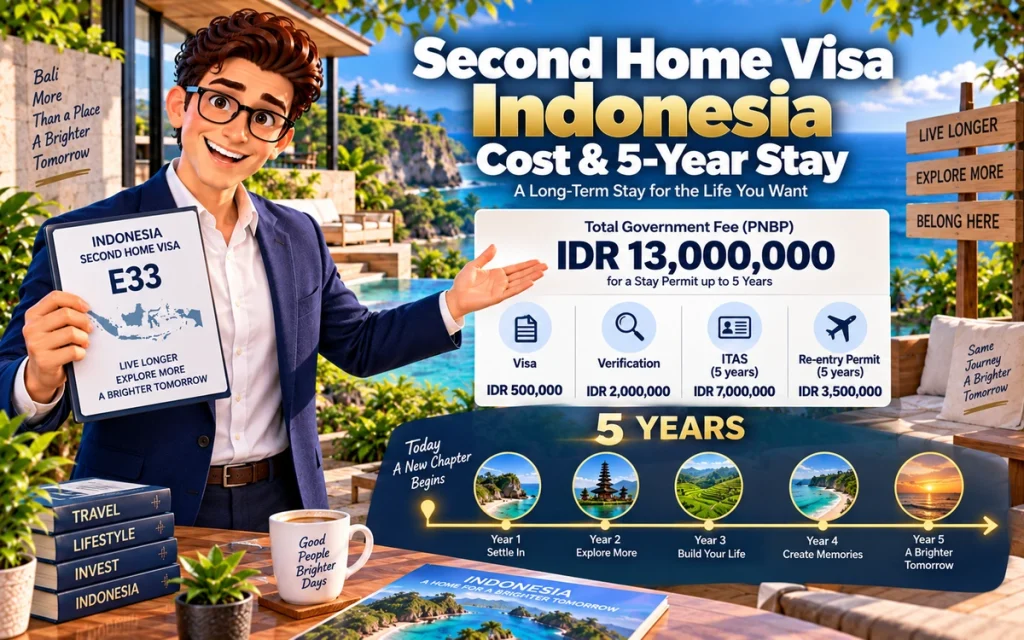
The current official PNBP for an E33 stay of up to five years is Rp13,000,000. The official breakdown is:
Limited Stay Visa: Rp500,000
Visa Verification: Rp2,000,000
Limited Stay Permit (ITAS) for five years: Rp7,000,000
Re-entry Permit for five years: Rp3,500,000
Total official PNBP: Rp13,000,000
Government Fees vs Financial Commitment
The Rp13,000,000 official PNBP is separate from the Immigration Guarantee. The PNBP is the immigration charge for the visa and related stay documents, while the US$130,000 or US$1,000,000 property route concerns the Immigration Guarantee.
Are Azra Solutions Service Fees Included?
No. Government PNBP and professional immigration assistance fees are separate. If an applicant uses a consultant or professional service provider, the service fee should be confirmed separately.
6. How Long Can You Stay in Indonesia With E33?
The current official E33 page states that the first Limited Stay Permit can be granted for up to five years. The permit may be extended, subject to the rule that the total stay in Indonesia does not exceed ten years.
E33 Stay Period
For the current E33 framework, five years is the maximum initial stay period stated on the official Immigration page. This should not be described as a ten-year initial grant.
Why Do Some Websites Say 10 Years?
Some Second Home Visa information published online reflects earlier rules, older explanations, or simplified descriptions of the cumulative stay framework. The current official E33 page distinguishes the initial stay of up to five years from extension, with the overall stay in Indonesia capped at ten years under the stated framework.
Applicants should check the current E33 page and their issued immigration documents rather than relying on a generic statement that the visa simply provides a ten-year stay.
7. Can You Work in Indonesia With a Second Home Visa?
The answer requires more nuance than a simple yes or no. The current official E33 page states that the holder may undertake work, education, or other activities by reporting the concurrent activity to the Immigration Office that issued the stay permit.
At the same time, the official rules prohibit activities inconsistent with the stay permit. The E33 page also states that the holder may not sell goods or services except where such activity is required by the permitted work.
What Activities Are Permitted?
The official E33 description allows tourism, purchasing goods, visiting family and friends, and certain work, education, or other activities subject to reporting of concurrent activities and applicable rules.
What Work Activities Are Restricted?
E33 should not be treated as a general-purpose work permit. If the planned activity involves employment, professional work, selling goods or services, or another regulated activity, confirm the correct immigration and work authorization requirements before beginning that activity.
What Does Concurrent Activity Reporting Mean?
The official E33 description refers to reporting concurrent activities to the issuing Immigration Office. Holding E33 does not automatically authorize every type of work or business activity.
Remote workers should also understand the separate Indonesia Digital Nomad Visa pathway, which is specifically designed for eligible remote workers under the E33G category.
8. Second Home Visa Indonesia Application Process

- Determine whether the standard E33 route matches your intended activities and residence plans.
- Prepare the passport, personal information, bank statement, photograph, curriculum vitae, travel history, and itinerary.
- Prepare the information and documents relevant to the Immigration Guarantee.
- Submit the visa application through the applicable Immigration eVisa process.
- Pay the required immigration charges.
- Complete Immigration document checks, payment verification, profiling, and verification.
- Wait for approval and visa issuance.
- Enter Indonesia using the issued visa and complete the stay-permit process.
- Fulfil and report the Immigration Guarantee within the required period.
The current official E33 page states that the visa process takes four working days after the visa payment is received. Processing can still depend on document completeness and verification.
Does E33 Require a Sponsor?
The current official E33 page explicitly states that a guarantor or sponsor is not required. The same page, however, contains procedural instructions referring to a sponsor account being used to submit an application in the eVisa system. This is a distinction between the substantive requirement for a guarantor and the technical submission workflow. Applicants should follow the current technical instructions in the eVisa system.
9. Second Home Visa Indonesia Documents Checklist
- Passport with at least six months of remaining validity.
- Recent color photograph.
- Three months of personal bank statements showing at least US$2,000 or equivalent.
- Curriculum vitae.
- Travel history.
- Travel itinerary.
- Documents supporting the applicable Immigration Guarantee.
- Additional documents requested by the Immigration system or Immigration Office, if applicable.
Document requirements can change with immigration procedures and individual circumstances. Always check the current official eVisa requirements before submission.
10. Can Your Family Join You?
Yes. The current official E33 description states that the holder may bring family members to stay in Indonesia, provided the applicable immigration laws and requirements are met.
Family members should not automatically be assumed to receive the same visa index as the principal E33 holder. Each family member’s relationship, nationality, immigration status, and intended stay should be assessed under the applicable family or related immigration category. For family-based routes, see our Indonesia Family Visa guide.
Prepare relationship documents such as marriage or birth certificates where relevant and confirm the appropriate visa route before filing family applications.
Where permanent residence is relevant to a family-based immigration strategy, see our guide to Family KITAP.
11. Second Home Visa vs Other Indonesian Long-Stay Routes
Indonesia has several long-stay immigration routes. The appropriate route depends on the applicant’s purpose, personal circumstances, financial position, work or business activity, and family situation.
Second Home Visa / E33: A long-term residence route based on the E33 Visa Rumah Kedua framework and its Immigration Guarantee requirements.
Retirement Visa: A route designed for applicants who meet the applicable retirement requirements.
Investor Visa: A route connected with qualifying investment and company or investment structures.
Digital Nomad / E33G: A separate Second Home category specifically listed for remote workers.
Working Visa: A route for foreign nationals whose intended activities require employment-related immigration authorization.
Choosing a visa based only on the length of stay can create problems. The underlying purpose and permitted activity should be checked first.
Foreign nationals following an employment-based residence pathway can also review the Working KITAP guide for information about permanent stay options.
12. Second Home Visa vs Retirement Visa
Foreign nationals considering Indonesia primarily for retirement should also review the requirements for the Indonesia Retirement Visa before comparing the two residence options.
The standard E33 route and retirement-specific routes should be treated as separate immigration pathways. E33 is not simply another name for a retirement visa.
Retirement routes have their own eligibility criteria and documentation, while E33 has its own Immigration Guarantee and activity framework. Applicants should compare the applicable retirement category with E33 based on their actual circumstances.
If permanent residence is part of your long-term retirement planning, you should also understand the separate Retirement KITAP pathway.
13. Second Home Visa vs Investor Visa
E33 is the Second Home Visa route and uses the Immigration Guarantee framework described above. Investor visas are separate visa categories under Indonesia’s investor classification and may depend on qualifying investment or company structures.
A foreign national establishing or investing through an Indonesian company should review the investor route separately rather than assuming E33 is the correct immigration category.
Foreign nationals whose primary purpose is investment in an Indonesian business may also want to compare the Investor KITAS pathway.
Foreign investors planning beyond temporary residence can also review the Investor KITAP pathway separately.
14. Can Second Home Visa Lead to KITAP?
The E33 page states that the limited stay permit can be transferred to another type of stay permit, subject to applicable immigration rules. This does not mean that a Second Home Visa holder automatically receives permanent residence after a fixed number of years.
A KITAP or ITAP application is a separate immigration process with route-specific eligibility, residence history, documentation, and approval requirements. Applicants considering permanent residence should review the current KITAP rules before assuming that their E33 history automatically qualifies them. For the broader permanent-stay framework, see our Indonesia KITAP guide.
15. Common Second Home Visa Mistakes
- Treating the Immigration Guarantee as though it were a visa fee.
- Assuming that the old Rp2 billion financial requirement is automatically the current E33 requirement.
- Confusing a five-year initial stay with a ten-year initial grant.
- Assuming that E33 automatically authorizes every type of work or business activity.
- Assuming that all family members use the same visa category as the principal applicant.
- Relying on an old Second Home article without checking the current official E33 page.
- Ignoring the post-issuance Immigration Guarantee reporting requirement.
- Assuming that holding E33 automatically creates a path to KITAP without checking route-specific requirements.
If your long-term objective is permanent residence, learn more about Indonesia KITAP and the different pathways that may lead to ITAP.
16. Frequently Asked Questions
What is the Second Home Visa Indonesia?
It is the common name for Indonesia’s Visa Rumah Kedua route. The standard E33 category is a limited stay visa intended for foreign nationals who want to live in Indonesia under the applicable Second Home framework.
What is the E33 Visa Indonesia?
E33 is the official visa index for Visa Rumah Kedua. It is listed by the Directorate General of Immigration under Indonesia’s Second Home Visa categories.
How much does the Second Home Visa Indonesia cost?
The current official PNBP for an E33 stay of up to five years is Rp13,000,000. This does not include the separate Immigration Guarantee or any professional service fee.
How long can I stay in Indonesia with E33?
The first Limited Stay Permit can be issued for up to five years. The official E33 page states that it can be extended, with the overall stay in Indonesia not exceeding ten years under the stated framework.
Do I need a sponsor for E33?
The current official E33 page states that a guarantor or sponsor is not required. The eVisa application instructions nevertheless refer to a sponsor account in the submission workflow, so applicants should follow the current technical instructions in the eVisa system.
Do I need US$130,000 to apply?
The E33 route requires an Immigration Guarantee. One option is a commitment and subsequent proof of at least US$130,000 in the applicant’s own account at a state-owned bank in Indonesia, subject to the official requirements.
Can I use property instead of the financial commitment?
The current E33 page provides an alternative involving qualifying apartment or condominium property in Indonesia valued at at least US$1,000,000.
Can I work in Indonesia with a Second Home Visa?
The official E33 page allows work, education, or other activities subject to reporting concurrent activities to the issuing Immigration Office. Activities must remain consistent with the applicable stay permit and immigration rules.
Can my family join me?
The official E33 page states that family members may stay in Indonesia with the holder when the applicable immigration requirements are met. Each family member’s appropriate immigration category should be confirmed separately.
Can Second Home Visa holders obtain KITAP?
The E33 page allows the limited stay permit to be transferred to another type of stay permit subject to applicable rules, but KITAP is not an automatic entitlement after a fixed period. Eligibility must be assessed under the current KITAP framework.
17. How Azra Solutions Can Help
Applying for a Second Home Visa Indonesia involves more than paying the government fee. The applicant needs to understand the E33 route, prepare the required documents, address the Immigration Guarantee, and ensure that planned activities comply with the applicable stay permit.
- Second Home Visa eligibility assessment.
- Document review and preparation.
- E33 application assistance.
- Immigration process coordination.
- Family and related immigration planning.
If you are considering Indonesia as your second home, Azra Solutions can help you review your circumstances and determine the appropriate immigration route before you begin the application.
Official Immigration Sources
Directorate General of Immigration — Indonesia Visa List
Directorate General of Immigration — E33 Visa Rumah Kedua