
Investor KITAP is the permanent stay route for qualifying foreign investors who want to maintain long-term residence in Indonesia after their investor ITAS or KITAS stage. For investors following the Investor ITAS to ITAP pathway, the KITAP stage involves more than simply extending a temporary stay permit: the applicant must meet the applicable investment, residence, immigration, and corporate documentation requirements.
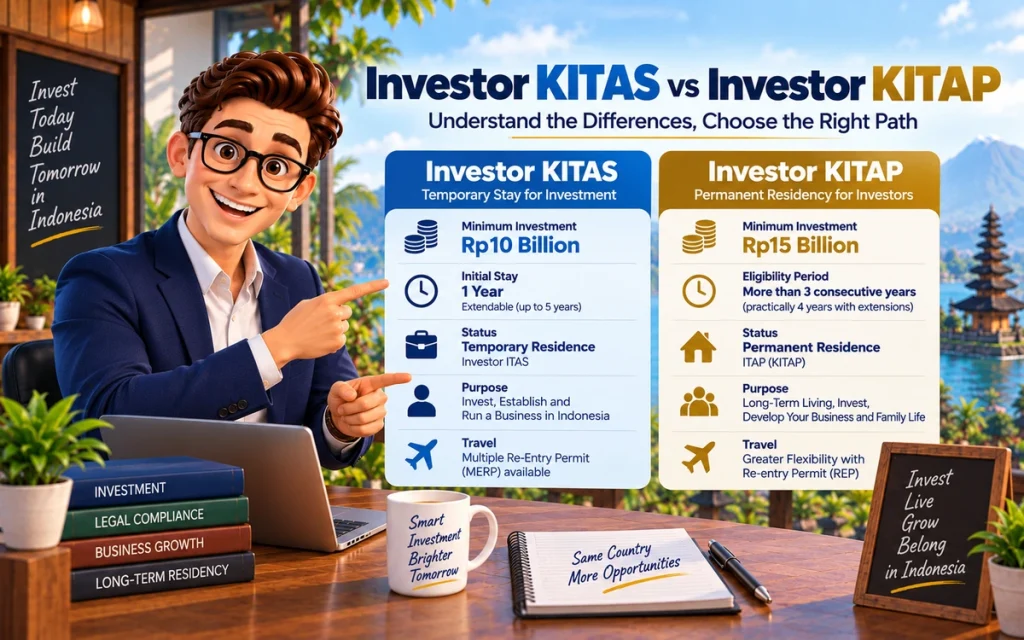
One of the most important points to understand is that the investment threshold can differ between the Investor KITAS and Investor KITAP stages. Current operational Immigration guidance for an Investor ITAS to ITAP application lists a minimum qualifying personal share value of IDR 15 billion. This should be distinguished from the IDR 10 billion threshold associated with the Investor ITAS or KITAS stage.
The residence timing also requires careful attention. Current Immigration operational guidance commonly uses the wording “more than 3 consecutive years” for an investor applying to change from ITAS to ITAP. In practice, Azra Solutions works with the fourth-year stage when planning an Investor KITAP application, based on our recent experience handling an Investor ITAS to ITAP application.
Investor KITAP at a Glance
For the broader Indonesia Residency framework and the main Indonesia KITAP guide, see the related AzraID resources.
| Item | Investor KITAP |
| Immigration status | ITAP / KITAP |
| Purpose | Long-term permanent stay for qualifying investors |
| Qualifying personal shareholding | IDR 15 billion |
| Previous immigration status | Investor ITAS / KITAS |
| Practical pathway | 4-year stage |
| Official operational wording | More than 3 consecutive years |
| Corporate structure | PT PMA |
| Application route | ITAS → ITAP |
The rest of this guide explains who can qualify, how the IDR 10 billion and IDR 15 billion thresholds work, how the residence period should be understood, which documents are normally required, how the ITAS to ITAP process works, and what investors should consider regarding family, travel, work activities, and changes to their PT PMA or shareholding.

What Is an Investor KITAP in Indonesia?
Investor KITAP is the permanent stay route available to qualifying foreign investors under Indonesia’s immigration framework. It allows an eligible investor to move from the temporary residence stage under Investor ITAS or KITAS to the permanent stay stage under ITAP, subject to the applicable requirements.
For investors, the KITAP stage can provide a more stable long-term immigration position than repeatedly relying on temporary Investor KITAS permits. However, KITAP should not be understood as a visa or as an automatic authorization to perform any type of employment in Indonesia.
KITAP vs ITAP
ITAP stands for Izin Tinggal Tetap, or Permanent Stay Permit. KITAP is the commonly used term associated with the permanent stay permit and its documentation. In everyday immigration discussions, people often use “KITAP” when referring to the permanent residence status or card.
For an investor, the important distinction is that the immigration status is based on ITAP. The investor is not applying for a separate “Investor KITAP visa”; rather, the relevant pathway is the change of immigration status from ITAS to ITAP when the investor meets the applicable conditions.
Who Is Investor KITAP For?
Investor KITAP is intended for qualifying foreign investors who meet the requirements for the investor-based permanent stay pathway. In the typical pathway covered by this guide, the foreign national already holds an Investor ITAS or KITAS and has maintained the qualifying investment and immigration position required for the ITAS to ITAP application.
Is Investor KITAP a Visa?
No. Investor KITAP is not a visa. It is associated with Indonesia’s permanent stay immigration status under ITAP.
This distinction matters because a visa determines entry and the initial basis for obtaining an immigration stay permit, while ITAP concerns the foreign national’s right to maintain permanent stay in Indonesia under the applicable immigration framework. The conditions attached to the investor’s activities, employment, travel, and corporate position should therefore be assessed separately rather than assuming that KITAP automatically permits every activity.
Foreign Investors in a PT PMA
The typical Investor KITAP pathway is connected to a foreign investor’s qualifying shareholding in an Indonesian foreign investment company, commonly referred to as a PT PMA. The corporate structure and the investor’s personal ownership position should therefore be reviewed together.
The key point is that the investor’s qualifying personal shareholding should be identifiable from the company’s legal and corporate records. Immigration documentation may be used to establish the connection between the foreign national, the shareholding, and the PT PMA.
Existing Investor KITAS / ITAS Holders
The main pathway covered by this guide is for a foreign national who already holds an Investor ITAS, commonly referred to as an Investor KITAS, and is preparing to change that temporary stay status to ITAP.
Before beginning the application, the investor should review the full history of the Investor ITAS, including the duration of qualifying residence, current validity, investment position, and supporting corporate documents. This helps identify potential issues before they become problems during the ITAS to ITAP application.
Key Eligibility Conditions
Investor KITAP eligibility should be assessed across several areas: the investor’s qualifying personal shareholding, the required period of qualifying residence, the validity and history of the Investor ITAS, the status of the PT PMA, and the completeness of supporting immigration and corporate documentation.
Investor KITAP Requirements in Indonesia
The requirements for an Investor KITAP application cover both immigration eligibility and evidence of the investor’s qualifying position in Indonesia. For an Investor ITAS to ITAP application, current operational Immigration guidance lists requirements relating to the applicant’s personal shareholding, residence history, PT PMA documentation, and supporting immigration documents.
Minimum Qualifying Shareholding
For the Investor ITAS to ITAP pathway, current operational Immigration guidance lists a minimum qualifying personal share value of IDR 15 billion. This is one of the most important requirements to verify before applying for Investor KITAP.
The IDR 15 billion figure should not be interpreted simply as money sitting in the investor’s personal bank account. The relevant issue is the investor’s qualifying shareholding in the Indonesian investment company, supported by appropriate corporate and legal documentation.
This is also why investors who previously qualified for an Investor KITAS at the IDR 10 billion stage should review their current shareholding before planning the KITAP application. The investment position that supported the earlier Investor ITAS does not automatically establish that the requirements for the ITAP stage have been satisfied.
Residence History
Current operational Immigration guidance for an investor changing from ITAS to ITAP commonly states that the foreign national must have held ITAS for more than 3 consecutive years. This residence history is an important part of the eligibility assessment.
For practical planning, Azra Solutions works with the fourth-year stage for Investor KITAP applications based on our recent experience handling an Investor ITAS to ITAP application. Investors should therefore avoid waiting until the end of their current ITAS validity before reviewing their eligibility and preparing the required documentation.
The difference between the wording “more than 3 consecutive years” and the practical fourth-year pathway should be understood carefully. The former reflects wording used in current operational Immigration guidance, while the latter reflects the practical timing used by Azra Solutions based on recent case experience.
PT PMA Requirements
The investor’s PT PMA documentation is an important part of the application because Immigration may need evidence that the investor’s corporate and shareholding position is properly documented.
Common corporate documents include the company’s NIB, company deed, relevant amendments, AHU approval or registration evidence, and company bank statements. Depending on the application and current operational requirements, additional corporate or investment evidence may also be requested.
Passport and Immigration Documents
The applicant should also prepare the core immigration documents required for the ITAS to ITAP application. These commonly include a valid passport, the current ITAS, the application documents, guarantee or sponsor documentation where applicable, and the required integration statement.
The current ITAS should also be reviewed for its remaining validity. Current operational Immigration guidance for the investor ITAS-to-ITAP route may require at least 30 days of remaining ITAS validity when the application is submitted, so timing the application correctly is important.
Why Does Investor KITAS Require IDR 10 Billion but Investor KITAP Require IDR 15 Billion?
The IDR 10 billion and IDR 15 billion figures apply to different stages of the investor immigration pathway. The IDR 10 billion threshold is associated with the Investor ITAS or KITAS stage, while current operational Immigration guidance for an Investor ITAS to ITAP application lists a minimum qualifying personal share value of IDR 15 billion.
These figures should therefore not be treated as contradictory requirements. An investor may have qualified for an Investor KITAS under the applicable IDR 10 billion threshold and later need to satisfy the higher qualifying shareholding requirement when preparing for the Investor KITAP stage.
IDR 10 Billion Investor KITAS Stage
The Investor KITAS or Investor ITAS stage is the temporary stay stage for qualifying foreign investors. Under the investor framework, the qualifying investment position is an important part of establishing eligibility for this immigration status.
For investors who entered the Investor KITAS pathway based on the IDR 10 billion threshold, it is important to understand that this figure relates to the investor’s qualifying position and should not simply be understood as the amount of paid-up capital required to establish a PT PMA.
A PT PMA may have its own corporate capital requirements, while the foreign investor may have a separate personal shareholding requirement for immigration purposes. These are related concepts, but they are not automatically the same thing.
IDR 15 Billion Investor KITAP Stage
For an Investor ITAS to ITAP application, current operational Immigration guidance lists a minimum personal share value of IDR 15 billion. This is the figure an investor should review when preparing for the KITAP stage.
The requirement is particularly important because an investor who qualified for Investor KITAS at an earlier stage may assume that the same investment position will automatically remain sufficient for KITAP. That assumption can create a problem during preparation.
Before applying, the investor should review the current shareholder records and supporting corporate documents to confirm that the qualifying personal shareholding can be properly demonstrated.
What If You Already Have a Rp10 Billion Investor KITAS?
If you already hold an Investor KITAS that was obtained on the basis of the IDR 10 billion investor threshold, you should review your current qualifying shareholding before planning the KITAP application.
Having a valid Investor KITAS does not by itself establish that every requirement for ITAP has been satisfied. The KITAP stage has its own requirements, including the current operational requirement for a minimum IDR 15 billion personal share value for the investor route.
The practical question is therefore not simply, “Do I already have an Investor KITAS?” It is, “Does my current investment and corporate position satisfy the requirements applicable to my Investor KITAP application?”
Do You Need to Increase Your Qualifying Shareholding?
If your current qualifying personal shareholding is below the amount required for the Investor ITAS to ITAP pathway, you may need to review and adjust your shareholding position before applying. The appropriate structure depends on the company’s ownership, legal documents, and the investor’s circumstances.
This should not be treated as simply adding IDR 5 billion to a personal bank account. The issue is the qualifying personal shareholding and the evidence supporting that position, together with the relevant PT PMA corporate documentation.
Any proposed change to the shareholding structure should be handled carefully because corporate changes can affect the company’s legal records, shareholder documentation, and the evidence used in the immigration application. It is better to review the structure before making changes than to discover an eligibility problem when the KITAP application is already being prepared.
How Many Years of Investor KITAS Are Required Before KITAP?
For an investor following the ITAS to ITAP pathway, the residence history is an important part of the KITAP eligibility assessment. Current operational Immigration guidance commonly states that an investor must have held ITAS for more than 3 consecutive years before applying to change status to ITAP.
In practical planning, Azra Solutions works with the fourth-year stage for an Investor KITAP application. This approach is based on our recent experience handling an Investor ITAS to ITAP application and is intended to give applicants a clear planning point rather than waiting until their immigration status is close to expiry.
Why You May See “3 Years” and “4 Years” Online
The difference between “more than 3 consecutive years” and “4 years” is one of the most common sources of confusion when researching Investor KITAP. The two expressions should not automatically be treated as evidence that one source is correct and the other is wrong.
Current operational Immigration guidance uses the wording “more than 3 consecutive years.” In practical terms, an applicant who has passed the three-year point is entering the period in which the ITAS to ITAP pathway becomes relevant, subject to the other requirements and the timing of the application.
Azra Solutions uses the fourth-year stage as the practical planning milestone based on recent experience with an actual Investor ITAS to ITAP application. This gives clients a clear operational point for preparing the application while recognizing that the official wording and the practical case-planning language are not identical.
For this reason, applicants should not rely on a simple statement such as “exactly three years” or “exactly four years” without considering the current operational guidance, the applicant’s actual ITAS history, and the timing of the intended application.
What Azra Solutions’ Recent Case Experience Shows
Based on our recent experience handling an Investor ITAS to ITAP application, applicants should begin preparing for the KITAP stage well before their ITAS reaches the end of its validity. The practical requirement we work with is the fourth year of qualifying residence, while current Immigration operational pages may describe the residence requirement as more than three consecutive years.
In practice, preparation should include reviewing the investor’s shareholding, PT PMA records, NIB, company deed and AHU documentation, company financial evidence, passport, current ITAS, and other supporting documents. Resolving inconsistencies early is generally preferable to trying to correct them during the application process.

How to Convert Investor KITAS to KITAP
Converting an Investor KITAS to KITAP is a change of immigration status from ITAS to ITAP. The process requires the investor to demonstrate that they meet the applicable Investor KITAP requirements and to submit the required immigration and corporate documentation for review by Immigration.
The application should be prepared as a complete eligibility package rather than as a simple extension of the existing Investor KITAS. In particular, the investor’s qualifying shareholding, residence history, PT PMA documents, and current immigration documents should be reviewed before the application is submitted.

1. Confirm Eligibility
The first step is to confirm that the investor is ready for the ITAS to ITAP pathway. This includes reviewing the investor’s qualifying residence history, current Investor ITAS, qualifying personal shareholding, and the status of the PT PMA.
For practical planning, Azra Solutions uses the fourth-year stage for Investor KITAP applications based on recent case experience. At the same time, current operational Immigration guidance commonly describes the residence requirement as more than 3 consecutive years.
Eligibility should be checked before preparing the final application because identifying a problem at this stage gives the investor an opportunity to address it before submitting the ITAP application.
2. Review Qualifying Shareholding
The investor’s qualifying personal shareholding should be reviewed against the requirement applicable to the Investor ITAS to ITAP pathway. Current operational Immigration guidance lists a minimum personal share value of IDR 15 billion.
The shareholding should be supported by corporate records that clearly establish the investor’s ownership position. If the investor previously qualified for Investor KITAS at the IDR 10 billion stage, the current shareholding should be checked rather than assuming that the earlier investment position is automatically sufficient for KITAP.
If a restructuring or increase in shareholding is necessary, it should be completed and documented properly before the immigration application is filed.
3. Review PT PMA Documents
The next step is to review the PT PMA documentation supporting the investor’s position. Common documents include the company’s NIB, company deed, relevant amendments, AHU approval or registration evidence, and company bank statements.
The information in these documents should be consistent with the investor’s passport, immigration records, and shareholding evidence. Differences in names, ownership percentages, company information, or other key details should be identified and resolved before submission where possible.
Corporate compliance is important because the ITAS to ITAP application is not assessed solely on the foreign national’s immigration history. The supporting company and investment evidence may also be reviewed.
4. Prepare Immigration Documents
Prepare the required immigration documents, including the passport, current ITAS, application documents, guarantee or sponsor documentation where applicable, integration statement, and other supporting documents required for the specific application.
The current ITAS should be checked carefully for its remaining validity. Investors should avoid leaving the application until the final days of the permit because current operational requirements may specify a minimum remaining validity at the time of filing.
5. Submit the ITAS → ITAP Application
Once the eligibility and documentation review is complete, the ITAS to ITAP application can be submitted through the applicable Immigration process. Current operational procedures may involve submitting the application through the designated electronic immigration system and completing the required government payment.
The application should contain consistent information across the immigration and corporate documents. A complete and well-organized submission makes it easier for the reviewing officers to assess the investor’s eligibility.
6. Immigration Verification
After submission, Immigration reviews and verifies the application and supporting documents. Current operational procedures can involve document verification at the Immigration Office followed by further review or verification by the Directorate General of Immigration.
During this stage, Immigration may assess whether the applicant satisfies the applicable requirements and whether the supporting evidence is consistent. If additional clarification or documentation is required, the applicant may need to respond before the application can proceed.
The duration of the review can vary depending on the completeness of the application, the need for verification, and the operational circumstances of the relevant Immigration authorities.
7. ITAP / KITAP Issuance
Once the application has passed the required verification and approval stages, the applicant proceeds to the issuance of the ITAP and the associated KITAP documentation.
At this point, the investor moves from the temporary stay stage under ITAS to the permanent stay stage under ITAP. The investor should continue to maintain compliance with the conditions applicable to their immigration status and investment position after the KITAP is issued.
The conversion process is therefore best viewed as a structured transition from Investor ITAS to ITAP, with investment, corporate, and immigration evidence reviewed together.
Documents Required for Investor KITAP
An Investor KITAP application requires a combination of immigration documents, sponsor or guarantee documents, and corporate evidence supporting the investor’s qualifying position. The exact documents can depend on the applicant’s circumstances and the current operational requirements of Immigration.

For an ITAS to ITAP application, the most important point is consistency: the information in the investor’s immigration records, passport, shareholding documents, and PT PMA records should support the same eligibility story.
| Document | Purpose |
| Passport | Confirms the applicant’s identity, nationality, and travel document information. |
| Current Investor ITAS / KITAS | Shows the applicant’s current immigration status and residence history. |
| ITAS application or ITAP application documents | Provides the formal application information required for the change of status. |
| Guarantee or sponsor documents | Supports the immigration application where a guarantee or sponsor is required. |
| Sponsor KTP / identification | Provides the identification information of the relevant Indonesian sponsor or guarantor, where applicable. |
| Integration statement | Confirms the applicant’s undertaking to comply with the applicable Indonesian laws and regulations. |
| NIB of the PT PMA | Supports the existence and operational registration of the company connected with the investor. |
| Company deed and relevant amendments | Shows the company’s legal structure and corporate information. |
| AHU approval or registration evidence | Supports the legal registration of the PT PMA and its corporate records. |
| Company bank statement | Provides supporting evidence of the company’s financial activity and may be requested for the relevant period. |
| Shareholding evidence | Supports the investor’s qualifying personal shareholding in the PT PMA. |
Passport and Immigration Records
The passport and current Investor ITAS are fundamental parts of the application. Immigration records should be checked for consistency with the applicant’s identity and residence history.
The remaining validity of the current ITAS should also be reviewed before filing. Investors should plan the application in advance rather than treating the ITAP process as something to begin only when the existing permit is close to expiry.
PT PMA Corporate Documents
Corporate documents establish the legal and operational background of the investment. Depending on the application, these may include the PT PMA deed, amendments, AHU approval or registration evidence, NIB, and company bank statements.
These documents should be reviewed together with the investor’s shareholding evidence. The company information and the investor’s ownership information should be consistent across the relevant records.
Shareholding Evidence
Shareholding evidence is particularly important for an Investor KITAP application because the qualifying investment requirement concerns the investor’s personal shareholding position.
Current operational Immigration guidance lists a minimum personal share value of IDR 15 billion for the Investor ITAS to ITAP pathway. This should not be confused with the separate paid-up capital requirements of a PT PMA.
If the investor’s shareholding has changed since the Investor KITAS was issued, the updated corporate records should be reviewed before the ITAP application is submitted.
Before You Apply: Investor KITAP Document Checklist
- Confirm that the Investor KITAS / ITAS residence history meets the applicable requirement.
- Confirm the qualifying personal shareholding is at the applicable Investor KITAP level.
- Check the PT PMA deed and relevant amendments.
- Check AHU corporate registration or approval records.
- Confirm the company’s NIB is available and consistent with the corporate records.
- Prepare the relevant company bank statements and other supporting corporate evidence.
- Check the investor’s passport and current ITAS.
- Prepare the required guarantee, sponsor, and integration documents.
- Check that names, company information, and shareholding information are consistent across documents.
- Start the review before the current ITAS approaches expiry.
Immigration requirements can change and additional documents may be requested depending on the applicant and the application. A document checklist should therefore be treated as a preparation framework, not as a guarantee that no additional evidence will be required.
Investor KITAP and PT PMA Requirements
An Investor KITAP is closely connected to the investor’s position in the PT PMA. For that reason, the ITAS to ITAP process should not be viewed only as an immigration application. Immigration may also review the corporate records and evidence that support the investor’s qualifying shareholding.
The key distinction is between the foreign investor’s personal shareholding and the PT PMA’s overall corporate capital. These are related but are not the same requirement.
Personal Shareholding vs PT PMA Capital
For Investor KITAP purposes, the relevant investment threshold should be understood as the qualifying personal share value attributed to the foreign investor. Current operational Immigration guidance for the Investor ITAS to ITAP pathway lists a minimum personal share value of IDR 15 billion.
This should not be interpreted as meaning that the PT PMA simply needs to show IDR 15 billion as its total paid-up capital. A company’s capital structure and an individual investor’s shareholding position are different matters.
The investor should therefore be able to demonstrate how their personal ownership position is reflected in the company’s legal and corporate records.
What Happens If Your Shareholding Changes?
A change in shareholding should be reviewed before assuming that the existing Investor KITAP position remains unaffected. A transfer, reduction, restructuring, or other change may alter the investor’s qualifying position.
If a significant corporate change is planned, the immigration implications should be assessed before the transaction is completed. This is particularly important where the change could reduce the investor’s qualifying personal shareholding below the applicable threshold.
The safest approach is to review the proposed corporate change together with the investor’s immigration status, rather than treating the corporate transaction and immigration status as separate issues.
In practice, Investor KITAP readiness depends on three connected elements: the investor’s personal qualifying shareholding, the supporting PT PMA corporate records, and the investor’s immigration history. All three should be reviewed before the ITAS to ITAP application is filed.
How Long Is an Investor KITAP Valid?
An Investor KITAP is an ITAP-based permanent stay status, but “permanent” does not mean that the permit can simply be left unattended indefinitely. The status remains subject to the applicable immigration requirements, reporting obligations, and any extension or other administrative process required by Immigration.
The validity and continuation of an Investor KITAP should therefore be understood in two parts: the period granted for the ITAP itself and the ongoing obligation to maintain the conditions that support the immigration status.
Initial Grant
After an Investor ITAS to ITAP application is approved, the applicant receives ITAP as the permanent stay permit. The associated KITAP documentation reflects the holder’s ITAP status.
The exact administrative validity and conditions should be checked against the ITAP issued to the applicant and the current Immigration rules applicable at the time of issuance.
Extension
An ITAP can be extended in accordance with the applicable Immigration procedure. Current Immigration information states that an ITAP can be extended for an unlimited period, subject to the application being submitted within the applicable period and the relevant requirements being satisfied.
This means that Investor KITAP should not be described simply as a permit that expires permanently after one fixed period. Instead, the holder must manage the applicable extension process and continue to meet the conditions required for the status.
What Can Affect Your KITAP Status?
Changes in the investor’s circumstances can have immigration implications. These may include changes to the qualifying shareholding, the PT PMA structure, or other circumstances relevant to the basis on which the Investor KITAP was granted.
Travel and residence arrangements should also be managed carefully. Holding KITAP does not remove the need to comply with applicable rules concerning departure from and return to Indonesia, reporting, and maintenance of immigration status.
For this reason, Investor KITAP holders should periodically review both their immigration position and their investment structure, especially before making a significant corporate change or planning extended travel outside Indonesia.
The practical takeaway is simple: KITAP provides a long-term permanent stay status, but it is not a “set and forget” immigration document. Continued compliance and proper administration remain important throughout the life of the status.
Can an Investor KITAP Holder Leave Indonesia?
Yes. An Investor KITAP holder can leave Indonesia and return to Indonesia, provided the holder has the required valid travel document and the applicable Izin Masuk Kembali (Re-Entry Permit). A KITAP does not mean that international travel is unrestricted or that the holder can ignore the validity of the re-entry facility.
Under Indonesia’s immigration framework, Izin Masuk Kembali is the mechanism that allows a foreign national holding ITAS or ITAP to enter Indonesia again after travelling outside the country. The re-entry permit can cover multiple journeys while it remains valid.
KITAP and Re-Entry
For an Investor KITAP holder planning international travel, the first practical check should be the validity of the passport, ITAP/KITAP, and Izin Masuk Kembali. These documents should be checked before departure, especially when the trip is planned close to the expiry of any immigration document.
The applicable re-entry facility should remain valid for the intended return to Indonesia. Do not assume that holding KITAP by itself is sufficient for every international departure and return.
Travel Outside Indonesia
An Investor KITAP holder can travel outside Indonesia for business, personal, or other permitted purposes, subject to the applicable immigration rules. International travel does not automatically cancel KITAP simply because the holder temporarily leaves Indonesia.
However, prolonged absence or circumstances showing that the holder no longer intends to maintain residence in Indonesia can have immigration consequences. Investors who expect to spend extended periods outside Indonesia should review their situation before departure rather than assuming that KITAP can remain unaffected indefinitely.
Can an Investor KITAP Holder Work in Indonesia?
An Investor KITAP is a permanent stay status, not a blanket work permit. An Investor KITAP holder may carry out activities connected with their investment and the basis of their stay, but employment or other work activities must be assessed separately under the applicable immigration and employment rules.
The key point is to distinguish the right to reside in Indonesia from authorization to perform work. Holding KITAP does not automatically mean that every type of employment, professional activity, or position is permitted.
KITAP Is a Residence Status
ITAP provides the holder with permanent stay status in Indonesia. It does not by itself replace every other authorization that may be required for a particular activity.
For an investor, the immigration basis is connected to the qualifying investment and the investor’s position in the relevant PT PMA. Activities undertaken in that capacity should remain consistent with the applicable immigration conditions.
Investor Activities vs Employment
Managing or participating in an investment does not necessarily mean the same thing as taking employment with an Indonesian company. If the investor intends to work for an employer, perform a role outside the permitted investor activities, or undertake another regulated professional activity, additional requirements may apply.
Before starting a new employment or professional activity, the investor should confirm whether that activity is covered by their existing immigration status or requires separate authorization.
When Separate Work Authorization May Apply
Separate work-related authorization may be relevant when an Investor KITAP holder intends to perform activities that fall within Indonesia’s foreign-worker employment framework. The applicable requirements depend on the nature of the work, the position, the employer, and the current regulations.
This is why an Investor KITAP should not be marketed or understood as an unrestricted work permit. The correct question is not simply whether the person has KITAP, but whether the specific activity they intend to perform is legally permitted under the immigration and employment framework.
Can Your Family Join You on an Investor KITAP?
Yes. An Investor KITAP holder may be able to bring eligible family members to live in Indonesia through the appropriate family-based immigration status. However, a spouse or child does not automatically receive KITAP simply because the principal investor holds Investor KITAP.
Each family member must qualify for the immigration status applicable to their circumstances, and the supporting documents and application route should be checked separately.
Spouse
A spouse of an Investor KITAP holder may have access to a family-based residence pathway, subject to the applicable Immigration requirements. The spouse’s application is assessed based on the family relationship and the immigration category available at the time of application.
The marriage documentation should be properly prepared and, where required, legalized, registered, translated, or otherwise accepted under the applicable Indonesian administrative requirements.
Children
Eligible children may also be able to obtain an appropriate family-based residence status in Indonesia. The exact route depends on factors such as the child’s age, family relationship, nationality, and the immigration status available under the current rules.
Parents should prepare the relevant birth certificate and family relationship documents and ensure that the child’s identity information is consistent across the supporting records.
Family Immigration Is a Separate Application
It is important to distinguish the principal investor’s KITAP from the immigration status of family members. The family member’s permit should be applied for and maintained under the category that legally applies to that person.
For this reason, families should not assume that everyone automatically receives the same duration, conditions, or rights as the principal Investor KITAP holder.
Investor KITAS vs Investor KITAP
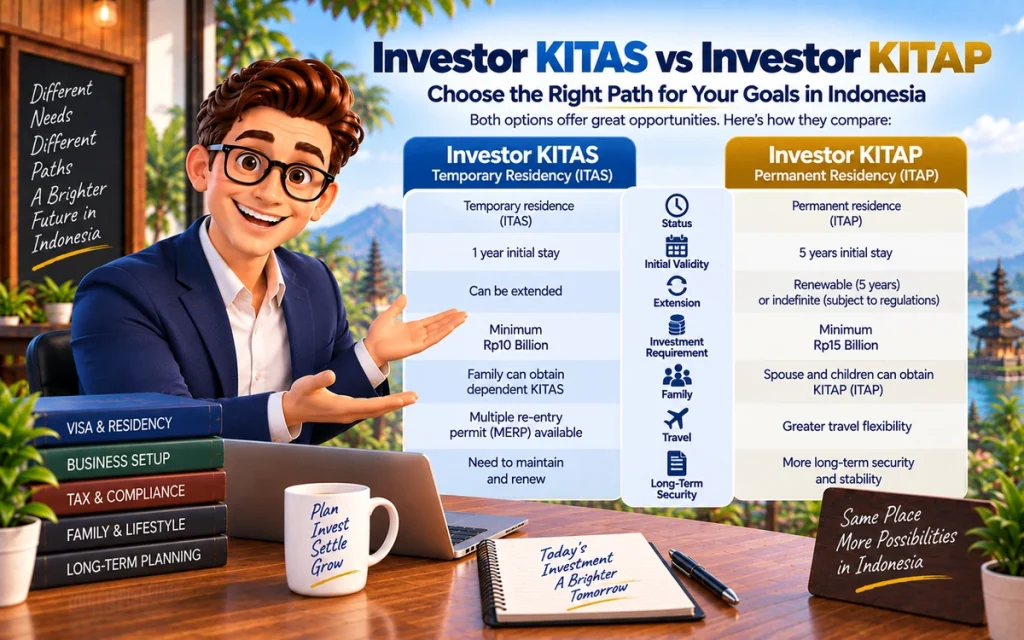
Investor KITAS and Investor KITAP are different stages of Indonesia’s immigration framework for qualifying foreign investors. Investor KITAS is based on ITAS, or limited stay, while Investor KITAP is based on ITAP, or permanent stay.
The two should not be treated as interchangeable. The investment threshold, residence history, immigration status, and long-term planning considerations can differ between the two stages.
| Point | Investor KITAS | Investor KITAP |
| Immigration status | ITAS / Limited Stay Permit | ITAP / Permanent Stay Permit |
| Typical purpose | Temporary or initial long-term investor residence | Permanent stay for a qualifying investor |
| Qualifying personal shareholding | IDR 10 billion stage | IDR 15 billion stage |
| Residence pathway | Investor ITAS / KITAS | Investor ITAS / KITAS → ITAP / KITAP |
| Residence history | Used as the qualifying investor residence stage | Current operational guidance commonly refers to more than 3 consecutive years; Azra Solutions uses the fourth-year stage for practical planning |
| Corporate evidence | PT PMA and supporting corporate records | PT PMA and supporting corporate records remain important |
| Long-term status | Limited stay | Permanent stay status |
| Extension / continuation | Subject to the applicable ITAS rules | ITAP can be extended under the applicable Immigration procedure |
Investor KITAP vs Other KITAP Categories
Investor KITAP is one of several pathways to permanent stay in Indonesia. The correct KITAP category depends on the foreign national’s underlying circumstances, such as investment, employment, family relationship, or retirement.
Although these pathways all lead to ITAP, they are not interchangeable. Their eligibility requirements, supporting documents, and the activities that support the immigration status can be different.
| KITAP Category | Main Basis | Typical Applicant |
| Investor KITAP | Qualifying investment and personal shareholding in a PT PMA | Foreign investor who qualifies for the investor ITAS to ITAP pathway |
| Working KITAP | Qualifying employment or work-based immigration pathway | Foreign professional who qualifies through an applicable work-based route |
| Family KITAP | Family relationship with an eligible Indonesian or foreign resident | Spouse or eligible family member qualifying under the relevant family pathway |
| Retirement KITAP | Retirement-based eligibility and applicable residence requirements | Foreign retiree who meets the requirements of the applicable retirement pathway |
Common Investor KITAP Mistakes
Investor KITAP applications can become more complicated when an investor relies on outdated information, confuses different investment requirements, or waits too long to prepare. The following are some of the most common mistakes to avoid.
Assuming IDR 10 Billion Is Enough
The IDR 10 billion threshold is associated with the relevant Investor KITAS stage. Current operational Immigration guidance for the Investor ITAS to ITAP pathway lists a minimum personal share value of IDR 15 billion. An investor who qualified for Investor KITAS at the earlier threshold should therefore review their current qualifying shareholding before applying for KITAP.
Treating IDR 15 Billion as a Bank Balance
The Investor KITAP investment requirement should not be understood simply as having IDR 15 billion sitting in a personal or company bank account. The relevant issue is the investor’s qualifying personal shareholding, supported by appropriate corporate documentation.
Waiting Until the ITAS Is About to Expire
ITAS to ITAP preparation should begin before the current permit reaches its final days. Eligibility, shareholding, PT PMA records, and supporting documents can take time to review and update. Waiting too long can create unnecessary pressure and may leave insufficient time to address documentation issues.
Ignoring PT PMA Compliance
An Investor KITAP application is not based only on the foreign investor’s passport and immigration history. Corporate evidence such as the NIB, company deed, AHU records, bank statements, and shareholding documentation can form an important part of the application. These records should be current and consistent.
Confusing KITAP with Work Authorization
KITAP is a permanent stay status. It should not automatically be interpreted as unrestricted authorization to perform every type of employment or professional activity in Indonesia. The applicable rules for employment or other regulated activities should be reviewed separately.
Relying on Outdated Immigration Information
Immigration requirements and operational procedures can change. Older webpages, visa articles, or forum discussions may still show investment thresholds or procedures that no longer reflect the current operational position. Investors should verify important requirements against current Immigration information before submitting an application.
How Much Does Investor KITAP Cost?
The cost of an Investor KITAP application consists of more than one type of expense. The applicant should distinguish the official government immigration fees from professional service fees and any corporate or document-related costs.
Official Immigration fees can change, so applicants should verify the applicable PNBP tariff at the time of filing. Current Immigration information lists ITAP fees based on the period granted, including a 5-year ITAP, a 10-year ITAP, and an ITAP for an unlimited period.
| Cost Category | What It May Include |
| Government immigration fees | PNBP for the applicable ITAP grant or other immigration services required for the application. |
| Re-entry permit | Applicable Izin Masuk Kembali / Re-Entry Permit if required for the investor’s travel arrangements. |
| Professional or agency fees | Fees charged by an immigration consultant, legal adviser, or service provider assisting with the application. |
| Corporate and document costs | Potential costs for corporate amendments, document preparation, translation, legalization, certification, or other supporting requirements. |
Government Immigration Fees
Current official Immigration information lists the following ITAP PNBP categories: ITAP valid for up to 5 years at IDR 5 million per application, ITAP valid for up to 10 years at IDR 10 million per application, and ITAP for an unlimited period at IDR 15 million per application.
These are government immigration fees and should not be confused with professional service fees. The exact fee applicable to an individual Investor KITAP application should be confirmed through the current Immigration system or the relevant Immigration Office before payment.
Professional or Agency Fees
If an investor uses an immigration consultant, lawyer, or other professional service provider, the service fee is separate from the government PNBP. The amount can vary depending on the scope of assistance, the applicant’s circumstances, and whether corporate or family immigration services are included.
Corporate and Document Costs
Additional costs can arise if the investor needs to update corporate records, prepare amendments, obtain supporting documents, translate documents, or complete other administrative requirements before submitting the ITAS to ITAP application.
These costs are not necessarily part of the KITAP immigration fee itself. They should therefore be budgeted separately when calculating the total cost of the transition.
How Long Does Investor KITAP Take?
There is no single guaranteed timeline for every Investor KITAS to KITAP application. The overall process depends on document readiness, the applicant’s eligibility, the condition of the PT PMA records, Immigration verification, and whether additional clarification or documents are required.
For planning purposes, it is better to divide the process into preparation, submission, verification, and issuance rather than relying on one fixed number of days.
1. Document Preparation
The preparation stage covers the eligibility review and collection of the required immigration and corporate documents. This includes checking the investor’s residence history, qualifying personal shareholding, PT PMA records, passport, current ITAS, and supporting documents.
This stage can take longer if corporate records need to be updated or if the investor’s shareholding structure has changed. Starting early gives the investor more time to resolve these issues.
2. Application Submission
Once the documents are ready, the ITAS to ITAP application is submitted through the applicable Immigration process and the required government fees are paid.
The time required at this stage depends partly on whether the application is complete and whether the information submitted is consistent across the immigration and corporate documents.
3. Immigration Verification
After submission, Immigration carries out the applicable verification and review. Current operational procedures can involve review at the Immigration Office and further verification by the Directorate General of Immigration.
Additional questions, requests for clarification, or requests for supporting documents can affect the overall processing time.
4. ITAP / KITAP Issuance
After the required verification and approval stages are completed, the ITAP and associated KITAP documentation can be issued.
The issuance stage should not be treated as a guaranteed fixed-date event because processing depends on the relevant Immigration workflow and the circumstances of the individual application.
What Can Delay an Investor KITAP Application?
- Incomplete or inconsistent immigration documents.
- Insufficient evidence supporting the investor’s qualifying personal shareholding.
- Differences between the shareholding evidence and PT PMA corporate records.
- Outdated or incomplete NIB, deed, AHU, or other company documentation.
- Changes to the PT PMA or shareholding structure that have not been properly documented.
- Additional Immigration verification or requests for clarification.
- Starting the application too close to the expiry of the current ITAS.
When Should You Start Preparing?
Investors should begin reviewing their Investor KITAP readiness well before the current ITAS approaches expiry. The practical fourth-year pathway used by Azra Solutions means that planning should begin before the investor reaches the final application stage.
A useful approach is to conduct an early readiness review covering the residence history, qualifying personal shareholding, PT PMA compliance, corporate documents, and immigration records. This allows potential issues to be identified while there is still time to resolve them.
Rather than asking only “How many days does KITAP take?”, the more useful planning question is: “When should I start preparing so that my application is ready within the applicable Immigration window?”
Frequently Asked Questions About Investor KITAP
What is an Investor KITAP?
Investor KITAP is an ITAP-based permanent stay status for a qualifying foreign investor in Indonesia. For the Investor ITAS to ITAP pathway, eligibility is supported by the investor’s qualifying personal shareholding, residence history, PT PMA records, and required immigration documentation.
How much investment is required for Investor KITAP?
Current operational Immigration guidance for the Investor ITAS to ITAP pathway lists a minimum personal share value of IDR 15 billion. This is different from the IDR 10 billion threshold associated with the relevant Investor KITAS stage.
Is IDR 10 billion enough for Investor KITAP?
Not necessarily. IDR 10 billion is associated with the relevant Investor KITAS stage, while current operational Immigration guidance for the Investor ITAS to ITAP pathway lists IDR 15 billion as the minimum personal share value. An existing Investor KITAS holder should review their current qualifying shareholding before applying for KITAP.
Why is the Investor KITAP threshold IDR 15 billion?
The IDR 15 billion threshold applies to the Investor ITAS to ITAP pathway under current operational Immigration guidance. The IDR 10 billion and IDR 15 billion figures should therefore be understood as requirements applying at different stages rather than as contradictory figures.
How many years of Investor KITAS are required before KITAP?
Current operational Immigration pages commonly state that the investor must already have held ITAS for more than 3 consecutive years. For practical planning, Azra Solutions works with the fourth-year stage based on recent experience handling an Investor ITAS to ITAP application. Investors should therefore plan for the fourth-year stage rather than waiting until the final moment.
Can I convert Investor KITAS to KITAP?
Yes, an eligible Investor ITAS / KITAS holder can apply for a change of status to ITAP when the applicable requirements are satisfied. The process involves reviewing residence history, qualifying personal shareholding, PT PMA records, immigration documents, and completing the required Immigration verification.
Can I get Investor KITAP directly without Investor KITAS?
The availability of a direct ITAP route depends on the immigration category and the applicant’s circumstances. Investor KITAP should not automatically be treated as a direct-entry route. This article focuses on the Investor ITAS to ITAP pathway, which is the practical pathway relevant to an existing Investor KITAS holder.
Can an Investor KITAP holder work in Indonesia?
KITAP is a permanent stay status and should not automatically be treated as unrestricted work authorization. Investor activities and employment are separate issues, and any work or regulated professional activity should be assessed against the applicable authorization requirements.
Can my spouse and children join me on Investor KITAP?
Eligible family members may be able to obtain an appropriate family-based immigration status in Indonesia. However, family members do not automatically receive the principal investor’s KITAP and must qualify under the immigration category applicable to their own circumstances.
Can an Investor KITAP holder travel outside Indonesia?
Yes. An Investor KITAP holder can travel outside Indonesia, subject to the applicable immigration requirements and a valid Izin Masuk Kembali / Re-Entry Permit. KITAP should not be treated as an unconditional right to leave and re-enter Indonesia without checking the relevant immigration documents.
Is Investor KITAP permanent forever?
KITAP is a permanent stay status, but “permanent” does not mean that the holder can ignore immigration administration indefinitely. Current Immigration information provides for ITAP extension, including an unlimited-period extension category, subject to the applicable procedure and requirements.
What happens if my shareholding changes after getting Investor KITAP?
A material change in shareholding should be reviewed for possible immigration implications. A transfer, reduction, or restructuring that affects the investor’s qualifying personal shareholding may affect the basis supporting the immigration status. The immigration implications should be assessed before completing a significant corporate change where possible.
Investor KITAP Readiness Checklist
- You understand the difference between the IDR 10 billion Investor KITAS stage and the IDR 15 billion Investor KITAP stage.
- Your qualifying personal shareholding is properly documented.
- Your Investor ITAS residence history has been reviewed against the applicable requirement.
- Your PT PMA deed, AHU records, NIB, and relevant corporate documents are current and consistent.
- Your passport and current ITAS are valid and properly documented.
- You have prepared the required sponsor, guarantee, integration, and supporting documents.
- You have reviewed the application timeline before the current ITAS approaches expiry.
- You understand that KITAP residence status and work authorization are separate matters.
- You have checked your re-entry arrangements before international travel.
- You have reviewed the immigration implications of any planned shareholding or corporate changes.
Because Immigration requirements and operational procedures can change, applicants should verify the applicable requirements at the time of filing. This FAQ is intended to explain the Investor KITAP pathway and common planning issues, not to replace an individual eligibility assessment.
Get Help With Your Investor KITAP Application
Applying for an Investor KITAP is a long-term immigration process that requires more than simply meeting the investment threshold. Your residence history, qualifying personal shareholding, PT PMA documentation, immigration records, and application documents all need to be properly aligned before you apply.
Azra Solutions can assist foreign investors with the preparation and review of an Investor ITAS to ITAP application, including:
- Reviewing your Investor KITAS / ITAS history and eligibility
- Reviewing your qualifying personal shareholding
- Checking PT PMA corporate documents and supporting records
- Reviewing the immigration documents required for the ITAS to ITAP process
- Preparing the application and supporting documentation
- Assisting with the Immigration application and coordination process
Based on our recent experience handling an Investor ITAS to ITAP application, we recommend reviewing your eligibility and documentation well before the final application stage. This gives you time to identify potential gaps in your residence history, shareholding structure, or corporate documentation before they become a problem.

Ready to Plan Your Investor KITAP?
If you are currently holding an Investor KITAS and are planning to move to Investor KITAP, Azra Solutions can help you review your position and prepare for the next stage.
Contact Azra Solutions to discuss your Investor KITAP pathway and find out what you need to prepare for your application.