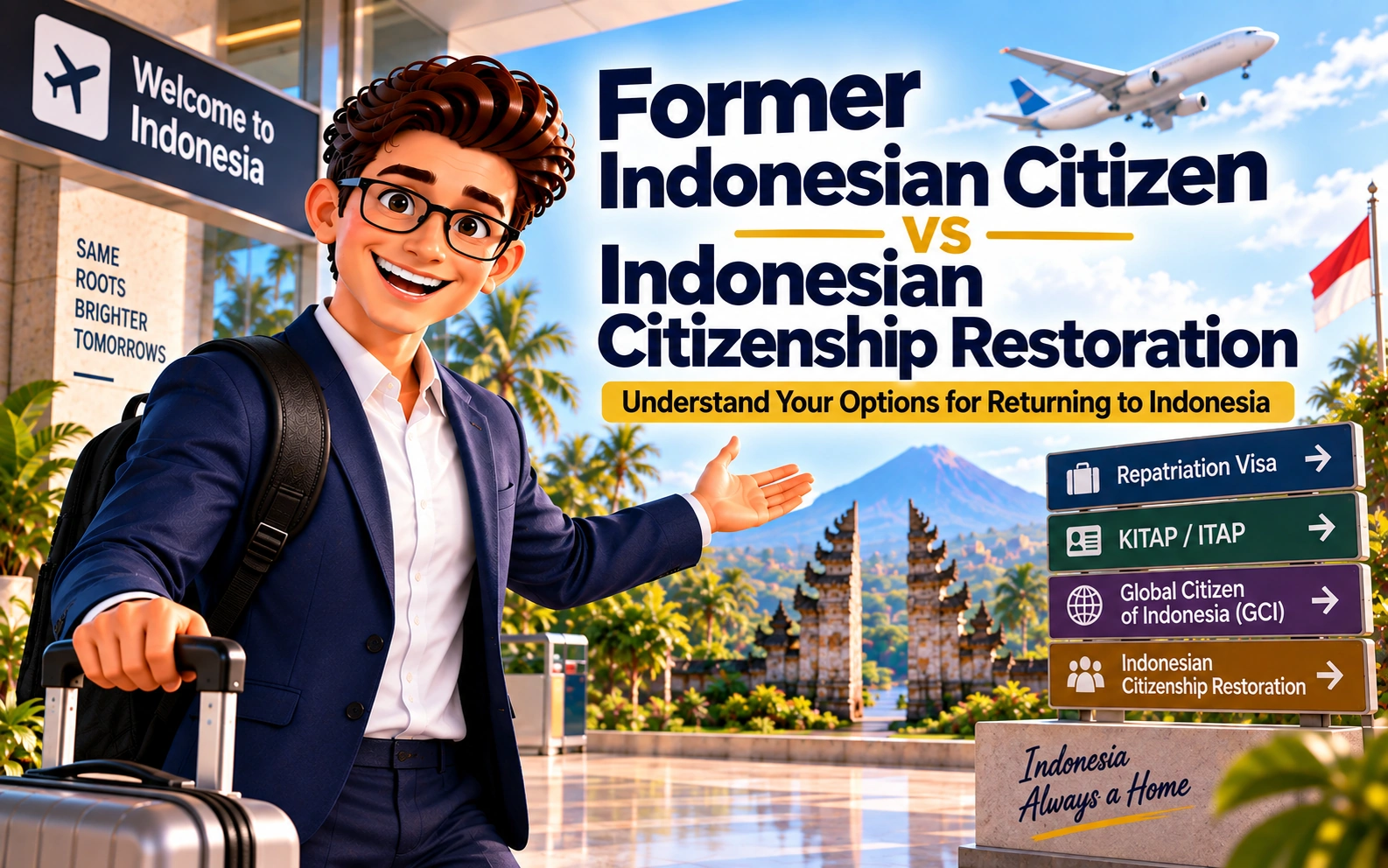
Former Indonesian citizens who want to return to Indonesia often face a basic but important question: do you need to regain Indonesian citizenship before you can live in Indonesia again?
Not necessarily. Indonesian immigration status and Indonesian citizenship are separate legal matters, and the correct route depends on the outcome you actually want.
A former Indonesian citizen may, if eligible, use immigration pathways designed for returning to Indonesia as a foreign national. Current Indonesian Immigration categories include repatriation visas for former Indonesian citizens, as well as permanent-residence pathways under the Global Citizen of Indonesia (GCI) framework.
Citizenship restoration is a separate nationality-law matter. Law No. 12 of 2006 distinguishes between the general route under Article 31 and the specific route under Article 32. This distinction is important because Article 32 does not automatically apply to every former Indonesian citizen.
This guide explains the difference between returning to Indonesia, obtaining permanent residence, and becoming an Indonesian citizen again.
1. Former Indonesian Citizen: What Does the Status Mean?
Who Is a Former Indonesian Citizen?
A former Indonesian citizen is a person who previously held Indonesian citizenship but is no longer an Indonesian citizen under the applicable nationality law. In practical immigration terms, a former Indonesian citizen who now holds foreign nationality is treated as a foreign national and generally requires an appropriate visa or stay permit to enter and remain in Indonesia.
Why Your Citizenship History Matters
Your previous Indonesian citizenship can be an important part of determining which immigration or citizenship pathway may apply. Depending on the route, evidence may include an Indonesian birth certificate, former Indonesian KTP, Indonesian passport, Indonesian travel document, diploma, or other official Indonesian records.
Former Indonesian Citizen vs Current Indonesian Citizen
Being a former Indonesian citizen does not mean that Indonesian citizenship continues automatically. A person may now hold foreign nationality while still having family, historical, cultural, or economic ties to Indonesia. Those ties may support eligibility for certain immigration programs, but they are not the same as current Indonesian citizenship.
2. What Is Indonesian Citizenship Restoration?
What Does “Restoring” Indonesian Citizenship Mean?
Indonesian citizenship restoration means obtaining Indonesian citizenship again through a legal procedure that applies to the individual’s circumstances. However, former Indonesian citizens should not assume that there is one universal restoration procedure for everyone.
Article 31 vs Article 32: Why the Legal Basis Matters
Law No. 12 of 2006 provides different legal routes for people who have lost Indonesian citizenship. Article 31 provides that a person who has lost Indonesian citizenship may obtain it again through the naturalization procedure referred to in Articles 9–18 and Article 22.
Article 32 provides a different route for persons who lost Indonesian citizenship under the specific circumstances identified in Article 23(i) and Article 26(1) or (2). Those applicants may submit a written application to the Minister without following the procedures in Articles 9–17.
This distinction is critical. Article 32 should not be presented as the restoration procedure for every former WNI. A former Indonesian citizen therefore needs to establish the legal circumstances surrounding the loss of citizenship before determining whether Article 31, Article 32, or another legal provision applies.
Citizenship Is Different From Immigration Residence
An immigration permit determines whether a foreign national may enter, stay, or reside in Indonesia. Citizenship determines nationality. Therefore, a visa, KITAP, GCI, or repatriation visa should not be described as citizenship restoration.
Does Every Former Indonesian Citizen Have the Same Pathway?
No. The applicable route can depend on why Indonesian citizenship was lost, when it was lost, the person’s current nationality, marital and family circumstances, where the person currently lives, available evidence, and other legally relevant facts.
3. Former Indonesian Citizen vs Indonesian Citizenship Restoration
Immigration Status vs Citizenship Status
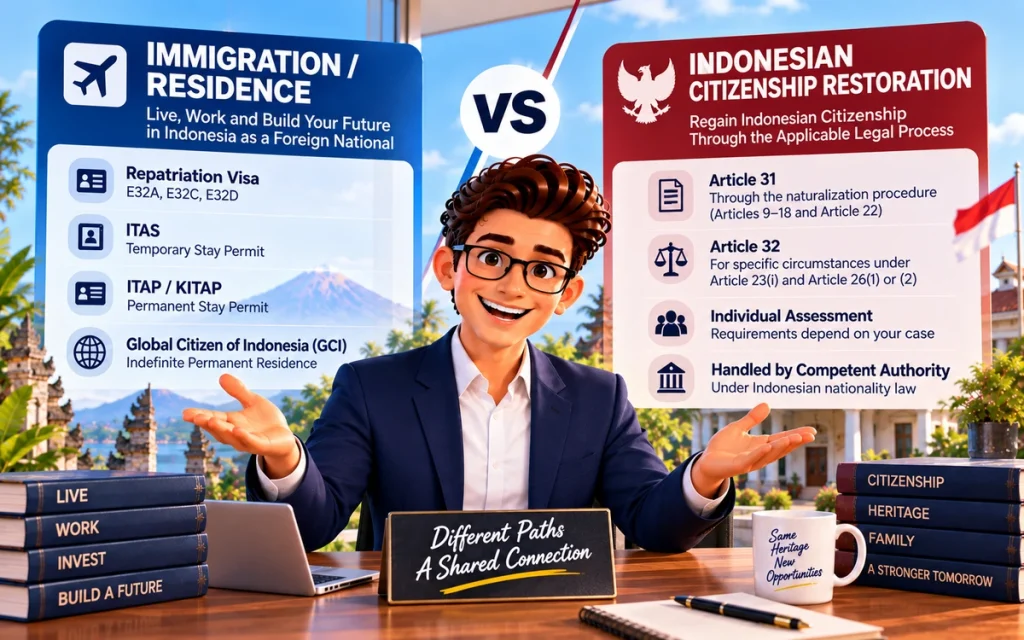
The central difference is the legal result. An immigration pathway can allow a foreign national to enter and reside in Indonesia for a specific period or, under qualifying permanent-residence programs, indefinitely. Citizenship restoration concerns whether the person becomes an Indonesian citizen again.
Right to Stay vs Nationality
If your primary objective is to live in Indonesia while remaining a foreign citizen, your first research should generally focus on immigration options. If your objective is specifically to become an Indonesian citizen again, you need to analyze Indonesian citizenship law separately.
Side-by-Side Comparison
| Issue | Immigration / Residence Route | Citizenship Route |
| Main objective | Live or reside in Indonesia as a foreign national | Regain Indonesian citizenship where legally available |
| Legal result | Visa, ITAS, ITAP/KITAP, or qualifying GCI residence status | Indonesian nationality if the applicable procedure is approved |
| Foreign nationality | Generally remains | Consequences depend on the applicable legal route |
| Repatriation visa | May be relevant | Does not itself restore citizenship |
| KITAP / ITAP | Permanent residence | Not the same as citizenship |
| GCI | Indefinite permanent residence for eligible persons | Does not itself restore citizenship |
| Main authority | Directorate General of Immigration | Competent citizenship authorities under Indonesian nationality law |
4. Can a Former Indonesian Citizen Live in Indonesia Without Restoring Citizenship?
Returning to Indonesia as a Foreign National
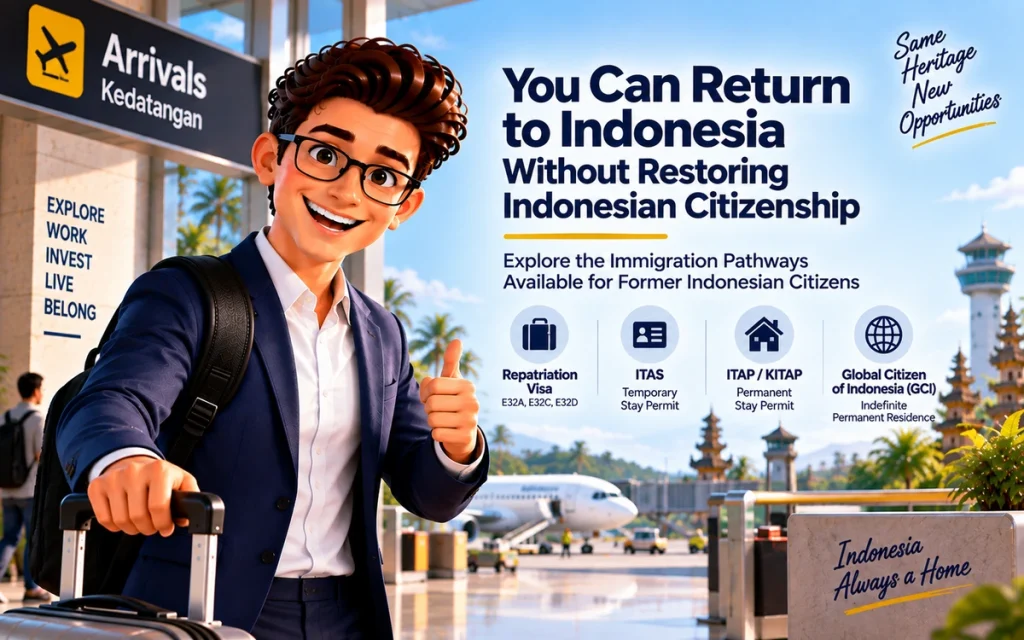
Yes, if the person qualifies for an applicable immigration pathway. This is one of the most important points for former Indonesian citizens to understand: you do not necessarily need to restore Indonesian citizenship simply because you want to live in Indonesia again.
For more information about the broader immigration options available to former Indonesian citizens, see the Former Indonesian Citizen guide.
Repatriation Visa Options
The current official Immigration visa catalogue includes several repatriation categories for former Indonesian citizens, including E32A (5-year), E32C (2-year), and E32D (1-year). The catalogue also includes GCI-related categories such as E32E and E32F.
For a detailed explanation of the repatriation framework, see the Indonesia Repatriation Visa guide.
Permanent Residence Options
Former Indonesian citizens may also have access to permanent-residence pathways in qualifying circumstances. These can include certain ITAP/KITAP routes and the Global Citizen of Indonesia framework.
Why Residence Does Not Automatically Restore Citizenship
Residence and nationality are legally distinct. A person can have a long-term or indefinite right to reside in Indonesia while remaining a citizen of another country. Conversely, obtaining Indonesian citizenship again requires a citizenship procedure.
5. Repatriation Visa vs Indonesian Citizenship Restoration
What Is a Repatriation Visa?
A repatriation visa is an immigration pathway for qualifying foreign nationals who have a particular connection with Indonesia. For former Indonesian citizens, repatriation visas can provide a legal pathway to return and reside in Indonesia without first becoming an Indonesian citizen again.
E32 Repatriation Visa Categories
The current Immigration framework includes E32A (5-year), E32C (2-year), and E32D (1-year) repatriation categories for former Indonesian citizens. The specific requirements, permitted activities, validity, stay conditions, and subsequent immigration status depend on the applicable visa category.
For detailed information about E32D, see the E32D Repatriation Visa guide.
What a Repatriation Visa Does
A repatriation visa provides an immigration basis for entering and residing in Indonesia under the conditions of the relevant visa category. It can therefore address the question: “How can I return to and stay in Indonesia as a former Indonesian citizen?”
What a Repatriation Visa Does Not Do
A repatriation visa does not itself restore Indonesian citizenship. The holder remains a foreign national unless Indonesian citizenship is separately obtained through the applicable citizenship procedure.
6. KITAP vs Indonesian Citizenship

What Is KITAP / ITAP?
ITAP is Indonesia’s Permanent Stay Permit. KITAP is commonly used to refer to the permanent residence status or card associated with ITAP. It allows an eligible foreign national to maintain permanent residence in Indonesia under immigration law. However, KITAP is not Indonesian citizenship.
Can a Former Indonesian Citizen Obtain ITAP?
Certain former Indonesian citizens may qualify for ITAP through specific immigration pathways. However, it would be inaccurate to say that every former WNI automatically qualifies for KITAP.
For a detailed explanation of permanent residence specifically for former Indonesian citizens, see the Former Indonesian Citizen KITAP guide.
A Specific ITAP Without Status Conversion Route
Current Immigration guidance describes a specific ITAP-without-status-conversion pathway for certain people who lose Indonesian citizenship while in Indonesia. The guidance includes circumstances such as being granted foreign citizenship while in Indonesia or holding a valid foreign passport or equivalent evidence of foreign nationality.
The guidance also requires evidence of former Indonesian citizenship and states that the application for this particular route must be submitted no later than 14 days after the legal event causing the loss of Indonesian citizenship, where the person resides in Indonesia. This 14-day requirement is route-specific and should not be interpreted as a universal deadline for every former Indonesian citizen seeking ITAP.
Is KITAP the Same as Indonesian Citizenship?
No. KITAP/ITAP provides permanent residence to a foreign national. Indonesian citizenship is nationality. A KITAP holder therefore remains a foreign citizen unless a separate citizenship procedure changes that status.
7. GCI vs Indonesian Citizenship Restoration
What Is Global Citizen of Indonesia?
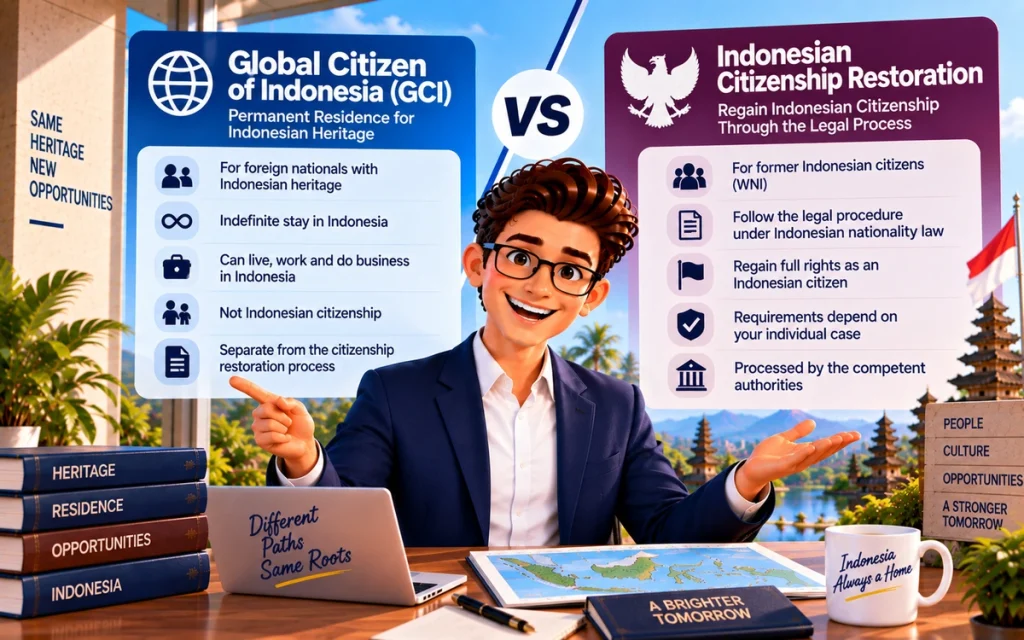
The Global Citizen of Indonesia (GCI) framework was officially launched by Indonesian Immigration on 26 January 2026. GCI is designed for eligible foreign nationals who have qualifying blood, kinship, historical, or strong ties to Indonesia and provides indefinite permanent residence to eligible applicants.
For the full explanation of the program, see the Global Citizen of Indonesia (GCI) official overview.
Former Indonesian Citizens and GCI
Former Indonesian citizens are among the groups that can be relevant to GCI. The current Immigration visa catalogue includes E32E (Permanent Resident Repatriation Visa – GCI) and E32F (Special Expertise Repatriation Visa – GCI).
Does GCI Restore Indonesian Citizenship?
No. GCI is an immigration and permanent-residence framework. It does not restore Indonesian citizenship. A former Indonesian citizen can potentially obtain indefinite permanent residence through a qualifying GCI pathway while continuing to hold foreign citizenship.
GCI Permanent Residence vs Indonesian Citizenship
The distinction is simple: GCI is permanent residence, while citizenship restoration concerns nationality. If your objective is to live permanently in Indonesia while retaining foreign nationality, GCI may be relevant. If your objective is to become Indonesian again, you must separately examine Indonesian citizenship law.
8. Does Every Former Indonesian Citizen Qualify to Restore Indonesian Citizenship?
Former WNI Status Alone Is Not Enough
No. Being a former Indonesian citizen does not automatically establish eligibility for Article 32 restoration. The legal basis for the loss of citizenship must first be identified.
When Article 32 Applies
Article 32 applies to persons who lost Indonesian citizenship under Article 23(i) or Article 26(1) or (2). These provisions cover specific circumstances. Therefore, the phrase “former Indonesian citizen” alone is not enough to determine whether Article 32 applies.
When Article 31 Becomes Relevant
Article 31 states that a person who has lost Indonesian citizenship may obtain it again through the naturalization procedure referenced in Articles 9–18 and Article 22. Some former Indonesian citizens may therefore need to consider the naturalization framework rather than the specific Article 32 procedure.
Why Individual Assessment May Be Necessary
Cases involving acquisition of another nationality, former dual-nationality situations, marriage to a foreign citizen, old citizenship records, inconsistent civil documents, or uncertainty about when and how citizenship was lost may require individual legal analysis.
9. Why Did You Lose Indonesian Citizenship?
Loss of Citizenship Through Another Nationality
Article 23 of Law No. 12 of 2006 contains several grounds for loss of Indonesian citizenship, including certain circumstances involving acquisition of another citizenship. If you became a citizen of another country, you should establish when the foreign citizenship was acquired, how it was acquired, whether Indonesian authorities recorded the loss, and which legal provision applied.
Foreign Passport or Evidence of Foreign Nationality
Certain provisions of Article 23 also concern possession of a foreign passport or passport-like document that can be interpreted as evidence of another nationality. The exact facts matter.
Former Dual-Nationality Situations
People who previously had limited dual-nationality status as children can have a different legal history from adults who later lost Indonesian citizenship. Their circumstances should be assessed according to the rules applicable to their status.
Marriage-Related Loss of Citizenship
Article 26 addresses certain citizenship consequences arising from marriage to a foreign citizen. These circumstances are specifically relevant to Article 32.
Why Your Citizenship History Matters
Old Indonesian passports, KTP, birth certificates, family records, school records, and other official documents can help establish that you were previously Indonesian, when your citizenship changed, and why it changed.
10. How to Restore Indonesian Citizenship
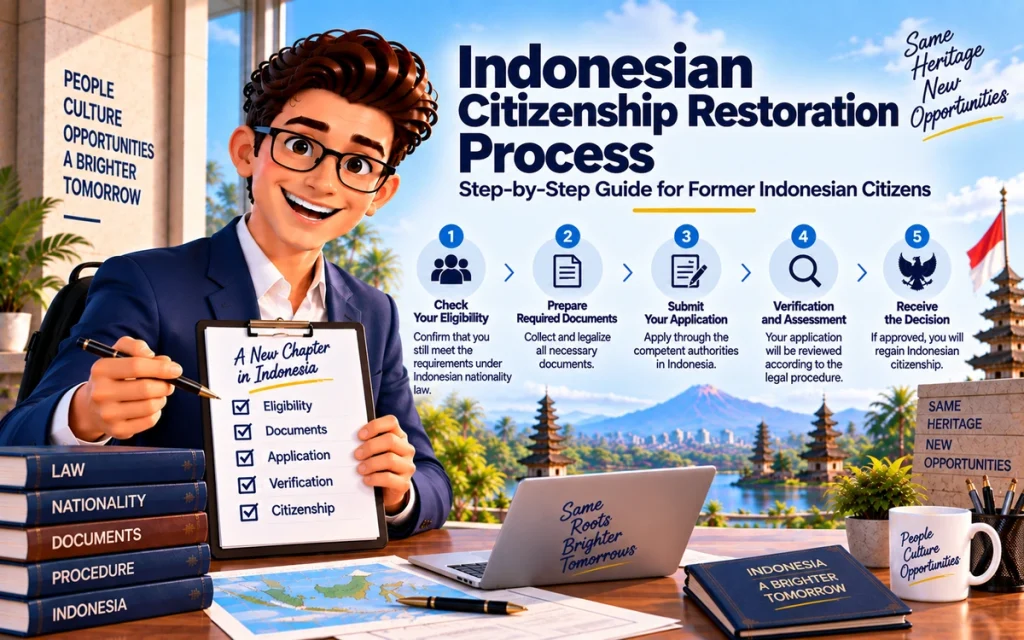
Step 1: Establish Your Previous Indonesian Citizenship
The first step is to collect reliable evidence that you previously held Indonesian citizenship. Useful documents may include an Indonesian passport, KTP, birth certificate, or other official Indonesian records.
Step 2: Identify Why Citizenship Was Lost
Determine the legal event that caused the loss of Indonesian citizenship. This can determine whether Article 31, Article 32, or another provision applies.
Step 3: Determine the Applicable Citizenship Route
If Article 32 applies, the applicant can use the specific procedure for obtaining Indonesian citizenship again. If Article 32 does not apply, Article 31 points to the naturalization procedure under Articles 9–18 and Article 22.
Step 4: Prepare the Required Documents
AHU’s current citizenship service requirements include an application letter, proof of birth, evidence of previous Indonesian citizenship, relevant marriage/divorce/death documents where applicable, children’s birth certificates where applicable, a written declaration of loyalty to Indonesia, KTP/KK/NIT where applicable, curriculum vitae, recent photographs, and proof of PNBP payment.
Step 5: Submit Through the Applicable Government Procedure
Follow the current AHU/SAKE procedure and any additional submission requirements applicable to the applicant. For eligible applicants residing outside Indonesia, the Indonesian Representative can have a role in the submission process under the applicable citizenship law.
Step 6: Government Verification and Decision
AHU’s current information states that online document verification is performed after documents are submitted and considered complete and correct. AHU states a maximum of seven days for this verification stage. This should not be interpreted as a guaranteed seven-day end-to-end citizenship restoration process. For Article 32, Article 33 of Law No. 12 of 2006 provides that approval or rejection is given by the Minister or authorized official no later than three months from receipt of the application.
Step 7: Complete Follow-Up Requirements
After approval, any required updates to citizenship, civil-registration, immigration, and travel-document records should be completed according to the applicable procedure.
11. Documents Former Indonesian Citizens May Need
Official Article 32 Restoration Requirements
- Application letter.
- Birth certificate or proof of birth.
- Indonesian passport or other evidence that the applicant was previously an Indonesian citizen.
- Marriage, divorce, or spouse-death documents where applicable.
- Children’s birth certificates where applicable.
- Written declaration of loyalty to the Republic of Indonesia, Pancasila, and the 1945 Constitution.
- KTP, KK, or NIT where applicable.
- Curriculum vitae.
- Recent color photographs.
- Original proof of PNBP payment.
Documents Explaining Citizenship Loss
Documents explaining how and when Indonesian citizenship was lost can be important to the legal analysis. Depending on the case, these may include foreign naturalization documents, foreign passport records, marriage records, Indonesian citizenship-loss records, official correspondence, or other government documents.
Immigration Evidence of Former WNI Status
For immigration applications, the required documents depend on the visa or residence category. Former Indonesian citizenship may be established through documents such as an Indonesian birth certificate, former KTP, Indonesian passport, Indonesian travel document, diploma, or other acceptable official evidence.
12. Government Fees and Costs
Citizenship Restoration PNBP
AHU’s current FAQ lists the government PNBP for an application to obtain Indonesian citizenship again at Rp1,000,000. This is a government fee and is separate from immigration fees and professional service fees.
Immigration Government Fees
Visa, ITAS, ITAP, and other immigration services have separate government tariffs. The amount depends on the specific immigration service and applicable government regulations.
Professional Service Fees
Consultant or legal-professional fees are separate from government PNBP. Applicants should distinguish between government fees and professional service fees.
Why Fees Should Be Rechecked Before Filing
Government tariffs and procedures can change. The Rp1,000,000 figure above reflects the AHU information reviewed for this 2026 article. Applicants should confirm the current official tariff before submitting an application.
13. How Long Can the Process Take?
AHU Online Verification
AHU currently states that online document verification can take a maximum of seven days after the documents are considered complete and correct. This is a verification-stage timeframe, not a guaranteed total processing time.
Article 32 Decision Period
For Article 32 applications, Article 33 of Law No. 12 of 2006 states that approval or rejection is given no later than three months from receipt of the application.
Article 31 / Naturalization
Where Article 31 applies, the naturalization procedure has its own statutory stages. An Article 31 case should not be assumed to follow the same timeline as Article 32.
Immigration Processing
Immigration processing times depend on the specific visa or residence category, document completeness, verification, and the applicable government system.
Document Preparation Can Take Longer
For former Indonesian citizens, gathering old citizenship records can be an important part of the process. The practical timeline can therefore be longer than the official administrative processing period.
14. Which Government Authority Handles Each Process?
Immigration Routes
Repatriation visas, ITAS, ITAP/KITAP, and GCI fall under Indonesia’s immigration framework administered by the Directorate General of Immigration.
Citizenship Routes
Citizenship applications are handled under Indonesia’s nationality framework through the competent Ministry of Law/AHU functions and the procedures established by Indonesian citizenship legislation. Indonesian Representatives may also have a role for eligible applicants living overseas.
Why the Division Matters
An immigration application does not replace a citizenship application. Likewise, a citizenship application does not automatically provide the immigration status required while a person remains a foreign national.
15. Which Path Should You Research First?

The best starting point is not simply the fact that you are a former Indonesian citizen. Start with what you want to achieve.
| Your Objective | What to Research |
| I want to live in Indonesia again | Former-WNI immigration options and repatriation visas |
| I want long-term or permanent residence | ITAP/KITAP eligibility and GCI |
| I want indefinite residence while keeping foreign nationality | GCI and other qualifying permanent-residence options |
| I want Indonesian citizenship again | Article 31 vs Article 32 and the applicable citizenship procedure |
| I am unsure which route applies | Citizenship history, current nationality, reason for citizenship loss, and intended purpose in Indonesia |
This approach helps prevent a common mistake: starting a citizenship process when the actual objective is residence, or choosing a residence product when the actual objective is Indonesian nationality.
16. Common Mistakes Former Indonesian Citizens Should Avoid
Assuming Article 32 Applies to Every Former WNI
Article 32 applies to specific circumstances identified in the law. It should not be treated as a universal citizenship-restoration procedure.
Assuming KITAP Means Citizenship
KITAP/ITAP is permanent residence for a foreign national. It does not automatically restore Indonesian citizenship.
Assuming GCI Restores Citizenship
GCI provides indefinite permanent residence to eligible persons. It does not change the applicant’s original citizenship.
Assuming Repatriation Means Citizenship Restoration
A repatriation visa is an immigration pathway. It does not automatically change nationality.
Treating the 14-Day ITAP Rule as Universal
The 14-day requirement applies to a specific ITAP-without-status-conversion route. It is not a universal deadline for every former Indonesian citizen.
Using Outdated Immigration Information
Indonesia’s immigration framework has developed significantly, including the introduction of GCI in 2026. Former Indonesian citizens should verify the current official immigration category and requirements before applying.
Confusing Visa Validity With Stay Period
Visa validity and authorized stay are different concepts. Applicants should review the conditions attached to the specific visa and resulting stay permit.
17. Frequently Asked Questions
Can a Former Indonesian Citizen Become an Indonesian Citizen Again?
Potentially, yes. The applicable route depends on the legal basis under which Indonesian citizenship was lost. Law No. 12 of 2006 distinguishes between the Article 31 naturalization route and the specific Article 32 route.
Can a Former Indonesian Citizen Live in Indonesia Without Restoring Citizenship?
Yes, if the person qualifies for an applicable immigration pathway. Current options include former-WNI repatriation visas and, for qualifying applicants, permanent-residence pathways.
What Are E32A, E32C, and E32D?
They are current repatriation visa categories for former Indonesian citizens: E32A is a 5-year category, E32C is a 2-year category, and E32D is a 1-year category.
What Are E32E and E32F?
They are GCI-related repatriation categories: E32E is the Permanent Resident Repatriation Visa – GCI and E32F is the Special Expertise Repatriation Visa – GCI.
Is KITAP the Same as Indonesian Citizenship?
No. KITAP/ITAP is permanent residence under Indonesian immigration law. Citizenship is nationality.
Does GCI Restore Indonesian Citizenship?
No. GCI provides indefinite permanent residence to eligible foreign nationals and does not change their original citizenship status.
What Is the Difference Between Article 31 and Article 32?
Article 31 provides a route through the naturalization procedure for persons who have lost Indonesian citizenship. Article 32 provides a specific written-application route for people who lost citizenship under the circumstances identified in Article 23(i) and Article 26(1)–(2).
How Much Does Indonesian Citizenship Restoration Cost?
AHU’s current FAQ lists Rp1,000,000 in PNBP for an application to obtain Indonesian citizenship again. Other professional or administrative costs may be separate.
Does AHU Process Citizenship Restoration in Seven Days?
The seven-day figure refers to the online document-verification stage after the documents are considered complete and correct. It is not a guaranteed total processing time.
How Long Is the Article 32 Decision Period?
Article 33 of Law No. 12 of 2006 states that approval or rejection is given no later than three months from receipt of the application.
What Documents Can Prove Former Indonesian Citizenship?
Depending on the procedure, documents can include a former Indonesian passport, Indonesian birth certificate, former KTP, Indonesian travel document, diploma, or other official Indonesian records.
Do I Need Indonesian Citizenship to Live Permanently in Indonesia?
Not necessarily. Eligible foreign nationals may have permanent-residence options such as ITAP/KITAP or GCI. These remain legally different from Indonesian citizenship.
18. Former Indonesian Citizen vs Citizenship Restoration: Key Takeaways
- Returning to Indonesia, obtaining permanent residence, and regaining Indonesian citizenship are three different legal objectives.
- A former Indonesian citizen may be able to return to and live in Indonesia without first restoring Indonesian citizenship.
- Current immigration pathways include repatriation categories such as E32A, E32C, and E32D, while E32E and E32F are relevant to former-WNI GCI pathways.
- KITAP / ITAP is permanent residence, not citizenship.
- Global Citizen of Indonesia (GCI) provides indefinite permanent residence to eligible applicants and does not itself change citizenship.
- Indonesian citizenship restoration depends on the legal circumstances under which Indonesian citizenship was lost.
- Article 32 is not universal; it applies to the specific circumstances identified in Article 23(i) and Article 26(1)–(2), while Article 31 provides the general naturalization route referenced by the law.
- AHU currently lists Rp1,000,000 as the PNBP for an application to obtain Indonesian citizenship again.
- The most important first step is to establish when and why Indonesian citizenship was lost, what citizenship is currently held, and whether the actual objective is residence or Indonesian nationality.
The core distinction is simple: immigration law determines how a foreign national may enter and reside in Indonesia; citizenship law determines nationality. For former Indonesian citizens, choosing the correct path begins by deciding which of those outcomes is actually required.
Need Help Understanding Your Indonesia Immigration Options?
If you are a former Indonesian citizen and need help understanding which Indonesian immigration pathway may be relevant to your circumstances, Azra Solutions can assist with immigration-related options and document preparation. Citizenship-specific eligibility and nationality-law questions should be confirmed through the competent Indonesian citizenship authority and, where appropriate, qualified legal counsel.
Contact Azra Solutions for immigration assistance and case assessment.
Official Sources
- Directorate General of Immigration — Official Visa Catalogue
- Directorate General of Immigration — Immigration Stay Permits
- Official Immigration — Global Citizen of Indonesia launch information
- Official Immigration — ITAP Without Status Conversion guidance
- AHU — Citizenship FAQ and current service requirements
- AHU — Guide to Obtaining Indonesian Citizenship Again
- Law No. 12 of 2006 — Official AHU PDF