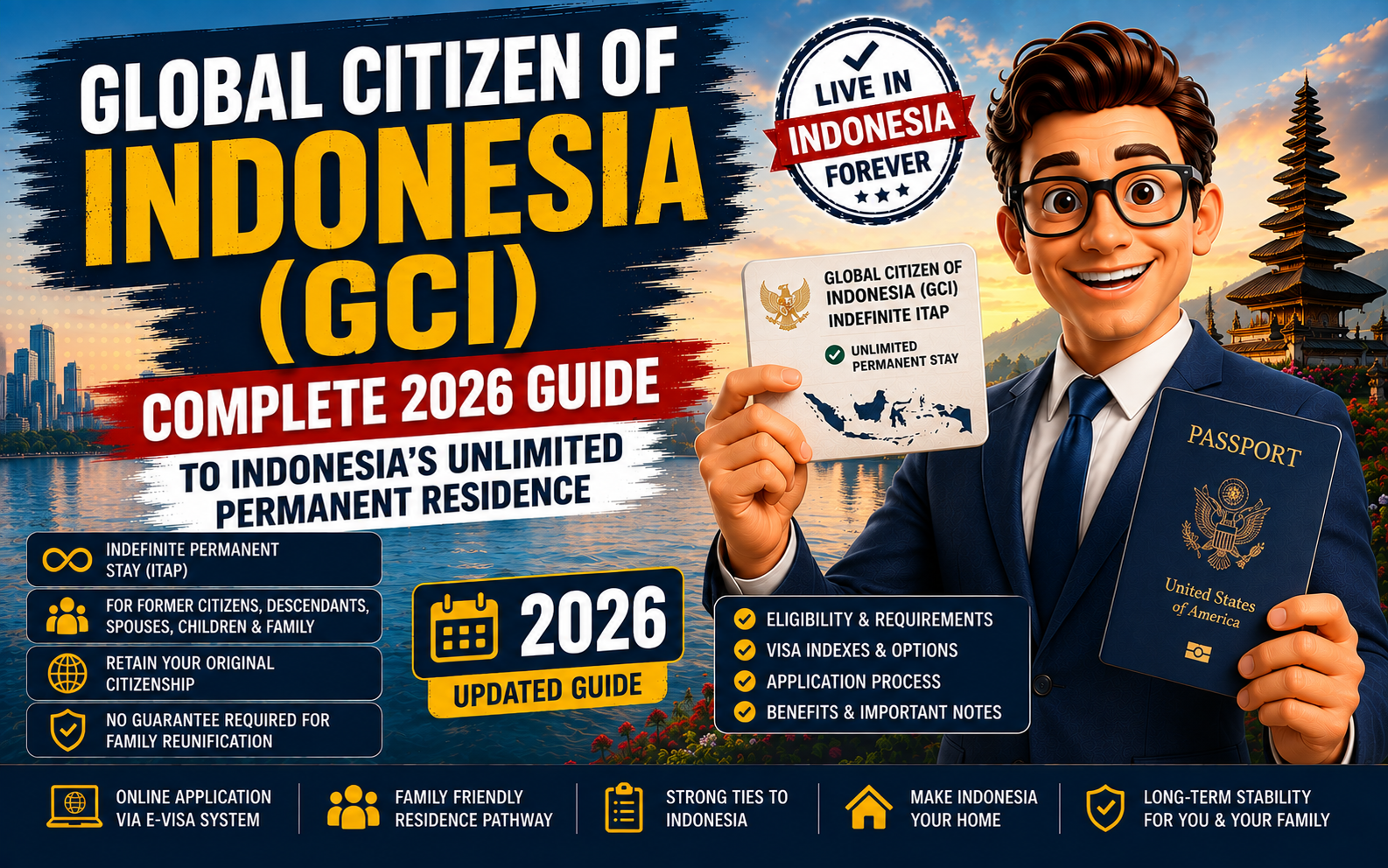
Indonesia has introduced a new immigration pathway for foreign nationals who have strong ties to the country but do not necessarily want to change their existing citizenship.
The Global Citizen of Indonesia (GCI) policy provides eligible foreign nationals with an indefinite Permanent Stay Permit (ITAP) while allowing them to retain their original citizenship. The policy is designed for people with Indonesian blood ties, family relationships, historical connections, or other strong ties to Indonesia.
GCI is particularly relevant for former Indonesian citizens, descendants of former Indonesian citizens, spouses of Indonesian citizens, children from mixed marriages, and certain family members of GCI holders.
The policy was officially inaugurated by the Directorate General of Immigration on January 26, 2026, as part of the 76th Immigration Service Day. Applications are submitted online through Indonesia’s electronic visa system, and eligible GCI applicants can receive an indefinite ITAP after entering Indonesia.
For international families, this development is particularly important. A foreign spouse of an Indonesian citizen or a child from a mixed marriage may now have access to a long-term residence pathway that does not require giving up their existing citizenship. Family-reunification applicants are also exempt from the immigration guarantee requirement applicable to certain other GCI categories. In this guide, we explain what Global Citizen of Indonesia (GCI) means, who can qualify, the available GCI visa indexes, how the application process works, the difference between GCI and Indonesian citizenship, and how the policy applies to spouses and children of mixed marriages.
What Is the Global Citizen of Indonesia (GCI)?

Global Citizen of Indonesia (GCI) is an Indonesian immigration policy that provides an indefinite Permanent Stay Permit (ITAP) to eligible foreign nationals who have strong ties to Indonesia.
According to the Directorate General of Immigration, these ties can include blood relationships, family relationships, historical connections, or other strong connections with Indonesia. Importantly, obtaining GCI does not change the applicant’s original citizenship status.
This means that GCI is fundamentally a residence solution, not a new form of Indonesian citizenship.
A foreign national who qualifies for GCI can obtain the right to reside in Indonesia indefinitely while continuing to hold their existing foreign nationality, subject to the applicable immigration rules.
Who Is GCI Designed For?
The policy was created primarily for foreign nationals who have meaningful connections with Indonesia.
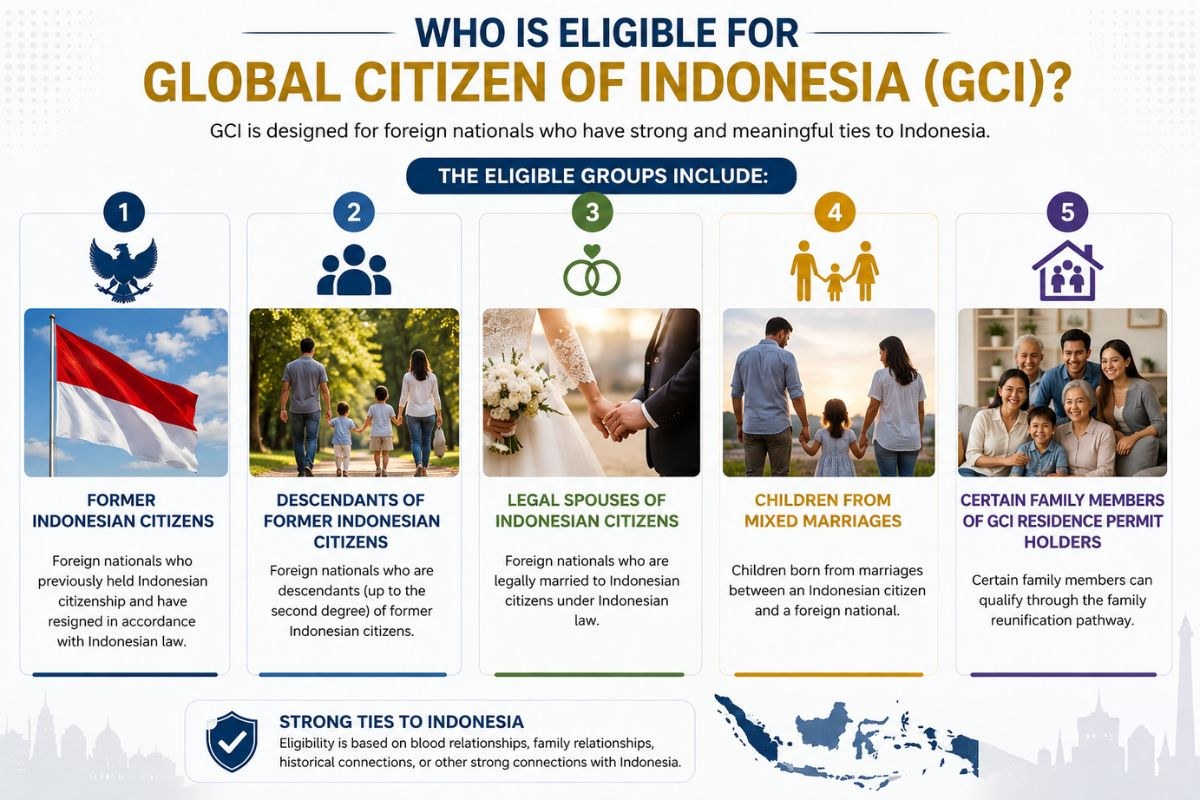
The officially identified groups include:
- Former Indonesian citizens;
- Descendants of former Indonesian citizens up to the second degree;
- Legal spouses of Indonesian citizens;
- Children from mixed marriages; and
- Certain family members of GCI residence permit holders through family reunification.
This makes GCI particularly relevant to Indonesian diaspora communities and international families.
For example, a foreign national who is legally married to an Indonesian citizen may be eligible under the family-reunification framework. Likewise, a child born from an Indonesian–foreign mixed marriage can fall within the GCI framework.
Why Is GCI Important?
Before GCI, people with strong personal or family connections to Indonesia could face a difficult choice between maintaining their foreign citizenship and obtaining a long-term residence status in Indonesia.
GCI provides another immigration pathway by allowing eligible foreign nationals to establish indefinite residence in Indonesia without changing their original citizenship.
For families, this can be particularly significant.
For example:
A foreign national is married to an Indonesian citizen and wants to make Indonesia their permanent home.
Under the GCI framework, an eligible spouse can potentially obtain an indefinite ITAP through the family-reunification pathway while retaining their existing nationality. The official policy also states that family-reunification applicants are not subject to the immigration guarantee requirement.
GCI in Simple Terms
The easiest way to understand GCI is:
Strong ties to Indonesia
↓
Eligible foreign national
↓
GCI application
↓
Indefinite ITAP
↓
Live in Indonesia long-term
↓
Retain original citizenship
GCI therefore provides a long-term residence option for eligible foreign nationals who have a meaningful connection to Indonesia but do not want residence in Indonesia to require a change of nationality.
When Was GCI Introduced in Indonesia?

The Global Citizen of Indonesia (GCI) policy was officially inaugurated by Indonesia’s Directorate General of Immigration on January 26, 2026, during the 76th Immigration Service Day.
The policy was introduced as a new immigration pathway for foreign nationals who have strong ties to Indonesia, including former Indonesian citizens, descendants of former Indonesian citizens, spouses of Indonesian citizens, and children from mixed marriages.
The launch marked an important development in Indonesia’s immigration policy because eligible foreign nationals can obtain an indefinite Permanent Stay Permit (ITAP) without having to give up their existing foreign citizenship.
GCI Is an Immigration Policy, Not a New Citizenship Status
Although the name Global Citizen of Indonesia may sound like a new type of citizenship, GCI is actually an immigration residence pathway.
The Indonesian government specifically describes GCI as a policy that provides an unlimited permanent stay permit while not changing the applicant’s original citizenship status.
This distinction is important for foreigners who want to make Indonesia their long-term or permanent home while continuing to hold their current nationality.
For example, an eligible foreign spouse of an Indonesian citizen does not become an Indonesian citizen simply by obtaining GCI. Instead, the foreign spouse obtains an Indonesian indefinite ITAP while retaining their existing citizenship, subject to the applicable laws and immigration requirements.
GCI Was Designed to Address Long-Term Residence for People With Strong Indonesian Ties
According to Immigration, GCI is intended to provide a solution for people who have a strong connection to Indonesia but may not be able or willing to change their nationality.
The policy specifically covers groups connected to Indonesia through:
- Previous Indonesian citizenship;
- Indonesian ancestry;
- Marriage to an Indonesian citizen;
- Children of mixed Indonesian–foreign marriages; and
- Certain family-reunification relationships.
This makes GCI particularly relevant to the Indonesian diaspora and international families.
GCI Has Continued to Be Socialized During 2026
The introduction of GCI did not end with its January inauguration.
Indonesian Immigration continued to provide information about GCI during 2026. For example, the Immigration Office in Yogyakarta held a GCI and Golden Visa dissemination event on June 4, 2026, explaining the program as a long-term residence facility for foreign nationals with strong connections to Indonesia, including former Indonesian citizens, descendants, spouses of Indonesian citizens, and children of mixed marriages.
This continued government dissemination is important because GCI is still a relatively new immigration policy, and applicants should rely on the latest official Immigration information when preparing an application.
2026 Timeline
For a simple overview:
January 26, 2026
→ GCI officially inaugurated by the Directorate General of Immigration
2026
→ GCI e-visa categories made available through the electronic visa system
June 4, 2026
→ Immigration Yogyakarta continued official dissemination of GCI and its relationship with Indonesia’s broader immigration programs
The official GCI system currently lists several visa indexes, including E31A, E31B, E31C, E32E, E32F, E32G, and E32H.
Why the 2026 Date Matters
Because GCI is a relatively new policy, information published before its official implementation may no longer reflect the current process.
For anyone researching GCI Indonesia, GCI visa requirements, or permanent residence in Indonesia, it is therefore important to distinguish older announcements from the current 2026 immigration framework.
The current official information confirms that GCI applications are submitted online through evisa.imigrasi.go.id, and that eligible GCI e-visa holders receive an indefinite ITAP after entering Indonesia, without needing to visit an Immigration Office for the ITAP issuance.
2026 Update: GCI is now an officially implemented Indonesian immigration pathway. Applicants should always check the latest requirements and visa indexes through the official Indonesian Immigration system before applying.
Who Is Eligible for GCI?
The Global Citizen of Indonesia (GCI) program is designed for foreign nationals who have a strong connection to Indonesia through citizenship history, ancestry, marriage, family relationships, or other qualifying ties.
Based on the current information published by Indonesian Immigration in 2026, the GCI framework covers several specific categories of foreign nationals.
The available GCI visa indexes include E31A, E31B, E31C, E32E, E32F, E32G, and E32H.
Former Indonesian Citizens
Former Indonesian citizens (ex-WNI) may qualify for GCI through the E32E visa category.
This pathway is designed for people who were previously Indonesian citizens and now hold foreign citizenship but want to return to Indonesia and establish long-term residence.
The GCI framework allows eligible former Indonesian citizens to obtain an indefinite ITAP without having to give up their current foreign citizenship.
Former Indonesian Citizens With Special Skills
Former Indonesian citizens with qualifying special skills may fall under the E32F category.
This category forms part of the GCI framework for individuals whose connection to Indonesia is combined with a special-skills consideration.
The exact requirements should be assessed according to the applicable GCI category and the current Immigration requirements at the time of application.
Descendants of Former Indonesian Citizens
Foreign nationals who are descendants of former Indonesian citizens can potentially qualify under the GCI program.
The current framework covers descendants up to the second degree through the E32G category.
This category is particularly relevant to members of the Indonesian diaspora who may have never held Indonesian citizenship themselves but have a qualifying family connection to a former Indonesian citizen.
Descendants of Former Indonesian Citizens With Special Skills
The GCI framework also provides E32H for descendants of former Indonesian citizens up to the second degree who fall within the special-skills category.
This creates a separate pathway for applicants whose Indonesian family connection is combined with the relevant special-skills criteria.
Spouses of Indonesian Citizens
A foreign national who is legally married to an Indonesian citizen can potentially apply through E31A.
This is one of the most important GCI categories for international families.
For example:
A foreign national is legally married to an Indonesian citizen and wants to make Indonesia their permanent home.
If the applicant satisfies the applicable requirements, the spouse may use the GCI family-reunification pathway to obtain an indefinite ITAP while retaining their foreign citizenship. Immigration has specifically identified legal spouses of Indonesian citizens as subjects of the GCI policy.
Spouses of ITAS or ITAP Holders
The GCI framework also includes E31B, which covers a foreign national joining a spouse who holds an Indonesian ITAS or ITAP, subject to the applicable requirements.
This category is separate from E31A and demonstrates that GCI is not limited only to spouses of Indonesian citizens.
Children of Mixed Marriages
Children born from a legal marriage between an Indonesian citizen and a foreign national may qualify under E31C.
This is particularly relevant to families affected by Indonesia’s rules concerning children of mixed marriages.
The GCI pathway provides an immigration residence option for eligible children while their citizenship situation remains governed separately by Indonesian nationality law.
This distinction is important:
GCI residence status
is not the same as
Indonesian citizenship.
A child may have a particular citizenship status under Indonesian nationality law while separately holding an immigration document or facility under the GCI framework.
Family Members Through Family Reunification
The GCI framework also allows certain family members to join eligible GCI residence permit holders through family reunification.
Immigration identifies family reunification as part of the GCI framework, meaning the program is not limited solely to the principal applicant.
The exact eligibility of a family member depends on the applicable visa category and the relationship to the principal GCI holder.
Who May Not Be Eligible for GCI?
Immigration has also identified circumstances that can prevent a foreign national from qualifying for GCI.
The 2026 Immigration socialization materials state that GCI does not apply to certain foreign nationals, including those:
- originating from countries or territories that were formerly part of Indonesia;
- involved in separatist activities; or
- having certain foreign civil-service, intelligence, or military backgrounds.
These exclusions are important because having an Indonesian family connection does not necessarily mean that every foreign national automatically qualifies for GCI.
Eligibility must still be assessed against the specific GCI category and the applicant’s personal circumstances.
GCI Eligibility at a Glance
| Applicant Category | GCI Visa Index |
| Spouse of an Indonesian Citizen | E31A |
| Spouse of an ITAS/ITAP Holder | E31B |
| Child of a Mixed Marriage | E31C |
| Former Indonesian Citizen | E32E |
| Former Indonesian Citizen with Special Skills | E32F |
| Descendant of Former Indonesian Citizen up to 2nd Degree | E32G |
| Descendant of Former Indonesian Citizen up to 2nd Degree with Special Skills | E32H |
These categories and indexes are reflected in the current Indonesian Immigration GCI information published in 2026.
Does Having Indonesian Ancestry Automatically Qualify You for GCI?
No.
Having an Indonesian parent, grandparent, or other family connection does not by itself mean that a foreign national automatically receives GCI.
The applicant must fall within one of the applicable GCI categories and satisfy the requirements for that category.
For descendants, Immigration specifically refers to descendants of former Indonesian citizens up to the second degree.
Therefore, applicants should establish the exact family relationship and determine which GCI visa index applies to their circumstances before submitting an application.
GCI Eligibility Is Category-Specific
One of the most important things to understand about GCI is that there is no single set of requirements that applies identically to every applicant.
For example:
Foreign spouse of WNI
→ E31A
Child of WNI + WNA
→ E31C
Former WNI
→ E32E
Descendant of former WNI
→ E32G
Each category has its own legal basis and supporting requirements.
Therefore, applicants should first identify their GCI visa index before preparing documents or assessing whether they qualify.
2026 Takeaway
The GCI program is primarily designed around Indonesia-related connections, rather than simply being a general permanent-residence program available to all foreigners.
The strongest qualifying relationships currently identified by Immigration include:
Former Indonesian citizenship
→ Indonesian ancestry
→ Marriage to an Indonesian citizen
→ Mixed-marriage family relationship
→ Family reunification
For this reason, someone who simply wants permanent residence in Indonesia but has no qualifying Indonesian connection should not assume that GCI is the appropriate pathway. Other Indonesian immigration programs, such as the Golden Visa, may be more relevant depending on their circumstances.
What Does GCI Provide?
The Global Citizen of Indonesia (GCI) provides eligible foreign nationals with an indefinite Permanent Stay Permit (ITAP) in Indonesia while allowing them to retain their original citizenship.
This is the central feature of the GCI policy.
Unlike immigration pathways that provide residence for a fixed period and require repeated extensions, GCI is designed to provide permanent residence without a fixed expiry period, subject to the applicable Indonesian immigration rules.
For people with strong family, historical, or ancestral connections to Indonesia, this can provide a significantly more stable long-term residence arrangement.
Indefinite Permanent Stay Permit
The most important benefit of GCI is the indefinite ITAP.
Immigration describes GCI as a policy that grants an indefinite permanent stay permit to eligible foreign nationals who have blood ties, kinship, historical connections, or other strong ties to Indonesia.
This means an eligible GCI holder can establish long-term residence in Indonesia without having to follow the ordinary process of repeatedly renewing a fixed-term residence permit.
However, indefinite does not mean that the holder has no immigration obligations.
GCI holders remain subject to Indonesian immigration regulations, including applicable reporting and other obligations associated with their residence status.
Retain Your Original Citizenship
Another important feature of GCI is that obtaining the residence status does not change the applicant’s original citizenship.
For example:
A foreign national who is legally married to an Indonesian citizen may obtain GCI and live permanently in Indonesia while continuing to hold their foreign citizenship.
GCI therefore provides a distinction between:
Citizenship
and
Permanent residence.
The applicant does not become an Indonesian citizen merely by obtaining GCI.
This is particularly relevant for former Indonesians, members of the Indonesian diaspora, foreign spouses of Indonesian citizens, and children of mixed marriages.
Integrated Digital Application Process
GCI was also designed around an integrated digital immigration process.
Applications are submitted online through Indonesia’s electronic visa system:
evisa.imigrasi.go.id
The GCI e-visa categories are integrated with Indonesia’s border-crossing system, including both autogates and manual immigration counters.
Applicants who want to use the autogate facility must complete the All Indonesia Arrival Declaration before arriving in Indonesia.
This means that much of the GCI process is designed to take place digitally rather than requiring applicants to handle every stage through a physical Immigration Office.
ITAP Issued Within 24 Hours After Entering Indonesia
One of the notable features announced by Immigration is what happens after the GCI holder enters Indonesia.
According to the Directorate General of Immigration, within 24 hours after entering Indonesia, the GCI e-visa holder will receive the indefinite ITAP without needing to visit an Immigration Office.
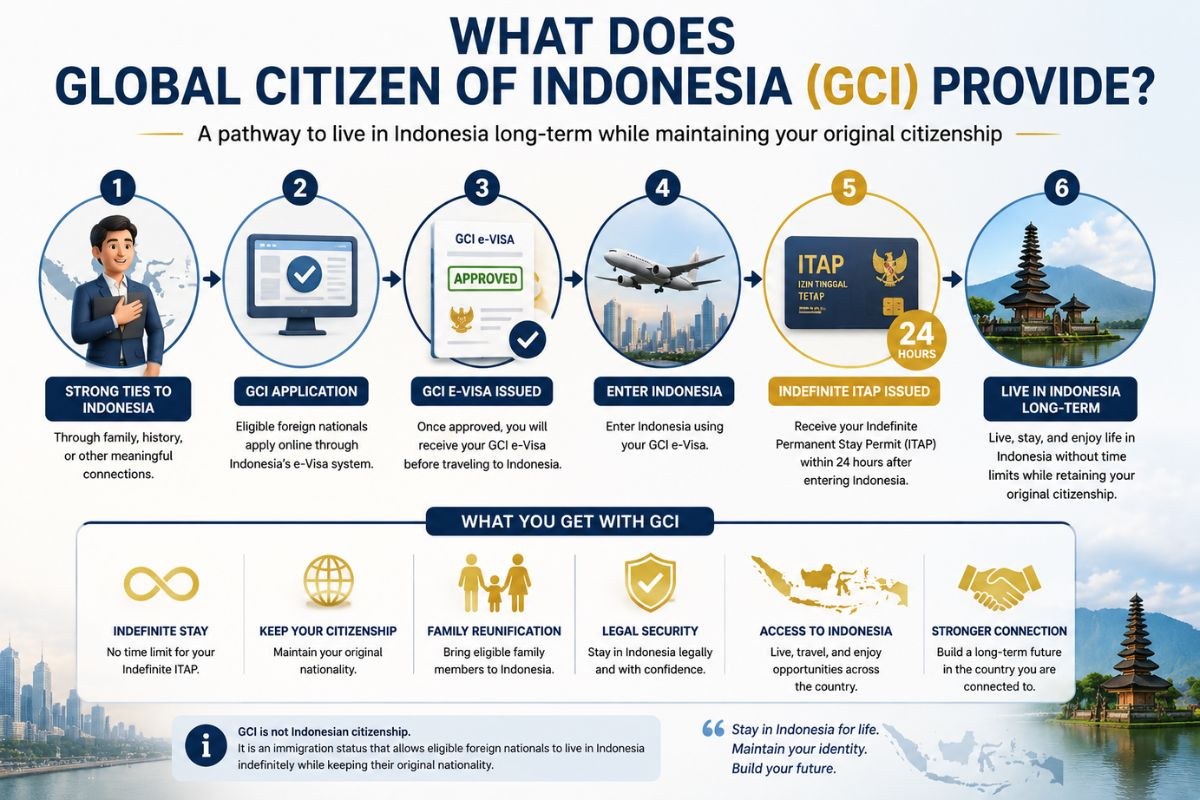
The process can therefore be summarized as:
Online GCI application
↓
GCI e-visa
↓
Enter Indonesia
↓
Indefinite ITAP issued within 24 hours
This should not be interpreted as meaning that the entire GCI application is always completed within 24 hours. The 24-hour period specifically refers to the issuance of the ITAP after the eligible GCI e-visa holder enters Indonesia.
Family Reunification Without an Immigration Guarantee
GCI also provides an important benefit for certain family-reunification applicants.
Immigration confirms that the immigration guarantee requirement does not apply to GCI applicants under the family-reunification classification.
This includes:
- Legal spouses of Indonesian citizens;
- Children from mixed marriages; and
- Spouses of GCI holders.
This is particularly important for international families.
For example:
A foreigner legally married to an Indonesian citizen may apply through the applicable GCI family-reunification pathway without being required to provide the immigration guarantee that applies to certain other GCI categories.
This makes GCI particularly relevant to the WNI–WNA family and mixed-marriage community.
Different GCI Categories Have Different Requirements
GCI is not a single immigration pathway with exactly the same requirements for everyone.
The benefits and requirements can depend on the applicant’s GCI category.
For example, Immigration states that former Indonesian citizens and their descendants are subject to specific income and immigration-guarantee requirements, while family-reunification applicants are exempt from the immigration guarantee requirement.
Similarly, applicants applying under a special-skills pathway may require an invitation or statement of urgency from the central government as the guarantor.
Therefore, applicants should identify the appropriate GCI visa index before assuming that every GCI benefit or requirement applies to them in exactly the same way.
What GCI Does Not Automatically Provide
It is equally important to understand what should not be assumed from GCI.
Obtaining GCI does not automatically mean that the foreign national:
- becomes an Indonesian citizen;
- receives Indonesian citizenship;
- receives unrestricted employment rights;
- receives unrestricted business rights; or
- is exempt from Indonesian immigration regulations.
The specific rights and activities available to a GCI holder must be assessed according to the applicable immigration and sectoral regulations.
We will discuss these issues separately later in this guide, particularly in the sections covering citizenship, employment, business activities, and family reunification.
GCI Benefits at a Glance
| GCI Feature | What It Means |
| Indefinite ITAP | Eligible applicants can obtain permanent residence without a fixed expiry period |
| Original citizenship retained | GCI does not itself change the applicant’s nationality |
| Online application | Applications are submitted through the Indonesian e-visa system |
| Integrated border system | GCI e-visas are integrated with autogates and manual immigration inspection |
| ITAP after entry | Immigration states that ITAP is issued within 24 hours after entering Indonesia |
| No immigration guarantee for family reunification | Applies to eligible spouses, mixed-marriage children, and spouses of GCI holders |
| Digital process | Designed to reduce the need for physical Immigration Office visits |
These features are based on the official GCI information released by the Directorate General of Immigration in 2026.
GCI in Simple Terms
The easiest way to understand the main benefit of GCI is:
GCI gives eligible foreign nationals a pathway to live in Indonesia indefinitely without requiring them to change their existing citizenship.
For an eligible foreign spouse, former Indonesian citizen, descendant, or child of a mixed marriage, this can provide a much more stable long-term connection to Indonesia than a conventional temporary residence arrangement.
However, GCI remains an immigration status, not a citizenship status. The holder must continue to comply with Indonesian law and the obligations attached to their residence permit.
How Long Is the GCI Permanent Stay Permit Valid?
One of the most important features of the Global Citizen of Indonesia (GCI) program is that eligible applicants can receive an indefinite Permanent Stay Permit (ITAP).
Unlike a temporary residence permit that expires after a fixed period, an indefinite ITAP does not have a predetermined expiry date. This allows eligible GCI holders to maintain long-term residence in Indonesia without going through the ordinary cycle of renewing a fixed-duration stay permit.
The Directorate General of Immigration specifically describes GCI as a policy that grants an indefinite permanent residence permit to eligible foreign nationals with strong ties to Indonesia.
What Does “Indefinite” Mean?
In the context of GCI, indefinite means that the ITAP is not issued with a fixed end date in the same way as a temporary residence permit.
For example, a qualifying foreign spouse of an Indonesian citizen may obtain GCI and receive an indefinite ITAP, allowing them to remain in Indonesia on a permanent-residence basis.
However, indefinite does not mean that the holder is free from immigration obligations.
The holder must continue to comply with Indonesian immigration regulations and any reporting or administrative requirements applicable to their ITAP.
Is GCI the Same as Indonesian Citizenship?
No.
An indefinite ITAP gives the foreign national a permanent residence status in Indonesia. It does not automatically make the person an Indonesian citizen.
The distinction is:
GCI
→ Indonesian immigration residence status
Indonesian citizenship (WNI)
→ Indonesian nationality
The official GCI policy specifically states that the applicant’s original citizenship status is not changed.
Therefore, a foreign spouse who obtains GCI does not automatically lose their existing citizenship or become a WNI.
Does an Indefinite ITAP Need to Be Renewed?
The important distinction is between renewing the validity of the residence permit and fulfilling ongoing immigration obligations.
Because the GCI ITAP is indefinite, it is not designed to expire after a fixed number of years like a temporary residence permit.
However, GCI holders should still comply with the applicable reporting and administrative requirements imposed on holders of indefinite ITAP.
Foreign nationals should therefore not interpret “indefinite” as meaning that they can obtain the permit once and then completely ignore their immigration obligations.
What Happens If the GCI Holder Changes Their Immigration Status?
GCI is an immigration status rather than a citizenship status.
If a GCI holder later changes their immigration circumstances, they should verify the applicable rules before taking action.
For example, a GCI holder may need to consider the consequences of:
- changing to another residence category;
- ending their residence in Indonesia;
- acquiring Indonesian citizenship;
- changing their nationality; or
- other changes that affect their immigration status.
The appropriate procedure depends on the individual’s circumstances and the regulations in force at the time.
Is the GCI ITAP Permanent Even If the Holder Leaves Indonesia?
The fact that GCI provides an indefinite ITAP should not be interpreted as an unlimited right to remain outside Indonesia without complying with Indonesian immigration requirements.
Travel outside Indonesia, re-entry, reporting obligations, and other matters remain subject to the applicable immigration rules.
GCI holders should therefore check the current requirements before making long-term plans to live outside Indonesia.
How Long Is GCI in Simple Terms?
The simplest way to understand it is:
GCI e-Visa
↓
Enter Indonesia
↓
Indefinite ITAP
↓
No fixed expiry date
↓
Continue complying with Indonesian immigration obligations
The Directorate General of Immigration states that GCI e-visa holders receive the indefinite ITAP within 24 hours after entering Indonesia, without needing to visit an Immigration Office.
Importantly, this 24-hour period refers to the issuance of the ITAP after entry, not necessarily the entire GCI application process.
2026 Takeaway
For eligible foreign nationals, GCI represents a significant change in Indonesia’s long-term residence framework.
Instead of receiving another fixed-duration residence permit, an eligible GCI applicant can obtain an indefinite ITAP while retaining their original citizenship.
However:
Permanent residence is not the same as citizenship.
GCI provides a long-term immigration status, while Indonesian citizenship remains governed by Indonesia’s separate nationality laws.
How Does the GCI Application Process Work?
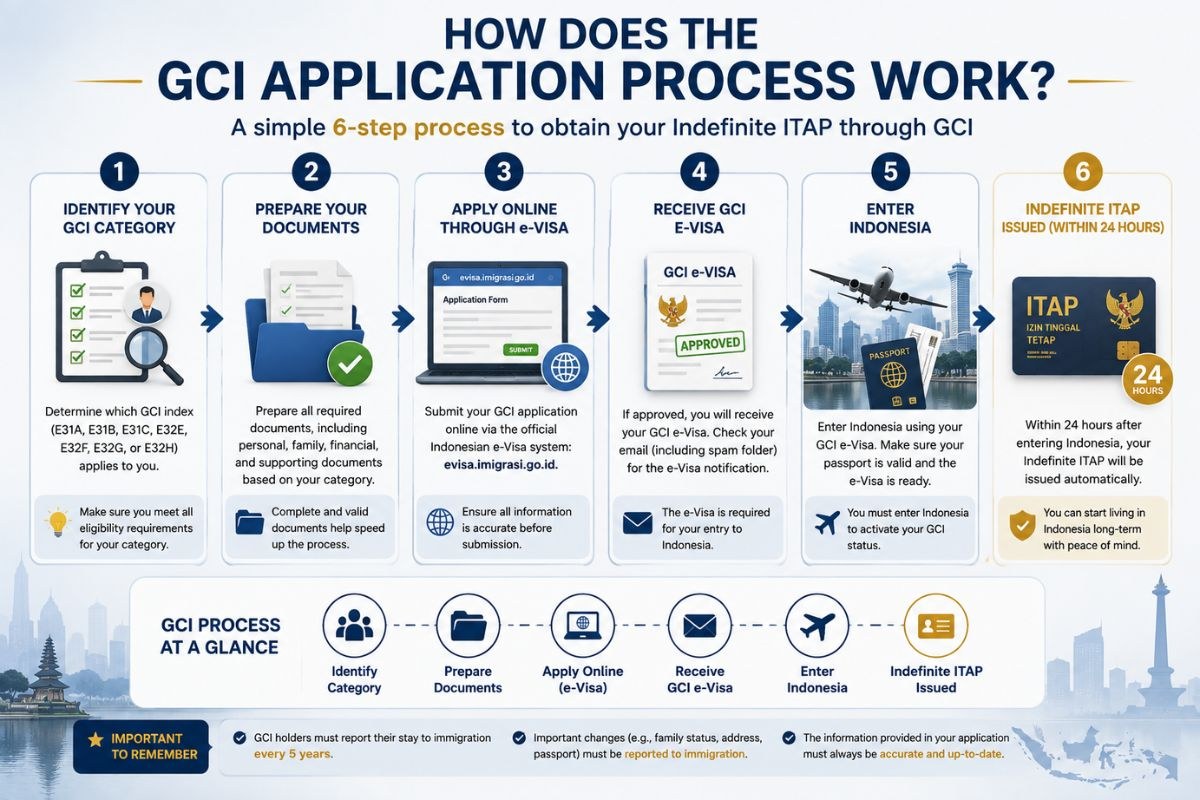
The Global Citizen of Indonesia (GCI) application is designed as an online immigration process.
Eligible applicants submit their application through Indonesia’s official electronic visa system rather than starting the process by visiting an Immigration Office in person.
The official application platform is:
Immigration describes GCI as an integrated process in which the applicant applies for the relevant GCI e-visa, enters Indonesia, and then receives an indefinite Permanent Stay Permit (ITAP) after arrival.
Step 1 — Identify the Correct GCI Category
The first step is determining which GCI visa index applies to the applicant.
The available categories include:
- E31A — Spouse of an Indonesian Citizen
- E31B — Spouse of an ITAS/ITAP holder
- E31C — Child of a mixed marriage
- E32E — Former Indonesian Citizen
- E32F — Former Indonesian Citizen with Special Skills
- E32G — Descendant of a Former Indonesian Citizen up to the Second Degree
- E32H — Descendant of a Former Indonesian Citizen up to the Second Degree with Special Skills
The correct category is important because the supporting requirements can differ depending on the applicant’s relationship or connection to Indonesia.
Applicants should therefore determine the applicable GCI index before preparing the application.
Step 2 — Prepare the Required Supporting Documents
Once the appropriate GCI category has been identified, the applicant should prepare the supporting documentation required for that category.
The documents can vary depending on the applicant.
For example, a foreign spouse applying through E31A will have a different basis for the application from a former Indonesian citizen applying through E32E.
Similarly, a child of a mixed marriage applying through E31C will need to establish the relevant family relationship.
Applicants should use the current requirements displayed in the official immigration system for their specific GCI index rather than relying on a generic document checklist found online.
This is particularly important because GCI is a relatively new immigration program and requirements can be updated.
Step 3 — Submit the Application Online
The GCI application is submitted electronically through:
evisa.imigrasi.go.id
The November 2025 Immigration announcement described GCI as an all-in-one online process, while the January 2026 official inauguration confirmed the electronic visa-based application and subsequent ITAP issuance after entry into Indonesia.
Applicants should carefully enter their personal information and upload the required documents according to the applicable GCI category.
Any discrepancy between the applicant’s passport, supporting documents, and application information can potentially cause additional verification or delays.
Step 4 — Receive the GCI E-Visa
After the application has been approved, the applicant receives the applicable GCI e-visa.
The e-visa is the document that allows the applicant to enter Indonesia under the relevant GCI pathway.
It is important to understand that:
The GCI e-visa and the indefinite ITAP are connected stages of the process, but they are not the same document.
The e-visa facilitates entry into Indonesia, while the ITAP is the permanent stay permit issued after the eligible holder enters Indonesia.
Step 5 — Enter Indonesia
After receiving the GCI e-visa, the applicant enters Indonesia using the approved visa.
Immigration has stated that GCI e-visa holders can use Indonesia’s immigration inspection system, including autogates and manual immigration counters, subject to the applicable requirements.
Applicants who intend to use the autogate system should also complete the required All Indonesia Arrival Declaration before arrival.
Step 6 — Receive the Indefinite ITAP
This is one of the most significant features of the GCI system.
According to the Directorate General of Immigration, within 24 hours after entering Indonesia, a GCI e-visa holder will receive an indefinite ITAP without needing to visit an Immigration Office.
The simplified process can therefore be illustrated as:
Online GCI application
↓
GCI e-visa approval
↓
Enter Indonesia
↓
Indefinite ITAP issued within 24 hours
This is different from saying:
“The entire GCI application takes 24 hours.”
The official 24-hour statement specifically concerns the issuance of the ITAP after the GCI e-visa holder enters Indonesia.
Step 7 — Continue to Comply With ITAP Obligations
Obtaining an indefinite ITAP does not mean that the applicant has no further immigration responsibilities.
The foreign national remains subject to Indonesian immigration regulations and must comply with the obligations applicable to their ITAP.
This can include matters relating to:
- reporting;
- address changes;
- passport changes;
- immigration status;
- re-entry permissions; and
- other changes affecting the foreign national’s residence in Indonesia.
For example, Indonesian Immigration continues to provide separate procedures for matters such as passport changes, address changes, ITAP administration, and Multiple Re-Entry Permits.
Therefore, GCI should be understood as a long-term immigration status, not as the end of all immigration administration.
GCI Application Process at a Glance
| Stage | What Happens |
| 1. Identify category | Determine the correct GCI visa index |
| 2. Prepare documents | Prepare requirements for the selected category |
| 3. Apply online | Submit through the Indonesian e-visa system |
| 4. Receive GCI e-visa | Obtain the approved electronic visa |
| 5. Enter Indonesia | Enter Indonesia using the GCI e-visa |
| 6. ITAP issuance | Indefinite ITAP is issued within 24 hours after entry |
| 7. Maintain status | Continue complying with Indonesian immigration obligations |
Do You Need to Visit an Immigration Office?
For the initial GCI process, Immigration has specifically stated that the applicant does not need to visit an Immigration Office to receive the indefinite ITAP after entering Indonesia. The ITAP is issued through the integrated process.
However, this should not be interpreted as meaning that a GCI holder will never need to deal with Immigration for any future matter.
Certain administrative events may still require an application or update through the immigration system or the relevant Immigration Office.
Is the GCI Process the Same for Everyone?
No.
The overall online structure is similar, but the requirements depend on the GCI category.
For example:
E31A
→ foreign spouse of Indonesian citizen
E31C
→ child of mixed marriage
E32E
→ former Indonesian citizen
E32G
→ descendant of former Indonesian citizen
Each applicant should therefore start by identifying the correct visa index rather than using another applicant’s checklist.
Important 2026 Note
GCI is a relatively new Indonesian immigration pathway. The official information available in 2026 provides the overall structure of the application and the post-arrival ITAP process, but applicants should always check the current requirements displayed by Indonesian Immigration for the specific GCI visa index before submitting an application.
Do not rely solely on older articles published when GCI was first announced in November 2025, because the program has continued to be implemented and socialized during 2026.
What Are the GCI Visa Indexes?
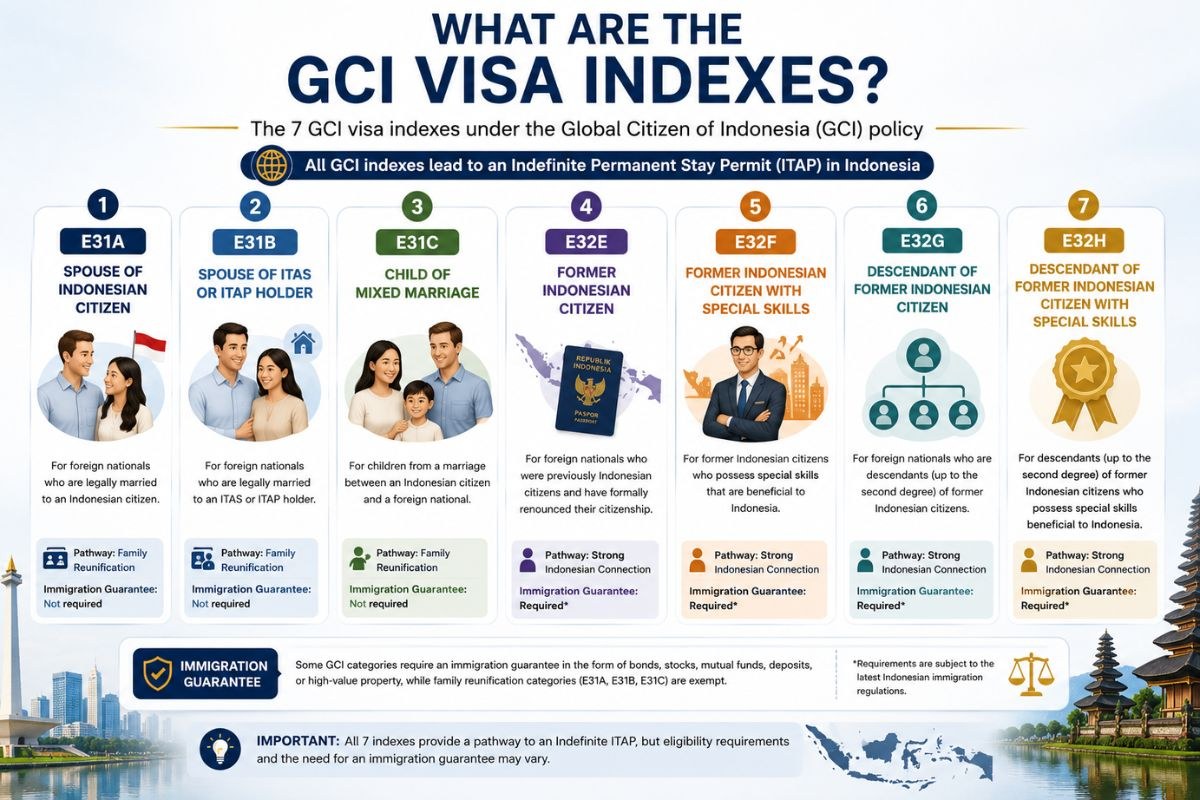
The Global Citizen of Indonesia (GCI) program is not a single visa category with identical requirements for every applicant.
Indonesia uses different visa indexes within the GCI framework depending on the applicant’s relationship or connection to Indonesia.
The current GCI visa indexes published by Indonesian Immigration are:
| GCI Visa Index | Main Category |
| E31A | Spouse of an Indonesian Citizen |
| E31B | Spouse of an ITAS or ITAP holder |
| E31C | Child of a mixed marriage |
| E32E | Former Indonesian Citizen |
| E32F | Former Indonesian Citizen with Special Skills |
| E32G | Descendant of a Former Indonesian Citizen up to the Second Degree |
| E32H | Descendant of a Former Indonesian Citizen up to the Second Degree with Special Skills |
These seven indexes are part of the GCI framework currently published by Indonesian Immigration.
E31A — Spouse of an Indonesian Citizen
E31A is the GCI visa index for a foreign national who joins their Indonesian citizen spouse.
This is particularly relevant to WNI–WNA couples who want the foreign spouse to establish long-term residence in Indonesia.
For example:
An Australian citizen is legally married to an Indonesian citizen and wants to make Indonesia their permanent home.
The foreign spouse may apply under the applicable E31A GCI pathway, provided the applicant satisfies the requirements.
One important benefit for family-reunification applicants is that the immigration guarantee requirement does not apply to eligible applicants under this category.
E31B — Spouse of an ITAS or ITAP Holder
E31B is intended for a foreign national who joins a spouse who holds an Indonesian ITAS or ITAP.
This category is different from E31A because the principal family relationship is connected to the spouse’s Indonesian residence permit rather than specifically to Indonesian citizenship.
The applicant must still satisfy the applicable GCI requirements for the E31B category.
E31C — Child of a Mixed Marriage
E31C applies to a child born from a legal marriage between an Indonesian citizen and a foreign national.
This category is particularly relevant to families dealing with mixed-marriage citizenship and immigration issues.
An important distinction is that:
E31C is an immigration pathway. It does not itself determine the child’s Indonesian citizenship.
The child’s nationality remains governed by Indonesia’s citizenship laws and the laws applicable to the foreign parent’s nationality.
Therefore, parents should not treat GCI and Indonesian citizenship as the same legal matter.
E32E — Former Indonesian Citizen
E32E is the GCI category for a former Indonesian citizen (ex-WNI).
This provides a pathway for people who previously held Indonesian citizenship but are now foreign nationals and want to return to Indonesia for long-term residence.
The GCI framework allows eligible former Indonesian citizens to obtain an indefinite ITAP while retaining their current foreign citizenship.
This category is particularly relevant to the Indonesian diaspora.
E32F — Former Indonesian Citizen With Special Skills
E32F is designed for a former Indonesian citizen who qualifies under the special-skills pathway.
The special-skills category is different from the standard former-WNI pathway.
Immigration states that applicants under the special-skills route require an invitation letter or statement of urgency from the central government, which serves as the guarantor.
This reflects the government’s intention to attract individuals whose skills may provide a particular contribution to Indonesia.
E32G — Descendant of a Former Indonesian Citizen
E32G is the GCI pathway for descendants of former Indonesian citizens up to the second degree.
This category can be relevant to members of the Indonesian diaspora who have never personally held Indonesian citizenship but can establish the qualifying family relationship.
The key point is that the applicant’s Indonesian connection is established through ancestry rather than through their own previous Indonesian citizenship.
E32H — Descendant of a Former Indonesian Citizen With Special Skills
E32H combines two elements:
- A qualifying descent from a former Indonesian citizen up to the second degree; and
- The applicable special-skills qualification.
It is therefore distinct from the standard E32G descendant pathway.
Applicants should establish both the qualifying family relationship and the requirements applicable to the special-skills category.
GCI Visa Indexes at a Glance
For easier reference:
E31A
→ Foreign spouse of an Indonesian citizen
E31B
→ Foreign spouse of an ITAS/ITAP holder
E31C
→ Child of an Indonesian–foreign mixed marriage
E32E
→ Former Indonesian citizen
E32F
→ Former Indonesian citizen with special skills
E32G
→ Descendant of former Indonesian citizen up to second degree
E32H
→ Descendant of former Indonesian citizen up to second degree with special skills
Which GCI Visa Index Is Relevant to You?
The simplest way to identify the appropriate category is to start with your relationship to Indonesia.
If you are married to an Indonesian citizen
→ E31A
If your spouse holds an Indonesian ITAS or ITAP
→ E31B
If you are a child from an Indonesian–foreign mixed marriage
→ E31C
If you previously held Indonesian citizenship
→ E32E
If you previously held Indonesian citizenship and qualify under the special-skills route
→ E32F
If you are a descendant of a former Indonesian citizen up to the second degree
→ E32G
If you are a qualifying descendant and also meet the special-skills criteria
→ E32H
This category-first approach is important because the supporting requirements are not necessarily identical across all GCI indexes.
GCI Visa Index vs Indonesian Citizenship
The GCI visa index should not be confused with nationality.
For example:
E31A
does not mean:
“The foreign spouse becomes Indonesian.”
Instead:
E31A
→ GCI immigration pathway
→ indefinite ITAP
while:
WNI
→ Indonesian citizenship
The same principle applies to E31C.
A child of a mixed marriage may have Indonesian citizenship under the applicable nationality law while separately having an immigration status under the GCI framework.
Why the GCI Visa Index Matters
Identifying the correct GCI index is one of the first things an applicant should do before preparing an application.
Choosing the wrong category can lead to:
- incorrect supporting documents;
- an application based on the wrong relationship;
- additional verification; or
- delays in processing.
For this reason, applicants should not simply copy another person’s GCI document checklist.
An E31A spouse application, for example, is fundamentally different from an E32E former-WNI application.
The safest approach is to identify the correct GCI index first and then check the current requirements for that specific category through the official Indonesian Immigration system.
2026 Update: Seven GCI Visa Indexes
As of the latest official information available in 2026, the GCI framework includes seven visa indexes:
E31A, E31B, E31C, E32E, E32F, E32G, and E32H.
These categories cover family relationships, mixed-marriage children, former Indonesian citizens, Indonesian ancestry, and special-skills pathways.
Because GCI is a relatively new immigration policy, applicants should always verify the current category and requirements through the official Immigration system before submitting an application.
GCI for Spouses of Indonesian Citizens

One of the most important GCI pathways for international families is the route available to a foreign spouse of an Indonesian citizen.
Under Indonesia’s GCI framework, a foreign national who is legally married to an Indonesian citizen can apply through the E31A GCI visa category, subject to the applicable requirements.
This is particularly relevant for couples in a WNI–WNA marriage who want the foreign spouse to establish a long-term or permanent life in Indonesia.
The GCI framework provides an indefinite Permanent Stay Permit (ITAP) for eligible applicants while allowing the foreign spouse to retain their existing citizenship.
Who Can Use the E31A GCI Pathway?
The E31A category is intended for a foreign national who has a qualifying marriage relationship with an Indonesian citizen.
In practical terms, this means the applicant must be able to establish the legal marriage relationship with the Indonesian spouse and satisfy the requirements applicable to the E31A category.
For example:
A British citizen legally marries an Indonesian citizen and wants to make Indonesia their permanent home.
If the foreign spouse meets the applicable GCI requirements, E31A is the relevant GCI pathway to examine.
The foreign spouse does not become an Indonesian citizen simply by obtaining E31A or GCI.
Instead:
Legal marriage to WNI
↓
E31A GCI application
↓
GCI e-visa
↓
Enter Indonesia
↓
Indefinite ITAP
The applicant’s original citizenship remains separate from their Indonesian immigration status.
Does the Foreign Spouse Need to Give Up Their Citizenship?
No.
One of the central features of GCI is that obtaining the residence facility does not change the applicant’s original citizenship status.
This is particularly important for foreign spouses who want to live permanently in Indonesia but do not want residence in Indonesia to require them to become Indonesian citizens.
GCI should therefore be understood as a permanent residence pathway, not a citizenship program.
Is an Immigration Guarantee Required for the Foreign Spouse?
For eligible applicants under the family-reunification pathway, Immigration states that the immigration guarantee requirement does not apply.
The family-reunification category includes:
- legal spouses of Indonesian citizens;
- children from mixed marriages; and
- spouses of GCI holders.
This is an important distinction because some other GCI categories, particularly those involving former Indonesian citizens and their descendants, have separate requirements involving income and immigration guarantees.
Therefore, a foreign spouse should not assume that the financial requirements applicable to an E32E or E32G applicant also apply in the same way to E31A.
Is E31A the Same as the Ordinary Spouse Visa?
Not exactly.
A foreign spouse of an Indonesian citizen may encounter different immigration pathways depending on their circumstances.
The important distinction is that E31A is the GCI pathway, designed to provide an indefinite ITAP for eligible applicants.
GCI therefore represents a different long-term residence framework from an ordinary temporary family-based residence arrangement.
For couples considering their long-term immigration strategy, it is important to determine which pathway is appropriate rather than assuming that every foreign spouse should use the same visa category.
What About a Spouse Who Is Already in Indonesia?
A foreign spouse who is already in Indonesia should not assume that they can simply change any existing immigration status into GCI without checking the applicable procedure.
The GCI application is structured around the relevant GCI e-visa, and Immigration states that GCI applications are submitted online through the electronic visa system.
Therefore, the foreign spouse should first determine:
- their current immigration status;
- whether they qualify for E31A;
- whether an application from their current location/status is permitted; and
- what procedure is currently displayed in the official e-visa system.
This distinction is important because being married to a WNI does not automatically convert an existing visa into GCI.
What Documents Are Needed for E31A?
The exact supporting documents should be checked against the current E31A requirements in the official Immigration system.
At a minimum, the applicant should be prepared to establish the underlying family relationship, including the legal marriage to the Indonesian citizen.
Depending on the applicant’s circumstances, Immigration may require supporting documents relating to:
- the foreign spouse’s identity;
- the Indonesian spouse’s identity;
- the legal marriage;
- passport information; and
- other documents specified for the E31A application.
Because GCI is a relatively new program, applicants should use the current official checklist rather than relying on an old spouse-visa checklist or another applicant’s documents.
What Happens After the Foreign Spouse Enters Indonesia?
According to Immigration’s 2026 GCI announcement, the GCI e-visa is integrated with Indonesia’s border-crossing system.
After the foreign spouse enters Indonesia using the approved GCI e-visa, the indefinite ITAP is issued within 24 hours, and the applicant does not need to visit an Immigration Office for that issuance.
The process can therefore be summarized as:
E31A application
→ GCI e-visa
→ Enter Indonesia
→ Indefinite ITAP
The 24-hour statement refers specifically to ITAP issuance after entry, not necessarily the entire E31A application process.
Does Marriage Automatically Give the Foreign Spouse GCI?
No.
Marriage to an Indonesian citizen creates the family relationship that may make the foreign national eligible for the E31A GCI pathway, but the foreign spouse must still complete the applicable immigration application process.
In other words:
Marriage creates eligibility; it does not automatically issue GCI.
The foreign spouse must still apply through the appropriate immigration system and satisfy the applicable requirements.
What About Divorce After Obtaining GCI?
This is an area where applicants should be careful.
Because E31A is based on a qualifying family relationship, a change in that relationship may affect the foreign national’s immigration circumstances.
A divorce does not mean that every immigration consequence is automatically the same for every person. The applicable rules depend on the individual’s status, circumstances, and current immigration regulations.
Therefore, a GCI holder who divorces their Indonesian spouse should obtain a specific immigration assessment rather than assuming that their status will automatically continue unchanged or automatically terminate.
GCI and the WNI–WNA Marriage Journey
For a foreign spouse, the overall journey may look like this:
Marriage legally registered in Indonesia or recognized under applicable Indonesian rules
↓
Foreign spouse qualifies for family-based immigration
↓
E31A GCI application
↓
GCI e-visa
↓
Entry into Indonesia
↓
Indefinite ITAP
↓
Long-term residence in Indonesia
The important point is that marriage, immigration residence, and citizenship are three separate legal matters.
A marriage does not automatically make the foreign spouse Indonesian, and GCI does not automatically change their nationality.
Why E31A Is Important for Mixed-Marriage Families
E31A is particularly relevant to the readers of this article because many people discover GCI only after researching marriage or spouse immigration options in Indonesia.
A foreigner may first search for:
“How can I marry an Indonesian?”
Then:
“Can I stay in Indonesia after marriage?”
And eventually:
“Can my Indonesian spouse sponsor my permanent residence?”
GCI provides an additional long-term residence pathway for eligible foreign spouses through E31A.
This is why foreign spouses should understand GCI as part of their broader long-term immigration planning rather than viewing marriage and immigration as completely separate subjects.
2026 Takeaway for Foreign Spouses
For a foreign national legally married to an Indonesian citizen:
E31A
→ GCI pathway for spouse of WNI
GCI
→ indefinite ITAP for eligible applicants
Original citizenship
→ remains unchanged by GCI
Immigration guarantee
→ not required for eligible family-reunification applicants
Application
→ submitted online through the Indonesian e-visa system
After entry
→ ITAP issued within 24 hours according to Immigration’s 2026 announcement.
For couples planning to marry or already married, however, the exact eligibility and current document requirements should always be checked against the latest official Immigration system.
GCI for Children of Mixed Marriages

The Global Citizen of Indonesia (GCI) program is also relevant to children born from a legal marriage between an Indonesian citizen and a foreign national.
Under the GCI framework, these children may qualify through the E31C visa category.
This is particularly important for families with children who have a connection to both Indonesia and another country. However, it is essential to understand that GCI immigration status and Indonesian citizenship are two different legal matters.
A child may have rights or obligations under Indonesian nationality law while separately holding an immigration status under the GCI framework.
What Is E31C?
E31C is the GCI visa category for a child born from a legally recognized marriage between a foreign national and an Indonesian citizen.
Indonesian Immigration specifically lists:
Anak hasil perkawinan sah antara Orang Asing dengan WNI (E31C)
as one of the GCI categories.
In English, this can be understood as:
Child of a legal marriage between a foreign national and an Indonesian citizen.
The E31C pathway allows an eligible child to obtain the GCI residence facility while the child’s nationality remains governed separately under Indonesian citizenship law.
Does E31C Automatically Make the Child an Indonesian Citizen?
No.
This is one of the most important points for parents to understand.
E31C is an immigration category.
It does not itself grant Indonesian citizenship.
The distinction is:
E31C GCI
→ immigration/residence pathway
Indonesian citizenship
→ nationality status governed by Indonesian citizenship law
Therefore, parents should not assume that obtaining E31C automatically determines whether their child is Indonesian, a dual national, or a foreign national.
The child’s citizenship must be assessed separately based on the applicable nationality rules.
Can a Child of Mixed Marriage Have Indonesian Citizenship?
Potentially, yes.
Indonesia has specific nationality rules governing children born from mixed marriages. Depending on the circumstances, a child may have Indonesian citizenship and, in certain cases, limited dual-nationality status during childhood.
However, the citizenship question should not be confused with GCI.
For example:
A child born to an Indonesian mother and a foreign father may have a legal connection to Indonesian citizenship under Indonesian nationality law. The child may also fall within the E31C GCI framework.
The two questions are separate:
Question 1: What is the child’s citizenship?
Question 2: What immigration status does the child hold or need?
Parents should therefore assess both matters separately.
Why Is E31C Important for Mixed-Marriage Families?
Mixed-marriage families can sometimes have complicated immigration and nationality situations.
For example, a child may:
- have an Indonesian parent;
- have a foreign parent;
- hold or potentially hold more than one nationality during childhood;
- live outside Indonesia;
- later move to Indonesia; or
- need Indonesian immigration documentation for long-term residence.
The E31C GCI pathway provides an immigration framework for eligible children of mixed marriages.
This is particularly useful for families who want their child to maintain a long-term connection with Indonesia without treating residence status as the same thing as citizenship.
Does E31C Change the Child’s Existing Citizenship?
No.
The official GCI policy states that GCI provides permanent residence without changing the applicant’s original citizenship status.
Therefore, obtaining E31C should not be understood as a process of:
foreign citizenship → Indonesian citizenship
Instead, it is:
existing citizenship status → GCI immigration residence pathway
This distinction is particularly important for children of mixed marriages because their nationality may already be subject to specific rules under Indonesian citizenship law.
Is E31C the Same as an Indonesian Passport?
No.
An Indonesian passport is evidence of Indonesian citizenship and is fundamentally different from an immigration visa or stay permit.
E31C is part of Indonesia’s immigration system.
An Indonesian passport is part of Indonesia’s nationality system.
Therefore:
E31C ≠ Indonesian passport
and:
GCI ≠ Indonesian citizenship
Parents should determine the child’s nationality status first and then establish which immigration documents are required based on the child’s actual circumstances.
What Happens If the Child Already Has Indonesian Citizenship?
If a child is already an Indonesian citizen, the family should not assume that the child needs GCI simply because one parent is a foreign national.
Indonesian citizens generally have a different legal position from foreign nationals under immigration law.
The appropriate documentation will depend on the child’s citizenship status, travel documents, residence circumstances, and the applicable Indonesian regulations.
For families dealing with mixed-nationality children, this is one of the reasons it is important to distinguish:
citizenship
from
immigration residence.
What If the Child Has Limited Dual Citizenship?
Some children of mixed marriages can have a period of limited dual citizenship under Indonesian nationality law.
This is a separate legal framework from GCI.
Parents should therefore keep track of:
- the child’s nationality status;
- Indonesian citizenship registration;
- foreign citizenship documentation;
- Indonesian passport or travel documentation, where applicable;
- immigration status in Indonesia; and
- the obligations that arise when the child reaches the relevant age under Indonesian nationality law.
GCI does not replace these nationality procedures.
Does E31C Have an Immigration Guarantee Requirement?
Immigration has specifically stated that the immigration guarantee requirement does not apply to GCI applicants under the family-reunification classification.
This includes:
- legal spouses of Indonesian citizens;
- children of mixed marriages; and
- spouses of GCI holders.
Therefore, an eligible child applying under E31C does not have to satisfy the immigration-guarantee requirement that applies to certain other GCI categories.
This is an important difference between E31C and some of the GCI pathways for former Indonesian citizens or descendants of former Indonesian citizens.
What Happens After the E31C GCI Visa Is Approved?
The overall process follows the integrated GCI framework.
E31C application
↓
GCI e-visa
↓
Child enters Indonesia
↓
Indefinite ITAP issued within 24 hours
Immigration states that GCI e-visa holders receive the indefinite ITAP within 24 hours after entering Indonesia, without needing to visit an Immigration Office.
Again, this should not be interpreted as saying that every E31C application is approved within 24 hours.
The 24-hour period refers to the ITAP issuance after entry into Indonesia.
What If the Child Lives Outside Indonesia?
A child of a mixed marriage does not necessarily need to live in Indonesia simply because the child has an Indonesian parent.
The appropriate immigration and citizenship arrangements depend on the family’s circumstances.
If the family intends to relocate the child to Indonesia for long-term residence, the parents should determine whether E31C GCI or another immigration/citizenship pathway is appropriate.
This is especially important when the child already holds Indonesian citizenship or has limited dual citizenship.
GCI and Mixed-Marriage Citizenship Are Not the Same Thing
For parents, the easiest way to understand the relationship is:
Mixed marriage
→ creates a family relationship between WNI and WNA
↓
Child is born
↓
Citizenship is determined under nationality law
↓
Immigration status is assessed separately
↓
E31C may be relevant if the child qualifies under the GCI framework
This prevents one of the most common misunderstandings:
A GCI visa is not a substitute for citizenship registration.
E31C vs Indonesian Citizenship
| Issue | E31C GCI | Indonesian Citizenship |
| Legal system | Immigration | Nationality |
| Main purpose | Residence in Indonesia | Citizenship status |
| Does it automatically make the child WNI? | No | N/A |
| Can it change existing citizenship? | No | Governed by nationality law |
| Permanent residence | Yes, if eligible | Not an immigration permit |
| Relevant to mixed-marriage children | Yes | Yes |
This distinction is particularly important for parents who are simultaneously dealing with Indonesian citizenship registration, passports, affidavit matters, and immigration residence.
Parents Should Plan Citizenship and Immigration Separately
For a mixed-marriage family, the best approach is to treat these as two separate planning questions.
First:
What is my child’s citizenship status?
Second:
What immigration status does my child need to live in Indonesia?
Only after answering those questions should the family determine whether E31C GCI is appropriate.
This is especially important for children who have lived overseas for many years or who have more than one nationality.
2026 Takeaway for Mixed-Marriage Families
For children of a legal Indonesian–foreign marriage:
E31C
→ GCI pathway specifically listed for children of mixed marriages
GCI
→ provides an immigration residence pathway
Indonesian citizenship
→ governed separately by nationality law
Immigration guarantee
→ not required for eligible family-reunification applicants
Indefinite ITAP
→ available under the GCI framework for eligible applicants
The key message for parents is simple:
Do not treat GCI, Indonesian citizenship, dual citizenship, passport status, and affidavit matters as the same thing.
Each serves a different legal purpose.
What Are the Income and Investment Requirements?
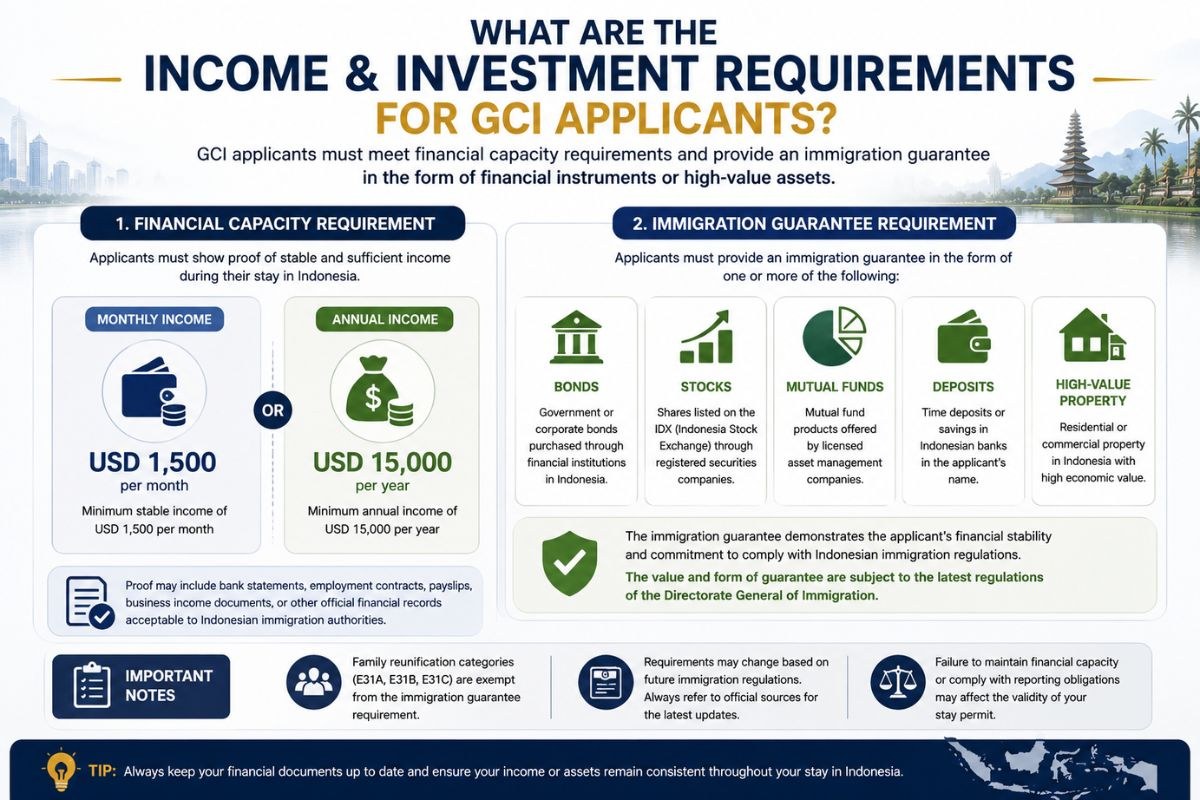
The financial requirements for Global Citizen of Indonesia (GCI) are not the same for every applicant.
In particular, Indonesian Immigration has identified specific income and immigration-guarantee requirements for former Indonesian citizens and their descendants. By contrast, applicants under the family reunification pathway are not subject to the immigration guarantee requirement.
This distinction is important because a foreign spouse of an Indonesian citizen should not assume that the financial requirements applicable to a former WNI or Indonesian descendant automatically apply to them.
Minimum Income Requirement for Former Indonesian Citizens and Their Descendants
For former Indonesian citizens and their descendants, Immigration has announced a minimum income requirement of approximately:
USD 1,500 per month
or
USD 15,000 per year
This requirement forms part of the special conditions announced for these GCI categories.
Applicants should understand that these figures are presented by Immigration as part of the requirements for the relevant GCI categories, rather than as a universal income threshold for every person applying for GCI.
Does Every GCI Applicant Need to Show USD 1,500 per Month?
No.
This is an important distinction.
The income requirement specifically relates to the categories for which Immigration has announced these financial conditions, particularly former Indonesian citizens and their descendants.
It should not automatically be applied to:
- foreign spouses of Indonesian citizens;
- children of mixed marriages; or
- spouses of GCI holders
when they apply under the applicable family-reunification pathway.
For those family-reunification categories, Immigration has stated that the immigration guarantee requirement does not apply.
Therefore, applicants should always determine their GCI visa index first before assessing which financial requirements apply.
What Is the Immigration Guarantee?
For certain GCI categories, Immigration requires an immigration guarantee.
The official 2026 announcement explains that this guarantee can take the form of an investment commitment, including assets such as:
- bonds;
- stocks;
- mutual funds;
- deposits; or
- high-value property.
The applicable value depends on the GCI category.
This guarantee is different from simply showing that the applicant has enough money to support themselves.
In other words:
Income requirement
→ demonstrates the applicant’s financial capacity
while:
Immigration guarantee
→ is a separate financial guarantee required for certain GCI categories.
Can Property Be Used as an Immigration Guarantee?
For the relevant GCI categories, Immigration states that the immigration guarantee may include ownership of high-value property.
However, applicants should not assume that any property automatically qualifies.
The applicable property requirements, valuation, ownership structure, and other conditions should be checked against the current Immigration requirements for the applicant’s specific GCI category.
This is particularly important for foreign nationals because property ownership in Indonesia is subject to its own legal restrictions.
What Happens to the Immigration Guarantee?
The official Immigration announcement states that the immigration guarantees are refundable if the GCI holder decides to end their stay or change their residence permit status.
This means the guarantee should not be viewed simply as a permanent payment to the Indonesian government.
Instead, it functions as an immigration guarantee subject to the applicable rules.
The exact procedure for releasing or refunding the guarantee should be confirmed with Immigration when the applicant decides to terminate or change their GCI residence status.
Do Family-Reunification Applicants Need an Immigration Guarantee?
No, according to the official 2026 GCI policy.
Immigration specifically states that the immigration guarantee requirement does not apply to GCI applicants classified under family reunification.
This includes:
- Legal spouses of Indonesian citizens
- Children of mixed marriages
- Spouses of GCI holders
This is especially important for readers coming from our Marriage in Indonesia for Foreigners article.
For example:
A foreign national legally married to an Indonesian citizen applying through the applicable E31A family-reunification pathway is not subject to the immigration guarantee requirement that applies to certain other GCI categories.
What About Applicants With Special Skills?
Special-skills applicants are treated differently.
Immigration states that applicants under the special-skills pathway require an invitation letter or statement of urgency from the central government, with the government serving as the guarantor.
Therefore, their requirements should not be evaluated using the same framework as either:
- former WNI/descendant applicants; or
- family-reunification applicants.
The applicant’s specific GCI index determines the applicable requirements.
Financial Requirements by GCI Category
A simplified overview is:
| GCI Applicant Type | Income / Financial Requirement |
| Former Indonesian Citizen | Specific financial requirements, including approximately USD 1,500/month or USD 15,000/year |
| Descendant of Former Indonesian Citizen | Specific financial requirements, including approximately USD 1,500/month or USD 15,000/year |
| Family Reunification | No immigration guarantee requirement |
| Special Skills | Government invitation/statement of urgency and government guarantor |
The exact requirements should always be checked against the applicant’s specific GCI visa index and current Immigration system.
Why the GCI Visa Index Matters for Financial Requirements
This is one of the reasons we discussed the GCI visa indexes earlier in this guide.
Consider two applicants:
Applicant A
Former Indonesian citizen
→ E32E
→ subject to the applicable financial requirements for that category.
Applicant B
Foreign spouse of Indonesian citizen
→ E31A
→ family reunification
→ no immigration guarantee requirement.
Both applicants may qualify for GCI, but their financial requirements are not necessarily the same.
Therefore, it would be misleading to publish one universal statement such as:
“Everyone applying for GCI needs USD 1,500 per month and an investment guarantee.”
That is not what the official 2026 policy says.
Is USD 15,000 a Fee?
No.
The approximately USD 15,000 per year figure should not be described as an application fee.
It is part of the income requirement announced for the relevant GCI categories.
Similarly, an immigration guarantee should not automatically be described as a government fee.
The two concepts are different:
Income
→ financial qualification
Immigration guarantee
→ guarantee for certain GCI categories
Government fee
→ separate immigration application or service charge
Keeping these concepts separate helps prevent applicants from misunderstanding the actual cost of GCI.
What Should Applicants Prepare Financially?
Applicants in categories subject to financial requirements should be prepared to demonstrate their financial position according to the current Immigration requirements.
Depending on the applicable category, this may involve:
- evidence of the required income;
- documentation supporting the financial source;
- qualifying investment assets; or
- qualifying property.
However, applicants should not rely on a generic checklist because the applicable requirements can differ by GCI index.
2026 Takeaway
The most important point is:
GCI does not have one universal financial requirement for every applicant.
For the categories specifically identified by Immigration, former Indonesian citizens and their descendants may be subject to:
Approximately USD 1,500/month or USD 15,000/year
plus the applicable immigration guarantee requirements.
For family-reunification applicants, including eligible spouses of Indonesian citizens, children of mixed marriages, and spouses of GCI holders:
The immigration guarantee requirement does not apply.
This distinction is particularly important when comparing E31A/E31C family-based GCI applications with E32E/E32G ancestry-based applications.
GCI vs Golden Visa Indonesia
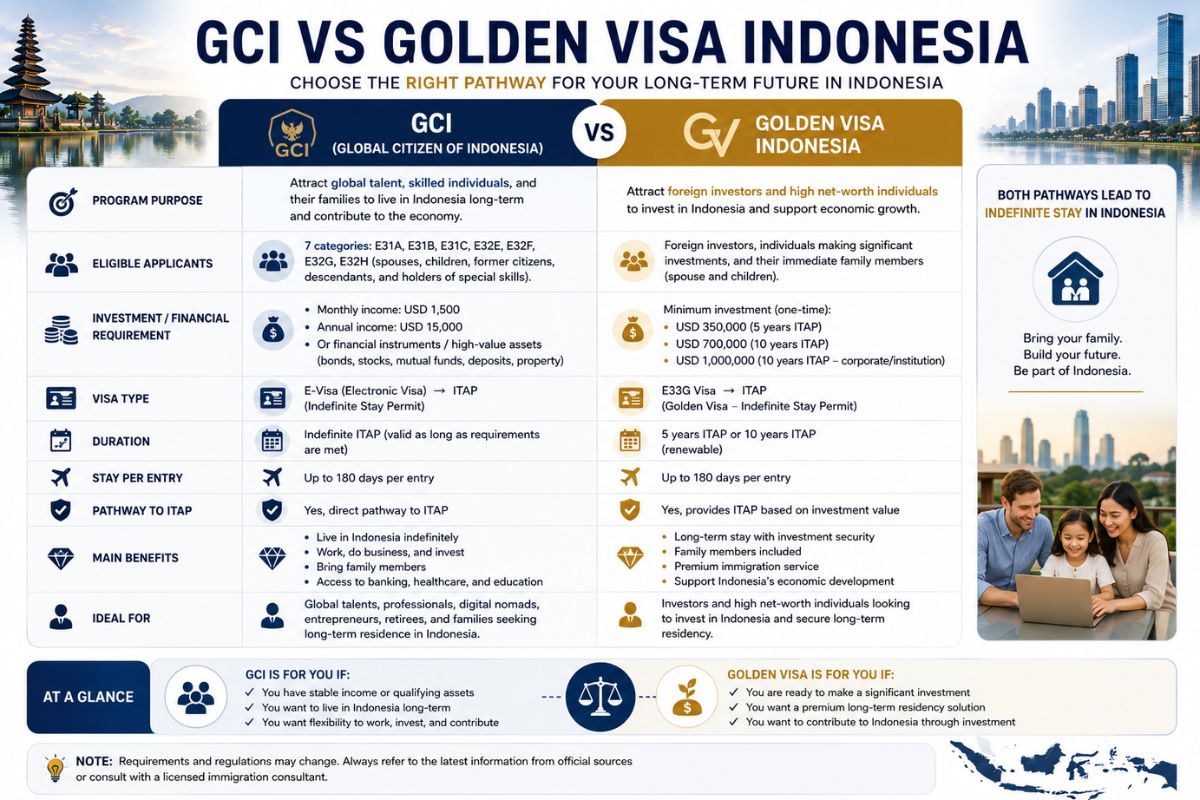
The Global Citizen of Indonesia (GCI) and Indonesia’s Golden Visa are both long-term immigration pathways, but they are designed for very different types of foreign nationals.
The biggest difference is simple:
GCI is primarily based on a person’s connection to Indonesia, while Golden Visa is primarily designed around investment, economic contribution, and other qualifying criteria.
GCI provides an indefinite Permanent Stay Permit (ITAP) to eligible foreign nationals with Indonesian blood ties, family relationships, historical connections, or other strong ties to Indonesia.
Golden Visa, on the other hand, is intended to attract foreign investors, entrepreneurs, highly skilled individuals, researchers, and other foreign nationals considered beneficial to Indonesia’s economy and development.
What Is the Main Difference Between GCI and Golden Visa?
The two programs can be understood as follows:
Global Citizen of Indonesia (GCI)
→ Based primarily on a qualifying connection to Indonesia
→ Designed for former WNI, descendants, spouses, mixed-marriage children, and certain family members
→ Provides an indefinite ITAP for eligible applicants
→ Does not change the applicant’s original citizenship
Golden Visa Indonesia
→ Based primarily on investment, professional qualifications, economic contribution, or other qualifying grounds
→ Designed to attract individuals who can contribute to Indonesia
→ Provides long-term residence according to the applicable Golden Visa category
→ Does not itself make the holder an Indonesian citizen
The official Immigration service currently lists both GCI and Golden Visa as separate immigration facilities.
Who Is GCI Designed For?
GCI is specifically relevant to foreign nationals who already have a meaningful connection to Indonesia.
The officially identified groups include:
- Former Indonesian citizens;
- Descendants of former Indonesian citizens up to the second degree;
- Legal spouses of Indonesian citizens;
- Children from mixed marriages; and
- Certain family members through family reunification.
For these applicants, the reason for applying is generally their connection to Indonesia, rather than simply their ability or willingness to make an investment.
For example:
A foreign national married to an Indonesian citizen may have a strong reason to live permanently in Indonesia even without making a qualifying investment.
This is exactly the type of situation for which the GCI framework can be relevant.
Who Is Golden Visa Designed For?
Golden Visa is aimed at attracting foreign nationals who can provide an economic, investment, professional, or strategic contribution to Indonesia.
Depending on the applicable category, this can include:
- Investors;
- Corporate investors;
- Entrepreneurs;
- Highly skilled individuals;
- Researchers;
- Individuals with specific professional or strategic qualifications; and
- Other qualifying foreign nationals.
The key difference is that a person generally does not need Indonesian ancestry or an Indonesian spouse simply to qualify for a Golden Visa.
Instead, eligibility is determined according to the requirements of the relevant Golden Visa category.
GCI Provides Indefinite Permanent Residence
One of the most significant differences is the residence period.
GCI provides eligible applicants with an indefinite ITAP.
Immigration describes GCI as a policy granting permanent residence without a time limit to eligible foreign nationals.
Golden Visa categories, meanwhile, have their own defined periods and requirements.
Therefore, someone looking specifically for permanent residence in Indonesia without a fixed expiration period may find GCI particularly relevant if they have a qualifying Indonesian connection.
Do Both Programs Require Investment?
No.
This is another major distinction.
GCI is not a universal investment visa.
Some GCI categories have financial requirements and immigration guarantees, particularly categories involving former Indonesian citizens and their descendants. However, eligible family-reunification applicants are exempt from the immigration guarantee requirement.
Golden Visa, by contrast, includes investment-based pathways as one of its central mechanisms.
Therefore:
Having money to invest does not automatically mean GCI is the correct visa.
Likewise:
Having Indonesian ancestry or an Indonesian spouse does not mean Golden Visa is the most appropriate option.
The applicant’s circumstances determine which pathway makes sense.
GCI vs Golden Visa: Family Connection
This is perhaps the clearest distinction.
Consider a foreign national married to an Indonesian citizen.
The applicant has:
A legal family relationship with Indonesia
→ potentially relevant to E31A GCI
Now consider a foreign national who has no Indonesian spouse, no Indonesian ancestry, and no previous Indonesian citizenship, but is willing to make a qualifying investment.
That person may instead need to examine the Golden Visa framework.
In simple terms:
Family / ancestry connection
→ GCI
Investment / economic contribution
→ Golden Visa
This is a simplified explanation; actual eligibility always depends on the specific category and current requirements.
GCI vs Golden Visa for Foreign Spouses
For a foreign spouse of an Indonesian citizen, GCI can be particularly relevant.
Under the GCI framework:
Foreign spouse of WNI
→ E31A
→ family reunification
→ eligible for indefinite ITAP
→ no immigration guarantee under the family-reunification classification.
This makes GCI fundamentally different from an investment-based immigration strategy.
A foreign spouse should therefore not assume that they need to invest a large amount of money simply to obtain permanent residence in Indonesia.
GCI vs Golden Visa for Former Indonesians
Former Indonesian citizens are another group for whom GCI is particularly relevant.
A former WNI may have a direct historical and legal connection to Indonesia even though they now hold another nationality.
GCI specifically provides categories for former Indonesian citizens, including:
E32E
→ Former Indonesian Citizen
E32F
→ Former Indonesian Citizen with Special Skills
Golden Visa does not exist specifically because someone was previously Indonesian.
Therefore, a former WNI should examine the GCI framework before assuming that an investment-based Golden Visa is the appropriate route.
GCI vs Golden Visa for Investors
The situation is reversed for a foreign investor who has no Indonesian family or ancestry connection.
Suppose a foreign entrepreneur wants to move to Indonesia and establish a significant investment.
If that person does not qualify under any GCI category, the Golden Visa may be more relevant because the program was designed to attract investment and economic contribution.
This is why the two programs should not be viewed as competing visas for exactly the same applicants.
They solve different immigration objectives.
GCI vs Golden Visa Indonesia — Comparison Table
| Feature | GCI | Golden Visa |
| Main purpose | Long-term residence for people with strong Indonesian ties | Attract investment, talent, and economic contribution |
| Indonesian ancestry required? | For relevant ancestry categories | Generally no |
| Indonesian spouse required? | For relevant family category | Generally no |
| Investment required? | Not for every category | Investment is central to some categories |
| Former WNI pathway | Yes | Not specifically designed for former WNI |
| Mixed-marriage child pathway | Yes — E31C | Not specifically |
| Indefinite ITAP | Yes, for eligible GCI applicants | Category-dependent |
| Citizenship changes? | No | No |
| Family reunification | Available within GCI framework | Separate rules apply |
| Immigration guarantee | Category-dependent; family reunification exempt | Depends on applicable Golden Visa category |
| Main reason for eligibility | Connection to Indonesia | Investment, contribution, skills, or qualifying status |
The two programs therefore serve different immigration objectives.
Which Is Better: GCI or Golden Visa?
There is no universal answer.
The better option depends on why the foreign national wants to live in Indonesia.
GCI may be more appropriate if:
- You are a former Indonesian citizen;
- You are a descendant of a former Indonesian citizen;
- You are married to an Indonesian citizen;
- You are a child of a mixed marriage;
- You qualify through GCI family reunification; or
- You otherwise have a qualifying strong connection to Indonesia.
Golden Visa may be more appropriate if:
- You are a qualifying investor;
- You are an entrepreneur;
- You have special professional or strategic qualifications;
- You are a researcher or highly skilled individual; or
- You do not have the Indonesian family or ancestry connection required for GCI.
The correct choice should therefore begin with the applicant’s eligibility, not simply the length of residence offered.
Can Someone Qualify for Both GCI and Golden Visa?
Potentially, a foreign national could have circumstances that make more than one Indonesian immigration pathway relevant.
However, this does not mean that an applicant should automatically apply for both.
The appropriate immigration strategy depends on:
- the applicant’s current nationality;
- family relationship with Indonesia;
- previous Indonesian citizenship;
- ancestry;
- investment;
- professional qualifications;
- current immigration status; and
- intended activities in Indonesia.
Applicants should compare the actual requirements and legal consequences of each pathway before choosing one.
GCI Is Not a Replacement for Golden Visa
GCI should not be described as Indonesia’s new version of a Golden Visa.
They are separate programs.
GCI
was created primarily to address long-term residence for foreign nationals with strong connections to Indonesia.
Golden Visa
was developed as a tool to attract foreign investment, talent, and other strategic contributions.
The Indonesian Immigration Directorate General itself publishes information distinguishing the two programs.
2026 Takeaway
The easiest way to remember the difference is:
GCI = connection to Indonesia.
Golden Visa = investment, talent, or economic contribution.
For a foreign spouse of an Indonesian citizen:
E31A GCI
may be the more natural pathway because the eligibility is based on the family relationship.
For a foreign investor without an Indonesian family connection:
Golden Visa
may be more relevant.
Neither program automatically grants Indonesian citizenship.
And for GCI in particular, the key advantage is the availability of an indefinite ITAP for eligible applicants.
Can GCI Holders Work or Run a Business in Indonesia?
Obtaining a Global Citizen of Indonesia (GCI) gives an eligible foreign national an indefinite Permanent Stay Permit (ITAP) in Indonesia.
However, permanent residence and the right to carry out a particular economic activity are not necessarily the same thing.
A GCI holder who wants to work, operate a business, make an investment, or conduct another regulated activity in Indonesia should still comply with the regulations that apply to that specific activity.
This distinction is important because GCI is fundamentally an immigration residence pathway, not a blanket authorization to perform every type of work or business activity in Indonesia.
Does GCI Automatically Give You the Right to Work?
GCI should not be interpreted as an automatic unrestricted work permit.
The official GCI announcements focus on the indefinite ITAP and the applicant’s connection to Indonesia. They do not state that every GCI holder is automatically authorized to undertake any employment without complying with separate employment regulations.
Therefore, a GCI holder who receives a job offer from an Indonesian company should first determine whether the proposed employment is permitted under the applicable Indonesian employment and immigration regulations.
Depending on the nature of the work, employer, position, and sector, additional requirements may apply.
What If a GCI Holder Wants to Work for an Indonesian Company?
A foreign national working for an Indonesian company may be subject to Indonesian regulations governing the employment of foreign workers.
This means the company should assess:
- the foreigner’s position;
- the nature of the work;
- the applicable employment regulations;
- whether the position is open to foreign workers;
- employer obligations; and
- any required employment documentation or approvals.
The existence of an indefinite ITAP does not mean that the employer can simply disregard the rules governing foreign workers.
Therefore:
GCI provides the residence status. The right to perform regulated employment must be assessed separately.
Can GCI Holders Work Remotely?
This question requires particular care.
A GCI holder may have foreign employment or operate activities connected to a business outside Indonesia. However, whether a particular activity can legally be performed while physically residing in Indonesia depends on the nature of the activity and the applicable Indonesian regulations.
The GCI program itself should not be presented as a blanket digital nomad work authorization.
Foreign nationals should therefore distinguish between:
Living in Indonesia
and
performing income-generating activities while physically in Indonesia.
Those are not necessarily the same legal question.
Can GCI Holders Start a Business in Indonesia?
GCI itself does not automatically create an Indonesian company or grant a foreign national unrestricted business rights.
A GCI holder who wants to establish or invest in an Indonesian business should still comply with the applicable corporate, investment, licensing, and sector-specific regulations.
Depending on the business structure, this may involve matters such as:
- establishing an Indonesian legal entity;
- obtaining the appropriate NIB and business licenses;
- selecting the correct KBLI;
- complying with foreign investment requirements where applicable;
- meeting capital requirements;
- complying with sector-specific regulations; and
- fulfilling tax and reporting obligations.
Therefore:
GCI residence status and Indonesian business ownership are separate matters.
Can a GCI Holder Become a Shareholder in an Indonesian Company?
Potentially, but the answer depends on the type of company, business sector, foreign ownership rules, and applicable investment regulations.
GCI itself does not remove the legal restrictions that may apply to foreign investment.
For example, a foreign national who wants to establish a PT PMA must still comply with the Indonesian investment and corporate framework applicable to PT PMA.
Likewise, certain business sectors may have restrictions or special requirements concerning foreign ownership.
The applicant should therefore assess the proposed business activity separately from their GCI eligibility.
Does GCI Give the Right to Become a Director?
Not automatically.
Being a GCI holder does not by itself mean that a foreign national can automatically occupy every corporate position in an Indonesian company.
The legality of holding a particular corporate position depends on the applicable corporate, investment, employment, and sectoral regulations.
A GCI holder who intends to become a director, commissioner, manager, or another officer should therefore assess the position separately.
Can a GCI Holder Invest in Indonesia?
GCI does not prevent an eligible foreign national from considering investment in Indonesia.
In fact, Immigration describes GCI as creating opportunities for diaspora and individuals with strong connections to Indonesia to contribute to various sectors of national development.
However, investment activity remains subject to the applicable Indonesian investment regulations.
The important distinction is:
GCI
→ establishes immigration residence
Investment regulations
→ determine whether and how a foreigner may invest
Therefore, GCI should not be presented as an investment license.
What About Buying Property?
GCI also does not automatically give a foreign national the same property rights as an Indonesian citizen.
Property ownership in Indonesia is governed by separate laws and regulations.
A foreign national may have access to certain forms of property ownership or rights to property depending on their legal status and the type of property involved, but GCI should not be interpreted as granting unrestricted freehold land ownership.
This is particularly important for former Indonesians who may assume that their historical connection to Indonesia gives them the same property rights as a current WNI.
Their immigration status and nationality status remain separate legal matters.
Can a GCI Holder Open a Bank Account?
An indefinite residence status can make it easier for a foreign national to establish a long-term administrative presence in Indonesia.
However, banking services are governed by the policies and requirements of individual financial institutions and applicable Indonesian regulations.
GCI should therefore not be described as an automatic guarantee that every bank will open every type of account for the holder.
The bank may still conduct its own:
- identity verification;
- tax-residency checks;
- source-of-funds checks;
- compliance screening; and
- account-opening procedures.
Does GCI Make a Foreign National a Local Resident for Every Purpose?
No.
GCI establishes a long-term Indonesian immigration residence status.
It does not automatically convert the holder into an Indonesian citizen or eliminate all rules that distinguish Indonesian citizens from foreign nationals.
This distinction can matter for:
- employment;
- investment;
- property;
- taxation;
- regulated professions;
- business ownership;
- corporate positions; and
- access to certain public services.
Each area has its own legal framework.
GCI Is a Residence Solution, Not a Universal Economic License
This is probably the most important way to understand this issue.
The GCI program solves a particular problem:
How can an eligible foreign national with a strong connection to Indonesia live in Indonesia indefinitely without changing their citizenship?
It does not necessarily answer every separate question about:
“What economic activities can this person perform in Indonesia?”
Those questions must be assessed under the relevant regulations.
What Should GCI Holders Do Before Starting Work or Business?
Before beginning a regulated activity, a GCI holder should determine:
- What exactly is the activity?
- Is it employment, investment, business ownership, professional practice, or another activity?
- Does the activity have foreign-national restrictions?
- Does the employer or company have additional obligations?
- Are additional licenses, approvals, or registrations required?
- Are there sector-specific rules?
- Are there Indonesian tax obligations associated with the activity?
This is particularly important for professionals, entrepreneurs, investors, and former Indonesian citizens returning to Indonesia.
Example: Foreign Spouse of an Indonesian Citizen
Consider a foreign national who is married to an Indonesian citizen and obtains E31A GCI.
The person receives:
E31A
↓
GCI
↓
Indefinite ITAP
This gives the person long-term residence in Indonesia.
If the person subsequently wants to:
work for an Indonesian company,
or:
establish a PT PMA,
those activities should be assessed under their respective regulations.
The person should not assume:
“I have GCI, therefore I can automatically do anything a WNI can do.”
That would be an incorrect interpretation of the program.
Example: Former Indonesian Citizen Returning to Indonesia
The same principle applies to a former WNI who obtains E32E GCI.
The applicant may have lived in Indonesia previously and may have deep cultural and family connections to the country.
Nevertheless:
Former Indonesian citizenship
and
current foreign-national status
are separate legal facts.
GCI provides the immigration residence pathway.
Any proposed employment, investment, property ownership, or regulated professional activity must still be assessed under the rules applicable to foreign nationals.
Can GCI Holders Work or Run a Business? — Quick Answer
| Activity | Does GCI Automatically Authorize It? |
| Live in Indonesia indefinitely | Yes, for eligible GCI holders |
| Indonesian citizenship | No |
| Unrestricted employment | Not automatically |
| Work for an Indonesian company | Subject to applicable regulations |
| Start an Indonesian business | Subject to investment/corporate regulations |
| Own shares in an Indonesian company | Subject to foreign ownership rules |
| Become a company director | Subject to applicable corporate and immigration rules |
| Buy property | Subject to Indonesian property laws |
| Invest in Indonesia | Possible subject to applicable investment rules |
The table above deliberately uses “subject to applicable regulations” rather than claiming that GCI itself provides unrestricted economic rights. That is the safer and more accurate interpretation based on the official GCI materials currently published by Immigration.
2026 Takeaway
GCI gives eligible foreign nationals something extremely valuable:
The ability to live in Indonesia indefinitely while retaining their original citizenship.
But GCI should not be interpreted as:
a universal work permit, business license, investment license, or Indonesian citizenship.
For any regulated economic activity, the GCI holder must still comply with the laws governing that activity.
This distinction will become increasingly important as more former Indonesians, diaspora members, international families, entrepreneurs, and professionals begin using the GCI pathway in Indonesia.
GCI and Family Reunification
The Global Citizen of Indonesia (GCI) program is not limited to the principal foreign national who qualifies through Indonesian ancestry, former Indonesian citizenship, or another direct connection to Indonesia.
The policy also provides a family reunification pathway for certain family members.
This is particularly important for international families because GCI is designed not only to provide long-term residence for an individual, but also to help maintain family unity in Indonesia.
Under the official 2026 GCI policy, family members who may fall under the family-reunification framework include:
- Legal spouses of Indonesian citizens;
- Children from mixed marriages; and
- Spouses of GCI holders.
What Is Family Reunification Under GCI?
Family reunification allows eligible family members to obtain an immigration status connected to their qualifying family relationship.
In the context of GCI, this means that a foreign national does not necessarily have to establish their own Indonesian ancestry or former Indonesian citizenship if they qualify through the relevant family relationship.
For example:
A foreign national who is legally married to an Indonesian citizen may qualify for GCI through the family relationship rather than through Indonesian ancestry.
Likewise, a spouse of an existing GCI holder may potentially qualify through the family-reunification framework.
Who Can Apply Through GCI Family Reunification?
The official GCI announcement identifies three important groups:
1. Legal spouse of an Indonesian citizen
→ Foreign spouse may apply through the applicable GCI family-reunification category.
2. Child of a mixed marriage
→ Child of an Indonesian citizen and foreign national may qualify under the applicable GCI category.
3. Spouse of a GCI holder
→ Foreign spouse of an eligible GCI holder may qualify through family reunification.
These relationships are particularly relevant to international families who intend to establish long-term residence in Indonesia.
Why Is Family Reunification Important?
Without a family-reunification mechanism, a family could potentially face different immigration statuses even though they live together.
For example:
One spouse may qualify for GCI because they are a former Indonesian citizen, while their foreign spouse has no Indonesian ancestry.
The GCI family-reunification framework provides a mechanism for the spouse to obtain a corresponding long-term residence pathway.
This helps families plan their residence in Indonesia as a family unit rather than treating every family member as an entirely separate immigration case.
Is an Immigration Guarantee Required for Family Reunification?
No.
This is one of the clearest benefits of the GCI family-reunification framework.
The Directorate General of Immigration specifically states that the immigration guarantee requirement does not apply to GCI applicants under the family-reunification classification.
The exemption covers:
- Legal spouses of Indonesian citizens;
- Children from mixed marriages; and
- Spouses of GCI holders.
This means an eligible family member does not have to provide the investment or property-based immigration guarantee applicable to certain other GCI categories.
Does Family Reunification Mean the Family Member Automatically Gets GCI?
No.
The existence of a family relationship does not mean the immigration status is automatically issued.
The applicant still needs to:
- establish the qualifying family relationship;
- apply under the appropriate GCI category;
- provide the required supporting documentation; and
- satisfy the applicable immigration requirements.
Therefore:
Family relationship creates the basis for the application; it does not automatically grant the immigration status.
Family Reunification for a Foreign Spouse of an Indonesian Citizen
This is perhaps the most common situation for Azra clients.
A foreign national who is legally married to an Indonesian citizen may qualify under the GCI family-reunification framework.
The relevant GCI category is:
E31A — Spouse of an Indonesian Citizen
The simplified pathway is:
Legal marriage
↓
E31A GCI application
↓
GCI e-visa
↓
Entry into Indonesia
↓
Indefinite ITAP
Immigration states that GCI e-visa holders receive their indefinite ITAP within 24 hours after entering Indonesia, without needing to visit an Immigration Office.
Again, the 24-hour statement relates to the ITAP issuance after entry, not necessarily the time required to approve the initial application.
Family Reunification for Children of Mixed Marriages
The second important group is children born from a legal Indonesian–foreign marriage.
The relevant GCI category is:
E31C — Child of a Mixed Marriage
This provides an immigration pathway for eligible children while keeping their citizenship status as a separate legal matter.
This distinction is especially important because a child of a mixed marriage may have specific rights or citizenship status under Indonesian nationality law.
Parents should therefore assess:
Citizenship
and
Immigration residence
separately.
GCI does not replace Indonesian citizenship registration or other nationality procedures.
Family Reunification for Spouses of GCI Holders
GCI also recognizes the family of an existing GCI holder.
A foreign spouse of a GCI holder can potentially apply through the applicable family-reunification pathway.
For example:
A former Indonesian citizen obtains GCI and receives indefinite ITAP. Their foreign spouse does not have Indonesian ancestry or former Indonesian citizenship.
The spouse may potentially use the family-reunification framework rather than needing to qualify independently as a former Indonesian citizen or descendant.
This is an important feature because it allows the GCI holder’s family to establish a long-term residence arrangement together.
Does the Family Member Need the Same GCI Category as the Main Applicant?
Not necessarily.
The family member’s immigration category is determined by their own relationship to the qualifying person.
For example:
Principal applicant
→ Former Indonesian citizen
→ E32E
Foreign spouse
→ Family relationship
→ applicable spouse/family-reunification category
The spouse does not need to prove that they were previously Indonesian simply because the principal applicant was a former WNI.
Likewise, a child of a mixed marriage has a specific category under E31C.
This is why each family member’s situation should be assessed individually.
Can Parents Be Included Under GCI Family Reunification?
The official GCI announcement specifically identifies legal spouses of WNI, children of mixed marriages, and spouses of GCI holders as the family-reunification groups exempt from the immigration guarantee.
The published announcement does not provide a general statement that every type of family member—such as parents, siblings, or adult children—is automatically eligible for GCI family reunification.
Therefore, applicants should not assume that every relative can be added to a GCI application.
For relatives not specifically identified in the published GCI framework, the appropriate immigration category should be checked separately.
Can Family Members Apply at the Same Time?
The official GCI announcement confirms the family-reunification framework but does not establish a universal rule stating that every family member must or can submit their application simultaneously with the principal applicant.
Therefore, families should not assume that all applications must be submitted together.
The practical procedure depends on:
- the principal applicant’s GCI category;
- the family member’s relationship;
- the relevant GCI visa index;
- the family’s current location; and
- the requirements displayed in the immigration system at the time of application.
What Documents Prove the Family Relationship?
The specific document requirements depend on the GCI category.
However, the applicant must generally be able to establish the underlying relationship.
For example:
Spouse
→ legal marriage documentation
Child
→ birth documentation and evidence of the parent-child relationship
Spouse of GCI holder
→ marriage documentation plus evidence of the principal applicant’s GCI status
The exact document list should be taken from the current requirements for the applicable GCI visa index rather than from a generic family-reunification checklist.
Family Reunification Does Not Change Citizenship
Another important point is that family reunification under GCI does not automatically change a family member’s nationality.
For example:
A foreign spouse of an Indonesian citizen:
→ remains a foreign national
→ receives GCI residence status if approved
A child of a mixed marriage:
→ citizenship determined separately under nationality law
→ GCI residence assessed separately
A spouse of a GCI holder:
→ remains a foreign national
→ may obtain a residence status through family reunification
This distinction is fundamental to understanding the GCI system.
GCI Family Reunification at a Glance
| Family Member | GCI Relevance | Immigration Guarantee |
| Spouse of Indonesian Citizen | E31A | Not required under family reunification |
| Child of Mixed Marriage | E31C | Not required under family reunification |
| Spouse of GCI Holder | Family reunification | Not required under family reunification |
| Parent of GCI Holder | Not specifically identified in the official announcement | Must assess separately |
| Sibling of GCI Holder | Not specifically identified in the official announcement | Must assess separately |
This table reflects what is specifically stated in the 2026 official GCI announcement.
Example: A Mixed-Marriage Family
Consider a family consisting of:
Father
→ Indonesian citizen
Mother
→ foreign national
Child
→ born from their legal mixed marriage
The family may have separate immigration considerations:
Mother
→ E31A GCI
Child
→ E31C GCI, if applicable
The child’s citizenship must then be assessed separately under Indonesian nationality law.
This illustrates why GCI, marriage, and citizenship should not be treated as one single legal process.
Example: Former WNI With a Foreign Spouse
Another example:
Husband
→ former Indonesian citizen
→ E32E GCI
Wife
→ foreign citizen
→ family reunification pathway
The husband does not need to prove that his wife is a former Indonesian citizen.
The wife’s eligibility is based on her qualifying family relationship to the GCI holder.
This is one of the practical reasons why the family-reunification component of GCI is important for the Indonesian diaspora.
Why GCI Family Reunification Matters for International Families
The underlying objective is straightforward:
Families with a legitimate connection to Indonesia should have a mechanism to live together in Indonesia on a long-term basis.
The 2026 GCI policy explicitly describes the family-reunification exemption from the immigration guarantee as a measure intended to support family unity and provide convenience to families with legitimate ties to Indonesia.
For international couples and mixed-marriage families, this can significantly simplify long-term immigration planning.
2026 Takeaway
The GCI family-reunification framework is particularly important for three groups:
Foreign spouse of WNI
→ E31A
Child of mixed marriage
→ E31C
Spouse of GCI holder
→ family reunification
For these eligible applicants:
No immigration guarantee is required under the family-reunification classification.
However, family reunification does not mean automatic approval, automatic permanent residence, or automatic citizenship.
Each applicant must still apply under the appropriate immigration category and satisfy the applicable requirements.
What Documents Are Required for GCI?
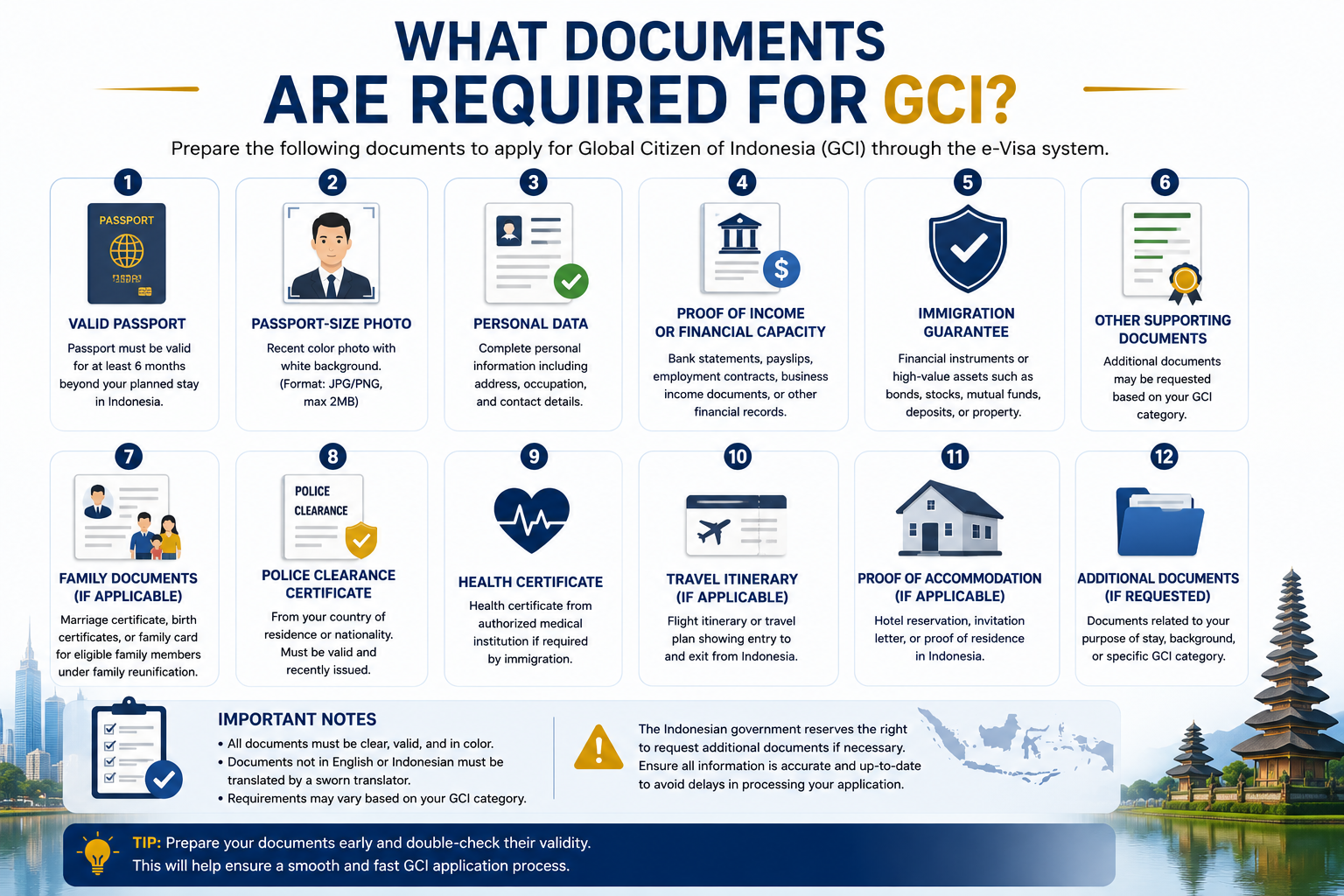
The documents required for a Global Citizen of Indonesia (GCI) application depend on the applicant’s GCI visa index.
There is no single document checklist that applies identically to every GCI applicant.
For example, a foreign spouse of an Indonesian citizen applying under E31A has a different basis for eligibility from a former Indonesian citizen applying under E32E, while a child of a mixed marriage falls under E31C.
Indonesian Immigration currently lists the relevant GCI visa categories separately within its official visa application system.
Therefore, applicants should first identify the correct GCI index and then prepare the documents required for that specific category.
Basic Documents for a GCI Application
Although requirements can vary between categories, a GCI applicant should generally be prepared to provide documents establishing:
- The applicant’s identity;
- A valid foreign passport;
- The applicant’s qualifying relationship or connection to Indonesia;
- Supporting documents relevant to the selected GCI category; and
- Any additional financial, guarantee, or special-skills documentation required by that category.
The exact checklist should be taken from the current official Immigration application system for the relevant visa index.
This is important because GCI is a relatively new immigration framework and requirements can be updated as the system develops.
Passport and Identity Documents
A valid foreign passport is fundamental to the application because GCI is an immigration facility for foreign nationals.
The applicant should ensure that the personal information in the passport is consistent with the information entered into the GCI application.
Particular attention should be paid to:
- Full name;
- Date of birth;
- Nationality;
- Passport number;
- Passport expiry date; and
- Other biographical information.
Any discrepancy between the passport and supporting documents can create additional verification requirements.
Documents Proving the Applicant’s Connection to Indonesia
The most important supporting documents will generally depend on why the applicant qualifies for GCI.
For example:
Foreign spouse of WNI
→ documents proving the legal marriage and the Indonesian spouse’s citizenship.
Child of mixed marriage
→ documents proving the child’s birth and relationship to the Indonesian parent.
Former Indonesian citizen
→ documents establishing that the applicant previously held Indonesian citizenship.
Descendant of former Indonesian citizen
→ documents establishing the qualifying family lineage.
The underlying principle is simple:
The documents must establish the legal basis for the GCI category being used.
Documents for E31A — Spouse of an Indonesian Citizen
For an applicant applying under E31A, the key issue is establishing the qualifying marriage relationship with an Indonesian citizen.
Supporting documents may therefore include documentation relating to:
- The foreign spouse;
- The Indonesian spouse;
- The legal marriage; and
- The Indonesian spouse’s citizenship.
Applicants should use the current E31A checklist shown by Immigration when preparing the application.
The official Immigration website currently identifies E31A as Visa Keluarga, confirming that it is handled as a family-based category.
Documents for E31B — Spouse of an ITAS or ITAP Holder
For E31B, the applicant must establish the relevant marriage relationship and the immigration status of the spouse who holds the Indonesian ITAS or ITAP.
The documentation therefore differs from E31A because the basis of the application involves the spouse’s Indonesian residence status.
Applicants should not simply copy an E31A document checklist for an E31B application.
The correct requirements should be taken from the current E31B application category.
Documents for E31C — Child of a Mixed Marriage
For E31C, the applicant needs to establish the relevant parent-child relationship.
Documents may therefore include:
- The child’s passport;
- Birth certificate or equivalent birth documentation;
- Documents identifying the parents;
- Evidence of the Indonesian parent’s citizenship; and
- Other documents required by Immigration for the E31C category.
The official Immigration system identifies E31C as:
Visa Keluarga (Anak dari Ibu/Ayah WNI)
which confirms that this category is specifically connected to a child with an Indonesian parent.
Documents for E32E — Former Indonesian Citizen
An applicant under E32E needs to establish that they were previously an Indonesian citizen.
This means documentation relating to the applicant’s previous Indonesian nationality becomes particularly important.
Depending on the applicant’s history, relevant evidence may include official documents showing:
- Previous Indonesian citizenship;
- Loss or release of Indonesian citizenship;
- Previous Indonesian identity documents; or
- Other official evidence establishing former WNI status.
Applicants should use the current E32E requirements because the appropriate evidence can depend on how and when the applicant lost Indonesian citizenship.
Documents for E32F — Former Indonesian Citizen With Special Skills
E32F combines two elements:
- The applicant’s previous Indonesian citizenship; and
- The applicable special-skills qualification.
Therefore, the applicant may need documentation establishing both aspects.
Immigration has stated that applicants under the special-skills pathway require an invitation letter or statement of urgency from the central government, with the government acting as guarantor. This makes the documentation different from an ordinary former-WNI application.
Applicants should therefore not prepare E32F using only the E32E document requirements.
Documents for E32G — Descendant of a Former Indonesian Citizen
For E32G, the applicant needs to establish the qualifying family relationship to a former Indonesian citizen.
This means the application may require a chain of documents connecting:
Applicant
↓
Parent / grandparent
↓
Former Indonesian citizen
The exact documents required to prove the lineage depend on the applicant’s family structure.
Applicants should therefore prepare official civil-status documents that establish the relevant family relationship.
Documents for E32H — Descendant With Special Skills
E32H combines:
- qualifying descent from a former Indonesian citizen; and
- the applicable special-skills criteria.
Therefore, the applicant must establish both the family connection and the special-skills qualification.
As with E32F, the special-skills element can involve government documentation or an invitation/statement of urgency from the central government.
Financial Documents May Also Be Required
Certain GCI categories have financial requirements.
As discussed earlier in this guide, Immigration has identified income and immigration-guarantee requirements for certain former-WNI and descendant categories.
Therefore, applicants in those categories may need to provide documentation supporting their financial eligibility.
This can include evidence relating to:
- Income;
- Financial assets;
- Qualifying investments;
- Deposits;
- Securities; or
- Qualifying property.
However, applicants should not assume that every GCI applicant needs the same financial documents.
For example, eligible family-reunification applicants are treated differently from former-WNI and descendant categories.
Documents for an Immigration Guarantee
Where an immigration guarantee applies, the applicant may need documentation relating to the qualifying financial guarantee.
Immigration has identified forms such as:
- Bonds;
- Shares;
- Mutual funds;
- Deposits; and
- High-value property
as possible forms of the guarantee for relevant categories.
The exact documentation and value should be confirmed against the current requirements for the applicant’s specific GCI index.
Documents for Family Reunification
Family-reunification applicants should focus on documents establishing the relevant family relationship.
For example:
Foreign spouse of WNI
→ marriage documentation + Indonesian spouse’s identity/citizenship documents.
Child of mixed marriage
→ birth documentation + parent-child relationship + Indonesian parent’s documentation.
Spouse of GCI holder
→ marriage documentation + evidence of the principal applicant’s GCI status.
Immigration specifically states that eligible family-reunification applicants are exempt from the immigration guarantee requirement.
Documents Should Match the GCI Visa Index
One of the most important practical rules is:
Do not prepare documents based on another person’s GCI application unless the applicant has the same GCI visa index.
For example:
E31A
is based on marriage to a WNI.
E32E
is based on former Indonesian citizenship.
E32G
is based on qualifying descent.
Their supporting documents therefore have different purposes.
Using the wrong document set can result in an incomplete application or additional requests for clarification.
GCI Document Checklist by Category
| GCI Index | Main Evidence to Establish |
| E31A | Legal marriage + Indonesian spouse’s citizenship |
| E31B | Legal marriage + spouse’s ITAS/ITAP |
| E31C | Child’s identity/birth + Indonesian parent relationship |
| E32E | Previous Indonesian citizenship |
| E32F | Previous Indonesian citizenship + special-skills qualification |
| E32G | Qualifying descent from former Indonesian citizen |
| E32H | Qualifying descent + special-skills qualification |
This table is intended as a planning guide, not a replacement for the live Immigration checklist.
The official Immigration portal currently lists the GCI-related visa categories separately, which reinforces the importance of checking the requirements for the exact category being applied for.
What If a Required Document Is Not Available?
Applicants with older Indonesian family connections can sometimes face a practical problem: historical civil documents may no longer be easily available.
For example, a descendant may know that a grandparent was an Indonesian citizen but may not immediately have the documents proving the complete family lineage.
In such cases, applicants should not substitute unrelated documents simply because they appear to show a connection to Indonesia.
Instead, the applicant should determine what official evidence Immigration accepts for establishing the relationship.
This is particularly important for E32G and E32H applications.
Do Documents Need to Be Translated?
The requirement for translation, legalization, apostille, or other document formalities can depend on the document and the current Immigration requirements.
Foreign-issued civil documents may require additional formalities before they can be accepted by Indonesian authorities.
Applicants should therefore check the current instructions applicable to their specific GCI application rather than assuming that every foreign document can be uploaded exactly as issued.
Do All Documents Need to Be Submitted at the Same Time?
The application is designed as an online process, but applicants should follow the document-upload instructions displayed in the official system.
If Immigration requests clarification or additional evidence, the applicant should respond according to the instructions given through the application system.
The important point is to ensure that the initial application is as complete and consistent as possible.
GCI Documents: What Applicants Should Prepare First
Before starting the online application, applicants can organize their documents into five groups:
1. Identity
- Passport
- Personal information
2. Indonesian Connection
- Marriage certificate
- Birth certificate
- Citizenship evidence
- Former-WNI documents
- Family lineage documents
3. Financial Evidence
- Income evidence, where applicable
- Financial assets, where applicable
- Investment/property guarantee, where applicable
4. Special-Skills Evidence
- Relevant professional or qualification documents
- Government invitation or statement of urgency, where applicable
5. Family-Reunification Evidence
- Marriage documentation
- Birth documentation
- Evidence of the principal GCI holder’s status, where applicable
This organization can make the application process much easier because the applicant already has the documents grouped according to the reason for eligibility.
Do Not Use an Old GCI Checklist Without Verification
GCI was officially launched in January 2026, and Immigration has continued socializing the policy during 2026.
The official Immigration website also continues to maintain and update its online visa categories.
Therefore, applicants should check the live e-Visa requirements before submitting their application rather than relying exclusively on a checklist published several months earlier.
This is particularly important for applicants whose cases involve:
- mixed marriages;
- former Indonesian citizenship;
- Indonesian ancestry;
- children with foreign passports;
- special skills; or
- family reunification.
2026 Takeaway
There is no universal GCI document checklist.
The correct documents depend primarily on the applicant’s GCI visa index and the legal basis for their eligibility.
The safest approach is:
Identify the GCI index
↓
Check the current official requirements
↓
Prepare documents proving the qualifying relationship
↓
Prepare financial/special-skills documents if applicable
↓
Submit through the official e-Visa system
The official Indonesian Immigration portal should remain the primary reference for the current document requirements because the GCI system is still relatively new and its online categories continue to be maintained during 2026.
How Long Does GCI Processing Take?
The processing time for a Global Citizen of Indonesia (GCI) application should be understood in two separate stages:
- Processing and approval of the GCI application and e-Visa
- Issuance of the indefinite ITAP after the applicant enters Indonesia
These two stages should not be confused.
Indonesian Immigration has specifically stated that the indefinite ITAP is issued within 24 hours after a GCI e-Visa holder enters Indonesia. However, this does not mean that the entire GCI application is approved within 24 hours.
Is GCI Approved Within 24 Hours?
Not necessarily.
The 24-hour timeframe announced by Immigration refers to the issuance of the indefinite ITAP after the GCI e-Visa holder enters Indonesia.
It should therefore be understood as:
GCI application submitted
↓
Immigration verification
↓
GCI e-Visa approved
↓
Applicant enters Indonesia
↓
Indefinite ITAP issued within 24 hours
The 24-hour period applies to the final ITAP issuance after entry, rather than the entire application process.
How Long Does the GCI Application Take Before Approval?
As of 2026, Immigration has not published one universal processing time that applies to every GCI application.
This is important because the GCI framework contains several different categories, including:
E31A — Spouse of an Indonesian Citizen
E31B — Spouse of an ITAS or ITAP holder
E31C — Child of a Mixed Marriage
E32E — Former Indonesian Citizen
E32F — Former Indonesian Citizen with Special Skills
E32G — Descendant of a Former Indonesian Citizen
E32H — Descendant with Special Skills
Each category can involve different supporting documents and verification requirements.
Therefore, Azra should not publish a fixed statement such as “GCI takes 3–5 working days” unless Immigration officially establishes that timeframe for the specific category.
What Can Make the Processing Time Longer?
The application may require additional verification when the applicant’s circumstances are more complicated.
This can include cases involving:
- Historical Indonesian citizenship;
- Former Indonesian nationality;
- Indonesian ancestry;
- Complex family relationships;
- Foreign civil documents;
- Mixed-marriage documentation;
- Special-skills qualifications;
- Financial requirements; or
- Immigration guarantees.
For example, an E32G application may require Immigration to verify a family lineage connecting the applicant to a former Indonesian citizen.
That type of application is naturally different from a straightforward E31A application based on a legally documented marriage to a WNI.
What If Immigration Requests Additional Documents?
If Immigration requests additional documents or clarification, the overall processing time can take longer because the application cannot simply proceed as though the missing information were already available.
Applicants should respond through the official application system and provide the requested evidence as accurately as possible.
This is particularly important when Immigration needs to verify the applicant’s relationship or connection to Indonesia.
Does a More Complete Application Process Faster?
A complete and consistent application can help avoid unnecessary delays caused by missing or contradictory information.
Before submitting, applicants should check that:
- Passport information is correct;
- Names are consistent across documents;
- Dates of birth are correct;
- Marriage or birth documents are clear;
- Family relationships can be established;
- Former-WNI documentation is available where required;
- Financial documents are prepared where applicable; and
- Special-skills documentation is available where applicable.
However, applicants should not interpret this as a guarantee of faster approval.
Complete documentation helps reduce avoidable problems, but Immigration still determines the processing of each application.
Does the GCI Visa Have an Expiration Period?
The GCI framework is designed around an indefinite permanent stay permit, rather than a conventional fixed-term ITAP.
Immigration describes GCI as an unlimited stay facility for eligible foreign nationals with strong ties to Indonesia.
However, the applicant must first successfully complete the GCI application and enter Indonesia using the approved GCI e-Visa before the indefinite ITAP is issued.
What Happens Within 24 Hours After Entry?
Once the GCI e-Visa holder enters Indonesia, Immigration states that the indefinite ITAP is issued within 24 hours.
The process is designed to be digital and integrated, meaning the applicant does not need to visit an Immigration Office simply to obtain the ITAP after entry.
This is one of the major practical advantages of the GCI system.
Does the Applicant Need to Wait in Indonesia for the ITAP?
The applicant must enter Indonesia using the approved GCI e-Visa before the post-entry ITAP issuance can take place.
The important sequence is therefore:
Approval first → entry into Indonesia → ITAP issuance.
The 24-hour period is tied to the entry event, not to the date on which the application was initially submitted.
Can Applicants Track Their GCI Application?
The official Indonesian e-Visa website provides an online facility for applicants to track their visa application status.
Applicants should therefore monitor the application through the official system rather than relying solely on emails, agents, or unofficial third-party websites.
This is particularly useful if Immigration requests additional information during the application.
What If the Application Is Still Processing?
Applicants should avoid assuming that a pending application means that something is wrong.
Immigration may still be reviewing:
- Eligibility;
- Supporting documents;
- Family relationships;
- Nationality history;
- Financial information; or
- Other category-specific requirements.
If the application remains pending, the applicant should first check the status and any notifications in the official e-Visa system.
If Immigration requests additional information, the applicant should respond accordingly.
GCI Processing Time vs ITAP Issuance
This distinction is important enough to summarize:
| Stage | Timeframe |
| GCI application review | No single universal timeframe officially published for all categories |
| GCI e-Visa issuance | Depends on application and Immigration verification |
| Entry into Indonesia | Must occur using the approved GCI e-Visa |
| Indefinite ITAP issuance after entry | Within 24 hours, according to Immigration |
The 24-hour figure should therefore never be used in the article as “GCI processing time.”
The accurate wording is:
“The indefinite ITAP is issued within 24 hours after the GCI e-Visa holder enters Indonesia.”
Can Azra Guarantee a GCI Processing Time?
No responsible immigration consultant should guarantee a government processing time unless Immigration itself provides such a guarantee.
A professional service can help applicants:
- identify the correct GCI category;
- review documents;
- identify inconsistencies;
- prepare the application;
- monitor the application; and
- respond to document requests.
But the final verification and approval remain with Indonesian Immigration.
This is particularly important for GCI because it is a relatively new immigration framework and Immigration’s digital implementation continues to develop.
GCI Processing Time: The 2026 Answer
For applicants researching “How long does GCI take?”, the most accurate answer is:
There is no single officially published processing time for every GCI application.
What Immigration has clearly confirmed is:
After the GCI e-Visa holder enters Indonesia, the indefinite ITAP is issued within 24 hours.
Therefore, applicants should think about the process in two stages:
Application & approval
→ processing time varies
After entering Indonesia
→ indefinite ITAP issued within 24 hours
This distinction prevents one of the most common misunderstandings about the GCI program.
Do GCI Holders Need to Report Their Stay?
A Global Citizen of Indonesia (GCI) holder receives an indefinite Permanent Stay Permit (ITAP) in Indonesia. However, having an indefinite ITAP does not mean that the holder is completely outside Indonesia’s immigration reporting and administrative requirements.
GCI holders remain foreign nationals and must continue to comply with the applicable Indonesian immigration regulations.
At the same time, it is important to distinguish between a general requirement to report one’s presence and specific reporting obligations that arise because of a particular civil or immigration event.
Is There a Special GCI “Lapor Diri” Requirement?
Based on the official GCI information currently published by Indonesian Immigration, there is no separate GCI-specific requirement stating that every GCI holder must periodically report their physical presence to an Immigration Office simply because they hold GCI.
The official GCI announcement focuses on the integrated issuance of the GCI e-Visa and indefinite ITAP, including the issuance of the ITAP within 24 hours after entry into Indonesia.
Therefore, applicants should not assume that GCI creates a special recurring requirement such as:
“Every GCI holder must visit Immigration every year to report their stay.”
We have not found an official 2026 GCI publication establishing such a universal requirement.
Does Having an Indefinite ITAP Mean No Reporting Is Required?
No.
An indefinite ITAP does not mean that a foreign national can ignore all immigration administration.
GCI holders remain subject to the general obligations applicable to foreign nationals holding Indonesian immigration status.
Certain events can trigger specific reporting or administrative requirements.
These may include changes involving:
- Civil status;
- Marriage;
- Divorce;
- Death;
- Nationality;
- Passport;
- Address or domicile; or
- Other information relevant to the person’s immigration status.
The applicable procedure depends on the event.
What If a GCI Holder Gets Divorced?
This is particularly important for GCI holders whose eligibility is based on a family relationship.
For example, a foreign national who holds E31A GCI because they are the spouse of an Indonesian citizen should not assume that divorce has no immigration consequences.
Indonesian Immigration has a specific reporting mechanism for foreign nationals who divorce. The current Immigration information for this service states that the report must be submitted within 60 days from the date of divorce, together with the relevant immigration and divorce documents.
The documents listed include items such as:
- Passport;
- Current stay permit;
- ITAP;
- E-Visa;
- Marriage certificate; and
- Divorce certificate.
For a GCI holder, the actual immigration consequences of divorce should then be assessed based on the person’s specific GCI category and circumstances.
Therefore:
Divorce should be reported; do not simply assume that the GCI status automatically continues unchanged.
What If the GCI Holder’s Passport Changes?
A change of passport can also require immigration administration.
This is particularly relevant because GCI is linked to the foreign national’s passport and immigration identity.
If the holder obtains a new passport, they should ensure that their immigration records are updated according to the applicable procedure.
Immigration offices provide a specific passport mutation process for foreign nationals holding Indonesian stay permits.
The important principle is:
A new passport does not mean the foreign national should simply continue using outdated immigration information.
The immigration record should be updated appropriately.
What If the GCI Holder Changes Address?
A GCI holder who changes their residence should also pay attention to the applicable immigration administration relating to their place of residence.
Foreign nationals residing in Indonesia are subject to immigration supervision, and address information can be relevant to that supervision.
Therefore, GCI holders should keep their residence information accurate and comply with any applicable reporting procedure when their address changes.
What If the GCI Holder Changes Nationality?
This is an especially important issue for GCI holders because one of the fundamental features of GCI is that it allows eligible foreign nationals to retain their existing citizenship.
If the person later changes or acquires another nationality, the immigration consequences should be assessed separately.
Immigration offices maintain procedures for reporting changes in nationality, including documentation from the relevant foreign diplomatic mission where applicable.
A GCI holder should therefore not assume that a change in nationality is merely a personal matter unrelated to their Indonesian immigration status.
What If the GCI Holder Dies in Indonesia?
There are also specific immigration reporting procedures when a foreign national dies in Indonesia.
Current Immigration guidance requires reporting of the death and supporting documents, including the deceased person’s passport and ITAS/ITAP, together with the civil registration death certificate.
This is generally an obligation handled by the relevant family member, sponsor, or responsible party rather than by the deceased person.
What About Children Born in Indonesia?
A GCI holder who has a child born in Indonesia should pay particular attention to the child’s immigration and civil-registration status.
Immigration currently provides a report of birth for a child born to foreign nationals in Indonesia.
The report is generally required within 90 days of the birth, after which the appropriate immigration stay-permit process must be completed for the child.
For a mixed-marriage family, this can become more complicated because the child may have an Indonesian parent and potentially have nationality rights under Indonesian citizenship law.
Therefore, parents should handle:
birth registration
and
citizenship
and
immigration status
as separate but interconnected matters.
Does a GCI Holder Need to Visit Immigration Every Year?
Not simply because they hold GCI.
The key distinction is between:
Routine annual reporting
and
reporting a specific change or event.
We have not found an official 2026 GCI announcement requiring every GCI holder to physically visit an Immigration Office every year merely to confirm that they are still living in Indonesia.
Instead, GCI is designed as an integrated digital immigration facility with an indefinite ITAP.
However, specific immigration or civil-status events may trigger reporting obligations.
What About Immigration Supervision?
Not having a periodic “GCI report” does not mean GCI holders are exempt from immigration supervision.
Foreign nationals remain subject to Indonesian immigration law and can be subject to immigration monitoring and enforcement.
Immigration continues to strengthen digital systems for monitoring foreign nationals, including the use of technology and reporting systems involving accommodation providers and other stakeholders. For example, Immigration’s 2026 APOA program continues to facilitate reporting of foreign nationals staying at accommodation facilities.
This is different from saying that the GCI holder personally must submit a periodic report.
GCI Reporting vs Accommodation Reporting
This distinction is useful.
GCI holder
→ has an indefinite ITAP
→ remains subject to immigration regulations
Hotel / accommodation provider
→ may have obligations to report foreign guests through the applicable immigration reporting system.
Immigration’s 2026 APOA socialization specifically concerns reporting the presence of foreign nationals by accommodation providers and other stakeholders.
Therefore, a foreign national staying at a hotel does not necessarily have to personally submit the same report that the hotel is required to submit.
What Should GCI Holders Keep Updated?
For practical purposes, GCI holders should keep their immigration information accurate, particularly:
- Passport;
- ITAP;
- Address;
- Civil status;
- Nationality;
- Family information; and
- Other information that may affect their immigration status.
If an important personal or civil-status event occurs, the holder should check whether Indonesian Immigration requires a specific report or administrative update.
Common Events That May Require Immigration Reporting
| Event | Should It Be Checked With Immigration? |
| Change of passport | Yes |
| Change of address | Yes |
| Marriage | Yes, where relevant |
| Divorce | Yes |
| Change of nationality | Yes |
| Death of GCI holder | Yes |
| Birth of a child in Indonesia | Yes |
| Routine annual GCI report | No universal GCI-specific requirement found |
This table is intentionally conservative. The exact reporting procedure depends on the event and the person’s immigration circumstances.
What GCI Holders Should Not Assume
A GCI holder should not assume:
“My ITAP is indefinite, so I never need to deal with Immigration again.”
That is incorrect.
The better interpretation is:
The residence permit is indefinite, but the holder remains subject to Indonesian immigration administration and reporting obligations that may arise from specific events.
This is an important distinction for anyone planning to live in Indonesia permanently.
Five-Year Reporting Requirement
GCI holders should distinguish the indefinite validity of the ITAP from their ongoing reporting obligations. Current Immigration information indicates a five-year reporting cycle rather than an annual renewal of the GCI.
In practical terms, the GCI holder should report every five years and should also update Immigration earlier when important personal information changes, such as civil status, address, passport, or nationality.
The five-year report is an administrative reporting obligation. It does not mean that the GCI or ITAP expires or must be renewed every five years, and it does not require the holder to leave Indonesia.
The exact procedure for completing the report should be checked against the current Immigration system when the reporting date approaches, because digital implementation and administrative procedures may change.
2026 Takeaway
For GCI holders, there is currently no universal annual GCI visit requirement; current Immigration information instead indicates a five-year reporting cycle, with earlier reporting when important personal information changes.
However, GCI holders remain foreign nationals with Indonesian immigration status and must comply with applicable reporting and administrative requirements when relevant events occur.
Particular attention should be paid to:
- passport changes;
- address changes;
- marriage or divorce;
- nationality changes;
- death; and
- children born in Indonesia.
For example, Immigration currently provides a specific 60-day reporting period for foreign nationals who divorce, while the birth of a child to foreign nationals in Indonesia has a 90-day reporting timeframe.
So the safest rule for GCI holders is:
You do not have a universal annual “GCI report,” but you must keep your immigration records updated and report relevant changes when required.
Frequently Asked Questions About GCI
What is Global Citizen of Indonesia (GCI)?
Global Citizen of Indonesia (GCI) is an Indonesian immigration policy that provides an indefinite Permanent Stay Permit (ITAP) to eligible foreign nationals who have strong connections to Indonesia.
These connections can include Indonesian ancestry, former Indonesian citizenship, family relationships, historical ties, or other qualifying connections established under the applicable GCI category.
GCI allows eligible foreign nationals to maintain their existing foreign citizenship while obtaining indefinite residence in Indonesia.
Does GCI Give Indonesian Citizenship?
No.
GCI is an immigration residence facility, not a citizenship program.
A GCI holder remains a foreign national and retains their existing citizenship, subject to the laws of their country of nationality.
The main benefit is the ability to reside in Indonesia indefinitely without having to become an Indonesian citizen.
Who Can Apply for GCI?
The GCI framework covers several groups, including:
- Former Indonesian citizens;
- Descendants of former Indonesian citizens up to the second degree;
- Legal spouses of Indonesian citizens;
- Children from mixed marriages; and
- Certain family members of GCI holders through family reunification.
The applicant must still satisfy the requirements of the specific GCI category.
Can a Foreign Spouse of an Indonesian Citizen Apply for GCI?
Yes.
A legal foreign spouse of an Indonesian citizen can apply under the applicable GCI family category, currently identified as E31A.
Family-reunification applicants are also exempt from the immigration guarantee requirement.
Can a Child From a Mixed Marriage Apply for GCI?
Yes.
Children from mixed marriages are included within the GCI framework and are covered by the relevant family-based category, including E31C.
However, the child’s citizenship status and immigration status are separate legal matters.
GCI does not automatically determine or change the child’s nationality.
Can a Former Indonesian Citizen Apply for GCI?
Yes.
Former Indonesian citizens are specifically included in the GCI framework.
The current Immigration visa list identifies E32E as the permanent-residence GCI category for former Indonesian citizens.
Former Indonesian citizens should establish their previous Indonesian citizenship using the documents required by Immigration.
Can the Child or Grandchild of a Former Indonesian Citizen Apply?
Potentially, yes.
The GCI framework includes descendants of former Indonesian citizens up to the second degree.
The current Immigration system identifies E32G as the permanent-residence GCI category for descendants of former Indonesian citizens.
Applicants must be able to establish the qualifying family lineage.
Is GCI the Same as Indonesia’s Golden Visa?
No.
They are separate immigration programs.
GCI primarily focuses on diaspora, former Indonesian citizens, ancestry, family relationships, and strong connections to Indonesia.
Golden Visa, by contrast, is primarily designed around investment, talent, and economic contribution.
Immigration itself has emphasized that the two programs have different target groups and mechanisms.
How Long Is a GCI Stay Permit Valid?
GCI provides an indefinite Permanent Stay Permit (ITAP).
This means the residence permit does not operate like an ordinary fixed-term stay permit that simply expires after one, two, or five years.
However, the holder still has ongoing immigration obligations, including the reporting requirement discussed earlier in this article.
Does GCI Need to Be Renewed Every Five Years?
No.
The five-year reporting requirement should not be confused with renewal.
A GCI holder has an indefinite ITAP, while Immigration’s 2026 socialization explains that GCI holders must report themselves every five years or when important personal information changes.
Therefore:
Five-year reporting ≠ five-year ITAP renewal.
Does a GCI Holder Have to Leave Indonesia Every Five Years?
No.
The five-year reporting requirement does not mean that the holder must leave Indonesia.
GCI is specifically designed to provide indefinite residence in Indonesia.
The five-year obligation is an immigration reporting requirement, not a mandatory exit from the country.
How Long Does GCI Processing Take?
There is no single officially published processing time that applies to every GCI application.
The important confirmed timeframe is what happens after entry into Indonesia.
Immigration states that a GCI e-Visa holder receives the indefinite ITAP within 24 hours after entering Indonesia.
The 24-hour period should therefore not be advertised as the total GCI application processing time.
Can I Apply for GCI From Outside Indonesia?
Yes.
The GCI application is submitted online through Indonesia’s electronic visa system.
The official Immigration announcement states that GCI applications are submitted through:
evisa.imigrasi.go.id
The GCI e-Visa is integrated with Indonesia’s immigration crossing system.
Do I Need to Visit an Immigration Office to Get the ITAP?
Under the standard GCI process, no.
Immigration states that after the GCI e-Visa holder enters Indonesia, the indefinite ITAP is issued within 24 hours without requiring the applicant to visit an Immigration Office.
Can GCI Holders Work in Indonesia?
GCI provides an indefinite residence status, but it should not automatically be interpreted as an unrestricted work permit.
Whether a GCI holder can undertake a particular employment or professional activity must be assessed under the regulations governing that activity.
The residence status and the authorization to perform regulated work are separate issues.
Can GCI Holders Start a Business in Indonesia?
GCI itself is an immigration residence facility.
A GCI holder who wants to establish, own, or operate an Indonesian business must still comply with applicable investment, corporate, licensing, employment, and sector-specific regulations.
GCI should therefore not be described as a business license.
Is an Immigration Guarantee Required for All GCI Applicants?
No.
Eligible applicants under the family-reunification classification are exempt from the immigration guarantee requirement.
Immigration specifically identifies legal spouses of Indonesian citizens, children from mixed marriages, and spouses of GCI holders under this exemption.
Other GCI categories can have different financial or guarantee requirements.
Can the Immigration Guarantee Be Refunded?
For GCI categories where an immigration guarantee applies, Immigration states that the guarantee can be refunded when the GCI holder ends their stay or changes their residence-permit status, subject to the applicable procedure.
This is why an immigration guarantee should not simply be described as a non-refundable visa fee.
Can GCI Holders Bring Their Family to Indonesia?
Yes, in relevant circumstances.
The GCI framework includes family reunification.
Immigration specifically identifies spouses of GCI holders among the family members who may apply under the relevant family-reunification framework.
Each family member must still meet the applicable requirements.
Can Parents of a GCI Holder Automatically Get GCI?
Not automatically.
The official GCI framework specifically identifies certain family relationships, including spouses and children in the relevant categories.
The fact that someone is a relative of a GCI holder does not mean that every type of relative automatically qualifies.
Parents and other relatives should have their immigration eligibility assessed separately.
Does GCI Give Permanent Residence for Life?
GCI provides an indefinite ITAP, meaning the residence permit is not limited to a fixed number of years.
However, “indefinite” should not be interpreted as meaning that the holder can ignore Indonesian law or immigration obligations.
The holder remains subject to Indonesian immigration regulations and reporting requirements.
Can GCI Be Cancelled?
An indefinite ITAP does not mean the status can never be cancelled.
Like other Indonesian immigration statuses, a GCI holder remains subject to Indonesian law and the applicable grounds for immigration action.
Therefore, GCI should be understood as indefinite residence subject to continued legal compliance, rather than an unconditional lifetime guarantee.
Is GCI Available in 2026?
Yes.
GCI was officially launched by the Directorate General of Immigration on 26 January 2026.
Immigration offices continued conducting GCI socialization and implementation activities throughout 2026, including updates concerning the electronic visa system.
Where Do I Apply for GCI?
GCI applications are submitted online through the official Indonesian Immigration e-Visa system:
Applicants should use the official Immigration platform and verify the current requirements for their specific GCI category before submitting an application.
GCI FAQ — Quick Answers
| Question | Short Answer |
| Does GCI grant citizenship? | No |
| Does GCI provide permanent residence? | Yes, indefinite ITAP |
| Can a foreign spouse of a WNI apply? | Yes |
| Can former WNI apply? | Yes |
| Can descendants of former WNI apply? | Yes, subject to the applicable degree/category |
| Can mixed-marriage children apply? | Yes |
| Is Golden Visa the same as GCI? | No |
| Does every GCI applicant need an immigration guarantee? | No |
| Does GCI expire after five years? | No |
| Must GCI holders leave Indonesia every five years? | No |
| Do GCI holders have a five-year reporting obligation? | Yes |
| Is GCI approval guaranteed within 24 hours? | No |
| Is ITAP issued within 24 hours after GCI entry? | Yes |
| Can GCI holders automatically work without restrictions? | Not necessarily |
| Can GCI holders automatically operate any business? | No |
| Can GCI holders retain their foreign citizenship? | Yes |
2026 Takeaway
The Global Citizen of Indonesia program creates a new long-term immigration pathway for foreign nationals with qualifying connections to Indonesia.
The most important points are:
- GCI provides indefinite ITAP;
- It does not grant Indonesian citizenship;
- Former WNI, qualifying descendants, spouses of WNI, and children of mixed marriages can fall within the program;
- Certain family members can qualify through family reunification;
- Eligible family-reunification applicants are exempt from the immigration guarantee;
- GCI applications are submitted online through the official e-Visa system;
- ITAP is issued within 24 hours after the GCI e-Visa holder enters Indonesia;
- GCI holders have a five-year reporting obligation, as well as reporting duties when important personal data changes; and
- GCI does not automatically override separate rules governing employment, business, investment, property, or other regulated activities.
For anyone considering GCI in 2026, the most important first step is to determine which GCI category actually matches their connection to Indonesia before preparing the application.
Final Thoughts: Is GCI Right for You?
The Global Citizen of Indonesia (GCI) represents a significant change in Indonesia’s approach to long-term residence for foreign nationals with genuine connections to the country.
Officially launched in January 2026, GCI provides an indefinite Permanent Stay Permit (ITAP) for eligible foreign nationals while allowing them to retain their existing citizenship. The program is specifically aimed at people with Indonesian ancestry, former Indonesian citizenship, family relationships, historical connections, and other qualifying ties to Indonesia.
For many applicants, this makes GCI fundamentally different from ordinary Indonesian visa and residence-permit options.
GCI Is Not Just Another Indonesian Visa
GCI should not be viewed simply as another long-term visa.
Its main purpose is to create a permanent-residence pathway for people who already have a meaningful connection to Indonesia.
This can include:
- Former Indonesian citizens;
- Descendants of former Indonesian citizens;
- Foreign spouses of Indonesian citizens;
- Children of mixed marriages; and
- Certain family members of GCI holders.
The underlying concept is therefore:
A long-term immigration connection to Indonesia without requiring the foreign national to change their existing citizenship.
Who Should Consider GCI?
GCI may be particularly relevant if you are:
A former Indonesian citizen
You previously held Indonesian citizenship but now hold another nationality and want to establish permanent residence in Indonesia.
A descendant of a former Indonesian citizen
You have Indonesian family ancestry and can establish the qualifying family relationship.
A foreign spouse of an Indonesian citizen
You are legally married to a WNI and want a long-term residence solution in Indonesia.
A child from a mixed marriage
You have an Indonesian parent and qualify under the relevant GCI category.
A spouse of a GCI holder
Your spouse qualifies for GCI and you want to establish a long-term family residence arrangement in Indonesia.
These are precisely the types of relationships that the GCI framework was created to address.
GCI May Be More Appropriate Than a Regular Temporary Residence Permit
For someone who already qualifies for GCI, repeatedly maintaining temporary residence may not always be the most logical long-term strategy.
GCI provides an indefinite ITAP, meaning the applicant does not have to approach the program as a conventional one-, two-, or five-year residence permit.
The process is also designed to be integrated digitally.
A GCI e-Visa holder receives the indefinite ITAP within 24 hours after entering Indonesia, without needing to visit an Immigration Office for the ITAP issuance.
This can make GCI particularly attractive to applicants who know that Indonesia is going to be their long-term home.
But GCI Is Not Automatically the Best Option for Everyone
Having a connection to Indonesia does not necessarily mean that GCI is automatically the right immigration strategy.
The applicant should first consider:
- Their current nationality;
- Their previous Indonesian citizenship, if any;
- Their family relationship with Indonesia;
- Their ancestry;
- Their current immigration status;
- Their intended activities in Indonesia;
- Their financial circumstances; and
- Their long-term plans.
For example, a foreign investor without Indonesian ancestry or a qualifying family relationship may need to examine Indonesia’s Golden Visa or another appropriate immigration pathway instead.
Similarly, someone who only intends to stay in Indonesia temporarily may not need an indefinite ITAP.
GCI Does Not Mean Indonesian Citizenship
This is perhaps the most important point to remember.
GCI ≠ Indonesian citizenship.
A GCI holder remains a foreign national.
The program provides:
Foreign citizenship
Indonesian indefinite ITAP
rather than:
Foreign citizenship
→
Indonesian citizenship
This distinction allows eligible individuals to maintain their existing nationality while establishing a permanent life in Indonesia.
GCI Does Not Remove Every Rule for Foreign Nationals
An indefinite ITAP provides long-term immigration residence, but it does not automatically give a foreign national every legal right available to an Indonesian citizen.
Areas such as:
- Employment;
- Business activities;
- Investment;
- Property;
- Taxation;
- Regulated professions; and
- Other sector-specific activities
may have their own rules.
Therefore, GCI should be considered the immigration foundation for living in Indonesia, while other legal requirements should be assessed separately according to what the person intends to do.
The Five-Year Reporting Obligation Still Matters
GCI provides an indefinite ITAP, but the holder still has immigration responsibilities.
As discussed earlier in this article, Immigration’s 2026 socialization states that GCI holders must report themselves every five years, or earlier when important personal information changes, such as civil status or address.
This means:
Indefinite residence
does not mean:
no immigration obligations.
The holder should continue keeping their immigration information accurate and complying with applicable reporting requirements.
The Most Important Step Is Choosing the Correct GCI Category
GCI is not one single application category.
The applicant’s circumstances determine which GCI index applies.
For example:
E31A
→ spouse of Indonesian citizen
E31C
→ child of mixed marriage
E32E
→ former Indonesian citizen
E32G
→ descendant of former Indonesian citizen
Other categories apply to spouses, special-skills applicants, and other qualifying situations.
Choosing the correct category is therefore one of the most important parts of the application process.
GCI Is Particularly Significant for the Indonesian Diaspora
One of the broader objectives of GCI is to reconnect Indonesia with its global diaspora.
Immigration has described the program as an opportunity for the diaspora and individuals with special ties to Indonesia to contribute to national development while maintaining their existing citizenship.
For former Indonesians who have spent decades overseas, this can create an entirely new possibility:
Returning to live in Indonesia without first having to give up their current nationality.
For families with Indonesian ancestry, it can also provide a clearer long-term residence pathway.
What Should You Do Before Applying?
Before submitting a GCI application, a prospective applicant should:
1. Determine eligibility
Confirm that you actually fall within one of the GCI categories.
2. Identify the correct visa index
Do not select a category simply because it offers indefinite residence.
3. Prepare supporting documents
Make sure the documents establish the relationship, ancestry, former citizenship, or other qualifying basis.
4. Review financial requirements
Some categories have additional income and immigration-guarantee requirements.
5. Check the current official requirements
GCI is a relatively new program and its digital implementation continues to develop.
6. Apply through the official Immigration system
Applications are submitted through evisa.imigrasi.go.id.
When Professional Assistance Can Be Useful
GCI may look straightforward on paper, but some applications can involve complicated documentation.
Professional assistance can be particularly useful when the case involves:
- Former Indonesian citizenship;
- Multiple generations of Indonesian ancestry;
- Foreign civil documents;
- Mixed marriages;
- Multiple family members;
- Special-skills categories;
- Financial guarantees; or
- Questions about the correct GCI category.
The purpose of professional assistance should be to help the applicant understand and properly prepare the application, not to promise approval or bypass Immigration requirements.
Final Takeaway
The Global Citizen of Indonesia is one of the most significant new Indonesian immigration pathways introduced in 2026.
For the right applicant, its biggest advantages are clear:
Indefinite ITAP
Retention of existing citizenship
Integrated digital application
Family-reunification possibilities
No immigration guarantee for eligible family-reunification applicants.
But GCI is not a universal immigration solution.
The key question is not simply:
“Do I want permanent residence in Indonesia?”
It is:
“Do I qualify for GCI, and which GCI category applies to my situation?”
Once that question is answered correctly, the rest of the application process becomes much clearer.
For anyone considering GCI in 2026, the safest approach is to review the current official Indonesian Immigration requirements, identify the correct GCI category, prepare the supporting evidence carefully, and ensure that any work, business, investment, property, or other activities in Indonesia comply with their respective regulations.