Updated for 2026
Having an Indonesian parent or grandparent can create a meaningful connection to Indonesia, but family ancestry does not automatically make a foreign national an Indonesian citizen or give them the right to live in Indonesia.
For eligible descendants of former Indonesian citizens, Indonesia now has specific immigration pathways designed around that connection. The most relevant options include the E32B 5- or 10-Year Descendant Visa and, for qualifying descendants, the E32G Permanent Resident Descendant Visa under the Global Citizen of Indonesia (GCI) policy.
The distinction matters. E32B provides a long-term residence pathway, while GCI can provide indefinite permanent residence without changing the applicant’s original citizenship. The appropriate route depends on the applicant’s relationship to the former Indonesian citizen, documentation, intended length of residence, and applicable immigration requirements.
This guide explains the Visa for Descendants of Former Indonesian Citizens, including E32B, GCI and E32G, eligibility, ancestry documentation, investment requirements, permitted activities, costs, application procedures, and the difference between Indonesian residence and citizenship.
1. What Is the Visa for Descendants of Former Indonesian Citizens?
Indonesia provides immigration pathways specifically for certain descendants of people who previously held Indonesian citizenship.
The E32B Descendant Visa is officially intended for children or grandchildren of former Indonesian citizens. The Directorate General of Immigration describes these as first- and second-degree descendants. The visa provides a long-term stay option of five or ten years, depending on the selected category.
In 2026, descendants also need to be aware of the Global Citizen of Indonesia (GCI) framework. GCI was officially launched on January 26, 2026, and includes descendants of former Indonesian citizens up to the second degree among its eligible categories. GCI provides indefinite permanent residence without changing the person’s original citizenship status.
Therefore, when someone searches for an Indonesia Visa for Descendants of Former Indonesian Citizens, they should not assume that there is only one possible immigration route.
The relevant question is: What type of Indonesian immigration status is appropriate for your family relationship and your intended stay?
Who Is This Immigration Pathway For?
The descendant category is particularly relevant to foreign nationals whose Indonesian family connection comes through a parent or grandparent who previously held Indonesian citizenship.
For example: Applicant → Parent → Former Indonesian Citizen may establish a first-degree descendant relationship. Another example is Applicant → Parent → Grandparent → Former Indonesian Citizen, which may establish a second-degree descendant relationship.
The applicant must still satisfy the applicable immigration requirements and provide documents that establish the claimed family relationship.
What Is the Difference Between a Descendant and a Former Indonesian Citizen?
A former Indonesian citizen is someone who previously held Indonesian citizenship but is no longer an Indonesian citizen.
A descendant of a former Indonesian citizen is a different category. The applicant may have Indonesian ancestry but may never personally have held Indonesian citizenship.
This distinction is important because the immigration routes are not necessarily the same.
For broader context, readers can explore the Former Indonesian Citizen immigration guide, which explains the main immigration pathways available to people who previously held Indonesian citizenship.
2. Who Qualifies as a Descendant of a Former Indonesian Citizen?
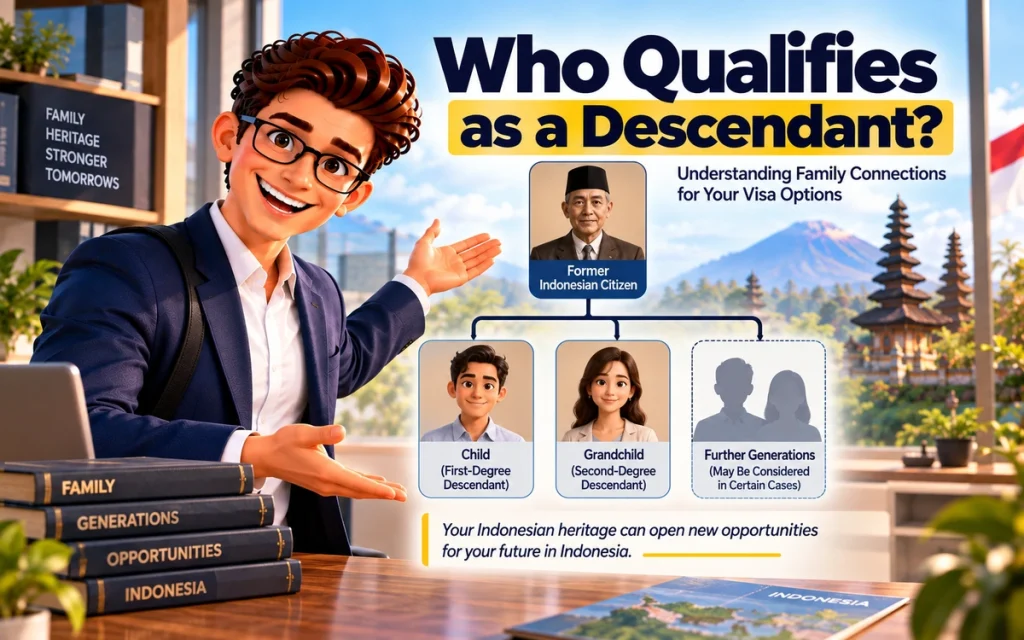
The relationship between the applicant and the former Indonesian citizen is central to the descendant visa category.
Under the official E32B description, the relevant descendants are children and grandchildren, corresponding to first- and second-degree descendants.
First-Degree Descendants: Children
A child of a person who previously held Indonesian citizenship may fall within the descendant category, subject to the applicable requirements. The applicant should be able to establish the relationship through official civil or family documents.
Second-Degree Descendants: Grandchildren
A grandchild of a former Indonesian citizen may also fall within the descendant category. The documentary chain becomes longer: Applicant → Parent → Grandparent → Former Indonesian Citizen.
How Family Relationships Are Established
For immigration purposes, the strongest approach is usually a continuous documentary chain rather than a single ancestry document. The applicant should be able to connect each generation using civil-status records, while separately establishing that the relevant ancestor was in fact an Indonesian citizen or former Indonesian citizen.
For example, a grandchild may need evidence connecting the applicant to a parent, the parent to a grandparent, and the grandparent to the former Indonesian citizen. Where names changed after marriage, transliteration differs between countries, or dates are inconsistent, additional civil records or explanatory evidence may be needed. The objective is to make the family relationship understandable to the reviewing authority without relying on assumptions.
Supporting evidence may include birth certificates, marriage certificates, family records, documents showing the former Indonesian citizen’s identity or previous Indonesian status, and other supporting civil or immigration records. The objective is to create a consistent documentary chain.
What About Great-Grandchildren?
The degree of descent matters because immigration categories are defined by the relationship recognized by the applicable visa or residence framework. A family tree may show a broader Indonesian ancestry, but that does not by itself extend an E32B or E32G route beyond the degree stated in the current rules. If the connection is more remote, the applicant should first identify whether another immigration category is available rather than assuming that the descendant category continues automatically.
This is also why ancestry research should be completed before an application is filed. A person may know that a great-grandparent was Indonesian, yet the immigration question is not simply whether Indonesian ancestry exists. The relevant questions are who held Indonesian citizenship, what the exact family relationship is, and which current immigration category recognizes that relationship.
Applicants should not automatically assume that great-grandchildren qualify. Current official descriptions specifically refer to descendants up to the second degree for the relevant descendant pathways.
3. What Visa Options Are Available to Descendants?
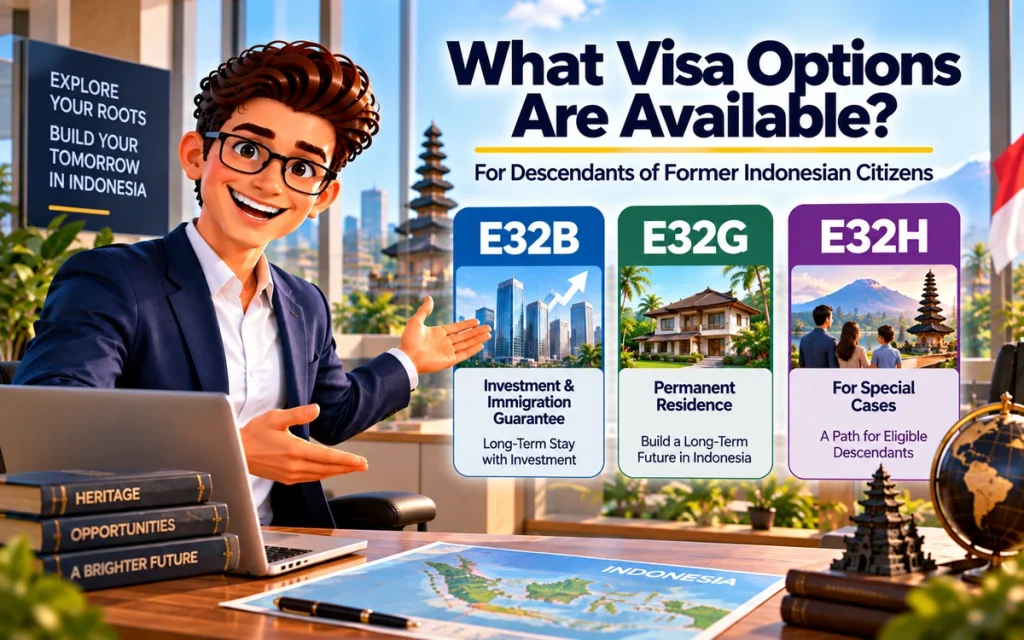
The Indonesian immigration catalogue currently identifies several visa categories within the Repatriation and Descendant Visas framework.
- E32B — 5 or 10-Year Descendant Visa
- E32G — Permanent Resident Descendant Visa under Global Citizen of Indonesia
- E32H — Special Expertise Descendant Visa under Global Citizen of Indonesia
E32B: 5-Year or 10-Year Descendant Visa
E32B is the long-term descendant visa for eligible children or grandchildren of former Indonesian citizens. The official Immigration description identifies five- and ten-year options and states that the visa does not require a sponsor.
E32G: Permanent Resident Descendant Visa
E32G belongs to the Global Citizen of Indonesia framework. GCI was officially introduced in January 2026 and provides indefinite permanent residence to qualifying foreign nationals with specified connections to Indonesia, including descendants of former Indonesian citizens up to the second degree.
For a broader explanation of the GCI framework, eligibility concepts, and permanent residence, see the Global Citizen of Indonesia (GCI) official overview.
E32H: Special Expertise Descendant Visa
E32H is also listed under the GCI descendant categories, but it is a special expertise pathway and should not be presented as though every descendant automatically qualifies.
4. E32B Descendant Visa Indonesia: 5-Year and 10-Year Options
The E32B Descendant Visa Indonesia is one of the principal immigration options for eligible children and grandchildren of former Indonesian citizens.
Who Can Apply for E32B?
The official description identifies children and grandchildren of former Indonesian citizens. The applicant must also satisfy the applicable documentary, financial and immigration requirements.
How Long Can You Stay?
E32B provides a long-term residence framework with a five-year or ten-year option. The official Immigration information also states that the stay permit can be extended, subject to applicable rules.
Does E32B Require a Sponsor?
The current official E32B description states that this visa does not require a sponsor.
What Activities Are Permitted?
According to Immigration, E32B holders may undertake activities related to tourism, shopping, visiting family or friends, work, education, and other permitted activities, subject to applicable reporting requirements. This does not mean every regulated professional activity is automatically permitted without additional compliance.
5. E32B Visa Requirements
Applicants should prepare their E32B application around two major questions: Can I establish the required family relationship? Can I satisfy the financial and immigration requirements?
Passport
The applicant needs a valid passport meeting the applicable validity requirement.
Immigration Guarantee
E32B has a specific immigration guarantee or investment commitment requirement. The amount and permitted form depend on whether the applicant applies for the five-year or ten-year option.
Proof of Sufficient Funds
Applicants must also demonstrate sufficient financial means according to the applicable requirements. This is separate from the immigration guarantee.
Passport Photo
The application requires a recent photograph meeting the applicable technical specifications.
Proof of Indonesian Descent
Applicants should prepare documents establishing the relationship between themselves and the former Indonesian citizen. For a child route: Applicant → Parent → Former Indonesian Citizen. For a grandchild route: Applicant → Parent → Grandparent → Former Indonesian Citizen.
6. E32B Investment and Immigration Guarantee
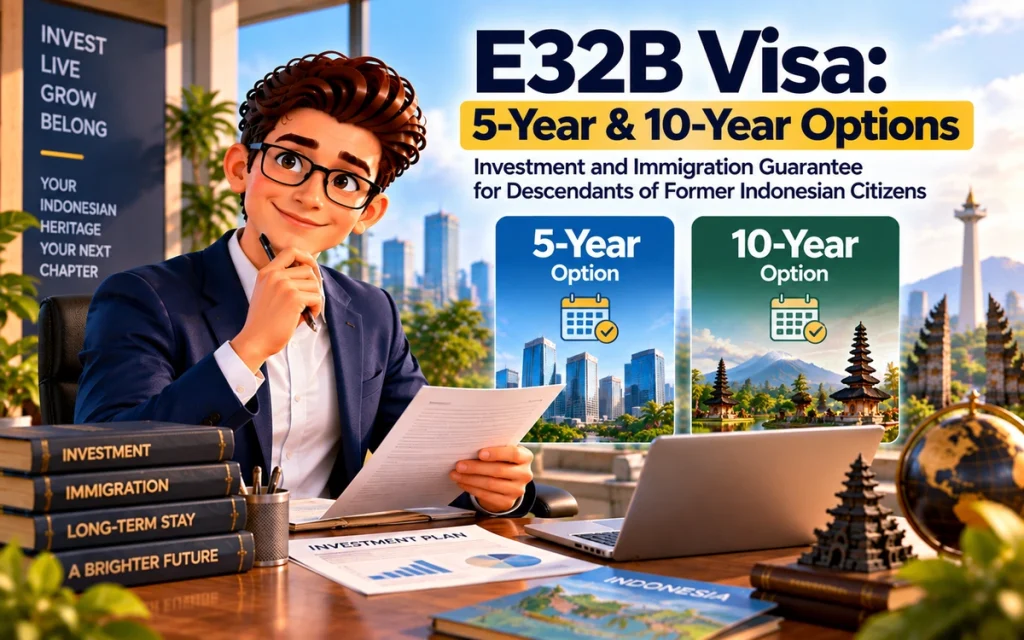
One of the most important financial requirements under E32B is the immigration guarantee.
5-Year E32B
The applicable immigration guarantee is USD 30,000. Permitted instruments include specified forms such as Indonesian government bonds, shares of publicly listed Indonesian companies, mutual funds, or deposits in a state-owned Indonesian bank.
10-Year E32B
The corresponding commitment for the ten-year option is USD 60,000 under the applicable instruments. Applicants should verify current requirements before transferring or placing funds.
The 90-Day Fulfillment Requirement
The current E32B framework requires the applicable commitment to be fulfilled and reported within the specified period after entering Indonesia.
Why Older E32B Information Can Be Confusing
Historical articles and older government materials may describe different Golden Visa amounts or structures. Applicants should prioritize current Directorate General of Immigration requirements.
7. How Long Does E32B Last and Can It Be Extended?
One common source of confusion is the difference between visa validity and the duration of the stay permit.
Visa Validity vs Stay Permit
The E32B visa allows entry under the relevant immigration framework, while the resulting stay permit provides the applicable residence period. Official E32B information provides five- or ten-year residence options and addresses extension under the applicable limits.
5-Year Option
The applicant can select the five-year E32B pathway when the requirements are satisfied.
10-Year Option
The ten-year option provides a longer initial residence period and has a higher immigration guarantee requirement.
Extension Rules
Immigration states that E32B’s stay permit can be extended subject to the applicable conditions and overall limits.
Conversion to Another Stay Permit
The official description also indicates that the stay permit can be converted into another type of stay permit where applicable requirements are satisfied.
8. E32B vs E32G: How Are the Descendant Pathways Different?
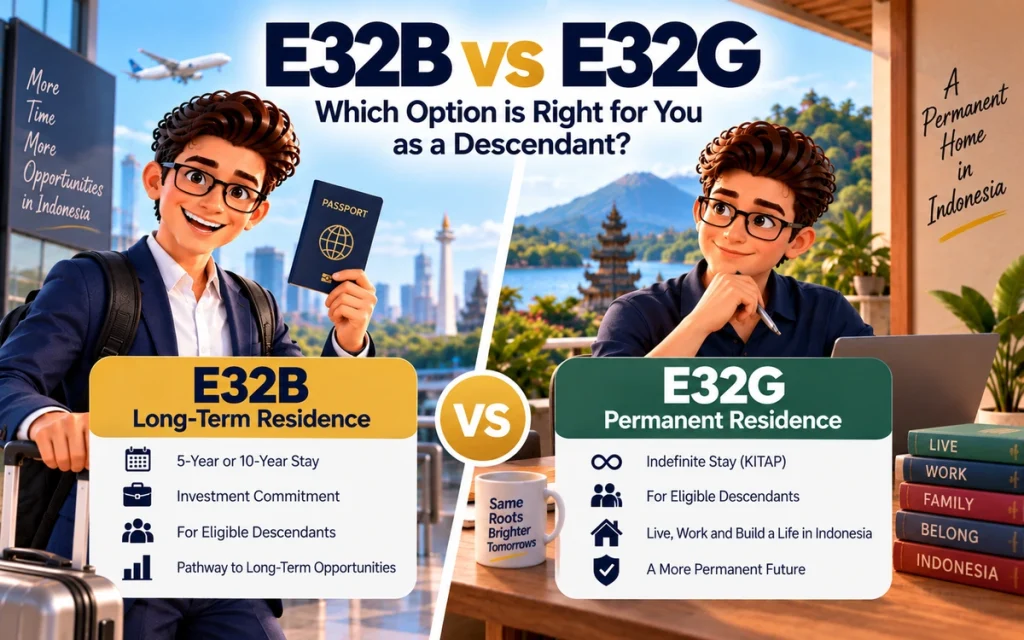
The current Immigration catalogue lists E32B as a 5 or 10-Year Descendant Visa and E32G as the Permanent Resident Descendant Visa under GCI.
| Feature | E32B | E32G |
| Immigration framework | Golden Visa | Global Citizen of Indonesia |
| Target | Eligible children/grandchildren of former Indonesian citizens | Qualifying descendants under GCI |
| Residence structure | 5 or 10 years | Indefinite permanent residence |
| Citizenship | Does not itself grant Indonesian citizenship | Does not change original citizenship |
| Sponsor | No sponsor under E32B | GCI framework |
| Main concept | Long-term residence | Permanent residence |
The exact eligibility and documentary requirements should be assessed against the current official rules. E32B and E32G represent different immigration structures; the appropriate route depends on the applicant’s circumstances.
9. GCI Permanent Residence for Descendants of Former Indonesian Citizens
The Global Citizen of Indonesia policy is particularly important for descendants because it introduced a permanent-residence framework recognizing strong ties to Indonesia.
GCI was officially launched on January 26, 2026. Immigration describes it as granting indefinite permanent residence to foreign nationals with specified ties to Indonesia, including descendants of former Indonesian citizens up to the second degree.
What Is GCI?
GCI is an immigration residence policy, not a new Indonesian citizenship category. The official announcement states that GCI provides indefinite permanent residence without changing the applicant’s original citizenship status.
Who Can Use E32G?
E32G is identified by Immigration as the Permanent Resident Descendant Visa under GCI. For descendants, the relevant relationship is generally within the second degree under the GCI framework.
How GCI Differs From E32B
The practical distinction is important when planning long-term residence. E32B is a temporary-stay descendant visa with a total stay framework that can extend up to ten years. E32G is part of the GCI system and is designed for qualifying descendants who meet the conditions for indefinite permanent residence. The two categories therefore address different residence outcomes even though both can be relevant to people with Indonesian ancestry.
The choice between these pathways should be based on the applicant’s actual eligibility and intended residence arrangement. A person should not select a category merely because it has a longer name or appears more permanent. The supporting evidence, financial conditions, immigration guarantee, and the specific GCI requirements should all be reviewed before submission.
E32B is a five- or ten-year descendant visa, while GCI’s descendant route can provide indefinite permanent residence for eligible applicants. Immigration states that eligible GCI e-visa holders receive an indefinite ITAP within 24 hours after entering Indonesia, subject to the applicable process.
Does GCI Give Indonesian Citizenship?
No. GCI does not itself change the applicant’s original citizenship.
10. Documents Proving Your Indonesian Ancestry
For a descendant-based immigration application, proving the family relationship can be as important as proving financial eligibility.
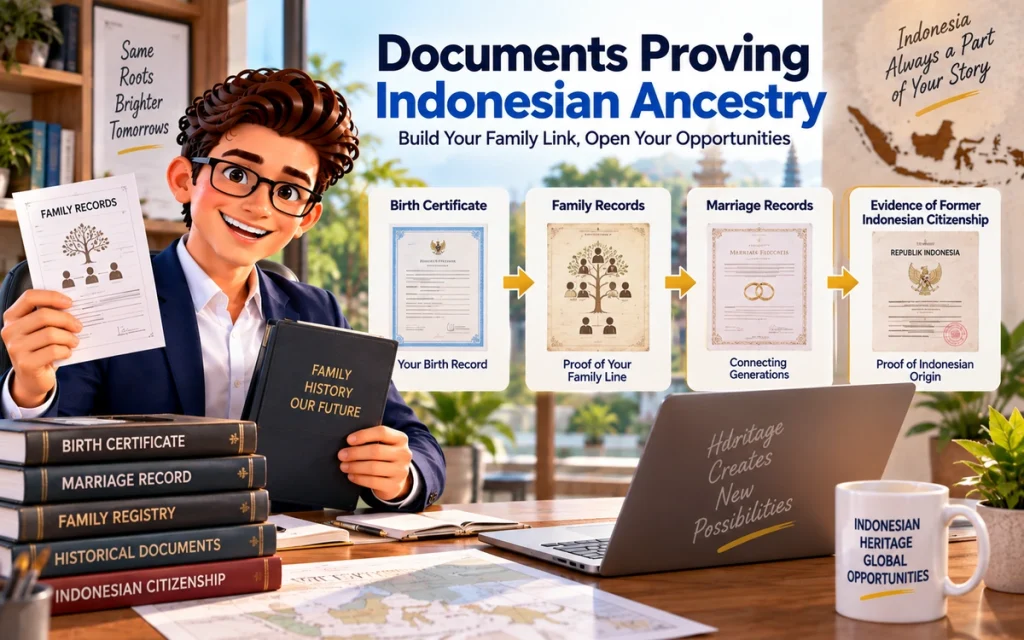
Establishing the Parent-Child Relationship
Useful evidence may include the applicant’s birth certificate, the parent’s civil records, documentation establishing the parent’s former Indonesian status, and other supporting records.
Establishing the Grandparent-Grandchild Relationship
For a grandchild, the chain is: Applicant → Parent → Grandparent → Former Indonesian Citizen. Each relevant relationship should be supported by appropriate documentation.
Birth Certificates and Civil Documents
Depending on the family history, useful documents may include birth certificates, marriage certificates, divorce records, death certificates where relevant, family records, previous Indonesian identity documents, citizenship documentation, and other official civil records.
When Additional Supporting Evidence May Be Needed
Additional evidence may be important when names changed after marriage, transliteration differs, records contain inconsistent dates, documents are unavailable, or the relationship passes through multiple generations. A strong application should present a consistent documentary chain.
11. Can Descendants Work, Study, and Bring Family to Indonesia?
Working in Indonesia
The E32B framework permits work-related activities, but the official description also refers to reporting those activities to the immigration office that issued the stay permit. This should not be read as a blanket exemption from other Indonesian employment, professional, licensing, tax, or sector-specific rules. Immigration permission and the legal requirements governing the actual work are related but not identical questions.
Applicants planning to work should therefore identify the activity, employer or business structure, and any additional permits or reporting that may apply before starting work. The same principle applies to education or other activities carried out in Indonesia.
The official E32B information allows work-related activities, subject to reporting to the relevant Immigration Office and other applicable Indonesian requirements. This should not be interpreted as an unrestricted exemption from employment, licensing or sector-specific rules.
Studying in Indonesia
Education is also listed among activities that may be undertaken under E32B, subject to applicable immigration requirements.
Bringing Spouse and Children
Immigration states that an E32B holder may bring family members to reside in Indonesia provided applicable immigration regulations are followed. Family members do not automatically receive the same E32B visa.
Entering and Leaving Indonesia
The official E32B description states that holders may enter and exit Indonesia during the validity of the stay permit without applying for a new visa, subject to the relevant conditions.
12. Do Descendants Need Indonesian Citizenship?
No general rule requires a descendant to become an Indonesian citizen simply because they have Indonesian ancestry. Residence is not citizenship.
E32B Does Not Automatically Make You Indonesian
E32B is an immigration pathway and does not by itself confer Indonesian citizenship.
GCI Does Not Change Original Citizenship
Immigration states that GCI grants indefinite permanent residence without changing the applicant’s original citizenship status.
When Citizenship Restoration Becomes Relevant
Former Indonesian citizens considering restoration of citizenship can also review Former Indonesian Citizen vs Indonesian Citizenship Restoration for a detailed comparison of the separate residence and citizenship concepts. Citizenship restoration is a separate legal issue. A former Indonesian citizen who wants to regain Indonesian citizenship must consider the applicable Indonesian citizenship law and the procedure corresponding to the legal basis under which Indonesian citizenship was previously lost.
13. Who May Not Qualify?
Not everyone with an Indonesian family connection will automatically qualify for a descendant visa. Eligibility depends on the relevant visa category and its requirements.
Beyond the Second Degree
The current descendant framework identifies children and grandchildren, or descendants up to the second degree, for the relevant categories. Someone whose Indonesian ancestor is more remote should not assume the same route applies.
Certain Government or Security Positions
The official E32B framework contains restrictions concerning certain foreign nationals who hold specific government, law-enforcement, intelligence or military positions abroad.
Separatist Involvement
The E32B framework also identifies certain individuals associated with separatist activities among excluded categories.
Conduct Contrary to National Interests
The official requirements contain eligibility restrictions related to conduct considered contrary to Indonesia’s national interests. Complex cases should receive an individual assessment.
14. How to Apply for a Descendant Visa
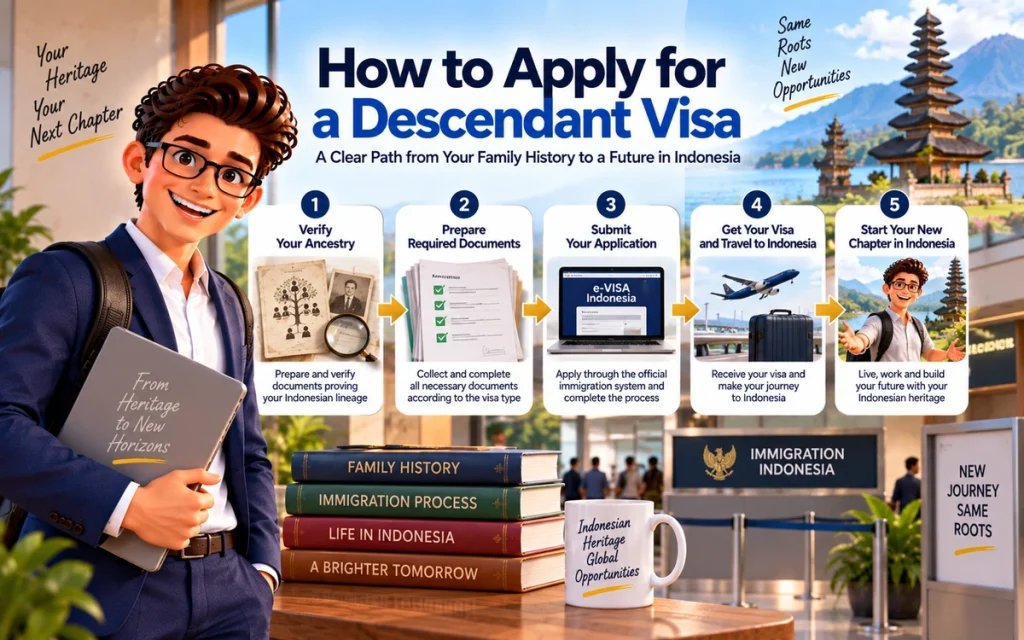
Step 1: Determine Your Descendant Category
Establish whether you are the child or grandchild of a former Indonesian citizen, or potentially within another specialized GCI category.
Step 2: Determine the Appropriate Visa Pathway
Former Indonesian citizens should also distinguish descendant-based immigration from repatriation pathways. See the Indonesia Repatriation Visa guide for more information about routes designed for people who previously held Indonesian citizenship.
Depending on the circumstances, the relevant category may include E32B, E32G, or another applicable immigration category.
Step 3: Prepare Proof of Ancestry
Build the documentary chain connecting you to the former Indonesian citizen.
Step 4: Prepare Financial and Immigration Documents
For E32B, this includes the applicable immigration guarantee and proof of financial capacity.
Step 5: Submit Through the Immigration System
GCI applications are submitted online through the Indonesian electronic visa system. Immigration states that GCI e-visas, including E32G, are integrated into the border-crossing system.
Step 6: Complete Verification and Payment
The application goes through applicable checking, payment, verification and approval stages.
Step 7: Receive the Visa
Once approved and issued, the applicant can use the visa according to its applicable entry conditions.
Step 8: Enter Indonesia and Obtain the Relevant Stay Permit
After entry, the applicant receives the relevant stay permit. For GCI e-visa holders, Immigration states that an indefinite ITAP is issued within 24 hours of entry, subject to the applicable process.
15. Costs and Processing Time
Costs can consist of government immigration fees, investment or immigration guarantee requirements, document preparation, translation or legalization where applicable, and professional assistance if used.
E32B 5-Year Cost
The current E32B government fee should be checked directly against the Immigration payment system at the time of application.
E32B 10-Year Cost
The ten-year option has a separate government fee and a higher immigration guarantee requirement. Applicants should verify the amount displayed in the official Immigration system before payment.
What the Government Fee Covers
Government immigration charges are only one part of the financial picture. An applicant may also have costs for translations, document legalization or apostille where applicable, civil-record retrieval, professional assistance, and any investment or immigration guarantee required by the selected category. These amounts should not be combined into one headline figure because they serve different purposes.
For reference, Indonesian Immigration offices publish general tariff information for stay permits, including separate tariffs for limited and permanent stay permits. However, a generic tariff page should not be treated as a substitute for the exact amount generated for the applicant’s specific E32B or GCI application. The official electronic visa or Immigration payment process should control the amount actually payable at the time of application.
The government fee relates to the official immigration service and should not be confused with the USD-denominated immigration guarantee or other personal and professional costs.
Processing Time
Processing time should be separated into two stages: preparation and Immigration processing. Preparation can take longer when an applicant must obtain historical civil records, prove a multi-generation relationship, correct inconsistent names, arrange translations, or prepare an investment commitment. Once the application is complete, the official system and Immigration verification process determine the processing timeline.
Applicants should therefore avoid treating a quoted processing period as a guarantee for the entire project. A straightforward application with complete documents can have a very different preparation timeline from an ancestry case requiring records from several jurisdictions.
Processing time depends on the completeness of the application, document verification, payment, Immigration review, and any additional requirements that may apply.
16. Common Mistakes Descendants Should Avoid
Assuming Any Indonesian Ancestry Automatically Qualifies
Having an Indonesian ancestor is important, but the applicable visa category has specific eligibility requirements.
Confusing E32B With GCI
Readers who are evaluating permanent residence options can also review the Former Indonesian Citizen KITAP guide for additional information about the KITAP framework for eligible former Indonesian citizens.
Confusing Residence With Citizenship
A long-term or permanent residence permit does not automatically make the holder an Indonesian citizen.
Using Outdated E32B Requirements
Golden Visa regulations have developed over time. Applicants should be careful with old articles containing outdated financial figures or visa conditions.
Failing to Establish the Family Relationship
A single document showing that an ancestor was Indonesian may not establish the complete relationship.
Misunderstanding the Visa Validity Period
Applicants should distinguish between the visa’s entry validity and the duration of the resulting stay permit.
Assuming Family Members Automatically Receive the Same Visa
A spouse or child may need a separate immigration basis.
17. Frequently Asked Questions
What visa can descendants of former Indonesian citizens get?
Eligible descendants may have access to specific descendant immigration pathways, including E32B and, for qualifying applicants, E32G under GCI.
Can a child of a former Indonesian citizen apply for E32B?
A child of a former Indonesian citizen falls within the first-degree descendant category described for E32B, subject to applicable requirements and documentation.
Can a grandchild of a former Indonesian citizen apply?
Yes, grandchildren are identified as second-degree descendants under the E32B framework, subject to applicable requirements.
Can great-grandchildren apply for the descendant visa?
Applicants should not automatically assume that great-grandchildren qualify. Current descendant descriptions identify children and grandchildren, or descendants up to the second degree.
How much does E32B cost?
E32B has separate government fees for the five-year and ten-year options, in addition to the applicable immigration guarantee and other potential costs. Confirm current tariffs through the official Immigration system before payment.
Does E32B require a sponsor?
The current official E32B description states that no sponsor is required.
Can E32B holders work in Indonesia?
The official E32B framework allows work-related activities, subject to reporting and other applicable Indonesian requirements.
What is E32G in Indonesia?
E32G is the Permanent Resident Descendant Visa under the Global Citizen of Indonesia framework.
What is the difference between E32B and E32G?
Former Indonesian citizens should also distinguish these pathways from repatriation options. See the Indonesia Repatriation Visa guide for more information.
Does GCI give Indonesian citizenship?
No. GCI provides indefinite permanent residence without changing the applicant’s original citizenship status.
Can descendants of former Indonesian citizens get permanent residence in Indonesia?
Qualifying descendants can potentially use the GCI descendant pathway. Immigration identifies E32G as the Permanent Resident Descendant Visa under GCI.
Do I need to restore Indonesian citizenship to live in Indonesia?
Not necessarily. Eligible foreign nationals may have immigration residence pathways that allow them to live in Indonesia without restoring Indonesian citizenship.
18. Key Takeaways
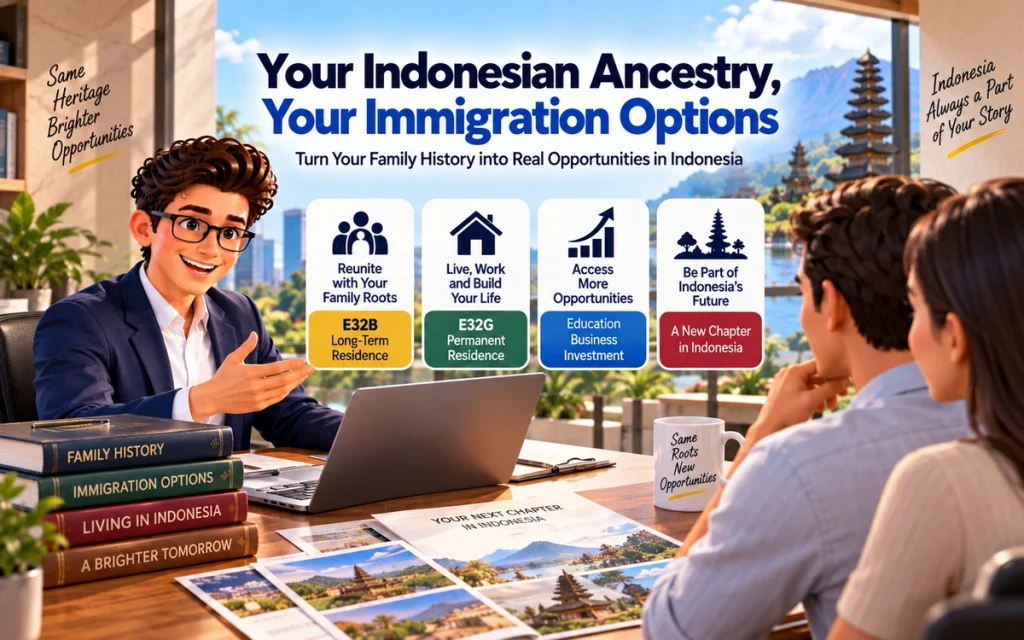
For descendants of former Indonesian citizens, Indonesian immigration offers more than one potential pathway.
E32B is the principal five- or ten-year descendant visa for eligible children and grandchildren of former Indonesian citizens.
E32G is the permanent-resident descendant pathway under the Global Citizen of Indonesia framework.
The two routes should not be treated as identical. E32B provides long-term residence, while GCI can provide indefinite permanent residence for qualifying applicants.
Prospective applicants should establish the family relationship, prepare the documentary chain, determine the applicable pathway, understand financial and immigration requirements, distinguish residence from citizenship, and verify current requirements with Indonesian Immigration before applying.
Need Help Understanding Your Indonesian Immigration Options?
Understanding your eligibility for an Indonesian descendant visa can depend on your family relationship, ancestry documents, and the immigration pathway that applies to your situation.
Get personalized assistance from our immigration team to understand your available options and the documents you may need.