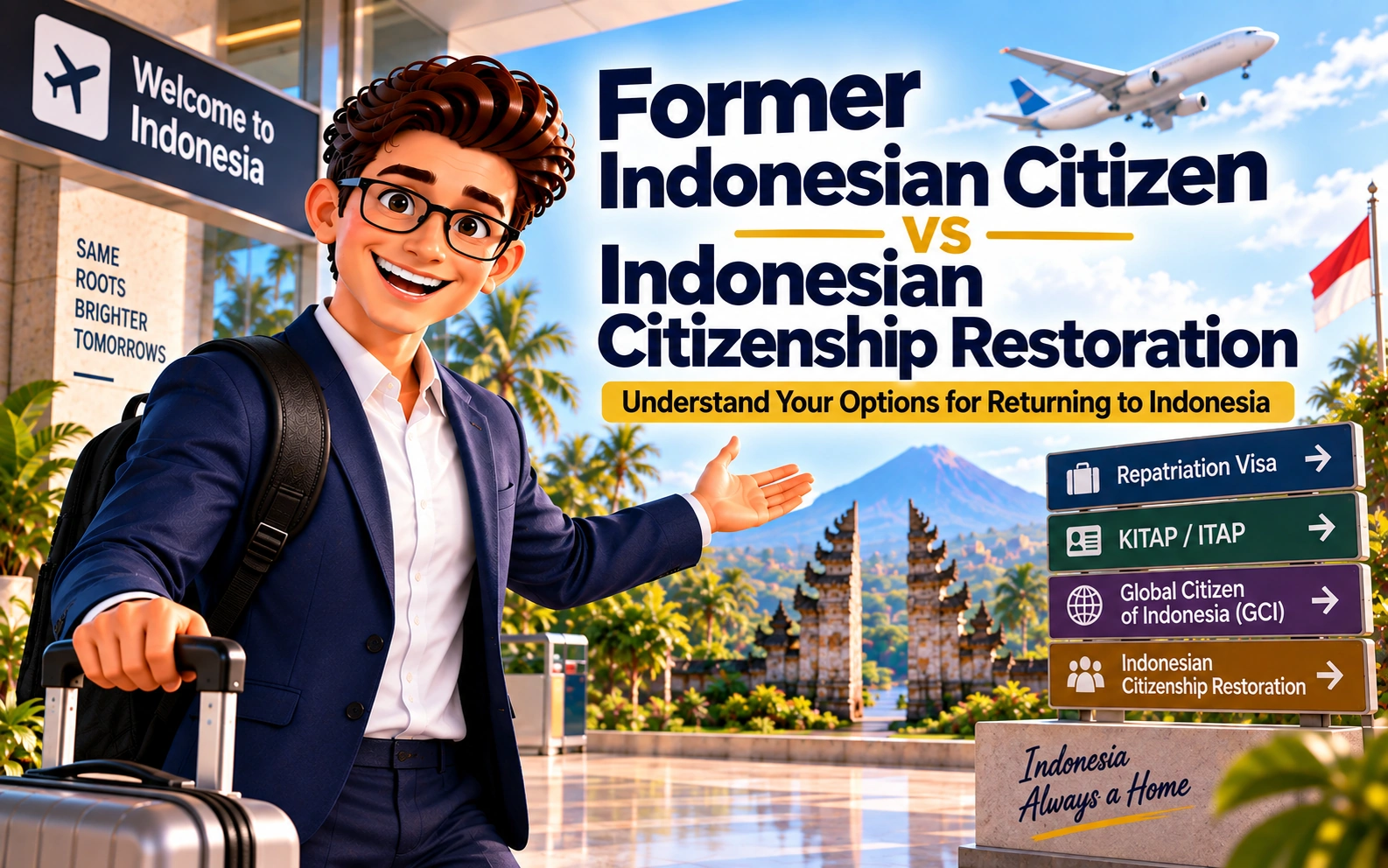
If you are a former Indonesian citizen who now holds foreign citizenship and want to return to Indonesia, there are several immigration options available in 2026. Understanding these options as part of the wider Indonesia Residency framework can help you determine which pathway may be relevant to your situation.
Depending on your circumstances, intended length of stay, and eligibility, you may be able to apply for a Former Indonesian Citizen Visa, an Indonesia Repatriation Visa, or a permanent residence route under the Global Citizen of Indonesia (GCI) framework.
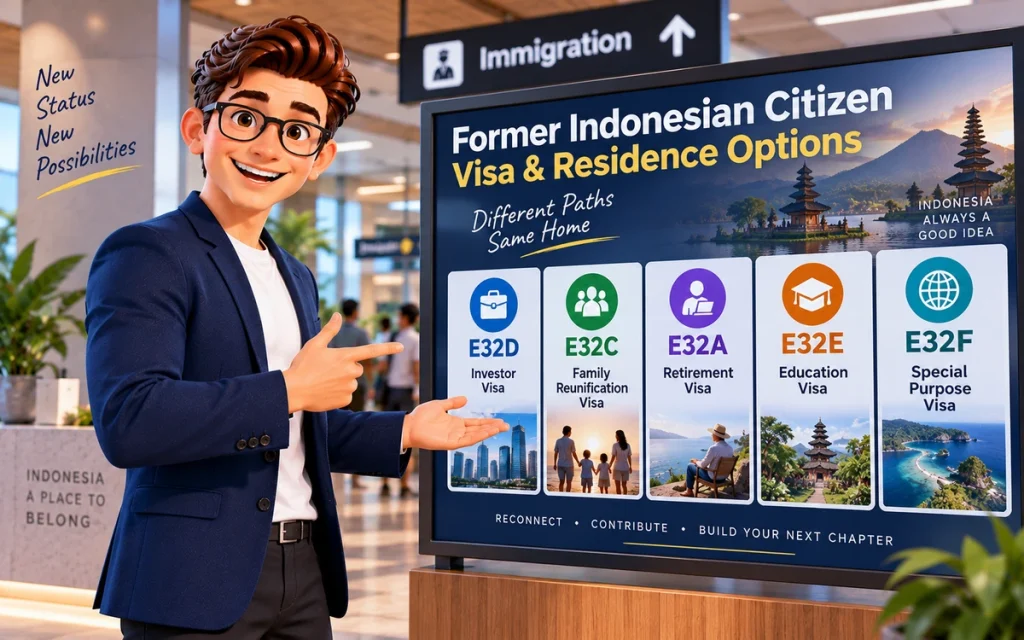
Current immigration routes include E32D for a 1-year repatriation stay, E32C for a 2-year repatriation stay, E32A for a 5-year repatriation route, and GCI-related routes including E32E and E32F.
Importantly, returning to Indonesia as a foreign national is different from restoring Indonesian citizenship. A visa, ITAS, ITAP, or GCI status does not by itself restore Indonesian citizenship.
This guide explains the main immigration options for former Indonesian citizens, the differences between repatriation and permanent residence, financial and documentary requirements, family options, and the process of returning to Indonesia in 2026.
1. What Is a Former Indonesian Citizen?

Who Is Considered a Former Indonesian Citizen?
A former Indonesian citizen is a person who previously held Indonesian citizenship but is now a citizen of another country.
This situation may arise when a person lost or relinquished Indonesian citizenship, acquired another nationality under circumstances recognized by Indonesian law, or otherwise ceased to be an Indonesian citizen.
For immigration purposes, proof that you previously held Indonesian citizenship can be important when applying for a repatriation or permanent residence route.
Why Former Indonesian Citizens May Need an Indonesian Visa or Stay Permit
Once a person is no longer an Indonesian citizen, their right to enter and remain in Indonesia is generally determined by their current nationality and immigration status.
Having previously been an Indonesian citizen does not automatically give a person the same immigration rights as a current Indonesian citizen.
A former Indonesian citizen who wants to return for an extended period therefore needs to determine the appropriate immigration route. Depending on eligibility, this may include a repatriation visa, a permanent residence route, or another immigration status.
Proof That You Previously Held Indonesian Citizenship
Applicants should prepare documents that establish their former Indonesian citizenship. Examples may include:
- Previous Indonesian passport
- Indonesian identity card or KTP
- Indonesian birth certificate
- Indonesian family records
- Indonesian diploma or educational document
- Certificate or other official evidence relating to previous Indonesian citizenship
- Other documents accepted by Indonesian Immigration
The exact documents required depend on the immigration category being applied for.
2. Can a Former Indonesian Citizen Return to Indonesia?
Returning to Indonesia as a Foreign National
Yes. A former Indonesian citizen who now holds foreign citizenship can return to Indonesia as a foreign national, subject to the applicable immigration requirements.
Indonesian Immigration has specific repatriation routes for former Indonesian citizens, including E32D, E32C, and E32A. Permanent residence options are also available through the Global Citizen of Indonesia framework for eligible applicants.
These routes form part of Indonesia’s broader Indonesia Residency system, which includes temporary residence, permanent residence, family-based residence, investment, work, education, repatriation, and other specialized pathways.
Your Immigration Options in 2026
| Immigration Route | General Purpose | Stay Framework |
| E32D | Repatriation for former Indonesian citizens | 1 year |
| E32C | Repatriation for former Indonesian citizens | 2 years |
| E32A | Long-term repatriation for former Indonesian citizens | 5-year visa route |
| E32E | Permanent Resident Repatriation under GCI | Indefinite permanent residence |
| E32F | Special Expertise Repatriation under GCI | Indefinite permanent residence |
The specific requirements, financial commitments, supporting documents, and eligibility conditions vary between categories.
Returning to Indonesia Does Not Automatically Restore Indonesian Citizenship
Immigration status and citizenship status are separate legal matters.
A former Indonesian citizen may legally live in Indonesia as a foreign national under an appropriate immigration status without becoming an Indonesian citizen again.
Likewise, obtaining permanent residence does not automatically restore Indonesian citizenship. If your objective is to become an Indonesian citizen again, you must separately examine the applicable Indonesian nationality laws and procedures.
3. Former Indonesian Citizen Visa Options in Indonesia
Overview of Repatriation and Global Citizen of Indonesia Routes
Indonesian Immigration currently lists repatriation and Global Citizen of Indonesia routes specifically relevant to former Indonesian citizens. The main routes discussed in this guide are E32D, E32C, E32A, E32E, and E32F.
E32D, E32C, and E32A are repatriation routes with different periods of stay. E32E and E32F are connected to the Global Citizen of Indonesia framework and are designed for permanent residence in Indonesia.
E32D — 1-Year Repatriation Visa
E32D is the 1-Year Repatriation Visa for former Indonesian citizens. It provides a route for eligible former Indonesian citizens who want to return to Indonesia under a temporary stay framework. The E32D route may be relevant for applicants who want a shorter repatriation period rather than immediately pursuing indefinite permanent residence. Applicants should verify the current documentary and financial requirements applicable to E32D before submitting an application.
E32C — 2-Year Repatriation Visa
E32C is the 2-Year Repatriation Visa for former Indonesian citizens. It provides a longer repatriation stay than E32D and may be relevant to former Indonesian citizens who want to spend an extended period in Indonesia while remaining under a temporary residence framework. The exact application requirements should be confirmed based on the applicant’s circumstances and the current Immigration system at the time of application.
E32A — 5-Year Repatriation Visa
E32A is the 5-Year Repatriation Visa for foreign nationals who previously held Indonesian citizenship and intend to return to Indonesia for residence. The E32A stay permit can be extended, subject to the applicable rules, with total stay not exceeding 10 years. It also allows entry and exit during the validity of the stay permit without requiring a new visa.
E32E — Permanent Resident Repatriation Visa
E32E is the Permanent Resident Repatriation Visa under the Global Citizen of Indonesia framework. It is relevant to eligible former Indonesian citizens who want permanent residence rather than a fixed-term repatriation stay.
E32F — Special Expertise Repatriation Visa
E32F is the Special Expertise Repatriation Visa under the Global Citizen of Indonesia framework. This route is intended for eligible applicants who fall within the special expertise category. Eligibility is category-specific; special expertise alone should not be treated as an automatic guarantee of approval.
4. Indonesia Repatriation Visa for Former Indonesian Citizens
What Is the Indonesia Repatriation Visa?
The Indonesia Repatriation Visa is an immigration route designed for eligible former Indonesian citizens who want to return to Indonesia as foreign nationals. The current Immigration framework includes different repatriation categories, including E32D, E32C, and E32A.
The route allows former Indonesian citizens to return to Indonesia without requiring them to regain Indonesian citizenship first.
E32D: 1-Year Repatriation Visa
E32D provides a 1-year repatriation route for former Indonesian citizens. It may be relevant to applicants who want to return to Indonesia for a defined period and do not initially require a longer-term repatriation arrangement.
E32C: 2-Year Repatriation Visa
E32C provides a 2-year repatriation route. It may be considered by former Indonesian citizens who intend to spend more time in Indonesia while remaining under a temporary stay arrangement.
E32A: 5-Year Repatriation Visa
E32A provides a longer-term repatriation route and is specifically intended for former Indonesian citizens planning to return to Indonesia for residence. Its stay can be extended subject to the applicable rules, with total stay not exceeding 10 years.
Which Repatriation Option May Suit Your Situation?
The appropriate route depends on your personal circumstances and long-term objective. Consider the following questions:
- How long do you intend to live in Indonesia?
- Do you want temporary residence or indefinite permanent residence?
- Do you have documentation proving your previous Indonesian citizenship?
- Do you meet the financial or investment requirements applicable to your chosen route?
- Do you intend to work, operate a business, study, or undertake another activity in Indonesia?
- Do you want your spouse or children to accompany you?
- Is your ultimate objective to regain Indonesian citizenship?
5. Global Citizen of Indonesia for Former Indonesian Citizens
What Is Global Citizen of Indonesia?
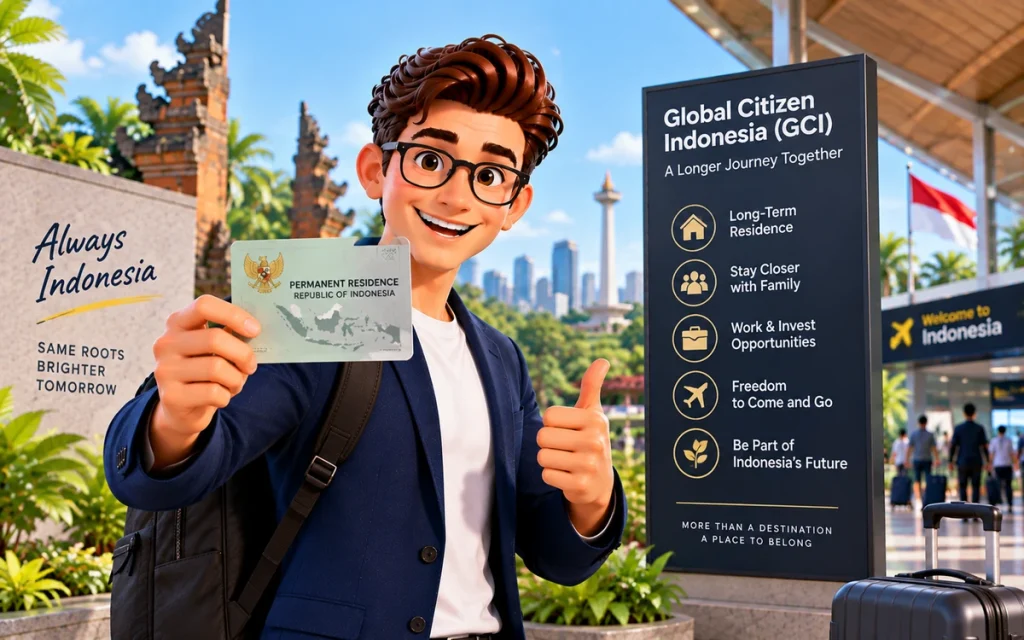
Global Citizen of Indonesia (GCI) is an Indonesian Immigration policy introduced in January 2026 that provides indefinite permanent residence to eligible foreign nationals who have qualifying blood, family, historical, or strong connections with Indonesia. Former Indonesian citizens are specifically included among the categories covered by GCI.
How GCI Applies to Former Indonesian Citizens
For former Indonesian citizens, GCI provides a pathway to permanent residence in Indonesia without requiring the applicant to first become an Indonesian citizen again. The GCI framework includes E32E for permanent resident repatriation and E32F for special expertise repatriation. Applicants must still satisfy the requirements applicable to their particular GCI category.
For a detailed explanation of GCI eligibility, requirements, application procedures, and related categories, read our complete Global Citizen of Indonesia guide.
GCI and Permanent Residence in Indonesia
One of the major characteristics of GCI is indefinite permanent residence. The policy specifically includes former Indonesian citizens and certain descendants, spouses, mixed-marriage children, and family members under applicable family reunification arrangements.
Does GCI Restore Indonesian Citizenship?
No. GCI does not automatically restore Indonesian citizenship. The GCI framework provides permanent residence without changing the individual’s citizenship status. Therefore, a former Indonesian citizen may hold foreign citizenship while maintaining indefinite permanent residence in Indonesia through the applicable GCI route.
6. E32E Indonesia: Permanent Residence for Former Indonesian Citizens
What Is E32E?
E32E Indonesia is the Permanent Resident Repatriation Visa under the Global Citizen of Indonesia framework. It is specifically relevant to eligible former Indonesian citizens who want permanent residence in Indonesia.
Who Can Apply for E32E?
E32E is intended for eligible former Indonesian citizens who satisfy the requirements of the Global Citizen of Indonesia framework. Eligibility should be assessed based on the applicant’s individual circumstances, including proof of previous Indonesian citizenship and the financial or immigration guarantee requirements applicable to the category.
E32E and Global Citizen of Indonesia
E32E should be understood as part of the GCI immigration framework rather than as a completely separate permanent residence program. The official Immigration visa list identifies E32E as the Permanent Resident Repatriation Visa Global Citizen of Indonesia.
Because E32E results in permanent residence under the GCI framework, applicants should also understand how ITAP/KITAP works more broadly. See our complete guide to Indonesia KITAP (ITAP) for an explanation of permanent stay permits, eligibility routes, and the distinction between KITAP and Indonesian citizenship.
E32E Compared With Repatriation ITAS
A repatriation ITAS is a temporary residence arrangement with a defined period of stay. E32E is associated with GCI and indefinite permanent residence for eligible applicants.
What Happens After Entering Indonesia?
Under the GCI implementation announced by Indonesian Immigration, GCI e-visa holders receive an indefinite ITAP after entering Indonesia. Applicants should still follow the current entry declaration and immigration procedures applicable at the time of travel.
7. E32F for Former Indonesian Citizens With Special Expertise
What Is E32F?
E32F is the Special Expertise Repatriation Visa Global Citizen of Indonesia. It is part of the GCI framework and is intended for eligible foreign nationals who fall within the special expertise category.
Who May Qualify?
Eligibility depends on the applicant’s circumstances and whether the applicant satisfies the special expertise requirements established by Indonesian Immigration. The category should not be interpreted as a general visa available to anyone who describes themselves as an expert.
Government Sponsorship or Supporting Documentation
Special expertise applicants may be required to provide documentation demonstrating the relevance and importance of their expertise. The exact supporting documents should be confirmed before an application is submitted.
E32F vs E32E
Both E32E and E32F are connected to GCI and permanent residence. E32E is the permanent resident repatriation route for eligible former Indonesian citizens, while E32F is associated with the special expertise category.
8. Requirements for Former Indonesian Citizens
Valid Foreign Passport
Former Indonesian citizens applying as foreign nationals must have a valid passport issued by their current country of nationality.
Proof of Previous Indonesian Citizenship
Applicants should prepare evidence demonstrating that they previously held Indonesian citizenship. Depending on the procedure, acceptable evidence may include a previous Indonesian passport, KTP or Indonesian identity document, birth certificate, diploma, certificate of loss of Indonesian citizenship, or other official documents showing previous Indonesian citizenship.
Proof of Sufficient Funds
Certain repatriation and GCI categories have financial requirements. These requirements should not be treated as universal because the applicable threshold and type of financial evidence can differ according to the immigration route.
Immigration Guarantee Where Required
Some immigration categories require an immigration guarantee. The form and value of the guarantee depend on the applicable immigration category.
Other Supporting Documents
Additional documents may include application documents, guarantee documents where applicable, domicile information, proof of financial capacity, documents establishing previous Indonesian citizenship, family documents, and category-specific supporting documents.
Because requirements differ between E32D, E32C, E32A, E32E, and E32F, applicants should not rely on a single generic document checklist.
9. Investment and Financial Requirements

Investment Requirements for Repatriation Visas
Financial and investment requirements depend on the specific repatriation category. For example, the E32A route includes an immigration guarantee commitment of at least USD 25,000 in qualifying Indonesian government bonds, publicly listed Indonesian shares, Indonesian mutual funds, or deposits at a state-owned bank.
This USD 25,000 amount is an immigration guarantee commitment, not the visa application fee.
Financial Requirements for GCI
GCI has specific financial requirements for certain categories. For former Indonesian citizens and descendants covered by the relevant provisions, Indonesian Immigration has stated a minimum income requirement of approximately USD 1,500 per month or USD 15,000 per year, alongside applicable immigration guarantee requirements.
Immigration Guarantee
An immigration guarantee is a financial commitment associated with the immigration status rather than simply being a visa fee. The form and value of the guarantee depend on the applicable immigration category.
Is the Immigration Guarantee Refundable?
For GCI, the immigration guarantee can be returned when the GCI holder ends their stay or changes their immigration status, subject to the applicable rules and conditions. Applicants should confirm the current procedure before making any investment or financial commitment.
10. Can Former Indonesian Citizens Work or Do Business in Indonesia?
Activities Allowed Under Repatriation Stay Permits
Immigration status determines what activities a foreign national may legally undertake in Indonesia. The E32A framework, for example, allows certain work, education, or other activities subject to reporting and compliance with applicable regulations.
Work Activities and Immigration Rules
If you intend to work in Indonesia, the specific nature of the work and your immigration status must be examined carefully. Additional employment requirements may apply depending on the type of activity, employer, position, and applicable Indonesian regulations.
If your long-term objective involves employment and permanent residence, you may also want to review our Working KITAP guide to understand the separate requirements for permanent residence through the employment route.
Business Activities and Other Permitted Activities
A former Indonesian citizen may be able to establish or participate in business activities in Indonesia, but the appropriate immigration and business structure must be considered separately. Immigration status should not be treated as a substitute for other business licensing, corporate, tax, or regulatory requirements.
If your plans involve investment in an Indonesian company, you can also review our Investor KITAP guide for information about the permanent residence route associated with qualifying investment circumstances.
Why Your Stay Permit Matters
The relevant questions include: What immigration status do you hold? What activity do you intend to undertake? Is that activity permitted under your status? Do you need additional authorization or reporting? Are there separate Indonesian business or employment regulations that apply?
11. Can Your Family Join You in Indonesia?

Bringing Family Members to Indonesia
Some repatriation and GCI arrangements allow eligible applicants to bring family members to Indonesia. The exact immigration route for each family member depends on the relationship, nationality, age, and applicable immigration category.
If your spouse, children, or other eligible family members will also live in Indonesia, you may need to consider a separate family-based immigration route. See our Indonesia Family Visa guide for an overview of family-based visa categories and eligibility.
Family Reunification Options
GCI includes family reunification provisions for certain eligible family members.
Spouse and Children
Spouses and children may have separate immigration options depending on their relationship to the principal applicant and the applicable GCI or family immigration category. For family members who may eventually qualify for permanent residence, our Family KITAP guide provides additional information about the family-based permanent stay route.
GCI Family Options
The GCI framework is broader than repatriation of former Indonesian citizens alone. It also covers certain descendants of former Indonesian citizens, spouses of Indonesian citizens, children from mixed marriages, and eligible family members through family reunification.
12. Former Indonesian Citizen vs Regaining Indonesian Citizenship
Living in Indonesia as a Foreign National
A former Indonesian citizen can potentially live in Indonesia as a foreign national under an appropriate immigration status. This allows the individual to maintain their current foreign nationality while obtaining permission to reside in Indonesia.
Permanent Residence Does Not Mean Indonesian Citizenship
Permanent residence and citizenship are different legal statuses. An ITAP allows a foreign national to maintain permanent residence in Indonesia under the applicable immigration framework. If you want to understand the broader permanent residence system, see our complete guide to Indonesia KITAP (ITAP).
Returning to Indonesian Citizenship
If your objective is to become an Indonesian citizen again, the process must be assessed under Indonesian citizenship law. This is separate from applying for a repatriation visa or GCI.
Immigration Status vs Citizenship Status
Before choosing an immigration route, determine whether your objective is temporary or long-term residence in Indonesia as a foreign national, permanent residence while retaining foreign citizenship, or restoration or acquisition of Indonesian citizenship under the applicable nationality rules.
13. How to Choose the Right Option
If You Want a Shorter Repatriation Stay
E32D may be relevant if you are looking for a 1-year repatriation route.
If You Want a Longer Repatriation Stay
E32C provides a 2-year repatriation route. E32A provides a longer-term repatriation option and is specifically intended for former Indonesian citizens planning to return to Indonesia for residence.
If You Want Permanent Residence
If your objective is indefinite permanent residence, the GCI framework should be examined. For eligible former Indonesian citizens, E32E is the Permanent Resident Repatriation Visa under GCI. You can also learn more about the broader permanent residence system in our Indonesia KITAP (ITAP) guide.
If You Qualify Under the Special Expertise Category
E32F may be relevant if you meet the special expertise requirements. This category should be assessed based on the actual eligibility criteria and supporting documentation.
If Your Goal Is to Become an Indonesian Citizen Again
If your ultimate goal is to regain Indonesian citizenship, do not select an immigration route solely on the assumption that permanent residence will automatically lead to citizenship. Immigration residence and citizenship are separate matters.
Applicants whose long-term plans are primarily related to retirement should also review the applicable retirement residence framework. See our Retirement KITAP guide for more information.
14. How to Apply as a Former Indonesian Citizen
Prepare Your Documents
Begin by collecting documents proving your current foreign nationality, previous Indonesian citizenship, identity, financial eligibility, family relationship where applicable, and any investment or immigration guarantee required for the selected category.
Submit the Visa Application
The application process depends on the selected visa category. GCI applications are submitted online through the official Indonesian Immigration e-visa system.
Immigration Verification
Immigration may review the applicant’s identity, citizenship history, supporting documents, financial evidence, and eligibility for the selected category. Additional documentation may be requested where necessary.
Visa Issuance
Once the application satisfies the applicable requirements and is approved, the relevant visa or immigration document can be issued. Applicants should carefully check the validity period, permitted activities, and conditions attached to their immigration status.
Enter Indonesia
After receiving the appropriate visa, the applicant can enter Indonesia according to the applicable immigration procedures.
Receiving the Appropriate Stay Permit
For GCI, the applicable implementation provides an indefinite ITAP after entry. For temporary repatriation routes, the applicable ITAS and its validity depend on the selected visa category.
15. Frequently Asked Questions
Can a former Indonesian citizen live in Indonesia?
Yes. A former Indonesian citizen who now holds foreign citizenship can live in Indonesia if they obtain and maintain an appropriate immigration status. Depending on eligibility, this may include a repatriation route or permanent residence through GCI.
What visa is available for former Indonesian citizens?
Current repatriation routes include E32D, E32C, and E32A. Eligible former Indonesian citizens may also qualify for GCI-related permanent residence routes such as E32E or E32F, depending on their circumstances.
What is the Indonesia Repatriation Visa?
The Indonesia Repatriation Visa is an immigration route designed for eligible former Indonesian citizens returning to Indonesia as foreign nationals. The current framework includes different repatriation categories with different stay periods.
Can a former Indonesian citizen get permanent residence in Indonesia?
Yes, eligible former Indonesian citizens may be able to obtain permanent residence under the Global Citizen of Indonesia framework.
What is E32E Indonesia?
E32E is the Permanent Resident Repatriation Visa under the Global Citizen of Indonesia framework. It is relevant to eligible former Indonesian citizens seeking permanent residence in Indonesia.
Does GCI give Indonesian citizenship?
No. GCI provides indefinite permanent residence but does not automatically change the holder’s citizenship.
Can former Indonesian citizens work in Indonesia?
Potentially, depending on the immigration status and applicable regulations. The specific activity should always be checked against the applicant’s actual immigration status.
Can my family join me in Indonesia?
Potentially, depending on the applicable repatriation or GCI family provisions. GCI includes family reunification arrangements for eligible family members under the applicable rules.
Can I become an Indonesian citizen again?
Potentially, depending on your circumstances and the requirements of Indonesian citizenship law. The process of becoming an Indonesian citizen again is separate from obtaining an Indonesian residence permit.
How do I prove that I was previously an Indonesian citizen?
Documents may include a previous Indonesian passport, KTP, birth certificate, diploma, certificate of loss of Indonesian citizenship, or other official documents demonstrating previous Indonesian citizenship. The exact evidence required depends on the immigration procedure.
Former Indonesian citizens are one of several groups covered by Indonesia’s broader residence framework. To understand how repatriation, family, work, investment, permanent residence, and other immigration pathways fit together, see our complete Indonesia Residency guide.
16. Get Professional Help With Your Indonesia Immigration Options
Returning to Indonesia as a former Indonesian citizen can involve more than choosing a visa.
The correct immigration route depends on your previous Indonesian citizenship, current nationality, intended length of stay, financial circumstances, family situation, intended activities in Indonesia, and whether your ultimate objective is residence or citizenship.
Azra Solutions can help former Indonesian citizens assess their available immigration options, review supporting documents, identify the appropriate visa or residence route, and assist with the application process.
If you are unsure whether E32D, E32C, E32A, E32E, E32F, GCI, or another immigration route is appropriate for your situation, a professional assessment can help you determine the next step before submitting an application.
Contact Azra Solutions to discuss your Indonesia immigration options as a former Indonesian citizen.
Official Immigration Sources
Information in this guide is based primarily on official Indonesian Immigration sources and reflects the immigration framework available in 2026.
Immigration regulations, visa categories, requirements, fees, and procedures may change. Applicants should verify the current requirements with Indonesian Immigration before submitting an application or making a financial commitment.