Foreign artists planning to undertake professional activities in Indonesia should identify the correct immigration and employment route before travelling or beginning an engagement. The appropriate pathway depends on the actual activity, the nature and duration of the engagement, the Indonesian sponsor or employer, and the applicable immigration and manpower rules. This guide explains the E23R artist work visa framework, short-term art-related visit activities, supporting documents, RPTKA considerations, and the application process. For broader context, see the Indonesia work visa guide for foreign professionals and the Indonesia temporary work visa guide.
This article is general information, not an individual legal opinion. Visa classifications, online application requirements, and implementing rules may change. Applicants and sponsors should verify current requirements with the Directorate General of Immigration and the relevant manpower authority before making travel or employment commitments.
Understanding the Indonesia Artist Work Visa
Who Is Considered a Foreign Artist?
The term foreign artist can cover creative professionals whose work is artistic in nature, including visual artists, painters, sculptors, illustrators, installation artists, and other practitioners engaged in creative or cultural projects. The label used by an applicant or event organizer does not, by itself, determine the correct visa category. Authorities may consider the actual duties, contractual arrangement, Indonesian host, duration, and whether the person is entering an employment relationship.
This guide focuses on artists outside the dedicated musician and singer topic addressed separately in AzraID’s planned musician and singer article. A person who performs music, works as a singer or DJ, or joins a music production crew should not automatically rely on this article. Their activity may fall under a different visit-visa or work-visa classification.
When Do Foreign Artists Need Work Authorization?
A foreign national engaged to work in Indonesia for an Indonesian employer or organization may fall within the foreign-worker framework. Immigration permission and manpower authorization are related but distinct: a visa or stay permit addresses immigration status, while manpower approval concerns the Indonesian employer’s authority to employ a foreign worker where required. Holding a visa does not automatically resolve every employment-law obligation.
This distinction matters where an artist is contracted for an ongoing role, receives remuneration from an Indonesian entity, works under the direction of a local organization, or performs duties over an extended period. A short visit for a limited artistic activity may be treated differently, but the parties should not assume that every paid appearance is automatically permitted under a visit visa.

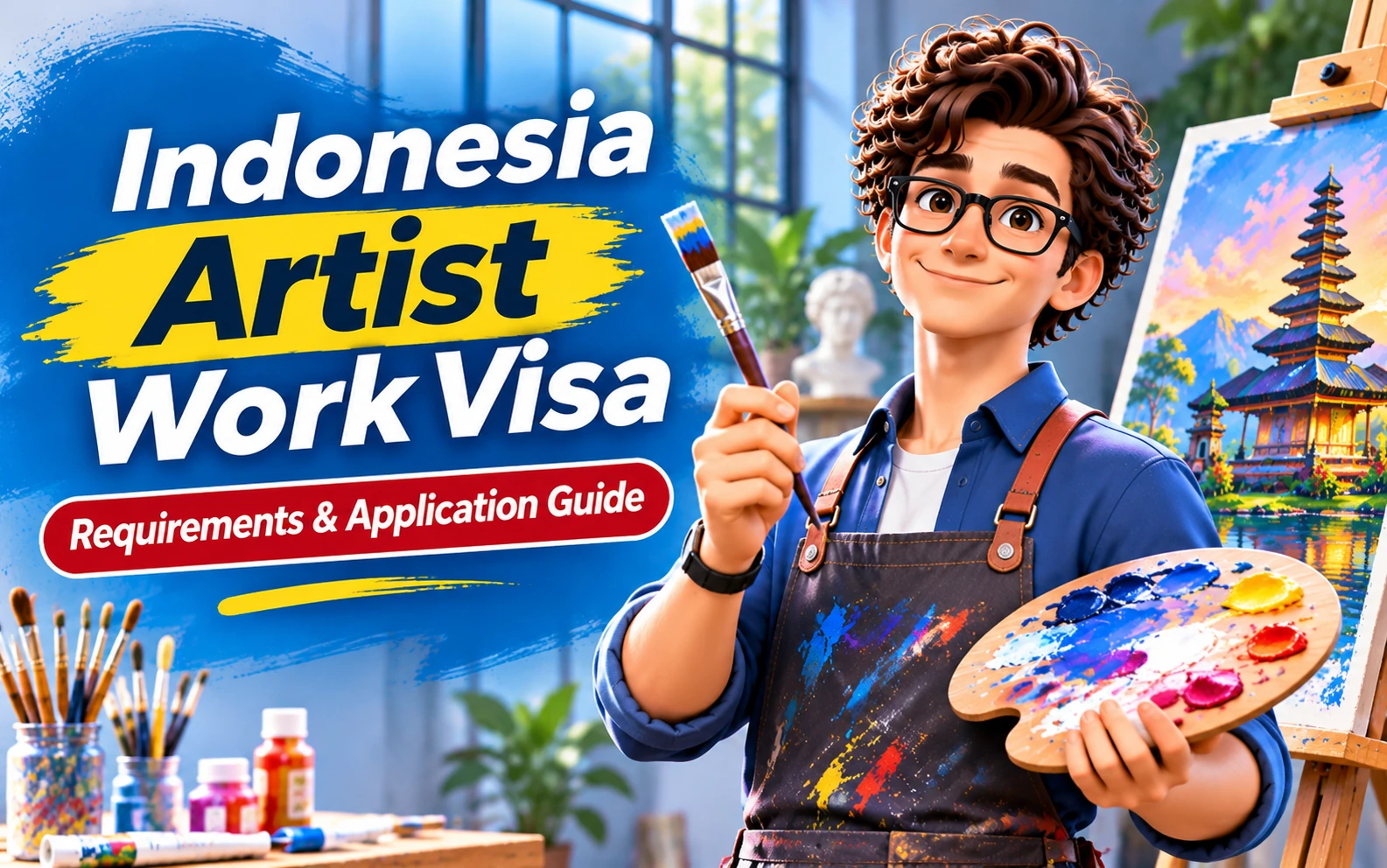
E23R Visa Indonesia: Artist Work Visa Explained
What Is the E23R Visa?
E23R is identified in Indonesian immigration service information as a limited-stay visa for working as an artist. The official immigration listing places the artist category within the E23 work-visa family. The initial stay periods published for the E23 work-visa family include 180 days, one year, and two years, subject to the applicable subcategory and current rules. Applicants should confirm the exact stay period and conditions displayed in the live eVisa system at the time of application.
Official reference: Immigration Office – ITAS categories and extensions
The E23R route should be assessed for an artist whose proposed activity is genuinely work as an artist in Indonesia and whose sponsor and supporting arrangements meet applicable requirements. It should not be selected solely because an applicant describes themselves as an artist. The specific job, contract, sponsor, and permitted activities must align with the visa classification.
Who Can Apply for an E23R Artist Visa?
An E23R application may be relevant to a foreign artist engaged by an eligible Indonesian sponsor or organization for an artistic role. The sponsor’s legal status, proposed position, contract or engagement documents, and any required manpower approval should be reviewed before submission. The applicant should ensure that their professional background and documents accurately support the activity described in the application.
There is no universal checklist that fits every artistic discipline or engagement. A visual artist participating in a long-term creative project may have a different supporting-document profile from an artist employed by a production company or cultural institution. The sponsor should confirm the current document list and application pathway through the official immigration system.
E23R Visa and Artist KITAS
KITAS is commonly used to refer to an Indonesian limited-stay permit (ITAS). E23R is the visa classification associated with the artist work route; the limited-stay permit is the immigration status granted through the relevant process. In everyday discussions, people may call the resulting work stay permit an Artist KITAS. A marketing label should not be mistaken for a separate legal category.
The duration, extension eligibility, and conditions of stay must be checked against the actual approval and current immigration rules. Applicants should not assume that every duration is available in every case or rely on third-party processing-time and fee claims as official government commitments.
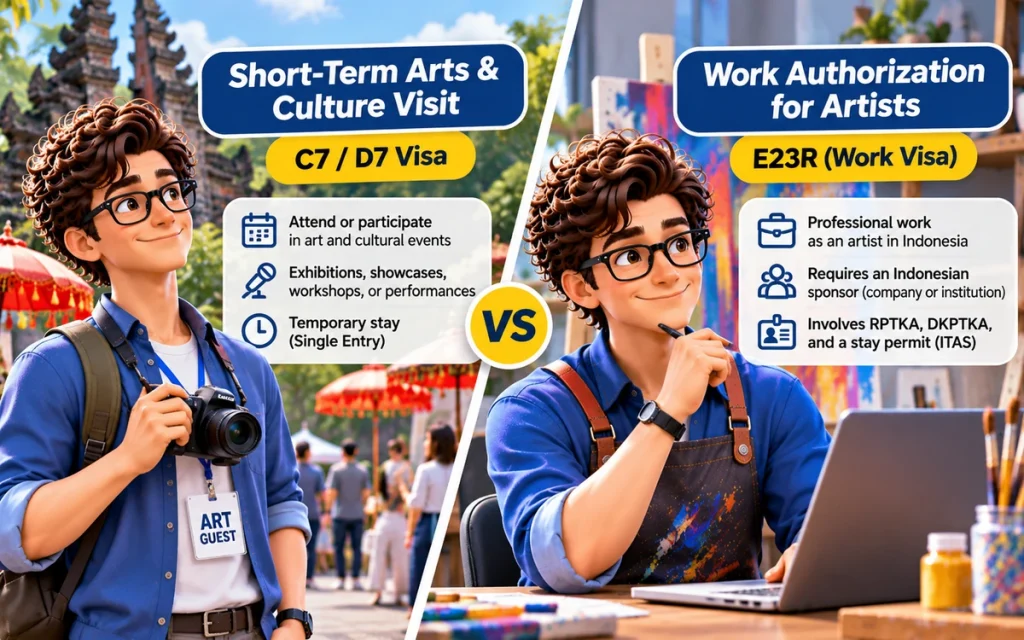
Short-Term Arts and Culture Visits: C7 and D7
How Should C7 and D7 Be Understood?
The visa classification landscape requires careful checking. The Minister of Immigration and Corrections Decree No. M.IP-08.GR.01.01 of 2025 is the current published visa-classification reference identified by the Ministry. It sets out D7 as a multiple-entry arts-and-culture visit category for specified activities, including theatre, dance, and circus. Separately, Immigration’s operational Molina user guide published in 2026 continues to display C7 as a general art performer and crew category, alongside C7A for music performers and C7B for music performer crew. These references should not be treated as interchangeable: D7 is the category described in the 2025 decree, while C7/C7A/C7B appear in operational application guidance. The exact category available for a particular activity must be checked in the live eVisa system before filing.
A short-term arts-and-culture visit category is not the same as an artist work route. The 2025 decree describes D7 as a visit category and sets out its own permitted activities and restrictions, including a prohibition on working in an employment relationship with an Indonesian individual or corporation and on selling goods or services. Do not transfer conditions from an older C7 classification document to D7, or assume that an operational code shown in an online guide has identical conditions. Review the current official description attached to the selected code.
When Is a Short-Term Art Visit Visa Appropriate?
A visit category may be relevant where the artist is undertaking a defined arts-and-culture activity that falls within the exact permissions of the category available in the current system. The 2025 decree describes D7 for specified arts-and-culture activities such as theatre, dance, and circus. Because the operational Molina guide also lists C7, the organizer should confirm which code is currently selectable and appropriate for the proposed event, and should read the restrictions attached to that code before making commitments.
No visit category should be treated as blanket permission for every paid artistic engagement. The legal distinction between a permitted visit activity and employment by an Indonesian person or corporation remains important. The organizer should verify the exact permitted activity, payment restrictions, sponsor requirements, and any prohibition on sales or employment stated for the live category. If the arrangement is in substance employment or ongoing work, assess the relevant work-permit pathway instead.
C7 vs. E23R: Understanding the Difference
The practical distinction is the legal purpose and nature of the activity. E23R is still identified in an Immigration Office ITAS service listing as a limited-stay visa for working as an artist. The 2025 classification decree, however, sets out the general E23 work route and does not itself name E23R in its published text. For short-term arts-and-culture visits, the same 2025 decree describes D7, while the 2026 Molina guide continues to list C7 and related C7A/C7B operational categories. Because these sources do not present the codes in exactly the same way, applicants should not assume that a code in an older guide or service page is automatically selectable or suitable today.
Where there is uncertainty, the sponsor should obtain case-specific confirmation from Immigration before signing contracts, advertising an event, purchasing non-refundable travel, or allowing the artist to begin activities. The code selected in the live eVisa portal and the conditions attached to the issued visa must govern the individual case.
Requirements for Foreign Artists Working in Indonesia
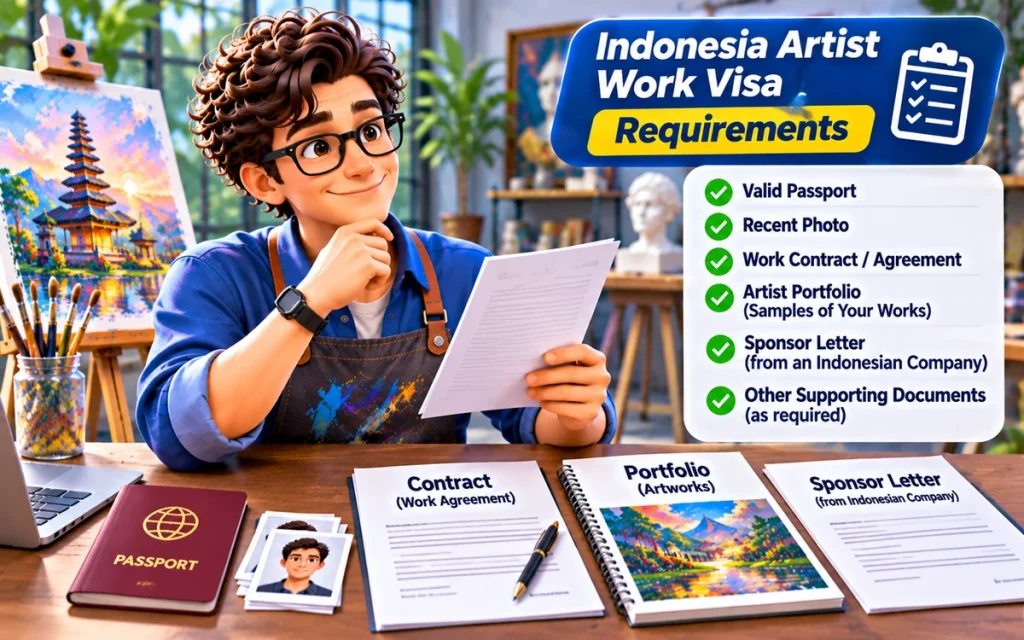
Passport and Personal Documents
Applicants should prepare a passport that meets the validity requirements applicable to the chosen visa, a recent photograph in the required format, and accurate personal details. The exact validity threshold, file format, and photograph specifications should be checked in the official application portal.
Depending on the case, the applicant may also be asked for a curriculum vitae, professional profile, portfolio, qualifications, or evidence of relevant experience. These materials should be consistent with the proposed role and should not exaggerate credentials or describe activities that differ from the actual engagement.
Employment or Engagement Agreement
The Indonesian sponsor may need an employment agreement, service agreement, engagement letter, or other supporting document explaining the artist’s role. It should identify the parties, scope of artistic duties, work location, engagement period, and relevant commercial or employment terms. The document should be genuine and consistent with the sponsor’s application.
A short event invitation may not be sufficient to support a long-term employment arrangement. Conversely, an applicant entering for a limited permitted visit activity should not present documents that imply a prohibited local employment relationship. The contract should reflect the real arrangement, not be drafted merely to fit a preferred visa label.
Indonesian Sponsor and Supporting Documents
The sponsor or host may need to provide corporate or institutional identity documents, address and contact details, a letter of guarantee or application, and evidence of the proposed activity. The exact list depends on the visa category and sponsor’s role. The organization should ensure that the person signing the application is authorized to act for it and that submitted information is accurate.
Where an event organizer, gallery, cultural institution, production company, or other host is involved, the parties should clarify who is legally responsible for the foreign artist and who will submit the immigration application. An informal invitation from an individual may not satisfy the requirements for a particular visa category.
Professional Qualifications and Portfolio
A portfolio can help explain the applicant’s artistic practice and support the credibility of the proposed role. Depending on the discipline, useful evidence may include exhibition records, catalogues, project descriptions, professional references, awards, published work, or relevant qualifications. Not every item is necessarily mandatory; the sponsor should follow the current official checklist.
The documents should tell a consistent story: the applicant’s experience, the Indonesian project, the sponsor, the duties, and the requested immigration route should match. If documents are not in Indonesian or English, a translation may be requested depending on the authority and application requirements.
Need Help Preparing Your Artist Work Visa Documents?
Azra Solutions can help review your documents, assess your proposed artistic engagement, and explain the applicable sponsorship and immigration requirements.
Important Visa Classification Update: 2025 Decree and Current Operational Listings
There is a material difference between the current published visa-classification decree and some operational Immigration service references. Decree of the Minister of Immigration and Corrections No. M.IP-08.GR.01.01 of 2025 is the current published classification reference. It describes D7 for specified arts-and-culture visit activities and E23 as a work route, but its published text does not name E23R or C7/C7A.
At the same time, an Immigration Office ITAS service page continues to identify E23R as a limited-stay visa for working as an artist, and the 2026 Molina user guide lists C7, C7A, and C7B operationally. This article reports those operational references transparently; it does not assume that every code remains available in every case or that older descriptions override the 2025 decree.
Before applying, the Indonesian sponsor should check the live eVisa portal, confirm the exact code currently selectable for the artist’s real activity, and verify the permitted activities, sponsor conditions, stay period, and restrictions attached to that code. If the online options and published references appear inconsistent, obtain written or case-specific confirmation from Immigration before travel or work begins.
RPTKA and Work Authorization for Foreign Artists
Indonesian Employer or Sponsor Responsibilities
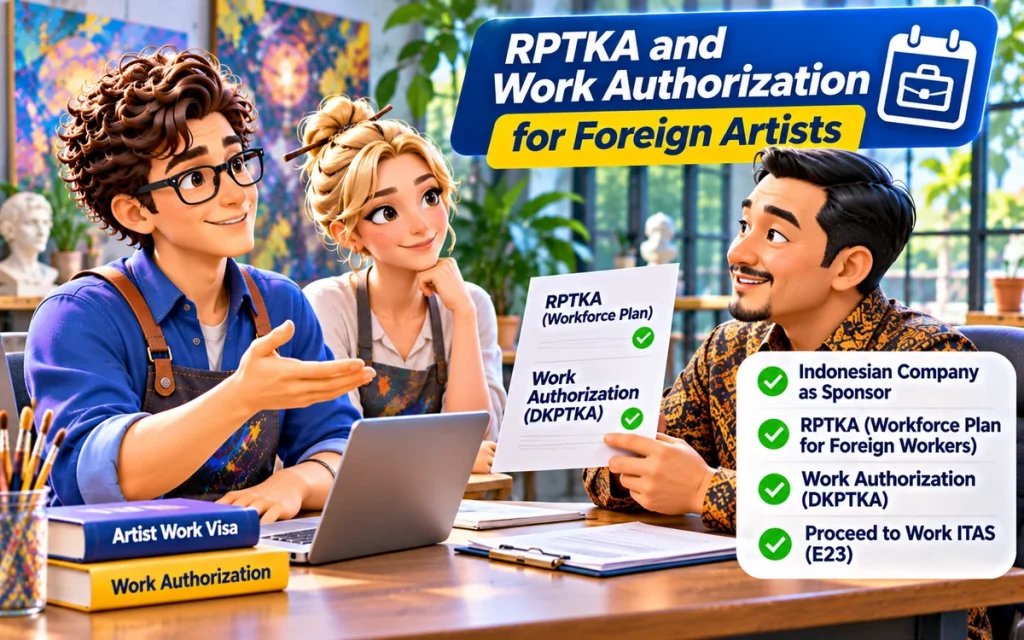
Indonesia’s foreign-worker framework places important responsibilities on the employer that uses foreign workers. Government Regulation No. 34 of 2021 regulates the use of foreign workers, including employer obligations, RPTKA approval, compensation arrangements, reporting, supervision, and administrative sanctions. The regulation defines RPTKA as a plan for employing foreign workers in specified positions and for specified periods.
Official reference: Government Regulation No. 34 of 2021
The Indonesian employer should determine whether it is legally an employer of a foreign worker for the proposed arrangement and whether RPTKA or a statutory exception applies. The label “sponsor” in an immigration application does not, by itself, settle the manpower-law analysis. The actual employment relationship and activity matter.
RPTKA Approval and Related Procedures
RPTKA is a manpower approval process, not an immigration visa. Where required, the employer must obtain the relevant approval before the foreign worker undertakes the covered work. The employer’s submission may involve information about the company, foreign worker, position, employment period, and supporting documents. The precise process and any exemptions must be checked against current manpower regulations and the applicable online system.
Official reference: Minister of Manpower Regulation No. 8 of 2021
The employer should not assume that immigration approval automatically substitutes for RPTKA approval, or vice versa. The two processes address different legal requirements and may need to be coordinated. Any applicable exception should be confirmed against the specific facts and current law rather than assumed from the artist’s job title.
DKPTKA and Other Applicable Obligations
The foreign-worker framework also addresses the Dana Kompensasi Penggunaan Tenaga Kerja Asing (DKPTKA), reporting, and other employer obligations. Whether a payment is due, the applicable amount, payment route, and any exemption depend on current rules and the particular employment arrangement. Employers should obtain an up-to-date calculation from the competent authority or qualified adviser rather than relying on an old online fee figure.
Employers may also have obligations relating to local companion workers, training or transfer of knowledge, reporting, and compliance with the approved position and employment period. These obligations should be reviewed as part of the overall hiring plan, not after the artist has already started work.
How to Apply for an Indonesia Artist Work Visa
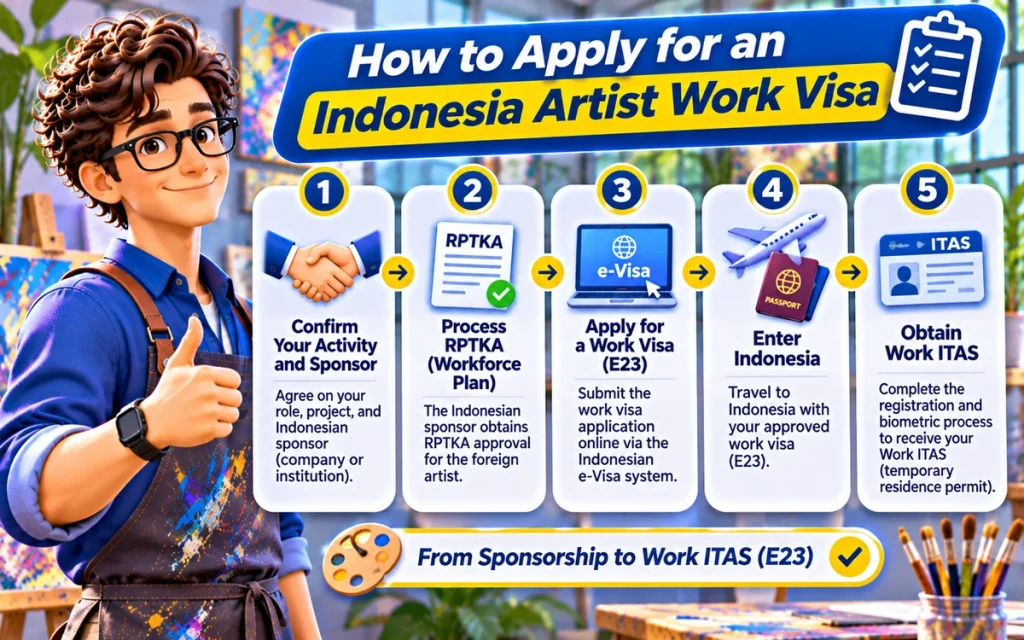
The process should begin with a review of the actual artistic activity and the Indonesian organization engaging the artist. The following sequence is a practical planning framework; the order and documents may vary according to the selected visa category and current government procedures.
Step 1 – Confirm the Artist’s Professional Activity
Describe the work accurately: artistic discipline, deliverables, work location, project dates, frequency of activity, and the party directing or engaging the artist. Clarify whether the engagement is a short permitted visit activity or work for an Indonesian employer. Do not choose a visa code before the activity has been assessed.
Step 2 – Identify the Appropriate Visa Category
Review the current work route and any permitted arts-and-culture visit category. Compare the 2025 visa-classification decree with the current live eVisa options and relevant operational guidance. Confirm sponsor eligibility, stay period, and activity restrictions. If the activity involves music performance, crew work, film production, or another separately classified activity, assess the relevant dedicated category.
Step 3 – Prepare Sponsorship and Work Authorization
The Indonesian organization should prepare sponsor documents and the artist’s supporting materials. It should separately assess manpower requirements, including whether RPTKA approval is required and whether DKPTKA or other employer obligations apply. Any required manpower approval should be coordinated with the immigration application.
Step 4 – Submit the Visa Application
The sponsor or authorized party should submit the application through the official eVisa system using the correct category and supporting documents. Check passport details, sponsor identity, purpose of stay, and activity description before submission. An application receipt is not the same as an issued visa.
Step 5 – Obtain the Relevant Stay Permit and Follow Its Conditions
After approval, the artist should follow instructions associated with the visa, entry, and stay permit. The artist and sponsor should retain copies of approvals and observe the authorized period, location, and activity conditions. Any extension, sponsor change, role change, or material change in the engagement should be reviewed before it occurs.
Official application portal: Indonesia eVisa
Artist Work Visa Validity, Extensions, and Compliance
E23R Stay Permit Periods
An Immigration Office ITAS service listing identifies E23R as a limited-stay visa for working as an artist and states that the E23 work-visa family includes initial stay options of 180 days, one year, and two years. This is an operational service-page reference, while the 2025 classification decree describes the broader E23 work route without naming E23R in its text. Treat the listed durations as indicative information only: the actual option available to an E23R applicant must be confirmed in the live eVisa system and in the individual approval.
Extension and Renewal Considerations
Extension eligibility and the maximum permitted stay depend on the applicable category and rules in force at the time. The sponsor should review renewal requirements well before the current permit expires. A new contract, changed role, new employer, or extended project may require additional review and cannot automatically be treated as a routine extension.
Responsibilities of Foreign Artists and Employers
The artist must remain within the scope of the approved activity and comply with Indonesian immigration and other applicable laws. The sponsor should monitor the permit period, ensure the engagement remains consistent with submitted documents, and complete any required reporting or employer obligations. Neither party should allow work to continue after the relevant authorization expires or outside its approved conditions.
Common Mistakes Foreign Artists Should Avoid
Using a Visit Visa for the Wrong Activity
A visit visa should not be treated as a general work permit. The fact that an artist is invited to Indonesia, appears at an event, or receives payment does not automatically establish that the activity is permitted under every visit category. Check the exact purpose and restrictions attached to the visa.
Confusing C7 and E23R
Visit and work routes should not be used interchangeably. E23R remains identified on an Immigration Office service page as an artist work category, but the 2025 decree uses the broader E23 work classification and does not name E23R in its published text. D7 is the arts-and-culture visit category described in the 2025 decree, while C7/C7A/C7B continue to appear in the 2026 operational Molina guide. Confirm the live category and its exact conditions before applying.
Working Outside the Approved Scope
An artist should not assume that approval for one project, sponsor, position, or activity authorizes a different engagement. Additional projects, a new Indonesian client, a change from a short event to an ongoing role, or a new work location may affect the appropriate authorization. Seek clarification before the activity changes.
Frequently Asked Questions About Indonesia Artist Work Visas
Can Foreign Artists Work in Indonesia?
Yes, foreign artists may be able to undertake artistic work in Indonesia when they hold the appropriate immigration permission and the Indonesian organization complies with applicable manpower requirements. The correct route depends on activity, sponsor, employment arrangement, and duration.
What Is the E23R Visa for Artists?
E23R is identified on an Immigration Office service listing as a limited-stay visa for working as an artist. Because the 2025 classification decree describes the broader E23 work route without naming E23R in its text, applicants should confirm the current operational code, requirements, and available stay period in the live eVisa system.
Can Artists Use a C7 Visa?
A visit category may be relevant for defined arts-and-culture activities. The 2025 classification decree describes D7 for specified activities such as theatre, dance, and circus, while the 2026 Molina guide still lists C7 and related codes. The organizer must confirm the currently selectable category and its specific restrictions in the live eVisa system.
Do Foreign Artists Need RPTKA?
An Indonesian employer using a foreign worker may be required to obtain RPTKA approval unless a specific statutory exception applies. Whether the requirement applies depends on the actual relationship and applicable rules. The employer should assess this separately from the immigration visa.
Can an Artist Bring Family to Indonesia?
Family members may have separate immigration options depending on the principal applicant’s permit, family relationship, and current rules. Family eligibility should be checked individually; it should not be assumed that every work visa automatically grants the same stay rights to dependants.
Can Azra Solutions Assist With an Artist Work Visa?
Azra Solutions can provide immigration consultation and assistance in reviewing the proposed artistic activity, identifying the relevant visa pathway, and coordinating supporting immigration and sponsorship procedures. Eligibility and approval remain subject to the competent Indonesian authorities and applicable regulations.
Get Assistance With an Indonesia Artist Work Visa
Planning to engage a foreign artist in Indonesia or work on an artistic project as an international creative professional? The first step is to confirm the correct visa route and understand the sponsor’s immigration and manpower responsibilities.
Azra Solutions provides immigration consultation and assistance for foreign professionals and Indonesian organizations. We can help review the proposed artistic engagement, assess the relevant immigration pathway, and explain the supporting documentation and coordination required for the application.
Contact Azra Solutions to discuss your planned artistic engagement and the applicable Indonesian immigration requirements. You can also visit the official immigration portal for government application information.
Need Assistance With an Indonesia Artist Work Visa?
Azra Solutions provides immigration consultation and assistance for foreign artists and Indonesian sponsors. Contact our team to discuss your planned artistic engagement and the appropriate immigration pathway.