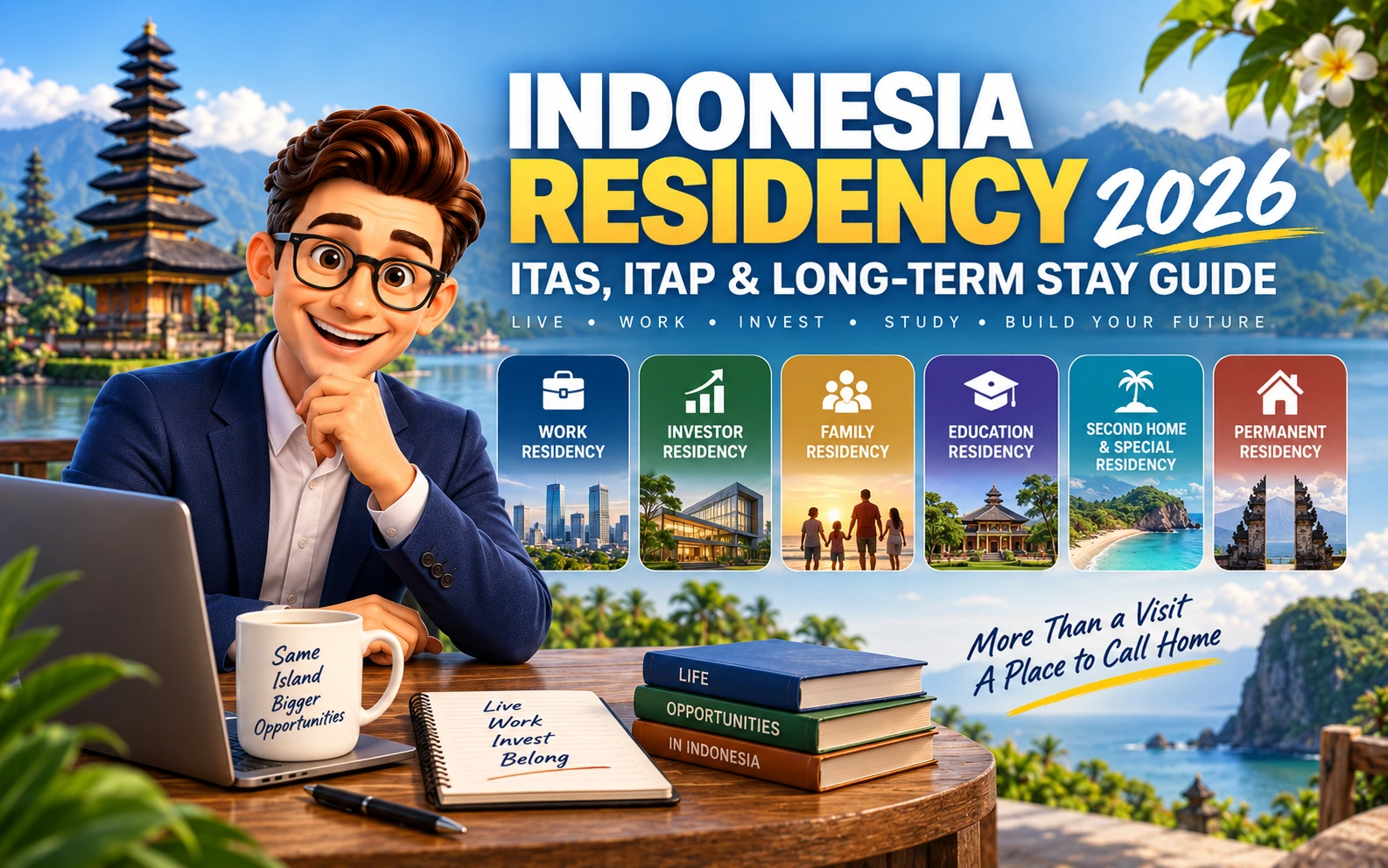
Indonesia Residency 2026 guide covering ITAS, ITAP and long-term stay options for foreigners

Indonesia Residency: ITAS, ITAP & Long-Term Stay Guide for Foreigners

Introduction

Indonesia is increasingly becoming a long-term destination for foreigners who want to work, invest, join their family, study, retire, return to their Indonesian roots, or establish a longer-term base in the country. For these purposes, understanding Indonesia’s immigration system is important because a short-term visit visa is not the same as a residence permit.

For foreigners who qualify for longer-term residence, Indonesia provides several immigration pathways depending on the purpose of stay. The current official visa framework includes work, investment, education, family, repatriation and former Indonesian citizen pathways, as well as Second Home and other specialized residence categories. These pathways are generally connected to Indonesia’s limited-stay residence framework (ITAS), while eligible foreigners may in certain circumstances progress to permanent stay status (ITAP).

However, choosing the right pathway can be confusing. Terms such as visa, ITAS, KITAS, ITAP and KITAP are often used interchangeably, even though they refer to different parts of Indonesia’s immigration system. The available options also depend on factors such as your nationality, purpose of stay, family circumstances, employment or investment status, and the specific requirements applicable to your category.

This guide explains how long-term residence in Indonesia works, from the basic distinction between a visa and a residence permit to the main ITAS/KITAS pathways and the routes that may lead to ITAP/KITAP. It is designed as a starting point for foreigners who want to understand their options before moving on to the detailed requirements for a specific residence category.

Article Scope

This pillar provides a high-level overview rather than replacing the detailed requirements of each visa or residence category. Specific eligibility, documents, validity periods, fees and procedures should always be checked against the latest Indonesian immigration rules and official guidance.

Current Immigration Framework

The current official Directorate General of Immigration visa list includes separate categories for Work, Investor, Education, Family, Repatriation and Former Indonesian Citizens, Second Home, and other specialized visa pathways. The detailed article sections will map these official categories to the broader concept of temporary and permanent residence without treating every visa code as a separate pillar.

1. Quick Answer: How Can Foreigners Become Residents in Indonesia?

Foreigners who want to live in Indonesia for an extended period generally need an immigration status that matches the purpose and conditions of their stay. Indonesia provides several long-term residence pathways, with the main framework covering limited stay through ITAS and permanent stay through ITAP, subject to the requirements of the relevant category.

The appropriate pathway depends on why you want to live in Indonesia. The current official immigration framework includes work and professional visas, investor visas, education visas, family visas, repatriation and former Indonesian citizen pathways, and Second Home and other specialized categories. These categories are not interchangeable: each has its own eligibility requirements, permitted activities, sponsor or supporting requirements, and period of stay.

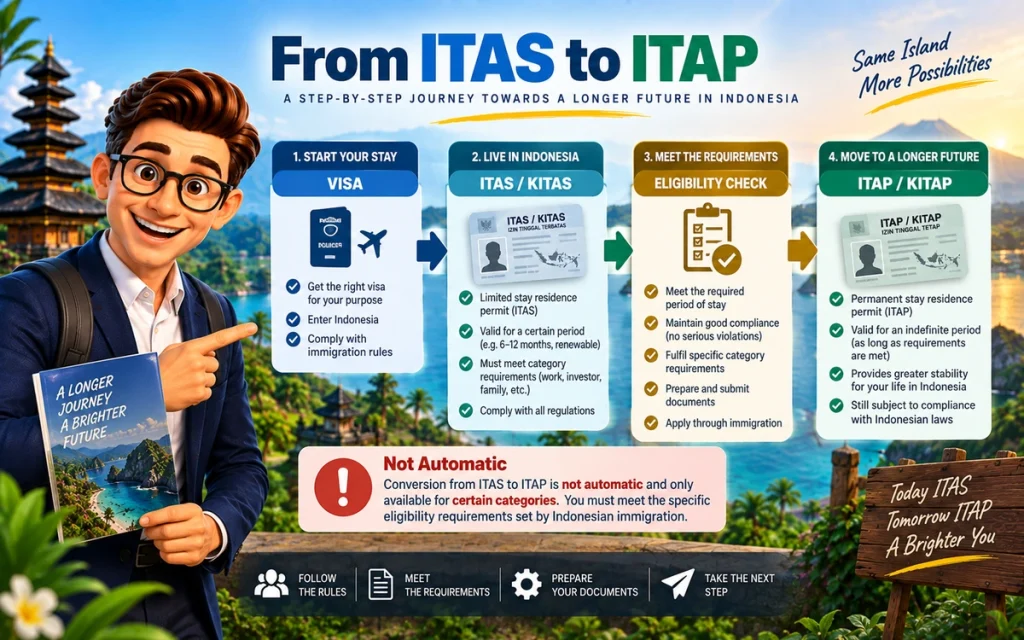
For many foreigners, the long-term residence journey begins with an ITAS (Izin Tinggal Terbatas), commonly associated with a KITAS. Depending on the person’s category and eligibility, an ITAS may later provide a pathway toward ITAP (Izin Tinggal Tetap), commonly associated with a KITAP. Certain categories may also have specific permanent-residence pathways under the applicable immigration rules.

In practical terms, there is no single ‘Indonesia residency visa’ that applies to everyone. Instead, you need to identify your purpose of stay first, then determine which immigration category best matches your circumstances. The rest of this guide explains the main pathways and how ITAS, KITAS, ITAP and KITAP fit into Indonesia’s broader residency system.

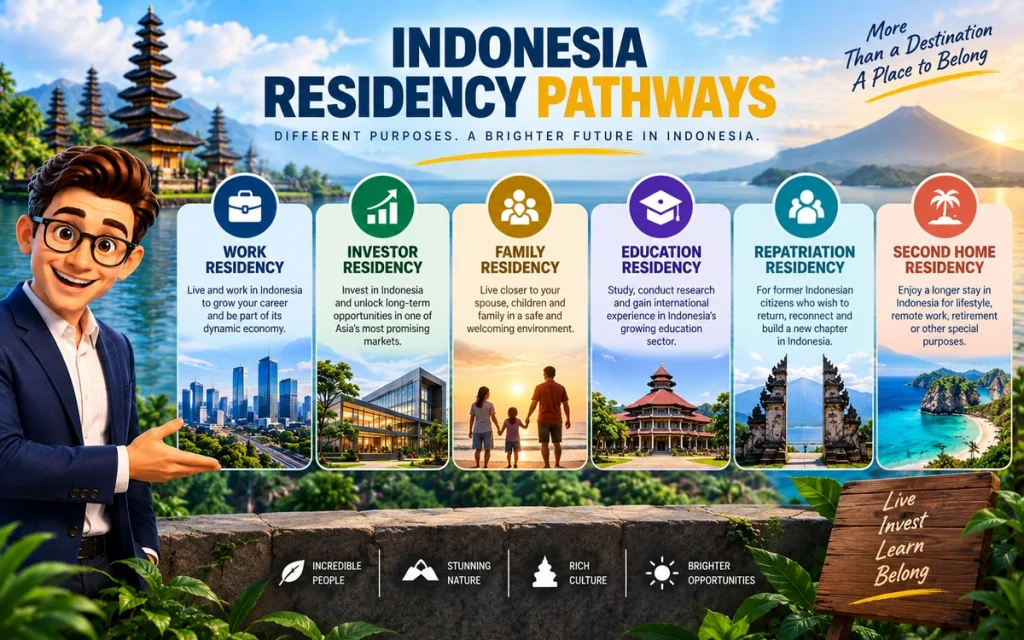
At a Glance: Indonesia Long-Term Residency Pathways

Purpose / SituationMain Residency Pathway
Work & professional activitiesWork / professional residence pathways
InvestmentInvestor residence pathways
Family & marriageFamily and spouse residence pathways
EducationEducation and student residence pathways
Repatriation / former Indonesian citizensRepatriation and former Indonesian citizen pathways
Second Home & special purposesSecond Home and other specialized residence pathways
Permanent residenceITAP / KITAP and other applicable permanent-residence pathways

The categories above are a high-level map for this pillar article. The detailed eligibility and visa codes within each category will be covered only where necessary and linked to dedicated supporting guides.

2. What Is Residency in Indonesia?

Residency in Indonesia refers to the legal status that allows a foreign national to live in Indonesia under an authorized stay arrangement for a specific purpose and period. It is different from simply visiting Indonesia on a tourist or other short-term visit visa. For long-term residence, the applicable immigration status depends on the foreigner’s purpose, eligibility and the requirements of the relevant category.

In Indonesia’s immigration framework, one of the key distinctions is between limited stay and permanent stay. Limited stay is generally associated with ITAS (Izin Tinggal Terbatas), while permanent stay is associated with ITAP (Izin Tinggal Tetap). The terms KITAS and KITAP are commonly used by foreigners to refer to the cards or documents associated with these residence permits.

However, residency should not be understood as one single visa or one universal program. The official Directorate General of Immigration visa list contains separate long-term categories for work, investment, education, family, repatriation and descendants of former Indonesian citizens, Second Home, and other specialized purposes. Within these categories there are further visa types and subcategories, each with its own conditions.

For example, the current official list includes E23 work visas and their specialized variants, E28 investor visas, E30 education visas, E31 family visas, E32 repatriation and former Indonesian citizen descendant visas, and E33 Second Home visas. It also includes E34 for medical treatment and E35 for working holidays. Not every long-stay visa belongs to the same residency pathway, so the purpose and legal basis of the stay must always be considered.

In practical terms, a foreigner who wants to establish a longer-term base in Indonesia should first identify the reason for staying in the country. The appropriate immigration pathway may then lead to an ITAS, and in eligible circumstances an ITAS may be changed to an ITAP. Certain categories also have specific permanent-residence pathways under Indonesian immigration rules.

ITAS and ITAP at a Glance

TermMeaningGeneral Role
ITASIzin Tinggal Terbatas (Limited Stay Permit)Temporary / limited residence
KITASCommon term for the card/document associated with ITASEvidence/document associated with limited stay status
ITAPIzin Tinggal Tetap (Permanent Stay Permit)Permanent residence status
KITAPCommon term for the card/document associated with ITAPEvidence/document associated with permanent stay status

The distinction between these terms is important because the visa that a foreigner applies for, the stay permit granted after the relevant immigration process, and the physical card or document commonly called KITAS or KITAP are related but not identical concepts.

Residency Depends on Your Purpose of Stay

There is no single residency route that fits every foreigner. A person coming to Indonesia to work may follow a different pathway from an investor, a foreign spouse of an Indonesian citizen, a student, a former Indonesian citizen, or a remote worker using a specialized Second Home category. This is why choosing the correct immigration category is the first step in planning a lawful long-term stay.

Throughout this guide, the term ‘residency’ is used as a practical umbrella term for lawful long-term residence in Indonesia. The specific legal status, however, remains determined by the applicable visa and stay-permit rules.

3. Visa vs Residence Permit in Indonesia

One of the most important things to understand before planning a long-term stay in Indonesia is that a visa and a residence permit are not the same thing. The two are closely connected, but they serve different functions within Indonesia’s immigration system.

In simple terms, a visa is generally the immigration authorization used to enter Indonesia for a particular purpose and under particular conditions. A residence permit, on the other hand, determines the foreigner’s authorized stay in Indonesia after entry. For long-term residence, the distinction becomes especially important because the applicable stay permit depends on the immigration category and the purpose of the foreigner’s stay.

Indonesia’s official visa list separates visit visas from long-term categories such as Work, Investor, Education, Family, Repatriation and Former Indonesian Citizen, Second Home, and other specialized visas. This means that seeing an ‘E’ visa category on the official list does not by itself mean that every E visa has identical residence rights. Each category has its own purpose and conditions.

For foreigners entering Indonesia under a limited-stay visa, the relevant long-term residence status is generally an ITAS (Izin Tinggal Terbatas). The physical or documentary evidence commonly associated with this status is known as a KITAS. Similarly, permanent residence is based on an ITAP (Izin Tinggal Tetap), commonly associated with a KITAP. The visa, the stay permit, and the card or electronic document should therefore be understood as related but distinct elements of the immigration process.

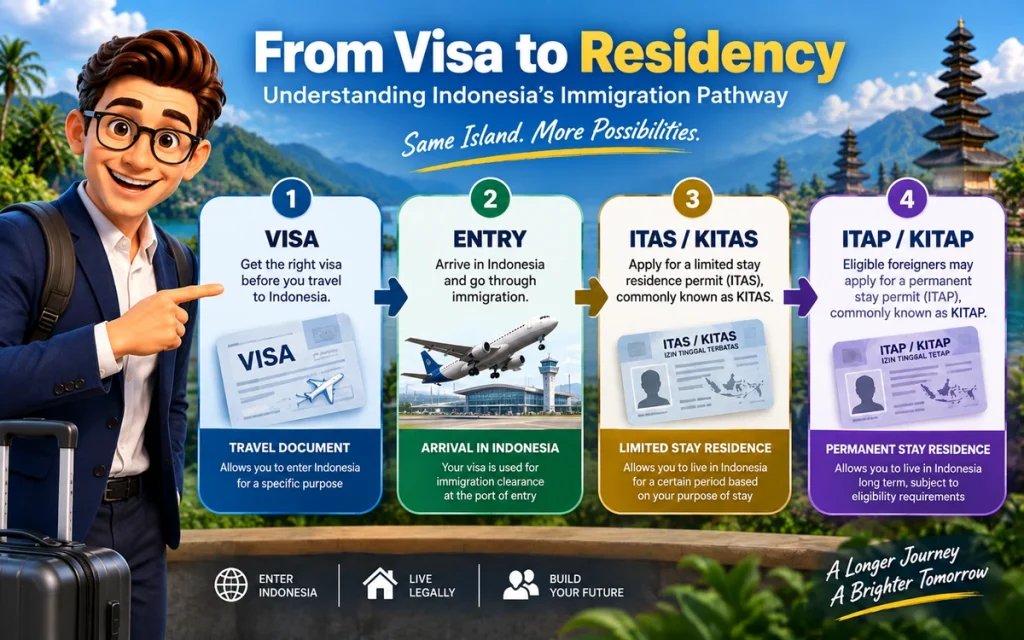
Visa, ITAS and ITAP: How They Relate

Immigration TermMain FunctionTypical RoleExample
VisaAuthorization to enter Indonesia for a specified purpose and categoryEntry stageE23 Work Visa
ITASLimited Stay PermitAuthorized limited residenceITAS obtained under an eligible work pathway
KITASCommon term for the card/document associated with ITASEvidence of limited-stay statusKITAS held by an eligible foreign resident
ITAPPermanent Stay PermitAuthorized permanent residence statusITAP obtained through an eligible pathway
KITAPCommon term for the card/document associated with ITAPEvidence of permanent-stay statusKITAP held by an eligible permanent resident

A Simple Example

Consider a foreign professional who is eligible for an Indonesian work pathway. The person may first obtain the appropriate work visa, enter Indonesia under that visa, and then complete the applicable process for an ITAS. The resulting limited-stay status is commonly referred to in everyday language as KITAS. If the person later meets the requirements for a change of status to ITAP, the immigration status can move from limited stay to permanent stay through the applicable procedure. The exact requirements depend on the category and should not be assumed to apply to every foreign resident.

Why This Distinction Matters

  • Choosing the wrong visa category can affect whether your intended activities are permitted.
  • The period of a visa and the period or conditions of a stay permit should not be treated as automatically identical.
  • Not every foreigner who stays in Indonesia for an extended period follows the same pathway.
  • An ITAS does not automatically mean that the holder qualifies for ITAP; permanent residence is subject to its own eligibility and immigration requirements.
  • Some categories have specific routes to permanent residence, while other long-stay categories may operate under different conditions.

Under current immigration guidance, an ITAS holder may apply for a change of status to ITAP in eligible categories, including workers, clergy, foreign investors, family reunification, repatriation, and certain Second Home categories. The applicable requirements and timing depend on the specific category.

The Key Takeaway

If your goal is to live in Indonesia long term, do not start by asking only, ‘Which visa should I get?’ Start by identifying your purpose of stay and the residence status that may apply to you. The visa is part of the entry process; the residence permit is what establishes your authorized stay under the applicable immigration framework.

4. Understanding ITAS & KITAS

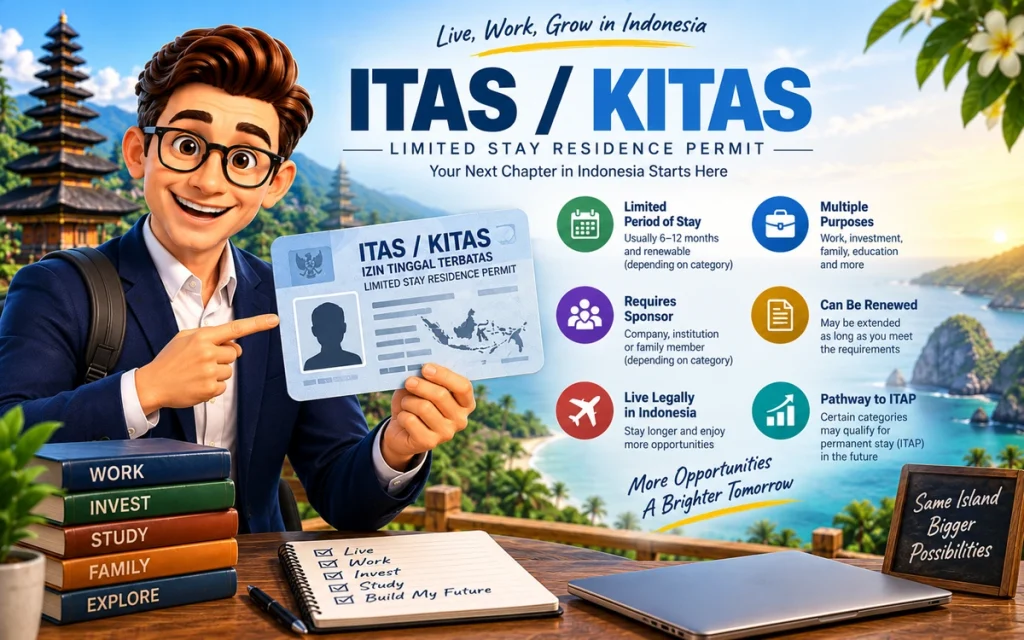
ITAS stands for Izin Tinggal Terbatas, or Limited Stay Permit. It is the immigration status that allows a foreign national to reside in Indonesia for a limited period under an approved purpose and category. In everyday conversation, foreigners commonly use the term KITAS when referring to the card or documentation associated with an ITAS.

ITAS is not a single immigration program. The current official Directorate General of Immigration visa list contains multiple visa categories that can lead to limited-stay residence, including Work, Investor, Education, Family, Repatriation and Former Indonesian Citizen, Second Home, and other specialized categories. Each category has its own purpose and eligibility requirements.

This distinction is important for anyone planning to live in Indonesia long term. A foreigner does not simply apply for a generic ‘KITAS’ without identifying the legal basis for the stay. Instead, the person normally needs to qualify under a particular immigration category, obtain the appropriate visa or follow the applicable status-change procedure, and then obtain the relevant ITAS.

Depending on the category, an ITAS may be issued for different periods. Current immigration service standards provide ITAS options with validity periods of up to 6 months, 1 year, or 2 years, while certain Second Home-related ITAS categories can have longer validity periods. The actual period available to an applicant depends on the applicable visa and immigration rules.

How ITAS Fits Into the Immigration Process

StageWhat It Means
1. Identify the purpose of stayDetermine whether the intended stay is based on work, investment, family, education, repatriation, Second Home, or another qualifying purpose.
2. Choose the appropriate immigration categoryThe visa category and its specific requirements must match the foreigner’s intended activity and circumstances.
3. Obtain the appropriate visa or qualify for a status changeDepending on the case, the applicant may apply for a limited-stay visa or, where permitted, apply to change an existing visit stay into ITAS.
4. Enter or complete the immigration process in IndonesiaThe applicable immigration procedures, document checks, and biometric requirements must be completed.
5. Receive the ITASOnce approved, the foreigner receives the applicable Limited Stay Permit, commonly referred to as KITAS in everyday usage.

In certain cases, an existing Visit Stay Permit (ITK) may be changed to an ITAS based on an application and the applicable category. Current Immigration guidance lists qualifying activities such as employment, professional expertise, religious work, foreign investment, research, education, family reunification, repatriation, Second Home, medical treatment, and certain humanitarian or public-benefit circumstances. Visit stays originating from Visa on Arrival or visa exemption cannot be changed into another stay permit through this procedure.

How Long Does an ITAS Last?

There is no single ITAS validity period for every foreign resident. The period depends on the underlying category and applicable regulations. For example, current immigration service standards list limited-stay permits of up to 6 months, 1 year, and 2 years, with specific longer-period options for certain Second Home categories. Extensions may also be available depending on the category.

Can ITAS Be Extended or Changed to ITAP?

An ITAS may be extended when the applicable requirements are met. Current 2026 immigration service standards state that an extension of ITAS can be granted for up to 2 years at a time, subject to the overall limits and category-specific rules.

An eligible ITAS holder may also apply for a change of status to ITAP. Current Immigration guidance identifies workers, religious workers, foreign investors, family reunification, repatriation, and certain Second Home categories as eligible groups for ITAS-to-ITAP status changes, subject to the applicable requirements. The application is generally submitted no later than 30 days before the ITAS expires.

Main ITAS Pathways Covered in This Guide

  • Work & Professional Residency
  • Investor Residency
  • Family & Spouse Residency
  • Education Residency
  • Repatriation & Former Indonesian Residency
  • Second Home & Special Residency

The sections that follow provide an overview of these six pathways. This pillar intentionally does not attempt to reproduce every visa code, document requirement, fee or procedural detail. Those subjects are better handled in dedicated supporting guides, while this article serves as the central map of Indonesia’s residency system.

Important: ITAS Is Not the Same as Permanent Residence

ITAS provides limited or temporary residence status. It should not be treated as permanent residence simply because it can be renewed or because some categories may provide relatively long periods of stay. Permanent residence is associated with ITAP and is subject to separate eligibility requirements.

5. Work & Professional Residency

Work and professional residency allows eligible foreign nationals to live in Indonesia for employment, professional, research, religious, and other qualifying activities. The applicable immigration pathway depends on the person’s occupation, role, employer or sponsor, and the nature of the activity they will perform in Indonesia.

Indonesia’s current immigration framework includes several work-related and professional categories rather than one single “Work KITAS.” These may cover employees, management and executive positions, specialized professionals, maritime workers, religious workers, researchers, and other qualifying professional activities.

The specific visa category depends on the applicant’s circumstances and the requirements applicable to the intended activity. Applicants should therefore choose the immigration category based on the actual work or professional activity they will perform in Indonesia, rather than simply choosing the longest or most convenient residence period.

Main Work & Professional Pathways

TypeGeneral Purpose
EmploymentWorking for an Indonesian employer or qualifying organization
Management & Executive RolesDirectors, managers, and other qualifying executive positions
Specialized ProfessionalsSpecific professional, technical, or specialist activities
Maritime & Specialized WorkQualifying maritime and other specialized activities
Religious WorkForeign religious workers performing authorized religious activities
Research & Professional ActivitiesQualifying research and other professional activities

The specific visa code and requirements depend on the applicant’s occupation, sponsor or employer, work activity, and applicable Indonesian immigration and employment regulations.

Do You Need a Work KITAS to Work in Indonesia?

Foreigners who intend to work in Indonesia must use an immigration pathway that permits the intended activity and comply with applicable employment regulations. Holding an ITAS or KITAS by itself does not automatically give a foreigner unrestricted permission to work.

This distinction is important because immigration residence status and employment authorization are related but separate matters. The appropriate immigration and employment requirements should be confirmed before starting work in Indonesia.

Work Residency Is Purpose-Specific

Work residency is purpose-specific. The immigration status must correspond to the foreigner’s actual role and permitted activities in Indonesia. A foreigner should therefore confirm the applicable immigration and employment requirements before starting work, changing roles, or performing activities outside the original purpose of stay.

6. Investor Residency

Investor residency allows eligible foreign nationals to live in Indonesia based on qualifying investment or business interests. Depending on the investment structure and the applicant’s circumstances, different investor visa categories may apply.

Indonesia’s current immigration framework includes several investor-related pathways, including investment in Indonesian companies and certain qualifying investment structures. The appropriate category depends on the type and level of investment, the applicant’s role, and the applicable immigration and business requirements.

Main Investor Residency Pathways

Investor TypeGeneral Purpose
Indonesian Company InvestmentForeign investment in an eligible Indonesian company
Company Establishment & Business InvestmentForeign investors establishing or investing in an Indonesian business
Capital Market InvestmentQualifying investment through Indonesia’s capital market
Special Economic / Priority AreasInvestment connected with designated economic or strategic areas
Other Qualifying Investment StructuresOther investment arrangements recognized under the applicable immigration framework

The specific investor visa category depends on the investment structure, amount, company or investment vehicle, and the applicant’s role in Indonesia. Applicants should verify the applicable requirements before choosing an investor residence pathway.

Do You Need a Work Permit as an Investor?

An investor residence pathway is different from a conventional employment-based work pathway. Whether a foreign investor may perform operational, managerial, or other activities in an Indonesian company depends on the specific immigration status, the applicant’s role, and applicable Indonesian employment and business regulations.

Holding an investor ITAS does not automatically mean that every type of work or operational activity is permitted. Investors should ensure that their intended activities are consistent with both immigration and employment requirements.

Investor Residency Is Investment-Specific

Investor residency is based on a qualifying investment structure and is therefore different from simply owning a business or holding shares in Indonesia. The appropriate immigration pathway depends on the nature of the investment, the applicant’s position, and the requirements applicable at the time of application.

7. Family & Spouse Residency

Family residency allows eligible foreign nationals to live in Indonesia based on a qualifying family relationship. This can include foreign spouses of Indonesian citizens, children, parents, and certain family members connected to foreign residents who hold eligible Indonesian residence permits.

Indonesia’s current immigration framework provides several family-based pathways, with the applicable category depending on the relationship between the applicant and the Indonesian citizen or foreign resident. Each pathway has its own eligibility and documentation requirements.

Main Family & Spouse Residency Pathways

Family RelationshipGeneral Purpose
Spouse of an Indonesian CitizenResidence for a foreign spouse married to an Indonesian citizen
Children of Indonesian CitizensResidence for qualifying foreign-national children of Indonesian citizens
Parents of Indonesian CitizensResidence for qualifying parents of Indonesian citizens
Family of ITAS/ITAP HoldersResidence for eligible family members of foreign residents in Indonesia
Other Qualifying Family RelationshipsOther family-based relationships recognized under Indonesian immigration rules

The specific E31 visa category depends on the family relationship and the immigration status of the person the applicant is joining.

Can a Foreign Spouse of an Indonesian Citizen Get KITAS?

Yes. A foreign spouse of an Indonesian citizen may qualify for a family-based ITAS, commonly referred to as a Spouse KITAS, provided the applicable immigration requirements are met. The residence pathway is based on the marriage and family relationship rather than employment or investment.

A spouse-based ITAS can also provide a potential pathway to permanent residence when the requirements for ITAP are satisfied. The exact requirements, documents, and timing depend on the applicant’s circumstances and the applicable immigration rules.

Children and Other Family Members

The E31 family framework is broader than spouse residence. It also covers several situations involving children and parents. These include children of WNA–WNI marriages, children joining Indonesian parents, children joining foreign parents who hold ITAS or ITAP, parents joining Indonesian citizens, and parents joining ITAS/ITAP holders. The current official list also includes a specific category for a child joining a sibling who holds ITAS or ITAP.

Can Family Residence Holders Work in Indonesia?

Family-based residence should not automatically be treated as unrestricted work authorization. The permitted activities and any applicable work rights depend on the specific immigration status and the rules governing the holder’s category. Before starting employment or another income-generating activity, a family residence holder should confirm whether the intended activity is permitted and whether additional immigration or employment requirements apply.

Family Residency and Permanent Residence

Certain family-based ITAS holders may qualify for ITAP when the applicable requirements are satisfied. For example, a foreign spouse of an Indonesian citizen may have a pathway from family-based ITAS to permanent residence after meeting the relevant marriage and residence requirements.

The detailed ITAS-to-ITAP process is explained separately in the Permanent Residence section of this guide.

Family Residency and Global Citizen of Indonesia (GCI)

The 2026 immigration framework also introduces additional permanent-residence pathways under the Global Citizen of Indonesia (GCI) policy for certain people with qualifying Indonesian family or historical connections. Official Immigration information identifies several E31 and E32 visa indexes within the GCI framework and states that eligible applicants can receive an unlimited ITAP after entering Indonesia, subject to the applicable requirements. This is a specialized pathway and should not be confused with ordinary family-based ITAS.

What Families Should Prepare For

  • Proof of the qualifying family relationship.
  • Valid passports and identity documents.
  • Marriage, birth, or other civil-status documents where applicable.
  • Evidence relating to the Indonesian or foreign resident family member.
  • Sponsorship or supporting documents where required.
  • Proof of financial support or other category-specific requirements where applicable.

Family Residency at a Glance

The key principle is simple: identify the exact family relationship first, then choose the E31 category that corresponds to that relationship. Indonesia’s family-residence system is much broader than a single spouse KITAS, and the available pathway can differ substantially between a spouse, child, parent, and other qualifying family member.

This pillar provides only the residency overview. Detailed requirements, document checklists, validity periods, costs, work rights, conversion options, and application procedures for each family category should be covered in dedicated supporting guides.

8. Education Residency

Indonesia also provides limited-stay residence pathways for foreign nationals whose primary purpose is education. The current official immigration framework places these pathways within the E30 education visa series, covering different types of study and educational activities. The appropriate category depends on the student’s level of education, institution, program, and other applicable requirements.

Education-based residence is different from entering Indonesia for a short course, tourism, or another temporary activity. Where a foreign student needs to live in Indonesia for an extended period to undertake qualifying education, the relevant education visa and ITAS pathway should be considered.

Main Education Residency Pathways

Visa CategoryGeneral UserPurpose
E30 / E30APrimary and secondary studentsFormal education at qualifying schools
E30BHigher-education studentsUniversity or other qualifying higher education
E30EStudents in a Special Economic ZoneQualifying education connected to an SEZ
E30FExchange studentsApproved student-exchange programs

The official visa list identifies separate E30 subcategories for primary/secondary education, higher education, Special Economic Zone education, and student exchange. The exact eligibility requirements, sponsor or educational institution requirements, and period of stay depend on the applicable category.

Who Can Use Education-Based Residence?

  • Foreign students enrolled in qualifying primary or secondary education programs.
  • Foreign students pursuing qualifying university or higher-education programs.
  • Foreign students participating in approved exchange programs.
  • Students whose education falls within a qualifying Special Economic Zone pathway.

Education Institution and Supporting Requirements

Education-based immigration status normally depends on the underlying educational activity and the supporting institution or organization. Applicants should therefore confirm that their school, university, exchange program, or other educational arrangement satisfies the requirements for the relevant immigration category before applying.

The documents required can vary by category, but may include a valid passport, proof of admission or enrollment, documents from the educational institution, proof of financial support, and other documents required by Immigration. Applicants should use the current official checklist for their specific visa category rather than relying on a generic student-visa checklist.

How Long Can a Student Stay in Indonesia?

The permitted stay depends on the specific E30 category. Education visas can have different validity periods, and the relevant ITAS may be extendable when the requirements are met. Students should therefore plan their residence around the actual program duration and the validity of their immigration status.

Can Education Residence Lead to ITAP?

Education is not generally presented as a standalone ITAS-to-ITAP pathway in the same way as employment, investment, family reunification, repatriation, or certain Second Home categories. A student who later wants to remain in Indonesia permanently would need to qualify under another immigration pathway that provides a route to ITAP. The appropriate pathway may depend on what the person intends to do after completing their studies.

Changing from Student Status to Another Residency Pathway

After completing an education program, a foreign graduate who wants to remain in Indonesia may need to change to a different immigration category based on their new purpose of stay. For example, a graduate who obtains qualifying employment may need a work-related pathway, while someone who qualifies through family or investment may need to use the corresponding family or investor pathway. The availability and procedure for any change of status depend on the applicable rules.

Education Residency at a Glance

The key principle is to match the immigration category to the actual educational activity. Indonesia’s current framework distinguishes between school education, higher education, exchange programs, and certain specialized education pathways rather than treating every foreign student as one generic category.

This pillar provides only an overview of education-based residence. Detailed student visa requirements, documents, costs, validity, extension procedures, and institution-specific requirements should be covered in dedicated supporting guides.

9. Repatriation & Former Indonesian Residency

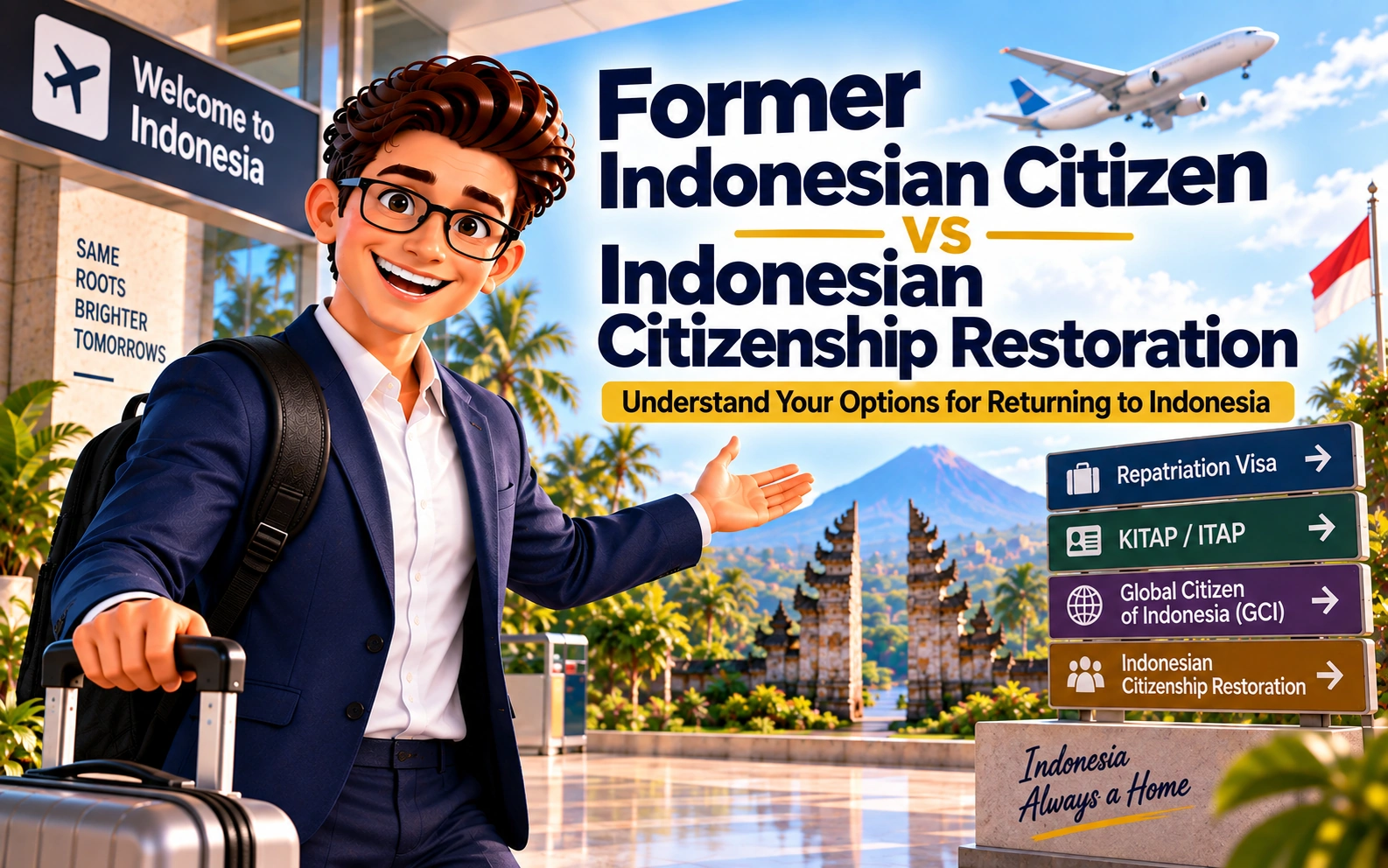
Indonesia has dedicated immigration pathways for certain former Indonesian citizens, their descendants, and other people with qualifying connections to Indonesia. These pathways are designed to make it easier for eligible individuals to return to Indonesia and establish a longer-term presence in the country.

The current official immigration framework places these pathways within the E32 series. The category includes repatriation visas for former Indonesian citizens, descendant-related pathways, and specialized Global Citizen of Indonesia (GCI) categories. Because the requirements and residence outcomes differ between these options, ‘repatriation’ should not be treated as one single visa or one universal permanent-residence route.

Main Repatriation & Former Indonesian Pathways

Visa CategoryGeneral GroupGeneral Purpose
E32AFormer Indonesian citizensFive-year repatriation / long-term residence pathway
E32BQualifying descendantsFive- or ten-year descendant pathway under the applicable Golden Visa framework
E32CFormer Indonesian citizensTwo-year repatriation pathway
E32DFormer Indonesian citizensOne-year repatriation pathway
E32EEligible former Indonesians / GCIPermanent-residence pathway under GCI
E32FEligible persons with qualifying Indonesian connection / expertiseSpecialized GCI pathway
E32GEligible descendants / GCIPermanent-residence pathway under GCI
E32HEligible descendants / special expertise / GCISpecialized GCI pathway

The official Immigration visa list currently identifies E32A through E32H as separate categories. Some are Golden Visa pathways with fixed periods of stay, while E32E and E32G are identified as GCI permanent-residence pathways. Applicants should therefore distinguish ordinary repatriation or descendant residence from GCI permanent residence.

Who May Qualify?

  • Former Indonesian citizens who meet the requirements of the applicable repatriation category.
  • Certain descendants of Indonesian citizens or former Indonesian citizens.
  • People who qualify under specialized GCI categories because of an eligible connection, background, or expertise.
  • Applicants who can provide the required evidence of their Indonesian citizenship history, family relationship, or other qualifying connection.

Repatriation Is Broader Than Returning to Indonesia

In immigration terms, repatriation is not simply the act of physically returning to Indonesia. It refers to a legal immigration pathway for people who meet defined criteria for residence based on their relationship with Indonesia. A former Indonesian citizen may therefore have access to a dedicated residence category that is different from the pathway available to an ordinary foreign national.

Global Citizen of Indonesia (GCI)

The 2026 framework also introduced Global Citizen of Indonesia (GCI) as a specialized pathway for certain people with strong Indonesian connections. Official Immigration information describes GCI as a policy intended for eligible former Indonesian citizens, descendants of former Indonesian citizens, spouses or family members in qualifying circumstances, and other specified groups. Depending on the category, the resulting residence status can include an unlimited ITAP.

GCI should be understood as a specialized permanent-residence framework rather than simply another name for a regular KITAS. The relevant E32 and related categories have their own eligibility requirements, and applicants should verify whether their specific family history or connection to Indonesia meets the current criteria.

Can Repatriation Lead to Permanent Residence?

Yes, certain repatriation pathways can lead to permanent residence. Current Immigration guidance recognizes repatriation as one of the categories that may qualify for an ITAS-to-ITAP change of status, while certain GCI categories provide a direct permanent-residence pathway. The route depends on the specific visa category and the applicant’s circumstances.

Documents and Evidence

Applicants should expect to provide evidence supporting the basis of their application. Depending on the category, this may include former Indonesian identity or citizenship documents, birth certificates, family records, proof of descent, marriage documents, or evidence of another qualifying connection. The exact document list should always be checked against the current official requirements for the selected visa.

Repatriation & Former Indonesian Residency at a Glance

For former Indonesians and their eligible descendants, Indonesia offers residence options that are distinct from ordinary work, investment, or family visas. The first step is to establish the applicant’s exact connection to Indonesia and then determine whether an E32 repatriation, descendant, or GCI pathway applies.

This pillar provides an overview only. Detailed eligibility criteria, documentary evidence, validity periods, investment or other conditions, GCI requirements, and application procedures should be covered in dedicated supporting articles and verified against the latest official Immigration guidance.

10. Second Home & Special Residency

Indonesia also provides several special-residency pathways for foreign nationals who do not fall under conventional work, investment, family, education, or repatriation categories. These include Second Home and other specialized residence options designed for specific purposes and qualifying applicants.

Because these pathways have different eligibility requirements and permitted activities, applicants should choose the category based on their actual circumstances rather than simply selecting the longest available residence period.

Main Second Home & Special Residency Pathways

The E33 series includes several special-residency categories covering different purposes and applicant profiles. The exact visa index depends on the applicant’s circumstances and the requirements applicable to the selected pathway.

Second Home Residency

The Second Home pathway is designed for eligible foreign nationals who want to establish a long-term connection with Indonesia without relying on conventional employment or family-based residence. Depending on the applicable category, Second Home residence may be available for longer periods and can be subject to financial, investment, or other qualifying requirements.

Second Home residence is not the same as an employment-based KITAS. Holders must comply with the conditions of their specific visa and should not assume that the status provides unrestricted permission to work in Indonesia.

Remote Worker Residency — E33G

Indonesia also provides a specialized remote-worker pathway under E33G for eligible foreign nationals who work remotely for an overseas company or business. The pathway is different from a conventional Indonesian employment visa because the underlying work arrangement is based outside Indonesia.

Applicants should review the specific E33G requirements and conditions before applying, particularly regarding employment, income, and the activities permitted during their stay.

Retirement Residency

Indonesia also offers dedicated retirement-related residence pathways for eligible foreign nationals who meet the applicable age, financial, insurance, and other requirements. These pathways are designed for residence rather than employment and therefore should not be confused with a work-based KITAS.

Other Specialized Residence Categories

Indonesia’s immigration framework also includes other specialized categories for specific purposes and qualifying applicants. These may include medical treatment and other specialized activities. Because these pathways are purpose-specific, they should not automatically be treated as general long-term residency options.

Can Second Home Residence Lead to ITAP?

Certain Second Home categories are recognized in current Immigration guidance as eligible for a change from ITAS to ITAP, subject to the applicable requirements. This does not mean every E33 holder automatically qualifies for permanent residence. Eligibility depends on the specific Second Home category, the person’s circumstances, and the requirements in force at the time of application.

Who Should Consider a Second Home or Special Residency Pathway?

  • Foreigners seeking a long-term base in Indonesia without an Indonesian employment relationship.
  • Eligible remote workers whose income and work arrangement fit the E33G requirements.
  • Retirees who meet the applicable retirement residence conditions.
  • Distinguished individuals, entrepreneurs, or experts who qualify for a specialized category.
  • Foreigners whose circumstances fit a specialized long-term residence program better than a conventional work, investor, or family pathway.

Important: Special Residence Does Not Mean Unlimited Rights

A long-term residence visa does not automatically grant every right available to an Indonesian citizen or to a foreigner holding a different residence category. Work rights, business activities, investment permissions, family sponsorship, financial requirements, and other conditions depend on the specific immigration category.

Second Home & Special Residency at a Glance

The best way to approach these pathways is to start with the person’s actual purpose and circumstances. If the goal is remote work, retirement, establishing a long-term base, or participating in a specialized program, the applicant should compare the relevant E33 or other special category against the conventional ITAS pathways before applying.

This pillar provides only a high-level overview. Detailed E33, E33E, E33F, E33G, E34 and other specialized visa requirements, costs, validity periods, financial thresholds, work rights, and application procedures should be addressed in dedicated supporting guides and checked against the latest official Immigration rules.

11. Understanding ITAP & KITAP

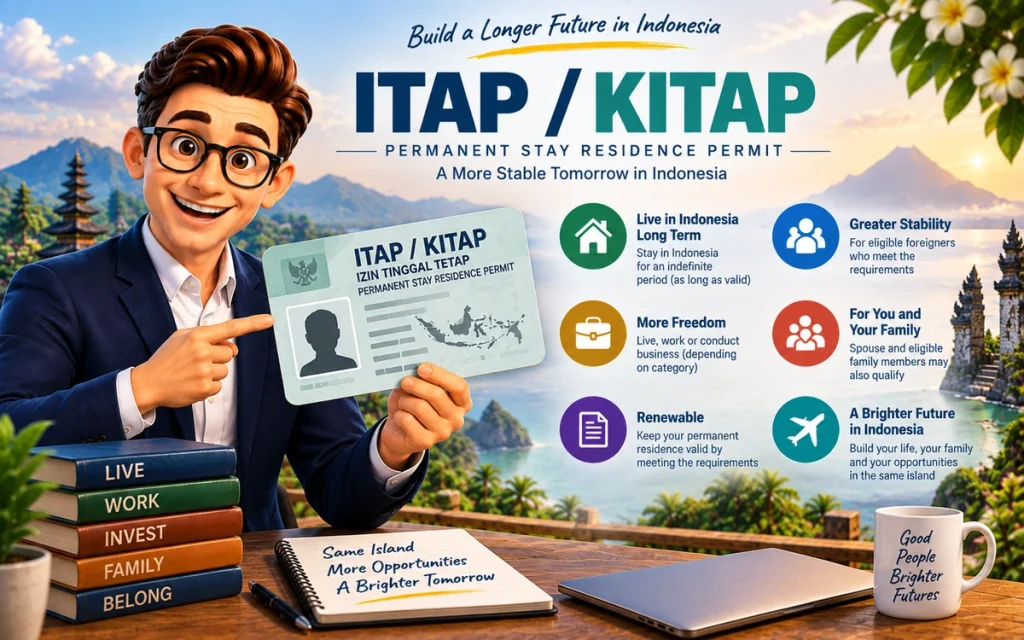
ITAP stands for Izin Tinggal Tetap, or Permanent Stay Permit. It is the Indonesian immigration status that allows certain foreign nationals to live and settle in Indonesia on a permanent-stay basis, subject to the conditions and requirements of the applicable category. KITAP is the term commonly used for the card or document associated with an ITAP.

ITAP is not simply a longer version of ITAS. It is a different residence status with its own eligibility rules, application procedures, and rights and responsibilities. A foreigner generally needs to qualify under a recognized permanent-residence pathway rather than assuming that any long-term visa or ITAS can automatically become ITAP.

Under the current immigration framework, ITAP can be obtained through certain ITAS-to-ITAP status changes and, for specific categories, directly without first holding an ITAS. The recognized pathways include employment, religious work, foreign investment, family reunification, repatriation, and certain Second Home categories, while direct ITAP is available in specified circumstances such as certain children and former Indonesian citizens.

ITAP vs ITAS at a Glance

FeatureITAS / KITASITAP / KITAP
Residence statusLimited / temporary stayPermanent stay
Main purposeLong-term temporary residence under a qualifying categoryMore permanent settlement in Indonesia
How obtainedThrough an eligible visa or permitted status-change processThrough an eligible ITAS-to-ITAP pathway or direct ITAP pathway
ValidityDepends on the category and applicable rulesCan be issued for specified periods and, in eligible cases, for an unlimited period
Extension / continuationSubject to category-specific rulesITAP can be extended for an unlimited period when the applicable requirements are met

Current Immigration service information lists ITAP issuance options including 5-year and other applicable periods, while ITAP can also be extended for an unlimited period under the relevant rules. The exact validity available to an applicant depends on the category and applicable regulation.

How Can a Foreigner Obtain ITAP?

  • Through a change of status from an eligible ITAS to ITAP.
  • Through a direct ITAP application where Indonesian immigration rules specifically allow it.
  • Through a family, repatriation, investment, employment, religious, or qualifying Second Home pathway where the applicant meets the applicable conditions.

ITAS to ITAP

For eligible ITAS holders, the change of status to ITAP is made by application through the immigration system. Current Immigration guidance states that the application must be submitted no later than 30 days before the ITAS expires. The recognized categories include workers, religious workers, foreign investors, family reunification, repatriation, and certain Second Home categories.

Direct ITAP Without ITAS Conversion

Not every permanent-residence case begins with an ITAS. Indonesian Immigration also provides a direct ITAP route for specific applicants. Examples include certain former Indonesian dual-nationality children who choose foreign citizenship and children born in Indonesia when one or both parents hold ITAP. Other direct-ITAP situations may apply under the current regulations.

Does ITAP Mean You Can Stay in Indonesia Forever?

ITAP is Indonesia’s permanent-stay status, but it should not be described as an unconditional right to remain in Indonesia forever. The status remains subject to immigration law, reporting and compliance obligations, the conditions of the relevant category, and any applicable cancellation or revocation provisions. In eligible cases, ITAP can be extended for an unlimited period rather than requiring the holder to obtain a completely new residence status after every fixed period.

KITAP and the Rights of a Permanent Resident

Holding a KITAP does not make a foreign national an Indonesian citizen. A KITAP holder remains a foreign national and must comply with the conditions attached to the residence status. Rights relating to employment, business, family, travel, taxation, property, and other activities should therefore be assessed according to the applicable laws rather than assumed from the word ‘permanent’.

Who Should Consider Permanent Residence?

  • Foreign workers who meet the requirements for an ITAS-to-ITAP pathway.
  • Eligible foreign investors.
  • Foreign spouses and other qualifying family members.
  • Eligible former Indonesian citizens and repatriation applicants.
  • Certain Second Home residents and other qualifying special categories.
  • Applicants who qualify for a direct ITAP pathway.

ITAP & KITAP at a Glance

The simplest way to understand ITAP is as Indonesia’s permanent-stay residence status for eligible foreign nationals. KITAP is the commonly used term for the card or document associated with that status. Unlike ITAS, ITAP is designed for more permanent residence, but it remains an immigration status subject to specific eligibility, compliance, and continuation requirements.

This pillar provides an overview only. Detailed ITAP eligibility, category-specific requirements, documents, costs, validity, extensions, and ITAS-to-ITAP procedures should be covered in dedicated supporting articles and verified against the latest official Immigration rules.

12. Who Can Qualify for ITAP?

Permanent residence in Indonesia is available only through specific immigration pathways. An ITAS holder cannot automatically obtain ITAP simply because they have lived in Indonesia for a long time. Eligibility depends on the legal basis of the residence, the applicant’s circumstances, and the requirements that apply to the relevant category.

Current Immigration guidance recognizes several categories that may qualify for a change from ITAS to ITAP, including workers, religious workers, foreign investors, family reunification, repatriation, and certain Second Home categories. There are also specific circumstances in which ITAP may be granted directly without first changing from ITAS.

1. Employment & Professional

Eligible foreign workers and certain professional or religious-worker categories may qualify for ITAS-to-ITAP status changes when the applicable conditions are met. Current Immigration guidance includes workers and religious workers among the recognized categories. The requirements can include evidence relating to the employment or professional activity, the sponsor, and the applicant’s continued eligibility.

For some work and religious-worker categories, current Immigration guidance requires the foreigner to have resided in Indonesia for at least three consecutive years from the date the ITAS was granted. Category-specific requirements should be checked before relying on this as a general rule for every employment pathway.

2. Investment

Foreign investors may qualify for ITAP through an eligible investment-based ITAS pathway. Immigration guidance recognizes foreign investment as a basis for ITAS-to-ITAP status changes, subject to the applicable investment, company, sponsorship, and residence requirements.

Investor ITAP should therefore be viewed as a continuation of an eligible investment-residence pathway rather than as an automatic benefit of owning a company or holding shares in Indonesia. The exact investment requirements and supporting evidence depend on the relevant investor category.

3. Family

Family reunification is one of the most significant routes to permanent residence. Eligible family-based cases can include a foreign spouse joining an Indonesian citizen, certain children joining an Indonesian parent, and family members joining a qualifying ITAP holder. The specific requirements depend on the relationship and the immigration status of the family member in Indonesia.

For a foreign spouse of an Indonesian citizen, current Immigration guidance states that the marriage must have reached at least two years for the ITAS-to-ITAP route. Other family categories have their own conditions.

4. Repatriation & Former Indonesians

Former Indonesian citizens can have specialized pathways to permanent residence. Repatriation is recognized as a basis for an ITAS-to-ITAP status change, while certain former Indonesian citizens and related applicants may qualify for direct ITAP or specialized GCI pathways. The applicant’s previous Indonesian citizenship status and supporting documentation are central to determining the correct route.

5. Second Home & Special Residence

Certain Second Home and special-residence categories can also provide a route to ITAP. Current Immigration guidance specifically identifies Second Home, special expertise, eminent persons, and foreign senior-citizen categories among the eligible ITAS-to-ITAP pathways, subject to the relevant conditions.

This does not mean that every E33 holder automatically qualifies for permanent residence. The applicant must meet the requirements of the specific category and the applicable ITAP rules.

6. Direct ITAP Pathways

Some applicants may receive ITAP without first going through an ITAS-to-ITAP conversion. Current Immigration service guidance identifies, among others, certain former Indonesian dual-nationality children who choose foreign citizenship, children born in Indonesia when a parent holds ITAP, and Indonesian citizens who lose Indonesian citizenship while in Indonesia as direct-ITAP cases.

Is Three Years of Residence Always Required?

No. The three-year residence requirement should not be presented as a universal rule for every ITAP applicant. Current Immigration guidance applies a minimum three-year consecutive residence condition to certain categories such as workers, religious workers, investors, and certain elderly foreign tourists seeking ITAS-to-ITAP status changes, while other family, repatriation, Second Home, GCI, or direct-ITAP pathways have different rules.

A Simple Way to Determine ITAP Eligibility

QuestionWhy It Matters
What is the basis of your current ITAS?Determines whether your category has an ITAP pathway.
Are you a worker, investor, family member, repatriation applicant, or special-residence holder?Different categories have different eligibility rules.
How long have you held or used your qualifying residence status?Some pathways have minimum residence requirements.
Do you have a qualifying Indonesian family or citizenship connection?May open family, repatriation, GCI, or direct-ITAP pathways.
Does your category require a commitment or investment?Additional evidence may be required before ITAP is approved.

The most important principle is that ITAP eligibility is category-specific. A foreigner should first identify the legal basis of their residence and then check the corresponding ITAP pathway rather than assuming that long-term residence alone creates a right to permanent residence.

13. From ITAS to ITAP

For eligible foreign residents, the change from ITAS (Limited Stay Permit) to ITAP (Permanent Stay Permit) is one of the main pathways from temporary residence to permanent residence in Indonesia. It is not an automatic conversion based solely on the length of time a foreigner has lived in Indonesia. The applicant must belong to an eligible category and satisfy the requirements applicable to that category.

Current Immigration guidance recognizes ITAS-to-ITAP status changes for categories including workers, religious workers, foreign investors, family reunification, repatriation, and certain Second Home categories. The exact requirements differ by pathway.

When Should You Apply?

An application to change ITAS to ITAP must be submitted no later than 30 days before the ITAS expires. In practice, applicants should begin preparing well before this deadline so that category-specific documents, sponsor information, financial or investment evidence, and other supporting requirements can be checked in advance.

General ITAS-to-ITAP Process

StageWhat Happens
1. Confirm eligibilityDetermine whether the current ITAS category has an ITAP pathway and whether the applicant meets the category-specific conditions.
2. Prepare documentsCollect the passport, current ITAS, sponsor/supporting documents, integration statement, and category-specific evidence.
3. Submit the applicationThe foreigner, sponsor, or responsible party submits the application through the applicable Immigration system.
4. Immigration verificationThe Immigration Office checks the application and documents and conducts the required photo/biometric or verification process.
5. PaymentApplicable immigration fees are verified and paid.
6. Directorate General reviewThe application is forwarded to the Directorate General of Immigration for the required decision.
7. ITAP issuanceIf approved, the permanent stay permit is issued electronically or through the applicable immigration process.

The official Immigration service workflow describes application receipt, photo taking, payment verification, forwarding by the Immigration Office to the Directorate General, and issuance after the required decision. The Directorate General decision is stated as being made no later than five working days after the application is received there, while the Immigration Office has up to three working days after payment is received to forward the application. These are official service standards and should not be interpreted as a guarantee that every case will be completed within the same overall time frame.

General Documents

The exact document checklist depends on the ITAP pathway. Official Immigration guidance lists general documents such as a valid passport, integration statement where required, current ITAS, sponsor or responsible-party evidence where applicable, and supporting identity or family documents. Category-specific applications may require additional evidence such as company documents, investment records, employment documentation, financial evidence, or proof of family relationship.

Category-Specific Requirements Matter

  • Workers may need employment and company-related documents and must satisfy the conditions applicable to their work category.
  • Investors may need evidence of qualifying investment, company structure, share ownership, and other investment commitments.
  • Family applicants may need marriage, birth, family-card, or other civil-status evidence.
  • Repatriation applicants may need evidence that they were previously Indonesian citizens or otherwise qualify for the relevant repatriation pathway.
  • Second Home and special-residence applicants may need to demonstrate the financial, asset, expertise, age, or other conditions attached to their specific category.

Does Everyone Need Three Years of ITAS?

No. A minimum period of residence applies to certain ITAS-to-ITAP categories, but it is not a universal requirement for every permanent-residence route. Current Immigration guidance and local Immigration service pages identify three consecutive years as a condition for several categories, including certain workers, investors, religious workers, and elderly foreign-tourist pathways, while family, repatriation, Second Home, GCI, and direct-ITAP cases can follow different rules.

What Happens If the Application Is Incomplete?

Immigration guidance states that if an application contains errors or missing documents, the applicant, sponsor, or responsible party can be notified electronically and asked to correct or complete the submission within the prescribed period. Applicants should therefore ensure that the uploaded documents are complete and consistent before submission.

ITAP Approval Is Not the End of Immigration Compliance

After obtaining ITAP, the foreign resident remains subject to Indonesian immigration requirements. This can include reporting obligations, maintaining valid identity and supporting documents, complying with the conditions of the residence category, and applying for any required extension or re-entry permission.

ITAS to ITAP: Key Takeaway

The safest way to approach an ITAS-to-ITAP application is to work backward from the specific ITAP category: confirm eligibility, identify the required evidence, prepare the application before the 30-day deadline, and follow the Immigration verification process. Because the requirements differ significantly between workers, investors, family members, repatriation applicants, and special-residence holders, there is no single checklist that applies to everyone.

This pillar provides the general pathway only. Detailed ITAS-to-ITAP requirements, documents, fees, processing procedures, and category-specific conditions should be covered in dedicated supporting guides and verified against the latest official Immigration information.

14. Rights & Responsibilities of Foreign Residents

Obtaining ITAS or ITAP gives a foreign national a lawful basis to reside in Indonesia, but it does not make the person an Indonesian citizen or give unrestricted rights to carry out every activity in the country. The rights and responsibilities of a foreign resident depend on the specific immigration status, visa category, permitted purpose of stay, and other Indonesian laws that may apply.

This is particularly important because two foreigners can both hold a long-term residence status while having different permitted activities. A work-based resident, investor, family member, student, remote worker, and Second Home holder may each have different conditions. The official visa framework itself separates these purposes into different categories.

Key Rights and Activities

AreaGeneral PrincipleImportant Note
ResidenceLive in Indonesia during the validity of the applicable stay permit.The residence must remain within the conditions of the approved category.
WorkWork may be permitted for categories designed for employment or other specifically authorized activities.Do not assume every ITAS or ITAP permits unrestricted employment.
Investment / BusinessCertain investor and other categories allow specified investment or business activities.Activities must match the applicable immigration and business rules.
FamilyEligible residents may have family-reunification or dependent pathways.Each family member generally needs the appropriate immigration status.
International travelITAS and ITAP holders can leave and re-enter Indonesia with a valid Re-Entry Permit.A valid IMK is required to preserve the residence status when traveling abroad.
Long-term residenceEligible ITAS holders may have a route to ITAP.ITAP eligibility is category-specific and not automatic.

Work Rights Depend on the Immigration Category

One of the most common misconceptions is that holding a KITAS or KITAP automatically means a foreigner can work anywhere in Indonesia. In reality, work rights depend on the legal basis of the residence and the applicable employment and immigration rules. A foreigner holding a work-related E23 or E25 pathway is in a different position from a student, family member, retiree, or remote worker using a specialized residence category.

Before starting employment, changing employers, taking a different position, or performing activities outside the original purpose of stay, the foreign resident should verify whether the activity is permitted and whether additional immigration or employment requirements apply.

Business and Investment Activities

Some residence categories are specifically connected to investment or business activities, while others are not. Investor residence may allow qualifying investment and company-related activities under its conditions, but a foreign resident should not assume that every ITAS or ITAP provides the same business rights. Company ownership, directorship, employment, and operational activities can also be governed by separate Indonesian business and employment regulations.

Travel Outside Indonesia and Re-Entry

Foreign residents who hold ITAS or ITAP and want to travel outside Indonesia must pay close attention to their Izin Masuk Kembali (IMK), or Re-Entry Permit. Immigration guidance states that ITAS and ITAP holders are required to have a valid Re-Entry Permit when leaving Indonesia and returning if they want to maintain their residence status.

A Re-Entry Permit can be issued for a single trip or, depending on the residence status and applicable rules, for multiple trips. Before traveling, residents should confirm that both their residence permit and Re-Entry Permit remain valid.

Family and Dependents

Long-term residents may have family-reunification options depending on their immigration category. However, a spouse, child, or parent does not automatically receive the same residence status as the principal foreign resident. Each family member must qualify under the appropriate family or dependent pathway.

Maintaining Valid Immigration Status

  • Keep the passport and residence documents valid.
  • Follow the conditions of the visa and stay permit.
  • Maintain required sponsorship or supporting arrangements where applicable.
  • Complete extensions, reporting, or other immigration procedures within the required time.
  • Maintain any investment, employment, family, financial, or other commitments required by the residence category.
  • Use a valid Re-Entry Permit when traveling abroad and returning to Indonesia.

Reporting and Compliance

Certain permanent residents also have periodic reporting obligations. For example, holders of an unlimited-period ITAP are required to report every five years to the Head of the Immigration Office responsible for their place of residence, using the applicable system and documents.

Other reporting, registration, sponsor, or compliance obligations can apply depending on the residence category. Residents should therefore not treat an unlimited-period ITAP as an exemption from immigration compliance.

What Can Put a Residence Status at Risk?

  • Allowing the relevant residence or Re-Entry Permit to expire without taking the required action.
  • Carrying out activities that are not permitted under the immigration category.
  • Failing to maintain category-specific commitments or supporting conditions.
  • Providing false, incomplete, or misleading information to Immigration.
  • Violating Indonesian immigration or other applicable laws.

Rights & Responsibilities: Key Takeaway

The safest way to think about Indonesian residency is that a residence permit gives a foreigner a defined legal status, not a blanket permission to do everything an Indonesian citizen can do. Always assess work, business, family, travel, and other activities against the specific immigration category and the relevant Indonesian regulations.

This section provides a general overview. Detailed work rights, tax obligations, property rules, banking, business licensing, family sponsorship, and other practical issues should be covered in dedicated guides and checked against the latest regulations applicable to the resident’s situation.

15. Cost of Indonesian Residency

1. Government Immigration Fees

The cost of Indonesian residency depends on the immigration pathway and the type of residence permit you apply for. Government immigration fees are only one part of the overall cost.

ITAS and ITAP have different government fees depending on the type and validity of the permit. Certain visa categories may also have different fee structures, particularly Golden Visa and other special-residence pathways.

For this reason, applicants should always check the latest official Immigration tariff applicable to their specific visa and residence category before making a payment.

2. Visa and Residence Permit Fees

Visa fees and residence-permit fees should be understood as separate components of the immigration process. Depending on the pathway, an applicant may first pay the applicable visa fee and then the relevant ITAS or ITAP fee.

The exact amount depends on the visa category, validity period, and type of application. A quoted government ITAS or ITAP fee should therefore not automatically be interpreted as the complete cost of obtaining legal residency in Indonesia.

3. Re-Entry Permit

Foreign residents who plan to travel outside Indonesia should also consider the cost of a Re-Entry Permit (Izin Masuk Kembali / IMK), where required.

The Re-Entry Permit is separate from the ITAS or ITAP fee. Its validity and applicable government fee depend on the type of permit and the circumstances of the resident. Before traveling internationally, ITAS and ITAP holders should make sure that their residence status and Re-Entry Permit remain valid.

4. Supporting and Administrative Costs

In addition to government immigration fees, some residency applications may involve supporting or administrative expenses. These can vary depending on the applicant and the immigration category.

Possible additional costs may include:
• Document translation, certification, or legalization where required.
• Medical, insurance, or other category-specific requirements where applicable.
• Sponsor or company administration costs where applicable.
• Civil-registration or other supporting administrative documents.
• Other documents or services required for a particular immigration pathway.

5. Professional Immigration Service Fees

Foreigners may choose to handle their immigration application themselves or use a professional visa and immigration service provider.

If a consultant or agency is used, the professional service fee is normally separate from government immigration charges. The scope of service can vary and may include document preparation, application submission, appointment coordination, immigration assistance, and follow-up during the process.

When comparing service providers, applicants should ask for a clear breakdown of government fees and professional service fees so they understand exactly what is included in the quoted price.

6. Why KITAS Prices Can Be Different

There is no single standard ‘KITAS price’ for every foreigner in Indonesia. The total amount can vary because the immigration category, validity period, visa fee, government permit fee, supporting requirements, sponsorship arrangements, and professional service package may all be different.

For example, the total cost of a work-based KITAS can be different from an investor, spouse, retirement, remote-worker, or other special-residence pathway.

This is why comparing only the headline price of a KITAS package can be misleading. A lower quotation may exclude government fees or important services, while a higher quotation may include more of the application process.

7. How to Estimate Your Total Residency Budget

A practical way to estimate your residency budget is to separate the costs into three groups:

1. Government immigration fees — the official visa, ITAS, ITAP, and other applicable immigration charges.
2. Supporting and administrative costs — documents, translations, certifications, medical or insurance requirements, and other category-specific expenses.
3. Professional service fees — optional fees charged by an immigration consultant or agency for handling the application.

Once these three components are identified, you can compare different residency pathways more accurately and understand the actual cost of maintaining legal residence in Indonesia.

8. Fees Can Change

Immigration fees and administrative requirements can change as Indonesian regulations and government fee schedules are updated. The figures or quotations available online may therefore become outdated.

Before submitting an application or making a payment, applicants should confirm the current requirements and applicable government fees through the official Indonesian Immigration system or the relevant Immigration Office.

For a long-term residency decision, it is also important to consider not only the initial application cost but the ongoing costs associated with extensions, Re-Entry Permits, supporting documents, and maintaining the conditions of the selected immigration status. This section provides a general overview of residency costs. Exact fees and requirements should always be verified against the latest official Immigration information for the applicant’s specific visa and residence category.

16. How Long Can Foreigners Stay in Indonesia?

There is no single maximum length of stay that applies to every foreigner in Indonesia. The permitted period depends on the visa category, the residence permit issued under that category, and whether the person qualifies for an extension, a change of status, or a permanent-residence pathway.

For long-term residents, the most useful distinction is between limited stay under ITAS and permanent stay under ITAP. Current Indonesian immigration rules provide different validity periods across work, investment, education, family, repatriation, Second Home, and other special-residence categories. The official visa list confirms that these purposes are divided into separate visa families rather than one universal long-term visa.

Short-Term Stay vs Long-Term Residence

Immigration StatusGeneral ConceptTypical Use
Visit Stay (ITK)Temporary stay for a permitted visit purposeTourism, business visits, social activities, and other short-term purposes
ITASLimited / temporary residenceWork, investment, education, family, repatriation, Second Home, and specialized long-term purposes
ITAPPermanent stayEligible foreign nationals who qualify for permanent residence

How Long Can an ITAS Last?

ITAS does not have one universal validity period. The duration depends on the specific visa and immigration category. Standard limited-stay pathways generally provide shorter residence periods, while certain Golden Visa and special-residence categories may provide 5- or 10-year residence.

Can ITAS Be Extended?

Yes. An ITAS may be extended when the category and applicable requirements allow it. The timing of an extension depends on the length of the existing ITAS. Current Immigration guidance states that an ITAS of up to one year can generally be applied for from 30 days before expiry, while an ITAS longer than one year can be applied for from three months before expiry.

An extension does not necessarily mean that the foreigner must remain on ITAS indefinitely. If the person qualifies for an ITAP pathway, a change of status may be more appropriate than repeatedly extending ITAS.

How Long Can ITAP Last?

ITAP provides permanent-stay status, but the specific period shown on the permit can vary. Current official fee schedules provide ITAP options of up to 5 years, up to 10 years, and an unlimited period. An unlimited-period ITAP does not mean that the holder is exempt from immigration obligations; the status remains subject to Indonesian immigration law and applicable reporting or compliance requirements.

Some Long-Term Visas Already Offer 5 or 10 Years

A foreigner does not always need to obtain ITAP in order to secure a long period of residence. Certain Golden Visa and special-residence categories can provide 5- or 10-year periods under ITAS, depending on the visa and its requirements. This is one reason why the term ‘permanent residence’ should not be confused with simply having a long visa validity.

Examples by Residency Purpose

PurposeHow Duration Is Determined
WorkDepends on the specific E23/E25/E26/E27/E29 category and applicable ITAS rules.
InvestmentDepends on the E28 category; certain Golden Visa investor categories can provide 5- or 10-year residence.
FamilyDepends on the E31 category and the family relationship; extensions and ITAP pathways may apply.
EducationDepends on the E30 category and the educational program.
Repatriation / former IndonesianDepends on the E32 category; certain categories provide 1-, 2-, 5-, or 10-year pathways, while GCI categories can provide permanent residence.
Second Home / special residenceDepends on the E33 or specialized category; some provide 1-, 5-, or longer periods.

What Determines How Long You Can Stay?

  • The specific visa category and its permitted stay period.
  • Whether the foreigner qualifies for an ITAS extension.
  • Whether the category provides an ITAS-to-ITAP pathway.
  • Whether the applicant qualifies for a direct ITAP or GCI permanent-residence pathway.
  • Whether category-specific commitments, such as investment, employment, education, family relationship, or financial requirements, remain satisfied.

Can You Stay in Indonesia Indefinitely?

For eligible foreign nationals, Indonesia can provide a practical pathway to indefinite long-term residence through an unlimited-period ITAP or certain direct permanent-residence pathways. However, ‘indefinite’ does not mean automatic or unconditional. The resident must maintain lawful status, comply with immigration requirements, and remain within the conditions of the applicable residence status.

The Key Takeaway

If your goal is to live in Indonesia for many years, do not focus only on the maximum validity of the first visa. Look at the entire residency pathway: initial visa, ITAS, extension options, ITAP eligibility, and any long-term or permanent-residence route available to your category. This gives a much more accurate picture of how long you can realistically remain in Indonesia.

17. Residency vs Indonesian Citizenship

Permanent residence and citizenship are two different legal statuses. An ITAP or KITAP allows an eligible foreign national to reside in Indonesia on a permanent-stay basis, but it does not make that person an Indonesian citizen. A foreign resident can therefore have a long-term or unlimited residence status while continuing to hold the citizenship and passport of another country.

This distinction is particularly important when planning a long-term future in Indonesia. Residency is primarily an immigration status, while citizenship is a nationality status governed by Indonesian citizenship law. Obtaining ITAP does not automatically start or complete the naturalization process.

ITAP vs Indonesian Citizenship

AspectPermanent Resident (ITAP/KITAP)Indonesian Citizen (WNI)
NationalityRemains a foreign nationalIndonesian nationality
PassportUses the passport of the foreign nationalityEligible for an Indonesian passport
ResidenceCan live in Indonesia under ITAP conditionsHas the right of residence as an Indonesian citizen
Immigration statusMust maintain the applicable residence status and comply with immigration rulesNot subject to foreign-resident stay permits
Citizenship rightsDoes not automatically receive all rights reserved to Indonesian citizensReceives rights and responsibilities attached to Indonesian citizenship
Path to citizenshipMay qualify for naturalization or another citizenship route if legal requirements are metAlready an Indonesian citizen

Does ITAP Automatically Lead to Citizenship?

No. Holding ITAP does not automatically convert a foreign national into an Indonesian citizen. Citizenship must be obtained through a separate legal process under Indonesian nationality law, and the applicant must satisfy the requirements of the applicable citizenship pathway.

Naturalization Is a Separate Process

Foreign nationals who want to become Indonesian citizens must follow a separate citizenship process under Indonesian nationality law. The requirements depend on the applicable citizenship pathway and may include residence, age, health, criminal-record, income, and other legal requirements.

Because citizenship has different legal consequences from permanent residence, applicants should evaluate the applicable nationality rules separately rather than assuming that holding ITAP automatically qualifies them for citizenship.

Citizenship for Foreign Spouses of Indonesian Citizens

Indonesian citizenship law provides a specific citizenship pathway for certain foreign nationals who are legally married to Indonesian citizens. The requirements and procedure are separate from the spouse’s immigration status and must be assessed under the applicable nationality law.

A foreign spouse may therefore have both an immigration pathway—such as family-based ITAS or ITAP—and a separate citizenship pathway. These should not be treated as the same process.

GCI Is Not Citizenship

An ITAP holder can remain a foreign citizen because permanent residence does not itself change nationality. GCI was specifically introduced to provide unlimited permanent residence to eligible foreign nationals without requiring them to give up their existing citizenship. Citizenship applications are different and must comply with Indonesian nationality rules, including the rules concerning dual citizenship.

Global Citizen of Indonesia (GCI) is a specialized permanent-residence pathway for eligible foreign nationals with qualifying Indonesian family, historical, or other connections to Indonesia. It can provide an unlimited ITAP while allowing eligible applicants to retain their foreign citizenship.

GCI is therefore a residence pathway, not a form of Indonesian citizenship.

Residency May Be the Better Option for Some Foreigners

Not every foreigner who wants to live in Indonesia permanently needs Indonesian citizenship. For some people, maintaining their existing nationality while holding an appropriate permanent residence status may be a more suitable option. This can be particularly relevant to former Indonesians, descendants, mixed families, and others with strong ties to Indonesia who want to live in Indonesia while retaining their existing nationality.

When Should You Consider Citizenship?

  • When you want Indonesian nationality rather than only the right to reside in Indonesia.
  • When you are prepared to meet the separate requirements under Indonesian citizenship law.
  • When you understand the implications for your current nationality and dual-citizenship status.
  • When your long-term personal, family, and legal circumstances make citizenship more appropriate than permanent residence.

Residency vs Citizenship: Key Takeaway

If your goal is to live in Indonesia long term or indefinitely, an eligible ITAP or other permanent-residence pathway may be sufficient; Indonesian citizenship is not automatically required. If your goal is to become an Indonesian national, however, citizenship must be pursued through a separate legal process.

The right choice depends on whether your priority is long-term residence in Indonesia or a change in nationality.

This pillar provides a high-level overview only. Citizenship eligibility, naturalization procedures, dual-nationality rules, and nationality-specific consequences should be checked against the latest Indonesian citizenship legislation and the relevant government authorities before making a citizenship decision.

18. Indonesia Residency FAQ

Can foreigners become residents in Indonesia?

Yes. Eligible foreign nationals can obtain limited residence through ITAS and, where they meet the applicable requirements, permanent residence through ITAP. The correct pathway depends on the purpose of stay and the applicant’s circumstances. Indonesia’s current official framework includes work, investment, education, family, repatriation, Second Home, and other specialized residence categories.

What is the difference between ITAS and KITAS?

ITAS is Izin Tinggal Terbatas, or Limited Stay Permit. KITAS is the common term used for the card or documentation associated with that limited-stay status. They are closely related but should not be treated as exactly the same legal concept.

What is the difference between ITAP and KITAP?

ITAP is Izin Tinggal Tetap, or Permanent Stay Permit. KITAP is the common term for the card or documentation associated with ITAP. ITAP is a permanent-stay immigration status, not Indonesian citizenship.

How can I stay in Indonesia long term?

First identify the purpose of your stay. Depending on your circumstances, you may qualify for work, investor, family, education, repatriation, Second Home, or another specialized residence pathway. An eligible ITAS holder may later qualify for ITAP, while certain applicants can qualify for direct permanent residence.

Can KITAS become KITAP?

In eligible cases, yes. The formal process is a change of status from ITAS to ITAP. Current Immigration guidance recognizes workers, religious workers, investors, family reunification, repatriation, and certain Second Home categories, among others, as eligible pathways. The application must generally be submitted no later than 30 days before the ITAS expires.

Do I need to live in Indonesia for three years before getting ITAP?

Not in every case. A three-year consecutive residence condition applies to certain categories, including workers, religious workers, investors, and foreign elderly tourists. Other family, repatriation, Second Home, GCI, and direct-ITAP pathways have different requirements.

Who qualifies for permanent residence in Indonesia?

Potentially eligible groups include qualifying workers, religious workers, investors, family members, repatriation applicants, certain Second Home residents, and people who qualify for direct ITAP or specialized GCI pathways. Eligibility is always category-specific.

Can a foreign spouse of an Indonesian citizen get permanent residence?

A foreign spouse may qualify for an ITAS-to-ITAP pathway when the applicable requirements are met. Current Immigration guidance states that, for the spouse route involving an Indonesian citizen, the marriage must have existed for at least two years. Other requirements also apply.

Can foreigners retire in Indonesia?

Yes. Indonesia has dedicated retirement-related residence categories, including the current E33E five-year retiree pathway and E33F one-year retiree pathway. Certain elderly foreign residents can also qualify for an ITAS-to-ITAP pathway when the applicable conditions are satisfied.

Can remote workers live in Indonesia long term?

Eligible remote workers may use the E33G Remote Worker Special Residency Visa, subject to its specific requirements and conditions. E33G should not be confused with a conventional Indonesian employment visa because the two pathways are based on different purposes and conditions.

Does ITAP make me an Indonesian citizen?

No. ITAP gives permanent-stay status but does not change nationality. An ITAP holder remains a foreign national unless they separately obtain Indonesian citizenship through a lawful citizenship process.

Can I keep my foreign citizenship while holding ITAP?

Yes. Permanent residence itself does not change nationality. Specialized GCI pathways are specifically designed to provide eligible people with unlimited permanent residence while retaining their foreign citizenship.

Can GCI holders become permanent residents without first having ITAS?

Certain GCI categories are structured as permanent-residence pathways and can provide an unlimited ITAP to eligible applicants. The exact eligibility depends on the relevant GCI category.

Can every KITAS holder work in Indonesia?

No. Work rights depend on the immigration category and the activity permitted under that category. A work-based residence status is different from family, education, retirement, remote-worker, or other specialized residence categories.

Can a KITAP holder work anywhere in Indonesia?

Not automatically. KITAP establishes permanent residence status, but work and business activities remain subject to the conditions of the immigration status and other applicable Indonesian regulations.

Can I leave Indonesia while holding ITAS or ITAP?

Yes, but residents should ensure that they have a valid Re-Entry Permit when leaving and returning to Indonesia so that their residence status is maintained under the applicable rules.

How much does Indonesian residency cost?

There is no single residency price. Costs can include the visa, ITAS or ITAP fee, Re-Entry Permit, supporting documents, and optional professional services. Government fees vary by category and validity period and should be checked against the current official tariff before payment.

How long can I stay in Indonesia with ITAS?

It depends on the category. Current immigration services provide different ITAS periods, including shorter conventional permits and 5- or 10-year options for certain Golden Visa and special-residence categories. The exact validity depends on the visa and applicable rules.

How long does ITAP last?

ITAP can be issued for specified periods, including up to five or ten years, and an unlimited-period option is available under the applicable rules. Unlimited ITAP does not remove immigration compliance and reporting obligations.

What is the best residency option for me?

There is no single best option for everyone. The right pathway depends on why you want to live in Indonesia—work, investment, family, education, repatriation, retirement, remote work, Second Home, or another qualifying purpose. Start with your purpose, then match it to the official immigration category.

Final Takeaway

Indonesia’s residency system is not one single visa program. It is a framework of different immigration pathways that allow eligible foreigners to live in Indonesia for limited or permanent periods depending on their purpose and circumstances. For most people, the key decision is to identify the correct legal basis for residence first, then determine whether the pathway can lead to ITAP or another form of long-term residence.

Because immigration rules, visa classifications, fees, and service procedures can change, applicants should always verify the latest requirements with the Directorate General of Immigration or the relevant Indonesian Immigration Office before submitting an application.

Conclusion

Living in Indonesia long term is possible through several immigration pathways, but there is no single residence option that is right for every foreigner. The best route depends on your purpose of stay, whether you plan to work or invest, your family situation, your connection to Indonesia, and the specific requirements of the immigration category that applies to you.

For many foreigners, the journey begins with an eligible visa and an ITAS, commonly known as KITAS. For those who meet the requirements, ITAS can in certain categories become a pathway to ITAP, commonly known as KITAP. Other applicants, including certain former Indonesian citizens, descendants, and GCI applicants, may have specialized or direct permanent-residence pathways.

The most important step is therefore not simply choosing a ‘KITAS’ or ‘KITAP’, but identifying the correct legal basis for your residence. Choosing the wrong category can affect your permitted activities, documents, costs, and long-term options.

Need Help Choosing the Right Indonesia Residency Pathway?

Indonesia’s immigration system can be complex, especially when you are comparing Work, Investor, Family, Education, Repatriation, Second Home, ITAS, ITAP, or GCI pathways. If you are unsure which option fits your situation, AzraID can help you assess your circumstances and identify the appropriate immigration route. Contact our immigration team for a consultation about your Indonesia residency options, eligibility, required documents, application process, and long-term residence planning.

👉 Contact AzraID via WhatsApp

Leave a Reply

Your email address will not be published. Required fields are marked *

Other News

C5A Visa Indonesia: Is the Content Creator Visa Available Yet in 2026?
27Aug

C5A Visa Indonesia: Is the Content Creator Visa Available…

Is the C5A Visa Indonesia already available? This complete 2026 guide explains the latest status of Indonesia's Content Creator Visa,…

How to Apply for Indonesia e-VOA Online in 2026: Easy Step-by-Step Guide for Foreigners
26Aug

How to Apply for Indonesia e-VOA Online in 2026:…

Planning a trip to Indonesia or Bali? Learn how to apply for an Indonesia e-VOA online with this easy step-by-step…

Bali Events October–December 2026: Best Festivals & Things to Do
26Aug

Bali Events October–December 2026: Best Festivals & Things to…

Discover the best Bali events from October to December 2026, including cultural festivals, wellness events, Christmas celebrations and New Year’s…

Living in Yogyakarta, Indonesia: A Complete Guide for Foreigners in 2026
21Aug

Living in Yogyakarta, Indonesia: A Complete Guide for Foreigners…

Thinking about living in Yogyakarta, Indonesia? Known locally as Jogja, Yogyakarta offers a different side of Indonesia for foreigners looking…

Indonesia Visa Extension 2026: How to Extend Your Stay in Indonesia
17Aug

Indonesia Visa Extension 2026: How to Extend Your Stay…

If you are already in Indonesia and want to stay longer, you may be wondering whether you can extend your…

Bali Visa 2026: Complete Guide to Visa & Entry Requirements for Bali
15Aug

Bali Visa 2026: Complete Guide to Visa & Entry…

Bali is one of the world’s most popular destinations for international travelers, attracting millions of visitors every year for holidays,…