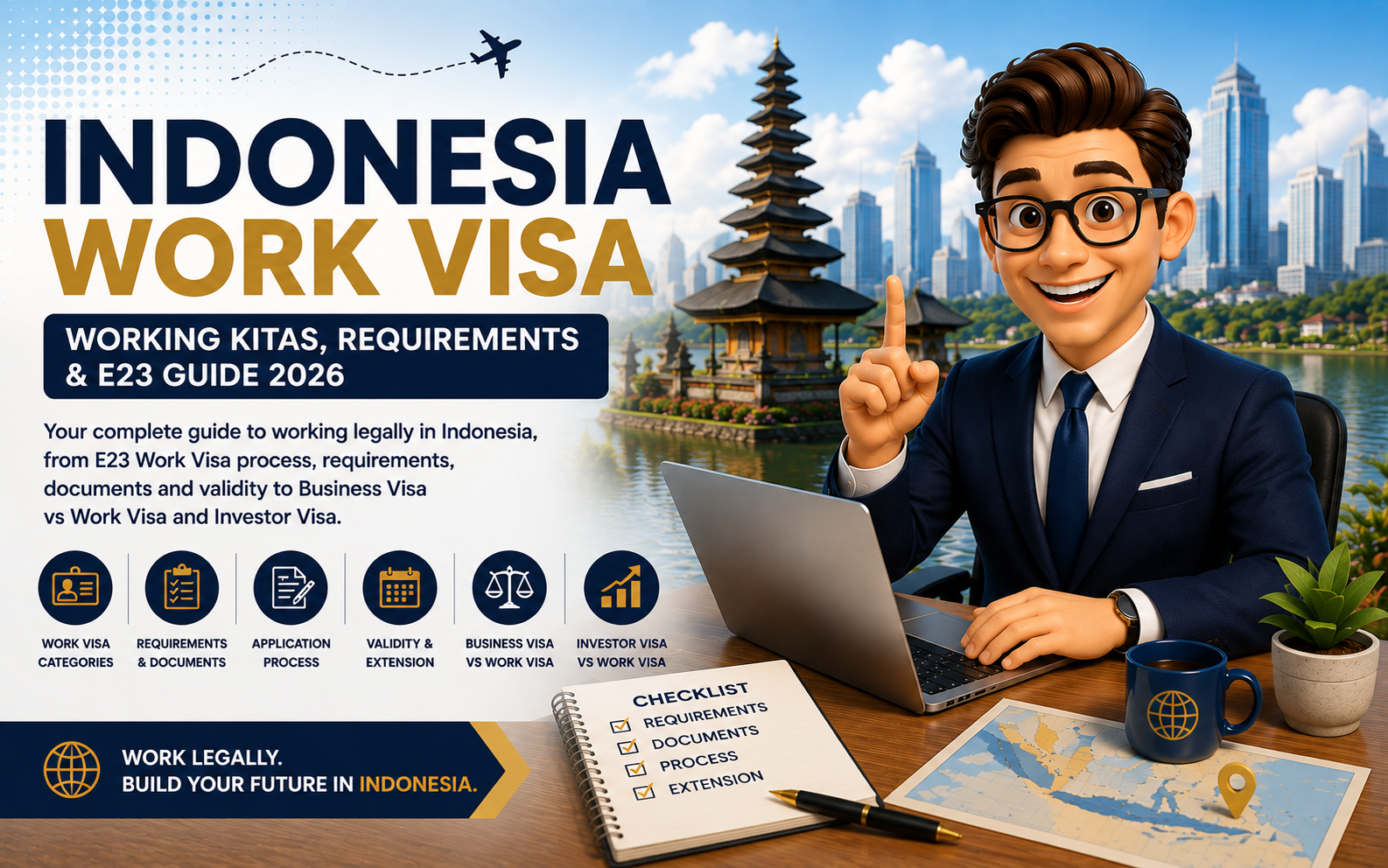
Working in Indonesia can offer exciting opportunities for foreign professionals, executives, specialists, and other foreign nationals looking to build their careers in one of Southeast Asia’s largest economies. However, before starting any employment or professional role, it is important to understand the correct immigration and employment arrangements required for working legally in Indonesia.
The term Indonesia Work Visa is often used broadly, but the process can involve several different elements. Depending on the role and applicable visa category, foreign nationals may need to understand the relationship between the appropriate Work Visa, Working KITAS or ITAS, employer sponsorship, and relevant foreign worker employment requirements.
This guide explains the main Indonesia Work Visa options, including the commonly discussed E23 Work Visa and Working KITAS, as well as other relevant work visa categories. It also covers the application process, general requirements, required documents, validity periods, extensions, and important differences between a Business Visa, Work Visa, and Investor Visa.
Whether you are a foreign professional planning to work in Indonesia or an Indonesian company preparing to employ a foreign worker, understanding the correct immigration arrangement before starting work is an important part of maintaining compliance and avoiding the use of an inappropriate visa for your activities.
If you are comparing different long-term immigration options, see our Indonesia Residency Guide for an overview of the main residency pathways available to foreign nationals.
1. What Is an Indonesia Work Visa?
An Indonesia Work Visa is a general term commonly used to describe the immigration arrangements available to foreign nationals who intend to carry out authorized employment or professional activities in Indonesia. The correct visa category depends on the foreign national’s role, the sponsoring employer, and the specific activities that will be performed in Indonesia.
For many foreign professionals, the process involves more than simply obtaining a visa before travelling to Indonesia. Employment-related requirements must also be completed through the relevant Indonesian authorities, and the Indonesian employer or sponsor plays an important role in initiating and supporting the process.
One of the commonly discussed options is the E23 Work Visa, which may be relevant for eligible foreign professionals working in Indonesia under an appropriate employment arrangement. However, E23 is not the only work-related visa category, and the correct option should always be matched to the actual position and purpose of the foreign national’s stay.
What Does an Indonesia Work Visa Allow You to Do?
An Indonesia Work Visa is intended to support authorized work-related activities in Indonesia in accordance with the approved visa, stay permit, employment arrangement, and applicable requirements. In general, the foreign national’s activities should be consistent with the position, purpose, and arrangement used to support the application.
This means that holding a work-related visa or Working KITAS should not be viewed as unlimited authorization to perform any type of work. The scope of the foreign national’s activities should remain aligned with the approved role and the relevant immigration and employment arrangements.
Who Needs an Indonesia Work Visa?
Foreign nationals who plan to take up employment or perform an ongoing professional role in Indonesia may need an appropriate work-related visa and stay arrangement. This can include foreign professionals, specialists, executives, managers, and other eligible foreign workers whose activities involve working for or under an authorized arrangement with an Indonesian company or other eligible organization.
The exact requirements can vary depending on the position, visa category, employer or sponsor, and nature of the activities in Indonesia. For this reason, the appropriate immigration option should be assessed before the foreign national starts working or enters Indonesia for an employment-related purpose.
Why a Business Visa Cannot Be Used as a General Work Visa
A Business Visa and a Work Visa serve different purposes. Business-related visa options may be suitable for permitted activities such as meetings, negotiations, business discussions, or other activities allowed under the relevant visa category. However, they should not automatically be treated as authorization to take up general employment or perform an ongoing working role in Indonesia.
If a foreign national will be employed, hold an authorized professional position, or perform activities that require a work-related immigration arrangement, the appropriate Work Visa and employment process may be required. Choosing the correct visa from the beginning is important to ensure that the intended activities match the purpose and conditions of the immigration status being used.
2. Understanding the Difference Between a Work Visa, Working KITAS and Work Permit
The terms Indonesia Work Visa, Working KITAS, and work permit are often used interchangeably, but they do not always refer to the same part of the process. Understanding the difference is important because working legally in Indonesia can involve both immigration arrangements and employment-related requirements.
In simple terms, the visa is connected to the foreign national’s purpose of entering Indonesia, while the ITAS is the Limited Stay Permit associated with the authorized stay. Separate employment-related approvals and requirements may also apply before a foreign national can take up an eligible working role.
What Is a Work Visa?
A Work Visa generally refers to a visa category intended for foreign nationals who enter Indonesia for an eligible work-related purpose. The appropriate category depends on the foreign national’s position, the sponsoring organization, and the purpose and nature of the activities to be carried out in Indonesia.
For example, the E23 Work Visa is one of the work-related visa options commonly associated with eligible foreign professionals. However, Indonesia has other work visa categories for different roles and circumstances, which is why the visa category should be assessed based on the actual employment arrangement rather than simply choosing a visa based on its general name.
What Is a Working KITAS or ITAS?
A Working KITAS is a commonly used term for an Izin Tinggal Terbatas (ITAS) held by a foreign national whose stay in Indonesia is connected to an authorized work-related purpose. ITAS is the Indonesian Limited Stay Permit that allows the holder to remain in Indonesia for the period and purpose approved under the relevant immigration arrangement.
For a broader explanation of KITAS pathways and the different purposes for which foreign nationals may obtain a limited stay permit, see our Indonesia KITAS Guide.
For this reason, it is more accurate to understand the Working KITAS as part of the foreign national’s limited stay status rather than simply describing it as a standalone work permit. The specific period and conditions of the ITAS depend on the applicable visa category and the approval granted to the foreign national.
What Is a Work Permit or Employment Authorization?
The term work permit is commonly used in everyday conversations to describe the authorization required for a foreign national to work. In Indonesia, however, the employment side of the process can involve separate requirements and approvals relating to the use of foreign workers.
For an employment arrangement involving a foreign worker, the Indonesian employer or sponsor may need to complete the relevant foreign worker employment process before or alongside the immigration application. This is why a foreign national should not assume that obtaining an immigration visa alone automatically covers every employment-related requirement.
Why These Terms Are Often Confused
The confusion usually happens because the overall process is often discussed using one general phrase such as “Work Visa” or “Working KITAS.” In practice, however, the process may involve several connected stages, including employment-related approvals, the appropriate visa application, entry into Indonesia, and the granting of the relevant ITAS.
Understanding these distinctions can help both foreign workers and Indonesian employers avoid using inaccurate terminology or assuming that one document automatically replaces another. The correct arrangement should always be based on the foreign national’s actual role, sponsoring employer, and applicable visa and employment requirements.
3. How Does the E23 Work Visa and Working KITAS Process Work?
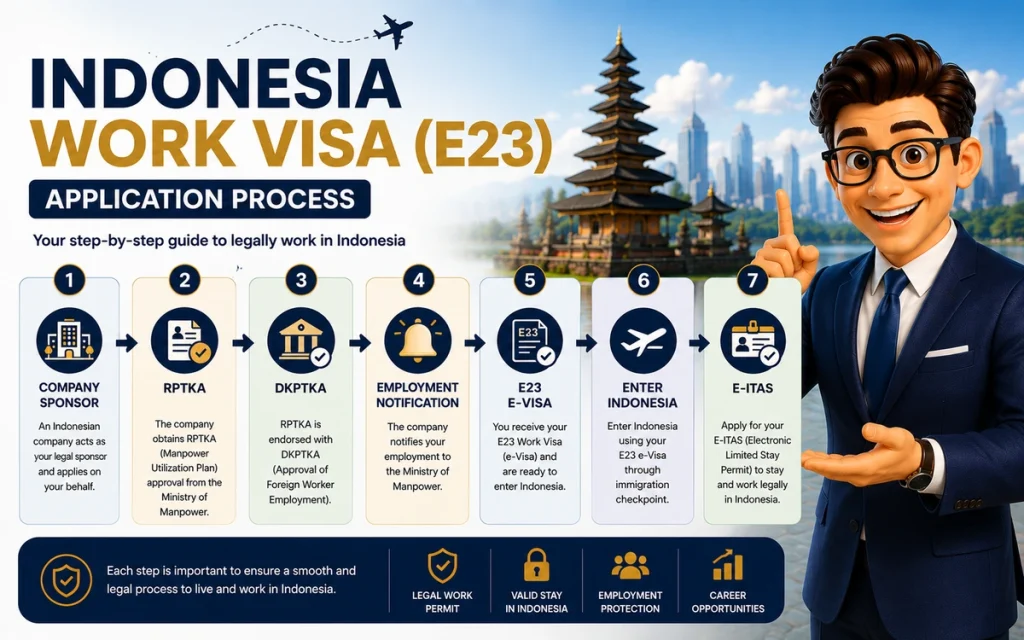
The E23 Work Visa and Working KITAS process involves both employment-related and immigration procedures. In general, the process is initiated and supported by the Indonesian employer or sponsor rather than by the foreign national independently. The exact requirements and sequence can depend on the foreign worker’s position, the sponsoring organization, and the applicable regulations.
For a typical employment arrangement, the process can be understood through five main stages: the employer starts the foreign worker employment process, completes the relevant RPTKA and employment requirements, applies for the appropriate E23 e-Visa, the foreign worker enters Indonesia, and the relevant electronic limited stay status is issued following entry.
Step 1: The Employer Starts the Foreign Worker Employment Process
The process generally begins with the Indonesian employer or sponsoring organization. Before the foreign national can start working in Indonesia, the employer must first determine whether the proposed position and foreign worker arrangement meet the applicable requirements for employing a foreign worker.
This stage is important because the employment arrangement, proposed position, period of employment, and supporting information can affect both the foreign worker employment process and the subsequent immigration application. The foreign national should therefore coordinate with the employer or sponsor before making plans to start work or travel to Indonesia for the role.
Step 2: RPTKA, DKPTKA and the Relevant Employment Notification
The next stage involves the relevant foreign worker employment process through the Ministry of Manpower. This can include the employer’s Rencana Penggunaan Tenaga Kerja Asing (RPTKA) process and other applicable employment requirements connected with the use of a foreign worker.
Where applicable, the employer must also complete the required Dana Kompensasi Penggunaan Tenaga Kerja Asing (DKPTKA) payment and obtain the relevant employment notification or approval used to support the foreign worker arrangement. The exact documents and requirements can vary depending on the employer, position, and applicable employment regulations.
Step 3: The Employer Applies for the E23 e-Visa
After the relevant employment-related requirements have been completed, the process can continue to the immigration stage. The Indonesian employer or sponsor submits the application for the appropriate E23 Work Visa through the applicable electronic immigration system, together with the required information and supporting documents.
Depending on the application and applicable requirements, the supporting documents may include the foreign national’s passport, employment-related documents, professional or educational information, and other documents required for the relevant visa category. The visa should be approved before the foreign national travels to Indonesia to begin the employment-related stay.
Step 4: The Foreign Worker Enters Indonesia
Once the E23 e-Visa has been issued, the foreign worker can enter Indonesia through an authorized immigration checkpoint within the validity period of the visa. The foreign national’s entry should be consistent with the purpose and conditions of the approved E23 visa and the supporting employment arrangement.
It is important to distinguish between the validity period for using a visa to enter Indonesia and the period of authorized stay after entry. These are separate concepts, and foreign workers should always check the conditions attached to the specific visa granted to them.
Step 5: E-ITAS and Re-Entry Status Following Entry
Following entry into Indonesia under the approved limited stay visa, the foreign national receives the relevant Limited Stay Permit or Izin Tinggal Terbatas (ITAS) in accordance with the applicable immigration process. For eligible electronic visa arrangements, the ITAS and re-entry status may be issued electronically following entry, subject to the procedures and conditions applicable to the specific case.
The period of the Working KITAS or ITAS depends on the visa category and approval granted. For E23 work-related categories, official immigration information lists initial ITAS periods of 180 days, one year, or two years, with extensions available in accordance with the applicable rules and overall stay limits. The foreign worker and sponsoring employer should continue to comply with the relevant immigration and employment requirements throughout the authorized stay.
4. Indonesia Work Visa Categories: E23 and Other Work Visa Options
Indonesia has several work visa categories designed for different types of professional roles and working arrangements. While E23 is one of the most commonly discussed categories, it is not the only option available to foreign nationals who intend to work in Indonesia. The correct category should be matched to the foreign national’s actual role, the sponsoring organization, and the purpose of the work to be carried out.
For this reason, foreign nationals and employers should not assume that every foreign worker uses exactly the same Working KITAS arrangement. Indonesia’s work visa framework includes categories for general sponsored employment, certain professional and executive positions, work in Special Economic Zones, maritime and offshore roles, religious work, research, and other specific circumstances.
E23 Work Visa
The E23 Work Visa is a work-related limited stay visa for foreign nationals working with an Indonesian sponsor. It is commonly associated with eligible foreign professionals whose employment arrangement requires a sponsored work and limited stay status in Indonesia.
Depending on the applicable role and subcategory, E23 can cover a wide range of professional fields, including management, industry, marketing, mining, plantations, health, finance, fisheries, law, film production, education, engineering, and other professional activities. The specific category should reflect the actual field and position of the foreign worker.
E23 and Relevant Professional Work Categories
The broader E23 framework includes specific professional work categories for different fields and occupations. This allows the immigration arrangement to be aligned more closely with the foreign national’s actual area of work rather than treating every foreign professional role as identical.
Examples of work fields listed under relevant E23 categories include management, industry, marketing, mining, plantations, health, finance, fisheries, law, film production, education, engineering, and professional roles such as professors, doctors, teachers, lecturers, artists, athletes, sports officials, and other eligible positions.
E23A and Other Special Work Visa Categories
E23A is intended for foreign nationals working with a sponsor in a Special Economic Zone (Kawasan Ekonomi Khusus or KEK). This category is separate from the general E23 work visa arrangement and should only be considered when the foreign worker’s employment and sponsoring arrangement falls within the applicable Special Economic Zone framework.
Indonesia also has other special work visa categories for specific circumstances. These include work arrangements connected with maritime and offshore operations, religious work, and other specialized purposes. The appropriate category should therefore be determined based on the actual role and legal basis for the foreign national’s work in Indonesia.
E25 for Company Commissioners and Executives
E25 is designed for eligible company commissioners and executives. The category includes specific arrangements for positions such as commissioners, directors, deputy directors, general managers, managers, and supervisors, depending on the applicable role and visa classification.
For foreign nationals holding senior management or executive positions, the E25 category may therefore be more relevant than a general E23 arrangement. The correct option should be assessed according to the foreign national’s actual corporate position and the requirements applicable to the sponsoring company.
Other Work Visa Categories in Indonesia
Other work-related visa categories include E26 for eligible crew working on ships, floating equipment, or offshore installations in Indonesian territory, E27 for religious workers, and E29 for researchers. Indonesia also maintains other specific work-related categories for certain specialized roles and employment arrangements.
Because the visa category must match the purpose and nature of the work, choosing the correct option is an important part of the application process. Foreign workers and sponsoring organizations should review the actual role, employment arrangement, and applicable requirements before submitting an application to ensure that the selected work visa category is appropriate.
5. What Activities Can You Do with an Indonesia Work Visa?
An Indonesia Work Visa is intended for work-related activities that match the approved visa category, employment arrangement, and purpose of stay. The exact activities a foreign national may carry out depend on the specific work visa and role approved for the individual, which is why there is no single list of activities that applies identically to every foreign worker.
For example, Indonesia has separate work visa categories for general professional work, company commissioners and executives, work in Special Economic Zones, maritime and offshore crew, religious workers, and researchers. The foreign national’s actual activities should therefore remain consistent with the category and position used to support the application.
Working in an Authorized Role
A foreign national should carry out work in the role and field that correspond to the approved employment and immigration arrangement. This is particularly important for sponsored employment, where the employer, position, professional field, and supporting documentation form part of the overall foreign worker process.
For example, an individual approved for an eligible professional role under a relevant E23 category should perform activities connected with that approved role. Likewise, a foreign national holding an executive work visa should carry out activities consistent with the corporate position and work arrangement supporting the application.
Activities Must Match the Approved Purpose and Arrangement
The purpose of the visa is not determined only by the fact that a foreign national is physically present at a workplace. The nature of the activities, the role being performed, the sponsoring organization, and the underlying employment arrangement should all remain aligned with the approved immigration status.
A foreign worker should therefore avoid assuming that one work-related visa automatically authorizes unrelated work for another company, a substantially different role, or activities outside the arrangement used to obtain the visa. If the employment situation changes, the foreign national and sponsoring organization may need to review whether additional immigration or employment procedures are required.
Activities That May Require a Different Visa or Stay Permit
Some activities may fall outside the scope of a particular work visa category and require a different immigration arrangement. This can happen when a foreign national changes employers, moves into a different type of corporate or executive role, undertakes activities under a different legal purpose, or changes from employment to investment-related activities.
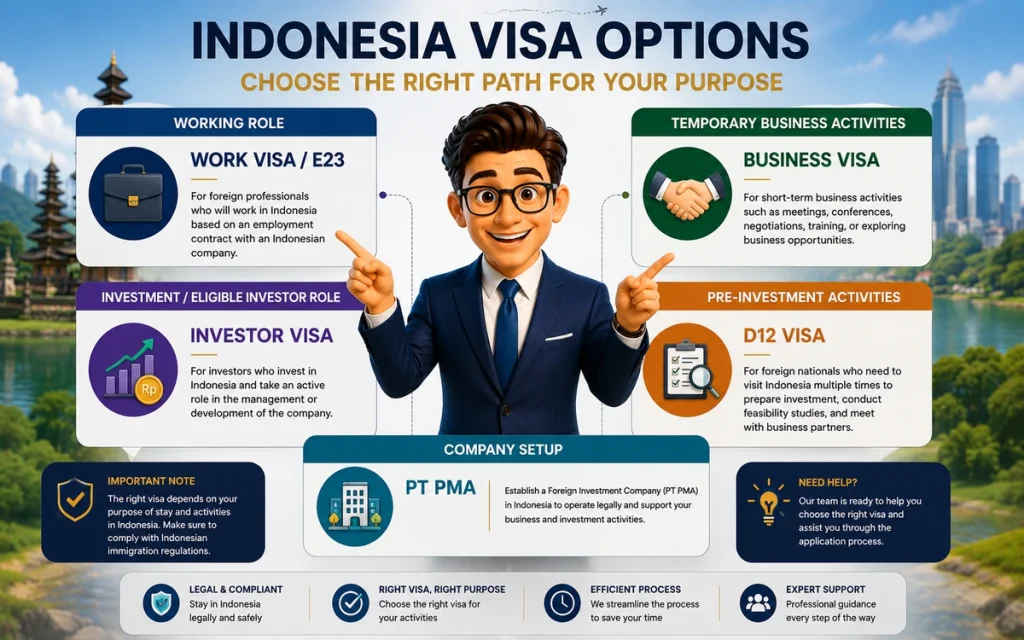
For this reason, the correct visa should be selected based on the actual purpose of the foreign national’s stay rather than on convenience alone. A Business Visa, Investor Visa, or another immigration option may be more appropriate in different circumstances, and these options should not automatically be treated as interchangeable with a Work Visa.
6. How Long Is a Working KITAS Valid?
The validity of a Working KITAS depends on the specific work visa category and the approval granted for the foreign national. It is important to distinguish between the period of validity of the visa, the period of authorized stay under the ITAS, and any extension that may be available.
For the E23 Work Visa and many related E23 professional categories, the initial ITAS can be granted for 180 days, one year, or two years. The appropriate period depends on the specific application and approval granted to the foreign worker and sponsoring employer.
Initial ITAS Period
For eligible E23 work visa categories, the initial Working KITAS or ITAS may be granted for one of the available periods of 180 days, one year, or two years. The period granted should match the approval issued for the individual case and should not be assumed to be the same for every foreign worker.
Different work visa categories may have different initial periods. For example, some specialized work-related categories can be granted for a different period under the applicable immigration rules. Foreign workers should therefore confirm the validity of the specific visa and ITAS issued for their own category rather than relying on a general assumption about Working KITAS validity.
Can a Working KITAS Be Extended?
A Working KITAS may be eligible for extension, subject to the applicable immigration and employment requirements. For E23 and related categories, an extension may be granted for a period that does not exceed the period of the initial ITAS, provided that the overall ITAS period does not exceed the applicable maximum limit.
Official immigration information for E23 and related work categories states that the overall ITAS period can be up to six years under the applicable extension rules. The sponsoring employer and foreign worker must continue to meet the relevant requirements when applying for an extension, including any employment-related approvals or supporting documents required for foreign workers.
Understanding Visa Validity vs ITAS Stay Period
Visa validity and the period of authorized stay are not always the same thing. The visa is used as part of the process that allows the foreign national to enter Indonesia for the approved purpose, while the ITAS represents the authorized limited stay status after entry.
For this reason, a foreign worker should always check the specific approval and ITAS issued for the case. The length of time available to use a visa for entry, the initial period of the ITAS, and any possible extension are separate elements of the overall immigration arrangement.
Before planning employment, travel, or an extension, foreign workers and sponsoring employers should confirm the conditions attached to the specific visa category and ITAS granted. This is particularly important when the employment contract, role, sponsoring company, or immigration arrangement changes during the foreign national’s stay in Indonesia.
7. Indonesia Work Visa Eligibility and General Requirements
Eligibility and general requirements for an Indonesia Work Visa depend on the specific visa category, the foreign national’s position, and the sponsoring employer or organization. Because Indonesia has several work visa categories, the requirements should be assessed according to the actual role and employment arrangement rather than assuming that every foreign worker follows exactly the same process.
In general, a sponsored work visa application involves requirements relating to the foreign worker, the Indonesian employer or sponsor, the proposed employment arrangement, and the supporting documents required for both the employment and immigration stages. The employer normally plays a central role because the application is connected to an authorized position and sponsorship arrangement.
Requirements for the Foreign Worker
The foreign worker must have a valid passport and meet the requirements applicable to the selected work visa category. For sponsored work visa applications, official immigration requirements generally include a passport that remains valid for at least six months, together with other personal and supporting documents required for the application.
Depending on the category and employment arrangement, the foreign worker may also need to provide a recent photograph, curriculum vitae, travel information, professional or educational information, and other documents needed to support the proposed role. The exact requirements can differ according to the visa category and the purpose of the foreign national’s work in Indonesia.
Requirements for the Indonesian Employer or Sponsor
An appropriate Indonesian employer or sponsor is generally required for sponsored work visa applications. The sponsoring organization is responsible for supporting the foreign worker’s application and completing the relevant employment and immigration procedures connected with the proposed role.
Before the immigration application proceeds, the employer may need to complete the applicable foreign worker employment process and obtain the relevant approval or authorization from the Ministry of Manpower. The sponsoring employer must also ensure that the proposed position and foreign worker arrangement are consistent with the applicable requirements.
Employment and Professional Requirements
The foreign worker’s proposed role should be clear and supported by the relevant employment arrangement. Depending on the position and visa category, this may involve professional qualifications, work experience, educational background, employment documents, or other information demonstrating the foreign national’s suitability for the role.
The position should also match the work visa category being requested. For example, a foreign national applying for an executive position, a professional role, research, religious work, or another specialized activity may fall under a different visa category or set of requirements. Matching the actual role with the correct category is therefore an important part of the eligibility assessment.
Additional Requirements Based on the Work Visa Category
Additional requirements may apply depending on the selected Indonesia Work Visa category. These can include specific employment approvals, supporting documents relating to the role, sponsor documents, professional information, or other documents required to demonstrate the purpose of the foreign national’s stay.
For this reason, foreign workers and employers should prepare the application based on the specific visa category being requested. A document or requirement that applies to one work visa category may not apply in exactly the same way to another, so the final requirements should always be confirmed against the applicable category and current immigration and employment procedures.
8. Indonesia Work Visa Application Documents
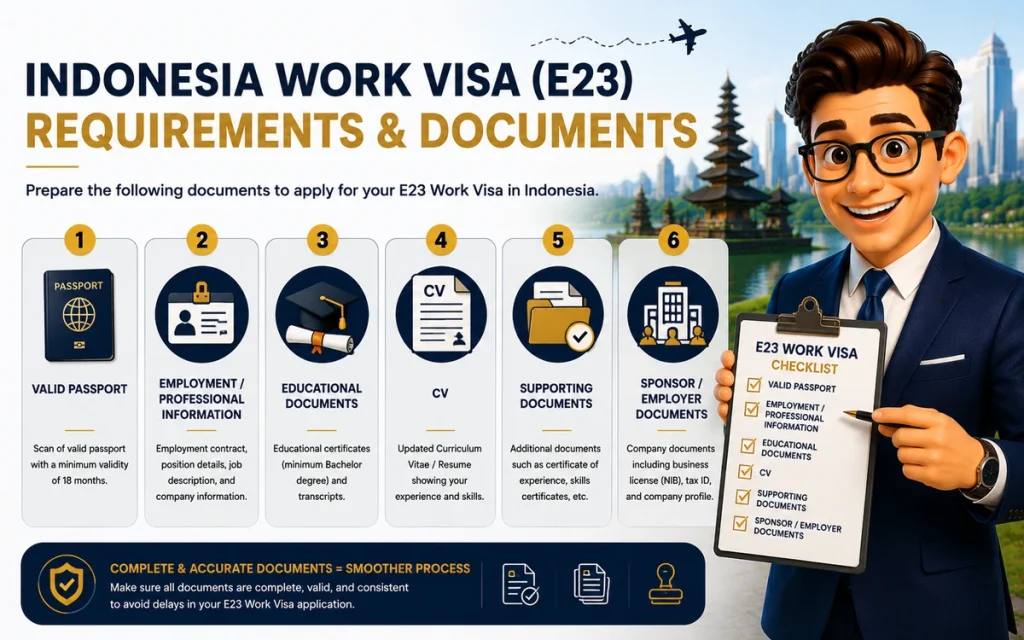
The documents required for an Indonesia Work Visa application depend on the specific visa category and the foreign worker’s employment arrangement. In a sponsored work visa application, documents are generally prepared for both the foreign national and the Indonesian employer or sponsor, together with employment-related and immigration supporting documents.
Because the requirements can differ between work visa categories, the final document checklist should always be confirmed against the specific visa being requested. The documents below provide a general overview of the main information commonly required for a sponsored work visa application.
Documents Required from the Foreign Worker
The foreign worker generally needs to provide a valid passport that meets the minimum validity requirement for the specific Work Visa and ITAS period being requested. Because passport validity requirements can vary depending on the visa category and intended stay period, applicants should ensure that the passport has sufficient remaining validity for the full application process. Depending on the applicable visa category, the application may also require a recent colour photograph, curriculum vitae, travel itinerary, and other personal information required to support the visa application.
Additional documents may be required to demonstrate the foreign national’s professional background and suitability for the proposed role. These can include educational documents, professional information, employment history, or other supporting documents relevant to the work visa category and position.
Documents Required from the Employer or Sponsor
For a sponsored work visa application, the Indonesian employer or sponsor is responsible for providing the relevant sponsorship and application documents. The sponsor generally needs to have an account in the applicable electronic immigration system before submitting a visa application for the foreign national.
Depending on the application, the employer or sponsor may need to prepare an application letter, sponsorship or guarantee statement, and other company or employment documents required to support the foreign worker’s visa application. The exact documents depend on the visa category and the underlying employment arrangement.
Employment and Immigration Supporting Documents
Employment-related supporting documents can include the relevant work authorization or approval from the Ministry of Manpower, together with documents supporting the foreign national’s proposed role and employment arrangement. For the immigration application, additional documents may include proof of sufficient living expenses, a recent photograph, curriculum vitae, travel information, and other information required under the applicable visa category.
The immigration and employment stages are connected but should not be treated as identical processes. The employer may first need to complete the applicable foreign worker employment requirements before the work visa application can proceed through the immigration system.
Additional Documents Based on the Visa Category
Additional documents may be required for certain work visa categories or specialized roles. For example, the immigration requirements can differ depending on whether the foreign national is applying as a professional employee, company executive, researcher, religious worker, crew member, or under another specific work-related category.
Before submitting an application, the foreign worker and sponsoring employer should review the requirements for the exact visa category being requested. Preparing the documents according to the correct category can help ensure that the application accurately reflects the foreign national’s role, purpose of stay, and sponsoring arrangement.
9. Can You Change or Extend Your Status in Indonesia?
A foreign national’s immigration and employment situation can change after arriving in Indonesia. An employment contract may be extended, a foreign worker may move to a new employer, or the purpose of stay may change. Whether the existing immigration status can be extended or changed depends on the specific circumstances and the requirements applicable to the relevant visa and stay permit.
It is important not to assume that every change can be handled automatically under an existing Working KITAS. The correct procedure should be assessed before the foreign national begins a new role, changes the sponsoring arrangement, or continues working beyond the validity of the current stay permit.
Extending a Working KITAS
A Working KITAS or ITAS may be extended if the foreign worker and sponsoring employer continue to meet the applicable immigration and employment requirements. For work-related ITAS, the extension process may require the relevant passport, the existing ITAS, proof of sponsorship, and supporting documents connected with the foreign worker’s employment arrangement.
For foreign experts or workers whose applications involve foreign worker employment requirements, supporting documents for the extension can also include the relevant RPTKA and evidence of the applicable DKPTKA payment. The extension should be prepared according to the validity period of the current ITAS and the requirements that apply to the specific work-related category.
Changing from Another Immigration Status
In some circumstances, a foreign national may be able to apply for a change of immigration status, subject to the applicable rules and the requirements of the intended status. For example, official immigration procedures provide a process for eligible foreign nationals to apply for a change from an Izin Tinggal Kunjungan (ITK) to an Izin Tinggal Terbatas (ITAS) for permitted purposes, including work-related activities.
However, not every visitor status can be changed in this way. Visa on Arrival and visa-exemption stay permits are specifically excluded from the ITK-to-ITAS change-of-status process. The requirements for any change of status should therefore be confirmed based on the foreign national’s current immigration status and the intended work visa category.
Changing Jobs or Employers
Changing jobs or employers can affect both the employment and immigration arrangements supporting a Working KITAS. A work-related stay permit is connected to a particular sponsoring arrangement, so a foreign worker should not assume that an existing Working KITAS can simply be used to begin working for a new employer without further procedures.
Depending on the circumstances, a change of employer or sponsor may require new employment approvals, an updated immigration process, or other documentation to ensure that the foreign national’s role and sponsorship remain consistent with the applicable requirements. Any change should be reviewed before the foreign worker starts the new position.
When a New Visa or Immigration Process May Be Required
A new visa or immigration process may be required when the foreign national’s role, employer, sponsor, or purpose of stay changes in a way that is no longer covered by the existing arrangement. This can include moving to a different work visa category, changing from employment to an investment-related purpose, or transferring to a new sponsoring organization.
The safest approach is to assess the intended change before it takes effect. By reviewing the foreign national’s current status, new role, sponsoring arrangement, and purpose of stay in advance, the appropriate extension, change-of-status, or new visa process can be identified before the existing immigration arrangement becomes inconsistent with the activities being carried out.
10. Business Visa vs Work Visa in Indonesia
A Business Visa and an Indonesia Work Visa are designed for different purposes. This distinction is important because both options may involve business-related activities, meetings, companies, or professional travel, but they do not provide the same authorization for a foreign national to carry out activities in Indonesia.
The correct option should be based on what the foreign national will actually do in Indonesia. If the purpose is a temporary business visit for permitted business activities, a Business Visa may be appropriate. If the foreign national will take up an authorized employment or ongoing professional role, the appropriate Work Visa and related employment arrangements may be required.
What Can You Do with a Business Visa?
Business visitor visa categories such as C2 Business Visa and D2 Multiple Entry Business Visa are intended for permitted business activities rather than general employment. Depending on the specific category, these activities can include attending meetings, conducting business discussions and negotiations, signing business agreements, purchasing goods, and carrying out other activities permitted under the relevant visitor visa.
A Business Visa should therefore be assessed according to the purpose of the visit. It can be suitable for foreign nationals who need to visit Indonesia temporarily to conduct legitimate business activities without taking up an employment role that requires a work-related immigration arrangement.
What Can You Do with a Work Visa?
An Indonesia Work Visa is intended for eligible foreign nationals who will carry out authorized work or professional activities under an appropriate employment and sponsorship arrangement. The foreign worker’s activities should remain consistent with the approved role, visa category, sponsoring organization, and applicable employment requirements.
For example, a foreign professional employed in an eligible position may require an E23 Work Visa or another appropriate work visa category. Company commissioners, directors, executives, researchers, religious workers, and maritime or offshore crew may fall under different work-related visa categories depending on their actual role and circumstances.
The Main Difference: Employment and Remuneration
One of the most important distinctions is that a Business Visa should not be treated as a general authorization to take up employment or receive salary, wages, or compensation for work from individuals or companies in Indonesia. The official conditions for the C2 Business Visitor Visa specifically state that the holder is not allowed to sell goods or services or receive salary, wages, or compensation for work or business from individuals or corporations in Indonesia.
A Work Visa, on the other hand, is connected to an authorized working role and the relevant employment and immigration arrangements. This is why foreign nationals should not choose a Business Visa simply because they are travelling to Indonesia for a company-related purpose. The actual activities and employment relationship must be considered before selecting the appropriate visa.
When Should You Choose a Business Visa Instead of a Work Visa?
A Business Visa may be more suitable when the foreign national is visiting Indonesia temporarily for permitted activities such as meetings, negotiations, discussions, signing business agreements, or other approved business purposes, without taking up general employment or an ongoing work role in Indonesia.
If your purpose is a temporary visit for meetings, negotiations, or other permitted business activities without taking up employment in Indonesia, an Indonesia Business Visa may be a more suitable option.
A Work Visa may be more appropriate when the foreign national will work in an authorized position for a sponsoring organization or carry out professional activities that fall within a work visa category. Before travelling or starting any activity, it is important to assess the actual purpose of the stay and select the immigration arrangement that matches it.
Business Visa vs Work Visa: Quick Comparison
A Business Visa is generally designed for temporary business visits and permitted business activities. A Work Visa is designed for eligible foreign nationals carrying out authorized work or professional roles under the appropriate sponsorship and employment arrangements.
The simplest question to ask is: are you visiting Indonesia to conduct permitted business activities, or are you coming to take up a working role? If the purpose is an ongoing employment or professional position, a Business Visa should not automatically be used as a substitute for the appropriate Work Visa.
11. Work Visa vs Investor Visa in Indonesia
An Indonesia Work Visa and an Investor Visa can both be relevant to foreign nationals who are actively involved in a company in Indonesia, but they are designed for different circumstances. The correct option depends on whether the foreign national is entering Indonesia primarily as an employee or professional worker, or as an investor connected with a qualifying investment and company arrangement.
This distinction is particularly important for foreign nationals who plan to establish a company or invest in an Indonesian business. In certain circumstances, an Indonesia Investor Visa may be the more appropriate immigration arrangement. In certain circumstances, an Investor Visa may be the more appropriate immigration arrangement.
What Is the Purpose of an Investor Visa?
An Investor Visa is intended for eligible foreign nationals carrying out investment-related activities in Indonesia. Depending on the specific investor visa category and applicable requirements, the holder may be permitted to invest, conduct activities related to business, investment, and company establishment, and carry out certain activities connected with the company in which the foreign national has invested.
Official immigration information also provides investor visa categories for different investment circumstances, including general investor arrangements, company establishment, capital market investment, Special Economic Zones, and certain Golden Visa-related investment categories. The appropriate category should therefore be selected according to the actual investment structure and purpose of stay.
Can an Investor Work in Their Own Company?
The answer depends on the specific Investor Visa category and the activities permitted under that category. For example, official information for E28A states that eligible holders may carry out investment and business activities, establish a company, and act as a member of the board of directors or board of commissioners in the company where they invest their capital. The holder may also supervise the production process of goods or services in the company they established.
However, this should not be interpreted to mean that every investor can automatically perform any type of employment role under an Investor Visa. The foreign national’s actual position, activities, shareholding or investment arrangement, and the specific visa category should all be considered before deciding whether an Investor Visa or a Work Visa is more appropriate.
When Is a Work Visa More Appropriate?
A Work Visa may be more appropriate when a foreign national is primarily employed in an authorized professional, technical, management, executive, or other eligible working role under a sponsoring organization. The immigration and employment arrangement should reflect the actual position being performed and the relationship between the foreign worker and the sponsoring employer.
For example, a foreign professional hired to perform a continuing role for an Indonesian company may need an appropriate E23 or other work-related visa category. Senior corporate positions may also fall under specific executive work visa categories, depending on the actual role and applicable requirements.
When Is an Investor Visa More Appropriate?
An Investor Visa may be more appropriate when the foreign national’s primary purpose is to make and maintain a qualifying investment and carry out activities permitted in connection with that investment. This can be particularly relevant for foreign nationals who are establishing a PT PMA in Indonesia or investing in an Indonesian company and participating in the company in a capacity permitted under the applicable investor visa category.
The investment and corporate structure should be reviewed carefully before applying. The correct immigration arrangement should be based on the foreign national’s actual activities rather than simply on the title of director, commissioner, shareholder, or employee used within the company.
If you are still exploring an investment opportunity and have not yet started the company or investment arrangement, a D12 Pre-Investment Visa may be relevant for eligible pre-investment activities.
Work Visa vs Investor Visa: The Key Difference
The main difference is the underlying purpose of the foreign national’s stay. A Work Visa is primarily connected with an authorized working role and the relevant employment and sponsorship arrangements. An Investor Visa is primarily connected with a qualifying investment and the activities permitted for the relevant investor category.
In some cases, the distinction can be more complex because a foreign national may be both an investor and actively involved in the management of a company. In these situations, the company structure, investment position, corporate role, and actual day-to-day activities should be assessed together before choosing the appropriate visa.
12. Common Mistakes Foreign Workers Should Avoid
Applying for an Indonesia Work Visa involves both immigration and employment considerations. One of the most common problems is assuming that all visa and Working KITAS arrangements work in the same way. The correct category and process should always match the foreign national’s actual activities, position, sponsor, and purpose of stay.
Understanding the following common mistakes can help foreign workers and sponsoring employers avoid using an inappropriate immigration arrangement or creating inconsistencies between the approved role and the activities actually carried out in Indonesia.
Using the Wrong Visa for Your Activities
A common mistake is selecting a visa based only on a general description such as “business” or “work” without reviewing the actual activities that will be carried out. A Business Visa may be appropriate for permitted business visits, meetings, negotiations, and other activities allowed under the relevant category, but it should not automatically be treated as a substitute for a Work Visa when the foreign national is taking up an authorized employment or professional role.
The visa should be selected according to the real purpose of the stay. Before travelling to Indonesia or starting a new activity, the foreign national and sponsor should assess whether the proposed role requires a work-related visa and employment arrangement or whether another immigration option is more appropriate.
Assuming All Working KITAS Categories Are the Same
Indonesia has different work visa categories for different types of roles and working arrangements. E23 is one of the main work visa categories, but there are also separate categories for company executives and commissioners, Special Economic Zone employment, maritime and offshore crew, religious workers, researchers, and other specific work purposes.
Foreign workers should therefore avoid assuming that every Working KITAS has identical conditions, permitted activities, validity periods, or supporting requirements. The specific category must match the foreign national’s actual role and the immigration purpose being requested. Indonesia’s visa classification also distinguishes between different work and investor categories rather than treating all professional activities as one general visa arrangement.
Working Outside the Approved Role or Arrangement
A work-related immigration arrangement should remain consistent with the approved role and sponsoring organization. An existing Working KITAS should not automatically be treated as general authorization to perform unrelated work, start working for another employer, or move into a substantially different role without reviewing the relevant employment and immigration requirements.
If the foreign worker changes employer, sponsor, position, or the nature of the activities being carried out, the existing arrangement may no longer accurately reflect the foreign national’s situation. These changes should be assessed before the new role or activity begins so that the appropriate process can be completed where required.
Confusing Visa Validity with the ITAS Period
Another common source of confusion is the difference between the validity of a visa for entry and the period of stay authorized under the ITAS. These are separate parts of the overall immigration process and should not be treated as the same thing.
For eligible work-related categories, official immigration information lists ITAS periods that can include 180 days, one year, or two years, depending on the category and approval, with extensions subject to the applicable rules and overall limits. Foreign workers should always check the period shown in their own approval and ITAS rather than relying on a general assumption about how long every Working KITAS remains valid.
Ignoring Employer and Sponsor Compliance Requirements
The Indonesian employer or sponsor plays a central role in a sponsored work visa application. The process can involve employment-related requirements as well as immigration procedures, and the sponsoring arrangement must remain consistent with the foreign worker’s actual role.
Foreign workers should not assume that immigration approval alone removes the need for the employer to comply with applicable foreign worker employment requirements. Likewise, employers should ensure that the position, supporting documents, sponsorship arrangement, and relevant employment approvals are properly aligned before and throughout the foreign worker’s authorized stay.
13. How Azra Solutions Can Help with Your Indonesia Work Visa
Applying for an Indonesia Work Visa can involve both employment-related and immigration procedures. The correct process depends on the foreign national’s role, the sponsoring organization, the selected visa category, and the documents required to support the application. Understanding these requirements from the beginning can help ensure that the proposed immigration arrangement matches the actual purpose of the foreign national’s stay.
Azra Solutions can assist foreign professionals and Indonesian companies in understanding the available options and preparing for the relevant visa and immigration process. Our support is designed to help clients navigate the application process with a clearer understanding of the required documents, sponsorship arrangements, and immigration steps involved.
Choosing the Right Work Visa and ITAS Category
The first step is identifying the immigration category that matches the foreign national’s actual role and purpose in Indonesia. Depending on the circumstances, this may involve an E23 Work Visa, another work-related visa category, an Investor Visa, or a different immigration arrangement.
Azra Solutions can help review the planned activities, professional role, company position, and sponsoring arrangement to identify the most appropriate direction before the application process begins. This can be particularly important when a foreign national is deciding between a Work Visa, Investor Visa, Business Visa, or another Indonesia visa option.
Document and Application Assistance
Work visa applications can require documents from both the foreign national and the sponsoring employer or organization. The required documents may include passport information, professional and employment documents, sponsorship documents, and other supporting information required for the relevant employment and immigration stages.
Azra Solutions can assist with document preparation, application coordination, and guidance throughout the relevant immigration process. The exact support can be adjusted according to the visa category and the specific circumstances of the foreign worker and sponsoring organization.
Support for Employers and Foreign Professionals
Because the sponsoring employer plays an important role in the process, work visa applications often require coordination between the foreign professional and the Indonesian company. The employment arrangement, proposed role, supporting documents, and immigration application should remain consistent with one another.
Azra Solutions can provide guidance for both employers and foreign professionals to help them understand the overall process and prepare the required immigration documentation. This can help create a clearer application process, particularly for companies employing foreign professionals for the first time or foreign nationals who are unfamiliar with Indonesia’s work visa system.
Ongoing Immigration Support
Immigration support may still be required after the initial visa and ITAS process has been completed. A foreign worker’s situation can change due to an ITAS extension, a new role, a change in sponsoring arrangements, or a different long-term plan in Indonesia.
Azra Solutions can provide ongoing assistance for relevant immigration needs and help clients review the appropriate next steps when their circumstances change. By assessing the foreign national’s current status and intended activities, the appropriate immigration process can be considered before changes are made.
14. Indonesia Work Visa FAQs
What is an Indonesia Work Visa?
An Indonesia Work Visa is a general term used to describe the immigration arrangements available to eligible foreign nationals who intend to carry out authorized work or professional activities in Indonesia. The correct visa category depends on the foreign national’s actual role, the sponsoring organization, and the purpose of the stay.
E23 is one of the main work-related visa categories, but Indonesia also has other work visa categories for specific professional, executive, maritime, religious, research, and other eligible work arrangements.
What is the difference between a Work Visa and Working KITAS?
A Work Visa and a Working KITAS are connected but are not exactly the same thing. The visa is part of the immigration arrangement used for the foreign national to enter Indonesia for an approved work-related purpose, while the Working KITAS refers to the Izin Tinggal Terbatas (ITAS) associated with the authorized limited stay in Indonesia.
The overall process may also involve separate employment-related requirements. This is why the terms Work Visa, Working KITAS, and work permit are often used together even though they can refer to different parts of the foreign worker process.
Do I need a Working KITAS to work in Indonesia?
Foreign nationals who intend to take up an eligible employment or professional role in Indonesia generally need the appropriate work-related immigration and employment arrangement. For many sponsored work arrangements, this includes an appropriate Work Visa followed by the relevant ITAS or Working KITAS.
The exact requirements depend on the foreign national’s role, visa category, sponsoring employer, and the activities to be carried out in Indonesia.
Can I work in Indonesia with a Business Visa?
An Indonesia Business Visa should not be treated as a general substitute for a Work Visa. Business visitor visa categories can be used for permitted business activities such as meetings, negotiations, discussions, and other approved business purposes, depending on the specific visa category.
However, if a foreign national will take up an authorized employment or ongoing professional role in Indonesia, the appropriate Work Visa and related employment arrangements may be required. The correct visa should always match the actual activities being carried out.
How long is a Working KITAS valid?
The validity of a Working KITAS depends on the specific work visa category and the approval granted. For the E23 Work Visa, the initial ITAS may be granted for 180 days, one year, or two years. The available period for other work visa categories may differ depending on the specific visa category.
Foreign workers should always check the specific period stated in their own immigration approval because the available period can depend on the visa category and the individual application.
Can a Working KITAS be extended?
A Working KITAS may be eligible for extension, subject to the applicable immigration and employment requirements. The sponsoring employer and foreign worker may need to provide the required supporting documents and maintain compliance with the requirements connected with the foreign worker’s role and sponsorship arrangement.
For E23 and related categories, the extension period and overall maximum stay are subject to the applicable immigration rules and the approval granted for the individual case.
What documents are required for an Indonesia Work Visa?
The required documents depend on the visa category and employment arrangement. Common documents can include a valid passport, recent photograph, curriculum vitae, professional or educational information, employment-related documents, sponsorship documents, and other supporting information required for the relevant application.
The Indonesian employer or sponsor may also need to prepare company and sponsorship documents and complete the relevant employment-related requirements before or alongside the immigration process.
Can I change employers with a Working KITAS?
Changing employers can affect both the employment and immigration arrangements supporting a Working KITAS. A foreign worker should not assume that an existing work-related stay permit can automatically be used to start working for a new employer without further procedures.
Depending on the circumstances, a change of employer or sponsor may require new employment approvals, an updated immigration process, or other supporting documentation before the new role begins.
Which Work Visa category is right for me?
The right Indonesia Work Visa category depends on your actual role, professional field, sponsoring organization, and purpose of stay. E23 may be relevant for eligible sponsored professional work, while other categories may apply to executives, commissioners, researchers, religious workers, maritime or offshore crew, or other specific work arrangements.
If your primary purpose is investment or establishing a company rather than employment, you may also want to review the requirements for an Indonesia Investor Visa.
Need Help with Your Indonesia Work Visa?
Not sure which Indonesia Work Visa or Working KITAS is suitable for your role and plans in Indonesia? The right option depends on your intended activities, sponsoring company, professional position, and immigration requirements.
Azra Solutions can assist foreign professionals and Indonesian companies with understanding the appropriate visa options, preparing the required documents, and navigating the relevant application process.
Planning to work legally in Indonesia? Our immigration team can help you with the E23 Working KITAS requirements, application process, and work permit arrangements. Contact us via WhatsApp for personalized assistance.