Indonesia remains one of Southeast Asia’s most attractive destinations for foreign entrepreneurs, business owners, investors, and professionals. However, choosing the right visa is essential before travelling to Indonesia for meetings, negotiations, market research, business exploration, or other commercial activities.
Whether you are looking for a Business Visa for Indonesia for a single trip, repeated business travel, or pre-investment activities, choosing the right visa depends on the purpose of your visit.
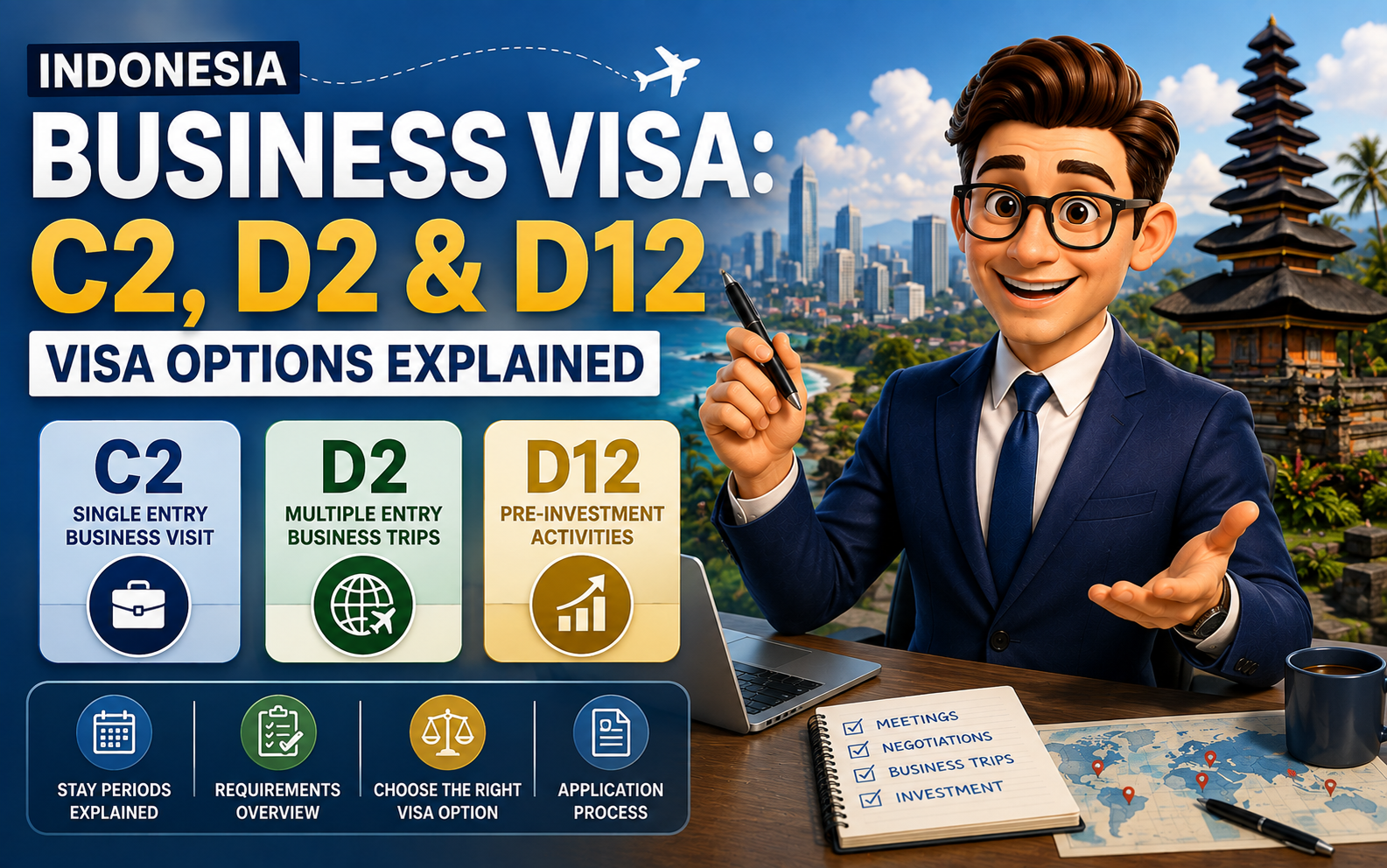
Indonesia offers several visa options for foreign nationals with different business purposes. The three main options covered in this guide are the C2 Business Visa for single-entry business visits, the D2 Business Visa for multiple business trips, and the D12 Pre-Investment Visa for foreigners exploring investment or business opportunities in Indonesia.
Each visa is designed for a different purpose. Choosing the wrong option can create unnecessary complications, especially when your activities involve frequent travel, pre-investment research, or plans to establish a long-term business presence in Indonesia.
This guide explains the main Indonesia Business Visa options, the differences between C2, D2, and D12, what you can and cannot do, and how to determine which visa is the most suitable for your business plans.
1. What Is an Indonesia Business Visa?
An Indonesia Business Visa is generally used by foreign nationals who need to visit Indonesia for legitimate business-related activities without taking up employment in the country. Depending on the purpose of the visit, a foreigner may need a different visa type, such as the C2 Business Visa for a single business visit, the D2 Business Visa for multiple business trips, or the D12 Pre-Investment Visa for exploring investment and business opportunities.
The right visa depends on why you are travelling to Indonesia and how often you need to enter the country. For example, someone visiting Indonesia for meetings or negotiations may have different visa needs from an entrepreneur conducting market research before establishing a company or an investor who needs to make repeated business trips.
For this reason, there is no single Indonesia Business Visa that is suitable for every business purpose. Understanding the nature of your planned activities is the first step in choosing the most appropriate visa option.
Who Is an Indonesia Business Visa For?
Indonesia Business Visa options are commonly relevant for foreign business owners, entrepreneurs, investors, company representatives, and professionals who need to visit Indonesia for permitted business-related purposes.
Depending on the visa type, this may include people who need to attend business meetings, hold discussions and negotiations, explore commercial opportunities, meet potential business partners, conduct market or pre-investment research, or make repeated visits to Indonesia for ongoing business relationships.
These visas are particularly useful for foreigners who have legitimate business interests in Indonesia but do not necessarily need to relocate to the country permanently or take up employment with an Indonesian company.
What Business Activities Can Foreigners Do in Indonesia?
The activities permitted during a business visit depend on the specific visa held. In general, the relevant visa options covered in this guide may be used for permitted activities such as business meetings, discussions, negotiations, commercial exploration, and other activities that fall within the scope of the applicable visa.
For example, C2 and D2 are intended for business visitor activities, while D12 is designed for specific pre-investment purposes. This means the best visa should always be selected based on the actual purpose of the visit rather than simply choosing the option with the longest validity or the greatest number of entries.
It is also important to understand that conducting business activities during a visit is not the same as taking up employment or working in Indonesia. If a foreign national plans to perform work that requires an appropriate work or stay permit, a business visa may not be the correct immigration option.
The next section provides a quick overview of the three main visa options—C2, D2, and D12—to help you identify which one may be the most suitable for your business plans in Indonesia.
2. Quick Answer: Which Indonesia Business Visa Do You Need?
Indonesia offers several Business Visa types for different purposes, with C2, D2, and D12 being three key options for foreign nationals with business-related plans.
The right Indonesia Business Visa depends mainly on three factors: the purpose of your visit, how often you need to travel to Indonesia, and whether your activities are focused on general business visits or pre-investment preparation.
For most foreign nationals, the choice will usually come down to the C2 Business Visa, the D2 Multiple-Entry Business Visa, or the D12 Pre-Investment Visa.
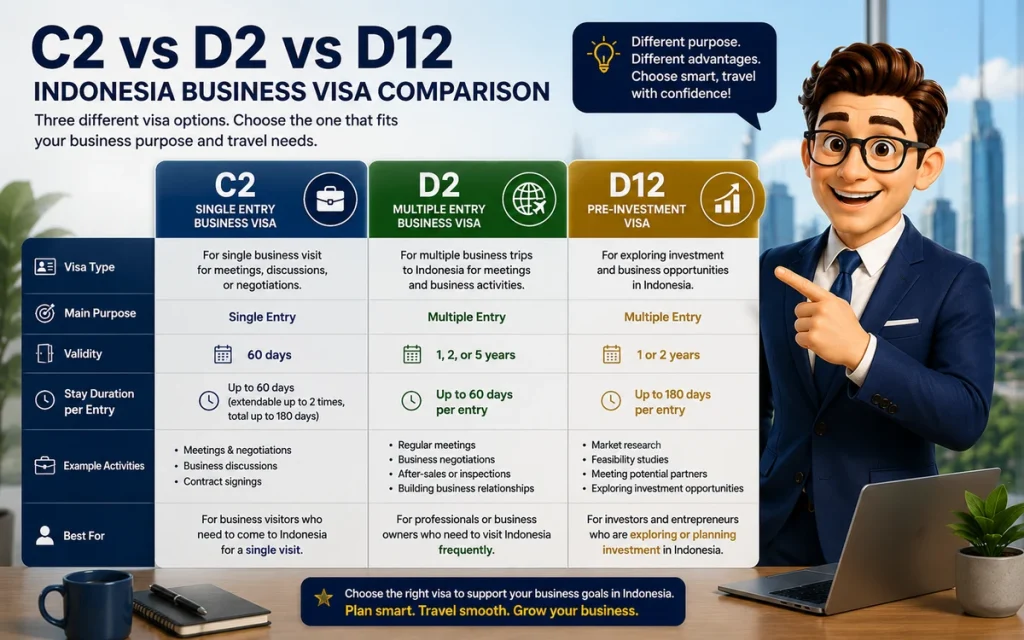
| Visa Type | Best For | Entry Type | Main Purpose |
| C2 Business Visa | Foreigners making a short-term business visit | Single entry | General permitted business activities, such as meetings, discussions, negotiations, and other business visits |
| D2 Business Visa | Foreigners who need to visit Indonesia repeatedly for business | Multiple entry | Repeated permitted business activities without applying for a new single-entry visa for every trip |
| D12 Pre-Investment Visa | Foreigners exploring investment or business opportunities | Multiple entry | Pre-investment activities, including exploring business opportunities and conducting permitted preliminary activities before investing |
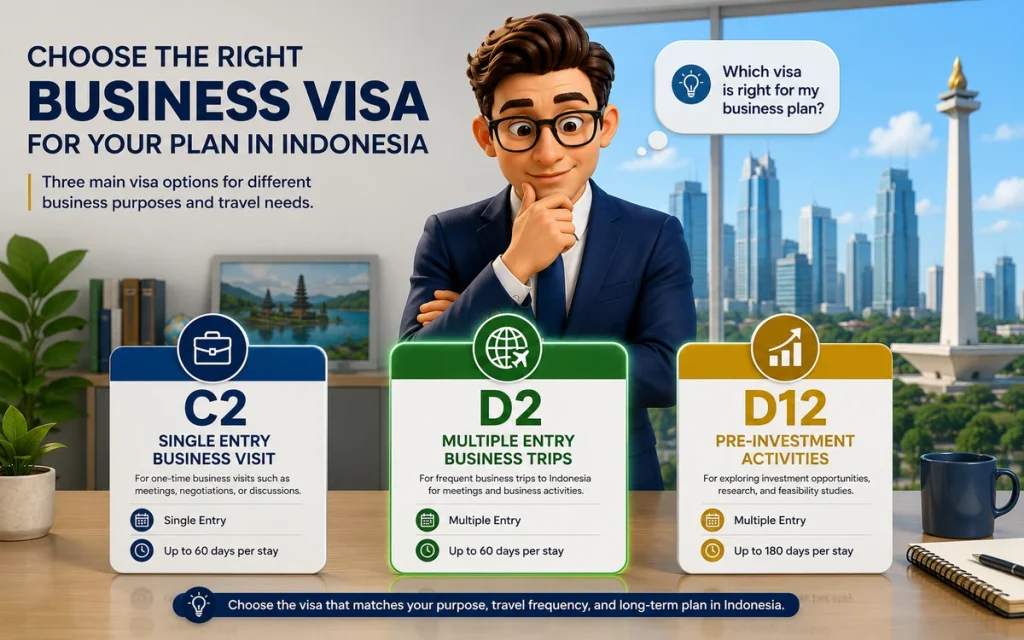
In simple terms, choose C2 if you are planning a single business visit to Indonesia, choose D2 if you expect to travel to Indonesia repeatedly for business purposes, and consider D12 if your main objective is to explore investment or prepare for establishing or developing a business in Indonesia.
The C2 and D2 options are primarily suited to general business visitor activities, with the main difference being the number of entries permitted. D12 serves a different purpose because it is specifically intended for pre-investment activities and is more relevant when your visit is connected to exploring investment opportunities or preparing for a potential business venture.
Choosing the correct visa is important because the permitted activities, entry arrangements, and overall purpose of each visa are not identical. Rather than choosing a visa based only on its validity period or the convenience of multiple entries, foreign nationals should select the option that most closely matches their actual plans in Indonesia.
The following sections explain each option in more detail, starting with the C2 Business Visa Indonesia, which is generally the most relevant option for a single business visit.
3. C2 Business Visa Indonesia: Single-Entry Option
The C2 Business Visa is designed for foreign nationals who need to visit Indonesia for permitted business-related activities on a single-entry basis. It is generally the most suitable option for people who have a specific business trip planned and do not need to enter Indonesia repeatedly under the same visa.
This visa may be relevant for business owners, company representatives, entrepreneurs, and other foreign professionals who need to travel to Indonesia to meet business partners, attend discussions, negotiate commercial matters, or carry out other permitted business visitor activities.
Because the C2 is a single-entry visa, it is generally more suitable for a defined business trip rather than ongoing travel between Indonesia and other countries. Foreign nationals who expect to make regular business visits may find the D2 Multiple-Entry Business Visa more suitable, while those primarily exploring investment opportunities may need to consider the D12 Pre-Investment Visa.
For a complete guide covering the C2 visa requirements, application process, stay period, and other important details, you can also read our dedicated C2 Business Visa Indonesia guide.
What Can You Do With a C2 Business Visa?
The C2 Business Visa can be used for business visitor activities that fall within the permitted scope of the visa. Depending on the applicable immigration rules and the purpose of the visit, these activities may include attending business meetings, holding discussions, conducting negotiations, purchasing goods, checking goods or production-related matters, and signing business agreements.
The visa is intended for genuine business visits rather than employment in Indonesia. This distinction is important because attending meetings or negotiating with business partners is different from taking up a job or performing work that requires a separate work-authorized immigration status.
Before applying, it is important to ensure that the actual activities planned in Indonesia match the purpose and permitted scope of the C2 visa.
How Long Can You Stay With a C2 Visa?
The C2 Business Visa allows you to stay in Indonesia for up to 60 days from the date of arrival. Because C2 is a single-entry visa, it is designed for one entry into Indonesia under that visa.
The stay permit can be extended twice, with each extension allowing up to an additional 60 days. This means that, subject to the applicable immigration requirements and approval, the total stay can reach up to 180 days.
In simple terms:
- Initial stay: Up to 60 days
- Extensions: Up to 2 extensions
- Maximum total stay: Up to 180 days
- Entry type: Single entry
This makes the C2 visa suitable not only for a short business trip but also for foreign nationals who need to remain in Indonesia for a longer period for permitted business visitor activities without needing multiple entries.
However, because C2 is a single-entry visa, leaving Indonesia ends the stay under that entry. If you expect to travel in and out of Indonesia repeatedly for ongoing business activities, the D2 Multiple-Entry Business Visa may be a more suitable option.
Who Should Choose the C2 Business Visa?
The C2 Business Visa may be suitable for foreign nationals who:
- Have a specific short-term business trip planned in Indonesia.
- Need to attend meetings, discussions, or negotiations with Indonesian business partners.
- Need to carry out other permitted business visitor activities.
- Do not need multiple entries into Indonesia under the same visa.
- Prefer a visa option designed for a defined single business visit.
For example, a foreign business owner travelling to Indonesia for a series of meetings with a potential distributor may find the C2 visa more suitable than a multiple-entry visa if only one trip is planned.
On the other hand, someone who expects to travel back and forth to Indonesia regularly for meetings or ongoing commercial relationships may be better suited to the D2 Business Visa. Foreign nationals whose primary purpose is to explore investment opportunities or prepare for establishing a business should also compare the C2 option with the D12 Pre-Investment Visa.
For a more detailed explanation of the C2 visa requirements, permitted activities, stay period, extensions, and application process, you can also read our complete guide to the C2 Business Visa Indonesia.
The next section explains the D2 Business Visa Indonesia, which is designed for foreign nationals who need greater flexibility to make repeated business trips to Indonesia.
4. D2 Business Visa Indonesia: Multiple-Entry Option
The D2 Business Visa is designed for foreign nationals who need to travel to Indonesia repeatedly for permitted business-related activities. Unlike the C2 Business Visa, which is intended for a single entry, the D2 provides a multiple-entry arrangement that may be more practical for people with ongoing business relationships or regular commercial commitments in Indonesia.
This option may be particularly relevant for foreign business owners, company representatives, and professionals who need to make repeated trips for meetings, discussions, negotiations, and other permitted business visitor activities. Instead of applying for a new single-entry business visa for every separate trip, an eligible D2 visa holder may have greater flexibility to enter Indonesia multiple times during the visa’s validity period, subject to the applicable conditions.
The D2 Business Visa is therefore generally best suited to an ongoing pattern of business travel rather than a one-time visit. However, the visa should still be chosen based on the actual purpose of the activities in Indonesia, not simply because multiple entries may be more convenient.
For a complete guide covering the D2 visa requirements, validity, permitted stay period, and application process, you can also read our dedicated D2 Multiple-Entry Business Visa Indonesia guide.
What Can You Do With a D2 Business Visa?
The D2 Business Visa may be used for permitted business visitor activities that fall within the scope of the visa. These may include attending business meetings, holding discussions, conducting negotiations, purchasing goods, checking goods or production-related matters, and signing business agreements.
The main advantage of the D2 visa is not a broader right to conduct business activities compared with every other business-related visa. Instead, its key feature is the ability to make repeated visits to Indonesia under a multiple-entry arrangement, subject to the visa’s applicable validity and stay conditions.
As with the C2 visa, holding a D2 Business Visa does not automatically authorize a foreign national to take up employment or perform activities that require a work-authorized immigration status. The planned activities should always match the permitted purpose of the visa.
How Long Can You Stay With a D2 Visa?
The D2 Business Visa is a multiple-entry visa, which means it is important to distinguish between the validity period of the visa and the length of stay permitted for each entry.
Depending on the visa granted, a D2 visa may be issued with a validity period of 1, 2, or 5 years. During that validity period, the holder can make multiple entries into Indonesia, subject to the conditions of the visa.
However, this does not mean that the holder can stay continuously in Indonesia for 1, 2, or 5 years. For each entry, the permitted stay is up to 60 days.
In simple terms:
- Visa validity: 1, 2, or 5 years
- Entry type: Multiple entry
- Stay per entry: Up to 60 days
This distinction is particularly important for foreign nationals planning regular business travel. A D2 visa valid for several years provides flexibility to return to Indonesia multiple times, but each stay must still follow the permitted stay period for each individual entry.
If you need to remain in Indonesia for a longer continuous period, rather than making repeated business trips, you should review whether another visa or immigration option is more suitable for your circumstances.
Who Should Choose the D2 Business Visa?
The D2 Business Visa may be suitable for foreign nationals who:
- Need to travel to Indonesia repeatedly for business purposes.
- Have ongoing meetings, discussions, or negotiations with Indonesian companies or business partners.
- Maintain regular commercial relationships that require multiple visits.
- Need greater flexibility for repeated business travel.
- Do not intend to take up employment in Indonesia under the D2 visa.
For example, a foreign company representative who needs to visit Indonesia several times throughout the year to meet suppliers, negotiate contracts, or maintain relationships with local business partners may find the D2 visa more practical than applying for a separate single-entry visa for every trip.
However, if you only need to make one specific business visit, the C2 Business Visa may be the simpler and more appropriate option. If your primary purpose is to explore investment opportunities, conduct preliminary research, or prepare for establishing a business in Indonesia, the D12 Pre-Investment Visa may be a better fit.
The next section explains the D12 Pre-Investment Visa Indonesia, which is designed for a different business-related purpose: exploring investment and business opportunities before making a longer-term commitment.
5. D12 Pre-Investment Visa Indonesia: For Exploring Business and Investment Opportunities
The D12 Pre-Investment Visa is designed for foreign nationals who need to make repeated visits to Indonesia while exploring investment or business opportunities. Unlike the C2 and D2 visas, which are primarily intended for general permitted business visitor activities, D12 is specifically relevant to pre-investment activities and the early stages of evaluating a potential business or investment project in Indonesia.
This visa may be suitable for foreign entrepreneurs, investors, and company representatives who are not yet ready to establish a company or make a final investment decision but need to spend time in Indonesia conducting preliminary activities.
For example, a foreign investor may need to visit Indonesia to assess potential business opportunities, conduct field surveys, evaluate a potential location, meet prospective partners, or carry out a feasibility analysis before deciding whether to proceed with an investment.
The D12 visa can therefore be an important option for foreigners who are moving beyond a simple business meeting and need to conduct more substantial pre-investment preparation. However, it is still important to choose the visa based on the actual activities planned and to move to the appropriate immigration status if the foreign national later begins activities that fall outside the permitted scope of the D12 visa.
For a more detailed explanation of the requirements, validity, stay arrangements, and application process, you can also read our dedicated D12 Pre-Investment Visa Indonesia guide.
What Can You Do With a D12 Visa?
The D12 Pre-Investment Visa may be used for permitted activities connected with preparing for a potential investment or business venture in Indonesia.
Depending on the applicable immigration rules, this may include exploring business opportunities, conducting field surveys, evaluating potential investment projects, carrying out feasibility analyses, and undertaking other permitted preliminary activities before making an investment or establishing a business.
This makes D12 particularly relevant when a foreign national needs to gain a better understanding of the Indonesian market or evaluate whether a specific business opportunity is commercially viable before making a longer-term commitment.
However, pre-investment activities should not be confused with actively working in Indonesia or assuming an operational role in an Indonesian company. Once a foreign national moves beyond exploration and begins activities that require a different immigration status, they may need to consider another visa or stay permit.
How Long Can You Stay With a D12 Visa?
The D12 Pre-Investment Visa is a multiple-entry visa available with a validity period of 1 or 2 years. Like the D2 visa, the overall validity of the visa should not be confused with the amount of time you can stay in Indonesia during one visit.
With a D12 visa, the holder can stay in Indonesia for up to 180 days per entry, subject to the conditions of the visa and the applicable immigration rules.
In simple terms:
- Visa validity: 1 or 2 years
- Entry type: Multiple entry
- Stay per entry: Up to 180 days
This makes D12 particularly useful for foreign investors and entrepreneurs who need more time in Indonesia during the pre-investment stage. For example, you may need an extended period to conduct field surveys, evaluate potential business locations, carry out feasibility analyses, and prepare for a possible investment or business venture.
The combination of multiple-entry flexibility and a longer stay period per entry can make D12 more suitable than C2 or D2 when the main purpose of the visit is substantial pre-investment preparation rather than a standard business trip.
Who Should Choose the D12 Pre-Investment Visa?
The D12 Pre-Investment Visa may be suitable for foreign nationals who:
- Are exploring potential investment opportunities in Indonesia.
- Plan to establish or invest in an Indonesian business but are still in the preparation stage.
- Need to conduct field surveys or evaluate potential business locations.
- Need to carry out feasibility analyses or other permitted pre-investment activities.
- Expect to make repeated visits to Indonesia before making a final investment decision.
For example, an entrepreneur considering opening a new business in Indonesia may need to visit several locations, assess the market, meet potential partners, and evaluate the commercial viability of the project before deciding whether to establish a company. In this situation, D12 may be more relevant than a visa designed primarily for a general business visit.
The C2 and D2 options may still be appropriate for many ordinary business visitor activities, but D12 is specifically designed for the pre-investment stage. The next section compares C2 vs D2 vs D12 directly to help you decide which Indonesia Business Visa may be the best fit for your particular plans.
For a complete explanation of eligible pre-investment activities, visa validity, stay period, requirements, and the application process, you can also read our dedicated D12 Pre-Investment Visa Indonesia guide.
6. C2 vs D2 vs D12: Which Indonesia Business Visa Is Right for You?
Choosing between the C2, D2, and D12 visas depends on the real purpose of your visit to Indonesia. Although all three options may be relevant to foreign nationals with business-related plans, they are designed for different travel patterns and purposes.
The simplest way to choose is to consider three questions: Are you making one business trip or repeated visits? Are your activities focused on general business activities or pre-investment preparation? And what exactly do you plan to do while you are in Indonesia?
Choose C2 If You Need a Single Business Visit
The C2 Business Visa may be the most suitable option if you are planning one specific business trip to Indonesia.
For example, you may need to visit Indonesia to attend meetings, discuss a potential commercial relationship, negotiate with a business partner, purchase goods, check production or goods, or sign a business agreement. If your visit is limited to a single planned trip and falls within the permitted business visitor activities, C2 may be the appropriate choice.
The main point to remember is that C2 is designed for a single-entry business visit. If you leave Indonesia and later need to return for further business activities, you may need to consider a new visa or a different visa option depending on your future travel plans.
Choose D2 If You Need to Travel to Indonesia Repeatedly
The D2 Business Visa may be more suitable if your business activities require you to travel to Indonesia multiple times.
This can be useful for foreign business owners, company representatives, or professionals who maintain ongoing relationships with Indonesian suppliers, clients, partners, or other commercial contacts. Instead of planning around one specific trip, the D2 option provides a multiple-entry arrangement for repeated visits, subject to the conditions of the visa.
For example, you may need to visit Indonesia several times to attend meetings, continue negotiations, manage commercial relationships, or conduct other permitted business visitor activities. In this situation, D2 may be more practical than repeatedly applying for a single-entry C2 visa.
However, multiple entries should not be the only reason for choosing D2. The actual purpose of your activities must still fall within the permitted scope of the visa.
Choose D12 If You Are Exploring Investment or Starting a Business
The D12 Pre-Investment Visa may be the better choice when your primary purpose is to explore an investment opportunity or prepare for establishing a business in Indonesia.
This may include evaluating the Indonesian market, conducting field surveys, assessing potential business locations, meeting prospective partners, or carrying out feasibility analyses before making a final investment decision.
For example, a foreign entrepreneur considering opening a business in Indonesia may need several visits to compare locations, understand market conditions, and evaluate whether the project is commercially viable. These activities are different in nature from simply attending a business meeting or maintaining an existing commercial relationship.
D12 is therefore particularly relevant during the pre-investment stage. If you later proceed with establishing a company, investing in an Indonesian business, or taking an active operational role, you may need to consider the appropriate next immigration option for your new circumstances.
Quick Decision Guide
Use this simple guide to identify the option that may best match your plans:
- Choose C2 if you need to make one business trip to Indonesia for permitted business visitor activities.
- Choose D2 if you need to make repeated business trips to Indonesia for permitted business visitor activities.
- Choose D12 if you are exploring investment opportunities or preparing to start a business in Indonesia.
If your plans involve employment, actively working in Indonesia, or taking on a role that requires a work-authorized immigration status, you should not assume that C2, D2, or D12 is automatically suitable. In that situation, a different visa or stay permit may be required.
The next section explains the types of activities that may generally fall within the scope of an Indonesia Business Visa and why it is important to match your planned activities with the correct visa category.
7. What Can You Do on an Indonesia Business Visa?
The activities you can carry out in Indonesia depend on the specific visa you hold. C2, D2, and D12 are designed for different purposes, so you should always ensure that your planned activities match the scope of your visa.
In general, business-related visitor activities may involve meeting business contacts, discussing potential commercial opportunities, conducting negotiations, purchasing or checking goods, and signing business agreements. For foreign nationals in the pre-investment stage, permitted activities may also include exploring investment opportunities, conducting field surveys, and carrying out feasibility analyses.
The key distinction is that these visas are intended for specific visitor or pre-investment purposes. They should not automatically be treated as permission to take up employment or perform any activity that falls outside the scope of the visa.
Meetings, Discussions and Negotiations
Business meetings are one of the most common reasons foreign nationals travel to Indonesia. Depending on the visa category and the permitted scope of activities, this may include meeting potential business partners, discussing commercial opportunities, negotiating agreements, or maintaining relationships with existing clients or suppliers.
For example, a foreign company representative may travel to Indonesia to meet a potential distributor and discuss the terms of a future commercial relationship. A business owner may also need to meet local partners to negotiate pricing, supply arrangements, or other business matters.
If the trip is focused on a single business visit, C2 may be relevant. If the same type of activity requires repeated travel to Indonesia, D2 may be more suitable.
Purchasing Goods and Checking Production
Certain permitted business visitor activities may also involve purchasing goods or checking goods, production, or other relevant business matters connected with a commercial relationship.
For example, an overseas business owner may visit Indonesia to inspect goods before completing a purchase, meet a supplier, discuss product specifications, or review matters related to an existing commercial order.
These activities can be important for businesses that source products or work with suppliers in Indonesia. However, the activity should remain within the permitted scope of the visa and should not be treated as a general authorization to work or perform operational duties in Indonesia.
Signing Business Agreements
Foreign nationals may also need to travel to Indonesia to discuss and sign business agreements with local companies or business partners.
This may involve reviewing the terms of a commercial agreement, participating in negotiations, or signing documents connected with a legitimate business transaction.
However, signing a business agreement should be distinguished from actively carrying out employment or day-to-day work in Indonesia. The immigration status required after an agreement is signed may change depending on what the foreign national plans to do next.
For example, someone who signs an agreement to explore a future investment may later need to consider a different immigration option if they proceed to establish a company or take an active role in its operations.
Pre-Investment Research and Business Exploration
Foreign nationals who are considering investing or establishing a business in Indonesia may need to conduct preliminary research before making a final decision.
Depending on the applicable visa and permitted activities, this may include conducting field surveys, evaluating potential business locations, exploring market opportunities, meeting prospective business partners, and carrying out feasibility analyses.
This type of activity is particularly relevant to the D12 Pre-Investment Visa, which is designed for foreigners in the pre-investment stage.
For example, an investor considering a new business in Bali, Jakarta, or another part of Indonesia may need to make several visits before deciding whether to proceed. The investor may compare potential locations, assess the market, meet prospective partners, and evaluate the commercial feasibility of the project.
Before travelling, it is always important to review the scope of the specific visa you are applying for. Choosing a visa based on its name alone is not enough—the planned activities must also match the purpose and conditions of that visa.
The next section explains an equally important issue: what you cannot do on an Indonesia Business Visa, including why a business visit should not be confused with taking up employment in Indonesia.
8. What Can You Not Do on an Indonesia Business Visa?
An Indonesia Business Visa should not be treated as a general permit to work in the country. While C2, D2, and D12 may allow specific business-related or pre-investment activities, the visa holder must ensure that their actual activities remain within the permitted scope of the visa.
The distinction between visiting Indonesia for business purposes and working in Indonesia is important. Attending a meeting, negotiating a business agreement, or conducting pre-investment research is different from taking up employment, performing a role for an Indonesian company, or carrying out work that requires a work-authorized immigration status.
Before travelling, foreign nationals should therefore consider not only the title of the visa but also the specific activities they expect to perform while in Indonesia.
Can You Work in Indonesia on a Business Visa?
In general, an Indonesia Business Visa is not intended to be used as a substitute for the appropriate immigration authorization required for employment or other work activities in Indonesia.
A foreign national should not assume that being a business owner, company director, investor, consultant, or professional automatically makes every activity a permitted business visitor activity. The correct immigration option depends on what the person will actually do in Indonesia and the nature of their relationship with the Indonesian company or business.
For example, attending meetings with a company or negotiating a potential partnership is different from being employed by that company and carrying out day-to-day operational duties. Similarly, conducting pre-investment research is different from actively managing business operations after the company has been established.
If your activities involve employment or another role that requires work authorization, you should obtain the appropriate visa or stay permit rather than relying on a C2, D2, or D12 visa.
When Do You Need a Work or Stay Permit Instead?
You may need to consider a different immigration option when your plans go beyond a temporary business visit or pre-investment activities.
For example, a different visa or stay permit may be more appropriate if you plan to:
- Take up employment with an Indonesian company.
- Perform day-to-day work or operational duties in Indonesia.
- Live in Indonesia on a longer-term basis.
- Hold a role that requires specific work authorization.
- Become actively involved in managing or operating an Indonesian company beyond the permitted scope of a business or pre-investment visit.
Foreign nationals who decide to establish or invest in an Indonesian company may also need to consider the appropriate long-term immigration arrangements based on their role, ownership, and planned activities.
The important point is that your immigration status should match what you actually do in Indonesia. Choosing a visa simply because it is easier to obtain, has a longer validity period, or allows multiple entries can create problems if the activities carried out do not match the purpose of the visa.
If you are unsure whether your planned activities require a Business Visa, a pre-investment option, an Investor Visa, or a work-authorized stay permit, it is advisable to review your situation before submitting an application.
The next section covers several other business-related visa options in Indonesia that may be relevant when your planned activities are more specific than general business visits or pre-investment preparation.
9. Other Business-Related Visa Options in Indonesia
C2, D2, and D12 are three of the main visa options to consider for general business visits, repeated business travel, and pre-investment activities in Indonesia. However, certain business purposes are more specific and may fall under a different visa category.
These additional options are generally relevant when the main purpose of the visit is connected with a particular professional or business activity rather than a standard business meeting, repeated business visit, or pre-investment exploration.
Before applying, foreign nationals should choose a visa based on the actual purpose of their visit and the specific activities they intend to carry out in Indonesia.
C10 Business Events Speaker Visa
The C10 Business Events Speaker Visa is intended for foreign nationals who travel to Indonesia to participate as a speaker, presenter, or similar role at certain business-related events.
This may be relevant for individuals invited to take part in activities such as business meetings, conventions, exhibitions, or other events covered by the permitted scope of the visa.
If the main purpose of your visit is specifically to appear as a speaker or presenter at a business event, C10 may be more appropriate than a general C2 or D2 Business Visa.
C11 Product and Service Promotion Visa
The C11 Product and Service Promotion Visa is intended for specific activities related to promoting products or services in Indonesia.
This option may be relevant for foreign nationals whose primary purpose is to participate in permitted promotional activities rather than simply attending meetings or conducting general business discussions.
Because promotional activities may have a different purpose from ordinary business visits, applicants should ensure that their planned activities match the specific scope of the C11 visa.
C17 Company Audit, Quality Control and Inspection Visa
The C17 Visa is intended for foreign nationals visiting Indonesia for permitted activities related to company audits, quality control, or inspections.
For example, this may be relevant when a foreign company needs to send a representative to Indonesia to carry out an audit, inspect production or quality standards, or perform another activity that specifically falls within the permitted scope of this visa category.
Because C17 is designed for a more specific purpose, it may be a better fit than a general business visitor visa when the primary reason for travelling to Indonesia is directly related to audit, quality control, or inspection activities.
D17 Multiple-Entry Company Audit, Quality Control and Inspection Visa
The D17 Visa is the multiple-entry option for foreign nationals whose visits are specifically connected with permitted company audit, quality control, or inspection activities.
This may be useful when the same activities require repeated visits to Indonesia. For example, a foreign company may need a representative to return regularly to inspect production quality, conduct audits, or perform other permitted inspection-related activities.
As with the other visa options discussed in this guide, the most suitable choice depends on the actual purpose of the visit. A multiple-entry visa should not be selected solely because repeated entries are convenient—the activities carried out during each visit must still match the purpose and permitted scope of the visa.
If your business activities do not clearly fit within C2, D2, D12, or one of these more specific categories, it is important to review your plans before applying. Choosing the correct visa from the beginning can help ensure that your travel and business activities in Indonesia are properly aligned with the applicable immigration requirements.
The next section explains the general requirements for an Indonesia Business Visa, including the key documents and sponsorship or guarantor arrangements that may apply depending on the visa type.
10. Indonesia Business Visa Requirements
The requirements for an Indonesia Business Visa depend on the specific visa type you are applying for. Although C2, D2, and D12 are all relevant to business-related travel, each visa has a different purpose and may involve different sponsor or guarantor arrangements.
However, several core requirements are important across these visa options. Applicants generally need a valid passport, supporting information that explains the purpose of their visit and relationship with the relevant party, and details of their planned accommodation or address while staying in Indonesia.
The documents submitted should always match the actual purpose of the visa application. For example, supporting information for a single business visit may differ from documentation for repeated business travel or pre-investment activities.
Passport Requirements
For C2, D2, and D12, the applicant must have a passport that is valid for at least 6 months.
Applicants should ensure that all passport information submitted during the application is accurate and consistent. The name, passport number, nationality, and passport validity details should match the information provided in the visa application and supporting documents.
Before applying, it is also important to ensure that the passport has sufficient validity remaining for the planned application and travel period. If the passport is close to expiry, renewing it before starting the visa process may help avoid unnecessary complications.
Sponsor or Guarantor Requirements
Sponsor or guarantor arrangements can differ depending on the specific visa type and the purpose of the visit. For this reason, applicants should ensure that the sponsor or guarantor arrangement is appropriate for the visa they are applying for and accurately reflects their planned activities in Indonesia.
The supporting party involved in the application should be relevant to the purpose of the visit, whether the foreign national is travelling for a single business visit, repeated business activities, or pre-investment purposes.
Because the appropriate sponsor or guarantor arrangement can vary between C2, D2, and D12, applicants should confirm the correct arrangement before submitting the application.
Supporting Documents
For C2, D2, and D12, applicants need supporting documentation that helps explain the purpose of their visit and their relationship with the relevant party in Indonesia.
This may include a statement letter, invitation letter, or correspondence from a government institution or private organization explaining its relationship with the foreign national concerned.
The application should also include the address where the foreign national will stay while in Indonesia.
Depending on the visa category and the purpose of the visit, the supporting documents should clearly explain whether the activities are connected with a business visit, repeated business travel, or pre-investment activities.
Providing accurate and relevant supporting information is important because the documents should be consistent with the purpose of the visa being requested. Applicants should avoid submitting a general explanation that does not clearly reflect what they actually plan to do in Indonesia.
Before submitting the application, it is advisable to review the requirements for the specific C2, D2, or D12 visa option and ensure that the passport, sponsor or guarantor arrangement, supporting documents, and Indonesian accommodation address are all prepared correctly.
11. How to Apply for an Indonesia Business Visa
The application process for an Indonesia Business Visa begins with choosing the visa category that matches the actual purpose of your visit. Although the overall process may appear similar, the required documents, sponsor or guarantor arrangements, and application details can vary between C2, D2, and D12.
For this reason, applicants should not simply choose a visa based on whether it offers a single entry or multiple entries. The purpose of the planned activities should always be the starting point.
The general application process usually involves the following steps.
Step 1: Choose the Right Visa Type
The first step is to determine whether your planned activities are best suited to C2, D2, D12, or another more specific visa category.
Choose C2 if you are planning a permitted single business visit. Consider D2 if you need to make repeated business visits to Indonesia. Consider D12 if your primary purpose is connected with exploring investment opportunities or carrying out permitted pre-investment activities.
If your activities involve employment, day-to-day work, or a long-term operational role in Indonesia, you may need to consider a different immigration option.
Choosing the correct visa before starting the application can help prevent delays and reduce the risk of submitting an application under a category that does not match your actual plans.
Step 2: Prepare the Required Documents
Once you have identified the correct visa type, prepare the documents and information required for that specific application.
This may include a valid passport, information about the purpose of your visit, details of your planned activities, and other supporting documents required by the relevant visa category.
Depending on the application, documents from an Indonesian sponsor, guarantor, company, business partner, or another relevant party may also be required.
All information submitted should be accurate and consistent. Applicants should pay particular attention to passport details, the stated purpose of the visit, and any information explaining their planned activities in Indonesia.
Step 3: Submit the Visa Application
After the required documents have been prepared, the visa application can be submitted through the applicable immigration process.
The application should clearly reflect the correct visa category and the actual purpose of the visit. Any supporting information should be consistent with the visa being requested.
Processing times can vary depending on the visa category, the completeness of the documents, the application volume, and any additional review required by the authorities. Applicants should therefore avoid making final travel arrangements before confirming the relevant visa status and requirements.
Step 4: Receive Your eVisa and Travel to Indonesia
Once the visa application has been approved, the applicant should review the eVisa carefully before travelling.
Make sure that the visa category, validity period, passport information, and other relevant details are correct. Visa holders should also understand the permitted purpose of the visa and any conditions that apply to their stay.
When entering Indonesia, the activities carried out should remain consistent with the visa that was granted. Holding an approved business or pre-investment visa does not automatically authorize activities outside the permitted scope of that visa.
If your plans change after the visa is issued—for example, from a short business visit to long-term employment or active business operations—you may need to consider a different immigration option before carrying out the new activities.
The next section compares an Indonesia Business Visa with other options that may become relevant as your plans develop, including Investor Visa and work-authorized immigration arrangements.
12. Do You Need a Business Visa, Investor Visa, or Work Visa?
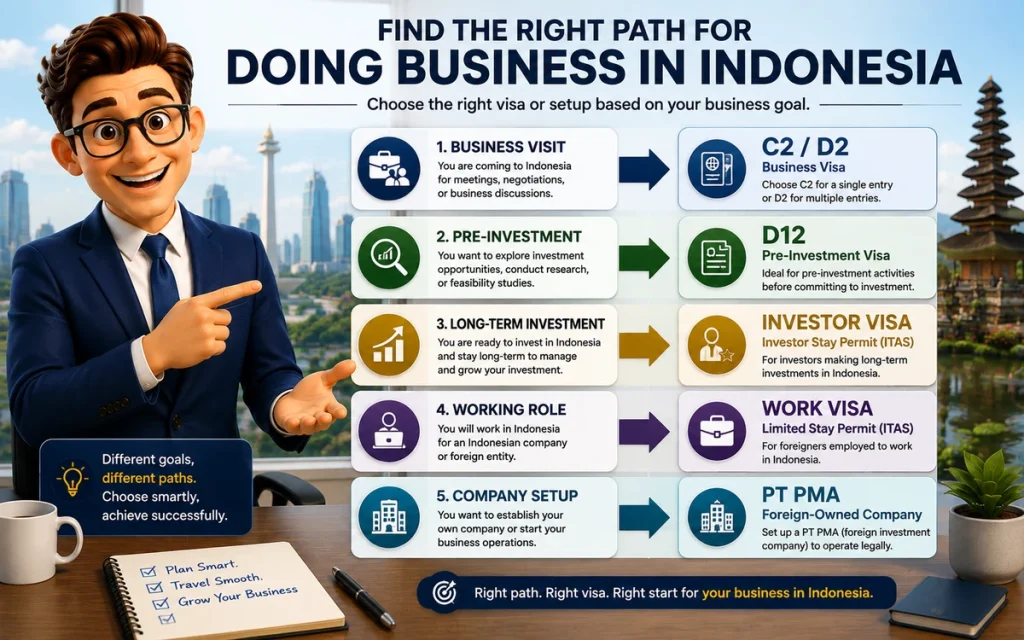
Choosing the right immigration option depends on what you actually plan to do in Indonesia. A Business Visa may be suitable for temporary business visits, while an Investor Visa or a work-authorized stay permit may be more appropriate for foreigners who plan to establish a longer-term presence or carry out activities beyond the scope of a business visit.
The most important factor is not simply your job title or whether you own a business. Instead, you should consider the purpose of your stay, the activities you will perform in Indonesia, and how long you expect to remain involved in the country.
Business Visa vs Investor Visa
An Indonesia Business Visa, such as C2 or D2, is generally designed for temporary business-related visits. D12, meanwhile, is intended for the pre-investment stage when a foreign national needs to explore business or investment opportunities before making a longer-term commitment.
An Investor Visa or Investor KITAS may become more relevant after you decide to invest in or establish an Indonesian company and need an appropriate longer-term immigration arrangement based on your role and investment position.
For example, a foreign entrepreneur may initially use the pre-investment stage to explore potential business opportunities, conduct market research, and evaluate whether a project is commercially viable. Once the decision is made to proceed and the business structure is established, the immigration needs may change.
The key difference is therefore the stage of your business plans:
- Business or pre-investment visa: suitable for permitted temporary visits, business exploration, or pre-investment activities.
- Investor Visa: may be more appropriate for a qualifying foreign investor who has moved beyond the exploration stage and needs a longer-term immigration arrangement.
The most suitable option should always be assessed based on the foreign national’s actual role, ownership structure, investment status, and planned activities.
For foreign nationals who have moved beyond the exploration stage and are considering a qualifying investment or a longer-term presence in Indonesia, you can also explore our guide to the Investor Visa Indonesia.
Business Visa vs Work Visa
A Business Visa should not be used as a substitute for a visa or stay permit that provides the appropriate authorization for employment or work activities in Indonesia.
A business visitor may attend meetings, hold discussions, negotiate agreements, or carry out other permitted activities within the scope of their visa. However, this is different from being employed by an Indonesian company or performing day-to-day work that requires work authorization.
For example, a foreign professional travelling to Indonesia for a meeting with a potential client may have different immigration needs from a foreign professional relocating to Indonesia to work for an Indonesian company.
Similarly, a foreign company representative may be able to make temporary business visits for permitted activities, but if the person will begin performing an ongoing operational role in Indonesia, a work-authorized immigration arrangement may be required.
If there is any uncertainty, it is important to assess the actual duties that will be performed rather than relying only on a broad description such as “business activities” or “consulting.”
If your planned activities involve employment or an ongoing operational role in Indonesia, you can also read our guide to the Indonesia Work Visa.
When Should You Consider Setting Up a PT PMA?
A PT PMA (foreign-owned company) may become relevant when foreign nationals decide to establish a formal business presence or make a qualifying foreign investment in Indonesia.
This is usually a different stage from simply visiting Indonesia for meetings or exploring potential opportunities. Before establishing a PT PMA, foreign investors may need to evaluate the market, identify suitable business activities, understand applicable regulations, and determine the appropriate company structure.
For example, a foreign entrepreneur may begin by visiting Indonesia to explore a potential opportunity and conduct permitted pre-investment activities. If the project proceeds, the entrepreneur may then need to establish the appropriate business entity and consider the relevant immigration arrangements for investors, directors, or other foreign personnel.
Setting up a PT PMA does not automatically mean that every foreign national involved in the business has the same visa or stay permit requirements. The appropriate immigration status can depend on the person’s role, ownership, activities, and whether they will actively work or reside in Indonesia.
If you are ready to move from exploring an opportunity to establishing a formal business presence, you can also read our guide to PT PMA setup in Indonesia.
In short, your choice should follow the development of your plans: use the appropriate Business Visa for permitted visits, consider D12 during the pre-investment stage, and review Investor or work-authorized options when your activities move into a longer-term investment, residency, or operational role.
The next section explains how Azra Solutions can help assess the right immigration option and support the application process based on your specific business plans in Indonesia.
13. How Azra Solutions Can Help With Your Indonesia Business Visa
Choosing the right visa is an important part of planning your business activities in Indonesia. The best option depends on the real purpose of your visit, how often you need to travel to Indonesia, and whether your plans are limited to temporary business visits or are part of a larger investment or business setup strategy.
At Azra Solutions, we help foreign nationals understand their available immigration options and choose an approach that is aligned with their actual plans in Indonesia.
Choosing the Right Visa for Your Business Purpose
Not every business-related activity requires the same visa. A foreign national travelling to Indonesia for a single business meeting may have different immigration needs from someone who needs to make repeated visits throughout the year or explore a potential investment before establishing a company.
Azra Solutions can help review the purpose of your visit and identify whether C2, D2, D12, or another relevant immigration option may be more suitable.
This can help you avoid choosing a visa based only on its validity period or number of permitted entries. Instead, the focus is on ensuring that the visa category is aligned with your planned activities.
Business Visa Application Assistance
The visa application process can involve different requirements depending on the category selected. Preparing the correct documents and providing accurate information about the purpose of the visit are important parts of the process.
Azra Solutions can assist with the application process by helping clients understand the relevant requirements, prepare the necessary information and supporting documents, and navigate the applicable immigration procedures.
Our support is designed to make the process clearer and more efficient while ensuring that the application is prepared according to the selected visa category.
Support for Business Setup and Investment in Indonesia
For some foreign nationals, a Business Visa is only the first stage of a larger plan.
You may initially travel to Indonesia to explore the market, meet potential partners, or conduct pre-investment activities. If you later decide to establish a business, invest in an Indonesian company, or create a longer-term presence in Indonesia, your immigration and business requirements may change.
Azra Solutions can also provide support for the next stages of your plans, including relevant immigration arrangements, investment-related services, and business setup in Indonesia.
Whether you are planning a single business visit, making repeated trips, exploring a potential investment, or preparing to establish a company, our team can help you understand the available options and determine the most suitable path based on your specific circumstances.
Contact Azra Solutions to discuss your Indonesia Business Visa options and receive guidance based on your business plans and intended activities in Indonesia.
14. Indonesia Business Visa FAQs
What is the Indonesia Business Visa?
An Indonesia Business Visa is a visa option used by foreign nationals who visit Indonesia for permitted business-related activities. The most suitable visa depends on the purpose of the visit, planned activities, and how often the foreign national needs to travel to Indonesia.
For the main options covered in this guide, C2 is generally used for a single business visit, D2 is designed for repeated business travel, and D12 is intended for eligible pre-investment activities.
What is the difference between C2 and D2 visas?
The main difference between C2 and D2 is the entry arrangement.
C2 is a single-entry visa, making it suitable for a specific business visit to Indonesia. D2 is a multiple-entry visa, making it more suitable for foreign nationals who need to travel to Indonesia repeatedly for permitted business activities.
The correct choice should still be based on the actual purpose of the visit and the activities planned in Indonesia.
Is D12 a business visa?
D12 is closely related to business and investment activities, but its primary purpose is specifically focused on the pre-investment stage.
It may be relevant for foreign nationals who need to explore investment opportunities, conduct field surveys, evaluate potential business locations, or carry out feasibility analyses before deciding whether to invest or establish a business in Indonesia.
Can I work in Indonesia with a business visa?
A Business Visa should not be treated as a general work permit.
While certain business-related activities may be permitted under C2, D2, or D12, taking up employment or performing work that requires work authorization may require a different visa or stay permit.
The correct immigration option depends on the actual activities you will perform in Indonesia.
How long can I stay in Indonesia on a business visa?
The maximum stay depends on the specific Indonesia Business Visa you hold. It is also important to distinguish between the validity period of the visa and the length of stay permitted for each entry.
For the three main options covered in this guide:
- C2 Business Visa: Up to 60 days initially, with up to 2 extensions, allowing a maximum total stay of up to 180 days.
- D2 Business Visa: Available with a validity period of 1, 2, or 5 years, with a stay of up to 60 days for each entry.
- D12 Pre-Investment Visa: Available with a validity period of 1 or 2 years, with a stay of up to 180 days for each entry.
For multiple-entry visas such as D2 and D12, the validity period does not mean that you can remain continuously in Indonesia for the entire 1-, 2-, or 5-year period. Each stay must follow the permitted stay period for the relevant entry.
Before making travel plans, you should always confirm the conditions attached to the specific visa granted to you.
Can I extend a C2 or D2 visa?
The extension arrangements for C2 and D2 are different.
The C2 Business Visa allows an initial stay of up to 60 days and can be extended up to 2 times, allowing a maximum total stay of up to 180 days, subject to the applicable immigration requirements and approval.
The D2 Business Visa allows a stay of up to 60 days for each entry and is available with a visa validity period of 1, 2, or 5 years. Because D2 is a multiple-entry visa, its visa validity period should not be confused with the permitted stay period for each entry.
Before making travel or long-term stay plans, always check the conditions attached to the specific visa granted to you.
Do I need a sponsor for an Indonesia Business Visa?
Sponsor or guarantor requirements can depend on the visa category and the application arrangement.
Depending on the specific visa, an Indonesian sponsor, guarantor, company, business partner, or other relevant supporting party may be required. The correct arrangement should match the actual purpose of the visit and the visa being applied for.
Which visa should I choose if I want to start a business in Indonesia?
The right option depends on which stage you are currently in.
If you are still exploring whether to invest or establish a business, the D12 Pre-Investment Visa may be relevant for permitted pre-investment activities. If you have already decided to establish a company or make a qualifying investment, you may need to consider the appropriate business setup and longer-term immigration arrangements.
If you are unsure whether C2, D2, D12, an Investor Visa, or another immigration option is suitable for your plans, it is important to assess your intended activities before submitting an application.
Still Unsure Which Indonesia Business Visa Is Right for You?
Choosing between the C2 Business Visa, D2 Multiple-Entry Visa, D12 Pre-Investment Visa, Investor Visa, or another Indonesian immigration option depends on your actual purpose and planned activities in Indonesia.
If you are still unsure which option is most suitable for your situation, Azra Solutions can help you assess your plans and guide you through the appropriate visa application process.