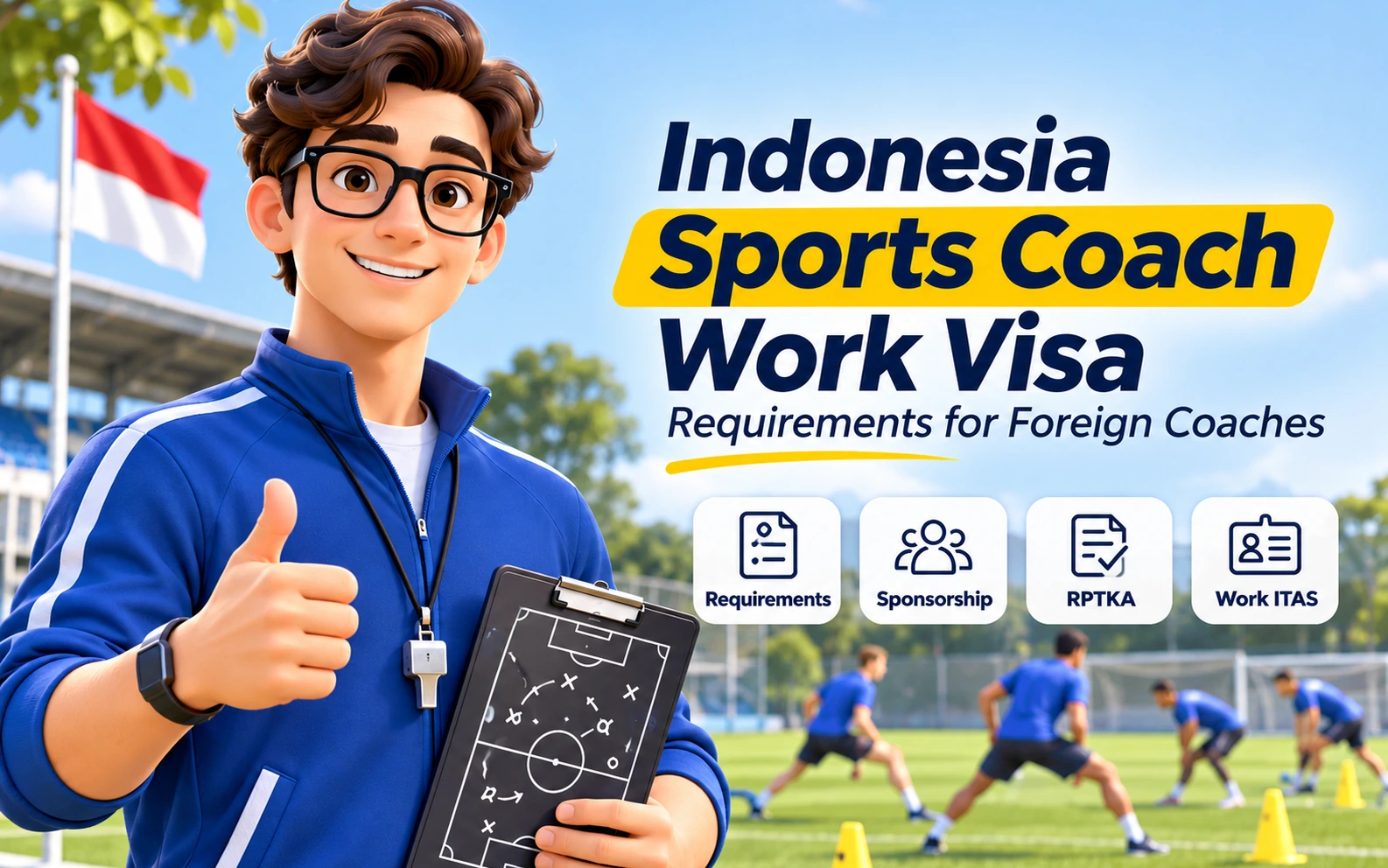
Foreign sports coaches may be recruited by Indonesian professional clubs, sports academies, federations, training centres, schools, and other sports institutions to deliver specialist coaching, athlete development, technical programmes, and performance support. Before accepting an assignment, however, a foreign coach and the Indonesian organisation engaging them should understand that sports-sector eligibility and immigration permission are separate parts of the process. For the wider legal and immigration framework, see our Indonesia work visa guide for foreign professionals.
An Indonesia Sports Coach Work Visa is not simply a matter of obtaining an entry visa. The proposed role must be assessed under Indonesia’s sports-sector rules, foreign-worker requirements, and immigration framework. The organisation should establish the coach’s actual duties, verify the coach’s qualifications and competency evidence, identify the relevant sports organisation or institution, and confirm the required government recommendations or approvals before the coach begins work.
This guide explains the main considerations for foreign coaches, including head coaches, assistant coaches, academy coaches, technical coaches, and specialist trainers. It is general information, not a guarantee that a particular position, applicant, or employer will qualify. Requirements can depend on the sport, the organisation, the employment arrangement, and the current government procedures.
Understanding the Indonesia Sports Coach Work Visa
The phrase Indonesia Sports Coach Work Visa is commonly used to describe the immigration pathway a foreign national needs when taking up a genuine coaching role in Indonesia. The visa and stay permit are only one part of the legal framework. A coach may also need to satisfy sports-specific qualification and recommendation requirements, while the Indonesian organisation may need to complete foreign-worker procedures.
A coach who is employed by an Indonesian club or academy is in a different position from a person who visits briefly to observe a programme, attend a meeting, or participate in a non-employment activity. The correct route depends on the substance of the assignment—not only the job title used in a contract, invitation letter, or promotional material. For sports personnel working with a sports organisation or institution, the additional requirements in PP 46/2024 must also be considered.
For a work assignment, the Indonesian organisation should coordinate the manpower and immigration process before the coach starts providing services. A visa should not be treated as permission to undertake any activity whatsoever. The foreign national must perform only the activities permitted by the issued visa and stay permit, and must comply with the applicable employment and sports-sector requirements.
Which Foreign Sports Coaches Can Work in Indonesia?
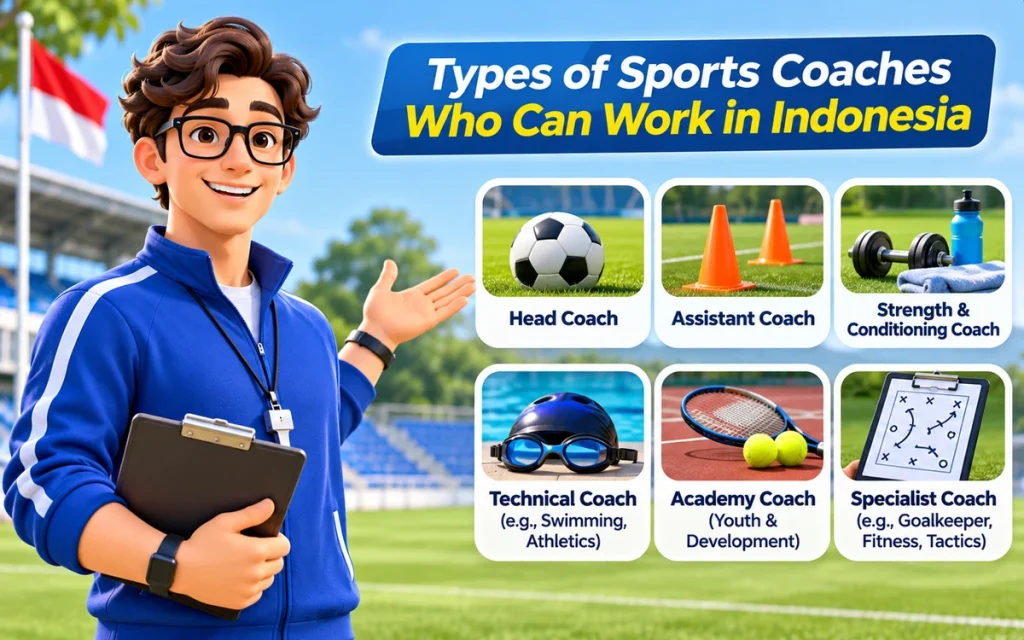
Indonesia’s sports legislation recognises coaching as a sports professional function. Government Regulation No. 46 of 2024 on Sports Administration (PP 46/2024) includes coaches and assistant coaches within the definition of sports personnel. It also refers to other professional functions such as referees, judges, managers, promoters, administrators, instructors, medical personnel, and technical specialists. The role must therefore be assessed according to its real duties and professional scope.
Head coaches
A head coach usually leads the sporting programme for a team, club, academy, or national or regional development project. Responsibilities may include setting training plans, selecting coaching methods, supervising assistant coaches, evaluating athlete performance, and coordinating with management or technical staff. The employer should describe the role accurately and provide evidence that the candidate’s qualifications match the sport and level of responsibility.
Assistant coaches
An assistant coach supports the head coach in delivering training, monitoring athletes, preparing sessions, and implementing technical or tactical plans. The fact that the role is described as assistant-level does not automatically remove sports-sector qualification requirements. The organisation should verify the applicable competency standard and ensure the job description reflects the actual work.
Academy and youth-development coaches
Sports academies and development programmes may engage foreign coaches to teach technical skills, structure training programmes, and develop local coaching capacity. Where the programme involves children or young athletes, the organisation should also address safeguarding, parental communication, supervision, and applicable child-protection procedures. These considerations are separate from immigration permission but are important parts of responsible sports administration.
Personal, specialist, and technical coaches
A specialist coach may focus on a particular discipline, position, skill, fitness component, or performance objective. A private or personal coaching arrangement should not automatically be assumed to fall within the same sports-organisation procedure described in Article 103, because that provision specifically refers to foreign sports personnel assigned to sports organisations and/or sports institutions. The parties should establish who engages and pays the coach, where the services are delivered, whether the activity is regular or commercial, and whether the arrangement constitutes work in Indonesia. The applicable manpower and immigration route should be assessed on the facts.
The article covers professional coaching work across clubs, academies, federations, training centres, and comparable sports institutions. It does not assume that every informal lesson, short visit, tournament appearance, or private arrangement follows the same route. For a related role, see our guide to Indonesia Work Visa for Professional Athletes.
Visa Options and Work Authorization for Foreign Coaches
The current published visa-classification reference reviewed for this article is Minister of Immigration and Corrections Decree No. M.IP-08.GR.01.01 of 2025 on Visa Classification. It sets out E23 as a limited-stay work route for a foreign national performing work or expert activities in an employment relationship with a guarantor (sponsor). The decree does not name a dedicated sports-coach subcategory in the relevant E23 section. This means the general E23 description alone should not be treated as confirmation that every coaching position can use that route.
The operational Immigration Office ITAS service listing separately identifies E23S for working as an athlete and E23T for working as a sports official. It does not list a dedicated coach category in that same group. The 2025 ministerial classification decree and the operational service listing therefore need to be read carefully and not treated as if they contain identical subcategory labels. For a foreign coach, the sponsor should obtain confirmation from Immigration of the exact visa index and activity description currently available for the actual coaching role before filing.
E23T is described on the Immigration Office ITAS service listing as a work visa for sports officials, while E23S is listed for athletes. Neither label should be assumed to cover a coach automatically. The 2025 classification decree describes the general E23 work route but does not name a specific coach subcategory in the relevant section. The sponsor must confirm the correct current route for the coach’s actual duties with Immigration.
Short-term attendance at a sports event, a meeting, or a training observation visit must also be distinguished from taking up a coaching job. A visit visa should not be used as a substitute for work authorisation where the foreign national will perform ongoing coaching duties, receive employment remuneration, or work under an Indonesian organisation’s direction. The sponsor should verify the permitted activities and restrictions for any proposed visit category before travel.
Legal Requirements for Foreign Sports Coaches
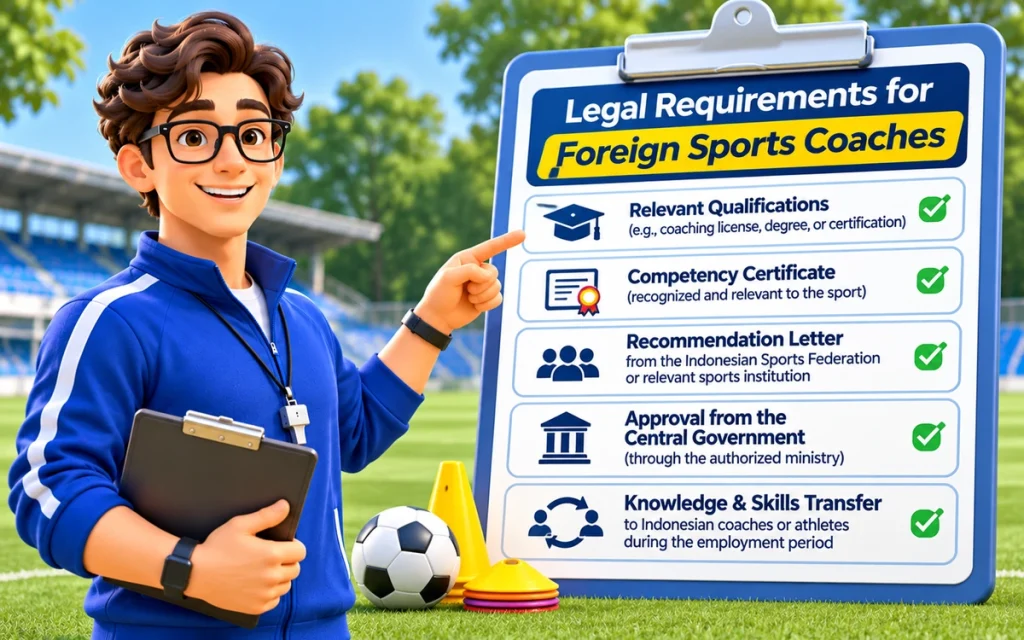
PP 46/2024 establishes specific requirements for foreign sports personnel. Article 101 expressly includes coaches and assistant coaches within the definition of sports personnel, and Article 103 applies requirements to foreign sports personnel assigned to sports organisations and/or sports institutions. They must hold qualifications and competency certificates, obtain a recommendation from the relevant national sports federation or another relevant institution, and obtain permission from the competent central government agency in accordance with applicable laws.
The same article requires foreign sports personnel to comply with local norms, culture, and customs, and to transfer knowledge and skills in line with their expertise. The organisation intending to use foreign sports personnel must submit a written application to the competent government agency, comply with applicable laws, and consider the candidate’s qualifications and competencies while verifying their authenticity and suitability for the organisation’s needs.
These are sports-sector requirements. They should not be collapsed into the immigration application or treated as documents that can be replaced by a visa. The organisation should identify the relevant authority and the current procedure for the sport and role concerned. The wording of PP 46/2024 refers to the competent central government agency; the practical application may involve additional institutional steps or technical guidance.
Qualifications, Competency Certificates, and Sports Federation Recommendations
Qualifications and competency certificates
A foreign coach should prepare evidence of formal education, coaching qualifications, professional licences, certificates issued by the relevant sport’s governing body, and a record of relevant coaching experience. The appropriate evidence depends on the sport and the level of the role. A certificate from a private course may be useful background information, but it should not automatically be assumed to satisfy a formal competency requirement.
The organisation should verify the issuing body, validity period, level, sport, and scope of each credential. If a certificate is issued overseas, the sponsor should ask the relevant Indonesian sports federation or competent institution whether it is recognised or whether additional verification, translation, or supporting evidence is needed. The organisation should not represent a qualification as officially recognised until that point has been confirmed.
Recommendation from the relevant sports federation or institution
Article 103 of PP 46/2024 requires a recommendation from the relevant national sports federation or another relevant institution. The relevant body will depend on the sport and the coach’s proposed function. The sponsor should identify the correct organisation early, rather than assuming that a recommendation from any club, event organiser, or private academy will be sufficient.
A recommendation request may need to explain the proposed role, the coach’s qualifications, the organisation’s needs, the programme, and the expected contribution to local sports development. The exact format, supporting documents, and processing route should be confirmed with the relevant federation or institution. Do not assume a uniform checklist applies to every sport.
Permission from the competent central government agency
PP 46/2024 also requires permission from the competent central government agency. The organisation should establish which agency is responsible for the proposed sports activity and what current procedure applies. A federation recommendation and a government permission are distinct concepts in the wording of Article 103; one should not be assumed to replace the other.
Because sports governance and administrative procedures can vary by discipline and programme, the sponsor should obtain current instructions directly from the relevant authority. This article does not claim that a single ministry, federation, or online form is responsible for every coaching engagement.
RPTKA and Indonesian Sponsorship Requirements
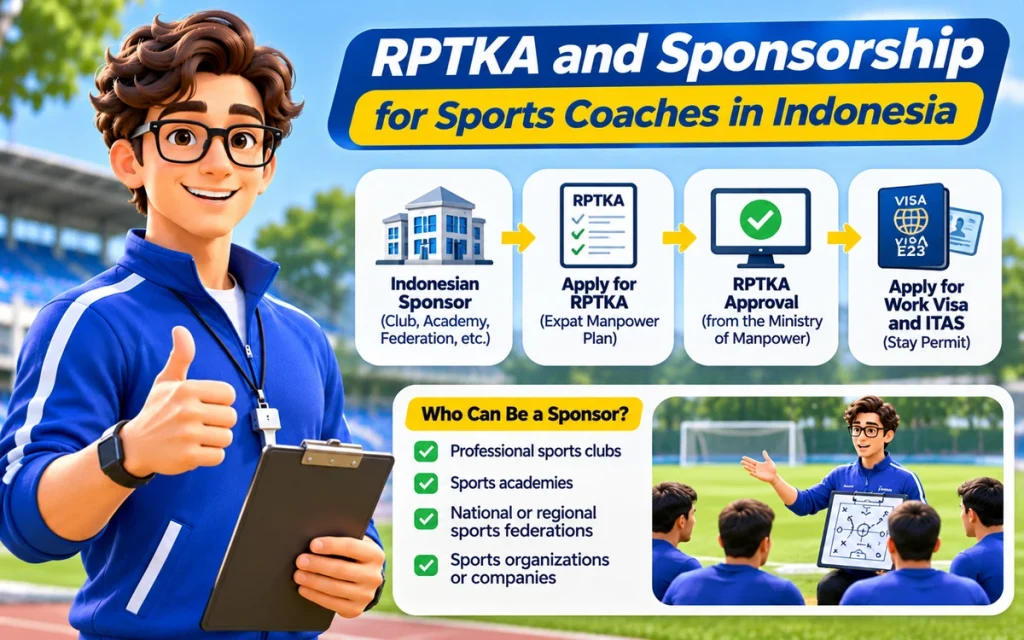
The sports-sector requirements operate alongside Indonesia’s foreign-worker framework. Government Regulation No. 34 of 2021 on the Use of Foreign Workers (PP 34/2021) regulates the use of foreign workers and the employer’s obligations, including the foreign-worker utilisation plan (Rencana Penggunaan Tenaga Kerja Asing or RPTKA), subject to the applicable rules and exceptions. The Ministry of Manpower’s implementing regulation is Minister of Manpower Regulation No. 8 of 2021.
An Indonesian organisation that intends to employ a foreign coach should assess whether it is an eligible employer and whether an approved RPTKA is required for the proposed employment. The organisation should not assume that being a sports club, foundation, academy, school, federation, or event company automatically creates an exemption. Any exception must be checked against the current legal provisions and the employer’s actual status.
Identifying the Indonesian employer or sponsor
The sponsor should be the appropriate Indonesian legal entity or institution that is genuinely responsible for the coaching engagement. Its documents, business or institutional activities, work location, proposed position, and contractual relationship should be consistent with the application. A sponsor should not be named only as a formality if another party will actually direct, employ, or pay the coach.
RPTKA and the position description
The proposed position should accurately describe the coach’s responsibilities, work location, and period of engagement. A generic title such as sports consultant may not accurately describe a role that involves daily training, team selection, technical instruction, or direct supervision of athletes. The sponsor should ensure that the RPTKA information, employment agreement, sports-sector recommendation, and immigration application are consistent.
Knowledge transfer and local counterpart
PP 46/2024 expressly requires foreign sports personnel to transfer knowledge and skills according to their expertise. The sponsor should plan how the foreign coach will support the development of Indonesian coaches, assistant coaches, athletes, or technical staff. The programme may include joint coaching sessions, structured mentoring, training materials, technical workshops, or documented development activities, depending on the role.
This sports-specific knowledge-transfer duty should be distinguished from any separate manpower obligations that may apply under the foreign-worker framework. The organisation should review both sets of requirements and document its compliance in a practical way.
DKPTKA and other employer obligations
The employer should review whether foreign-worker compensation fund payments (Dana Kompensasi Penggunaan Tenaga Kerja Asing or DKPTKA), reporting, local counterpart arrangements, and other obligations apply to its case. The amount, payment route, timing, and any exemptions must be checked against the current rules and the approved RPTKA. Do not rely on a general estimate without reviewing the actual employment period and employer category.
Documents Required for a Sports Coach Work Visa
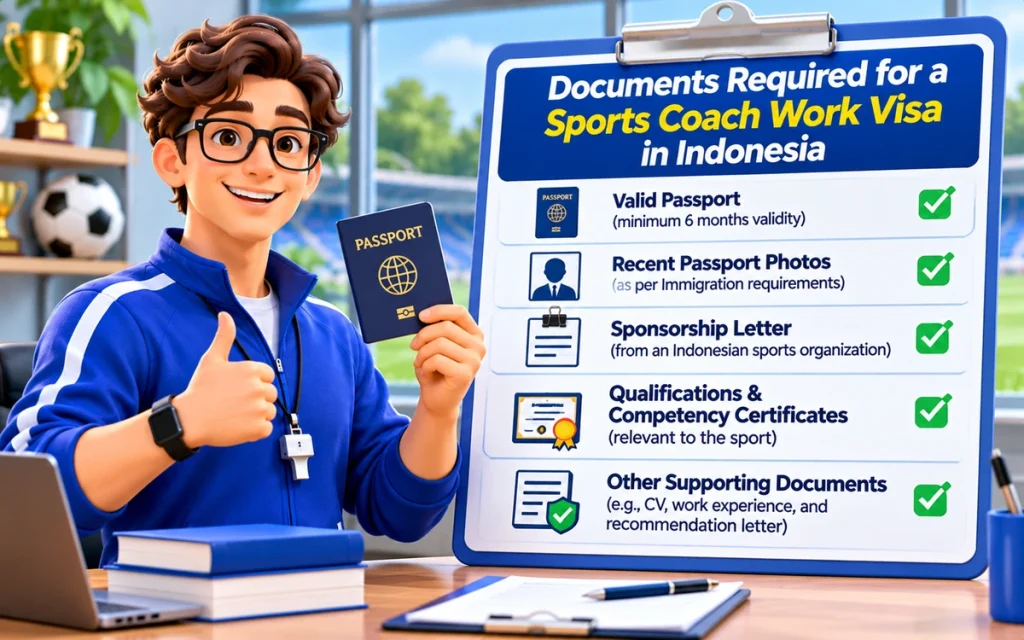
The exact checklist depends on the sport, the employer, the foreign-worker approval route, and the immigration category available when the application is filed. The list below is a preparation guide, not a universal official checklist. Some items may be requested by the sports authority, manpower authority, or Immigration depending on the case.
Documents from the foreign coach
- Passport with sufficient validity for the intended application and stay period.
- Recent passport-style photograph and personal information required by the current immigration system.
- Curriculum vitae detailing coaching history, teams or institutions served, and relevant achievements.
- Education records, coaching licences, competency certificates, and other professional credentials.
- Evidence of experience relevant to the proposed sport, level, and position.
- Proposed employment agreement or other required engagement document.
- Any translations, legalisations, verifications, or additional evidence requested by the relevant authority.
Documents from the Indonesian organisation
- Legal establishment and institutional or company documents, as applicable.
- Identity and authority documents of the responsible signatory or representative.
- Description of the sports programme, coaching position, duties, work location, and proposed engagement period.
- Employment agreement or draft agreement and explanation of the need for the foreign coach.
- RPTKA approval or related manpower documents, where required.
- Recommendation from the relevant national sports federation or other relevant institution.
- Permission or approval from the competent central government agency, where required.
- Sponsor information and supporting documents for the immigration application.
The sponsor should confirm the final checklist with the relevant sports authority, Ministry of Manpower process, and Immigration before submission. Documents may need to be updated if the role, employer, work location, or engagement period changes.
Need Help Preparing Your Sports Coach Work Visa Documents?
Planning to work as a sports coach in Indonesia? Azra Solutions can help review your coaching credentials, assess your Indonesian sponsor arrangements, and guide you through the applicable work permit and immigration requirements.
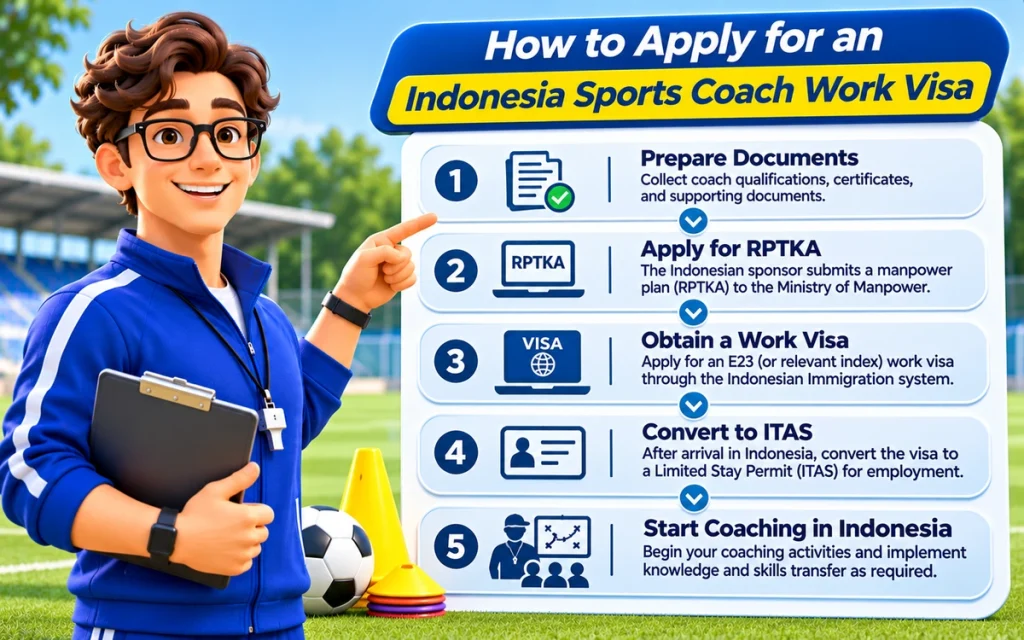
How to Apply for an Indonesia Sports Coach Work Visa
Step 1 – Define the coaching role and employer
Start by documenting the sport, coaching level, responsibilities, work location, schedule, remuneration, and duration. Identify the Indonesian organisation that will genuinely engage the coach. This information forms the basis for determining the sports-sector approvals, manpower route, and immigration category.
Step 2 – Verify the coach’s qualifications
Collect the coach’s professional records and verify that the qualifications and competency certificates match the role. Ask the relevant sports federation or institution whether the credentials meet the applicable standard and whether further verification is required. Resolve any uncertainty before the sponsor makes a formal recommendation request.
Step 3 – Obtain the relevant sports recommendation and government permission
The organisation should contact the relevant national sports federation or other relevant institution for the recommendation required under Article 103 of PP 46/2024. It should also identify and follow the procedure for obtaining permission from the competent central government agency. The required sequence and supporting documents should be confirmed for the specific sport.
Step 4 – Complete the foreign-worker process
The Indonesian employer should assess and complete the RPTKA process and related manpower obligations where required. The role and employment details must be consistent with the sports-sector documents and the intended immigration application. If the employer believes an exception applies, it should verify the legal basis and eligibility before proceeding.
Step 5 – Apply for the appropriate work visa
Once the relevant approvals and sponsor information are ready, the sponsor can proceed with the appropriate immigration application through the official eVisa system. The exact visa index and activity description must be checked in the live system. The 2025 classification decree describes E23 as a general employment or expert work route; the sponsor should not assume a sports-specific subcategory exists unless it is shown in current official guidance.
Step 6 – Enter Indonesia and complete stay-permit formalities
The coach should travel only after the required visa has been issued and should comply with the conditions attached to it. After arrival, the coach and sponsor should follow any registration, biometric, or stay-permit formalities required by the issued status and current procedure. The sponsor should retain copies of approvals and monitor the validity of the stay permit.
Step 7 – Begin coaching only within the approved scope
The coach should begin work only when the necessary approvals and immigration status are in place. Duties, work location, employer, and period of engagement should remain consistent with the approved documents. A material change—such as moving to another club, taking on a different role, or working for an additional organisation—should be reviewed before it takes effect.
Work ITAS, Stay Period, and Compliance
A limited-stay permit for work is tied to the approved purpose, sponsor, and conditions. The foreign coach should check the actual validity period and permitted activities stated in the issued documents rather than relying on a general online description or another person’s experience. The available duration may depend on the visa category, approval, and current immigration rules.
The coach should keep a copy of the passport, visa, stay permit, employment agreement, and relevant approvals. The sponsor should monitor expiry dates, reporting requirements, and any changes to the work arrangement. Renewal or extension should be planned early and should not be assumed to be automatic.
If the coaching engagement ends early, the coach changes employer, or the organisation changes the job description or work location, the parties should obtain advice on the required reporting, amendment, cancellation, or new application. Continuing to work under outdated sponsor or role information may create immigration and manpower compliance risks.
Foreign coaches must also respect local laws, norms, culture, and customs. In sports settings, this includes professional conduct, athlete welfare, safeguarding, and appropriate communication with athletes, parents, staff, and governing bodies. The knowledge-transfer obligation under PP 46/2024 should be treated as a substantive part of the assignment, not merely a sentence in the contract.
Common Mistakes Foreign Sports Coaches Should Avoid
Assuming a sports invitation is a work permit
An invitation to visit a club, attend a tournament, observe training, or speak at a seminar does not automatically authorise ongoing coaching work. The activity and the visa conditions must be reviewed before travel.
Using a sports-official visa for a coaching position
A visa classification for sports officials should not be assumed to cover coaches. The sponsor must match the real duties to the current classification and official description.
Treating a federation recommendation as the only approval
Article 103 refers to a federation or relevant-institution recommendation and permission from the competent central government agency. The sponsor should identify both requirements and confirm the current process.
Submitting credentials without verifying their relevance
A large portfolio of certificates does not necessarily prove that the candidate meets the competency standard for the specific sport or level. The sponsor should verify issuing bodies, validity, and recognition.
Using a nominal sponsor
The employer or sponsor information should reflect the genuine engagement. A mismatch between the sponsor, contract, actual work, and payment arrangement can create problems during review or later compliance checks.
Ignoring knowledge transfer
Foreign sports personnel are expressly required to transfer knowledge and skills in accordance with their expertise under PP 46/2024. The organisation should plan and document how this will happen.
Starting work before the required approvals are complete
The coach should not begin providing the approved work activity until the required sports-sector, manpower, and immigration steps have been completed.
Frequently Asked Questions
Can foreign sports coaches work in Indonesia?
Yes, subject to the applicable sports-sector, manpower, and immigration requirements. PP 46/2024 requires foreign sports personnel to hold appropriate qualifications and competency certificates, obtain a recommendation from the relevant sports federation or institution, and obtain permission from the competent central government agency.
Does a foreign sports coach need an RPTKA?
An RPTKA may be required under Indonesia’s foreign-worker framework when an Indonesian employer uses a foreign worker. The employer should assess PP 34/2021, its implementing rules, and any applicable exception for the specific employer and engagement.
Is E23T the visa for foreign sports coaches?
No. The Immigration Office ITAS service listing identifies E23T as the work visa for sports officials and E23S for athletes. Neither should automatically be treated as the coach category. The sponsor should confirm the current visa index applicable to the coach’s actual duties with Immigration.
Can a foreign coach work for a sports academy?
A sports academy may engage a foreign coach if the organisation and proposed role meet the applicable requirements. The academy should confirm its legal capacity to engage a foreign worker, obtain the relevant sports-sector recommendation and permission, and complete the required manpower and immigration procedures.
Can a foreign coach provide private lessons in Indonesia?
The answer depends on the actual arrangement, including who engages and pays the coach, whether the activity is regular or commercial, where it takes place, and whether it constitutes work in Indonesia. A private lesson should not automatically be treated as exempt from work authorisation. Obtain case-specific advice before the coach begins.
Are coaching certificates from overseas accepted?
Overseas qualifications may be relevant evidence, but the organisation should verify whether the certificate meets the applicable competency standard and whether the relevant Indonesian sports federation or institution recognises it. Additional verification or supporting documents may be required.
Does a foreign coach have to train Indonesian coaches?
PP 46/2024 requires foreign sports personnel to transfer knowledge and skills according to their expertise. The organisation should plan suitable knowledge-transfer activities and confirm any additional manpower-related obligations.
Can a foreign coach change clubs after receiving a work visa?
A change of employer or work arrangement should not be made informally. The sponsor and coach should first check whether the existing approvals and stay permit cover the new arrangement or whether amendments, cancellation, or a new application are required.
How long can a foreign sports coach stay in Indonesia?
The permitted stay depends on the visa and stay permit actually issued, the approved employment period, and the current rules. The sponsor should confirm the available duration in the live system and the issued approval rather than relying on a generic duration.
Where can the sponsor apply for the work visa?
The sponsor should use the official Indonesian eVisa portal and follow the current application instructions. Before submission, the sponsor should confirm the correct visa index for a coach with Immigration, because the 2025 decree describes a general E23 work route while the operational ITAS listing separately names E23S for athletes and E23T for sports officials without naming a coach-specific index.
Need Assistance With an Indonesia Sports Coach Work Visa?
Whether you are a foreign sports coach or an Indonesian sports organisation planning to hire foreign coaching professionals, Azra Solutions can provide immigration consultation and assistance with sponsorship arrangements, work authorisation, and visa requirements.
Contact our team to discuss your situation and identify the appropriate immigration pathway.
Official References and Legal Sources
- Government Regulation No. 46 of 2024 on Sports Administration – JDIH Kemenpora
- Government Regulation No. 34 of 2021 on the Use of Foreign Workers – JDIH Ministry of Manpower
- Minister of Manpower Regulation No. 8 of 2021 – JDIH Ministry of Manpower
- Minister of Immigration and Corrections Decree No. M.IP-08.GR.01.01 of 2025 – Visa Classification (PDF copy)
Immigration Office ITAS service listing – E23, E23S and E23T categories