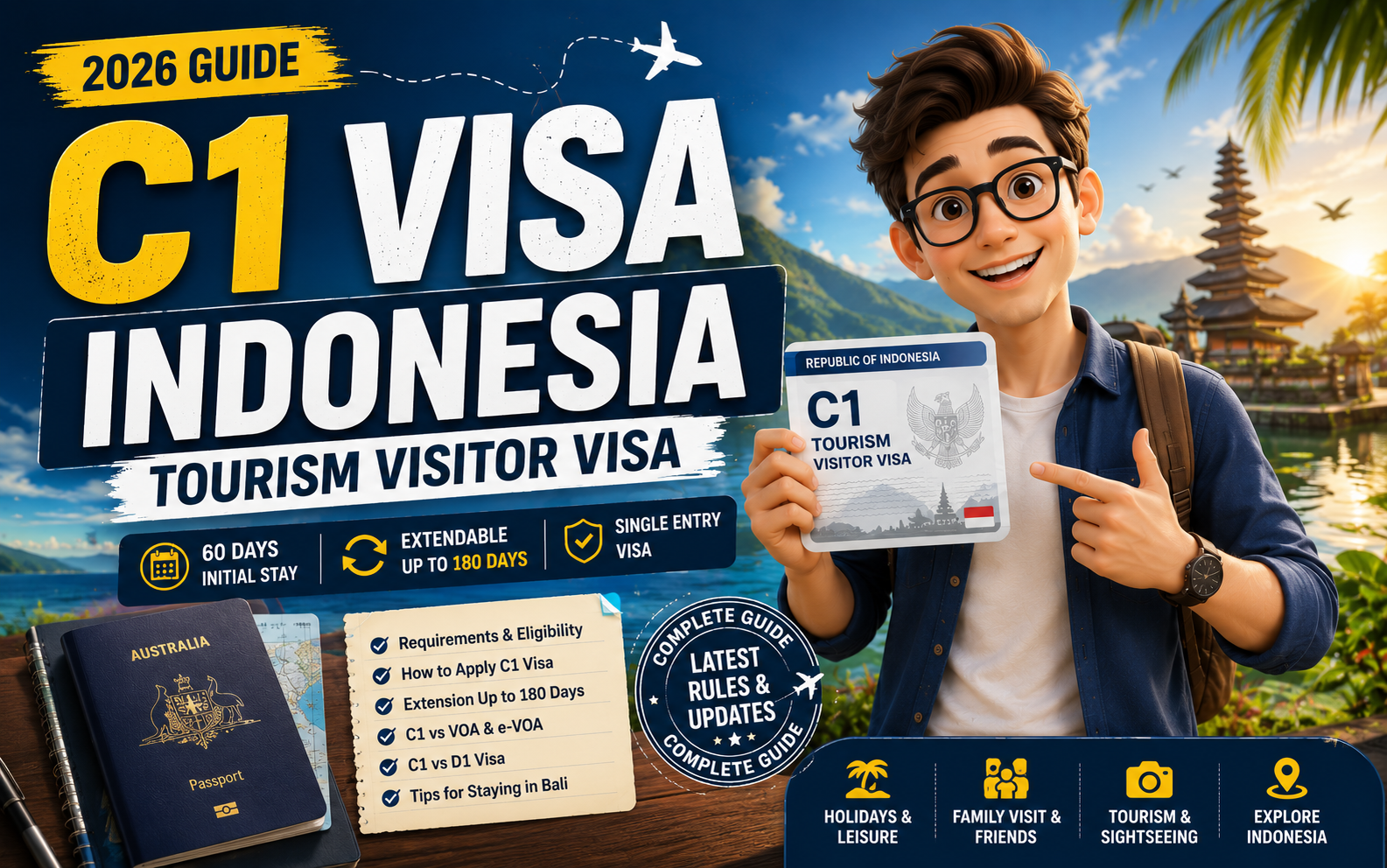
Planning a trip to Indonesia for more than a short holiday? The C1 Visa Indonesia is one of the main visa options for foreign nationals who want to visit Indonesia for tourism and other permitted temporary activities. The C1 is a single-entry visitor visa, with an initial stay of up to 60 days from the date of arrival. The stay can be extended several times, up to a total of 180 days, subject to Indonesian immigration rules.
For many travelers, choosing the right Indonesian visa is not simply a matter of checking whether a visa is required. The length of the planned stay, nationality, purpose of travel, eligibility for Visa on Arrival (VoA) or e-VOA, and the possibility of extending the stay can all affect which option makes the most sense. This is why understanding how the C1 Tourist Visa works before applying can help avoid unnecessary costs, delays, or problems during the trip.
The C1 Visa is primarily associated with tourism, but its permitted activities are broader than sightseeing alone. Indonesian Immigration allows C1 holders to use the visa for tourism, visiting family, attending meetings, incentives, conventions, exhibitions or similar events, and transit through Indonesia to another country. The visa does not authorize employment in Indonesia.
This guide explains the C1 Visa Indonesia from the perspective of a traveler or applicant, covering the requirements, government fee, application process, processing time, the meaning of “Waiting Verification,” stay duration, extension options, and the differences between C1 and other commonly considered visa options such as VOA, e-VOA and D1.
Whether you are planning a longer holiday in Bali, traveling around Indonesia, visiting family, or simply comparing your visa options before booking your trip, this guide will help you understand when the C1 Visa may be appropriate and what you should prepare before applying.
1. What Is C1 Visa Indonesia?
What Is the C1 Tourist Visa?
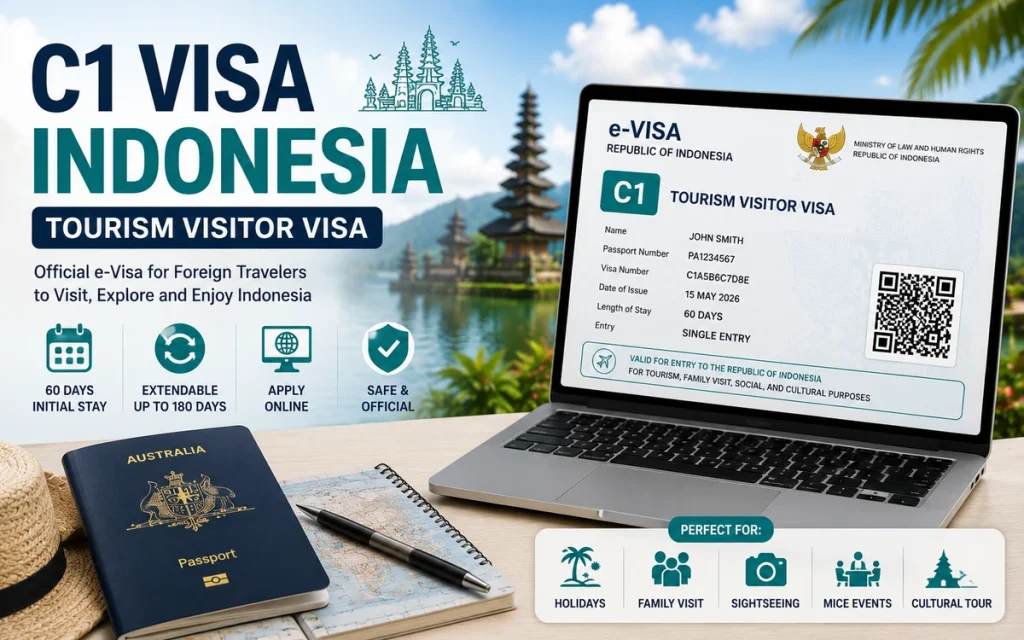
The C1 Visa Indonesia is a single-entry visitor visa designed primarily for foreign nationals who want to travel to Indonesia for tourism. Under Indonesia’s current visa classification, C1 is formally categorized as a Visa Kunjungan Wisata, or Tourism Visitor Visa. It is different from a Visa on Arrival because the C1 is a visa that is applied for before entering Indonesia and is issued for a specific visit.
A C1 Visa normally provides an initial stay of up to 60 days, calculated from the date the traveler enters Indonesia. The corresponding stay permit can be extended, allowing eligible travelers to remain in Indonesia for up to 180 days in total, subject to the applicable immigration requirements and extension process.
Because C1 is a single-entry visa, leaving Indonesia generally ends the stay associated with that entry. A traveler who needs to return to Indonesia after leaving should consider whether a multiple-entry visa, such as the D1 Tourist Visa, is more appropriate for the intended travel pattern.
Who Is the C1 Visa For?
The C1 Visa is intended for foreign nationals whose main reason for visiting Indonesia falls within the activities permitted under the tourism visitor visa category. The most common use is tourism, including holidays, sightseeing, and longer stays in destinations such as Bali, Jakarta, Yogyakarta, Lombok, and other parts of Indonesia.
The visa can also cover certain other temporary activities permitted under the C1 category, including visiting family and participating in meetings, incentives, conventions, exhibitions, or similar events. This makes C1 potentially useful for travelers whose plans involve more than ordinary sightseeing but do not amount to employment in Indonesia.
C1 can be particularly relevant for travelers who want more time in Indonesia than a short-stay option provides and who value the possibility of extending their stay without leaving the country. However, eligibility and the appropriate visa category depend on the traveler’s nationality, purpose of visit, and individual circumstances.
Is C1 a Tourist Visa?
Yes. C1 is officially classified as Indonesia’s Tourism Visitor Visa. For most applicants, its primary purpose is tourism, and it is one of the main visa options to consider when planning a longer tourist stay in Indonesia.
At the same time, calling C1 simply a “holiday visa” can be misleading because the category permits several other specified visitor activities. The important distinction is that these activities must remain within the scope of the C1 visa. C1 does not give the holder the right to take up employment or work in Indonesia.
For travelers deciding between C1, Visa on Arrival, e-VOA, or another visitor visa, the key questions are how long they plan to stay, whether they need an extension, whether they need single or multiple entry, and what activities they intend to undertake in Indonesia.
Need Help With Your C1 Visa?
Planning to apply for an Indonesia C1 Tourist Visa? AzraID can assist with the application process, document preparation, and immigration requirements.
2. Who Should Apply for a C1 Visa?
When C1 Is a Good Choice
C1 can be a good option for travelers planning a longer tourist stay who prefer to arrange their visa before departure and keep the option of extending their stay in Indonesia.
It can also suit travelers with a longer itinerary across destinations such as Bali, Lombok, Yogyakarta, or Jakarta, particularly when the planned stay may exceed the initial 60 days.
C1 may also be appropriate for permitted visitor activities beyond sightseeing, such as visiting family or attending certain meetings, incentives, conventions, exhibitions, or similar events.
Most importantly, C1 should be chosen based on the traveler’s actual purpose and travel pattern. A visa should not be selected simply because it offers a longer stay if another visa category is legally more appropriate for the intended activity.
When C1 May Not Be the Best Choice
C1 may not be the best choice for travelers who only need a short visit and are eligible for Visa on Arrival or e-VOA, depending on their nationality and circumstances.
Travelers who need repeated entries should consider a multiple-entry visa instead, because C1 is single-entry.
Travelers who intend to work for an Indonesian company, receive income from employment in Indonesia, or carry out activities that require a different immigration status should not use C1 as a substitute for a work or residence visa. The correct visa or stay permit depends on the actual activity and legal basis for the stay.
Finally, travelers should check their nationality-specific eligibility and current immigration requirements before applying. Indonesia’s visa rules can vary by visa category and nationality, so the right choice should always be based on the traveler’s current circumstances rather than a general assumption.
Travelers should also check whether their nationality is subject to additional immigration clearance requirements before applying. Certain nationalities may need to complete Indonesia’s Calling Visa clearance process before the applicable visitor visa can be issued. See our Calling Visa Indonesia guide for the current requirements, application process, processing time, and applicable costs.
3. What Can You Do With a C1 Visa?
Tourism and Travel
The main purpose of the C1 Visa Indonesia is tourism. Holders can travel around Indonesia for holidays, sightseeing, recreation, personal development, and learning about local attractions and destinations. The category also covers tourism activities such as traveling on a cruise ship.
This makes C1 suitable for travelers who want to spend an extended period exploring Indonesia rather than making only a short visit. Popular destinations such as Bali, Lombok, Jakarta, Yogyakarta, and other Indonesian islands can be included in a tourist itinerary, provided the traveler remains within the permitted scope of the visa.
Family and Personal Visits
C1 can also be used for visiting family in Indonesia. This is relevant for foreign nationals who are traveling to Indonesia to spend time with relatives or for other permitted personal-visit purposes covered by the visitor visa category.
The trip must remain within C1’s permitted activities; employment, long-term residence, or other regulated activities may require a different visa.
Permitted Meetings, Conventions and Related Activities
The C1 category is not limited to sightseeing. Indonesian Immigration also allows eligible C1 visitors to participate in certain meetings, incentives, conventions, exhibitions, and similar events. The current classification also allows specific business-related activities such as discussions, negotiations, or signing business agreements at offices, factories, or production sites, where those activities fall within the permitted C1 framework.
This distinction is important: attending a meeting or participating in an event is not the same as taking employment in Indonesia. Travelers should make sure that the activity they plan to undertake is specifically permitted under their visa and does not cross into work or another activity requiring a different immigration status.
What You Cannot Do With a C1 Visa
A C1 Visa does not give a foreign national the right to work in Indonesia or receive wages, compensation, or other payment for work or business activities from an individual or company in Indonesia. Indonesian Immigration expressly restricts C1 holders from selling goods or services or receiving remuneration for work or business conducted in Indonesia.
This means a traveler should not use a C1 Visa as a substitute for a work visa simply because the traveler can enter Indonesia and stay for a longer period. Working for an Indonesian employer, providing paid services in Indonesia, or carrying out activities that require a work authorization may require a different visa or stay permit.
Match the visa to the actual purpose of the trip. Employment, paid professional activities, investment, long-term residence, or other regulated activities may require a different immigration category.
| Requirement | What You Need |
| Valid passport | Passport valid for at least 6 months |
| Bank statement | Last 3 months, minimum USD 2,000 or equivalent |
| Passport photo | Recent color photograph meeting e-Visa specifications |
| Sponsor documents | Required where applicable under the current C1 rules |
| Travel document | Additional requirements may apply to non-national travel document holders or stateless applicants |
| Additional documents | Based on your nationality, travel document, and application circumstances |
4. C1 Visa Indonesia Requirements
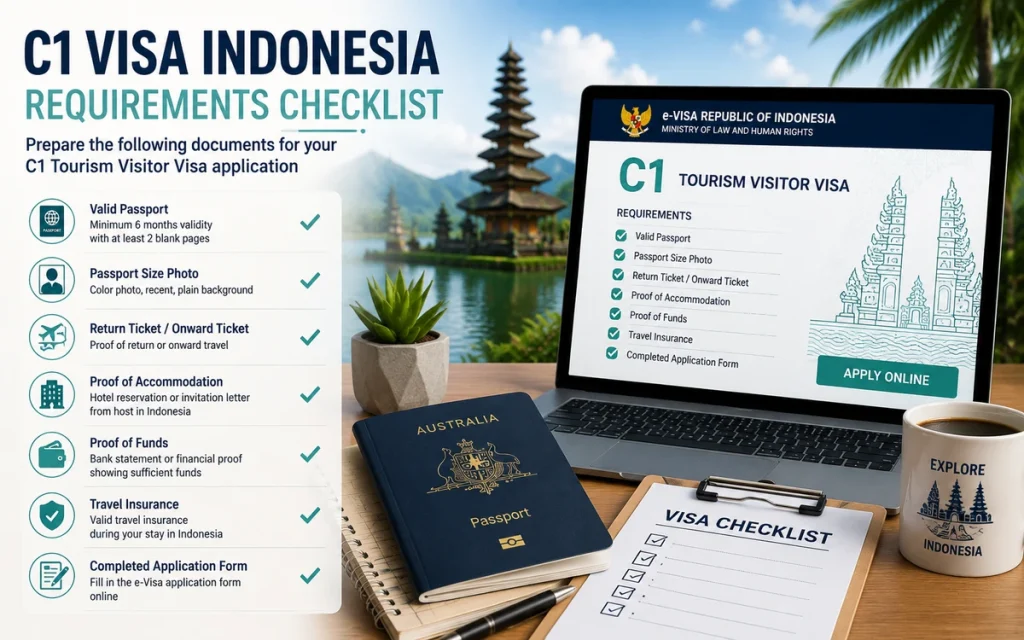
Before applying for a C1 Visa Indonesia, applicants should prepare the documents required by Indonesian Immigration. The exact requirements can depend on the applicant’s nationality, travel-document status, and application circumstances, so the official e-Visa system should be checked at the time of application.
C1 Visa Indonesia Requirements Checklist
Passport Requirements
Applicants must provide a valid travel document. For the current C1 application, Indonesian Immigration states that the passport should have at least 6 months of remaining validity before it expires.
Applicants using a travel document other than a national passport, or applicants who are stateless, may face additional requirements. These can include documentation relating to permission to return to the country where they currently reside. Check the requirements that apply to your specific status before submitting the application.
Financial / Proof of Funds Requirements
One of the key C1 Visa Indonesia requirements is proof of sufficient funds. The current Immigration information requires a bank statement covering the most recent 3 months showing funds of at least USD 2,000, or the equivalent amount in another currency, in the name of the foreign applicant or the sponsor.
Applicants should make sure the statement is clear, recent, and consistent with the information submitted in the visa application.
Photo Requirements
The C1 application requires a recent color passport-style photograph that meets the electronic file specifications set by the Indonesian Immigration system. Applicants should follow the format, size, background, and other technical specifications shown in the official application portal at the time of submission.
Sponsor or Guarantor Requirements
Sponsor or guarantor requirements can depend on the applicant’s nationality and travel-document status. Current Indonesian Immigration information is not identical across every official information page, so applicants should confirm whether a sponsor is required for their specific case before submitting the application.
Where a sponsor is required, the sponsor uses the official e-Visa system and submits the relevant application and supporting documents. Applicants should rely on the current requirements displayed in the official e-Visa system or confirmed by Indonesian Immigration for their individual circumstances.
Additional Documents Where Applicable
Additional documentation may be requested depending on the applicant’s nationality, travel document, or individual circumstances. This is particularly relevant for stateless applicants and holders of non-national travel documents.
Because immigration document specifications can be updated, applicants should use the requirements shown in the official e-Visa system when preparing the final submission rather than relying only on an older checklist.
Need Help With Your C1 Visa Documents?
Not sure whether your documents meet the C1 Visa requirements? AzraID can help you understand the required documents and the application requirements for your situation.
5. How Much Does a C1 Visa Indonesia Cost?
The current government fee for a C1 Visa Indonesia is IDR 1,000,000. Indonesian Immigration also lists verification costs for C1 at IDR 0. This is the official immigration fee (PNBP) and does not include any private agency or professional service fee that may be charged if an applicant uses an immigration service provider.
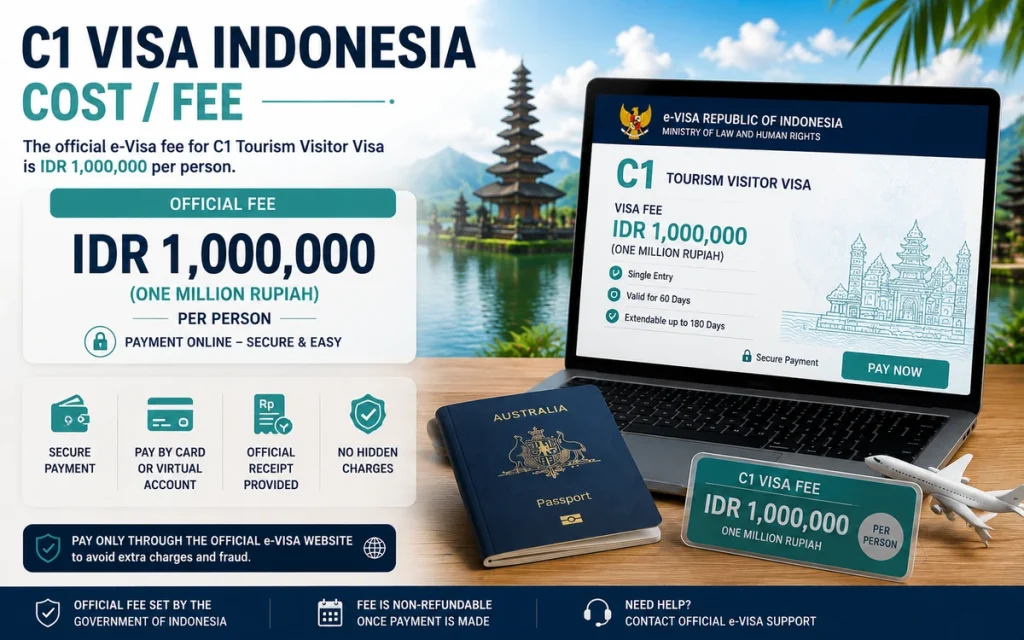
C1 Visa Indonesia Cost at a Glance
| Cost item | Amount | Notes |
| C1 Visa government fee (PNBP) | IDR 1,000,000 | Official C1 visa fee |
| Verification Fee I/II | IDR 0 | No additional verification fee listed for C1 |
| Agency / professional service fee | Varies | Only applies if you use a private visa or immigration service provider |
Is IDR 1,000,000 the Total Cost of a C1 Visa?
IDR 1,000,000 is the government visa fee listed for C1. It should not automatically be treated as the total amount an applicant will pay if the application is handled by an agency or other professional service provider. Private service fees are separate from Indonesian Immigration PNBP and vary by provider.
C1 Visa Extension Costs
The C1 visa fee and the cost of extending the resulting stay permit are separate matters. The C1 visa itself costs IDR 1,000,000, while any applicable extension-related immigration fee should be checked against the current PNBP tariff and the specific extension being requested.
Because immigration tariffs can be updated, applicants should confirm the amount shown in the official immigration system or current PNBP schedule when they are ready to apply or extend their stay.
C1 Visa Cost vs Private Service Fees
If you use a visa agency, the amount quoted by the provider may be higher than IDR 1,000,000 because it can include document preparation, application assistance, sponsor-related services where applicable, communication with the immigration system, and other professional services. Always ask the provider to separate official government fees from its own service charges.
Need Assistance With Your C1 Visa Application?
The Indonesian government visa fee is separate from professional immigration assistance. If you need help with your C1 Visa application, contact AzraID to discuss the process and requirements.
6. How to Apply for a C1 Visa Indonesia
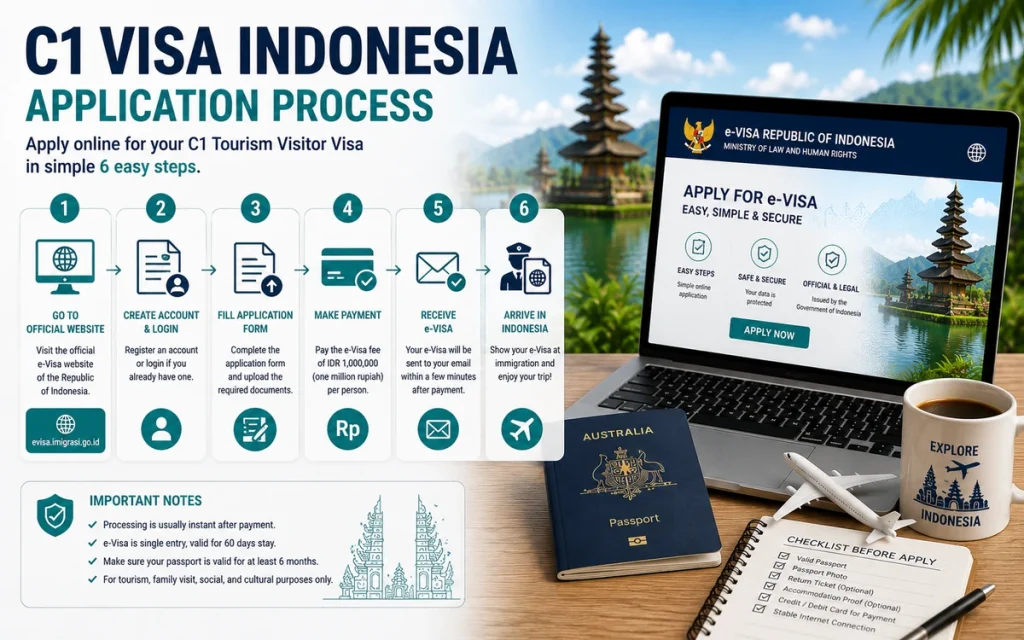
Step 1 — Prepare the Documents
Before starting the application, make sure your passport and supporting documents meet the current C1 requirements. This normally includes a passport with at least 6 months of remaining validity, a recent color photograph, and proof of sufficient funds through a bank statement covering the most recent 3 months with at least USD 2,000 or its equivalent.
If your circumstances require a sponsor or guarantor, that arrangement should be confirmed before the application is submitted. The exact sponsor requirement can depend on nationality and travel-document status, so applicants should follow the current requirements shown by Indonesian Immigration.
Step 2 — Submit the Application
The C1 Visa Indonesia application is submitted through the official Indonesian e-Visa system at evisa.imigrasi.go.id. The applicant or the eligible sponsor completes the online application and uploads the required electronic documents.
Where a sponsor is required, the sponsor must have a registered account in the e-Visa system and submit the application on behalf of the foreign national. The system is designed to allow documents to be reviewed digitally, reducing the need for applicants to submit a conventional paper application.
Step 3 — Verification and Payment
After the application and documents are submitted, Indonesian Immigration reviews the information and supporting files. If additional information or corrections are required, the application may be returned through the system so that the applicant or sponsor can make the necessary changes.
Once the application is ready for payment, the system generates the relevant billing information. The C1 government visa fee is currently IDR 1,000,000, while the published verification fee for C1 is IDR 0. Payment is made through the designated payment channels shown by the Indonesian immigration system.
Step 4 — Visa Issuance
After the required payment has been received and the application is approved, the C1 Visa is issued electronically. The approved e-Visa is sent to the email address registered in the application and can be used for the traveler’s entry into Indonesia.
The official Immigration information currently states that the processing time is four working days after the visa payment is received. This should be understood as the published processing framework rather than a guarantee that every application will be completed within exactly four working days, especially if documents require correction or additional verification.
Step 5 — Enter Indonesia
Once the C1 Visa has been issued, check the visa details carefully before traveling, including the passport number, name, visa type, validity period, and permitted stay. The C1 visa itself has a validity period that is different from the length of stay granted after arrival.
The current Immigration information states that a C1 Visa is valid for 90 days from the date of issuance for entry. The traveler must therefore use the visa within its validity period. After entering Indonesia, the initial stay is up to 60 days from the date of arrival, subject to the conditions of the visa and applicable immigration rules.
Travelers should keep a digital or printed copy of the issued e-Visa available during their journey. If the traveler plans to stay beyond the initial period, the extension process should be considered before the current stay permit expires.
7. C1 Visa Processing Time: How Long Does It Take?
Official Processing Framework
According to the current Indonesian Immigration information for the C1 Visa, the official processing time is four working days after the visa payment has been received. The application process includes checking the required documents, verifying the immigration fee payment, profiling and verification, approval, and visa issuance.
The four-working-day period should be understood from the point at which the required visa payment has been received, rather than from the moment an applicant first starts preparing the application. Submitting documents, correcting incomplete information, waiting for a payment instruction, or resolving an issue identified during verification can therefore affect the overall time from application start to visa issuance.
Why Processing Can Take Longer
Although four working days is the published processing time after payment, an application can take longer in practice when the documents or information require additional review. Incomplete documents, unclear scans, inconsistent personal information, payment issues, or requests for additional information can delay the application.
Applicants should also remember that the published timeframe is measured in working days. Weekends and Indonesian public holidays are not counted as working days, so the calendar period can be longer than four consecutive days.
Treat four working days as the published processing framework, not a guarantee of issuance immediately before a flight.
When Should You Apply Before Your Flight?
Apply well before departure rather than waiting until the last few days. Allow extra time for document preparation, payment, corrections, weekends, public holidays, and verification.
Also consider the e-Visa’s validity period when choosing when to apply.
As a practical rule, do not book a non-refundable international trip on the assumption that a C1 Visa will necessarily be issued on a particular day. If the application is still being processed as the departure date approaches, check the application status and follow the appropriate immigration or sponsor support channel rather than submitting duplicate applications without guidance.
8. C1 Visa Waiting Verification: What Does It Mean?
What “Waiting Verification” Means
“Waiting Verification” is a status applicants may see while their C1 Visa Indonesia application is being reviewed through the immigration system. In practical terms, the application has not yet reached final approval and issuance. The status should therefore not be interpreted as a visa approval, rejection, or a request to submit a new application.
Indonesian Immigration describes the C1 application process as including document checking, payment verification, applicant profiling and verification, approval, and visa issuance. This means an application can remain in a verification-related stage while Immigration is completing the checks required before a decision is made. The exact wording and display of application statuses can depend on the e-Visa system interface.
Applicants should also remember that the official C1 processing timeframe is four working days after the visa payment is received. Therefore, seeing a verification status shortly after submission or payment does not by itself mean that the application is delayed.
How Long Can Verification Take?
There is no separate official processing guarantee published specifically for a status called “Waiting Verification.” The relevant official timeframe for C1 is four working days after payment has been received. In practice, the total time can be longer if the application requires corrections, additional document review, payment clarification, or other verification.
Working days are also different from calendar days. Weekends and public holidays can extend the amount of calendar time an applicant waits even when the application remains within the official processing framework.
If the application has remained in a verification status beyond the published processing timeframe, the applicant or sponsor should check the application details and contact the appropriate immigration support channel for clarification. Avoid assuming that a long verification status automatically means the visa will be rejected.
What to Do If Your Application Is Still Pending
First, check the application status through the official e-Visa system and review the registered email address for any message requesting additional information or action. The Directorate General of Immigration provides an online application-tracking function so applicants can monitor the progress of their visa applications.
Next, check that the information submitted in the application is consistent with the passport and supporting documents. If a correction or additional document is requested, respond through the appropriate process as soon as possible.
If the application remains pending after the published processing period and there is no clear request or explanation in the system, the applicant or sponsor should contact Indonesian Immigration through the appropriate official support channel. For applications handled through a sponsor or professional visa provider, the sponsor or provider can also assist in checking the application and responding to any immigration request.
What If Your Flight Is Getting Close?
If your C1 Visa is still showing a verification status and your departure date is approaching, do not assume that the visa will be issued in time simply because the normal processing period has passed. Check the application immediately, confirm whether any action is required, and contact the appropriate immigration or sponsor support channel if the application is outside the published processing timeframe.
Travelers should also avoid relying on an unissued C1 Visa as if it were already valid for entry. The C1 Visa must be issued and used within its stated validity period before the traveler can rely on it for entry into Indonesia.
If you are considering another entry option because the C1 application is still pending, such as Visa on Arrival or e-VOA, check whether you are eligible for that option and understand that entering Indonesia under a different visa does not automatically activate a pending C1 Visa. The safest approach is to confirm the appropriate immigration route for your circumstances before traveling.
9. How Long Can You Stay in Indonesia With a C1 Visa?
Initial 60-Day Stay
A C1 Visa Indonesia provides an initial stay of up to 60 days, counted from the date the traveler enters Indonesia. This is the period granted as the initial stay permit for a C1 holder and is separate from the visa’s validity period for entering Indonesia.
For example, if a traveler enters Indonesia on June 10, the initial 60-day stay is calculated from that date rather than from the date the C1 Visa was issued. Travelers should always check the actual entry and stay information recorded by Indonesian Immigration after arrival.
Extending Up to 180 Days
The initial 60-day stay can be extended several times, with the total period of stay under the C1 visitor visa reaching up to 180 days. Indonesian Immigration states that extensions for the C1 stay permit can be handled online through the registered e-Visa account used by the sponsor.
The extension is not an automatic right simply because the traveler holds a C1 Visa. The application must meet the applicable immigration requirements and be submitted before the existing stay permit expires.
For travelers planning a longer stay, it is therefore important to monitor the expiry date of the current stay permit rather than waiting until the final days. The extension process can involve document submission, payment, verification, and approval, so planning ahead helps reduce the risk of an overstay.
Single Entry: What It Means
C1 is a single-entry visitor visa. This means the visa is intended for one entry into Indonesia. If a C1 holder leaves Indonesia after entering, the C1 stay associated with that entry does not provide a new entry when the traveler returns.
This distinction is important for travelers planning international trips during a long stay. Someone who intends to leave Indonesia and return multiple times should compare C1 with an appropriate multiple-entry visitor visa before traveling.
In short, C1 can provide up to 180 days of total stay through extensions, but that does not make it a multiple-entry visa. The traveler should separate two different questions: how long they want to remain in Indonesia and how many times they need to enter Indonesia.
10. Can You Extend a C1 Visa in Indonesia?
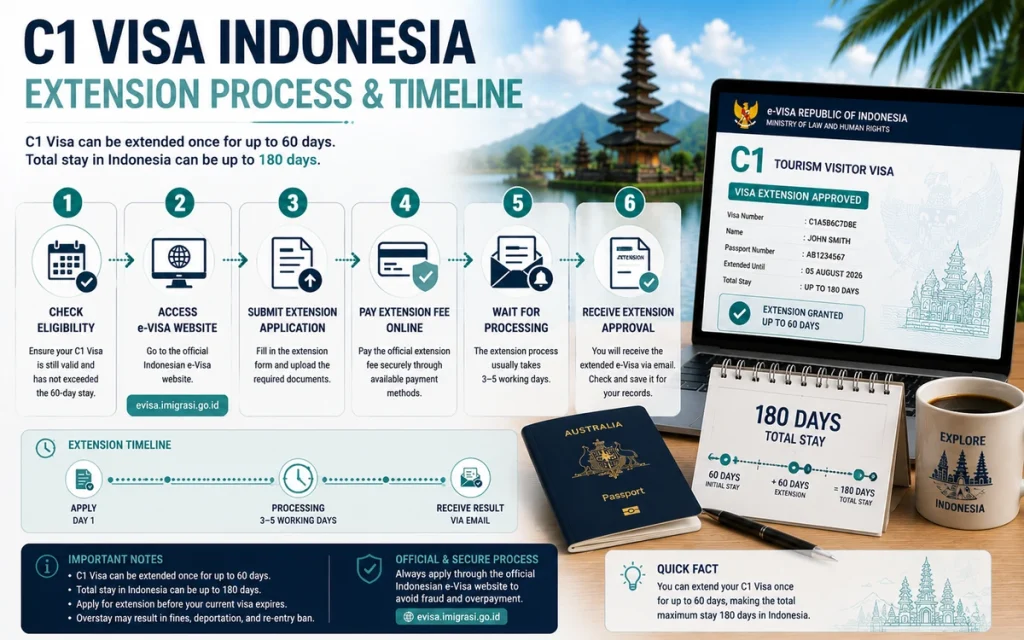
C1 Visa Extension Rules
Yes. A C1 Visa Indonesia can be extended while the holder is in Indonesia. The initial stay is up to 60 days from the date of arrival, and the stay permit can be extended several times until the total period of stay reaches a maximum of 180 days. Indonesian Immigration states that the extension can be submitted online through the sponsor’s registered account on the official e-Visa system.
The extension applies to the stay permit, not to the original C1 visa as a new entry visa. In other words, extending the C1 stay does not turn the single-entry C1 into a multiple-entry visa. If the traveler leaves Indonesia, the traveler should not assume that the same C1 can be used again to enter the country.
When to Start the Extension
Travelers should start planning the extension before the current stay permit expires. Waiting until the last day can create unnecessary risk because the extension process may require document review, payment, verification, and approval.
The exact submission window and operational requirements should be checked in the current e-Visa system or with the relevant immigration office because procedures can be updated. The important rule for travelers is simple: do not allow the existing stay permit to expire while waiting to decide whether an extension is needed.
If you know from the beginning that you intend to stay in Indonesia for longer than 60 days, it is better to plan the extension as part of your overall travel schedule rather than treating it as an emergency procedure near the expiry date.
Extension Process
For C1 holders, the extension process can be handled online through the sponsor’s registered e-Visa account. The sponsor submits the extension application and the required information and documents through the system.
The application is then subject to the applicable immigration verification and payment process. Once the extension is approved and the required immigration fees have been paid, the extended stay permit is issued according to the applicable rules.
Because immigration procedures and payment requirements can change, applicants should follow the instructions displayed in the official e-Visa system when submitting an extension. The traveler should also keep the confirmation and electronic immigration documents available for the remainder of the stay.
11. C1 Visa vs VOA vs e-VOA
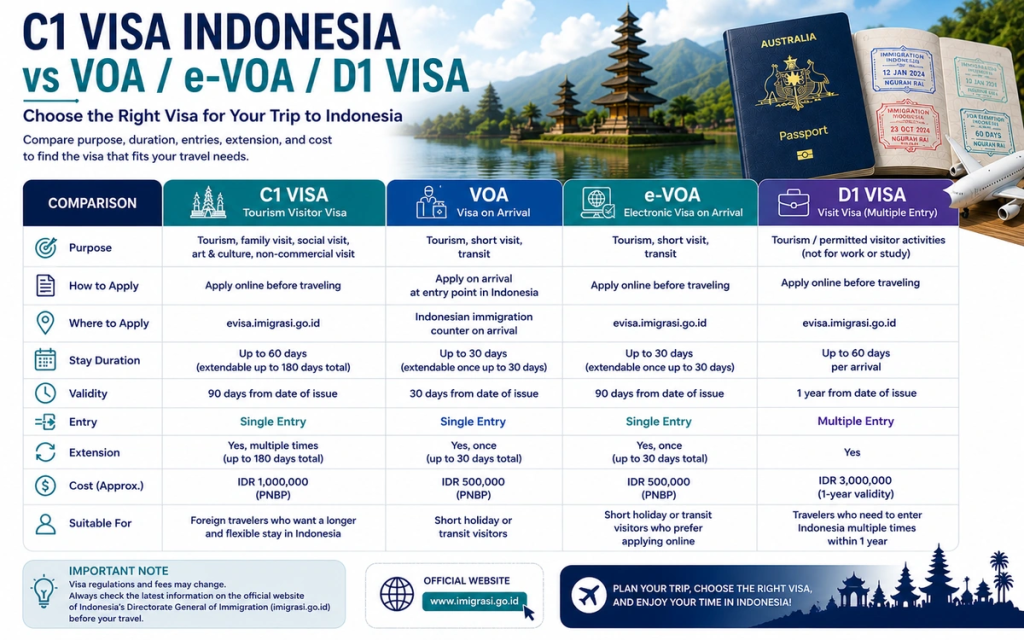
C1 vs VOA vs e-VOA at a Glance
C1, B1 VoA, and B1 e-VoA are all visitor options, but they differ in stay length, extension options, and application method. The table below summarizes the main differences.
| Feature | C1 Visa | B1 VOA | B1 e-VOA |
| Initial stay | Up to 60 days | Up to 30 days | Up to 30 days |
| Extension | Several times, up to 180 days total | Once, up to 60 days total | Once, up to 60 days total |
| Entry | Single entry | Single entry | Single entry |
| Sponsor | Sponsor required under current C1 application rules | No sponsor required | No sponsor required |
| Application | Pre-arranged through the official e-Visa system | At eligible arrival points or pre-arrival electronically | Online before arrival |
| Government visa fee | IDR 1,000,000 | IDR 500,000 | IDR 500,000 |
| Best suited to | Longer tourist stays and travelers planning ahead | Short tourist visits for eligible travelers | Short tourist visits arranged online before arrival |
C1 vs VOA
The C1 Visa Indonesia and B1 Visa on Arrival are both single-entry visitor options, but they are designed for different travel patterns. C1 provides an initial stay of up to 60 days and can be extended several times to a total of 180 days. B1 VoA provides an initial stay of up to 30 days and can be extended once to a total of 60 days.
C1 is therefore more relevant when a traveler expects a longer stay and wants to arrange the visa before traveling. B1 VoA can be more convenient for an eligible traveler who only needs a shorter visit and prefers the VoA route.
Another important difference is sponsorship. The current C1 information published by Jakarta Central Immigration states that a sponsor is required, while the current B1 VoA information states that no sponsor is required.
C1 vs e-VOA
B1 e-VoA is the electronic pre-arrival version of the Visa on Arrival route. It provides the same initial 30-day stay and can be extended once to a total of 60 days. The main convenience is that eligible travelers can arrange the VoA electronically before arriving in Indonesia.
C1 is different because it is a separate single-entry visitor visa with an initial stay of up to 60 days and a possible total stay of up to 180 days through extensions. C1 also follows its own application and sponsor requirements.
Which Option Is Better for Different Trip Lengths?
For trips of up to 30 days, eligible travelers may prefer B1 VoA or B1 e-VoA for simplicity, depending on whether they want to arrange the visa before departure.
For trips of more than 30 days but no more than 60 days, both C1 and B1 with its permitted extension may be relevant. C1 offers the longer initial stay, while B1 may suit travelers who prefer the VoA route.
For stays longer than 60 days, C1 is the most relevant of these three options because it can be extended up to 180 days, subject to eligibility and permitted activities.
If you are comparing C1 with other tourist visa options in Indonesia, see our guide to types of tourist visa in Indonesia for a broader overview of the available options and which visa may suit different travel plans.
12. C1 Visa vs D1 Visa Indonesia
C1 vs D1 at a Glance
The biggest difference between C1 and D1 is the number of entries. C1 is a single-entry visitor visa for tourism, while D1 is a multiple-entry visitor visa for tourism. The two categories should also be compared by visa validity and stay per entry: a longer D1 validity period does not mean that the holder can remain continuously in Indonesia for the entire validity period.
| Feature | C1 Visa | D1 Visa |
| Purpose | Tourism and other permitted visitor activities | Tourism and other permitted visitor activities |
| Entry | Single entry | Multiple entry |
| Visa validity | 90 days to enter | 1 year, 2 years, or 5 years |
| Stay per entry | Up to 60 days | Up to 60 days per arrival |
| Extension | Can be extended several times, up to 180 days total | Subject to the applicable D1 rules |
| Best suited to | One continuous stay in Indonesia | Travelers who need repeated entries |
| Government fee | IDR 1,000,000 | IDR 3,000,000 (1 year); IDR 5,000,000 (2 years); IDR 10,000,000 (5 years) |
C1 vs D1: What Is the Main Difference?
C1 is a single-entry visitor visa. A traveler can enter Indonesia once under the C1 visa and then remain for the permitted stay, subject to any approved extension. The current C1 information states that the initial stay is up to 60 days and can be extended several times up to a maximum total of 180 days.
D1 is a multiple-entry visitor visa. It is designed for travelers who need to enter Indonesia more than once during the visa’s validity period. The stay granted on each arrival is up to 60 days under the applicable D1 conditions.
The most important distinction is therefore not simply the number of years printed on the visa. D1 validity determines the period during which the multiple-entry visa can be used for entry, while the stay period determines how long the traveler may remain in Indonesia after each entry.
Which Visa Is Better for Your Travel Plans?
C1 is generally more suitable for a traveler who plans one entry and a longer continuous stay, especially when an extension may be needed.
D1 is generally more suitable for travelers who expect to leave Indonesia and return during the same broader travel period.
The choice depends on the itinerary: C1 for one entry and a potentially longer continuous stay; D1 when repeated entries are needed.
D1 Visa Validity and Government Fee
Current Indonesian immigration tariff information lists multiple-entry visitor visas with validity periods of 1 year, 2 years, and 5 years, among other options. The published government fees are IDR 3,000,000 for 1 year, IDR 5,000,000 for 2 years, and IDR 10,000,000 for 5 years.
These figures are government immigration tariffs and should not be confused with the stay permitted after each entry. A D1 visa with 2-year validity, for example, does not mean the holder can remain continuously in Indonesia for two years. The traveler remains subject to the applicable stay period for each entry.
The current published tariff also lists IDR 2,000,000 for a 2-year re-entry permit. That is a separate immigration charge and should not be presented as the D1 2-year visa fee.
13. Is C1 Visa the Same as the Former B211A Visa?
Understanding C1 and B211A
No. C1 should not simply be treated as a new name for B211A. B211A was used as a visitor visa index covering a range of permitted activities, while C1 is specifically identified under Indonesia’s current visa classification as the Tourism Visitor Visa.
B211A may still appear in older visa information and in official immigration information relating to certain visitor activities. For this reason, travelers should not assume that every activity previously associated with B211A has simply moved to C1.
For a standard tourism visit, C1 is the current Tourism Visitor Visa to consider. The correct visa should always be selected according to the traveler’s actual purpose and the activities they intend to undertake in Indonesia.
Why Do People Still Search for “B211A Tourist Visa Indonesia”?
B211A remains a common search term because it was widely used in older Indonesian visa information, travel websites, forums, and visa-service materials. As a result, travelers may still search for terms such as “B211A tourist visa Indonesia” even when looking for the current tourism visa.
If you are searching for a B211A tourist visa today, do not rely on older information alone. Instead, identify the current Indonesian visa category that matches your intended purpose of travel. For ordinary tourism, C1 is the current Tourism Visitor Visa.
This distinction is important because visa requirements, permitted activities, fees, sponsorship rules, application procedures, and stay conditions can change. Information written for the former B211A framework may therefore not accurately describe the current C1 requirements.
In short, B211A is still a useful historical search term, but C1 is the current tourism visa category that travelers should examine when planning a standard tourist visit to Indonesia.
14. C1 Visa for Bali
Can You Use a C1 Visa for Bali?
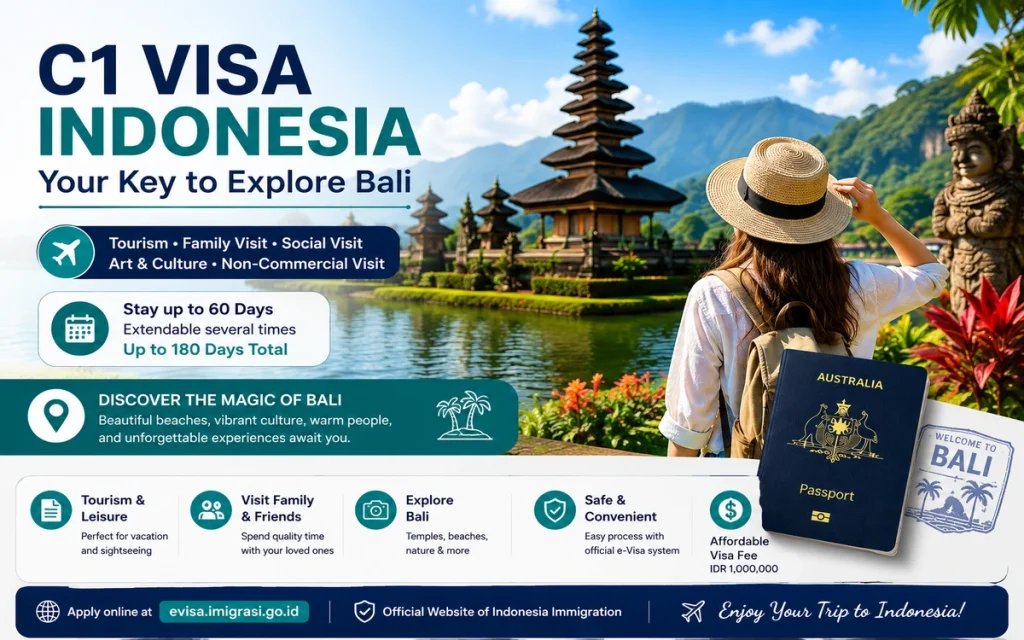
Yes. A C1 Visa Indonesia can be used to visit Bali because C1 is Indonesia’s Tourism Visitor Visa. The visa allows eligible foreign nationals to travel in Indonesia for tourism, including visiting tourist attractions and taking part in permitted tourism activities. Bali is therefore covered by the same C1 tourism rules that apply elsewhere in Indonesia.
The C1 Visa is not a special Bali visa. There is no separate “Bali C1 Visa” issued specifically for Bali. A traveler who obtains a valid C1 Visa for Indonesia can use it for a Bali itinerary as well as travel to other parts of the country, provided the traveler follows the conditions of the visa and Indonesian immigration rules.
C1 Visa Extension in Bali
If you are staying in Bali, you do not need to leave Indonesia simply because you want to extend an eligible C1 stay. The same C1 extension rules apply in Bali as elsewhere in Indonesia, and the extension is handled through the applicable immigration process.
For travelers who initially plan to spend 60 days in Bali but later decide to stay longer, the key point is to monitor the expiry date of the current stay permit and arrange any permitted extension before the stay expires. A C1 stay can be extended several times up to a total maximum of 180 days, subject to the applicable requirements.
Practical Tips for Travelers Staying in Bali
If you are planning a longer stay in Bali, decide early whether you are likely to need more than the initial 60 days and plan the extension before the current stay expires.
Keep your passport, e-Visa, stay information, and extension documents accessible, and track the exact expiry date of your stay permit rather than the visa issuance date.
C1 does not authorize employment or paid services in Indonesia. If your plans involve working or living in Indonesia for another purpose, assess the appropriate visa or stay permit before starting those activities.
Planning to Stay in Bali?
If you are planning to stay in Bali and are considering the C1 Tourist Visa, AzraID can help you understand the applicable requirements and visa application process.
15. C1 Visa Indonesia FAQ
Can I work in Indonesia with a C1 Visa?
A C1 Visa does not authorize employment in Indonesia. It is a visitor visa intended for tourism and other specifically permitted visitor activities. If your plans involve working, receiving remuneration for work, or providing paid services in Indonesia, you should apply for the visa or stay permit that legally covers that activity rather than using C1 as a substitute.
Can I enter Indonesia multiple times with a C1 Visa?
No. C1 is a single-entry visitor visa. Once you have used the visa to enter Indonesia, leaving the country does not give you another entry under the same C1 visa. If your itinerary requires repeated entries into Indonesia, a suitable multiple-entry visitor visa such as D1 should be considered.
Can I extend my C1 Visa?
Yes. The initial C1 stay is up to 60 days from arrival and can be extended several times up to a total maximum stay of 180 days. The extension concerns the stay permit and does not turn the C1 into a multiple-entry visa. Indonesian Immigration states that the extension can be submitted online through the sponsor’s registered e-Visa account.
Can I convert a C1 Visa to a KITAS?
Yes, Indonesian Immigration currently states that the C1 stay permit is eligible for conversion into a Temporary Stay Permit (ITAS/KITAS) with the same sponsor, subject to the applicable requirements and immigration category. However, conversion is not automatic simply because a person holds a C1 Visa. The applicant must qualify for the relevant ITAS basis and complete the required process.
What happens if my C1 Visa is still waiting verification?
“Waiting Verification” generally indicates that the application is still within the review process and has not yet reached final issuance. It should not automatically be interpreted as an approval or rejection. The official C1 processing timeframe is four working days after payment is received, but an application can take longer if documents require correction, additional review, or other verification. Check the e-Visa system and registered email for any request for action.
Is C1 better than VOA?
It depends on your trip. For a short visit, an eligible traveler may find B1 Visa on Arrival or e-VOA more convenient. C1 is more relevant when you want an initial stay of up to 60 days, need the visa arranged before departure, or expect to stay longer because C1 can be extended up to 180 days. Nationality, purpose of travel, and eligibility should also be considered before choosing.
How long can I stay in Indonesia with C1?
The initial C1 stay is up to 60 days from the date of arrival. With permitted extensions, the total stay can reach up to 180 days. The 180-day maximum does not mean that C1 is a multiple-entry visa; it remains a single-entry visitor visa.
Final Takeaway
For travelers planning a longer tourist stay in Indonesia, the C1 Visa can be a practical option because it provides an initial stay of up to 60 days and the possibility of extending the stay up to 180 days in total. It is a single-entry tourism visitor visa, so travelers should choose it based on both the length of their stay and whether they need to leave and re-enter Indonesia.
Before applying, check the latest Indonesian Immigration requirements, confirm that your intended activities are permitted under C1, prepare the required documents, and allow enough time for the application and any possible verification. If your travel plans involve work, multiple entries, long-term residence, or another regulated activity, a different Indonesian visa or stay permit may be more appropriate.
Need Assistance With Your C1 Visa Indonesia Application?
AzraID provides immigration assistance for foreigners applying for Indonesian visas. If you need help understanding the C1 Visa requirements, preparing your application, or navigating the application process, our team is here to assist you.