The E32D Repatriation Visa is an Indonesian immigration route designed for former Indonesian citizens who want to return to Indonesia and stay for an extended period. For eligible applicants, the visa provides a pathway to obtain an Indonesian limited stay permit and live in Indonesia for up to one year under the applicable immigration rules.
For former Indonesian citizens considering a return to Indonesia, understanding the E32D route is important because the visa has specific eligibility requirements, financial requirements, permitted activities, and immigration obligations. This guide explains the E32D Repatriation Visa in practical terms, including its requirements, cost, application process, financial commitment, and differences from other repatriation options. This article focuses specifically on the E32D Repatriation Visa and is intended for applicants who need a clear explanation of the current requirements and process.
1. What Is the E32D Repatriation Visa?
What Is E32D?
E32D is the official immigration classification for the 1-Year Repatriation Visa. It is intended for foreign nationals who were previously Indonesian citizens and now hold foreign citizenship, allowing them to return to Indonesia under a repatriation-based immigration route.
The E32D route is different from an ordinary tourist visa because it is structured for a longer stay and leads to an Indonesian limited stay permit (ITAS) under the applicable immigration procedure.
Who Is the E32D Visa For?
The E32D Repatriation Visa is intended primarily for former Indonesian citizens who wish to return to Indonesia and establish a temporary stay under the repatriation framework.
Applicants should be able to demonstrate their former Indonesian citizenship through appropriate supporting documents. The current official E32D requirements list documents such as an Indonesian KTP, birth certificate, Family Card (KK), Indonesian passport, diploma, or land certificate as examples of evidence.
Why Was the E32D Visa Created?
Indonesia’s repatriation visa classifications provide immigration pathways for former Indonesian citizens who wish to return to Indonesia without immediately seeking restoration of Indonesian citizenship.
The E32D route therefore serves a different purpose from Indonesian citizenship restoration. It is an immigration status for a foreign national, not a process for automatically becoming an Indonesian citizen again.
E32D Within Indonesia’s Repatriation Visa System
E32D is one of several repatriation-related visa classifications. Other classifications include E32C for a 2-year repatriation stay and E32A for a 5-year repatriation Golden Visa route, subject to their respective requirements.
Applicants who are considering a longer-term or permanent arrangement should also review the broader Indonesia Repatriation Visa options and the Indonesia Residency framework before selecting an immigration route.
2. Who Can Apply for an E32D Repatriation Visa?
Former Indonesian Citizens
The E32D route is intended for foreign nationals who were previously Indonesian citizens. The applicant must satisfy the applicable immigration requirements and provide evidence supporting the former Indonesian citizenship status.
Former Indonesian Citizens Who Now Hold Another Nationality
A person who previously held Indonesian citizenship and is now a citizen of another country may fall within the intended applicant group for E32D, provided that the person meets the current immigration requirements.
Holding a foreign passport does not by itself prove former Indonesian citizenship. Immigration may require supporting documentation showing the applicant’s previous status as an Indonesian citizen.
Proving Your Former Indonesian Citizenship
Examples of documents that may help establish former Indonesian citizenship include an Indonesian identity card (KTP), Indonesian birth certificate, Family Card (KK), previous Indonesian passport, Indonesian diploma, or other official documents that demonstrate a connection to Indonesian citizenship or civil registration.
Applicants should provide the strongest available evidence and ensure that names, dates, and other personal details are consistent across the documents. Where documents are unavailable or contain discrepancies, additional supporting evidence may be necessary.
When Another Immigration Route May Be More Appropriate
E32D is not necessarily the appropriate route for every former Indonesian citizen. Applicants seeking a longer stay, permanent residence, investment-based residence, family-based residence, or another specific purpose may need to consider a different immigration classification.
The broader Indonesia Residency guide provides an overview of Indonesian residence options and can help place the E32D route within the wider immigration system.
3. What Can You Do With an E32D Visa?
Living in Indonesia
The E32D route allows an eligible foreign national to stay in Indonesia under the corresponding limited stay permit for the permitted period. This makes it suitable for former Indonesian citizens who want to spend an extended period living in Indonesia rather than making repeated short visits.
Tourism and Visiting Family or Friends
The E32D classification also covers activities such as tourism and visiting family or friends, subject to the conditions attached to the stay permit and Indonesian immigration regulations.
Work-Related Activities
The official E32D classification includes work-related activities among the activities permitted under the applicable rules. However, this should not be interpreted as unrestricted permission to take any job or receive any form of remuneration in Indonesia.
Foreign nationals must comply with the conditions of their immigration status and any additional Indonesian requirements that apply to the particular work or activity.
Education and Other Permitted Activities
Education and other activities may also be permitted under the E32D classification, subject to the applicable regulations and conditions. Applicants planning to undertake a specific educational, professional, or commercial activity should verify whether additional permissions are required.
Activities That May Require Additional Immigration Permissions
Immigration status does not automatically authorize every activity in Indonesia. Activities involving employment, professional services, business operations, or other regulated activities may be subject to additional legal requirements.
Before starting a new activity, applicants should confirm that it is permitted under their stay permit and that any separate licensing, employment, or regulatory requirements have been satisfied.
4. How Long Can You Stay in Indonesia With E32D?
E32D’s 1-Year Stay Period
The E32D Repatriation Visa is classified as a 1-year repatriation visa. The corresponding stay permit allows the holder to remain in Indonesia for up to one year, subject to the applicable immigration rules.
Visa Validity vs Period of Stay
Visa validity and the period of stay are not the same thing. Under the current E32D process, the visa is valid for entry within 90 days from the date of issuance. Once the holder enters Indonesia, the applicable limited stay permit is issued according to the E32D procedure.
This distinction is important. The 90-day period concerns the window for entering Indonesia using the issued visa, while the stay permit determines how long the foreign national may remain in Indonesia.
Extension of E32D-Related Stay Permit
An E32D-related stay may be extendable through the applicable immigration process, subject to the rules in force at the time of application. Extension should be arranged before the current permitted stay expires.
Because immigration procedures and technical requirements can change, applicants should verify the current extension procedure through the official Indonesian immigration system before submitting an extension request.
Re-Entry and Leaving Indonesia
The E32D process includes a re-entry permit associated with the stay permit. This is important for applicants who need to leave Indonesia and return during their permitted stay.
Before travelling outside Indonesia, the holder should check that the relevant stay permit and re-entry permission remain valid and that there are no outstanding immigration obligations.
5. E32D Repatriation Visa Requirements

Valid Passport
Applicants generally need a passport with at least six months of remaining validity. The passport must be valid and suitable for international travel at the time of application and entry.
Proof of Financial Means
The E32D requirements include evidence of financial means. The applicant is required to provide a bank statement covering the previous three months showing at least US$2,000 or its equivalent, in the applicable applicant or guarantor’s name.
The financial evidence is intended to demonstrate that the applicant has sufficient funds for living expenses in Indonesia. Applicants should make sure the statement is recent and meets the format and account-name requirements requested in the current application system.
Proof of Former Indonesian Citizenship
Applicants should provide documentation demonstrating that they were previously Indonesian citizens. Depending on the applicant’s circumstances, acceptable supporting evidence may include an Indonesian KTP, birth certificate, Family Card (KK), previous Indonesian passport, diploma, land certificate, or another relevant official document.
Photograph and Supporting Documents
A recent color photograph is required as part of the application. Other supporting documents may include a curriculum vitae (CV), travel itinerary, and documents relevant to the applicant’s circumstances.
Other Documents Depending on the Applicant’s Circumstances
Additional documents may be requested depending on the applicant’s history, nationality, documentation, or intended activities in Indonesia. Applicants should follow the document checklist displayed in the official eVisa application system at the time of submission.
6. E32D Financial Requirements and the USD 10,000 Commitment

USD 2,000 Proof of Living Funds
The US$2,000 requirement is a proof-of-financial-means requirement. It is supported by a bank statement covering the previous three months and should not be confused with the separate US$10,000 financial commitment associated with the E32D route.
USD 10,000 Immigration Commitment
The E32D requirements also include a minimum US$10,000 financial commitment. This is separate from the official government visa and immigration fees.
Under the current requirements, the applicant must provide a commitment to complete, no later than 90 days after entering Indonesia, a qualifying financial placement of at least US$10,000, such as Indonesian government securities, shares in an Indonesian publicly listed company, mutual funds, or a deposit at a state-owned bank.
How the Commitment Is Fulfilled
The US$10,000 investment or deposit commitment is not the same thing as the government visa fee. The current E32D requirements also separately refer to maintaining an Immigration Guarantee of US$10,000. Applicants should therefore treat these as separate immigration requirements and follow the current eVisa instructions for the evidence and reporting required for each.
Because financial placement rules and reporting procedures can change, applicants should verify the current requirements through the official immigration system before making the placement.
When the Commitment Must Be Reported
The current E32D requirements state that the financial commitment must be completed no later than 90 days after the applicant enters Indonesia. Applicants should retain evidence of the qualifying placement and complete any required reporting or submission through the applicable immigration procedure.
Is the USD 10,000 an E32D Visa Fee?
No. The US$10,000 commitment should not be described as the E32D government visa fee. It is a separate financial requirement associated with the repatriation route.
The government fee for the E32D process is charged separately under Indonesia’s applicable non-tax state revenue (PNBP) regulations.
7. How Much Does the E32D Visa Cost?
Official E32D Government Fees
Based on the current Indonesian immigration fee structure, the official government charges for an E32D application and the associated stay permit and re-entry permit total IDR 6,000,000 for a stay of up to one year.
E32D Fee Breakdown
The current fee components are: Limited Stay Visa IDR 500,000; Category I Visa Verification IDR 1,000,000; ITAS for up to one year IDR 3,000,000; and Re-entry Permit for up to one year IDR 1,500,000.
These are government immigration charges. They should be distinguished from professional service fees, document preparation costs, translation or legalization costs where applicable, and other expenses that may arise from an individual application.
Government Fees vs Professional Service Fees
If an applicant uses an immigration consultant or other professional service provider, the total amount paid to that provider may be higher than the government PNBP because it can include professional assistance and administrative services.
Applicants should always request a clear breakdown showing which amount is paid to the Indonesian government and which amount represents professional service fees.
Other Possible Costs
Additional costs can depend on the applicant’s circumstances. Examples may include document translation, legalization or certification, courier services, travel expenses, banking costs, and other supporting-document expenses.
8. How to Apply for an E32D Repatriation Visa
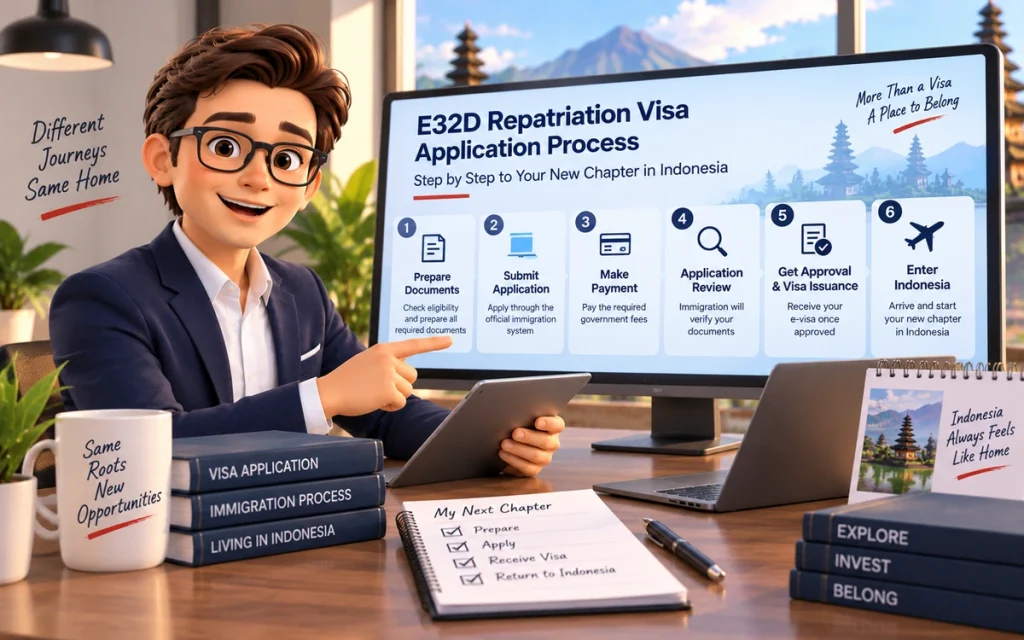
Prepare Your Documents
Start by preparing the passport, proof of former Indonesian citizenship, three-month bank statement showing the required financial means, photograph, CV, itinerary, and other supporting documents required by the current immigration system.
Submit the Application
The E32D application is submitted through Indonesia’s official eVisa immigration system. Applicants should enter their information carefully and upload documents in the required format.
Immigration Verification
The application goes through an immigration verification process. Immigration checks the applicant’s profile and supporting documentation before the application can proceed.
Payment and Processing
After the required payment is made and received, the application proceeds through the applicable verification and approval stages. The current official information states a processing period of five working days after payment is received.
Visa Issuance
Once approved, the E32D visa is issued electronically. The visa should be reviewed carefully to confirm the applicant’s details, visa classification, and validity information before travelling.
Entering Indonesia
The E32D visa must be used for entry within its applicable validity period. Under the current process, the visa is valid for entry for 90 days from issuance.
Receiving the Stay Permit
After entering Indonesia, the applicable ITAS and re-entry permit are issued automatically under the current E32D procedure. The holder should retain the electronic immigration documents and ensure that all information is correct.
9. Can E32D Visa Holders Work or Study in Indonesia?
Working in Indonesia
The E32D classification includes work-related activities, but the permission is subject to the conditions of the immigration status and Indonesian law.
An E32D holder should not assume that the visa provides unrestricted employment rights. Work must remain consistent with the activities permitted under the relevant immigration status, and any separate employment or professional requirements must also be satisfied.
Studying in Indonesia
Education is among the activities covered by the E32D classification, subject to applicable requirements. If an applicant intends to enroll in a formal educational program, the institution and the immigration authority should be consulted to confirm whether the proposed study is permitted under the holder’s status.
Double Activities and Additional Permissions
A foreign national may have more than one activity in Indonesia, but the activities must comply with the conditions attached to the immigration status and any other applicable Indonesian regulations.
Where a proposed activity falls under another regulated category, the applicant may need additional permission, licensing, or a different immigration route.
Restrictions on Employment and Compensation
E32D holders must comply with Indonesian immigration restrictions. This includes avoiding work or activities that are inconsistent with the permitted stay, prohibited sales activities, and prohibited receipt of remuneration, wages, or compensation from Indonesian individuals or companies where such payment is not permitted under the applicable rules.
10. E32D vs E32C vs E32A: Understanding the Key Differences
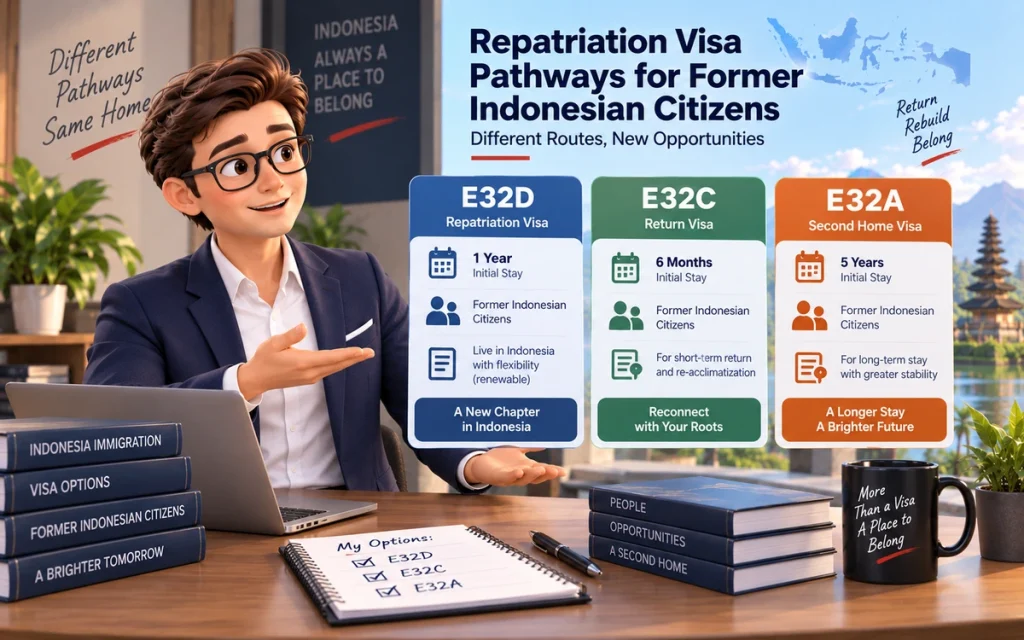
E32D — 1-Year Repatriation Visa
E32D is the 1-year repatriation route. It is intended for eligible former Indonesian citizens who want to return to Indonesia under a limited-stay repatriation framework.
E32C — 2-Year Repatriation Visa
E32C provides a longer repatriation stay period of up to two years, subject to its own eligibility, financial, documentary, and immigration requirements.
E32A — 5-Year Repatriation Visa Golden Visa
E32A is the 5-year repatriation Golden Visa route. It has different requirements from E32D, including a higher financial commitment under the applicable rules.
The E32A route should therefore not be treated simply as a longer version of E32D. Applicants should review the specific E32A requirements before deciding whether that route is appropriate.
How to Determine Which Route Fits Your Circumstances
The appropriate repatriation route depends on factors such as the intended length of stay, financial capacity, intended activities, and long-term residency plans.
Applicants who need a one-year route may consider E32D, while those seeking a longer repatriation arrangement may need to examine E32C, E32A, or other available immigration classifications.
11. E32D vs Other Options for Former Indonesian Citizens
E32D vs Permanent Resident Repatriation Options
E32D is a limited-stay route and should not be confused with permanent residence. Former Indonesian citizens seeking a permanent residency arrangement may need to examine the immigration classifications specifically designed for permanent or longer-term residence.
E32D vs GCI
Global Citizen of Indonesia (GCI) is a separate immigration concept for eligible former Indonesian citizens and other qualifying persons. It should be assessed separately from the E32D temporary repatriation route.
If you are considering the GCI route, review the existing Global Citizen of Indonesia guide for a more detailed explanation of its requirements and immigration implications.
E32D vs KITAP
KITAP, or Indonesia’s Permanent Stay Permit, is a different immigration status from E32D. KITAP provides permanent-stay status under the applicable Indonesian immigration rules and is not automatically granted simply because a person holds an E32D visa.
Applicants who are considering permanent residence should review the Indonesia KITAP guide to understand the available routes and eligibility requirements.
When a Different Residency Route May Be Relevant
A different route may be relevant when the applicant’s primary objective is permanent residence, family-based residence, investment, retirement, employment, or another specific purpose.
The right immigration route depends on the applicant’s individual circumstances and the requirements in force at the time of application.
12. Frequently Asked Questions About E32D Repatriation Visa
Is E32D specifically for former Indonesian citizens?
Yes. E32D is a repatriation visa classification intended for eligible former Indonesian citizens returning to Indonesia as foreign nationals.
How long can I stay in Indonesia with E32D?
The E32D route provides a stay period of up to one year under the corresponding limited stay permit, subject to the applicable immigration rules.
How much does E32D cost?
The current official government charges for the E32D process and associated one-year ITAS and re-entry permit total IDR 6,000,000. Professional service fees and other personal expenses are separate.
Do I need a sponsor for E32D?
The official E32D page currently states that a sponsor is not required. However, the same page also contains application instructions referring to a sponsor account and sponsor-related documentation. Because the two sections are inconsistent, applicants should verify the current eVisa application requirements for their specific case before submission.
Do I need to show USD 2,000?
Yes. The current requirements include a bank statement covering the previous three months showing at least US$2,000 or its equivalent, subject to the applicable account-name and documentation requirements.
What is the USD 10,000 commitment?
It is a separate financial commitment associated with the E32D route. The current requirements state that it must be completed no later than 90 days after entry through a qualifying financial placement, such as Indonesian government securities, listed Indonesian shares, mutual funds, or a state-owned Indonesian bank deposit, subject to the applicable rules.
Can I extend my E32D stay?
An E32D-related stay may be extendable under the applicable immigration rules. The extension should be arranged before the current permitted stay expires, and the current procedure should be confirmed through the official immigration system.
Can I leave and re-enter Indonesia?
The E32D process includes a re-entry permit associated with the stay permit. Before leaving Indonesia, the holder should confirm that the stay permit and re-entry permission are valid.
Can I work in Indonesia with E32D?
Work-related activities are included in the E32D classification, but this does not mean unrestricted employment. The activity must comply with the conditions of the immigration status and any other Indonesian employment or regulatory requirements.
What documents prove that I was formerly an Indonesian citizen?
Potential evidence includes an Indonesian KTP, birth certificate, Family Card (KK), previous Indonesian passport, diploma, land certificate, or other official documentation showing the applicant’s former Indonesian citizenship or relevant Indonesian civil status.
Can E32D lead to permanent residence?
E32D itself is a limited-stay route and does not automatically grant permanent residence. A person seeking permanent residence must satisfy the requirements of the relevant permanent-stay route.
What is the difference between E32D and E32C?
E32D is the 1-year repatriation route, while E32C is the 2-year repatriation route. Each classification has its own requirements and conditions.
13. Final Checklist Before Applying for E32D
Eligibility
Confirm that you fall within the intended former Indonesian citizen category and can provide evidence of your previous Indonesian citizenship.
Passport
Make sure your passport has at least six months of remaining validity and that your personal information is accurate.
Former Indonesian Citizenship Evidence
Prepare the strongest available documents proving your former Indonesian citizenship, such as a previous Indonesian passport, KTP, birth certificate, KK, diploma, or other relevant official records.
Financial Documents
Prepare a three-month bank statement demonstrating at least US$2,000 or the equivalent, in accordance with the current application requirements.
USD 10,000 Commitment Preparation
Understand the separate US$10,000 financial commitment and prepare to complete the qualifying financial placement within the required period after entering Indonesia.
Application Documents
Prepare the photograph, CV, travel itinerary, and any other supporting documents requested by the official eVisa system.
Immigration Compliance
After approval and entry into Indonesia, keep track of your stay permit validity, re-entry permission, extension deadlines, and any reporting or financial-commitment obligations.
For former Indonesian citizens planning to return to Indonesia, the E32D Repatriation Visa can provide a structured one-year immigration route. However, the correct application depends on your former citizenship records, financial documentation, intended activities, and long-term plans.
If you are unsure whether E32D is suitable for your circumstances or need assistance reviewing your documents before applying, contact the Azra Solutions immigration team for professional guidance.
Legal Basis and Official Immigration Sources
The E32D Repatriation Visa is governed by Indonesia’s immigration and non-tax state revenue regulations. The current official immigration information refers, among other instruments, to Government Regulation No. 45 of 2024 on Non-Tax State Revenue, Minister of Law and Human Rights Regulation No. 22 of 2023 as amended, Minister of Law and Human Rights Regulation No. 11 of 2024, and Minister of Immigration and Corrections Decree No. M.IP-08.GR.01.01 of 2025 concerning visa classifications.
Applicants should always verify the latest requirements, fees, documents, and application procedures through the official Directorate General of Immigration website and eVisa system before submitting an application.