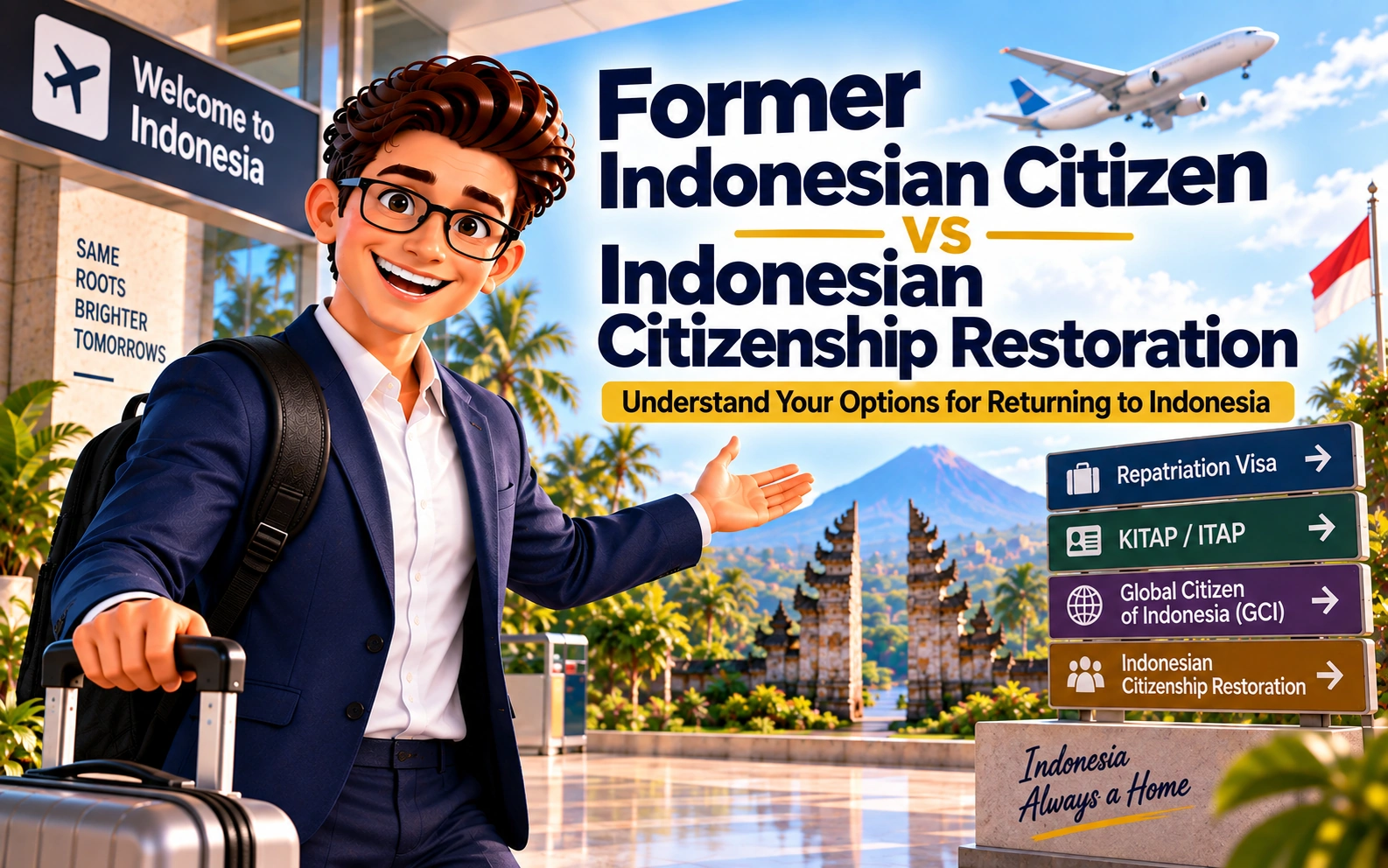
The E32C Repatriation Visa is an Indonesian limited stay visa designed for former Indonesian citizens who want to return to Indonesia and reside in the country for up to two years.
For former Indonesian citizens, the E32C route provides a specific repatriation pathway that allows them to return to Indonesia as foreign nationals while maintaining their current foreign citizenship. The visa provides a limited stay status rather than Indonesian citizenship or permanent residence.
Understanding the E32C Repatriation Visa involves more than knowing its two-year stay period. Applicants should understand who qualifies, which documents can prove their previous Indonesian citizenship, the financial requirements, the sponsor requirement, government fees, visa validity, the application process, permitted activities, extension rules, and available long-term immigration options.
This guide explains the E32C Repatriation Visa based on Indonesian Immigration information applicable in 2026.
1. What Is the E32C Repatriation Visa?
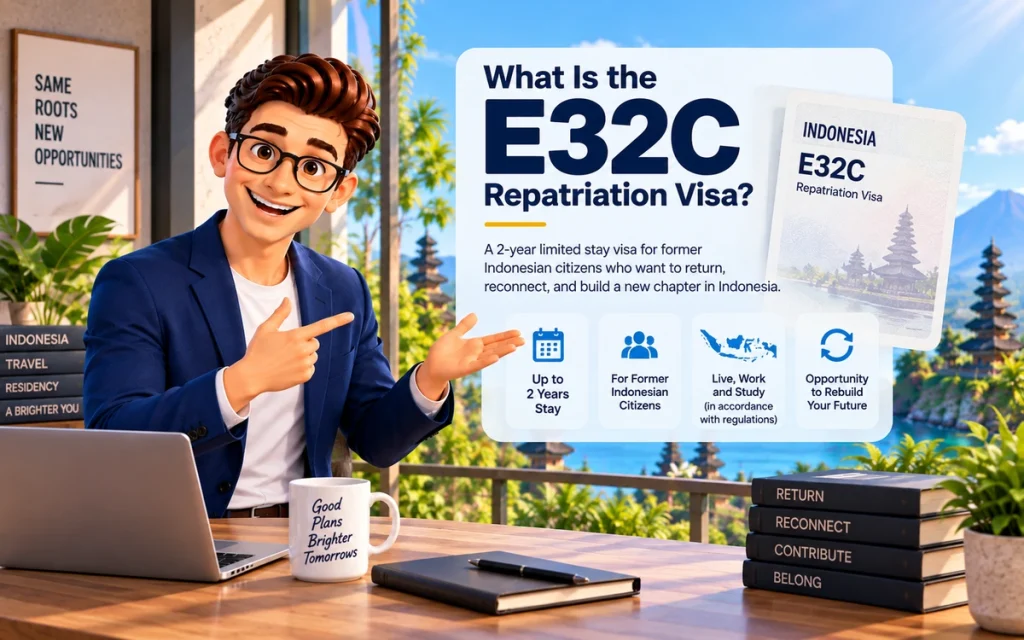
E32C as a Limited Stay Repatriation Visa
E32C is a Visa Tinggal Terbatas, or Limited Stay Visa, that allows an eligible former Indonesian citizen to enter Indonesia and stay for a maximum period of two years under the applicable immigration rules.
The stay permit associated with the visa can be extended and may also be transferred to another type of stay permit where the applicable requirements are met.
An important point is that the E32C Visa and the ITAS are not exactly the same thing. The visa is used for entry into Indonesia, while the limited stay permit governs the holder’s authorized residence.
Who the E32C Visa Is Designed For
The E32C route is designed specifically for former Indonesian citizens who are now foreign nationals.
This means that the applicant must have previously held Indonesian citizenship. Simply having Indonesian ancestry or an Indonesian parent does not necessarily mean that a person is a former Indonesian citizen.
People who have Indonesian ancestry but never held Indonesian citizenship may need to consider another immigration category, such as an applicable descendant route.
2. Who Can Apply for the E32C Visa?
Former Indonesian Citizenship Requirement
The applicant must be able to establish that they were previously an Indonesian citizen.
This is an important distinction because Indonesia has different immigration categories for former citizens, descendants of Indonesians, family members, investors, and other foreign nationals with connections to Indonesia.
Proving Previous Indonesian Citizenship
Indonesian Immigration specifically lists several documents that may be used to demonstrate that the applicant was an Indonesian citizen.
These include:
- Indonesian Identity Card (KTP)
- Indonesian birth certificate
- Family Card (KK)
- Indonesian passport
- Indonesian diploma or education certificate
- Certificate of land rights issued by the Indonesian government
Applicants should provide genuine and consistent documentation and should make sure that their identity information is consistent across the documents submitted.
If an applicant has more than one historical Indonesian document, keeping these documents together can help establish a clear record of previous Indonesian citizenship.
When Another Immigration Category May Apply
Not every foreign national with an Indonesian family connection should apply for E32C.
For example, a person who has Indonesian parents or grandparents but never held Indonesian citizenship may be considered under a descendant-related visa rather than a repatriation visa for former WNI.
Similarly, former Indonesian citizens seeking permanent residence may wish to examine the Global Citizen of Indonesia framework and the applicable E32E route.
3. E32C Repatriation Visa Requirements
Passport Requirement
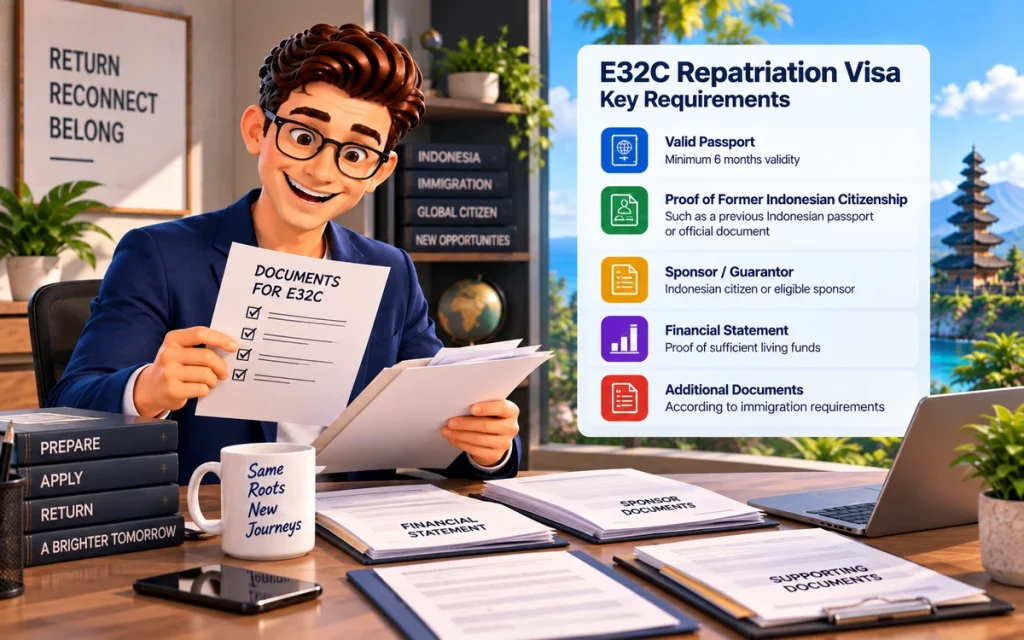
Applicants must hold a valid national passport.
The current official E32C requirements specify that the passport must remain valid for at least six months before its expiration.
Applicants should therefore check their passport validity before beginning the application process.
Proof of Former Indonesian Citizenship
Applicants must provide documentation demonstrating their previous Indonesian citizenship.
The official E32C requirements identify documents such as KTP, Indonesian birth certificate, KK, Indonesian passport, Indonesian diploma or education certificate, and Indonesian government-issued land rights certificate.
Financial Requirement
Applicants must demonstrate that they have sufficient funds to support themselves and, where applicable, their family while in Indonesia.
The E32C requirements specify a minimum amount of USD 2,000 or its equivalent. The financial evidence may be provided through a bank statement, savings account, or deposit covering the previous three months and may be held by the applicant or the guarantor, subject to the applicable requirements.
Sponsor or Guarantor Requirement
The E32C application requires a sponsor or guarantor.
The official Immigration E32C page states that the guarantor must have an account on the electronic visa system before submitting the visa application for the foreign national.
The guarantor is responsible for submitting the relevant application and supporting electronic documents through the official system.
Additional Application Information
The E32C application may also require information such as:
- Recent color photograph
- Curriculum vitae
- Travel history or itinerary
- Guarantee documentation
- Other information requested by the Immigration system
Applicants should make sure that all information submitted is accurate and consistent.
4. Documents Required for an E32C Visa
Personal and Passport Documents
Applicants should prepare:
- Valid national passport
- Recent color photograph
- Personal information required by the electronic visa system
- Curriculum vitae
- Travel history or itinerary where required
The passport should meet the validity requirement applicable to the E32C application.
Proof of Former Indonesian Citizenship
The applicant should prepare available Indonesian records that demonstrate previous citizenship.
Examples include KTP, KK, Indonesian birth certificate, Indonesian passport, Indonesian diploma, and applicable Indonesian land rights certificate.
Applicants do not necessarily need every historical document listed above. The documents required will depend on the applicant’s individual circumstances and the Immigration requirements applicable to the application.
Financial Documents
Financial evidence should demonstrate the required minimum funds and the required three-month account history.
Sponsor or Guarantor Documents
The guarantor must prepare the applicable guarantee documentation and maintain the necessary account for the electronic application.
5. How Much Does the E32C Repatriation Visa Cost?
Official Government Fees
The E32C Visa cost currently published by Indonesian Immigration for a two-year stay is IDR 8,500,000.
| Government Fee Component | Amount |
| Limited Stay Visa | IDR 500,000 |
| Category I Visa Verification Fee | IDR 1,000,000 |
| Limited Stay Permit for up to 2 years | IDR 5,000,000 |
| Re-entry Permit for up to 2 years | IDR 2,000,000 |
| Total | IDR 8,500,000 |
The IDR 8.5 million amount represents the government immigration fees currently published for the E32C two-year route.
Government Fees vs. Professional Service Fees
The government fee should not be confused with a professional immigration service fee. If an applicant uses an immigration consultant or other professional service provider, the total cost may be higher because professional assistance is separate from government immigration charges.
6. How Long Can You Stay in Indonesia With an E32C Visa?
Initial Two-Year Stay
The E32C route allows a maximum stay of up to two years, subject to the applicable immigration requirements.
E32C and ITAS
The E32C is a limited stay visa, while the residence status obtained through the route is an ITAS.
For eligible E32C applicants, the electronic ITAS and Re-entry Permit are issued automatically when the applicant arrives in Indonesia and is permitted to enter by the immigration officer at the immigration checkpoint.
7. E32C Visa Validity vs. Stay Period
Visa Validity
The E32C visa is valid for 90 days from the date it is issued. If the visa is not used within that period, the applicant must apply for a new visa before entering Indonesia.
ITAS Stay Period
The visa provides the basis for entry, while the associated limited stay permit governs the authorized period of residence in Indonesia. Under E32C, the maximum stay period is up to two years.
Why the Difference Matters
A two-year E32C does not mean that the applicant has two years to enter Indonesia after the visa is issued. The visa must be used within its 90-day validity period. Once the applicant enters Indonesia and is admitted, the applicable stay permit governs the period of authorized residence.
8. What Is E32C Intended For?
Returning to Indonesia as a Former Indonesian Citizen
The main purpose of E32C is repatriation. It allows a former Indonesian citizen who is now a foreign national to return to Indonesia and reside there under the applicable immigration conditions.
Residence and Personal Activities
E32C permits the holder to reside in Indonesia and undertake activities permitted under the visa and applicable Indonesian regulations.
Activities That Must Follow the Applicable Rules
The E32C route does not mean that every activity in Indonesia is unrestricted. The holder must comply with the conditions of the immigration status and Indonesian laws.
For any employment, professional activity, business activity, or regulated service, applicants should confirm the applicable requirements before beginning the activity.
9. Can E32C Visa Holders Work or Study in Indonesia?
Employment
The official E32C information allows activities related to employment provided that the applicable Indonesian rules are followed. This does not mean that an E32C holder can perform any type of work without restrictions.
Anyone planning to work in Indonesia should confirm that the intended employment activity complies with the conditions attached to the E32C route and any other applicable Indonesian requirements.
Business Activities
Business activities should be assessed separately from employment. Owning or managing an investment, participating in a business, providing services, or working for an Indonesian company can involve different legal and immigration considerations.
Education and Study
The official E32C description also allows education-related activities while complying with applicable regulations. Specific education and institutional requirements may still apply.
10. How to Apply for the E32C Repatriation Visa
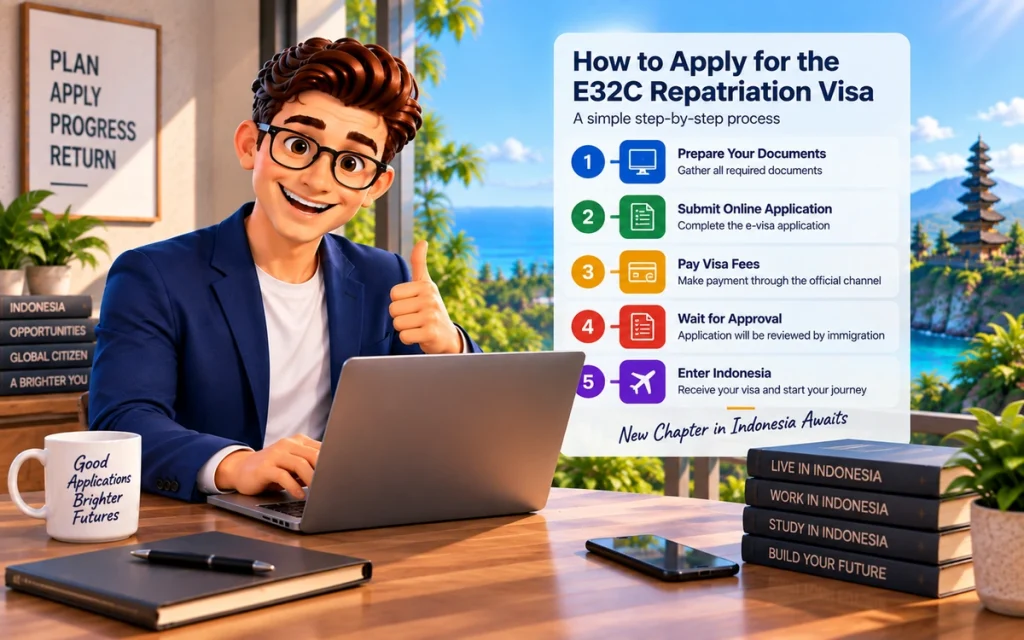
Step 1: Confirm Eligibility
First, confirm that the applicant is a former Indonesian citizen and that E32C corresponds to the intended residence plan.
Step 2: Prepare the Documents
Prepare the required electronic documents, including passport, proof of former Indonesian citizenship, financial evidence, photograph, sponsor or guarantor documentation, curriculum vitae, travel history or itinerary, and other documents requested by Immigration.
Step 3: Prepare the Sponsor or Guarantor
The sponsor or guarantor must have an account on the official evisa.imigrasi.go.id system and submit the application on behalf of the foreign national.
Step 4: Submit the Application
The guarantor logs into the electronic visa system and submits the application and required electronic documents.
Step 5: Immigration Verification
The application process includes checking completeness, payment verification, profiling and verification, approval, and visa issuance.
Step 6: Visa Issuance
Once approved and payment has been received, the E32C visa is issued electronically.
Step 7: Enter Indonesia
The applicant must use the E32C visa within its validity period. After entering Indonesia and being admitted, the applicable electronic ITAS and Re-entry Permit are issued automatically under the official procedure.
11. E32C Visa Processing Time
Official Processing Time
The current official Immigration page states that the E32C visa process takes five working days after the visa payment has been received, provided the application meets the applicable requirements.
Factors That Can Affect Processing
Applicants should make sure that all required documents are complete, the information submitted is accurate, payment is properly received, the sponsor has completed the required steps, and any additional request from Immigration is answered promptly.
12. Can the E32C Repatriation Visa Be Extended?
E32C Extension Framework
The official E32C information states that the stay permit can be extended online through evisa.imigrasi.go.id. Current Indonesian Immigration guidance provides an extension framework for ITAS, with the overall applicable ITAS period not exceeding six years.
An extension is not an automatic entitlement to the maximum duration.
When to Prepare an Extension
For an ITAS valid for more than one year, Indonesian Immigration guidance states that an extension application may be submitted as early as three months before the ITAS expires and no later than the applicable deadline before expiry.
Can E32C Be Converted to Another Stay Permit?
The official E32C page states that the stay permit obtained from this visa can be transferred to another type of stay permit where the applicable requirements are met. This is not an automatic conversion.
13. Can You Leave and Re-Enter Indonesia With E32C?
Re-Entry Permit
The current E32C government fee structure includes a Re-entry Permit valid for up to two years.
Travelling Outside Indonesia During E32C
Before travelling outside Indonesia, an E32C holder should check passport validity, ITAS validity, Re-entry Permit validity, and any current immigration requirements applicable to the trip.
14. E32C vs E32D Repatriation Visa
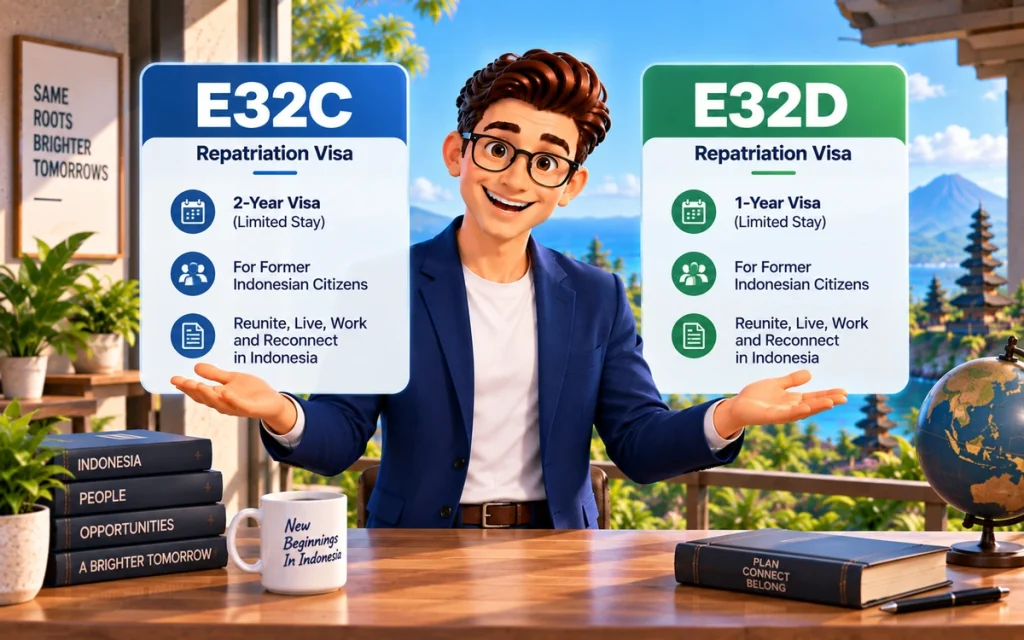
E32C: Two-Year Repatriation Route
E32C allows a former Indonesian citizen to stay in Indonesia for up to two years under the applicable limited stay framework.
E32D: One-Year Repatriation Route
E32D is the one-year repatriation route for former Indonesian citizens.
Key Differences
| Feature | E32C | E32D |
| Target applicant | Former Indonesian citizens | Former Indonesian citizens |
| Maximum initial stay | Up to 2 years | Up to 1 year |
| Immigration status | Limited Stay / ITAS | Limited Stay / ITAS |
| Repatriation route | Yes | Yes |
| Extension | Subject to applicable rules | Subject to applicable rules |
15. E32C vs E32A: 2-Year vs. 5-Year Repatriation Visa
E32C Two-Year Route
E32C provides a maximum initial stay of up to two years.
E32A Five-Year Route
E32A is the five-year repatriation Golden Visa route for former Indonesian citizens. It has different requirements and financial conditions from E32C.
Key Differences
| Feature | E32C | E32A |
| Applicant | Former Indonesian citizens | Former Indonesian citizens |
| Maximum initial stay | Up to 2 years | Up to 5 years |
| Category | Repatriation | Repatriation Golden Visa |
| Financial requirements | Minimum USD 2,000 evidence under E32C requirements | Separate Golden Visa financial requirements |
| Overall framework | Subject to applicable ITAS rules | Subject to Golden Visa rules |
16. E32C vs GCI / E32E Permanent Residence
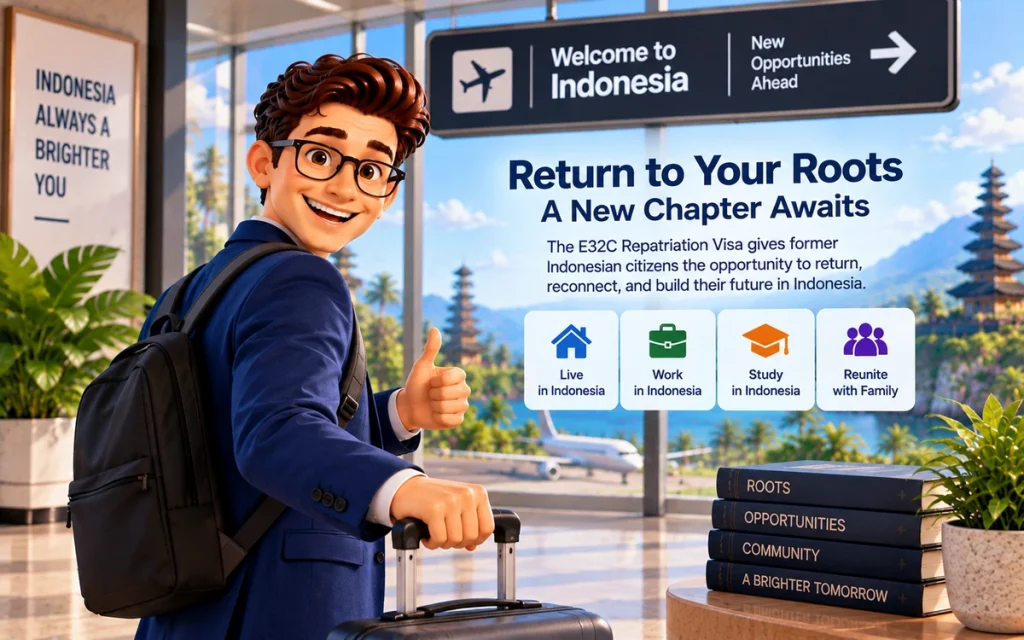
What Is E32E Under GCI?
E32E is the permanent resident repatriation route under the Global Citizen of Indonesia framework.
The GCI framework provides an immigration pathway that allows eligible foreign nationals to obtain permanent residence in Indonesia while retaining their existing foreign citizenship, subject to the applicable requirements.
Temporary Residence vs. Permanent Residence
E32C is a limited-stay repatriation route with an initial stay of up to two years. E32E under GCI is a permanent-residence route with its own eligibility requirements.
Holding E32C does not automatically mean that the holder qualifies for E32E or permanent residence.
E32C and Long-Term Repatriation Planning
Former Indonesian citizens planning to return to Indonesia for many years should consider their longer-term immigration position before their current ITAS approaches expiry.
Depending on the applicant’s circumstances, options may include extending an existing E32C ITAS, transferring to another eligible stay permit, applying under a family-based route, applying under another qualifying residence category, or considering the GCI permanent-residence framework where eligible.
17. What Happens After an E32C Stay Permit?
Extending the E32C ITAS
Where the applicant continues to meet the requirements, the E32C stay permit may be extended through the applicable immigration process.
Moving to Another Eligible Immigration Status
The official E32C information states that the stay permit may be transferred to another type of stay permit where the applicable requirements are fulfilled.
Long-Term Residence Options
Former Indonesian citizens who intend to make Indonesia their long-term home may wish to consider permanent-residence options in addition to extending a limited stay permit.
18. Frequently Asked Questions About the E32C Repatriation Visa
What is the E32C Repatriation Visa?
The E32C Repatriation Visa is a two-year limited stay visa for former Indonesian citizens who wish to return and reside in Indonesia under the applicable immigration rules.
Who can apply for an E32C Visa?
The E32C route is designed for foreign nationals who previously held Indonesian citizenship. Applicants must provide appropriate documentation demonstrating their former Indonesian citizenship.
How long can I stay in Indonesia with E32C?
The E32C route allows a maximum stay of up to two years, subject to the applicable immigration requirements.
How long is the E32C visa valid?
The E32C visa is valid for 90 days from the date it is issued and must be used to enter Indonesia within that period.
How much does the E32C Visa cost?
The current government fee for the E32C two-year route is IDR 8,500,000.
Does E32C require a sponsor?
Yes. The E32C application requires a sponsor or guarantor who submits the application through the official electronic visa system.
Can I work in Indonesia with E32C?
The official E32C description allows activities related to employment provided that the applicable Indonesian rules are followed. The holder must not undertake work that is inconsistent with the permitted immigration status or otherwise violate the conditions of the visa.
Can I study in Indonesia with E32C?
The official E32C description allows education-related activities while complying with applicable regulations. Specific education and institutional requirements may still apply.
Can I leave Indonesia and return with E32C?
Yes. The E32C route allows the holder to enter and leave Indonesia while the applicable Re-entry Permit remains valid.
Can the E32C Visa be extended?
Yes. The E32C stay permit can be extended subject to the applicable immigration requirements.
Can E32C be converted to another residence permit?
The official E32C information states that the stay permit can be transferred to another type of stay permit where the applicable requirements are met.
What is the difference between E32C and E32D?
E32C is the two-year repatriation route, while E32D is the one-year repatriation route for former Indonesian citizens.
What is the difference between E32C and E32A?
E32C provides a two-year repatriation route, while E32A is a five-year repatriation Golden Visa route with different eligibility and financial requirements.
What is the difference between E32C and GCI or E32E?
E32C is a limited-stay repatriation route. E32E is a permanent-residence repatriation route under the Global Citizen of Indonesia framework and has separate eligibility requirements.
For a broader overview of immigration options for former Indonesian citizens, see our Former Indonesian Citizen guide.
If you are considering the shorter one-year route, read our E32D Repatriation Visa guide for a detailed explanation of its requirements and application process.
You can learn more about this framework in our Indonesia Global Citizenship (GCI) guide.
Need Help With Your E32C Repatriation Visa?
Returning to Indonesia as a former Indonesian citizen can involve more than selecting a visa category. Your previous Indonesian citizenship records, financial documents, sponsor arrangements, intended activities, and long-term residence plans should all be considered before submitting an application.
Azra Solutions can assist former Indonesian citizens with E32C Repatriation Visa matters, including eligibility assessment, document preparation, application assistance, immigration coordination, and related Indonesian residency planning.
If you are unsure whether E32C is the appropriate route for your situation, contact our immigration team for a professional assessment before proceeding with your application.