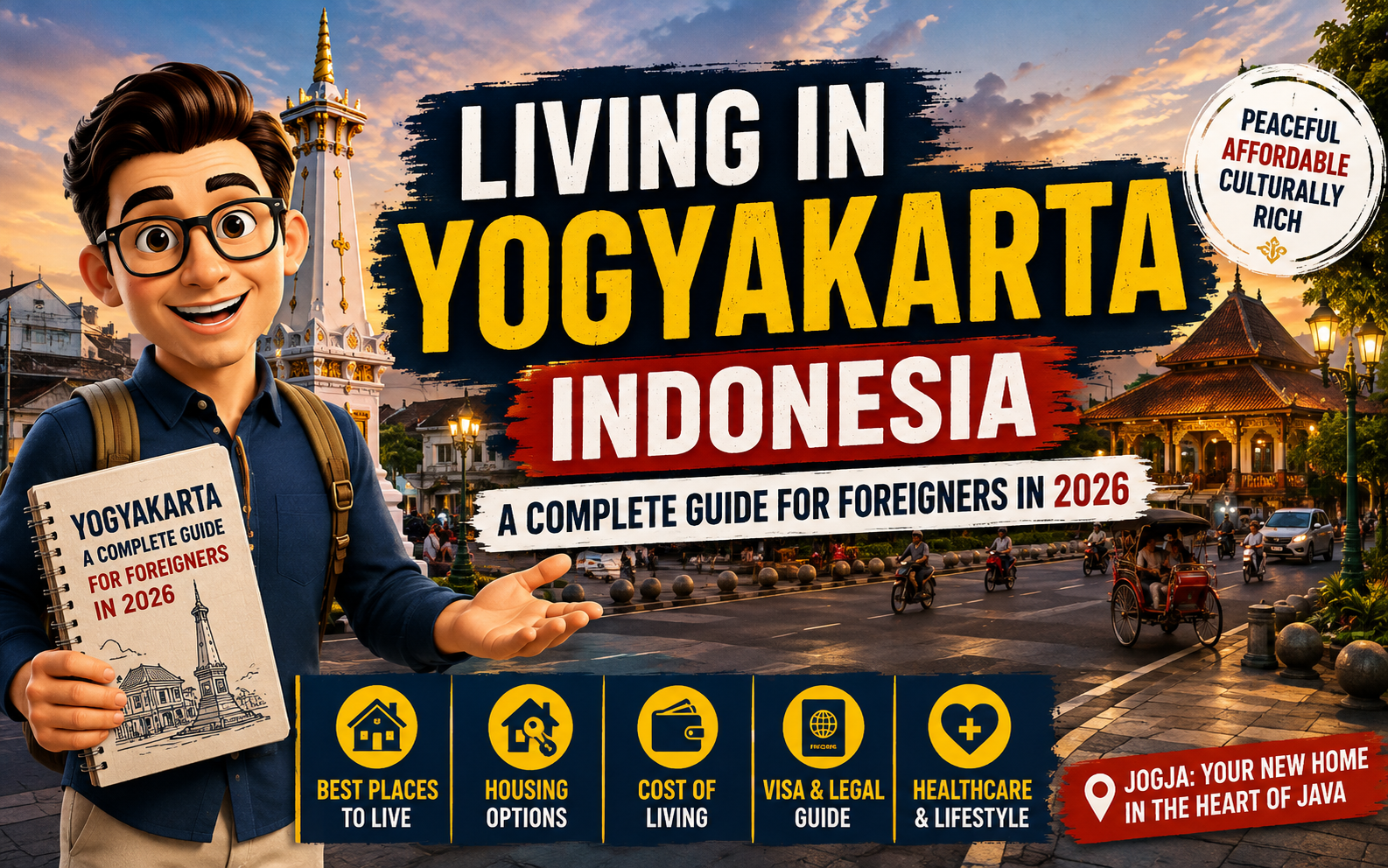
Thinking about living in Yogyakarta, Indonesia?
Known locally as Jogja, Yogyakarta offers a different side of Indonesia for foreigners looking to stay beyond a short holiday. While Bali is known for its international lifestyle and Jakarta for its fast-paced business environment, Yogyakarta is often chosen for something different: a more peaceful way of life, relatively affordable living, and a strong connection to Javanese culture and traditions.
For foreigners considering a move to Yogyakarta, there is much more to think about than simply finding a place to live. From the cost of living and the best areas to choose to accommodation, visas, remote work, healthcare, transportation, and everyday life, understanding what to expect can make the transition much easier.
This guide explains what foreigners need to know about living in Yogyakarta in 2026. Whether you are planning a long-term stay, working remotely, moving with your family, studying, investing, or simply looking for a quieter place to experience life in Indonesia, this article will help you understand whether Yogyakarta could be the right place for you.
Let’s start with one important question: why are more foreigners choosing to call Yogyakarta home?
Why Are Foreigners Choosing to Live in Yogyakarta?
Yogyakarta is attracting foreigners who are looking for a different way of living in Indonesia. Instead of the fast-paced environment of Jakarta or the highly international atmosphere found in many parts of Bali, Yogyakarta offers a slower, more peaceful, and culturally rich lifestyle.
For many people, one of the biggest reasons is the quality of everyday life. Yogyakarta is a city where modern conveniences and traditional life exist side by side. You can find cafés, shopping centres, universities, hospitals, and reliable everyday services, while local markets, traditional food, Javanese customs, and community life remain an important part of the city’s identity.
Another major attraction is the relatively affordable cost of living. Compared with many international destinations—and often with Jakarta or popular areas of Bali—daily expenses can be more manageable depending on your lifestyle. This can make Yogyakarta appealing to remote workers, retirees, students, families, and foreigners planning a longer stay in Indonesia.
Yogyakarta is also attractive to people who value a slower pace of life. While it is still an active city, many areas feel less hectic than Indonesia’s largest metropolitan centres. For foreigners who want more space to focus on work, family, personal projects, or simply enjoy everyday life at a more relaxed pace, this can be a significant advantage.
Perhaps most importantly, Yogyakarta has a strong cultural identity. Often regarded as one of Indonesia’s most important cultural centres, the city and surrounding region remain closely connected to Javanese traditions, arts, customs, and local values. For foreigners who want more than an international expat bubble and are interested in experiencing Indonesian culture more closely, this can make living in Yogyakarta especially rewarding.
Of course, Yogyakarta may not be the right choice for everyone. It has a smaller international community than Bali, English is not spoken everywhere, and adapting to local customs can take time. However, for many foreigners, these are not disadvantages—they are part of the reason why living in Jogja can feel more authentic and connected to everyday Indonesian life.
In short, foreigners are choosing Yogyakarta for a combination of peaceful living, relatively affordable costs, modern convenience, and a deeper connection to Indonesian and Javanese culture.
Is Yogyakarta a Good Place to Live for Foreigners?
For many foreigners, Yogyakarta can be an excellent place to live, especially for those looking for a more relaxed lifestyle and a closer connection to Indonesian culture.
One of the city’s biggest advantages is its balance between modern convenience and traditional life. Yogyakarta has modern shopping centres, restaurants, cafés, hospitals, universities, and a growing range of services, while local traditions and Javanese culture remain visible in everyday life.
The city can also feel more manageable than Indonesia’s largest metropolitan areas. Daily travel distances are often shorter, many essential services are relatively accessible, and life can feel less rushed. Depending on where you live, Yogyakarta can offer a quieter environment while still providing the facilities needed for comfortable long-term living.
However, living in Yogyakarta as a foreigner is different from living in a major international destination such as Bali. The foreign community is generally smaller, English is not spoken everywhere, and learning some Bahasa Indonesia can make daily activities much easier. Foreigners who are open to adapting to local customs and building connections with the local community may find the experience especially rewarding.
Yogyakarta may be particularly suitable for:
- Remote workers and digital nomads looking for a more affordable and peaceful base in Indonesia.
- Retirees who prefer a slower pace of life.
- Families looking for a culturally rich environment and a more relaxed daily routine.
- Students attracted by Yogyakarta’s well-known universities and educational environment.
- Entrepreneurs and investors exploring long-term opportunities in Indonesia.
- Foreigners who simply want to experience everyday Indonesian life beyond the typical tourist destinations.
Of course, whether Yogyakarta is the right place for you depends on your personal lifestyle and expectations. Those looking for a large international community, extensive nightlife, or a highly English-speaking environment may prefer other destinations. But for foreigners seeking a calmer lifestyle, relatively manageable living costs, and a more authentic connection with Javanese culture, Yogyakarta can be an excellent place to call home.
Before making the move, however, one of the most important things to understand is how much it actually costs to live in Yogyakarta.
Cost of Living in Yogyakarta in 2026
One of the main reasons foreigners consider living in Yogyakarta is its relatively affordable cost of living. Compared with Jakarta and many popular international destinations, Yogyakarta can offer a comfortable lifestyle with a more manageable monthly budget.
However, there is no single answer to how much you need to live here.
Your actual expenses will depend heavily on where you live, the type of accommodation you choose, how often you eat out, your transportation needs, and the lifestyle you want to maintain.
A single person living in a simple kost and eating mostly local food will have very different expenses from someone renting a private house, regularly visiting cafés and international restaurants, or maintaining a more premium lifestyle.
How Much Do You Need to Live in Yogyakarta?
For a single foreigner, a realistic starting budget for living in Yogyakarta in 2026 can be estimated as follows:
| Lifestyle | Estimated Monthly Budget | What to Expect |
| Budget | Rp7–10 million | Simple kost or modest accommodation, mostly local food, limited lifestyle spending and practical transportation. |
| Comfortable | Rp10–15 million | Better accommodation, a mix of local and international food, regular cafés or restaurants, and more flexibility in daily spending. |
| Premium | Rp15–25 million+ | Higher-quality accommodation, frequent dining out, more private transportation and a more international lifestyle. |
These figures should be treated as practical planning estimates rather than fixed prices. Your actual budget may be lower or higher depending on your personal choices and the area where you live.
Recent 2026 cost-of-living data also shows why accommodation makes such a significant difference. Estimates for a single person’s overall monthly expenses vary between sources, while one-bedroom rents commonly fall within a wide range depending on whether you live closer to the city centre or choose a more modest location.
Typical Monthly Expenses in Yogyakarta
To help you understand where your money may go, here is a practical guide to some of the main monthly expenses.
| Expense | Typical Monthly Cost |
| Kost / guesthouse room | Rp1.5–3.5 million |
| One-bedroom apartment | Around Rp2.5–5 million |
| Private house | Around Rp3–10 million+ |
| Food and groceries | Around Rp2–4 million |
| Transportation | Around Rp500,000–2 million+ |
| Internet and utilities | Around Rp500,000–1.5 million+ |
| Coworking, cafés and lifestyle | Depends heavily on personal spending |
Accommodation is usually the biggest variable. A long-term kost can significantly reduce your monthly expenses, while renting a larger private house in a popular or premium area can increase your budget considerably. Recent 2026 market estimates place long-term kost or guesthouse accommodation around Rp1.5–3.5 million, while one-bedroom apartments commonly range from roughly Rp2.5 million to Rp5 million depending on location and facilities.
Food can also be highly flexible. An inexpensive local restaurant meal may cost around Rp15,000–35,000, while cafés, international restaurants, imported products and frequent dining out can quickly increase your monthly spending.
For utilities, the actual cost depends heavily on the size of your accommodation and how much electricity you use, particularly if you regularly run air conditioning. Recent 2026 estimates place home internet at roughly Rp200,000–500,000 per month, while utilities can vary significantly depending on the property.
Budget vs Comfortable Lifestyle
A budget lifestyle in Yogyakarta does not necessarily mean an uncomfortable one.
You could live in a furnished kost, eat regularly at local warung, use a motorcycle or ride-hailing services, and still enjoy many of the cafés and attractions the city has to offer.
A comfortable lifestyle, on the other hand, may include better accommodation, more frequent dining at cafés and restaurants, private transportation, a gym or coworking membership, and greater flexibility for entertainment and travel.
This is one of Yogyakarta’s biggest advantages: your lifestyle can be adjusted more easily to match your budget.
What Can Increase Your Cost of Living?
Your monthly budget can increase significantly if you:
- rent a larger private house or premium accommodation;
- choose a central or more popular neighbourhood;
- regularly eat at international restaurants and cafés;
- frequently use private cars or long-distance ride-hailing services;
- buy imported food and products;
- travel frequently around Indonesia or internationally;
- have family, education or higher healthcare expenses.
For families, the biggest additional costs can include larger accommodation, private transportation, health insurance and education.
Is Yogyakarta Cheaper Than Jakarta or Bali?
For many lifestyles, Yogyakarta can be significantly more affordable than Jakarta, particularly when it comes to housing. Current 2026 comparison data also shows substantially lower housing costs in Yogyakarta than in Jakarta.
Compared with Bali, the answer depends heavily on where in Bali you are comparing it with. Popular international areas can have considerably higher accommodation and lifestyle costs, while less tourist-focused areas may be more affordable.
But the appeal of Yogyakarta is not only about spending less.
The city offers the possibility of combining relatively manageable living costs with a slower pace of life, modern everyday conveniences and a much deeper connection to Javanese culture.
For many foreigners, that combination is what makes Yogyakarta particularly attractive for long-term living.
Once you have a realistic idea of your budget, the next important question is where you should actually live in Yogyakarta.
Best Areas to Live in Yogyakarta
Choosing where to live is one of the most important decisions when moving to Yogyakarta.
The city and its surrounding areas can offer very different lifestyles. Some neighbourhoods are more convenient for first-time foreigners, while others are better suited to families, remote workers, people looking for more space, or those who want a quieter and more local environment.
The good news is that Yogyakarta is not a one-size-fits-all destination.
You can choose an area close to cafés and international-friendly facilities, live near universities and modern services, find a quieter residential neighbourhood, or move further north for greener surroundings and a slower pace of life.
Quick Comparison: Which Area Is Right for You?
| Area | Best For | Lifestyle | Things to Consider |
| Prawirotaman | First-time foreigners, solo residents and digital nomads | Creative, social and walkable | Can feel more tourist-oriented and busier at certain times |
| Kotabaru and Central Yogyakarta | Convenience, long-term residents and families | Central, established and practical | More urban, with less space than outer residential areas |
| Depok and Seturan | Remote workers, students and people who want modern convenience | Young, energetic and well connected | Traffic can be busy around major roads and university areas |
| Sleman | Families and long-term residents | Residential, spacious and quieter | Travel times vary depending on the exact location |
| Bantul and Kasihan | People seeking a more local and relaxed lifestyle | Less urban, creative and community-oriented | A scooter or other transportation may be more important |
| Northern Sleman and Kaliurang | Nature lovers and people seeking peace | Green, quiet and cooler in some areas | Further from the city and daily services can be less convenient |
Prawirotaman: Best for First-Time Foreigners
If you are moving to Yogyakarta for the first time and want an easier transition into daily life, Prawirotaman is one of the most attractive areas to consider.
The neighbourhood is well known for its cafés, restaurants, boutique accommodation, creative spaces and a more internationally familiar atmosphere. It is also relatively walkable compared with many parts of the city, which can make everyday life easier when you are still learning how to get around Yogyakarta.
Prawirotaman can be particularly suitable for:
- solo foreigners;
- digital nomads;
- writers, artists and creative professionals;
- couples;
- people who enjoy cafés and restaurants;
- newcomers who want to meet other international residents.
The biggest advantage is convenience. You can enjoy a more social and creative environment without completely separating yourself from local Yogyakarta life.
However, Prawirotaman may not be the best choice if your main priority is complete peace and quiet. Parts of the area can feel more tourist-oriented, and accommodation may cost more than in some less internationally known residential neighbourhoods.
Choose Prawirotaman if you want: a comfortable first introduction to living in Yogyakarta, with cafés, restaurants and a more international atmosphere close by.
Kotabaru and Central Yogyakarta: Best for Convenience
For foreigners who want to stay close to everyday services, central areas such as Kotabaru and other parts of Central Yogyakarta can be highly practical.
Kotabaru is known for its more established residential character, leafy streets and historical architecture, while central areas provide easier access to restaurants, shopping, healthcare, railway connections and many of the city’s main facilities.
This can be a good option for:
- long-term residents;
- couples and families;
- professionals;
- people who prefer shorter travel distances;
- foreigners who value convenience over having a large property.
The main advantage of central living is simple: you spend less time travelling to everyday destinations.
The trade-off is that central locations can feel more urban and may offer fewer options for large houses, private gardens or a quieter suburban lifestyle.
Choose Kotabaru or Central Yogyakarta if you want: to be close to the city’s main facilities and prefer a practical, established neighbourhood.
Depok and Seturan: Best for Modern Convenience and Remote Workers
The Depok, Seturan and Condongcatur areas are particularly attractive for people who want access to modern everyday facilities and a younger, more energetic environment.
These areas are influenced by Yogyakarta’s large university population and are surrounded by cafés, restaurants, minimarkets, services and growing residential developments. They can also be practical for remote workers who want plenty of options for working outside the home.
This area may suit:
- digital nomads;
- remote workers;
- students and researchers;
- young professionals;
- people who enjoy cafés and an active daily environment.
You are likely to find more modern accommodation options and plenty of everyday conveniences nearby.
The main disadvantage is that some parts can be busy, particularly during peak hours or around university areas. If you choose this part of Yogyakarta, it is worth visiting the exact neighbourhood before committing to a long-term rental.
Choose Depok or Seturan if you want: modern convenience, cafés, services and an active environment with good access to northern and central Yogyakarta.
Sleman: Best for Space and Long-Term Living
Sleman is a broad area, so the experience can vary significantly depending on the exact neighbourhood you choose.
In general, it can be an attractive option for foreigners who want more space, a more residential environment and potentially better access to larger houses than in central parts of the city.
Some parts of Sleman remain close to universities, restaurants and modern facilities, while others offer greener surroundings and a much quieter lifestyle. This flexibility is one of Sleman’s biggest advantages.
Sleman can be particularly suitable for:
- families;
- couples;
- long-term residents;
- remote workers who prefer a home-based lifestyle;
- people looking for larger houses or more outdoor space.
The main thing to consider is location.
Sleman is not one single neighbourhood. A property close to the city may feel completely different from one further north. Travel time, access to supermarkets, healthcare, schools, restaurants and your workplace should all be checked before choosing a specific property.
Choose Sleman if you want: more flexibility, more residential options and the possibility of a quieter long-term lifestyle.
Bantul and Kasihan: Best for a More Local and Relaxed Lifestyle
For foreigners who want to move away from the busiest parts of Yogyakarta and experience a more local environment, Bantul and nearby areas such as Kasihan can be worth considering.
These areas can offer a different rhythm of life, with more residential neighbourhoods, creative communities and, depending on the location, a less urban atmosphere than central Yogyakarta. Housing options can also include private houses and longer-term rentals that may appeal to people looking for more space.
This may suit:
- long-term residents;
- artists and creative professionals;
- couples and families;
- people who want a quieter environment;
- foreigners who are comfortable living further from the most international parts of the city.
The trade-off is convenience.
Depending on exactly where you live, cafés, supermarkets, coworking spaces and other facilities may require more travel. Having a scooter or another reliable way to get around can therefore become more important.
Choose Bantul or Kasihan if you want: a more relaxed, local and residential lifestyle while remaining reasonably connected to Yogyakarta.
Northern Sleman and Kaliurang: Best for Greenery and Peace
If your priority is nature, quiet surroundings and a slower pace of life, Northern Sleman and the Kaliurang area offer a very different experience from central Yogyakarta.
As you move further north towards Mount Merapi, the environment becomes greener and, in higher areas, can feel noticeably cooler than the city. Kaliurang is particularly known as a quieter hill area with a more peaceful atmosphere.
This area may be ideal for:
- nature lovers;
- writers and creative professionals seeking solitude;
- retirees or long-term residents;
- people who work mainly from home;
- anyone who wants to escape the busier parts of the city.
However, this lifestyle requires more planning.
Properties can be more dispersed, travel to central Yogyakarta takes longer, and internet and other services should be checked carefully before committing to a rental. A scooter or private transportation can also be much more important.
Choose Northern Sleman or Kaliurang if you want: greenery, peace and a lifestyle that feels further removed from the pace of the city.
Which Area Should You Choose?
If you are still unsure, this simple guide may help:
Choose Prawirotaman if…
You are new to Yogyakarta and want cafés, restaurants, walkability and a more international atmosphere.
Choose Kotabaru or Central Yogyakarta if…
You want maximum convenience and easy access to the city’s main facilities.
Choose Depok or Seturan if…
You enjoy modern convenience, cafés and an active environment close to universities and everyday services.
Choose Sleman if…
You are looking for more space, a residential lifestyle and flexibility for long-term living.
Choose Bantul or Kasihan if…
You want a quieter and more local environment while remaining connected to the city.
Choose Northern Sleman or Kaliurang if…
You prioritise greenery, peace and a slower lifestyle over being close to central Yogyakarta.
My Best Advice: Do Not Choose Your Long-Term Home Too Quickly
If possible, spend your first few weeks in temporary accommodation and explore different parts of Yogyakarta before signing a long-term rental agreement.
A neighbourhood that looks perfect online can feel very different once you experience the traffic, noise, accessibility, internet quality and everyday atmosphere in person.
For most foreigners, the best area is not necessarily the most popular area—it is the area that best matches the lifestyle you want to build.
Once you have an idea of where you want to live, the next step is understanding the different accommodation options available, from a simple kost to an apartment or a private house.
Finding a House, Apartment or Kost
Finding the right accommodation is an important part of settling into life in Yogyakarta. Foreigners have several options depending on their budget, length of stay, and preferred lifestyle, from a simple kost to a private house or a more modern apartment.
Renting a House
Renting a private house can be a good option for families, couples, or foreigners planning to stay in Yogyakarta for the longer term. Houses generally offer more space, privacy, and flexibility than other types of accommodation.
The available options can vary significantly depending on the area. Central and popular locations may be more convenient but can be more expensive, while areas further from the city centre may offer larger properties and a quieter environment.
Before agreeing to a long-term rental, make sure you understand what is included in the price, such as furniture, maintenance, internet, utilities, and any additional service charges.
Apartments
Apartments can be suitable for foreigners who prefer a more modern and practical living arrangement. Depending on the building, an apartment may offer facilities such as security, parking, shared areas, or other services.
However, the number and type of apartment options in Yogyakarta may be more limited compared with Jakarta or some larger international destinations. Availability, location, and facilities should therefore be considered carefully before making a decision.
Living in a Kost
A kost is a common type of accommodation in Indonesia, particularly popular among students and long-term residents. A kost can range from a simple furnished room to a more modern residence with private bathrooms, air conditioning, Wi-Fi, parking, and additional facilities.
For a single foreigner or someone who has just arrived in Yogyakarta, a kost can be a practical option while getting familiar with different neighbourhoods before committing to a longer-term house rental.
What Should Foreigners Check Before Renting?
Before signing or paying for accommodation, it is wise to check:
- The exact location and surrounding neighbourhood.
- Whether the property is furnished or unfurnished.
- What is included in the rental price.
- Electricity, water, internet, and other additional costs.
- The rental period and payment schedule.
- Deposit and refund terms.
- Property access, parking, and security.
- The condition of the property before moving in.
If possible, view the property in person before making a significant payment. Photos and online listings do not always show the full condition of the accommodation or its surrounding environment.
For foreigners planning to stay in Yogyakarta for the long term, it is also important to make sure that your accommodation arrangements are consistent with your immigration and local administrative requirements.
Once your accommodation is planned, the next important step is making sure you have the right visa or stay permit for living in Yogyakarta.
Visas for Foreigners Living in Yogyakarta
If you are planning to live in Yogyakarta, one of the first things you need to understand is that there is no separate “Yogyakarta Visa.”
The visa or stay permit you need depends on why you are staying in Indonesia, not the city where you choose to live.
A foreigner visiting Yogyakarta for tourism may need a different immigration pathway from someone planning to work remotely, invest in a business, join a spouse or family member, study, or work for an Indonesian company.
Before making long-term plans, it is important to choose an immigration status that genuinely matches your purpose and the activities you intend to carry out in Indonesia.
Short-Term Visitors
If you are coming to Yogyakarta for tourism or a relatively short stay, the appropriate option may include a Visa on Arrival (VoA), e-VOA, or another Visit Visa, depending on your nationality, eligibility, and travel plans.
The length of stay and permitted activities can differ between visa categories. Some visit stay permits may also be eligible for an extension, while others have different rules or limitations.
For this reason, you should always check the conditions of your specific visa rather than assuming that every visitor can simply stay longer or extend their visa.
Can You Extend Your Visa While Living in Yogyakarta?
This is an important question for many foreigners who arrive in Indonesia and later decide that they would like to stay longer.
In some cases, yes—but your ability to extend your stay depends entirely on the type of visa or stay permit you hold.
For example, the Yogyakarta Immigration Office states that a stay permit based on a Visa on Arrival may be extended once for up to 30 additional days, subject to the applicable requirements and procedures. An application may be submitted through the relevant immigration process before the current permitted stay expires.
Other Visit Visas and stay permits can have different extension periods, eligibility requirements, sponsors, or procedures.
This means there is no single rule that applies to every Indonesia visa extension.
Before applying for an extension, you should check:
- the exact visa or stay permit you currently hold;
- whether that specific immigration category is eligible for an extension;
- how many extensions are permitted, if any;
- the maximum period of stay allowed;
- the application deadline;
- whether you need a sponsor or additional supporting documents;
- whether your intended activities remain permitted under your current immigration status.
Most importantly, do not wait until the last minute. Immigration applications should be planned before your permitted stay expires.
If you are already living in Yogyakarta and need to extend your stay, the relevant immigration process may depend on your address, visa category, and the current immigration procedures applicable to your case.
When a Visa Extension Is Not the Right Solution
Extending your current visa is not always the best option.
If your circumstances have changed—for example, you originally arrived as a tourist but now qualify for a different long-term purpose—simply extending your existing visa may not necessarily be the appropriate immigration pathway.
Depending on your situation, you may need to consider another visa, a different stay permit, or an eligible change of immigration status.
For this reason, it is important to think beyond the question:
“How can I stay longer?”
The more important question is:
“What immigration status is appropriate for what I am actually doing in Indonesia?”
That distinction can make a significant difference for anyone planning to live in Yogyakarta for the long term.
Remote Workers and Digital Nomads
Foreigners who work remotely should pay particular attention to the immigration rules that apply to their situation.
Indonesia has specific stay permit pathways for eligible foreign nationals, including the Remote Worker ITAS (E33G), subject to the applicable requirements and conditions.
For someone planning to make Yogyakarta their base while working remotely, choosing the correct immigration status is more important than simply finding a visa with a long validity period.
If you are planning a long-term move, make sure your stay permit genuinely matches your work arrangements and intended activities.
Investors and Business Owners
Foreigners who establish or invest in an Indonesian company may have a different immigration pathway, including an Investor ITAS, depending on their investment structure, position, and eligibility.
This is particularly relevant for entrepreneurs who are not only living in Yogyakarta but are also planning to establish a genuine business or investment in Indonesia.
The Indonesian immigration framework provides ITAS pathways for foreign investment, and ITAS extensions may also be available depending on the applicable category and conditions.
For investors, immigration arrangements should be considered alongside the company’s legal structure, investment requirements, shareholding, and business activities.
Family, Employment and Other Long-Term Purposes
Other immigration pathways may be available for foreigners who:
- are joining an Indonesian spouse or eligible family member;
- have been legally employed by an eligible Indonesian company;
- are studying in Indonesia;
- qualify for another recognised purpose for obtaining a Limited Stay Permit (ITAS).
The appropriate pathway depends on your individual circumstances.
Some ITAS categories may also be extended, but the extension period, requirements, application timing, and overall permitted duration can vary depending on the specific ITAS category. Official immigration guidance lists extension rules for different categories, including foreign investors, remote workers, family members, employees, students, and other eligible foreign nationals.
Choose Your Visa Based on Your Purpose, Not Your Location
The most important thing to remember is simple:
Yogyakarta is where you live, but your visa or stay permit must match why you are living in Indonesia.
A tourist, remote worker, investor, employee, student, and family member may all choose to live in the same area of Yogyakarta while holding very different immigration statuses.
If you want to stay longer, do not automatically assume that a visa extension is always the right answer. In some cases, extending your current stay permit may be appropriate. In other cases, you may need a different immigration pathway based on your new purpose of stay.
Before making a long-term commitment, make sure you understand:
your current immigration status → the activities you are permitted to carry out → whether an extension is available → and whether another visa or ITAS would be more appropriate for your long-term plans.
Once your immigration arrangements are in place, another important question for many foreigners is whether Yogyakarta can provide the internet, working environment, and everyday infrastructure needed for remote work.
Digital Nomads, Internet and Remote Work
Yogyakarta is becoming an increasingly attractive option for digital nomads and remote workers who want a different experience from Indonesia’s larger international hubs.
The city may not have the same size of international remote-working community as Bali, but that can also be part of its appeal.
For many people, Yogyakarta offers a combination of more manageable living costs, a slower pace of life, strong café culture, growing work-friendly spaces, and the opportunity to experience Indonesian life beyond the country’s most internationally developed tourist destinations.
For remote workers who value focus, affordability and everyday balance, Yogyakarta can be an excellent long-term base.
Is Yogyakarta a Good Place for Digital Nomads?
For many remote workers, yes.
Yogyakarta can work particularly well for people who do not need to be surrounded by a large international community every day and prefer a city where work and everyday life can feel more balanced.
It may be especially suitable for:
- freelancers;
- online business owners;
- remote employees;
- writers and creative professionals;
- designers and developers;
- consultants;
- entrepreneurs managing international businesses.
The biggest difference compared with Bali is the overall atmosphere.
Bali can offer a larger international community, more dedicated coworking spaces and a stronger global networking environment. Yogyakarta, on the other hand, can feel less focused on the digital-nomad lifestyle itself and more like a real Indonesian city where remote work is simply part of your everyday life.
For some people, that makes it easier to focus.
Remote Work in Yogyakarta at a Glance
| Remote Work Need | What to Expect in Yogyakarta |
| Home internet | Widely available in many urban and residential areas, but quality should be checked at the exact property before renting. |
| Mobile data backup | Strongly recommended for remote workers in case of home internet interruptions. |
| Coworking spaces | Available, with more options around central and northern parts of the city. |
| Work-friendly cafés | Common, particularly in popular residential, university and creative areas. |
| International community | Smaller than Bali, but easier to build deeper connections over time. |
| Cost of working | Generally more manageable than many major international hubs. |
| Best suited for | Remote workers who value focus, affordability, culture and a slower pace of life. |
The exact experience will depend on where you choose to live. Someone based in Prawirotaman or Depok may have a very different daily routine from someone living further north in Sleman or near Kaliurang.
Internet and Connectivity
For most remote workers, internet quality is one of the first things to check before committing to a long-term rental.
Fixed home internet is available in many parts of Yogyakarta, particularly in more developed urban and residential areas. However, availability and connection quality can vary between neighbourhoods and even between properties on the same street.
For that reason, never assume that a property has reliable internet simply because it is advertised as suitable for remote work.
Before signing a long-term rental agreement, ask:
- Which internet provider is available at the property?
- Is the connection already installed?
- What is the typical download and upload speed?
- Is the connection shared with other tenants?
- Has the internet experienced frequent interruptions?
- Is mobile signal strong enough to use as a backup?
For anyone whose income depends on an online connection, a backup mobile data plan is highly recommended.
A practical setup for many remote workers is:
Home internet → primary connection
Mobile data / hotspot → backup connection
This simple preparation can prevent a short internet interruption from becoming a major work problem.
Coworking Spaces and Work-Friendly Cafés
You do not necessarily need to work from home every day.
Yogyakarta has a growing number of coworking spaces, shared work environments and cafés where remote workers can spend several hours working, meeting clients or simply changing their daily routine.
Areas around Prawirotaman, Depok, Seturan and other university and creative districts can offer particularly convenient access to cafés and work-friendly environments.
However, the best option depends on the type of work you do.
A café may be perfect for writing, emails or casual work, but may not be ideal for:
- frequent video calls;
- confidential meetings;
- long uninterrupted work sessions;
- work requiring a quiet environment.
If your work depends heavily on meetings or concentration, consider choosing accommodation with a dedicated workspace or using a coworking space.
Choosing the Right Area for Remote Work
When choosing where to live, think about your working style.
Prawirotaman may suit you if…
You enjoy working from cafés and want a more social, creative and internationally familiar environment.
Depok or Seturan may suit you if…
You want modern conveniences, plenty of cafés and easy access to services.
Sleman may suit you if…
You prefer working primarily from home and want more space for a dedicated workspace.
Northern Sleman or Kaliurang may suit you if…
Your work allows you to prioritise peace and nature, but you should check internet quality carefully before committing to a property.
Your ideal neighbourhood is not necessarily the area with the most cafés. For many remote workers, a reliable connection, a quiet workspace and a comfortable daily routine are more valuable than being surrounded by coworking spaces.
A Different Kind of Digital Nomad Experience
Yogyakarta may be particularly appealing if you are looking for something beyond the typical digital-nomad environment.
You can work online while spending your free time exploring traditional markets, local food, historical areas, art communities and the wider cultural life of Central Java.
The city allows remote work to fit into an Indonesian lifestyle rather than making the entire city revolve around remote workers.
That difference can be especially attractive for people planning a longer stay.
Remote Work and Indonesian Immigration Rules
Having a remote job does not automatically mean that every Indonesian visa or stay permit is appropriate for your situation.
If you are planning to work remotely while living in Indonesia, your immigration status should match your circumstances and the activities you intend to carry out.
Indonesia provides specific immigration pathways for eligible remote workers, including the Remote Worker ITAS (E33G), subject to the applicable requirements and conditions.
Before moving to Yogyakarta for remote work, make sure you understand:
- whether your current immigration status is appropriate;
- what activities are permitted under that status;
- the requirements for a long-term stay;
whether you may need to extend your stay or apply for a different immigration pathway.
Is Yogyakarta Better Than Bali for Digital Nomads?
There is no universal answer.
Bali may be better if you want:
- a large international community;
- frequent networking opportunities;
- a more established digital-nomad ecosystem;
- a wider choice of dedicated coworking spaces;
- an internationally oriented lifestyle.
Yogyakarta may be better if you want:
- a more manageable cost of living;
- a slower pace of life;
- a stronger connection to Indonesian and Javanese culture;
- fewer lifestyle distractions;
- a city that feels less dependent on tourism;
- a potentially more sustainable environment for long-term focus.
For some remote workers, Bali is the place to network.
For others, Yogyakarta is the place to actually get work done.
Final Thoughts for Remote Workers
Yogyakarta is not trying to become another Bali—and that is one of its strengths.
If you need a large international community, constant networking events and a highly developed digital-nomad ecosystem, Bali may offer more options.
But if you are looking for a place where you can work remotely, control your living costs, build a calmer routine and experience a deeper side of Indonesia, Yogyakarta deserves serious consideration.
The key is to choose the right area, verify your internet connection before committing to accommodation and make sure your visa or ITAS is appropriate for your remote-working arrangements.
Once your work setup is in place, the next question is what everyday life in Yogyakarta actually feels like—from healthcare and transportation to safety and daily convenience.
Everyday Life: Healthcare, Transportation and Safety
For foreigners planning to live in Yogyakarta, everyday comfort is about more than finding the right house and visa. Access to healthcare, reliable transportation, and a sense of personal safety can make a significant difference when choosing a place to live.
Healthcare
Yogyakarta has a wide range of healthcare services, including hospitals, clinics, and government health facilities. Depending on your location and needs, you can access general medical care, specialist services, emergency treatment, and other healthcare support.
For emergencies, the city also operates PSC 119 YES, while government hospital services provide 24-hour emergency care and medical support.
Before moving to Yogyakarta, it is a good idea to understand how your health insurance works in Indonesia and which hospitals or clinics are included in your coverage. For long-term residents, choosing accommodation with reasonable access to healthcare can also be an important consideration.
Transportation
Getting around Yogyakarta is relatively practical, although your experience will depend on where you live and how often you travel.
Many residents use motorcycles or cars, while ride-hailing services can also be convenient for daily trips. Yogyakarta also has the Trans Jogja public bus network, with routes and hundreds of stops across Yogyakarta and surrounding areas.
For foreigners who are new to Indonesia, ride-hailing can be a practical option while getting familiar with the city. Those planning to drive or ride a motorcycle should make sure they understand the applicable licensing requirements, local traffic conditions, and road safety rules.
Safety
Yogyakarta is often considered an attractive city for people looking for a calmer lifestyle, but, like anywhere else, foreigners should continue to use normal precautions.
Keep personal belongings secure, be aware of your surroundings, take extra care when travelling at night, and be particularly cautious on the road. Traffic conditions and driving habits may be different from what you are used to in your home country.
For most foreigners, everyday life in Yogyakarta can feel manageable and relatively relaxed, especially once they become familiar with their neighbourhood and local routines. However, choosing the right area, understanding how to get around, and knowing where to access healthcare are all important parts of settling in comfortably.
Beyond everyday convenience, one of the things that truly sets Yogyakarta apart is its culture. For many foreigners, the opportunity to live closer to Javanese traditions and local customs is one of the biggest reasons to choose Jogja in the first place.
Yogyakarta Culture, Traditions and Local Way of Life
If there is one thing that truly makes Yogyakarta different from many other places in Indonesia, it is this: you are not simply choosing a city—you are choosing a way of life.
For foreigners who want more than modern cafés, comfortable accommodation, and affordable living, Yogyakarta offers something increasingly difficult to find in fast-changing destinations: a city where culture is still part of everyday life.
Here, Javanese traditions are not only preserved for tourists or displayed during special events. They remain woven into the rhythm of daily life—in the way people speak, greet one another, interact with neighbours, celebrate important occasions, and show respect to family and the wider community.
A Slower Way of Living
Life in Yogyakarta often moves at a different pace.
Of course, the city has traffic, busy commercial areas, universities, and the energy of a growing urban centre. But beyond the busiest streets, there is still a strong sense of everyday rhythm that many foreigners find refreshing.
Mornings may begin with the sounds of neighbourhood activity rather than the pressure of a major international city. Small food stalls open, local markets become active, people stop to talk with neighbours, and daily life unfolds around communities rather than simply offices, shopping centres, and tourist attractions.
For foreigners coming from fast-paced cities, this can feel like a significant change.
Living in Yogyakarta can give you permission to slow down.
It can mean spending less time rushing between appointments, more time enjoying a coffee without feeling pressured to leave, taking an evening walk through your neighbourhood, or simply becoming familiar with the people and places around you.
That does not mean Yogyakarta is a quiet village. It is a major city with more than enough activity for daily life. The difference is that, for many people, the city can still feel human in scale and emotionally connected to its local community.
A Place Where Javanese Culture Is Still Alive
Yogyakarta is widely associated with Javanese cultural heritage, and this is one of its greatest attractions for foreigners who want to experience Indonesia beyond the typical international tourist environment.
Art, music, dance, batik, traditional architecture, language, food, and ceremonies all contribute to the city’s identity. But what makes living here different from simply visiting is the opportunity to experience these things gradually and naturally.
You do not have to visit a cultural attraction every day to feel connected to Yogyakarta’s identity.
You may see traditional celebrations in your neighbourhood. You may hear Javanese spoken between family members and neighbours. You may notice different forms of etiquette in social situations. You may discover that relationships, politeness, patience, and respect can play an important role in everyday interactions.
For a foreigner who is willing to observe, learn, and participate respectfully, living in Yogyakarta can become a much deeper cultural experience than simply passing through as a tourist.
Living Among People, Not Just Other Expats
One of the biggest differences between Yogyakarta and highly international destinations is that it can be easier to step outside the familiar expat bubble.
This may not be the right environment for everyone. If you want to live somewhere where almost everything is designed around international visitors and English is spoken almost everywhere, you may find other destinations easier.
But for many foreigners, that is exactly what makes Yogyakarta special.
Living here can encourage you to learn some Bahasa Indonesia, understand local habits, try food you may never have ordered before, build relationships with Indonesian neighbours, and become more comfortable with a different way of seeing everyday life.
Over time, a simple interaction with the people around you can become one of the most meaningful parts of living abroad.
The local warung where someone remembers your usual order.
The neighbour who greets you every morning.
The small shop where you slowly learn enough Bahasa Indonesia to have a real conversation.
The invitation to a local celebration.
These are small experiences, but together they can transform Yogyakarta from a place where you are staying into a place that starts to feel like home.
Respect Is an Important Part of the Experience
Living in Yogyakarta also means understanding that you are becoming part of a community with its own customs, values, and social expectations.
Foreigners do not need to become experts in Javanese culture before arriving. However, being open-minded and respectful can make a significant difference.
Learning basic Bahasa Indonesia, dressing appropriately for the situation, understanding local etiquette, respecting religious and cultural events, and being considerate of neighbours can help make everyday life much smoother.
In return, many foreigners discover that making an effort to understand the local culture can open doors that would otherwise remain closed.
The more you invest in understanding the place where you live, the richer the experience can become.
The Appeal of a More Authentic Indonesian Experience
For some foreigners, Bali may offer beaches, a large international community, and an established lifestyle designed around visitors from around the world.
Yogyakarta offers something different.
It can offer the opportunity to build a life inside Indonesia rather than around an international version of Indonesia.
That distinction is important.
You can still enjoy good cafés, modern restaurants, comfortable accommodation, reliable internet, and many of the conveniences needed for long-term living. But when you step outside those spaces, the city remains deeply connected to its own history and identity.
For foreigners who want their time in Indonesia to be more than a long holiday, this can be incredibly valuable.
A City That Can Feel More Like Home Over Time
Yogyakarta may not always make its strongest impression in a single day.
Its appeal often grows slowly.
At first, you may notice the affordability, the food, the cultural attractions, and the relaxed atmosphere. But after spending more time in the city, many people begin to appreciate the smaller things: familiar streets, local routines, relationships with neighbours, favourite food stalls, and the feeling of belonging to a community rather than simply staying in a destination.
That may be Yogyakarta’s greatest strength.
It is a city that can reward people who are willing to stay long enough to understand it.
For foreigners looking for a peaceful place to build a life, raise a family, focus on remote work, study, retire, or simply experience Indonesia in a more meaningful way, Yogyakarta offers more than a lower cost of living. It offers the possibility of a different rhythm of life.
And perhaps that is the real reason why, for the right person, living in Yogyakarta can become much more than moving to another city—it can become a genuine change in how you choose to live.
Pros and Cons of Living in Yogyakarta
No city is perfect, and Yogyakarta is no exception.
For the right person, living in Jogja can offer an exceptional quality of life. The city combines a relatively affordable lifestyle, modern everyday conveniences, a strong cultural identity, and a pace of life that many foreigners find more comfortable than larger Indonesian cities.
However, Yogyakarta may not suit everyone.
Before deciding to move, it is important to look beyond the positive images and consider what everyday life here may actually feel like.
The Advantages of Living in Yogyakarta
| Pros | Why It Matters |
| More Peaceful Lifestyle | Yogyakarta can offer a slower and less hectic rhythm of life than larger metropolitan areas, making it attractive for people who value balance and everyday comfort. |
| Relatively Affordable Living | Accommodation, food, and many daily expenses can be more manageable depending on your lifestyle and the area where you choose to live. |
| Strong Cultural Identity | Javanese traditions, arts, food, customs, and local values remain an important part of everyday life. |
| Modern Everyday Convenience | You can still access hospitals, shopping centres, cafés, universities, digital services, and many other facilities needed for long-term living. |
| Good for Long-Term Living | The combination of lifestyle, culture, affordability, and practical facilities can make Yogyakarta attractive for remote workers, families, students, retirees, and other long-term residents. |
| Closer Connection to Local Life | Compared with highly international destinations, it can be easier to experience everyday Indonesian life and build connections within the local community. |
The Challenges of Living in Yogyakarta
| Cons | What to Consider |
| Smaller International Community | The expat and digital-nomad community is generally smaller than in major international hubs such as Bali, which may feel limiting for people who want constant international networking. |
| English Is Not Spoken Everywhere | Learning basic Bahasa Indonesia can make everyday life significantly easier, particularly when dealing with local services and communities. |
| Traffic Can Still Be Busy | Although Yogyakarta may feel calmer overall, some roads and popular areas can experience heavy traffic, especially at certain times of the day. |
| Fewer International Connections | Yogyakarta may offer fewer direct international connections than larger cities, so some travel plans may require an additional domestic connection. |
| Hot and Humid Climate | Like many parts of Indonesia, the tropical climate can take time to adjust to, particularly for foreigners arriving from cooler countries. |
| Different Social and Cultural Expectations | Foreigners may need time to understand local customs, etiquette, and community values. Being open-minded and respectful is an important part of settling in successfully. |
So, Is Yogyakarta Worth It?
For many foreigners, the advantages can easily outweigh the challenges—especially if you are looking for something different from the typical expat lifestyle.
Yogyakarta may not offer the same international atmosphere as Bali or the same scale of business and infrastructure as Jakarta. But that is also part of its appeal.
You can still enjoy the practical comforts needed for modern life while living in a city where local culture, traditions, and a slower rhythm remain part of everyday life.
In the end, Yogyakarta is likely to suit you best if you value:
- A more peaceful and balanced lifestyle.
- Relatively manageable living costs.
- A strong connection to Indonesian and Javanese culture.
- Modern facilities without the intensity of a major metropolitan city.
- The opportunity to build a life that feels more connected to the local community.
If that sounds like the kind of life you are looking for, the next question becomes practical: what should you actually do before moving to Yogyakarta?
How to Move to Yogyakarta: A Practical Checklist
Moving to another country can feel complicated, especially when you are trying to arrange your visa, accommodation, finances, and everyday life at the same time.
The good news is that you do not need to solve everything at once.
If you are seriously considering living in Yogyakarta, breaking the process into a few practical steps can make your move much easier.
1. Decide Why You Are Moving to Indonesia
Start by being clear about the purpose of your move.
Are you planning to:
- work remotely?
- retire in Indonesia?
- join your spouse or family?
- study?
- invest or start a business?
- work for an Indonesian company?
- stay in Indonesia for another long-term purpose?
Your answer is important because your purpose of stay should help determine the immigration pathway that is appropriate for you.
2. Choose the Right Visa or Stay Permit
Once you understand your purpose, the next step is to make sure you have the appropriate Indonesian visa or stay permit.
Remember: there is no special visa just for living in Yogyakarta. Your immigration status is based on what you are legally coming to Indonesia to do.
For example, the appropriate pathway may be different for a remote worker, investor, employee, student, or family member.
It is important to understand your visa conditions before making long-term commitments. Do not assume that a visa allowing you to stay in Indonesia automatically permits every type of activity.
3. Prepare a Realistic Monthly Budget
Before moving, calculate how much you expect to spend each month.
Your budget should include:
- accommodation;
- food and daily expenses;
- transportation;
- utilities and internet;
- healthcare and insurance;
- visa or immigration-related costs;
- entertainment and personal spending;
- emergency savings.
It is also wise to prepare additional funds for your first few months. Initial expenses can be higher because you may need to pay deposits, temporary accommodation, transportation, or other setup costs before you fully settle in.
4. Stay Temporarily Before Choosing a Long-Term Area
If possible, avoid committing immediately to a long-term rental before you understand the city.
Spend some time exploring different areas and ask yourself practical questions:
- How far is the area from the places you visit regularly?
- Is the neighbourhood quiet or busy?
- Are cafés, supermarkets, hospitals, or other services nearby?
- Is the internet reliable enough for your needs?
- Does the area match the lifestyle you want?
A neighbourhood that looks perfect online may feel completely different once you experience it in person.
5. Find Accommodation That Matches Your Lifestyle
Once you know which area you prefer, decide whether a house, apartment, or kost is the best option.
A single remote worker may prioritise convenience and internet access. A family may need more space and access to schools or healthcare. Someone planning to stay temporarily may prefer flexibility over a long rental commitment.
Before paying, check the rental terms carefully and make sure you understand what is included in the price.
6. Plan Your Work, Business or Daily Routine
Think about what your everyday life will actually look like after you arrive.
If you work remotely, check internet availability and prepare a backup connection. If you are starting a business, make sure your business structure and immigration arrangements are properly established. If you are moving with your family, consider healthcare, education, transportation, and your preferred residential environment.
Planning for everyday life is just as important as planning the move itself.
7. Learn the Basics of Local Life
You do not need to speak fluent Bahasa Indonesia before moving to Yogyakarta, but learning some basic words and everyday expressions can make a significant difference.
Take time to understand local customs, social etiquette, and the culture of the community where you live.
Yogyakarta can offer a particularly rewarding experience for foreigners who are open to adapting. A willingness to learn, observe, and respect local traditions can help turn the process of moving into a more meaningful long-term experience.
8. Give Yourself Time to Settle In
Moving to Yogyakarta is not only about arriving with the right visa and finding a house.
The first few weeks may involve adjusting to the climate, traffic, language, food, local systems, and a different pace of life.
Give yourself time.
Explore your neighbourhood. Meet people. Find your preferred places to eat and work. Learn how everyday services operate. Gradually, the city can become much easier to navigate—and eventually start to feel like home.
A Simple Way to Think About Your Move
The process can be summarised in eight simple steps:
Choose your purpose → Select the right immigration pathway → Prepare your budget → Explore Yogyakarta → Choose your area → Find accommodation → Plan your everyday life → Give yourself time to settle in.
With the right preparation, moving to Yogyakarta does not have to be overwhelming.
The key is to make your immigration status, budget, accommodation, and lifestyle plans work together before making a long-term commitment.
Frequently Asked Questions About Living in Yogyakarta
Is Yogyakarta a good place for foreigners to live?
Yes, Yogyakarta can be an excellent place to live for foreigners, particularly for those looking for a more peaceful lifestyle, relatively manageable living costs, and a closer connection to Indonesian and Javanese culture.
The city may be especially attractive to remote workers, students, families, retirees, and foreigners planning a longer stay in Indonesia. However, Yogyakarta may feel less international than Bali, and learning some Bahasa Indonesia can make everyday life easier.
How much does it cost to live in Yogyakarta?
The cost of living in Yogyakarta depends heavily on your lifestyle, accommodation, transportation, and personal spending habits.
Someone living in a simple kost and eating mostly local food may spend significantly less than someone renting a private house, regularly visiting international restaurants, and maintaining a more premium lifestyle.
Before moving, it is best to prepare a realistic monthly budget that includes accommodation, food, transportation, utilities, healthcare, insurance, and emergency savings.
Is Yogyakarta cheaper than Bali?
For many lifestyles, Yogyakarta can be more affordable than popular areas of Bali, particularly when it comes to accommodation and some everyday expenses.
However, prices can vary significantly depending on where you live and the lifestyle you choose. A luxury lifestyle in Yogyakarta can still be expensive, while a simple lifestyle in some parts of Bali may be more affordable than expected.
The biggest difference is not only cost. Yogyakarta and Bali offer very different lifestyles, communities, and cultural experiences.
Can foreigners live in Yogyakarta long term?
Yes. Foreigners can live in Yogyakarta for the long term as long as they hold an appropriate Indonesian visa or stay permit for their circumstances.
There is no special visa specifically for Yogyakarta. Your immigration status depends on the purpose of your stay in Indonesia, such as remote work, investment, family reunification, employment, study, or another recognised purpose.
What visa do I need to live in Yogyakarta?
The right visa or stay permit depends on why you are living in Indonesia.
A short-term visitor, remote worker, investor, employee, student, or family member may each qualify for different immigration pathways. Before making long-term plans, you should ensure that your visa or stay permit matches your intended activities in Indonesia.
Is Yogyakarta a good place for digital nomads?
Yogyakarta can be a good option for digital nomads and remote workers who prefer a quieter and potentially more affordable alternative to larger international hubs.
The city offers home internet options, mobile data, coworking spaces, and work-friendly cafés. However, the international digital-nomad community is generally smaller than in Bali.
If you plan to work remotely while living in Indonesia, make sure your immigration status is appropriate for your situation and intended activities.
Which area is best for foreigners to live in Yogyakarta?
The best area depends on your lifestyle.
Prawirotaman may suit those looking for cafés and a more international atmosphere. Depok can be convenient for access to modern facilities, universities, and shopping. Sleman may be better for people looking for more space and a quieter environment, while Central Yogyakarta or Kotabaru can offer convenient access to many everyday services.
If possible, it is a good idea to stay temporarily and explore different neighbourhoods before committing to a long-term rental.
Is Yogyakarta safe for foreigners?
Yogyakarta can offer a relatively comfortable environment for everyday life, but foreigners should still follow normal safety precautions.
Keep personal belongings secure, remain aware of your surroundings, take extra care when travelling at night, and be cautious when driving or riding on Indonesian roads.
Getting familiar with your neighbourhood and local routines can also make everyday life feel much more comfortable over time.
Can foreigners buy property in Yogyakarta?
Foreign property ownership in Indonesia is subject to specific legal rules and depends on the type of property, ownership structure, land title, and the foreigner’s immigration and investment status.
For foreigners considering property in Yogyakarta, it is important not to rely on informal arrangements or assumptions about ownership rights. The correct legal structure should be considered carefully before making any investment or payment.
Is Yogyakarta suitable for families?
Yogyakarta can be an attractive option for families looking for a more relaxed environment, access to healthcare, educational institutions, residential areas, and a strong cultural environment.
However, families should carefully consider practical factors such as school options, proximity to healthcare, transportation, accommodation size, and their overall long-term budget before moving.
Do I need to speak Bahasa Indonesia to live in Yogyakarta?
You do not need to speak fluent Bahasa Indonesia before moving to Yogyakarta, but learning the basics can make a significant difference.
English may be available in some hotels, cafés, restaurants, universities, and international-facing businesses, but it is not spoken everywhere. Basic Bahasa Indonesia can make daily communication easier and may also help you build stronger connections with the local community.
Final Thoughts
Living in Yogyakarta is not simply about finding a more affordable place to stay in Indonesia.
For many foreigners, the real attraction is the combination of a slower pace of life, modern everyday convenience, relatively manageable living costs, and the opportunity to experience Indonesian and Javanese culture more closely.
Yogyakarta may not be the right choice for everyone. It is less international than Bali, adapting to local life takes time, and understanding Indonesian culture can be an important part of the experience.
But for foreigners looking for something beyond a typical tourist destination, Yogyakarta can offer the opportunity to build a life that feels calmer, more connected, and more authentic.
Whether you are considering Yogyakarta as a base for remote work, retirement, family life, study, investment, or another long-term plan, the best first step is to understand how your visa, accommodation, budget, and lifestyle fit together.
Yogyakarta is not just a place to visit. For the right person, it can become a place to call home.
Planning to Live in Yogyakarta? Let Azra Solutions Help
Moving to Yogyakarta can be an exciting new chapter—but planning a long-term life in Indonesia also means understanding the right immigration pathway, visa requirements and stay permit options for your situation.
Whether you are planning to move to Yogyakarta as a digital nomad, remote worker, investor, business owner, employee or family member, choosing the right visa or ITAS is an important part of making your move smoother and avoiding unnecessary immigration problems later.
Azra Solutions can help you understand the available options and assist you with your Indonesian visa and immigration process based on your individual circumstances.
If you are planning to live in Yogyakarta, extend your stay, apply for a visa, or move to Indonesia for the long term, our team is ready to help.
Ready to Plan Your Move to Indonesia?
Contact Azra Solutions today to discuss your visa and immigration options and take the next step towards living in Yogyakarta.