Former Indonesian citizens who now hold foreign citizenship may still have a legal pathway to permanent residence in Indonesia. Under Indonesia’s immigration framework, former Indonesian citizens (eks WNI) are expressly recognized as a category that may be granted an Izin Tinggal Tetap (ITAP), commonly referred to as KITAP.
However, Former Indonesian Citizen KITAP is not the same thing as Indonesian citizenship, and it should not automatically be treated as identical to the E32E Repatriation Visa introduced under the Global Citizen of Indonesia (GCI) framework in 2026.
The applicable pathway depends on the person’s circumstances, current immigration status, documentary evidence, and the immigration category under which the application is made.
This guide explains KITAP/ITAP for former Indonesian citizens, including eligibility, requirements, proof of former Indonesian citizenship, application pathways, costs, rights, limitations, and the differences between KITAP, E32E, GCI, and Indonesian citizenship.
1. What Is Former Indonesian Citizen KITAP?
What KITAP Means in Indonesia
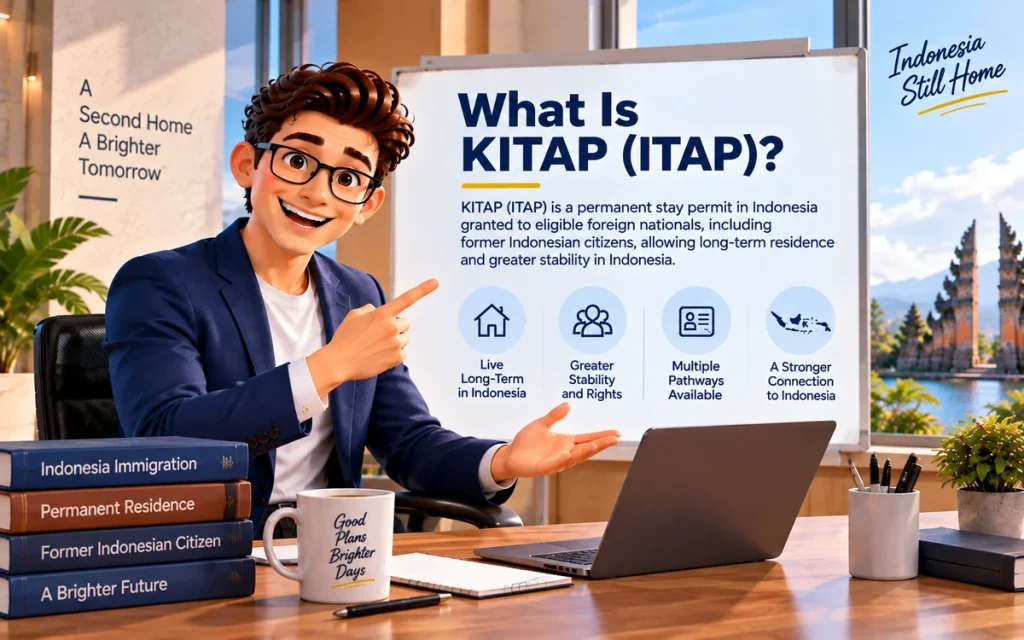
KITAP is commonly used to refer to the physical Kartu Izin Tinggal Tetap, while ITAP (Izin Tinggal Tetap) refers to the permanent stay permit/status itself. Indonesia’s Immigration Law recognizes former Indonesian citizens as one category eligible for ITAP.
KITAP vs ITAP
In everyday immigration discussions, the terms are often used interchangeably: ITAP means Izin Tinggal Tetap, the permanent stay permit/status, while KITAP means Kartu Izin Tinggal Tetap, the residence card/document associated with the permit.
What Permanent Residence Means for a Foreign National
Permanent residence allows an eligible foreign national to reside and settle in Indonesia under the applicable immigration status. It does not turn the person back into an Indonesian citizen.
2. Can a Former Indonesian Citizen Get KITAP in Indonesia?
Yes. Former Indonesian citizens are expressly recognized in Indonesian immigration law as a category that may be granted ITAP. However, this does not mean every former Indonesian citizen follows exactly the same procedure.
Former Indonesian Citizens Recognized Under the ITAP Framework
The Immigration Law specifically recognizes foreign nationals who were previously Indonesian citizens among categories that may be granted permanent stay permits.
Why the Exact Immigration Pathway Matters
The phrase Former Indonesian Citizen KITAP describes the residence status being considered, not necessarily one single administrative procedure. Official service information separately describes former-WNI ITAP cases, while the 2026 GCI framework introduced E32E.
3. Who May Qualify for Former Indonesian Citizen KITAP?
Former Indonesian citizens who now hold foreign nationality may fall within the ITAP framework, but eligibility must be assessed according to the applicable category and supporting evidence.
Former Indonesian Citizens Who Became Foreign Nationals
The clearest category is a person who was previously Indonesian and subsequently became a citizen of another country.
Former Indonesian Citizens Who Lost Indonesian Citizenship While in Indonesia
Current Immigration service standards specifically address an ex-WNI who lost Indonesian citizenship while in Indonesia, including evidence of former citizenship, return of Indonesian passport/e-KTP, and evidence of foreign citizenship.
Former Indonesian Citizens Returning to Indonesia
Since January 2026, GCI includes E32E, the Permanent Resident Repatriation Visa, for eligible former Indonesian citizens. This means applicants should compare available pathways.
4. Can a Former Indonesian Citizen Get KITAP Directly?
There is no single universal answer. Indonesian immigration rules distinguish between status transfers and circumstances in which ITAP may be granted without the same type of transfer.
Direct ITAP Without Status Transfer
Official Immigration services publish a specific procedure for granting ITAP without status transfer for qualifying categories. Former-WNI eligibility must be assessed against the applicable category.
ITAS to ITAP for Former Indonesian Citizens
Certain ITAS holders may change status to ITAP. It is inaccurate to say every former Indonesian citizen must first obtain KITAS for three years before KITAP.
Why There Is No Single KITAP Pathway for Every Former WNI
The applicant’s history and current immigration category matter. An ordinary ITAP case can differ from an E32E/GCI repatriation case.
5. Former Indonesian Citizen KITAP Requirements
Requirements depend on the applicable ITAP pathway, but official Immigration information identifies several relevant documents.
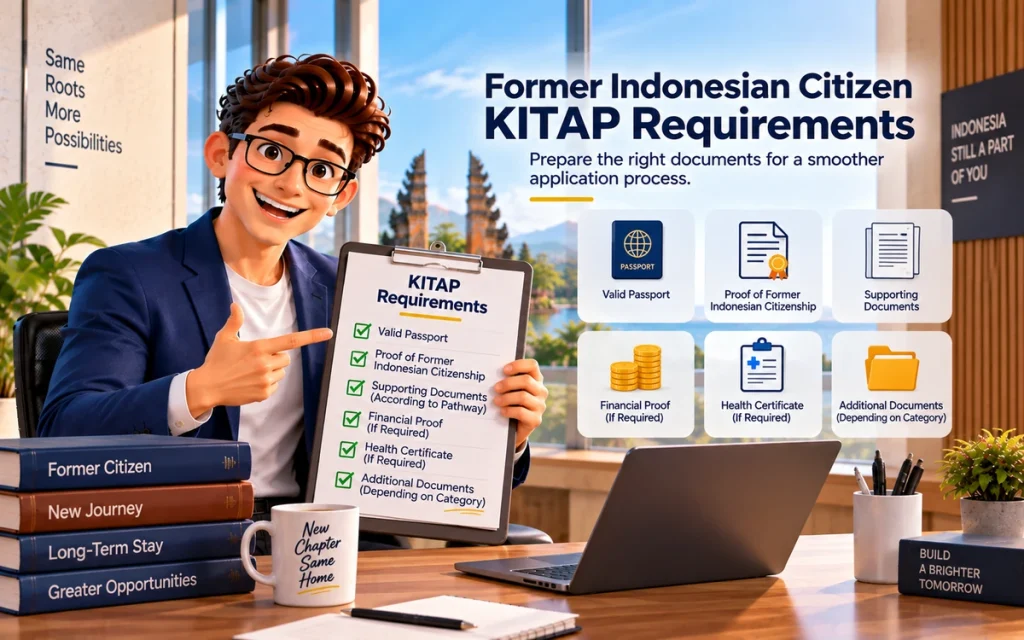
Valid Foreign Passport
An ITAP applicant must have a national passport.
Proof of Former Indonesian Citizenship
Possible evidence includes an Indonesian e-KTP, former Indonesian passport/travel document, birth certificate, diploma or other recognized evidence.
Evidence Related to Loss or Change of Indonesian Citizenship
Certain cases may require evidence that an Indonesian passport/e-KTP was returned and evidence from a foreign representative confirming foreign citizenship.
Immigration Guarantee or Sponsor Documents
A regular ITAP procedure may involve a Penjamin/guarantor depending on the pathway. This should not automatically be applied to GCI/E32E.
Additional Supporting Documents
Depending on the case, Immigration may require residence, family, previous immigration-status, citizenship-history or other category-specific documents.
6. How to Prove You Were a Former Indonesian Citizen?
Former Indonesian Passport
A previous Indonesian passport can be strong evidence of former Indonesian citizenship.
Indonesian KTP
An old KTP/e-KTP may help establish former Indonesian identity and citizenship history.
Birth Certificate
A birth certificate can form part of the historical civil-registration record.
Family Card and Other Civil Documents
Other civil documents may support the history, but applicants should distinguish identity/family evidence from evidence of citizenship.
Education or Property Records
Official Immigration information recognizes certain educational or other records as possible supporting evidence.
Evidence of Foreign Citizenship or Loss of Indonesian Citizenship
Some applications also require evidence that the applicant is now a foreign citizen.
7. Does a Former Indonesian Citizen Need a Sponsor for KITAP?
The answer depends on the immigration pathway.
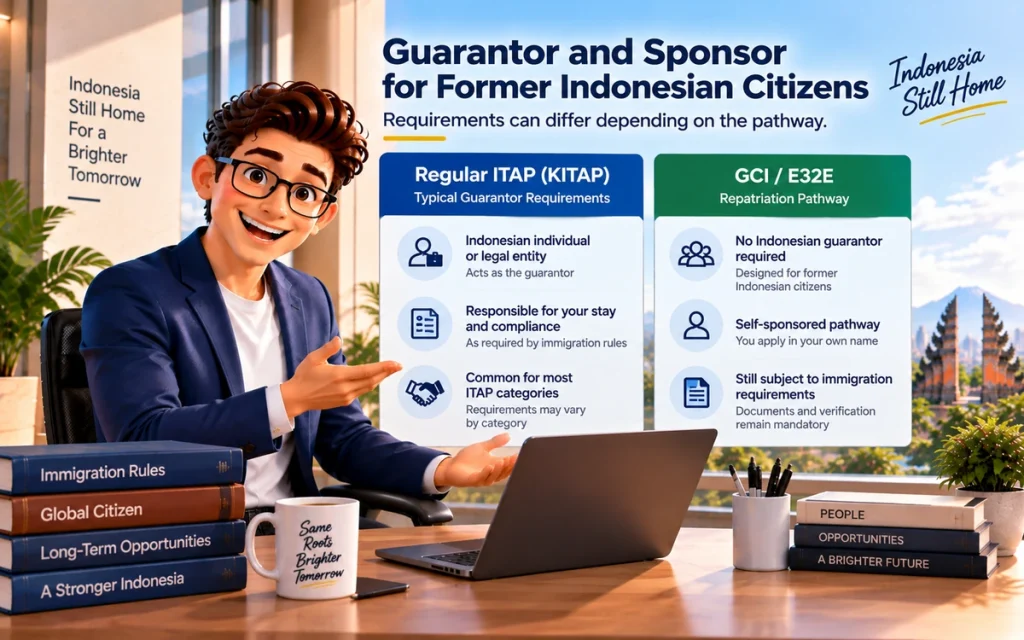
When a Guarantor May Be Required
Official ITAP procedures can require a Surat Jaminan and guarantor information. Some former-WNI procedures state that the application is submitted by the guarantor.
Why Sponsor Requirements Depend on the Immigration Route
Ordinary ITAP sponsor rules should not automatically be applied to every repatriation route. E32E is a GCI visa category with its own current requirements.
KITAP vs GCI/E32E Sponsor Rules
Do not state that all former Indonesian citizens need an Indonesian sponsor. First determine the applicable ITAP, ITAS-to-ITAP, direct ITAP or GCI/E32E route.
8. How to Apply for Former Indonesian Citizen KITAP
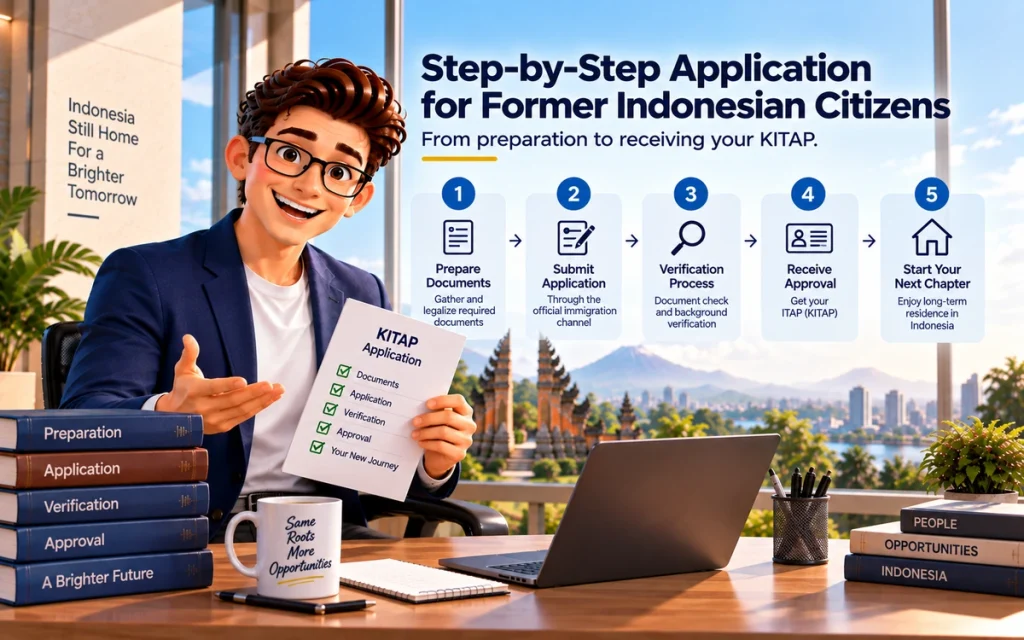
Step 1 — Determine the Applicable Immigration Pathway
Determine whether the applicant is pursuing direct ITAP, ITAS-to-ITAP, another permanent-stay category, or GCI/E32E.
Step 2 — Prepare Supporting Documents
Collect evidence of current foreign citizenship, former Indonesian citizenship, loss/change of citizenship where applicable, passport, civil/family documents and guarantor information where required.
Step 3 — Submit the Immigration Application
Use the applicable Immigration system. GCI applications are submitted online through evisa.imigrasi.go.id; other ITAP procedures may involve an Immigration office and guarantor.
Step 4 — Immigration Verification
Immigration reviews the application and may request corrections or supplementary documents.
Step 5 — Approval and Issuance of ITAP/KITAP
Once approved and requirements are completed, ITAP can be issued.
9. How Long Does Former Indonesian Citizen KITAP Last?
There is no single duration that applies to every former Indonesian citizen.
KITAP Validity Depends on the Applicable Category
Current official tariff information distinguishes ITAP periods up to 5 years, up to 10 years, and unlimited.
Fixed-Term ITAP vs Indefinite Permanent Stay
The system includes fixed-duration ITAP and an indefinite category. GCI also provides indefinite permanent residence to eligible applicants.
Renewal, Extension, or Status Continuity
Fixed-term ITAP holders must follow the applicable extension/renewal procedure and maintain immigration compliance.
10. How Much Does Former Indonesian Citizen KITAP Cost?
Government fees depend on the type and duration of ITAP and related services.
Indonesian Government Immigration Fees
Current Yogyakarta official tariff information lists Rp7,000,000 for ITAP up to 5 years, Rp12,000,000 up to 10 years, and Rp15,000,000 for an unlimited period. Separate re-entry permit fees may apply.
ITAP and Related Immigration Fees
Total government cost depends on duration, route, status transfer, re-entry permit and other applicable services.
Re-Entry Permit and Other Possible Charges
Re-entry permits are separate immigration services.
Professional Assistance Fees Are Separate
Consultant/lawyer fees are separate from government PNBP. Confirm the applicable official tariff for the exact service and application route.
11. What Can You Do With KITAP in Indonesia?
Living in Indonesia
The primary purpose of ITAP is permanent residence under the applicable immigration framework.
Leaving and Re-Entering Indonesia
International travel and re-entry remain subject to applicable immigration documents and re-entry permit requirements.
Working in Indonesia
KITAP should not automatically be treated as a universal work permit. Employment and regulated professional activities may require separate compliance.
Business and Investment Activities
KITAP is not itself a business licence. Corporate, licensing, investment, tax and sector rules may still apply.
Family and Household Considerations
Family members do not automatically receive the same immigration status as a KITAP holder.
12. What Are the Limitations of KITAP?
KITAP Does Not Grant Indonesian Citizenship
KITAP does not itself restore Indonesian citizenship.
KITAP Does Not Replace Sector-Specific Licenses
KITAP is not a work authorization, business licence, professional licence or citizenship.
Immigration Reporting and Compliance
Permanent residents remain subject to Indonesian immigration rules and compliance obligations.
Status Can Be Affected by Changes in Circumstances
Changes in citizenship, immigration status, family circumstances or other material facts may affect the immigration position.
13. Does KITAP Restore Indonesian Citizenship?
No. KITAP is an immigration residence status and does not by itself restore Indonesian citizenship.
KITAP Is an Immigration Status
ITAP allows an eligible foreign national to reside permanently under Indonesian immigration law.
Indonesian Citizenship Is a Separate Legal Status
Citizenship is governed by nationality law, not simply by possession of ITAP.
KITAP and Citizenship Applications Are Different Processes
Former Indonesian citizen → KITAP does not automatically mean former Indonesian citizen → Indonesian citizen again.
14. Former Indonesian Citizen KITAP vs E32E Repatriation Visa
KITAP/ITAP is the permanent-stay status. E32E is a specific Permanent Resident Repatriation Visa under the GCI framework.

Why the Difference Matters
The official GCI announcement states that eligible GCI eVisa holders receive indefinite ITAP after entry under the announced process. E32E is therefore a route to a permanent-residence outcome, while KITAP/ITAP describes the status.
15. Former Indonesian Citizen KITAP vs GCI
What GCI Is
Global Citizen of Indonesia is a policy launched by Indonesian Immigration in January 2026 providing indefinite permanent residence to eligible foreign nationals with qualifying Indonesian ties without changing their existing citizenship.
How Former Indonesian Citizens Fit Into GCI
Former Indonesian citizens are included among GCI subjects; E32E is the dedicated permanent-resident repatriation category.
Why GCI and KITAP Should Not Be Treated as Identical Terms
KITAP/ITAP = residence status; GCI = immigration policy/framework; E32E = a specific GCI visa route.
16. KITAP vs KITAS for Former Indonesian Citizens
KITAS/ITAS is limited stay; KITAP/ITAP is permanent stay. Certain ITAS categories may qualify for status transfer, while former WNI are separately recognized within the ITAP framework.
17. Former Indonesian Citizen KITAP vs E32A, E32C, E32D and E32F
E32A is a 5-year Repatriation Golden Visa; E32C is a 2-year Repatriation Visa; E32D is a 1-year Repatriation Visa; E32E is Permanent Resident Repatriation under GCI; E32F is Special Expertise Repatriation under GCI; KITAP/ITAP is the permanent stay status.
18. Common Mistakes Former Indonesian Citizens Should Avoid
Assuming KITAP Automatically Restores Citizenship
It does not.
Assuming Every Former WNI Follows the Same Path
The route depends on the applicant’s circumstances.
Using an Outdated Three-Year Rule
Do not apply a three-year rule universally to former WNI.
Confusing E32E With KITAP
E32E is a visa route under GCI; KITAP/ITAP is the residence status.
Using Unverified Fee or Processing-Time Information
Use current official Immigration sources.
Failing to Prepare Evidence of Former Indonesian Citizenship
Collect historical documents before starting the application.
19. Frequently Asked Questions About Former Indonesian Citizen KITAP
Can a former Indonesian citizen get KITAP in Indonesia?
Yes. Former Indonesian citizens are expressly recognized as a category that may be granted ITAP, subject to the applicable requirements and procedure.
Can an ex-WNI get KITAP directly?
Potentially, depending on the applicant’s category and circumstances. Current Immigration services distinguish direct ITAP categories from status-transfer procedures.
Does a former Indonesian citizen need KITAS before KITAP?
Not necessarily. There is no universal rule requiring every former Indonesian citizen to hold KITAS for a fixed period before KITAP.
What documents prove former Indonesian citizenship?
Possible evidence includes a former Indonesian passport/travel document, KTP/e-KTP, birth certificate, diploma and other recognized documents.
Does KITAP restore Indonesian citizenship?
No. KITAP is an immigration residence status and does not automatically restore citizenship.
Is KITAP the same as E32E?
No. KITAP/ITAP is a permanent-stay status; E32E is a specific Permanent Resident Repatriation Visa under GCI.
Is GCI the same as KITAP?
No. GCI is the policy/framework; KITAP/ITAP is the residence status.
Can a KITAP holder work in Indonesia?
KITAP should not automatically be treated as a universal work permit. Separate employment and sector rules may apply.
How much does KITAP cost?
Government fees depend on the applicable ITAP duration and service; official tariffs include separate 5-year, 10-year and unlimited categories plus possible re-entry permit fees.
How long does KITAP last?
The applicable period depends on the category and procedure; current official tariffs recognize up to 5 years, up to 10 years and unlimited ITAP.
20. Need Help With Your Former Indonesian Citizen KITAP?
If you are a former Indonesian citizen and want to understand your KITAP eligibility, immigration pathway, required documents, or the difference between KITAP and E32E/GCI, our immigration team can help you review your situation and explain the applicable options.
Contact Azra Solutions for immigration assistance in Indonesia.
Official Sources
Directorate General of Immigration — ITAP / former Indonesian citizen provisions
Kantor Imigrasi Yogyakarta — Standar Pelayanan 2026
Kantor Imigrasi Jakarta Pusat — ITAP without status transfer
Kantor Imigrasi Jakarta Pusat — ITAS to ITAP
Directorate General of Immigration — Visa ClassificationGlobal Citizen of Indonesia — official announcement