Introduction
Foreign musicians and singers planning to perform in Indonesia should identify the correct immigration route before confirming travel, rehearsals, concerts, festivals, or other professional engagements. The appropriate route depends on what the foreign national will actually do in Indonesia, the nature and duration of the engagement, the Indonesian organiser or sponsor, and whether the arrangement amounts to employment in Indonesia.
The Indonesia Musician Visa topic is not limited to the person standing on stage. A production may involve solo performers, band members, DJs, instrumentalists, tour personnel, sound engineers, lighting technicians, stage crew, and other supporting professionals. These people have different functions and may not all qualify under the same category.
Indonesia’s immigration classification includes C7A for a music performer and C7B for a music performer’s crew. Separately, immigration stay-permit information lists E23R as a limited-stay work visa for an artist. These categories are not interchangeable. C7A and C7B relate to specified music-performance and crew activities, while E23R is identified as an artist work route.
This guide explains the distinctions, issues event organisers should check, documents commonly relevant to an application, and practical steps before travel. Visa indexes, stay periods, fees, and online requirements can change, so applicants must verify the current category and checklist on the official eVisa portal. For a broader overview of related professional immigration routes, see our Indonesia work visa guide.
Understanding the Indonesia Musician Visa
A visa category should be selected by reference to the activity the foreign national intends to carry out, not merely the job title used in a contract, poster, or itinerary. A person described as a musician may be a visiting performer for a specific event, a member of a touring production team, or an artist engaged to work in Indonesia under a continuing arrangement. Those circumstances require separate assessment.
An organiser should prepare a clear description of the engagement. It should identify the event, venue, dates, role of each foreign national, whether the person will perform or provide technical support, who is responsible for the engagement, and whether there is an employment relationship with an Indonesian individual or entity. This information helps determine which route should be assessed.
An event visa does not automatically authorise every activity connected with entertainment. A visa issued for a particular performance or crew role should not be assumed to authorise unrelated work, a different engagement, or a change in the person’s actual role. The visa approval and its conditions remain central.
C7A Music Performer Visa Indonesia
C7A is identified in official immigration material as the Music Performer visa. It is relevant to foreign nationals whose principal activity in Indonesia is a music performance within the scope permitted by the category. The official eVisa guide published by the Yogyakarta Immigration Office in October 2026 lists C7A as single-entry with a 30-day stay description. Applicants must check the live portal because application conditions and available options may be updated. The published classification reference is the 2025 Visa Classification Decree, while the operational category list is shown in the Yogyakarta Immigration eVisa User Guide (October 2026).

Potential performers may include solo singers, vocalists, band members, instrumentalists, DJs, and other people whose principal role is to perform music. The label alone is not decisive. The applicant’s actual duties, event documents, and current official category description should be reviewed.
An important restriction must be understood: the official C7A classification states that the holder is not permitted to work in an employment relationship with an individual or corporation in Indonesia. Organisers should not assume C7A can be used for any arrangement simply because the person appears on stage. The legal character of the engagement and the permitted activity must be examined.
An overseas band invited to give a defined concert appearance may need assessment under the music-performer category. A foreign vocalist hired to fill an ongoing position at an Indonesian venue may have a different immigration and manpower profile. Both people sing, but their legal circumstances are not necessarily the same.
Organisers should retain consistent supporting information: event invitation or agreement, schedule, venue details, performance description, sponsor information, and each performer’s role. These materials should accurately reflect the actual engagement.
Who May Apply for C7A?
Potential applicants may include solo singers, vocalists, band members, instrumental performers, and DJs whose activity is genuinely a music performance. Whether a particular format is covered should be checked against the current official description and live application options.
Band members should not assume one application or one role description automatically covers every person travelling with the group. Each foreign national should be assessed individually. A lead singer, guitarist, drummer, DJ, tour manager, and sound technician do not necessarily perform the same function for immigration purposes.
A person combining performance with production, management, technical, or other duties should disclose those functions accurately. If the activities extend beyond the permitted scope, the organiser should seek clarification before travel or commencement of the additional activity.
C7A for Concerts, Festivals, Club Shows, and Music Events
Concerts and festivals often involve a defined event period, venue, organiser, and group of visiting performers. These details are useful when assessing a short-term performance route. A club appearance or private event should not automatically be treated as identical to a large concert: the actual arrangement, sponsor, documents, and activity remain relevant.
An organiser should prepare a performer list and identify each person’s role. The list should distinguish performers from production and technical crew. It should match the event schedule, invitation documents, and application information. Where an event includes several venues or dates, the itinerary should be disclosed and checked against the visa conditions.
Do not assume that a visa for one event authorises an unrelated performance for another organiser. If the itinerary changes, review whether the change is allowed and whether additional immigration steps are required.
C7B Music Performer Crew Visa Indonesia
C7B is identified in official immigration material as the Music Performer Crew visa. It is intended for eligible personnel supporting a music performance, rather than a person whose main role is to perform as a musician or singer. The official eVisa guide published by the Yogyakarta Immigration Office in October 2026 lists C7B as single-entry with a 30-day stay description. Check the live portal before every application. The operational category list is shown in the Yogyakarta Immigration eVisa User Guide (October 2026).

Depending on the event and official scope, supporting personnel may include sound engineers, lighting technicians, stage crew, production staff, and other technical or operational personnel supporting the performance. A tour manager or production manager may require closer assessment because the title can cover different duties. The person’s actual function matters more than the label on a business card.
A crew member should not apply under C7B merely because they travel with a band. The organiser should explain how the individual supports the music performance and why the role fits the relevant category. A performer should not be described as crew to avoid performer requirements.
Event documents should identify the crew member’s role, technical or operational function, event dates, and relationship with the organiser or sponsor. If the person will also perform on stage, provide services to another business, or undertake work beyond supporting the music event, those activities should be reviewed separately.
Who Is Considered Supporting Music Crew?
Supporting music crew can include professionals who prepare, operate, or deliver the technical and production elements of a performance. Examples may include audio engineers, lighting operators, stage technicians, backline technicians, and production personnel. These examples do not guarantee that every person with such a title qualifies: the official visa description and actual duties must be considered.
A manager’s title does not settle the issue. A tour manager coordinating a travelling group may have a different role from an Indonesia-based manager employed to run a venue or entertainment business. A production manager may be directly involved in the performance or may have broader business responsibilities. Describe the work in practical terms.
Where a person has mixed duties, do not conceal any part of the role. If the duties do not clearly fit the crew category, obtain clarification before filing.
E23R Artist Work Visa
An official immigration stay-permit information page lists E23R as a limited-stay work visa for an artist. This establishes that E23R is recognised in immigration information as an artist work route. It should not be treated as an automatic route for every foreign musician, singer, DJ, or touring-group member. The related guide for creative professionals outside the music sector is our Indonesia Artist Work Visa guide. The E23R service listing can be reviewed on Jakarta Pusat Immigration’s ITAS information page.
The suitability of E23R depends on the proposed work, the foreign national’s role, the Indonesian employer or sponsor, and the current requirements attached to the category. Applicants should verify whether E23R is available for their circumstances in the live eVisa system and confirm sponsor and supporting-document requirements before relying on it. Published visa-classification materials and operational immigration service listings may not present every code in exactly the same way. Applicants should read the classification decree together with current operational guidance and confirm the code available in the live system before filing. 2025 Visa Classification Decree and official Indonesian eVisa portal.
A foreign musician engaged for a continuing position, recurring performances, or an employment arrangement with an Indonesian organisation may need a work-permit and immigration assessment rather than assuming a short-term event category is sufficient. Conversely, a one-off performance does not automatically mean E23R is required. The correct route cannot be determined by payment alone or by the word artist in a contract.
Where an employment relationship exists, the Indonesian employer’s obligations under the foreign-worker framework must be considered. Government Regulation No. 34 of 2021 regulates the use of foreign workers, including the employer’s RPTKA obligations and related requirements. Minister of Manpower Regulation No. 8 of 2021 provides implementing rules. Whether an employer or arrangement is subject to an exception must be assessed under the applicable provisions. The principal manpower references are Government Regulation No. 34 of 2021 and Minister of Manpower Regulation No. 8 of 2021.
Before an E23R application, confirm the legal identity of the employer or sponsor, proposed position and duties, work location, intended period, relevant manpower approvals or exemptions, and current immigration checklist. Visa classification and manpower compliance are related but distinct legal questions.
C7A vs C7B vs E23R: Which Route Should You Consider?
The key distinction is the purpose and nature of the activity. C7A is the music performer category. C7B is the music performer crew category. E23R is listed as a limited-stay work visa for an artist. Compare the categories by looking at the person’s real role, the event or employment arrangement, and conditions in the current official system.
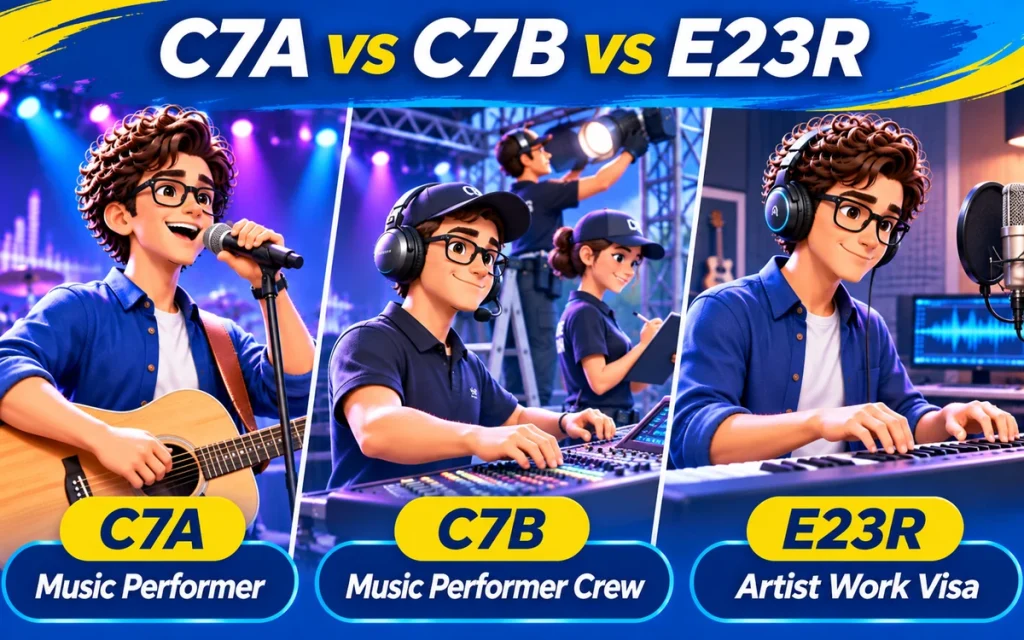
C7A is the category to assess where the foreign national’s principal activity is a music performance and the arrangement fits the official C7A scope. C7B is the category to assess where the person genuinely supports the music performance as crew. E23R may be relevant where the proposed arrangement is artist work under the applicable limited-stay work framework.
Do not select a category solely because it appears faster, cheaper, or more convenient. A mismatch between the visa and actual activity can create immigration and employment compliance risks for both the foreign national and Indonesian organiser. Where the facts are unclear, obtain case-specific advice before travel.
Requirements and Supporting Documents
Document requirements vary by category, sponsor type, nationality, and the current eVisa application process. The following is a preparation guide, not a substitute for the live checklist displayed by the immigration system.
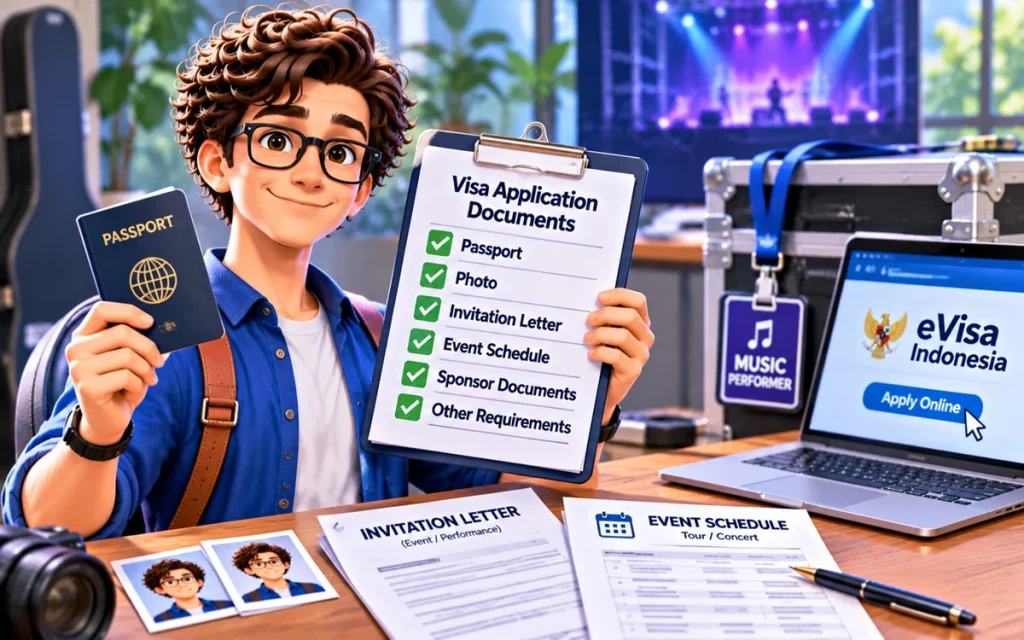
Personal and travel documents commonly include a valid passport, a recent photograph where requested, travel details, and other identity information required by the online application. Passport validity rules should be checked for the specific category and applicant circumstances.
Event and performance documents may include an invitation or engagement letter, event agreement, performance schedule, venue information, event organiser details, and a clear description of the applicant’s role. For a band or group, a roster identifying each member and their function can help keep applications consistent.
For C7B applicants, supporting documents should explain the technical or operational role and its connection to the music performance. A job title without a practical description may not adequately explain why the person is crew rather than a performer or another type of worker.
For E23R, the employer or sponsor should verify the current requirements for the artist work category. Depending on the applicable process, relevant materials may include corporate information, proposed position and duties, employment or engagement documents, manpower approvals or evidence of an applicable exemption, and documents requested by the eVisa system.
Do not submit inconsistent dates, job titles, sponsor details, or event descriptions. If an event is postponed, the venue changes, or the applicant’s role changes, check whether the application or issued visa needs to be updated. An old checklist is not proof that the same documents are currently required.
Need help reviewing the visa route for your performers or music crew?
Azra Solutions can help assess the proposed activity, performer and crew roles, Indonesian sponsor, and supporting documents before an application is submitted.
How to Apply for a C7A Music Performer Visa
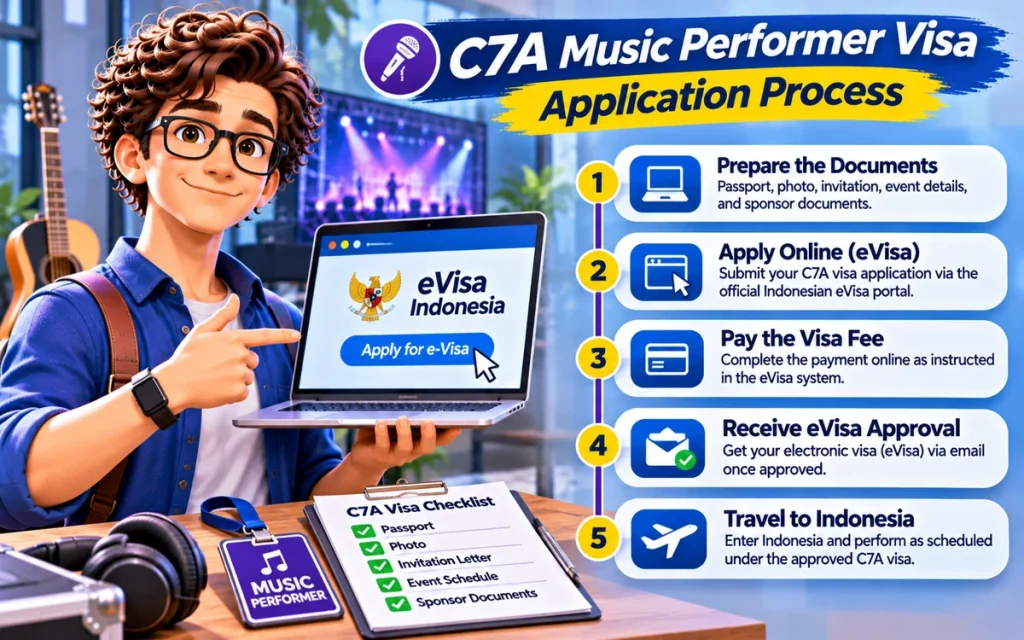
Step 1 – Confirm the performance. Identify the exact music activity, event dates, venue, organiser, and applicant’s role. Confirm that the activity is within the current C7A description.
Step 2 – Identify the appropriate sponsor. Confirm who is legally able and willing to act as sponsor or guarantor under current application rules. Being the event organiser does not automatically satisfy every sponsor requirement.
Step 3 – Prepare documents. Collect passport and personal information requested by the portal, together with accurate event and performance documents. Check that names, dates, and roles match across all records.
Step 4 – Submit through the official system. Use the official Indonesian eVisa portal and select the category matching the actual activity. Follow live instructions and pay only fees displayed through the official process.
Step 5 – Review approval. Before travel, check visa details, validity, permitted activity, entry conditions, and stay period. Keep access to the approval and supporting event information.
Step 6 – Perform within the approved scope. Do not assume the visa authorises employment or unrelated activities. Check any proposed change before it takes place.
How to Apply for a C7B Music Performer Crew Visa
Step 1 – Define the crew role. Prepare a practical description of technical or operational duties and explain how the person supports the music performance.
Step 2 – Confirm event and sponsor. Identify the event organiser, venue, dates, and party that will act as sponsor or guarantor under current rules.
Step 3 – Prepare consistent documents. Collect personal and travel information, event documents, crew lists, and a role description. Do not classify a performer as crew if that is not their actual role.
Step 4 – Submit the application. Use the official eVisa portal and follow the current C7B checklist and payment instructions.
Step 5 – Check visa conditions. Before departure, confirm the approval matches the applicant’s identity, travel plan, and supporting role. The crew member should remain within the approved scope in Indonesia.
How to Assess an E23R Artist Work Visa Application
Step 1 – Review the work arrangement. Determine whether the foreign artist will be employed by an Indonesian organisation, the expected duties, work location, and intended duration.
Step 2 – Confirm employer or sponsor. Check that the Indonesian entity is eligible to undertake the relevant sponsorship and employer responsibilities.
Step 3 – Review manpower compliance. Assess the RPTKA framework under Government Regulation No. 34 of 2021 and implementing rules, including whether a specific exception applies. Do not assume an exemption based only on the applicant’s artistic profession.
Step 4 – Verify the current E23R route. Confirm that E23R is available for the proposed case in the live immigration system and obtain the current document checklist.
Step 5 – Prepare and submit. Ensure immigration documents, employment information, and manpower records are accurate and consistent.
Step 6 – Observe work and stay conditions. After approval, comply with the approved position, sponsor obligations, work location, period, and applicable reporting or extension procedures.
Special Situations for Foreign Music Performers
International DJs performing at Indonesian clubs should distinguish a one-off guest performance from a recurring or resident engagement. A guest appearance may be assessed differently from an ongoing position with an Indonesian venue. Disclose the full schedule and commercial arrangement.
Foreign singers invited to a concert or festival should have the event and performance details documented. If the singer will also participate in promotional appearances, rehearsals, media activities, or other events, check whether those activities are included in the permitted scope.
International bands touring several Indonesian cities should not assume one event document automatically covers every venue or organiser. Review the itinerary, event parties, and changes against the visa conditions.
Music producers and session musicians require careful role assessment. A person performing music as part of a live event may differ from a producer engaged to provide studio services, create recordings, or work on a continuing project in Indonesia. Describe the activity accurately before choosing a category.
Resident musicians working for Indonesian venues present a different fact pattern from visiting performers. A continuing role, regular schedule, or employment arrangement may raise work authorisation and manpower questions. Obtain advice on the appropriate work route rather than treating each appearance as an isolated event.
Festival organisers should create a complete personnel matrix before applications begin. Separate performers, technical crew, production management, event staff, and other foreign professionals. Identify each person’s sponsor, duties, event dates, and intended visa category.
Common Mistakes When Applying
Using a tourist visa for an activity that is actually a professional music performance or work is a serious planning mistake. A visitor should not assume that a tourist or general visit category authorises a professional engagement.
Confusing performers with crew can lead to a category mismatch. A musician who performs on stage should not be classified as technical crew merely because they travel with a production team. A sound engineer should not be described as a performer if their actual role is technical support.
Payment alone does not determine the visa category. The analysis must consider the official activity description, employment relationship, sponsor, and actual work undertaken.
Outdated checklists are another risk. Visa indexes, stay periods, fees, and online requirements can change. A checklist used for a previous tour or a different nationality is not current authority.
Incomplete or inconsistent event details can also cause problems. Differences between the invitation letter, event schedule, crew list, sponsor information, and application form may lead to questions or delays. Prepare accurate information and use it consistently.
Immigration and Employment Compliance
Foreign nationals should carry out only activities permitted by their visa and stay authorisation. A visa should not be treated as general permission to work in the Indonesian entertainment industry. A change in role, employer, venue, event, or duration may require a fresh assessment.
Indonesian sponsors and employers should ensure that submitted information is accurate and that their responsibilities are understood. Where the arrangement is employment, the foreign-worker framework must be reviewed separately from the immigration visa classification.
Employers should assess whether an RPTKA is required and whether a statutory exception applies. The existence of an artist visa category does not by itself prove that every manpower obligation is waived. Equally, a performance visa does not automatically mean that every short-term performer is in an employment relationship. The facts and applicable rules control.
Before each engagement, confirm the current official visa category, sponsor requirements, documents, validity, permitted activities, and applicable manpower approval. Keep copies of the visa approval, event documents, and relevant correspondence.
Frequently Asked Questions
What visa do foreign musicians need to perform in Indonesia?
The route depends on the activity and arrangement. C7A is identified as Music Performer, C7B as Music Performer Crew, and E23R as a limited-stay work visa for an artist. Confirm the route in the live eVisa system.
What is the C7A Music Performer Visa?
C7A is the category identified for music performers. The October 2026 Yogyakarta Immigration guide lists it as single-entry with a 30-day stay description. Check the live portal for current requirements.
What is the C7B Music Performer Crew Visa?
C7B is identified for eligible crew supporting a music performance. The applicant’s actual technical or operational role should fit the official category.
Can foreign singers receive payment under C7A?
Do not decide the category only by whether payment is made. The official C7A classification includes a restriction on working in an employment relationship with an individual or corporation in Indonesia. Review the specific payment and engagement structure.
Can DJs use C7A in Indonesia?
A DJ whose principal activity is a music performance may need assessment under C7A. Check the exact performance format and engagement against the current official description.
Does a concert crew member need C7B?
C7B may be relevant for eligible music-performance crew. Confirm that the person’s actual duties support the performance and fit the official category.
What is the difference between C7A and C7B?
C7A is identified for music performers; C7B is identified for music performer crew. The distinction is based on actual function, not simply whether people travel with the same band.
Can foreign musicians work in Indonesia under E23R?
E23R is listed as a limited-stay work visa for an artist. Eligibility and availability for a particular musician must be verified in the current eVisa system, together with employer and manpower requirements.
Does an Indonesian promoter need to sponsor foreign musicians?
Sponsor or guarantor requirements depend on the selected category and current rules. The promoter should confirm whether it is eligible to act as sponsor or whether another entity must do so.
Can foreign musicians perform in multiple Indonesian cities?
Do not assume a visa for one event automatically covers every additional venue or organiser. Review the itinerary and arrangements against the visa conditions.
What documents are needed for a music performer visa?
The live eVisa checklist controls. Preparation commonly involves passport and personal information, event invitation or engagement documents, schedule, venue and organiser details, and an accurate role description. Additional documents may be required.
Can foreign musicians use a tourist visa for concerts?
A tourist visa should not be assumed to authorise a professional music performance. Match the activity to the appropriate official category before travel.
Conclusion: Choosing the Right Indonesia Musician Visa
Foreign musicians, singers, DJs, and music-production professionals should identify their actual role before travelling to Indonesia. C7A is the category identified for music performers, C7B for supporting music crew, and E23R is listed as an artist work visa under the limited-stay framework. Each route has a different purpose and must be assessed against current official conditions.
For event organisers, the safest starting point is a clear personnel list, accurate description of each person’s duties, complete event information, and confirmation of sponsor requirements. For continuing artist engagements or employment arrangements, immigration and manpower compliance should be reviewed together.
Azra Solutions can assist with reviewing the proposed activity, identifying immigration questions that need to be checked, and coordinating supporting documents. The correct route should always be confirmed against official rules and the applicant’s specific circumstances.
Contact Azra Solutions for assistance reviewing your proposed music performance, crew roles, sponsor, and visa documentation.
Official References and Legal Sources
Official Indonesian eVisa Portal: https://evisa.imigrasi.go.id/. Live visa index, current eligibility, sponsor rules, checklist, fees, and conditions.
Yogyakarta Immigration – eVisa User Guide (October 2026) . Lists C7A Music Performer and C7B Music Performer Crew as single-entry 30-day categories.
Yogyakarta Immigration – Music and Art Visa. Historical official example distinguishing C7A performers and C7B crew; not a current checklist.
Jakarta Pusat Immigration – Stay Permit Information. Lists E23R as a limited-stay work visa for an artist.
Government Regulation No. 34 of 2021. Foreign-worker framework and RPTKA requirements.
Minister of Manpower Regulation No. 8 of 2021. Implementing regulation for the use of foreign workers.
- Official Indonesian eVisa Portal – Current visa index, application checklist, sponsor rules, fees, and conditions.
- 2025 Visa Classification Decree – Published visa classification and permitted-activity reference.
- Yogyakarta Immigration eVisa User Guide (October 2026) – Operational list for C7A Music Performer and C7B Music Performer Crew.
- Jakarta Pusat Immigration ITAS Information – Public service listing identifying E23R as an artist work route.
- Government Regulation No. 34 of 2021 – Foreign-worker framework and RPTKA requirements.
- Minister of Manpower Regulation No. 8 of 2021 – Implementing regulation for the use of foreign workers.
Important information: Immigration classifications, eligibility, sponsor requirements, permitted activities, stay periods, fees, and application procedures may change. Always check the current official eVisa portal and applicable regulations before travel or submission. This article provides general information and does not guarantee visa approval.