Quick Answer
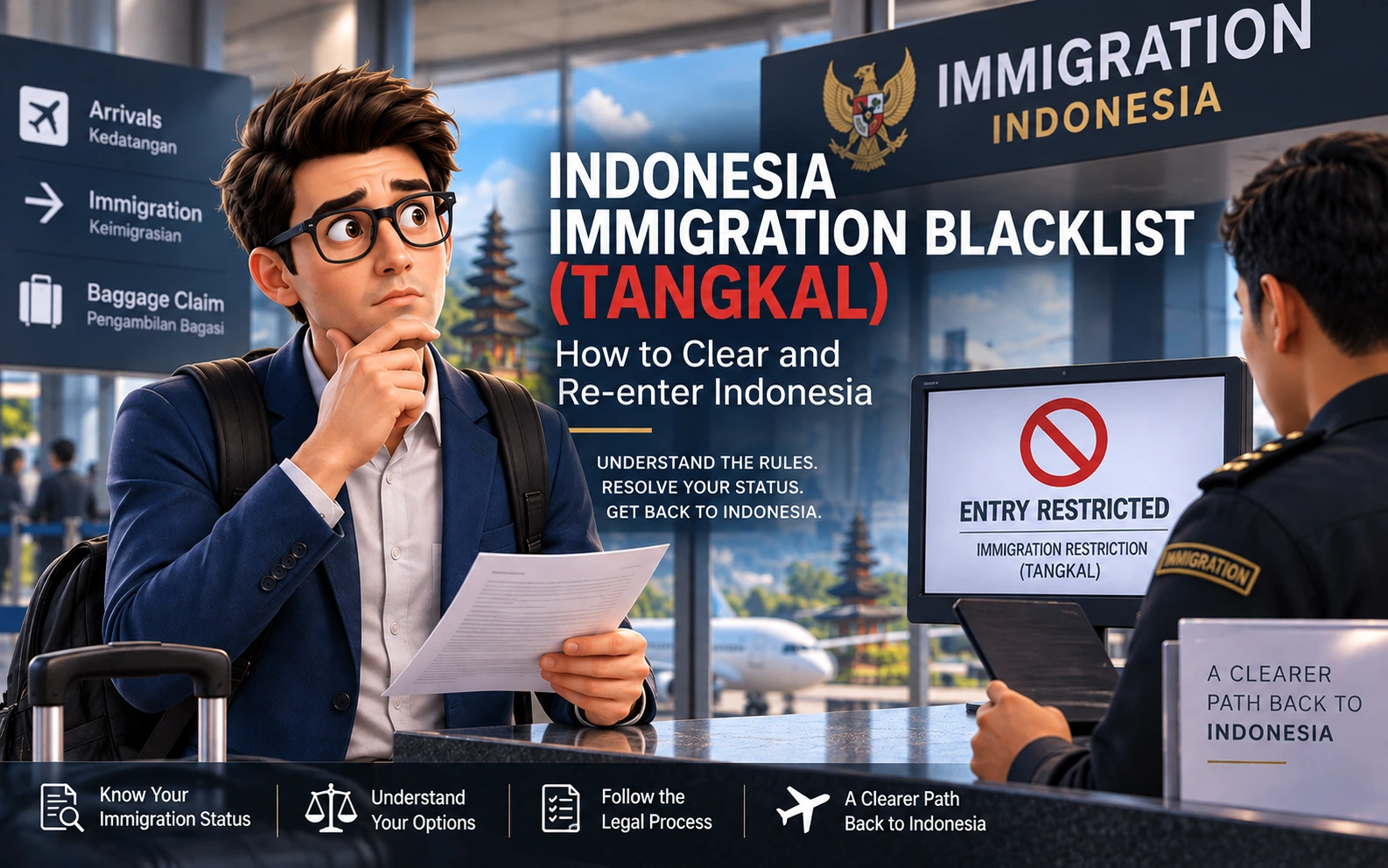
Indonesia’s immigration blacklist is commonly referred to as Tangkal or Penangkalan. In Indonesian immigration law, Penangkalan is an immigration restriction that can prevent a foreigner from entering Indonesia.
If you are subject to an active Penangkalan, an Immigration Officer must refuse your entry into Indonesia. Obtaining a new visa does not by itself override an active Penangkalan.
Under Law No. 63 of 2024 (UU No. 63 Tahun 2024), Penangkalan may generally be imposed for a maximum of 10 years and may be extended for a maximum of another 10 years. In certain cases involving a foreigner considered capable of disturbing security or public order, a lifetime Penangkalan may be imposed.
Whether a Penangkalan can be revoked before it expires depends on the circumstances and the applicable immigration decision-making process. A foreigner who was previously subject to Penangkalan and wishes to return to Indonesia may submit a written request for revocation to the competent immigration authority.
Because every immigration blacklist case can have different underlying circumstances, the appropriate process should be assessed based on the person’s immigration history, the reason for Penangkalan, and the current immigration records.
Indonesia Immigration Blacklist: Key Facts
| Issue | Key point |
| Legal term | Penangkalan |
| Common term | Tangkal / immigration blacklist |
| Effect | Can prevent a foreigner from entering Indonesia |
| Active restriction | Entry must be refused by an Immigration Officer |
| General maximum period | Up to 10 years |
| Possible extension | Up to another 10 years |
| Lifetime restriction | Possible in certain security or public-order cases |
| Revocation | May be requested in appropriate cases |
| Visa effect | A new visa does not automatically override an active Penangkalan |
| Cost | Depends on the case and applicable government tariff; there is no universal clearance fee |
What Is “Tangkal” or Penangkalan in Indonesia?
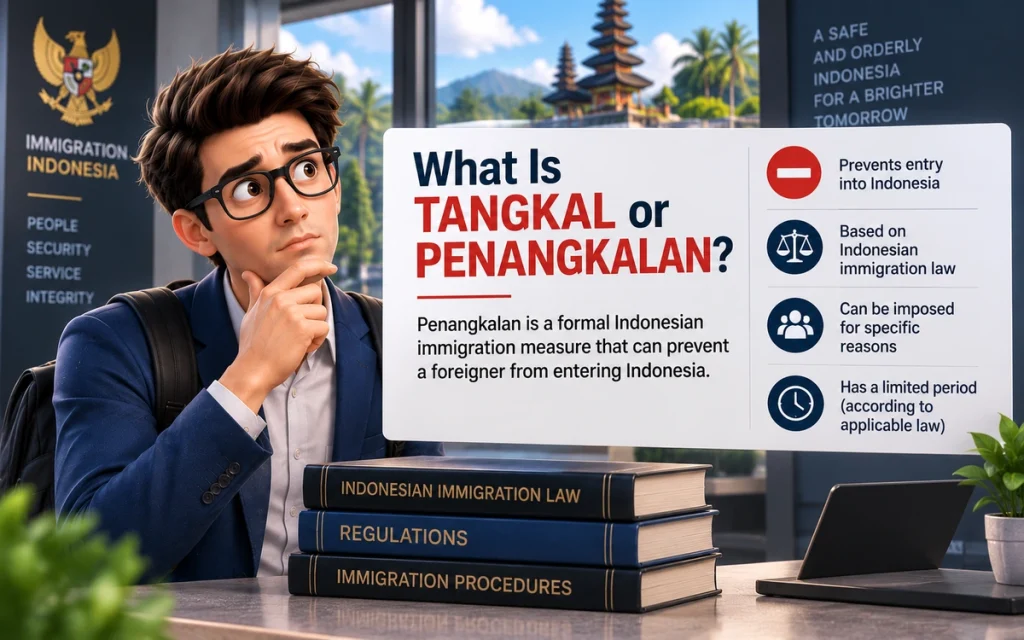
Penangkalan is the formal Indonesian immigration term for a restriction that can prevent a person from entering Indonesia. The term Tangkal is commonly used in Indonesia, while “Indonesia immigration blacklist” is a common English-language search term used by foreigners.
This is more than an informal warning or internal note. Penangkalan is a formal immigration measure with legal consequences for entry into Indonesian territory.
Under Indonesian immigration law, the Minister has authority to impose Penangkalan, while certain authorized officials may request that a person be placed under the restriction.
What Happens If You Are on Indonesia’s Immigration Blacklist?
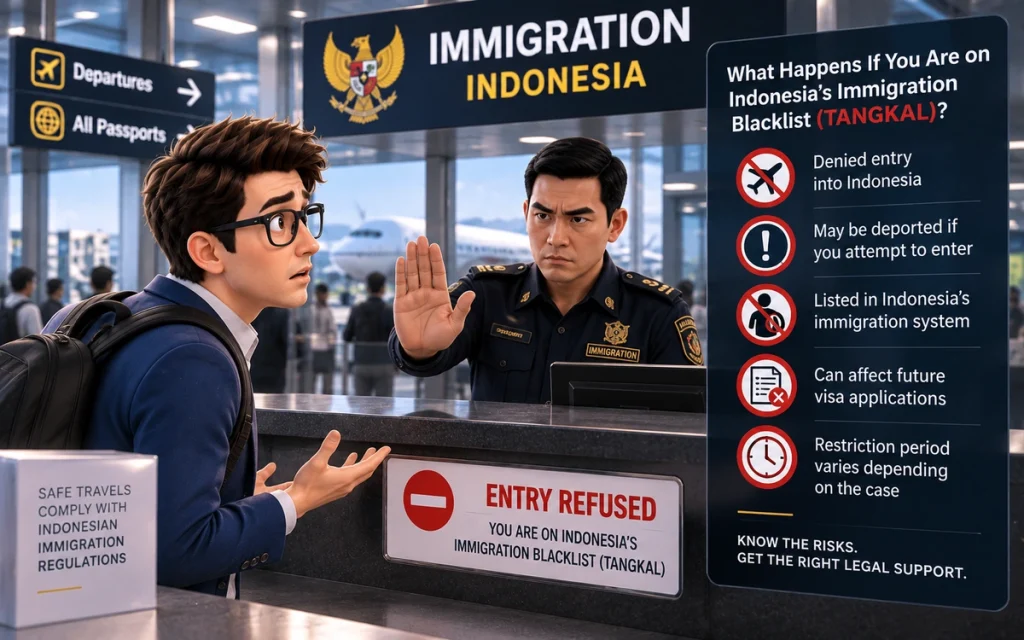
If a foreigner is subject to an active Penangkalan, an Immigration Officer must refuse entry into Indonesia. The restriction therefore has practical consequences at the point of entry.
Having a valid passport or visa does not necessarily resolve the problem. A visa does not automatically cancel or override an active Penangkalan.
If you believe you may be subject to an immigration blacklist, it is safer to clarify your status before making international travel arrangements. Attempting to resolve the issue only after arriving at an Indonesian airport can create avoidable travel and financial complications.
Why Can a Foreigner Be Placed on the Tangkal List?
Penangkalan can arise from different immigration circumstances. Depending on the case, immigration violations and other circumstances may result in immigration administrative measures, including Penangkalan.
One important example is overstay. Under Indonesian immigration rules, a foreigner who overstays for more than 60 days may be subject to deportation and Penangkalan.
Other cases may involve immigration violations, deportation, misuse of immigration facilities, or circumstances considered relevant to security or public order.
The exact reason for a Penangkalan should be determined from the individual’s immigration records and the underlying immigration decision rather than assumed from the fact that entry was refused.
How Long Does Indonesia Immigration Blacklist Last?
The duration of Penangkalan depends on the legal basis and circumstances of the case.
Under Article 102 of Law No. 63 of 2024, Penangkalan may be imposed for a maximum period of 10 years. The restriction may be extended for a maximum of another 10 years.
The same law also provides for the possibility of lifetime Penangkalan for a foreigner considered capable of disturbing security or public order.
For that reason, it is not accurate to describe every Indonesian immigration blacklist as permanent, nor is it safe to assume that every case ends after a fixed short period. The actual duration should be verified from the applicable immigration decision and records.
What Is the Difference Between Penangkalan Expiration and Revocation?
Expiration and revocation are not the same thing.
Expiration refers to the end of the applicable Penangkalan period under the relevant legal framework. Revocation refers to an official decision to remove or otherwise terminate the restriction through the applicable legal process.
A foreigner should therefore not assume that an active Penangkalan has disappeared simply because they believe sufficient time has passed. The current status should be verified through the competent immigration authority.
Can an Indonesian Immigration Blacklist Be Removed?
In appropriate cases, a Penangkalan may be subject to revocation. However, there is no general rule that every immigration blacklist can automatically be removed simply because a foreigner submits a request.
The possibility and procedure depend on the circumstances of the case, the reason for the Penangkalan, the applicable legal provisions, and the competent immigration authority’s assessment and decision.
Official immigration guidance states that a foreigner who was previously subject to Penangkalan and wishes to return to Indonesia may submit a written request for revocation of Penangkalan to the competent immigration authority.
The practical starting point is therefore to establish the basis and current status of the Penangkalan before deciding whether a revocation request is appropriate.
How to Request Revocation of Penangkalan
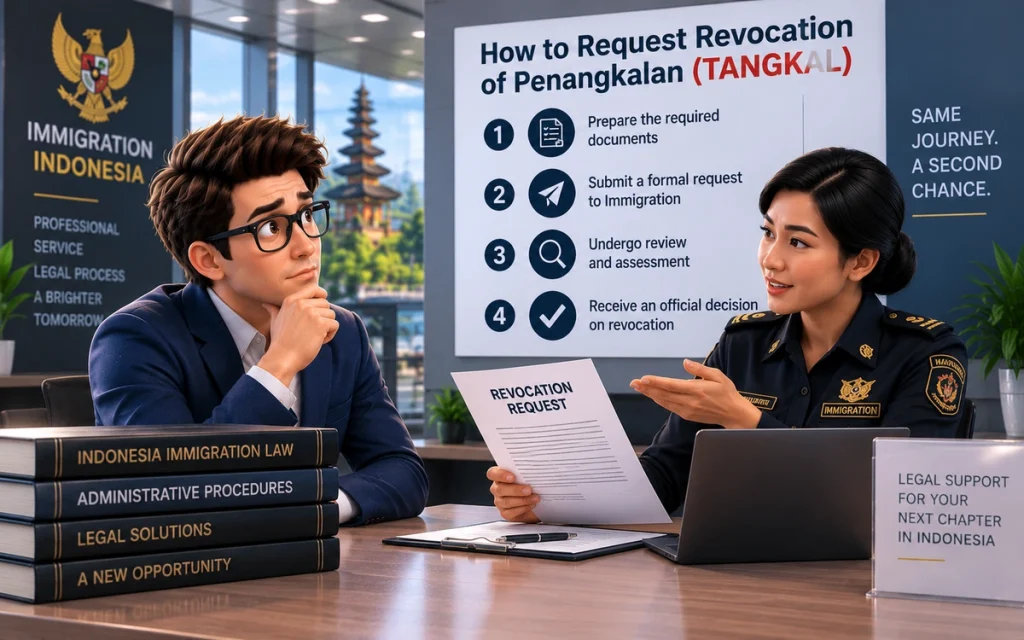
A revocation request should be treated as a formal immigration matter rather than simply as another visa application. The exact procedure can vary according to the circumstances of the case.
- Identify the current Penangkalan status.
- Determine the reason and legal basis for the restriction.
- Review the individual’s immigration history and relevant enforcement records.
- Prepare an appropriate written request and supporting information.
- Submit the request to the competent immigration authority.
- Allow the authority to review the request and make its decision.
Because procedures can vary, foreigners should avoid relying on a generic checklist as though it applied to every Penangkalan case.
What Documents May Be Needed?
There is no single universal document package for every Indonesia immigration blacklist case. The relevant documents depend on the reason for the Penangkalan and the individual’s immigration history.
Depending on the circumstances, relevant information may include:
- Passport and identity information
- Previous visa or stay permit information
- Information concerning the event that resulted in Penangkalan
- Deportation or immigration enforcement documentation, where applicable
- A written explanation or formal request
- Supporting evidence relevant to the circumstances
- Sponsor or guarantor information, where applicable
The exact documents should be determined from the specific immigration record and circumstances of the case. A generic explanation or unrelated documentation may not adequately address the underlying immigration issue.
How Much Does Indonesia Immigration Blacklist Clearance Cost?
There is no universal government fee that applies to every Indonesia immigration blacklist clearance case. Government tariffs can depend on the specific immigration service and the circumstances of the case.
For example, published Directorate General of Immigration tariff information includes a fee of IDR 90,000,000 per application for the revocation of Penangkalan for a foreigner subject to Penangkalan because of an overstay of more than 60 days or failure to pay the applicable burden fee.
This should not be interpreted as a general IDR 90,000,000 clearance fee for every type of Indonesian immigration blacklist. Before making a payment, confirm the official government tariff applicable to the specific case.
Deportation vs. Immigration Blacklist: Are They the Same?
No. Deportation and Penangkalan are different immigration measures.
Deportation concerns the removal of a foreigner from Indonesian territory, while Penangkalan concerns preventing a person from entering Indonesia.
The two measures can, however, arise in connection with the same case. For example, a foreigner who overstays for more than 60 days may be subject to deportation and Penangkalan.
Being deported from Indonesia therefore does not, by itself, establish that a person has a permanent immigration blacklist. The duration and status of any Penangkalan should be assessed separately.
Overstay and Indonesia Immigration Blacklist
Overstay is one circumstance that can lead to serious immigration consequences.
Under Indonesian immigration rules, an overstay of more than 60 days can result in deportation and Penangkalan.
Paying an overstay-related charge should not automatically be assumed to resolve every immigration consequence. Depending on the circumstances, there may also be separate issues involving immigration administrative measures, deportation, Penangkalan, outstanding fees or burden charges, and future visa or entry eligibility.
The consequences should therefore be assessed as a complete immigration case.
Can You Get a Visa After Being Blacklisted?
A foreigner should not assume that applying for a new visa will solve an active Penangkalan.
If a person remains subject to an active Penangkalan, the restriction can prevent entry even if the person otherwise has a visa.
The appropriate sequence is to determine whether a Penangkalan is active and whether it needs to expire or be formally revoked before making new travel or visa arrangements.
After the restriction has ended or been revoked, the foreigner must still satisfy the visa and entry requirements in force at that time.
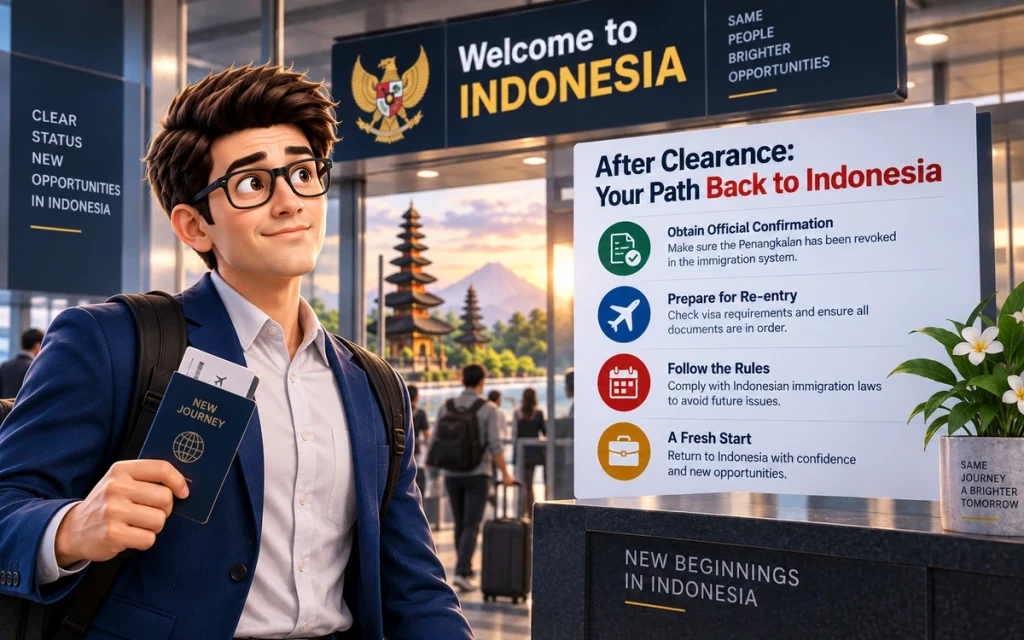
What Happens After Penangkalan Is Revoked?
Revocation of Penangkalan does not automatically guarantee admission to Indonesia.
Once the restriction has been officially revoked or otherwise ended, the foreigner must still comply with the immigration requirements applicable to the intended entry.
- Hold the appropriate visa or immigration facility, where required.
- Have a valid travel document.
- Meet the applicable entry requirements.
- Satisfy immigration eligibility requirements in force at the time of travel.
Revocation should therefore be understood as resolving the specific Penangkalan issue, not as an automatic guarantee of entry.
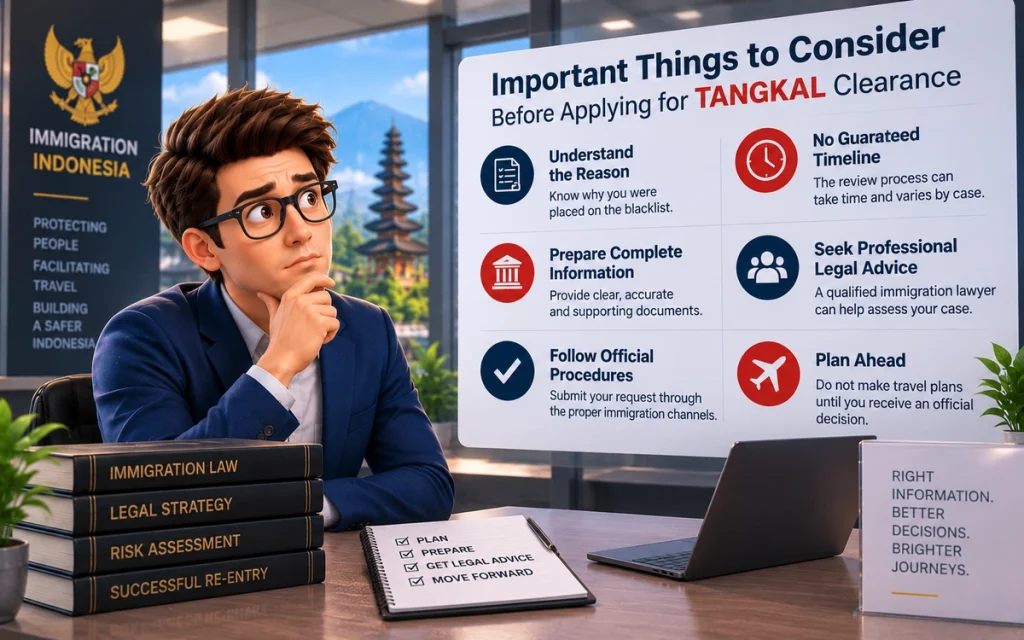
Important Considerations Before Returning to Indonesia
If you believe you may be subject to an Indonesia immigration blacklist, consider clarifying and resolving the issue before booking a flight to Indonesia.
Do not rely only on your visa status. A valid visa does not necessarily mean that an active Penangkalan has been removed.
Determine why the restriction exists. The underlying reason can affect the appropriate legal and administrative approach.
Check whether the restriction is still active. The duration and current status should be verified rather than assumed.
Review your previous immigration history. Previous overstays, deportation, immigration violations, or other enforcement actions may be relevant.
Do not assume another visa type will solve the problem. Changing visa or stay permit categories does not automatically cancel an active Penangkalan.
Resolve the issue before travel. Attempting to return while an active Penangkalan remains in place can result in refusal of entry.
When Should You Seek Immigration Legal Assistance?
Professional immigration assistance can be useful when the underlying immigration history is unclear or when a previous enforcement action may affect your ability to return to Indonesia.
- You were previously deported from Indonesia.
- You believe you may be on the Tangkal list.
- You were refused entry into Indonesia.
- You overstayed for more than 60 days.
- You received an immigration enforcement decision.
- You want to return to Indonesia after deportation.
- You are unsure whether your Penangkalan has expired.
- You want to assess whether a revocation request is appropriate.
- You need help reviewing your immigration history before applying for a new visa.
The objective is not simply to submit another visa application. The underlying immigration restriction should be understood first.
If you need immigration legal support in Bali, our team can help assess the circumstances of your case and identify the appropriate next steps.
What Is the Best Next Step?
If you believe you may be subject to an Indonesia immigration blacklist, the most practical first step is to clarify your current Penangkalan status and the reason for the restriction.
From there, the appropriate course may involve determining whether the restriction is still active, whether it has expired, or whether a revocation request should be considered.
Avoid making international travel or visa decisions based only on assumptions about your immigration status. For complex cases involving deportation, overstay, refusal of entry, or possible Penangkalan, a case-specific assessment before travelling can help prevent avoidable complications.
Need Help With Your Indonesia Immigration Blacklist?
If you believe you may be subject to Penangkalan, our immigration team can help you assess your situation and identify the appropriate next steps before you travel to Indonesia.
Indonesia Immigration Blacklist: Key Takeaways
- Tangkal is commonly used to refer to Penangkalan, a formal Indonesian immigration restriction.
- An active Penangkalan can result in refusal of entry into Indonesia.
- A new visa does not automatically override an active Penangkalan.
- Under UU No. 63 Tahun 2024, Penangkalan may generally last up to 10 years.
- It may be extended for up to another 10 years.
- Lifetime Penangkalan may apply in certain security or public-order cases.
- Expiration and revocation are different concepts.
- A revocation request may be possible in appropriate circumstances.
- There is no universal blacklist-clearance fee for every case.
- A specific published government tariff provides for IDR 90,000,000 per application for certain overstay-related Penangkalan revocation cases.
- Overstay of more than 60 days can lead to deportation and Penangkalan.
- Deportation and Penangkalan are different immigration measures, although they can occur together.
- After Penangkalan ends or is revoked, the foreigner must still satisfy the applicable visa and entry requirements.
- Case-specific assessment is important before attempting to return to Indonesia.
Professional Assistance With Indonesia Immigration Blacklist Matters
An Indonesia immigration blacklist issue can involve more than a visa application. The relevant immigration history, reason for Penangkalan, duration of the restriction, previous enforcement action, and intended return to Indonesia may all need to be considered together.
If you need professional assistance, see our Immigration Lawyer in Bali for Foreigners for case-specific immigration legal support.
Our team can help you understand the relevant immigration issue, review the circumstances of your case, and identify the appropriate legal and administrative steps.
Official Legal References
For the legal framework discussed in this article, refer to official Indonesian government sources, including:
- Law No. 63 of 2024 (UU No. 63 Tahun 2024) concerning amendments to the Immigration Law.
- Law No. 6 of 2011 concerning Immigration (UU No. 6 Tahun 2011 tentang Keimigrasian), as amended.
- Government Regulation No. 31 of 2013 concerning the implementing regulations of the Immigration Law, as amended.
- Official publications of the Directorate General of Immigration, Ministry of Immigration and Corrections of the Republic of Indonesia.
- Official immigration information concerning Penangkalan, deportation, overstay, and immigration administrative measures.
FAQ
What is an Indonesia immigration blacklist?
An Indonesia immigration blacklist is commonly referred to as Tangkal or Penangkalan. It is a formal immigration restriction that can prevent a foreigner from entering Indonesia.
How long does an Indonesia immigration blacklist last?
Under UU No. 63 Tahun 2024, Penangkalan may generally be imposed for up to 10 years and may be extended for up to another 10 years. Lifetime Penangkalan may apply in certain security or public-order cases.
Can an Indonesia immigration blacklist be removed?
A Penangkalan may be subject to revocation in appropriate cases. The applicable process depends on the circumstances, legal basis, and immigration authority involved. Revocation is not automatically granted in every case.
Is deportation from Indonesia permanent?
Deportation itself is not the same as a permanent immigration blacklist. However, deportation can be accompanied by Penangkalan. The applicable Penangkalan status and duration must be assessed separately.
Can I get a visa after being blacklisted by Indonesia?
A new visa does not automatically override an active Penangkalan. The restriction should be resolved or otherwise ended before relying on a new visa to return to Indonesia.
How much does Indonesia immigration blacklist clearance cost?
There is no universal clearance fee for every Penangkalan case. A published government tariff specifies IDR 90,000,000 per application for a particular category involving revocation of Penangkalan related to overstay of more than 60 days or failure to pay the applicable burden.
Can overstay result in an Indonesia immigration blacklist?
Yes. An overstay of more than 60 days can result in deportation and Penangkalan under Indonesian immigration rules.
What should I do if I think I am on Indonesia’s immigration blacklist?
Before travelling to Indonesia, clarify your current immigration status and the reason for any possible Penangkalan. If necessary, obtain a case-specific assessment to determine whether the restriction is active, has expired, or may be subject to a revocation request.