
Bali is one of Indonesia’s most popular destinations for foreign residents, investors, retirees, and entrepreneurs considering property. One of the first questions foreign buyers ask is: can foreigners own property in Bali?
The answer is yes, but not in the same way as an Indonesian citizen. A foreign national cannot simply register Indonesian Hak Milik (freehold) land in their own personal name. Indonesian law instead recognizes other structures through which eligible foreigners may hold or use residential property, enter into leasehold arrangements, acquire qualifying apartment interests, or use an Indonesian company for legitimate business activities.
The appropriate structure depends on the buyer, the property, the intended use, immigration documentation, land rights, and the regulations applicable to the transaction. For that reason, the more useful question is not simply whether foreigners can buy property in Bali, but what legal right the buyer will actually receive.
Before signing a reservation, paying a deposit, or transferring funds, a foreign buyer should establish who will be the registered holder, what right is being acquired, whether the property qualifies, how long the right lasts, whether the intended use is permitted, and what happens when the property is sold, transferred, renewed, or inherited.
This guide explains property ownership in Bali for foreigners, including Hak Pakai, leasehold, PT PMA structures, apartment ownership, minimum-price requirements, nominee risks, due diligence, and the practical legal issues foreign buyers should review.
What Property Rights Can Foreigners Hold in Bali?

Foreign property ownership in Bali is not a single legal category. The main structures foreign buyers commonly encounter include Hak Pakai, leasehold, qualifying apartment ownership, and company-held land rights where a PT PMA is used for a legitimate business purpose.
Hak Pakai
Hak Pakai, or Right to Use, is a registered land right recognized under Indonesian law. Eligible foreign nationals may hold Hak Pakai subject to the applicable requirements.
Leasehold
A leasehold arrangement gives the lessee contractual rights to use a property for an agreed period. A lease does not make the foreign lessee the owner of the underlying Hak Milik land.
HGB Through a PT PMA
Hak Guna Bangunan (HGB), or Right to Build, can be held by qualifying Indonesian legal entities, including a PT PMA where the structure and business activity comply with the applicable rules. The company—not its foreign shareholder personally—holds the company’s land right.
Apartment or Condominium Ownership
Eligible foreigners may also acquire qualifying apartment units under the applicable apartment and foreign-residential-property framework. The project, underlying land, unit title, minimum price, and buyer eligibility must be checked.
These structures are not interchangeable. Hak Pakai is a registered land right, leasehold is contractual, and a company-held land right belongs to the company. Understanding that distinction is central to Bali property law for foreigners.
Why Can’t Foreigners Own Hak Milik in Bali?
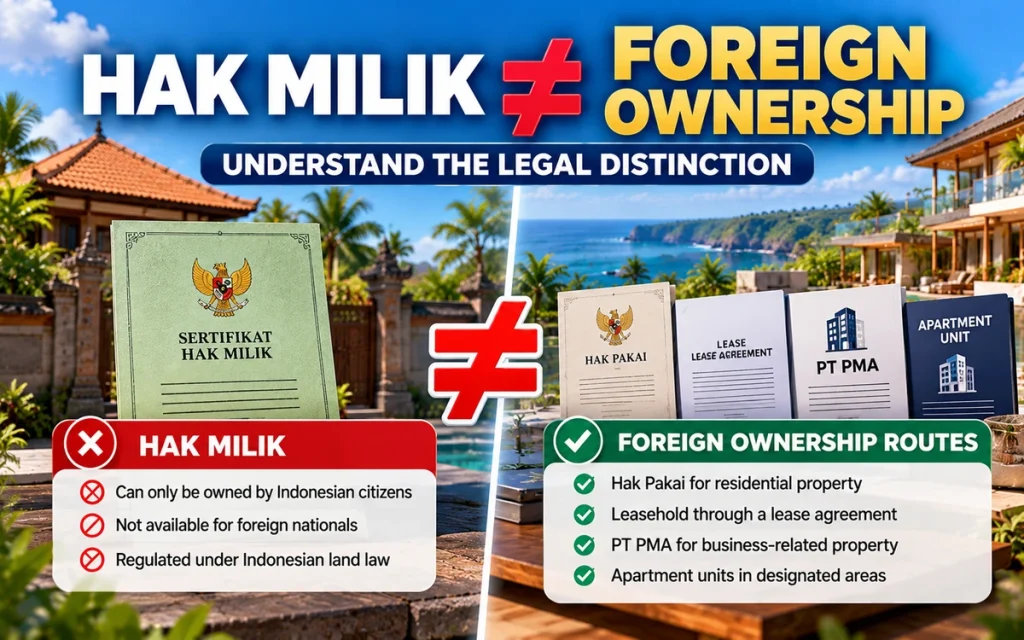
Indonesia’s Basic Agrarian Law, Law No. 5 of 1960, provides that only Indonesian citizens may have Hak Milik, subject to the statutory framework. This means a foreign national cannot simply purchase Hak Milik land in Bali and register that right in their own personal name.
A foreign buyer may nevertheless be able to acquire or use another legally recognized property right. The phrase “buying land in Bali” should therefore never be treated as proof that the foreign buyer will receive freehold title.
A private agreement with an Indonesian individual also does not turn the foreign buyer into the registered Hak Milik holder. If the land remains registered in another person’s name, the buyer should understand exactly what rights the documents do—and do not—create.
Concerned About a Bali Property Ownership Structure?
If you are considering a property in Bali, the appropriate legal structure depends on the property, intended use, buyer eligibility, and applicable Indonesian regulations. Establishing the structure before paying a deposit can help identify ownership, control, and transaction risks at an early stage.
For property-specific legal assistance, see Property Lawyer in Bali.
Concerned About a Bali Property Ownership Structure?
If you are considering a property in Bali, the appropriate legal structure depends on the property, intended use, buyer eligibility, and applicable Indonesian regulations. Establishing the structure before paying a deposit can help identify ownership, control, and transaction risks at an early stage.
Hak Pakai: A Residential Property Route for Foreigners
Hak Pakai is one of the principal registered land rights relevant to foreign residential property in Indonesia. Government Regulation No. 18 of 2021 recognizes foreigners as subjects who may hold Hak Pakai for a defined term, subject to the applicable requirements.

Who May Qualify for Hak Pakai?
Eligibility is not determined by nationality alone. For residential property, Government Regulation No. 18 of 2021 requires a foreigner who owns a qualifying residence or dwelling to have immigration documents in accordance with Indonesian law.
If immigration status forms part of your property planning, the broader Indonesia Residency guide explains the main Indonesian residence-permit framework.
What Residential Property Can Be Held?
The foreign-residential-property framework covers qualifying landed houses and apartment units. For landed houses, Government Regulation No. 18 of 2021 recognizes structures involving Hak Pakai, including Hak Pakai over State Land and certain Hak Pakai arrangements over Hak Milik or Hak Pengelolaan, subject to the required documentation and registration.
How Long Does Hak Pakai Last?
Hak Pakai is subject to statutory periods and, depending on the underlying land and legal basis, extension and renewal mechanisms. Buyers should not rely on a generic marketing statement about the total number of years without checking the certificate, the underlying land, the starting date, and the legal basis for any extension or renewal.
What Restrictions Apply?
The implementing rules impose restrictions on foreign residential ownership. Permen ATR/KBPN No. 18 of 2021 provides, among other things, that landed houses are subject to the applicable luxury-house category, generally one land parcel per person or family, and a land-area limit of 2,000 square metres, subject to the exceptions and ministerial approval described in the regulation. Commercial apartment units are addressed separately.
These rules should be checked against the specific property and the regulations in force when the transaction takes place.
Can Foreigners Buy Property Through a PT PMA?
A PT PMA is an Indonesian foreign-investment company. It can be relevant where property is genuinely connected to a qualifying business activity and the company is legally permitted to hold the relevant land right.
This is different from personal foreign ownership. If a PT PMA holds HGB or another permitted land right, the registered holder is the company. The foreign shareholder owns shares in the company; the shareholder does not personally own the company’s land as Hak Milik.

When Can a PT PMA Structure Be Relevant?
Depending on the business model and licensing, a PT PMA structure may be relevant to qualifying hospitality, commercial, office, development, or other investment activities. The company’s KBLI, investment status, licensing, zoning, land use, and actual business purpose should be reviewed together.
For a deeper explanation of company structuring and foreign investment, see PT PMA Lawyer in Bali.
HGB and PT PMA
HGB gives its holder the right to construct and possess buildings on land for a defined period under Indonesian law. It is not Hak Milik. Where a PT PMA holds HGB, the land right remains an asset of the company.
Corporate Compliance Matters
Using a PT PMA introduces corporate, tax, investment, licensing, and reporting obligations. It should not be treated as a generic shortcut for a foreigner who merely wants a private residence.
Where the property is part of an operating business or commercial transaction, the related corporate issues are discussed further in Business Lawyer in Bali.
What Is Leasehold Property in Bali?
Leasehold is widely used in Bali because it can give a foreign lessee contractual rights to use a property for an agreed period without transferring ownership of the underlying land.
The key distinction is simple: a lease is a contractual right. It should not be presented as equivalent to Hak Milik or a registered land right held personally by the foreign lessee.

What Should a Foreign Buyer Review in a Lease?
- Identity and authority of the parties
- Exact property and boundaries
- Lease term and commencement date
- Payment schedule
- Renewal or extension mechanism
- Permitted use
- Maintenance and repair obligations
- Taxes and other charges
- Default and termination provisions
- Assignment and sublease rights
- Treatment of buildings and improvements
- Handover at expiry
- Dispute-resolution provisions
The buyer should also verify that the lessor is legally entitled to grant the lease and that no existing mortgage, lease, dispute, or third-party right conflicts with the proposed arrangement.
Can Foreigners Buy Apartments or Condominiums in Bali?
Eligible foreign nationals may be able to acquire qualifying apartment units under Indonesia’s apartment and foreign-residential-property framework. Government Regulation No. 18 of 2021 specifically addresses apartment units that may be owned by foreigners.
Before buying an apartment or condominium in Bali, the buyer should verify the legal status of the project, the underlying land right, the unit documentation, foreign-buyer eligibility, applicable minimum-price rules, permitted use, and restrictions affecting transfer or resale.
A developer’s description of a project as “foreigner friendly” is not a substitute for checking the actual legal documents.
What Is the Minimum Property Price for Foreigners in Bali?
Indonesia applies minimum acquisition-price requirements to certain residential property acquired by foreigners. The applicable threshold depends on the location and property category.
Keputusan Menteri ATR/Kepala BPN No. 1241/SK-HK.02/IX/2022 on residential acquisition prices for foreigners is currently listed as in force by the Ministry of Agrarian Affairs and Spatial Planning/National Land Agency. Under that framework, Bali has a minimum acquisition price of IDR 5 billion for a landed house and IDR 2 billion for a commercial apartment unit.
These figures are regulatory thresholds, not market valuations. A property can be worth more or less in the market, while eligibility for a particular foreign-residential-property structure is a separate legal question.
Does the Minimum Price Apply to Every Property Structure?
No. A regulatory threshold for foreign residential ownership should not automatically be applied to every lease, corporate acquisition, villa transaction, or other property arrangement. The buyer should identify the legal structure first and then confirm which requirements apply.
What Requirements Must Foreign Buyers Meet?
The requirements depend on the right or structure being used. For qualifying residential ownership by a foreigner, the legal framework includes immigration-document requirements and restrictions concerning the property itself.
Depending on the transaction, the buyer may need to verify:
- Identity and immigration documentation
- Eligibility for the selected property right
- Property type and land status
- Applicable minimum acquisition price
- Land-area or quantity restrictions where relevant
- Permitted use and zoning
- Certificate or apartment-unit documentation
- Seller authority
- Transaction and registration documents
Eligibility should be established before the buyer makes a substantial financial commitment.
Can Foreigners Rent Out Property in Bali?
Holding or using property does not automatically authorize every form of commercial rental or hospitality activity. This distinction is particularly important in Bali, where villas are frequently marketed as income-producing investments.
A buyer intending to operate short-term accommodation, villa rentals, a guesthouse, hotel, or another commercial activity should separately examine zoning, land use, building legality, business licensing, taxation, and any sector-specific requirements.
There are therefore two separate questions: can the foreign buyer legally hold or use the property, and can the intended business activity legally operate from that property? A positive answer to the first does not automatically answer the second.
Can a Foreigner Buy Property Through an Indonesian Spouse?
Marriage to an Indonesian citizen does not automatically give the foreign spouse a personal right to hold Hak Milik.
Government Regulation No. 18 of 2021 provides that an Indonesian citizen married to a foreigner may hold the same land rights as other Indonesian citizens where the relevant land is not marital community property, evidenced by a notarized separation-of-property agreement.
Mixed-nationality couples should therefore review the marital-property regime, registered owner, source of funds, land title, succession consequences, and transaction documents before acquisition. Marriage should not be treated as a shortcut to foreign Hak Milik ownership.
Can Foreigners Inherit Property in Bali?
Government Regulation No. 18 of 2021 provides that a qualifying residence or dwelling owned by a foreigner may be inherited when the foreign owner dies. If the heir is also a foreigner, the heir must have immigration documentation in accordance with the applicable rules.
Inheritance planning should also consider the nature and remaining term of the underlying property right. The heir’s eligibility, documentation, renewal options, and any required transfer or registration process should be reviewed.
Why Are Nominee Property Arrangements Risky?
A nominee arrangement generally involves property being registered in another person’s name while a foreign buyer expects to exercise economic ownership or control through separate private documents.
The central risk is that the registered land right and the foreign buyer’s expectations may not be the same legal thing. A private agreement does not simply convert the foreign buyer into the registered Hak Milik holder.
Problems may arise if the relationship breaks down, the registered owner dies, creditors become involved, the property becomes disputed, or the parties disagree about control, sale, or succession.
A proposed nominee arrangement should therefore be reviewed based on the actual title, contracts, purpose, control arrangements, and applicable Indonesian law rather than on assurances that it is a common practice.
How to Conduct Legal Due Diligence Before Buying Property in Bali
Legal due diligence should take place before the buyer becomes financially committed. A desirable location, attractive villa, or projected rental return does not replace verification of the legal position.

Verify the Land Certificate and Registered Holder
Confirm the certificate type, registered holder, land details, and whether the proposed transaction can legally be completed under the intended structure.
Check Encumbrances, Mortgages and Disputes
Review whether the property is subject to mortgage rights, other encumbrances, court proceedings, claims, seizures, or other third-party interests.
Confirm Boundaries and Access
Compare the legal documents with the physical boundaries and access arrangements. Access rights can materially affect the practical and commercial use of a Bali property.
Check Zoning and Permitted Use
Confirm that the intended residential, rental, hospitality, or business use is compatible with the applicable spatial and land-use rules.
Review Building Legality
Check the relevant building documentation and whether the existing structure and intended use are consistent with the applicable approvals.
Review Seller Authority
Confirm that the seller has authority to enter the transaction and that all required spouses, heirs, shareholders, directors, or other parties and approvals are properly addressed where relevant.
Check Existing Leases and Third-Party Rights
A property may already be subject to a lease, management agreement, access arrangement, security interest, or other contractual right. These should be identified before completion.
Before You Pay a Property Deposit, Check the Legal Position
Property due diligence can identify issues involving title, encumbrances, zoning, building legality, access, existing rights, and transaction documents before you commit to the purchase. The earlier these issues are identified, the easier it is to assess whether the proposed structure matches the buyer’s intended use.
For more information about legal review of Bali property transactions, see Property Lawyer in Bali.
Before You Pay a Property Deposit, Check the Legal Position
Property due diligence can identify issues involving title, encumbrances, zoning, building legality, access, existing rights, and transaction documents before you commit to the purchase. The earlier these issues are identified, the easier it is to assess whether the proposed structure matches the buyer’s intended use.
How to Buy Property in Bali Legally as a Foreigner
Step 1: Define the Intended Use
Determine whether the property is for a private residence, long-term personal use, rental, hospitality, commercial investment, or another business activity.
Step 2: Select the Legal Structure
Identify whether Hak Pakai, leasehold, a qualifying apartment interest, a PT PMA structure, or another legally recognized arrangement fits the transaction.
Step 3: Verify Buyer Eligibility
Confirm the immigration documentation and other eligibility requirements that apply to the selected structure.
Step 4: Conduct Property Due Diligence
Review title, registered ownership, encumbrances, zoning, building legality, access, existing agreements, disputes, and permitted use.
Step 5: Review Taxes and Transaction Costs
Identify the taxes, duties, professional fees, registration charges, company costs, licensing expenses, and ongoing obligations relevant to the structure.
Step 6: Obtain Appropriate Professional Review
Use the appropriate notary/PPAT for the transaction and obtain qualified Indonesian legal advice where the structure, documents, dispute risk, or business arrangements require it.
Step 7: Complete the Transaction and Registration
Execute the required documents, payments, registration, and handover procedures applicable to the selected structure.
Step 8: Maintain Ongoing Compliance
After completion, monitor any applicable immigration, tax, land-right renewal, zoning, licensing, and corporate obligations.
What Taxes and Costs Should Foreign Buyers Expect?
The total cost of a Bali property transaction can extend beyond the advertised purchase price or lease premium. Depending on the structure, costs may include transaction taxes and duties, notary or PPAT fees, legal-review fees, registration charges, company costs, licensing expenses, property-management fees, and ongoing maintenance.
The exact tax treatment depends on the transaction, the parties, and the legal structure. Buyers should therefore calculate costs from the actual transaction rather than relying on a generic percentage found online.
For a PT PMA, buyers should also distinguish one-time acquisition costs from ongoing corporate, tax, investment-reporting, and licensing obligations.
What Happens When a Foreigner Wants to Sell or Exit the Property?
Exit planning should be considered before purchase. The process differs depending on whether the buyer holds Hak Pakai, a leasehold contract, an apartment interest, or an investment through a PT PMA.
For leasehold property, the agreement should address expiry, renewal, assignment, early termination, handover, and the treatment of improvements. For a registered land right, transfer is subject to the applicable land and registration rules. For a PT PMA investment, an exit can involve corporate or share-transfer considerations in addition to the property itself.
A buyer should therefore understand not only how to enter the transaction, but also how the chosen structure can be transferred, renewed, inherited, or terminated.
If ownership, contractual, payment, or control issues develop into a dispute, see Bali Dispute Lawyer for an overview of dispute-resolution options.
How Can Foreigners Choose the Right Property Structure in Bali?
There is no single structure that is appropriate for every foreign buyer. The analysis should begin with the purpose of the property.
Private Residence
A foreigner considering a private residence should examine whether they qualify for the applicable residential framework, including Hak Pakai and the restrictions that apply to the property.
Long-Term Personal Use
A leasehold may be relevant where the objective is long-term contractual use without ownership of the underlying land. The lease should clearly address duration, renewal, use, assignment, and exit.
Commercial or Hospitality Investment
A foreign investor planning a genuine business should examine whether a PT PMA and the relevant land rights, zoning, licensing, tax, and corporate structure are appropriate.
Apartment Ownership
An apartment buyer should verify the project, underlying land, unit documentation, buyer eligibility, minimum-price rules, and foreign-ownership restrictions.
The objective is not to find a shortcut around Indonesian property law. It is to choose a structure that accurately reflects the transaction and provides rights recognized under the applicable legal framework.
Need Professional Guidance on Property in Bali?
If you are unsure whether Hak Pakai, leasehold, a PT PMA structure, or another legally recognized arrangement is relevant to your plans, the property and intended use should be assessed before the transaction is finalized.
AzraID can help assess the nature of the request and coordinate with qualified Indonesian legal professionals where formal legal advice, advocacy, or representation is required. For broader legal matters involving foreign clients, see Lawyer in Bali for Foreigners.
FAQs About Foreign Property Ownership in Bali
Can foreigners legally own property in Bali?
Yes. Eligible foreigners may hold certain legally recognized property rights or residential property interests, subject to applicable requirements. They cannot simply hold Hak Milik land in their personal name.
Can foreigners buy a villa in Bali?
Potentially. The appropriate structure depends on the villa, land right, intended use, buyer eligibility, and whether the transaction is residential, leasehold, or connected to a qualifying business activity.
Can foreigners buy land in Bali?
A foreigner cannot simply register Hak Milik land in their personal name. Depending on the circumstances, other legally recognized rights or structures may be available.
Can foreigners buy property in Bali without a KITAS?
The answer depends on the structure. For qualifying residential ownership, Indonesian law requires the relevant immigration documentation. A lease or company structure raises different legal questions, so eligibility should be checked against the actual transaction.
Can foreigners buy an apartment in Bali?
Eligible foreigners may be able to acquire qualifying apartment units, subject to the project, underlying land, unit documentation, minimum-price rules, and other applicable requirements.
Can foreigners rent out property in Bali?
Holding or using property does not automatically authorize every rental or hospitality activity. Zoning, business licensing, building legality, taxation, and other sector requirements should be reviewed separately.
Can foreigners own property through a PT PMA?
A PT PMA may hold qualifying land rights for legitimate business purposes. The company owns its assets; its foreign shareholders do not personally own the company’s land as Hak Milik.
Can foreigners inherit property in Bali?
Qualifying foreign-owned residential property may be inherited under the applicable rules. If the heir is a foreigner, immigration-document and eligibility requirements must also be considered.
Is a nominee arrangement a substitute for legal foreign ownership?
No. A private nominee arrangement should not be treated as if it automatically gives the foreign buyer the registered Hak Milik right. The actual title and documents must be assessed under Indonesian law.
How long can a foreigner hold property rights in Bali?
The period depends on the structure. Hak Pakai, HGB, and leasehold have different legal or contractual terms and different extension, renewal, transfer, and expiry mechanisms.
Need Legal Assistance With Property in Bali?
Foreign property transactions in Bali can involve land rights, contracts, immigration documentation, corporate structures, zoning, licensing, taxation, and succession issues. The correct approach depends on the specific property and the buyer’s intended use.
For property-specific matters, see Property Lawyer in Bali.
For a foreign-investment company or corporate property structure, see PT PMA Lawyer in Bali.
For broader corporate matters, see Business Lawyer in Bali.
For disputes involving property or contractual rights, see Bali Dispute Lawyer.
For broader legal matters affecting foreign clients, see Lawyer in Bali for Foreigners.
AzraID can help assess the nature of your request and coordinate with qualified Indonesian legal professionals where formal legal advice, advocacy, or representation is required.
Legal Information Disclaimer
This article is provided for general informational purposes and does not constitute legal advice. Indonesian property transactions are fact-specific, and the applicable rules may depend on the buyer, property, land right, intended use, location, transaction structure, and regulations in force at the time of the transaction. Foreign buyers should verify the applicable requirements and obtain appropriate professional advice before signing documents, paying a deposit, or transferring funds.