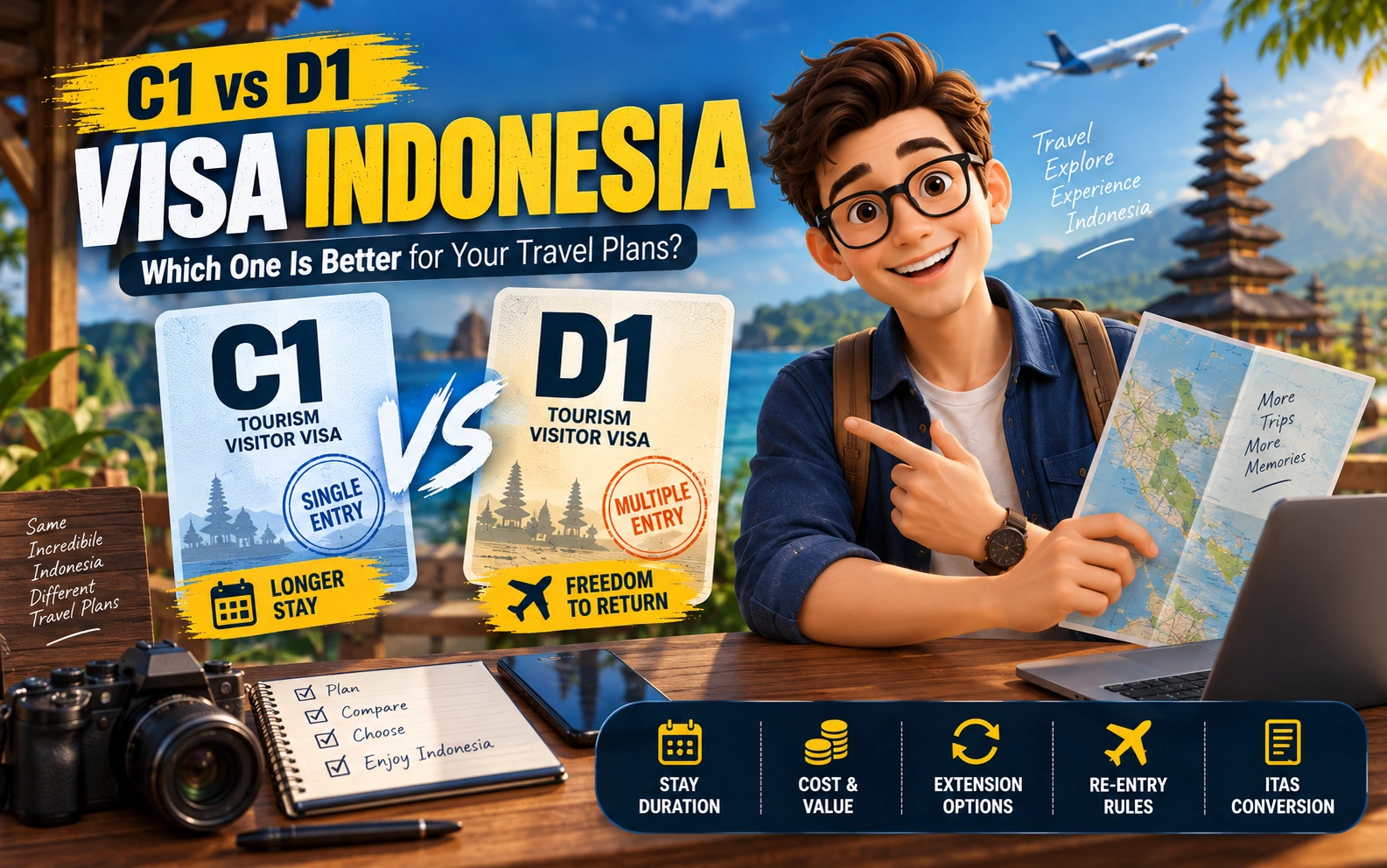
Choosing between Indonesia’s C1 and D1 visas depends largely on how you plan to travel. The C1 Visa is designed for a single entry and is often suitable for travelers who want to stay in Indonesia for a longer continuous period. The D1 Visa, by contrast, is a multiple-entry visitor visa that can be more practical for travelers who expect to leave Indonesia and return during the visa’s validity period.
This guide compares the two visas based on entry rules, stay duration, extension options, cost and value, re-entry, and the possibility of converting to an ITAS, helping you choose the option that best matches your travel plans.
1. C1 Visa vs D1 Visa: What’s the Difference?
The main difference between the C1 Visa and D1 Visa is how many times you can enter Indonesia. The C1 Visa is a single-entry visitor visa, while the D1 Visa is a multiple-entry visitor visa.
The C1 Visa is generally more suitable for travelers who want to remain in Indonesia for an extended continuous stay. It provides an initial stay of up to 60 days and can be extended several times, subject to the applicable immigration rules, up to a maximum total stay of 180 days.
The D1 Visa is designed for travelers who need to enter Indonesia multiple times. Depending on the visa validity selected, a D1 Visa can be valid for 1, 2, or 5 years. Each arrival allows a stay of up to 60 days, with extension options subject to the applicable immigration rules.
In simple terms, C1 is generally better for a longer continuous stay, while D1 is generally better for travelers who expect to make multiple trips to Indonesia.
2. C1 Visa vs D1 Visa at a Glance
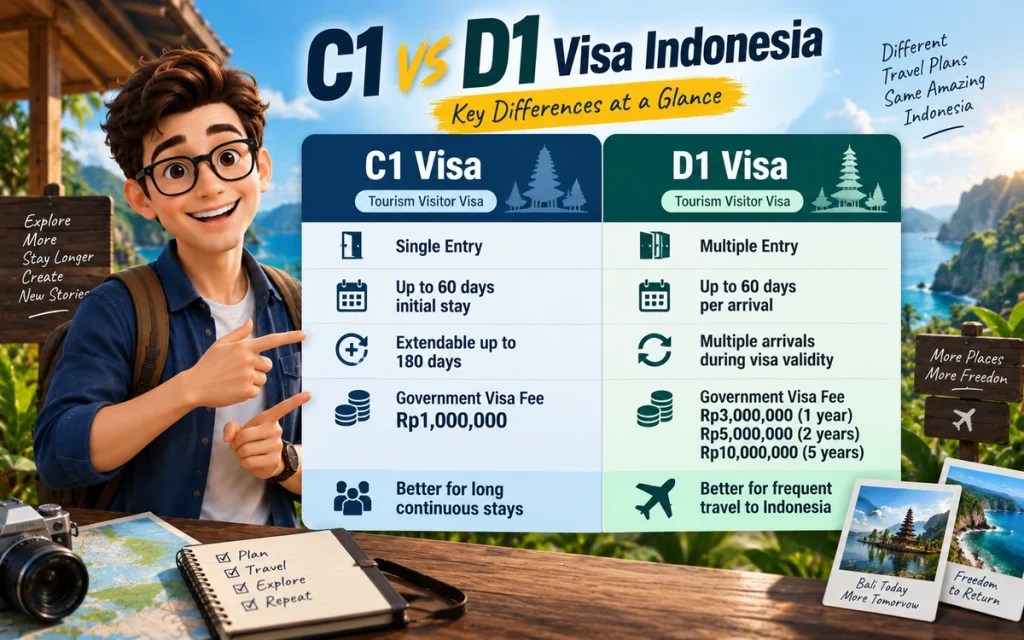
| Feature | C1 Visa | D1 Visa |
| Purpose | Tourism | Tourism |
| Entry type | Single entry | Multiple entry |
| Stay per entry | Up to 60 days | Up to 60 days |
| Visa validity | Single-entry visa | Up to 1, 2, or 5 years |
| Extension | Can be extended up to a maximum total stay of 180 days | Can be extended subject to applicable immigration rules |
| Leave and re-enter | No; leaving Indonesia ends the single-entry use | Yes, while the multiple-entry visa remains valid and entry requirements are met |
| ITAS conversion | May be converted to ITAS subject to applicable requirements | Cannot be converted to ITAS |
| Best suited for | Longer continuous stays | Multiple entries into Indonesia |
| Government visa fee | Rp1,000,000 | Rp3,000,000 (1 year); Rp5,000,000 (2 years); Rp10,000,000 (5 years) |
Although both visas allow an initial stay of up to 60 days, they serve different travel patterns. The most important factor is whether you need to stay in Indonesia continuously or return to Indonesia multiple times during the visa’s validity.
3. C1 Visa vs D1 Visa: Entry and Stay Duration
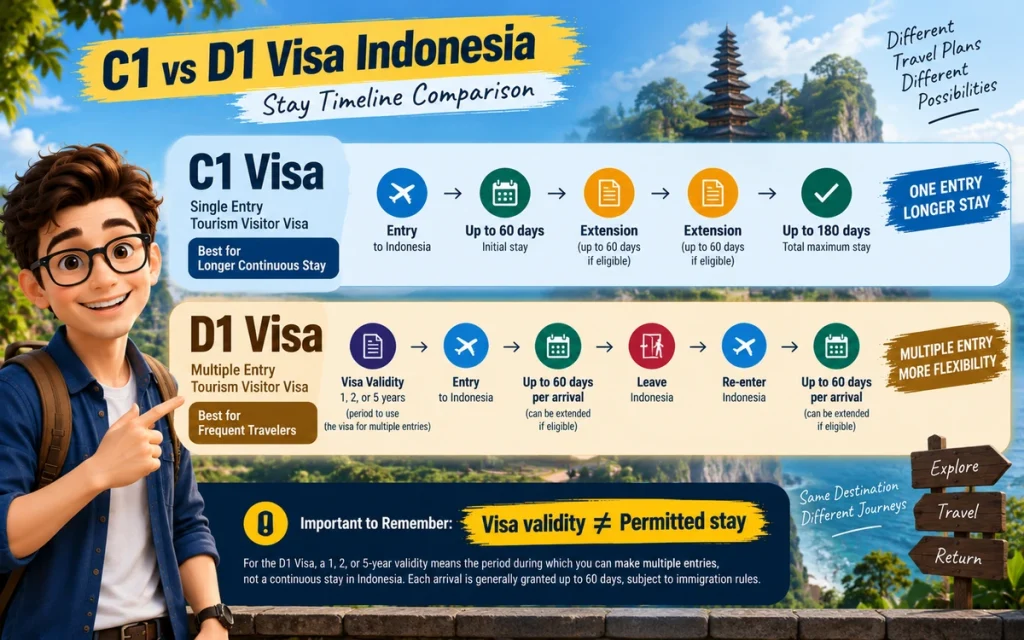
Both the C1 Visa and D1 Visa can provide an initial stay of up to 60 days in Indonesia. The key difference is what happens when you leave Indonesia and how the visa can be used for future entries.
The C1 Visa is a single-entry visa. Once you enter Indonesia, your stay permit begins from the date of arrival. The stay can be extended several times, subject to the applicable requirements, up to a maximum total stay of 180 days. However, if you leave Indonesia, the single-entry visa has been used and you generally need a new visa to return.
The D1 Visa works differently because it is a multiple-entry visa. It can remain valid for 1, 2, or 5 years, depending on the visa granted. Each time you enter Indonesia, you can generally receive a stay of up to 60 days, and that stay may be extended under the applicable immigration rules up to the permitted maximum.
It is important not to confuse visa validity with the permitted length of stay. A D1 Visa that is valid for five years does not allow you to stay in Indonesia continuously for five years. The validity determines the period during which you may use the multiple-entry visa, while each arrival has its own permitted stay period.
For travelers planning one long stay, C1 can be the simpler option. For travelers who expect to travel outside Indonesia and return several times, D1 can provide substantially more flexibility.
4. C1 Visa vs D1 Visa: Cost and Value
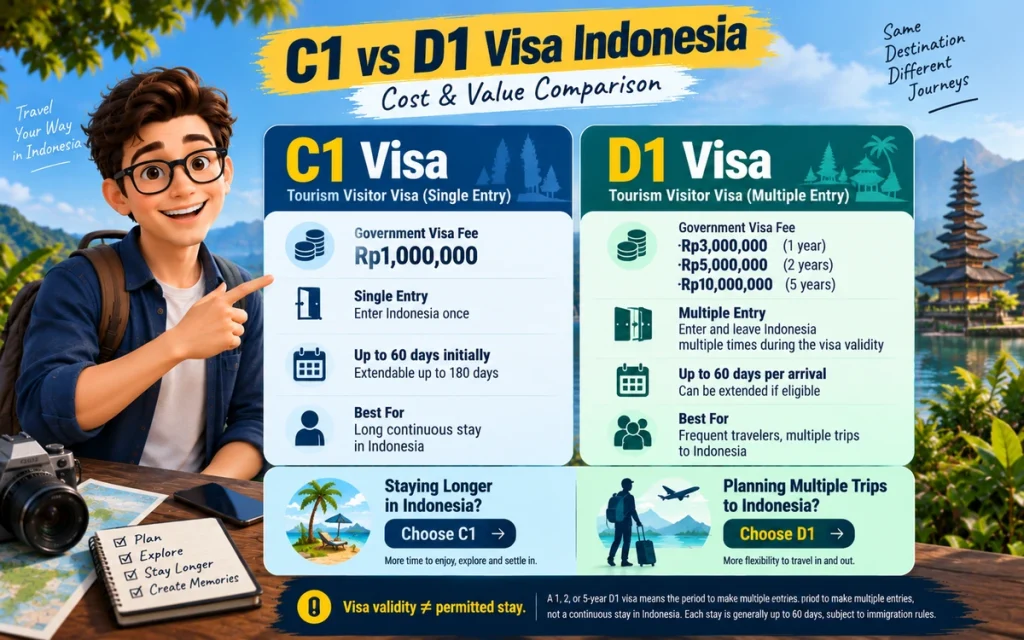
The C1 Visa has a government visa fee of Rp1,000,000. Because it is a single-entry visa, this lower upfront cost can make it a practical choice for travelers who mainly plan to enter Indonesia once and stay for an extended period.
The D1 Visa has a higher government fee because it provides multiple-entry privileges. The current government fees are Rp3,000,000 for a visa valid for up to 1 year, Rp5,000,000 for up to 2 years, and Rp10,000,000 for up to 5 years.
| D1 Visa Validity | Government Visa Fee | Average Fee per Year* |
| Up to 1 year | Rp3,000,000 | Rp3,000,000 |
| Up to 2 years | Rp5,000,000 | Rp2,500,000 |
| Up to 5 years | Rp10,000,000 | Rp2,000,000 |
* The average fee per year is a simple calculation of the government visa fee divided by the selected visa validity. It is not a separate annual immigration fee.
When comparing value, the D1 Visa can become more cost-effective for travelers who expect to return to Indonesia several times. The longer validity options reduce the average government visa cost per year, while also avoiding the need to apply for a new single-entry visa every time the traveler needs to make another trip to Indonesia.
For someone making only one trip, however, paying for a multiple-entry visa may not provide much additional value. In that situation, the C1 Visa can offer a lower-cost solution, particularly when the main goal is a longer continuous stay.
Therefore, the better-value option depends on travel frequency rather than the visa fee alone. C1 generally offers better value for one extended stay, while D1 can offer better long-term value for frequent travelers who regularly leave and return to Indonesia.
5. C1 Visa vs D1 Visa: Extension Options
Both the C1 Visa and D1 Visa allow the stay in Indonesia to be extended, subject to the applicable immigration requirements. The important point is that an extension applies to the stay permit in Indonesia, not to the underlying visa validity in the same way.
For the C1 Visa, the initial stay is up to 60 days from the date of arrival. The stay can be extended several times, with the total stay allowed under the C1 framework reaching up to 180 days.
The D1 Visa also allows an initial stay of up to 60 days for each arrival. That stay can be extended under the applicable rules, with the permitted total stay determined by the relevant immigration provisions.
This means travelers should distinguish between two separate concepts: how long the visa remains valid for entry and how long the traveler is allowed to remain in Indonesia after each entry. A longer D1 visa validity does not automatically extend the length of a single continuous stay.
If your priority is staying in Indonesia for several months without leaving, C1 can be a straightforward option because its single-entry structure is designed around a continuous stay. If you need to leave Indonesia and return during the visa’s validity, D1 provides the flexibility of multiple entries while still allowing extensions when applicable.
6. C1 Visa vs D1 Visa: Can You Leave and Re-Enter Indonesia?
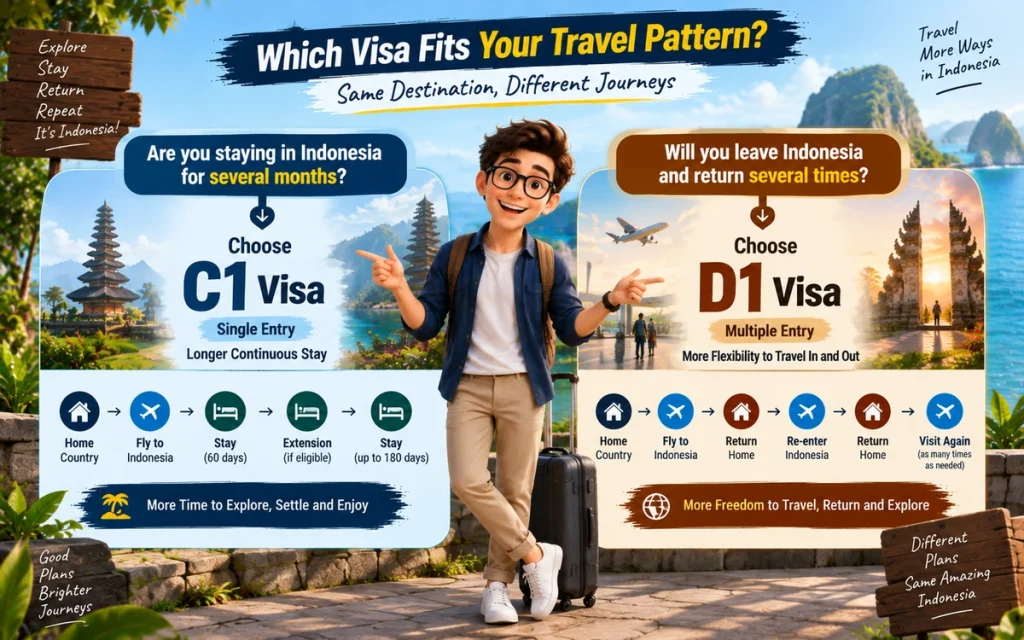
This is one of the most important differences between the C1 Visa and D1 Visa. The C1 Visa is a single-entry visa, while the D1 Visa is a multiple-entry visa.
With a C1 Visa, you can stay in Indonesia and extend your stay according to the applicable rules, but leaving Indonesia ends the use of that single-entry visa. If you want to return after leaving, you will generally need to obtain another visa that allows you to enter Indonesia again.
A D1 Visa is designed for travelers who need to leave Indonesia and return during the visa’s validity period. Because it is a multiple-entry visa, you can generally use the same D1 Visa for subsequent entries as long as the visa remains valid and you meet the applicable entry requirements.
This makes D1 particularly useful for travelers who divide their time between Indonesia and other countries. For example, someone who spends part of the year in Bali, travels to Singapore or Australia, and then returns to Indonesia may find the D1 structure more convenient than repeatedly applying for a new single-entry visa.
However, multiple-entry does not mean unlimited stay. Each entry is subject to its own permitted stay period, and travelers must continue to comply with Indonesian immigration requirements. The visa’s validity and the permitted stay after each arrival are separate matters.
If you do not expect to leave Indonesia during your stay, the re-entry advantage of D1 may not justify its higher visa fee. For a traveler planning one continuous stay, C1 can remain the more appropriate choice.
7. C1 Visa vs D1 Visa: Can You Convert to ITAS?
The C1 Visa can be converted to an ITAS, subject to the applicable requirements and the purpose of the intended ITAS. This is an important advantage for travelers whose plans may change from a temporary visit to a longer-term stay in Indonesia.
The conversion is not automatic. An applicant must qualify for an eligible ITAS category and meet the relevant requirements, including the requirements associated with the intended sponsor or guarantor where applicable. The application must also be submitted within the required period while the visitor stay is still valid.
The D1 Visa, on the other hand, cannot be converted directly to an ITAS. Travelers who enter Indonesia with a D1 Visa and later decide that they need a residence permit generally need to follow the appropriate visa and immigration process for the ITAS category they intend to obtain.
This difference can be significant for people who are considering Indonesia not only as a tourist destination but also as a possible longer-term base. If there is a realistic possibility that you will later need an ITAS, the C1 Visa may provide a more suitable pathway, provided you meet the requirements for the relevant ITAS category.
For travelers whose plans are strictly tourism and multiple visits, the D1 Visa may still be the more practical option because its main advantage is multiple-entry flexibility rather than residence conversion.
8. C1 Visa vs D1 Visa: Requirements
The basic application requirements for the C1 and D1 visas are similar because both are visitor visas, but applicants should always check the current requirements for their nationality and individual circumstances before applying.
For the C1 Visa, the application generally requires a valid travel document or passport, proof of sufficient funds, and a recent color photograph. The current official requirements include a passport valid for at least 6 months and evidence of living expenses of at least USD 2,000, shown through a bank statement covering the last 3 months.
The D1 Visa requires supporting documentation for the visitor visa application. Applicants should prepare a valid passport or travel document and the financial, photograph, and other supporting documents required under the current D1 application process. Requirements can vary according to the applicant’s nationality and circumstances, so the current requirements should be checked before submission.
For both visa types, the passport validity requirement is important. Applicants should also ensure that the information in the application, financial documents, photograph, and travel details is accurate and consistent. Additional requirements may apply to certain nationalities or travelers using non-standard travel documents.
The biggest practical difference is not the basic documentation but the type of visa being requested. C1 is designed for a single entry, while D1 is designed for multiple entries. Choosing the correct visa type before applying can help avoid applying for a visa that does not match your intended travel pattern.
9. Who Should Choose C1 Visa?
The C1 Visa is generally the better choice for travelers whose main goal is to stay in Indonesia for an extended, continuous period rather than make repeated international trips.
It can be particularly suitable for travelers planning a long holiday, spending several months in Bali or another part of Indonesia, or using Indonesia as a temporary base without needing to leave and re-enter during the same stay.
C1 can also be attractive when cost is an important consideration. With a government visa fee of Rp1,000,000, it has a lower initial visa cost than the D1 Visa. For someone making only one entry, paying for multiple-entry privileges may provide little additional benefit.
Another important consideration is future residence planning. Because the C1 Visa can be converted to an ITAS subject to the applicable requirements, it may be more appropriate for travelers who could later move from a visitor status to an eligible residence status in Indonesia.
Choose C1 if your travel plan looks like this: enter Indonesia once, stay for several months if needed, and leave Indonesia at the end of your stay. For this type of travel pattern, the single-entry structure of C1 is usually more aligned with the purpose of the trip.
10. Who Should Choose D1 Visa?
The D1 Visa is generally the better choice for travelers who expect to enter Indonesia multiple times during the visa’s validity period. Its multiple-entry structure is the main advantage over the C1 Visa.
D1 can be particularly useful for people who regularly travel between Indonesia and other countries. Instead of applying for a new single-entry visa after every trip outside Indonesia, eligible travelers can use the same D1 Visa for subsequent entries while it remains valid.
The longer validity options also make D1 attractive for frequent visitors. Travelers can choose a D1 Visa valid for up to 1, 2, or 5 years, depending on their needs and the visa granted. This can provide greater convenience for people who expect to return to Indonesia regularly.
D1 may also make sense for travelers who do not need an ITAS. Since the D1 Visa cannot be converted to an ITAS, it is better suited to people whose plans remain within the scope of temporary visits rather than those considering a move to an Indonesian residence status.
Choose D1 if your travel plan looks like this: enter Indonesia, spend time in the country, leave for another destination, and return to Indonesia again during the validity of your visa. For this type of travel pattern, multiple-entry access can provide significantly more flexibility than a single-entry visa.
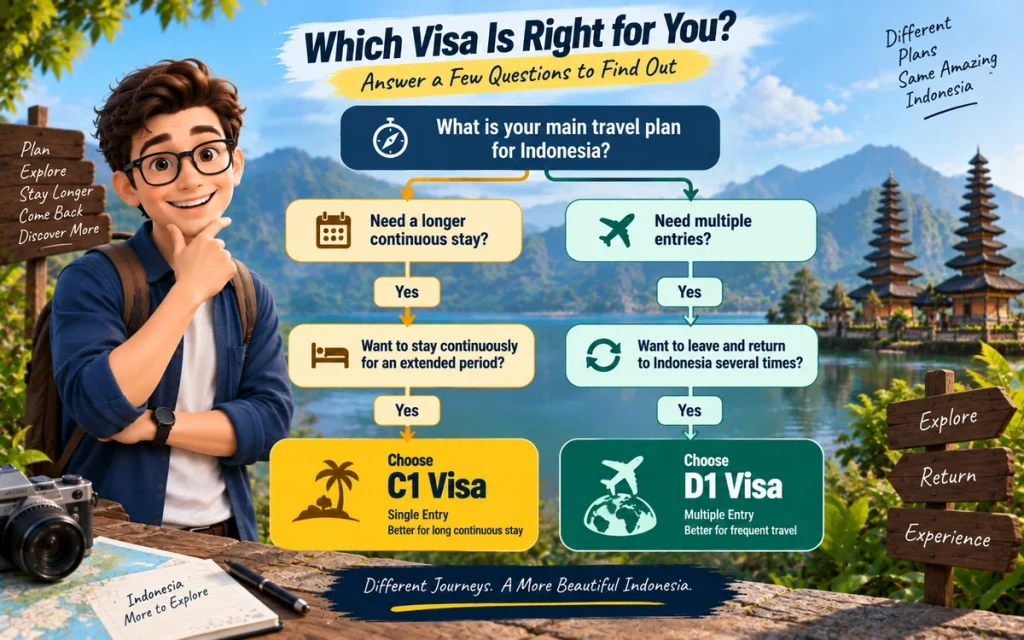
11. C1 or D1 Visa: Which Is Better for You?
Neither the C1 Visa nor the D1 Visa is universally better. The right choice depends on how you plan to use your time in Indonesia and whether you expect to leave and return during your visa’s validity.
If your priority is one extended stay, C1 is usually the more logical choice. It is a single-entry visitor visa with an initial stay of up to 60 days and extension options that can allow a total stay of up to 180 days. Its government visa fee is also lower at Rp1,000,000.
If you expect to travel outside Indonesia and return several times, D1 is generally more suitable. As a multiple-entry visitor visa, D1 is designed for repeated entries during its validity period. Current options include validity periods of up to 1, 2, or 5 years, with each arrival generally allowing a stay of up to 60 days subject to the applicable rules.
Another major factor is future residence planning. C1 may be converted to an ITAS when the applicant qualifies for an eligible ITAS category and meets the applicable requirements. D1 cannot be converted directly to an ITAS.
Use this simple rule when deciding:
| Your Travel Plan | Better Option |
| One main trip with a longer continuous stay | C1 Visa |
| Stay in Indonesia for several months without leaving | C1 Visa |
| Frequent trips in and out of Indonesia | D1 Visa |
| Need multiple entries over 1–5 years | D1 Visa |
| Possible future move to an eligible ITAS status | C1 Visa |
| Tourism only with no need for residence conversion | C1 or D1, depending on travel frequency |
Ultimately, the best visa is the one that matches your actual travel pattern. Choosing C1 simply because it is cheaper can be inefficient if you expect to leave and return to Indonesia. Likewise, choosing D1 may mean paying for multiple-entry flexibility that you never use if you only plan one extended stay.
12. Frequently Asked Questions
Is C1 or D1 better for a long stay in Indonesia?
C1 is generally better for one long continuous stay. It allows an initial stay of up to 60 days and can be extended several times up to a maximum total stay of 180 days, subject to the applicable rules.
Can I leave Indonesia and return with a C1 Visa?
C1 is a single-entry visa. Once you leave Indonesia, the single-entry visa has been used, so you generally need a new visa to return.
Can I leave Indonesia and return with a D1 Visa?
Yes. D1 is a multiple-entry visitor visa, so it is designed for travelers who need to leave and return to Indonesia during the visa’s validity period, subject to the applicable entry requirements.
How long can I stay in Indonesia with D1?
A D1 Visa generally provides an initial stay of up to 60 days per arrival. The stay may be extended under the applicable immigration rules, with the permitted total stay determined by those rules.
Is D1 a 5-year stay visa?
No. A 5-year D1 Visa refers to the visa’s validity for multiple entries, not a continuous five-year stay in Indonesia. Each arrival has its own permitted stay period.
Can C1 be converted to ITAS?
Yes, C1 can be converted to an ITAS when the applicant qualifies for an eligible ITAS category and satisfies the applicable requirements.
Can D1 be converted to ITAS?
No. D1 cannot be converted directly to an ITAS.
Which is cheaper, C1 or D1?
C1 has a government visa fee of Rp1,000,000. D1 costs Rp3,000,000 for up to 1 year, Rp5,000,000 for up to 2 years, or Rp10,000,000 for up to 5 years. The better value depends on how often you need to enter Indonesia.
Can I extend both C1 and D1?
Yes. Visitor stay permits associated with both single-entry and multiple-entry visitor visas can be extended subject to the applicable immigration requirements.
Which visa should I choose if I frequently travel between Indonesia and another country?
D1 is generally more suitable because it provides multiple-entry access during the visa’s validity period.
Conclusion
If you are planning to stay in Indonesia for one extended period, the C1 Visa is generally the better choice. It offers a lower government visa fee, an initial stay of up to 60 days, extension options, and a potential pathway to ITAS for eligible applicants.
If you expect to travel in and out of Indonesia regularly, the D1 Visa is usually more practical. Its multiple-entry structure allows you to return to Indonesia during the visa’s validity period without applying for a new single-entry visa each time.
The key is not simply choosing the cheaper visa. Instead, choose the visa that matches your travel pattern. C1 is generally better for one longer stay, while D1 is better for frequent entries and returns to Indonesia.
Need Help Choosing the Right Indonesia Visa?
Not sure whether C1 or D1 is the right option for your travel plans? AzraID can help you assess your travel pattern, stay duration, entry requirements, and future immigration plans before you apply.
Contact AzraID for Indonesia visa assistance and get professional guidance on choosing the right visa for your travel plans.
Let AzraID help you choose the right Indonesia visa before you apply.