Indonesia has become one of the world’s most popular destinations for content creators. From Bali’s beaches and luxury resorts to Jakarta’s urban lifestyle, Yogyakarta’s cultural attractions, and Indonesia’s extraordinary natural destinations, foreign YouTubers, TikTok creators, Instagram influencers, travel bloggers, photographers, videographers, and digital creators continue to come to Indonesia to create content for audiences around the world.
As the creator economy continues to grow, one question is becoming increasingly common:
“Does Indonesia have a visa specifically for content creators?”
The answer appears simple at first.
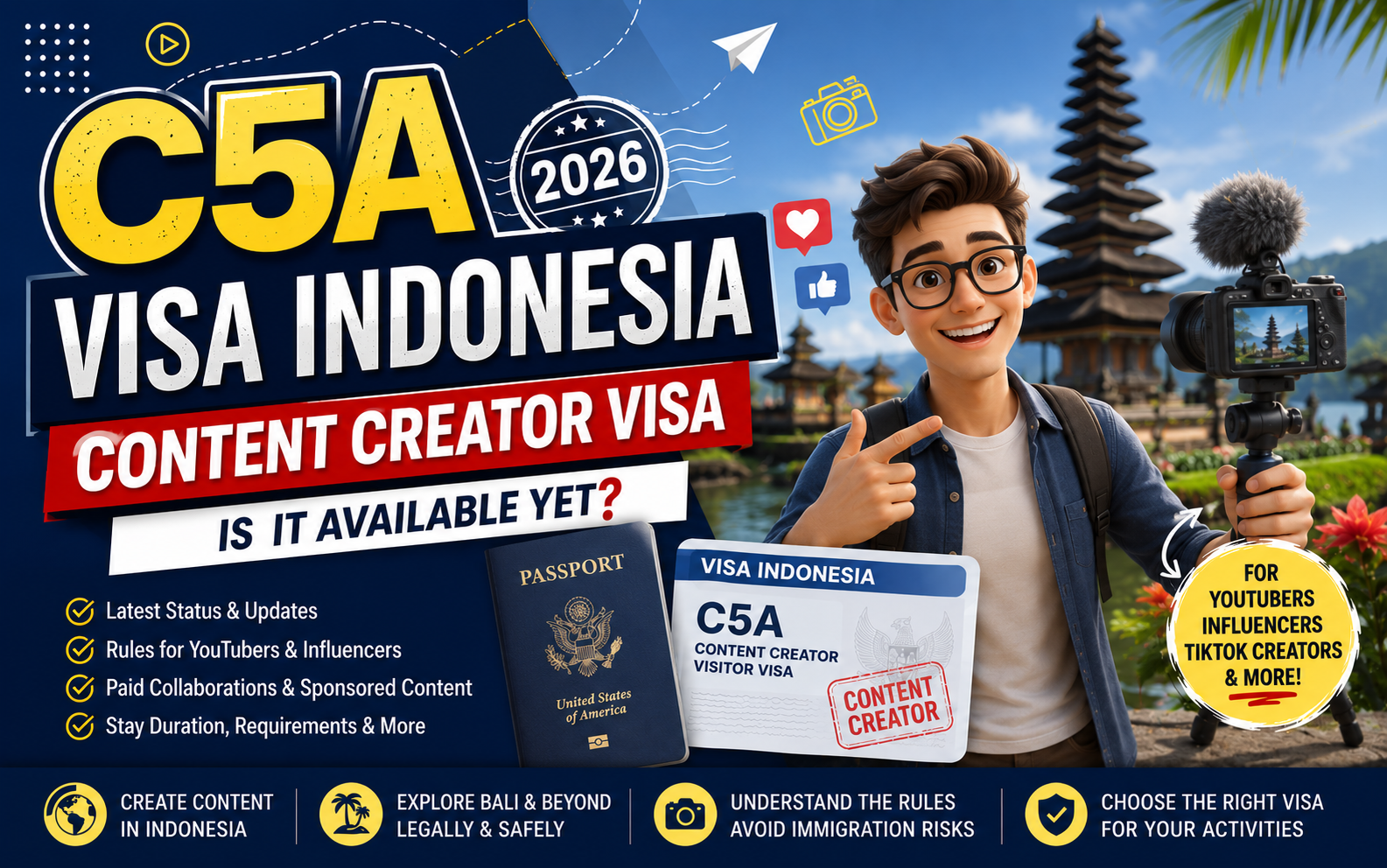
Indonesia’s official visa classification lists C5A as the Content Creator Visitor Visa, placing it alongside other single-entry visitor visa categories. This confirms that the C5A Visa Indonesia officially exists as a visa classification.
But this is where the confusion begins.
Many foreign creators are now searching for C5A Visa Indonesia, Indonesia Content Creator Visa, Bali Content Creator Visa, Indonesia Influencer Visa, Visa for YouTubers in Indonesia, and Visa for Influencers in Bali.
At the same time, many people are asking a much more important question:
If C5A is officially listed, can you actually apply for the C5A Content Creator Visa yet?
This distinction matters because an official visa classification and a fully operational visa application process are not necessarily the same thing.
As of the latest publicly available information reviewed for this article, C5A is clearly listed as an official Indonesian visa category. However, before any applicant or visa provider claims that the C5A visa can already be processed through a standard application procedure, the actual availability of its operational application route, requirements, fees, and other implementation details should be carefully verified through the relevant official immigration system.
This article explains what is currently known about the C5A Visa Indonesia, why the category was created, who it is intended for, whether foreign content creators can apply for it, and what creators should consider if they plan to produce content in Indonesia or Bali.
We will also examine some of the questions that matter most in practice, including:
- Is the C5A Visa Indonesia active and available in 2026?
- Can you apply for a C5A Content Creator Visa now?
- Who is the C5A visa intended for?
- Can YouTubers and influencers create content in Indonesia on a visitor visa?
- Can influencers accept paid collaborations or sponsored content in Bali?
- Does a free hotel stay in exchange for content count as a commercial activity?
- What is the difference between C5A, a tourist visa, C5 Media and Press Visa, and C14 Film-Making and Film Production Visa?
- What should foreign content creators do while the practical implementation of C5A remains unclear?
The goal is simple: to separate official facts from assumptions, marketing claims, and outdated information. Because when it comes to Indonesian immigration, choosing a visa based only on what a visa category is called can be risky. What ultimately matters is the current official status of the visa and whether the immigration permission actually matches the activities you plan to carry out in Indonesia.
Quick Answer: Is the C5A Visa Indonesia Available Yet?
Yes, C5A officially exists as an Indonesian visa classification. Indonesia’s official visa list identifies C5A as the Content Creator Visitor Visa (Visa Kunjungan Konten Kreator) under the category of Single-Entry Visitor Visas.
However, the existence of an official visa index does not automatically mean that a complete and publicly accessible application process is already operational.
This is the most important point for foreign content creators considering the C5A Visa Indonesia in 2026.
“So, what is the current status?”
Based on the official information that is currently publicly available:
- C5A is officially listed as the Content Creator Visitor Visa.
- The category is part of Indonesia’s official visa classification.
- However, foreign applicants should not automatically assume that C5A is already available as a standard visa product that can be applied for immediately.
- Before submitting an application or paying a visa provider, the current availability of the official C5A application route, requirements, fees, sponsor arrangements, permitted activities, and stay conditions should be verified through the relevant Indonesian immigration system.
This distinction is important because several other visa categories, such as C5 Media and Press Visitor Visa, already have publicly available operational details, including permitted activities, stay duration, requirements, and other provisions.
For C5A, by contrast, its presence on the official visa list confirms that the Content Creator Visitor Visa classification exists, but this alone should not be treated as proof that every foreign creator can already complete a standard C5A application.
The short answer is:
“C5A is officially listed, but its listing should not automatically be interpreted as confirmation that the visa is already fully operational and available for standard public applications.”
This is particularly important because foreign creators may find websites advertising:
- C5A Visa Indonesia
- Indonesia Content Creator Visa
- Bali Content Creator Visa
- Indonesia Influencer Visa
- Visa for YouTubers in Bali
- guaranteed C5A visa processing
- fixed C5A prices
- specific C5A requirements
Before relying on any of these claims, applicants should verify whether the provider can demonstrate a current, official, and operational C5A application procedure.
For now, the safest approach is to separate two different questions:
“Does the C5A visa officially exist?”
Yes. It is listed in Indonesia’s official visa classification as the Content Creator Visitor Visa.
Can every content creator already apply for C5A through a standard operational procedure?
This should not be assumed without verifying the current official application system and implementation status. That difference between “officially listed” and “fully operational and available to apply for” is at the center of the current confusion surrounding the C5A Content Creator Visa Indonesia.
What Is the C5A Visa Indonesia?
The C5A Visa Indonesia is officially listed as the Content Creator Visitor Visa, or Visa Kunjungan Konten Kreator in Indonesian.
C5A appears in Indonesia’s official visa classification under the category of Single-Entry Visitor Visas, alongside other specific visitor visa categories such as C5 for media and press activities and C14 for film-making and film production. This means that the Indonesian immigration system now officially recognizes content creation as a distinct visitor visa category.
At its core, the C5A category is intended to address a type of activity that has become increasingly common in Indonesia: foreign nationals visiting the country to create digital and social media content.
This may include content created for platforms such as:
- YouTube
- TikTok
- X
- Blogs and other digital platforms
The category is particularly relevant because modern content creation does not always fit neatly into traditional immigration categories. A foreign visitor may travel to Indonesia to document destinations, produce travel videos, share experiences with an online audience, create short-form social media content, or build content around Indonesia’s tourism, culture, lifestyle, accommodation, food, and other attractions.
However, it is important to understand what the current official listing does and does not tell us.
C5A Officially Means “Content Creator Visitor Visa”
The most important confirmed fact is straightforward:
C5A = Content Creator Visitor Visa.
Its official Indonesian name is:
Visa Kunjungan Konten Kreator.
The category is listed under Single-Entry Visitor Visas, rather than under Indonesia’s work visa categories.
This is significant because it shows that Indonesia has created a specific visa classification for content creators instead of treating all creator activities as automatically identical to:
- tourism;
- journalism;
- media reporting;
- film production; or
- employment.
At the same time, the name of the visa category alone should not be used to make assumptions about the complete scope of permitted activities.
For example, the official listing of C5A does not by itself confirm that every person who calls themselves a content creator may automatically carry out any type of commercial activity in Indonesia.
The actual distinction can be important.
A person may create content as:
- an independent travel creator;
- a YouTuber;
- a TikTok creator;
- an Instagram influencer;
- a travel blogger;
- a vlogger;
- a photographer;
- a videographer;
- a professional digital creator.
But their immigration situation may also depend on what they are actually doing in Indonesia.
For example, there may be an important difference between:
- recording a personal travel vlog;
- creating content for an existing online audience;
- accepting a sponsored campaign;
- fulfilling a contract with a company;
- receiving accommodation in exchange for mandatory promotional content; or
- joining a larger professional film or commercial production.
This is why the C5A Visa Indonesia should not simply be described as a general “influencer visa” that automatically authorizes every type of creator activity.
Why C5A Is Different From Other Visitor Visa Categories
Indonesia already has separate visitor visa categories for specific purposes.
For example, C5 is specifically identified as the Media and Press Visitor Visa, with official provisions for journalism, event coverage, and other media and press-related activities. C14 is separately identified for film-making and film production activities, including films, music videos, reality shows, documentaries, television programs, radio programs, and similar activities using locations in Indonesia.
The creation of a separate C5A Content Creator Visitor Visa is therefore important because a modern digital creator is not necessarily:
- a journalist;
- a member of the press;
- part of a professional film production; or
- an employee of an Indonesian company.
A travel YouTuber filming a destination, for example, may have a different purpose from a foreign journalist covering a news event or a production company filming a commercial project.
The C5A category appears to recognize this growing distinction within Indonesia’s visa classification.
The Key Point to Remember
For now, the safest and most accurate way to understand C5A is:
“C5A is an officially listed Indonesian visitor visa category specifically identified for content creators.”
However, the official visa listing alone does not provide sufficient grounds to assume the complete details of its practical implementation, including its exact application procedure, requirements, fees, sponsor arrangements, length of stay, extension options, or the full scope of activities permitted under the visa.
Those details should be verified separately through the latest official Indonesian immigration information before an application is submitted.
This is especially important for anyone searching for a Bali Content Creator Visa, Indonesia Influencer Visa, or Visa for YouTubers in Indonesia. While C5A is a national Indonesian visa category rather than a Bali-only visa, the correct immigration route should always be assessed based on the creator’s actual purpose and planned activities in Indonesia.
Why Did Indonesia Create a Content Creator Visa Category?
The creation of a specific Content Creator Visitor Visa category reflects a much larger change in the way people travel, work, communicate, and create value in the digital economy.
Indonesia has been updating its visa classification to make immigration services more relevant to changing global needs. In 2025, the Directorate General of Immigration simplified and reorganized Indonesia’s visa classification, reducing the number of visa indexes while also introducing and adjusting categories to better respond to the needs of international visitors and new forms of activity.
At the same time, digital creators have become an increasingly important part of Indonesia’s broader creative economy. Indonesian government institutions have also recognized the growing diversity of digital creator activities and the importance of developing a more professional and globally competitive creator ecosystem.
The Way People Travel and Create Content Has Changed
In the past, immigration activities could often be divided into relatively simple categories:
- Tourists travelled for holidays.
- Business visitors attended meetings.
- Journalists reported the news.
- Film crews produced professional films.
- Foreign employees worked for companies.
Today, those boundaries are not always as clear.
A single person may travel to Indonesia as a tourist while also being:
- a YouTuber;
- a TikTok creator;
- an Instagram influencer;
- a travel blogger;
- a vlogger;
- a photographer;
- a videographer; or
- a professional digital content creator.
During one trip, that person may visit tourist destinations, record videos, publish social media content, share experiences with a global audience, and generate income through an online creator business.
This creates a challenge for traditional immigration categories.
A modern content creator is not necessarily a journalist. They may not be part of a film production. They may also not be an employee of an Indonesian company.
This helps explain why a separate category such as C5A Content Creator Visitor Visa is significant. Indonesia’s official visa list now distinguishes C5A from C5, which is specifically designated for media and press activities.
Content Creation Does Not Always Fit Into Traditional Visa Categories
Consider the following examples.
A foreign tourist may visit Bali and casually record videos of their holiday for friends or a personal social media account.
Another person may travel to Indonesia specifically to produce travel videos for a large YouTube channel with millions of subscribers.
Another may be invited by a hotel to create promotional content.
Another may enter Indonesia under a commercial agreement with a brand.
Although all of these people may describe themselves as content creators, their actual activities and the purpose of their visit may be very different.
That is why simply asking:
“Are you a content creator?”
is not enough to determine the appropriate immigration category.
The more relevant questions may include:
- Why are you entering Indonesia?
- What activities will you perform while you are in Indonesia?
- Are you creating content independently?
- Are you fulfilling a commercial agreement?
- Are you receiving payment or another form of compensation?
- Are you creating content for a specific company or client?
- Are you part of a larger professional production?
A dedicated visa category can potentially provide greater clarity for activities that do not fit neatly into traditional tourism, journalism, film production, or employment classifications.
The Creator Economy Has Created New Types of Cross-Border Activities
Content creation is no longer simply a hobby.
Today, many creators operate professional online businesses. Their income may come from:
- advertising revenue;
- sponsorships;
- affiliate marketing;
- brand partnerships;
- paid promotions;
- subscriptions;
- digital products;
- commercial collaborations.
Indonesia itself increasingly recognizes digital creators as a distinct part of the modern creative economy. Recent government policy discussions have specifically addressed digital creators and the diverse nature of their business activities, reflecting the growing economic importance of this sector.
For immigration purposes, however, the rapid growth of the creator economy creates an important question:
How should a country classify a foreign national who is visiting the country while creating digital content professionally?
The C5A category appears to be part of Indonesia’s effort to create a more specific answer to that question.
Why Is a Separate Category Important?
Without a dedicated category, foreign creators may try to fit their activities into visa classifications that were not specifically designed for them.
For example, a content creator may not necessarily be:
- a journalist carrying out media coverage;
- a film producer undertaking a formal production;
- a foreign employee working for an Indonesian company; or
- simply an ordinary tourist with no professional content creation activities.
The official inclusion of C5A Content Creator Visitor Visa therefore recognizes that content creation can represent a distinct purpose of visit. This is particularly relevant for Indonesia, where destinations such as Bali attract large numbers of international creators who produce travel, lifestyle, hospitality, food, wellness, culture, and social media content.
However, the creation of a separate visa category does not mean that all questions have automatically been resolved.
The next challenge is practical implementation.
A clear and effective Content Creator Visa framework must eventually answer important questions such as:
- Who qualifies as a content creator?
- What type of content creation is permitted?
- Are commercial collaborations allowed?
- How are paid campaigns treated?
- What about free hotels or products provided in exchange for required content?
- Is a sponsor required?
- How long can the visa holder stay?
- Can the visa be extended?
- Where is the boundary between permitted content creation and activities that require a different immigration authorization?
These are precisely the questions that make the current status of the C5A Visa Indonesia so important.
The Main Purpose: Keeping Visa Categories Relevant to Modern Global Activity
The broader direction of Indonesia’s 2025 visa classification reform was to make immigration services more relevant to global developments and the changing needs of foreign nationals. The official introduction of C5A into the visa list should therefore be understood in the context of this broader modernization of Indonesia’s immigration classification system.
In simple terms:
The world now has a large and growing group of international travellers whose primary activities do not fit perfectly into traditional categories such as tourist, journalist, filmmaker, or employee.
The C5A Content Creator Visitor Visa recognizes that reality.
But recognition is only the first step.
For foreign creators, immigration consultants, hotels, brands, and other businesses, the most important issue remains how this category will work in practice and what activities it will officially allow once its full operational framework and application process can be clearly verified.
C5A Visa Indonesia vs “The Visa Is Already Fully Active”
One of the biggest sources of confusion surrounding the C5A Visa Indonesia is the assumption that once a visa category appears on Indonesia’s official visa list, it must already be fully active and available for standard applications.
That assumption is not always correct.
There is an important difference between:
1. A visa category being officially listed, and
2. A visa being fully operational as a complete application product.
Indonesia’s official visa list clearly includes C5A as the Content Creator Visitor Visa under the Single-Entry Visitor Visa category. This confirms that C5A officially exists as a visa classification.
However, a visa being listed is not necessarily the same as having all of its practical application details publicly available and operational.
What Does “Fully Operational” Normally Mean?
For a visa to function as a standard application product, applicants and sponsors would normally need clear information about matters such as:
- how and where to apply;
- whether the visa option is available in the official application system;
- whether a sponsor is required;
- the official visa fee and any verification fees;
- required documents;
- specific eligibility requirements;
- permitted activities;
- initial length of stay;
- extension options;
- conversion options, where applicable; and
- the applicable application and granting procedure.
This distinction can be clearly seen by comparing C5A with other Indonesian visa categories that have detailed operational pages.
For example, the official C5 Media and Press Visitor Visa page provides specific information about permitted activities, a stay period of up to 60 days, extension possibilities, sponsor requirements, official fees, required documents, specific requirements, and the visa application process.
The official C14 Film-Making and Film Production Visitor Visa page also provides detailed operational information, including permitted activities, stay conditions, fees, sponsor requirements, required documents, specific requirements, and the application process.
This is why the C5A situation requires careful interpretation.
Being Listed Does Not Automatically Mean “Ready to Apply”
The safest conclusion is:
C5A is officially recognized as a Content Creator Visitor Visa, but applicants should not automatically interpret its appearance on the official visa list as confirmation that a complete and standard C5A application process is already publicly available and operational.
In other words:
“C5A officially exists” and “C5A applications are fully operational” are two different statements.
The first statement can be confirmed from Indonesia’s official visa classification.
The second statement requires additional evidence from the current official implementation and application system.
This is particularly important because an applicant may see a website advertising:
- C5A Visa Indonesia
- Indonesia Content Creator Visa
- Bali Content Creator Visa
- Indonesia Influencer Visa
- guaranteed C5A approval;
- fixed C5A visa prices;
- specific C5A requirements; or
- fast C5A processing.
A professional visa provider should be able to distinguish between an officially listed visa category and a currently operational application route.
What Should Applicants Verify Before Paying for a C5A Visa?
Before paying any visa provider or making travel arrangements based specifically on C5A, foreign content creators should verify:
- Is C5A currently selectable through the relevant official immigration application process?
- Is there an active and official C5A application route?
- Are the current requirements officially available?
- Is a sponsor required?
- What is the official government fee?
- What activities are specifically permitted under C5A?
- What is the permitted length of stay?
- Can the stay permit be extended?
- Are there restrictions on receiving payment, compensation, or other benefits in connection with activities in Indonesia?
Until these questions can be answered from current and reliable official information, applicants should avoid treating assumptions as confirmed immigration rules.
Why This Matters for Content Creators
The word “Content Creator Visa” can easily create the impression that the answer is simple:
“I am a content creator, so I can apply for C5A.”
But immigration law is rarely that simple.
A YouTuber recording a personal travel vlog, an influencer completing a paid brand campaign, a creator receiving free accommodation in exchange for mandatory promotional content, and a professional production team filming a commercial project may all be creating content—but their activities may not necessarily be identical from an immigration perspective.
That is why the C5A visa classification alone should not be treated as a blanket authorization for every type of commercial or professional content creation activity.
The actual scope of permitted activities must be determined from the applicable official rules and operational implementation.
The Most Accurate Way to Describe the Current Situation
As of the information reviewed for this article, the most accurate wording is:
C5A is officially listed in Indonesia’s visa classification as the Content Creator Visitor Visa. However, its inclusion on the official visa list should not automatically be interpreted as confirmation that a complete, publicly accessible, and standard application process is already operational. Applicants should verify the current implementation and official application availability before submitting an application or paying a visa provider.
This distinction is the key to understanding the current status of the C5A Visa Indonesia.
And it is also why the next question is even more important:
“If C5A officially exists, what exactly is currently available to foreign content creators who want to apply for the visa?”
Why Are So Many Content Creators Searching for a Bali Content Creator Visa?
Although C5A is an Indonesian visa category, not a Bali-only visa, a large number of foreign creators specifically search for terms such as:
- Bali Content Creator Visa
- Bali Influencer Visa
- Visa for YouTubers in Bali
- Visa for Influencers in Bali
- TikTok Creator Visa Bali
- Bali Visa for Content Creators
The reason is simple: Bali has become one of the world’s most visible destinations for travel, lifestyle, hospitality, wellness, and social media content.
A search for Bali on platforms such as YouTube, Instagram, and TikTok produces an enormous volume of content created by both Indonesian and foreign visitors. Bali’s beaches, rice terraces, temples, hotels, villas, restaurants, wellness destinations, and cultural attractions have made the island a natural setting for digital storytelling and travel-related content. Foreign creators have also become increasingly influential in introducing Bali and other Indonesian destinations to international audiences.
Bali’s tourism scale also helps explain why the island attracts so much attention from international creators. In 2025, Bali recorded approximately 16.3 million total tourist visits, including about 7.05 million international visitors, and accounted for a significant share of Indonesia’s foreign tourist arrivals.
Why Bali Is So Attractive to Content Creators
For many creators, Bali offers a combination of subjects that are naturally suited to visual and social media content.
A creator can produce content about:
- beaches and surfing;
- rice terraces and natural landscapes;
- Balinese culture and traditions;
- temples and ceremonies;
- hotels and luxury resorts;
- private villas;
- restaurants and cafés;
- wellness and fitness;
- yoga and retreats;
- food and street food;
- fashion and lifestyle;
- adventure and outdoor activities.
This variety means that Bali can appeal to many different types of creators, including travel YouTubers, lifestyle influencers, food creators, photographers, videographers, wellness influencers, and social media personalities.
For businesses, collaboration with foreign creators can also provide access to international audiences. Tourism experts have noted that content created in English and other foreign languages can help introduce Bali, local businesses, and Indonesian destinations to potential visitors around the world.
Bali Has Also Become a Major Hub for the Global Creator Economy
Bali is not simply a holiday destination for many international visitors.
Over the years, areas such as Canggu, Ubud, Seminyak, Uluwatu, and other parts of the island have developed strong international communities of entrepreneurs, remote workers, photographers, videographers, influencers, and digital creators.
This creates a self-reinforcing ecosystem.
Creators come to Bali because they see content produced by other creators. They discover hotels, cafés, villas, beaches, and destinations through social media. Once they arrive, they create more content, which then introduces Bali to even larger global audiences.
As a result, many foreign nationals do not search for:
“Indonesia Content Creator Visa.”
Instead, they search directly for:
“Bali Content Creator Visa.”
From an SEO perspective, this makes Bali Content Creator Visa and Bali Influencer Visa particularly important search terms for this topic.
However, applicants should understand one important point:
There is no separate C5A visa exclusively for Bali.
Immigration and visa policy are determined at the national level. If C5A is available and applicable, it is an Indonesian visa category rather than a special visa issued only for Bali.
Why the Visa Question Has Become More Important in Bali
The increasing number of foreign creators has also created more questions about the difference between tourism, independent content creation, and commercial activities.
In 2026, Indonesian immigration authorities increased their scrutiny of foreign nationals who may be carrying out commercial activities while using residence permits that do not authorize those activities. This has brought particular attention to foreign influencers and content creators in Bali, especially where promotional work, paid campaigns, or exchanges of goods and services are involved.
For example, a foreign creator may travel to Bali and receive:
- payment from a local business;
- a free hotel stay in exchange for promotional content;
- complimentary meals in exchange for social media posts;
- free products in exchange for endorsements; or
- other benefits connected to a required promotional activity.
Indonesian immigration authorities have emphasized that the assessment is not necessarily limited to whether cash changes hands. The purpose of the stay, the nature of the activity, and whether there is economic value or a work-like exchange can all become relevant.
This has made the search for a Bali Content Creator Visa much more urgent.
Many creators are now asking:
Can I simply visit Bali and create content?
Can I accept a free hotel stay in exchange for an Instagram post?
Can I work with a Bali brand while holding a tourist visa?
Can I receive payment for a sponsored campaign?
Do I need the C5A Content Creator Visa?
These questions cannot always be answered simply by saying that someone is an “influencer” or “content creator.” The correct immigration assessment depends on the actual purpose and nature of the planned activities.
Bali’s Popularity Has Created a Gap Between Traditional Tourism and the Modern Creator Economy
This is one of the main reasons why the C5A Visa Indonesia has attracted so much interest.
A foreign creator may travel to Bali as an independent traveller while also producing videos for a YouTube channel. Another creator may have a commercial agreement with a resort. Another may be part of a larger production. Although all three may be creating content, their activities can be very different.
The growing number of these situations has made clearer visa guidance increasingly important.
Recent reporting has also highlighted calls for greater clarity regarding the distinction between independent creators documenting their travels and foreign nationals carrying out more clearly commercial or professional content activities in Indonesia.
The Key Point for Creators
The term “Bali Content Creator Visa” is useful because it reflects what many people are actually searching for online.
But from an immigration perspective, the more accurate question is:
What Indonesian visa or immigration permission applies to my actual content creation activities in Bali?
The answer may depend on:
- the purpose of your visit;
- the type of content you plan to create;
- whether you are creating content independently;
- whether you have a commercial agreement;
- whether you receive payment;
- whether you receive free goods or services in exchange for required content;
- whether you are working with an Indonesian business;
- and whether you are involved in a larger professional production.
This is why C5A Visa Indonesia and Bali Content Creator Visa have become such important topics. Bali’s global popularity among creators has created a real need for a visa framework that clearly addresses the modern reality of digital content creation while ensuring that foreign visitors use immigration permissions that match their actual activities.
Who Is the C5A Content Creator Visa Intended For?
The C5A Content Creator Visa is intended for foreign nationals whose purpose of visiting Indonesia involves creating digital or social media content. Officially listed as the Content Creator Visitor Visa (Visa Kunjungan Konten Kreator), C5A is particularly relevant to the growing number of international creators who travel to Indonesia and Bali to produce content for online audiences.
This means the topic is relevant to people searching for terms such as:
- Indonesia Content Creator Visa
- Content Creator Visa Indonesia
- C5A Visa Indonesia
- Bali Content Creator Visa
- Indonesia Influencer Visa
- Visa for YouTubers in Indonesia
- Visa for TikTok Creators in Bali
- Visa for Instagram Influencers in Indonesia
Potentially relevant creator profiles may include:
- YouTubers;
- TikTok creators;
- Instagram influencers and creators;
- travel bloggers;
- travel vloggers;
- social media influencers;
- digital content creators;
- photographers;
- videographers; and
- other creators producing content primarily for digital or social media platforms.
However, one important point must be understood from the beginning:
Not everyone who creates content is necessarily in exactly the same immigration situation.
The term “content creator” covers an extremely broad range of activities.
A person recording a personal holiday video for YouTube may have a different purpose from a professional influencer entering Bali to complete a paid campaign for a hotel. Likewise, a photographer creating travel content independently may be in a different situation from a production team filming commercial advertising for a company.
For this reason, the most important question is not simply:
“Am I a content creator?”
The more relevant question is:
“What exactly will I be doing in Indonesia?”
C5A May Be Relevant to YouTubers Visiting Indonesia
Many people search specifically for a Visa for YouTubers in Indonesia or a Bali Content Creator Visa for YouTubers.
A YouTuber may travel to Indonesia to create:
- travel vlogs;
- destination guides;
- food and restaurant reviews;
- hotel and villa content;
- cultural content;
- lifestyle videos;
- adventure content;
- documentary-style digital content; or
- other original content for an online audience.
However, the fact that someone is a YouTuber does not automatically determine which immigration permission is appropriate.
The actual circumstances remain important.
For example, there may be a difference between a creator who independently documents their holiday in Bali and a creator who enters Indonesia specifically to fulfil a pre-arranged commercial production or advertising contract.
This is why the C5A Visa Indonesia should be understood as a specific visa category for content creators rather than a blanket answer to every activity performed by someone who has a YouTube channel.
C5A May Also Be Relevant to TikTok Creators and Social Media Creators
TikTok and short-form video platforms have created a new generation of creators who may travel internationally primarily to produce content.
A foreign TikTok creator in Bali, for example, may create content about:
- Bali travel;
- hotels and resorts;
- cafés and restaurants;
- fashion and lifestyle;
- wellness and fitness;
- beaches and tourism;
- food;
- local culture; and
- travel experiences.
This is one reason why search terms such as Visa for TikTok Creators in Indonesia and Bali Influencer Visa are becoming increasingly relevant.
The same principle applies to other social media creators. A person may have a large audience and regularly monetize their content, but the appropriate immigration assessment should still depend on the purpose and nature of their actual activities in Indonesia.
What About Instagram Influencers?
The Indonesia Influencer Visa is another major search term connected to C5A.
However, it is important to clarify that “Indonesia Influencer Visa” is primarily a commonly used search term. The official visa category is C5A Content Creator Visitor Visa, not necessarily a separate visa officially named the “Influencer Visa.”
An Instagram influencer may create:
- Reels;
- Stories;
- destination content;
- hotel reviews;
- restaurant content;
- sponsored posts;
- lifestyle content; or
- brand campaigns.
Again, these activities should not automatically be treated as identical.
An influencer independently sharing their travel experience may have a different immigration situation from an influencer who has a contract requiring them to deliver specific promotional content in exchange for payment, accommodation, products, or other benefits.
This distinction becomes especially important in Bali, where influencer and hospitality collaborations are common.
Travel Bloggers and Travel Influencers
The Indonesia Content Creator Visa is also highly relevant to travel bloggers and travel influencers.
A travel creator may visit multiple destinations across Indonesia, including:
- Bali;
- Jakarta;
- Yogyakarta;
- Lombok;
- Labuan Bajo;
- Komodo;
- Raja Ampat;
- and other destinations.
Their content may be published as:
- blog articles;
- YouTube videos;
- TikTok videos;
- Instagram content;
- destination guides;
- photographs;
- newsletters; or
- other digital media.
The fact that content is published in written form rather than video does not necessarily change the fact that the person is creating digital content. However, the appropriate immigration assessment must still consider the actual purpose of the visit and any commercial arrangements connected to the activity.
What About Photographers and Videographers?
Photographers and videographers may also search for a Content Creator Visa Indonesia, particularly when travelling to Bali and other visually popular destinations.
However, photography and videography can cover very different activities.
For example:
Independent travel photography may involve documenting a personal trip.
Content creation may involve producing original digital content for an online audience.
Commercial photography may involve providing services to a hotel, brand, company, or client.
Professional film production may involve a larger project requiring a different immigration route, such as activities associated with C14 or another applicable visa category.
Therefore, a person should not choose C5A simply because they use a camera professionally.
The purpose, scope, contractual arrangements, and actual activities remain important.
Content Creators May Have Very Different Commercial Arrangements
This is where the C5A discussion becomes more complicated.
A content creator may:
- create content entirely independently;
- earn advertising revenue from an overseas platform;
- receive sponsorship from an international company;
- collaborate with an Indonesian brand;
- receive payment for a campaign;
- receive free accommodation in exchange for content;
- receive products or services in exchange for promotional posts.
These arrangements may not necessarily have the same immigration implications.
For example, a Bali influencer receiving a free hotel stay in exchange for required promotional content may need to be assessed differently from a tourist who independently decides to post photographs from their holiday.
Likewise, a YouTuber producing monetized travel content may have a different profile from a foreign national hired to create advertising content for an Indonesian company.
This is why the existence of the C5A Content Creator Visa is important, but its name alone does not answer every question about commercial activity, payment, sponsorship, or professional work.
The Most Important Principle: Look at the Actual Activity
For anyone considering the C5A Visa Indonesia, the best starting point is to clearly identify their planned activities.
Ask yourself:
- What content will I create in Indonesia?
- Why am I travelling to Indonesia?
- Am I creating content independently or for a client?
- Do I have a contract with a hotel, brand, company, or tourism business?
- Will I receive payment?
- Will I receive free accommodation, products, services, or other benefits?
- Am I required to deliver specific content in return?
- Am I working under the direction of an Indonesian company?
- Am I joining a larger professional production?
The answers to these questions can be more important than whether a person simply describes themselves as a YouTuber, TikToker, influencer, blogger, photographer, videographer, or digital creator.
Who Should Pay the Closest Attention to C5A?
The C5A Visa Indonesia is particularly relevant to foreign nationals who travel to Indonesia primarily because they intend to create content as part of their professional or public-facing activities.
This may include:
- international YouTubers visiting Indonesia to produce travel content;
- TikTok creators travelling to Bali for original content;
- Instagram creators documenting Indonesian destinations;
- travel bloggers producing destination guides;
- digital creators building content around Indonesian culture and tourism;
- lifestyle creators working on content projects during their visit; and
- social media personalities whose main purpose of travel includes creating digital content.
However, until the complete operational framework for C5A can be clearly verified, no applicant should assume that every type of content creation, paid collaboration, sponsorship, or commercial production is automatically covered by the visa category.
The safest approach is to assess the real purpose of the trip first and then verify which Indonesian immigration permission currently matches the planned activities.
Being a content creator is a profession or activity. It is not, by itself, a complete immigration classification.
That distinction is essential for anyone searching for the right Indonesia Content Creator Visa, Bali Content Creator Visa, or Indonesia Influencer Visa.
Can YouTubers Create Content in Indonesia?
Yes, YouTubers can create content in Indonesia, but the correct immigration permission depends on the actual purpose and nature of their activities.
This is one of the most important points for anyone searching for a Visa for YouTubers in Indonesia, Indonesia Content Creator Visa, C5A Visa Indonesia, or Bali Content Creator Visa.
The official Indonesian visa classification now specifically lists C5A as the Content Creator Visitor Visa, while separate categories also exist for media and press activities under C5 and film-making and film production under C14. This shows that Indonesian immigration does not necessarily treat every activity involving a camera, video, or online publication as exactly the same.
The Key Question Is Not Simply: “Are You a YouTuber?”
Having a YouTube channel does not automatically determine which visa is appropriate.
A YouTuber may come to Indonesia for very different reasons. For example, a creator may:
- record a personal travel vlog;
- create videos about Bali, Jakarta, Yogyakarta, or other Indonesian destinations;
- review food, hotels, villas, or tourist attractions;
- produce content independently for an existing YouTube audience;
- receive advertising revenue from YouTube;
- accept sponsorship from an overseas company;
- work with an Indonesian hotel or brand;
- receive payment for a promotional campaign; or
- participate in a larger professional production.
Although all of these activities involve creating videos, they should not automatically be treated as the same from an immigration perspective.
The more important questions are:
- Why are you entering Indonesia?
- What exactly will you do while you are in Indonesia?
- Are you creating content independently or for a client?
- Do you have a commercial agreement?
- Will you receive payment, compensation, or other benefits?
- Are you working with an Indonesian company?
- Are you part of a larger film or professional production?
These details can be more important than simply describing yourself as a YouTuber.
Personal Travel Vlogs and Professional Content Activities May Be Different
Consider two examples.
Example 1: A YouTuber Documents a Personal Holiday
A foreign visitor comes to Bali for a genuine holiday and independently records their trip. They visit beaches, restaurants, temples, and tourist attractions, then later publish a travel vlog for their audience.
Example 2: A YouTuber Enters Indonesia for a Commercial Campaign
Another creator comes to Bali specifically because a hotel or brand has arranged a campaign. The creator has agreed to produce a specific number of YouTube videos, promotional posts, or other content in exchange for payment or other benefits.
Both individuals may call themselves travel YouTubers.
However, the purpose of their visit and the nature of their activities may be very different.
This is why foreign creators should avoid relying on a simple rule such as:
“I have a YouTube channel, so any visa allows me to film content.”
The correct immigration assessment should be based on the real activity.
What About Monetized YouTube Videos?
Another common question is:
Can a YouTuber monetize videos created in Indonesia?
The answer should not be reduced to a simple assumption based only on where YouTube advertising revenue is received.
A creator’s income structure may involve:
- YouTube advertising revenue;
- overseas sponsorships;
- affiliate income;
- brand partnerships;
- paid promotional campaigns;
- Indonesian clients; or
- other commercial arrangements.
These situations can be materially different.
For example, the official C5 Media and Press Visitor Visa expressly states that its holders are not permitted to sell goods or services or receive salary, wages, or compensation for work or business from individuals or corporations in Indonesia. This illustrates why the source and nature of a creator’s activity and compensation can matter when assessing the appropriate immigration permission.
However, this C5 rule should not automatically be copied and assumed to be the final rule for C5A. Until the detailed operational provisions for the C5A Content Creator Visitor Visa can be verified, it would be inaccurate to claim that C5A has exactly the same permissions or restrictions as C5.
Can YouTubers Film Hotels, Restaurants, and Tourist Attractions?
A YouTuber may want to create content about:
- hotels and resorts;
- villas;
- restaurants and cafés;
- tourist attractions;
- beaches;
- temples;
- cultural experiences;
- adventure activities; and
- other destinations in Indonesia.
However, the nature of the arrangement remains important.
There can be a significant difference between:
A YouTuber independently choosing to review a hotel during a holiday
and:
A hotel inviting a YouTuber to Indonesia and requiring specific promotional videos in exchange for payment or complimentary accommodation.
The second situation involves a more clearly defined relationship and exchange of value.
This does not mean that every hotel review or complimentary experience automatically requires the same visa. Rather, it means the full circumstances should be assessed before assuming that the activity is permitted under a particular immigration status.
When Could a Different Visa Category Be Relevant?
Not every YouTube project necessarily falls within the same visa category.
For example, Indonesia’s C5 Media and Press Visitor Visa is specifically available for journalism, event coverage, and other media and press-related activities. The official C14 Film-Making and Film Production Visitor Visa separately covers activities such as making films, music videos, reality shows, documentaries, television programs, radio programs, and similar activities using locations in Indonesia.
Therefore, a creator should not automatically choose C5A simply because they publish videos on YouTube.
A professional documentary project, large-scale production, or media assignment may require a different assessment.
The Most Important Advice for YouTubers Coming to Indonesia
Before choosing a visa, a YouTuber should clearly identify the purpose of the trip.
Ask yourself:
- Am I travelling primarily for tourism?
- Is creating YouTube content one of my main purposes for visiting Indonesia?
- Am I filming independently?
- Do I have a sponsorship or commercial agreement?
- Will an Indonesian hotel, brand, or company pay me?
- Will I receive free accommodation or other benefits in exchange for required content?
- Am I producing content for a client?
- Am I part of a professional film, documentary, or commercial production?
The answers can help determine whether the planned activity is more closely associated with tourism, content creation, media and press activities, film production, or another immigration category.
The Bottom Line for YouTubers
Being a YouTuber does not automatically prohibit you from creating content in Indonesia, but neither does having a YouTube channel automatically give you permission to carry out every type of commercial, sponsored, or professional activity under any visa.
The C5A Visa Indonesia is especially important because it is officially listed as the Content Creator Visitor Visa, making it directly relevant to YouTubers and other digital creators.
However, until the full operational framework for C5A can be clearly verified, YouTubers should avoid making visa decisions based only on the phrase “Content Creator Visa.”
The safest approach is to assess the actual purpose of the trip, the content to be created, and any commercial arrangements involved before entering Indonesia.
Can Foreign Influencers Work in Bali?
Foreign influencers should not assume that they can carry out paid or commercial activities in Bali simply because they are visiting Indonesia as tourists or because the activity involves creating social media content.
This has become one of the most important questions surrounding the C5A Visa Indonesia, Bali Content Creator Visa, and Indonesia Influencer Visa.
Recent reporting in 2026 shows that Indonesian immigration authorities have increased scrutiny of foreign nationals in Bali who carry out commercial or work-like activities while holding visas that do not permit those activities. The issue has received particular attention in cases involving influencers, content creators, digital nomads, and foreign nationals who promote businesses or receive benefits in connection with their activities.
Being an Influencer Does Not Automatically Mean You Have a Right to Work in Bali
The term “influencer” can describe many different activities.
For example, a foreign influencer may:
- independently share photographs from a holiday;
- publish travel videos about Bali;
- review restaurants or hotels;
- receive advertising revenue from an overseas platform;
- promote an international brand;
- accept payment from an Indonesian business;
- receive free accommodation in exchange for required social media content;
- receive free meals or products in exchange for promotional posts; or
- work under a formal campaign or commercial agreement.
Although all of these activities may involve social media, they should not automatically be treated as the same from an immigration perspective.
The key issue is not simply:
“Are you an influencer?”
The more important question is:
“What are you actually doing in Bali, and what is the purpose and commercial nature of that activity?”
Paid Influencer Campaigns Can Raise Different Immigration Questions
Suppose an influencer enters Bali under a tourist visa and then signs an agreement with an Indonesian company to promote its products or services.
The company pays the influencer to:
- create Instagram Reels;
- publish TikTok videos;
- produce YouTube content;
- promote a hotel or resort;
- endorse a product; or
- deliver a defined social media campaign.
This is significantly different from a tourist independently posting photographs from their holiday.
Recent reporting on Bali’s immigration enforcement has highlighted that foreign nationals who engage in commercial activities while using visas that do not permit those activities may face immigration consequences.
For this reason, the assumption that:
“I can work in Bali as long as I call myself a content creator or influencer.”
can be risky.
What About a Free Hotel Stay in Exchange for Content?
This is one of the most important issues for the Bali Influencer Visa and Bali Content Creator Visa discussion.
Consider the difference between these two situations:
Situation 1:
An influencer independently books a hotel, enjoys their stay, and later decides to post about it on Instagram.
Situation 2:
A hotel offers five complimentary nights on the condition that the influencer creates three Reels, ten Stories, and a promotional post.
The second situation involves a defined exchange between the creator and the business.
Recent immigration warnings reported in 2026 have emphasized that the analysis is not necessarily limited to whether cash is paid. Promotional activities involving free goods or services, barter arrangements, or other benefits can also raise immigration issues when they are carried out as part of an exchange with economic value or a work-like arrangement.
This means a creator should not assume that an activity is automatically permitted simply because:
“I was not paid in cash.”
What About Overseas Income?
Another common question is:
“What if I am paid by a foreign company or earn money from overseas?”
The source of income is one relevant fact, but it should not be treated as the only factor.
A proper assessment may also consider:
- the purpose of the visit;
- where the activity is physically carried out;
- whether the creator has a contract;
- who is receiving the promotional benefit;
- whether an Indonesian business is involved;
- whether the creator is providing services;
- and whether the arrangement has the characteristics of commercial or work-like activity.
For example, Indonesia’s official visa rules for certain visitor categories specifically prohibit holders from selling goods or services or receiving salary, wages, or compensation for work or business from individuals or corporations in Indonesia. The exact rules depend on the visa category, which is why foreign influencers should not assume that one visa category’s rules automatically apply to another.
This is also why the detailed operational rules for the C5A Content Creator Visa are so important.
Does This Mean Foreign Influencers Cannot Create Any Content in Bali?
No.
Creating content by itself is not automatically the same as carrying out illegal work.
A foreign visitor may naturally take photographs and videos during a trip and share their experiences online. However, the legal and immigration assessment can become more complex when content creation is connected to:
- paid promotions;
- commercial contracts;
- brand campaigns;
- local clients;
- mandatory promotional obligations;
- free goods or services provided in exchange for content; or
- other arrangements involving economic value.
This is why there is no responsible one-sentence answer to the question:
“Can influencers work in Bali?”
The answer depends on the actual facts.
Can an Influencer Use C5A to Work in Bali?
This question should also be answered carefully.
C5A is officially listed as the Content Creator Visitor Visa, which makes it directly relevant to foreign influencers, YouTubers, TikTok creators, and other digital creators.
However, C5A is a visitor visa category, not a general work visa.
Therefore, foreign influencers should not automatically interpret the phrase “Content Creator Visitor Visa” as meaning:
“I can perform any type of paid work or commercial activity for any Indonesian company.”
The exact scope of permitted activities under C5A must be determined from its applicable official rules and operational implementation.
Until those complete details can be clearly verified, it would be inaccurate to claim that C5A automatically authorizes every type of influencer work, sponsored campaign, brand collaboration, or paid promotion.
When Might a Different Immigration Route Be Required?
A different immigration assessment may be necessary where a foreign influencer is:
- formally hired by an Indonesian company;
- receiving payment for professional services in Indonesia;
- working under the direction of a local employer;
- performing an ongoing role for a business;
- participating in a larger commercial production; or
- carrying out another activity that falls within Indonesia’s work-related immigration framework.
Indonesia’s immigration information separately recognizes work-related activities and professional activities involving compensation, including certain commercial film-making activities, under different immigration routes.
This is why choosing the correct visa should always be based on the real activity, rather than simply selecting the visa category with the most attractive name.
Questions Every Foreign Influencer Should Ask Before Coming to Bali
Before accepting a collaboration, a foreign influencer should ask:
- Am I visiting Bali mainly as a tourist or specifically to complete a content campaign?
- Do I have a contract with a hotel, villa, restaurant, brand, or company?
- Will I receive cash payment?
- Will I receive free accommodation, meals, products, or services?
- Am I required to deliver a specific number of posts, videos, or other content?
- Is an Indonesian business receiving a direct promotional benefit?
- Am I providing professional services?
- Does my current visa actually permit these planned activities?
These questions are particularly important for anyone searching for an Indonesia Influencer Visa or Bali Content Creator Visa.
The Bottom Line
Foreign influencers should not assume that every paid collaboration, sponsored campaign, or barter arrangement is permitted under a tourist or ordinary visitor visa.
At the same time, not every photograph, video, or social media post automatically constitutes work.
The correct answer depends on the actual purpose of the visit, the nature of the content activity, the existence of commercial obligations, and the immigration permission held by the foreign national.
The C5A Visa Indonesia is therefore a potentially important development for the growing creator economy. However, until the full operational rules for C5A can be clearly verified, foreign influencers planning commercial activities in Bali should carefully assess their situation and avoid relying on assumptions based solely on the fact that they are “content creators” or “influencers.”
Can Content Creators Use a Tourist Visa in Indonesia?
This is one of the most searched questions related to the C5A Visa Indonesia, Bali Content Creator Visa, and Indonesia Influencer Visa. The answer cannot be reduced to a simple rule that every person with a camera or social media account needs the same visa.
A foreign visitor may naturally take photographs and videos during a holiday and later share those experiences online. However, the immigration analysis can become more complex when the main purpose of the visit is professional content creation or when the activity involves a commercial arrangement.
Tourism and Commercial Content Creation Are Not Automatically the Same
A genuine tourist may independently document a trip to Bali, Jakarta, Yogyakarta, Lombok, Labuan Bajo, or other Indonesian destinations. A different situation may arise when a creator enters Indonesia specifically to complete a pre-arranged campaign, fulfil a contract, provide promotional services, or receive benefits in exchange for required content.
The key questions are therefore: Why are you entering Indonesia? What activities will you perform? Who requested the content? Is there a contract or campaign brief? Are you receiving payment, accommodation, products, services, or another benefit in exchange?
Do not choose an immigration route based only on the label “tourist” or “content creator.” The actual purpose and activity matter.
This is also why the official listing of C5A is important. C5A recognizes content creation as a distinct visitor-visa category, but the current operational availability and detailed scope of that category should still be verified through the official immigration system.
Is C5A the Same as the Indonesia Influencer Visa?
Not exactly. “Indonesia Influencer Visa” and “Bali Influencer Visa” are popular search terms, but the official category listed by Indonesia is C5A, the Content Creator Visitor Visa.
The term influencer is broader than the official visa title. An influencer may publish content on Instagram, TikTok, YouTube, or other platforms, while another content creator may be a travel blogger, photographer, videographer, or digital storyteller without using the label influencer.
For SEO and practical purposes, people searching for an Indonesia Influencer Visa, Bali Influencer Visa, Visa for Instagram Influencers in Indonesia, or TikTok Creator Visa Bali are often looking for information that overlaps with C5A. However, applicants should use the official visa classification when assessing their immigration options.
C5A is the official Content Creator Visitor Visa category; “Influencer Visa” is primarily a commonly used search term rather than the confirmed official name of a separate visa category.
C5A vs C5 Media and Press Visa
C5A and C5 should not be treated as interchangeable. Both are visitor-visa categories connected to activities that may involve cameras, publishing, and public audiences, but they have different intended purposes.
C5 is associated with media and press activities, while C5A is specifically listed as the Content Creator Visitor Visa. A journalist reporting a news event, a media organization covering an assignment, and an independent travel creator publishing digital content may therefore require different assessments.
Why the Difference Matters
A creator should not automatically apply for a media and press visa simply because they publish videos online. Likewise, a professional journalist should not automatically assume that C5A is the correct route simply because their work is also published digitally.
The appropriate visa should be based on the actual purpose of the trip, the nature of the assignment, the relationship with the commissioning organization, and the current official rules for the relevant category.
C5A vs C14 Film-Making and Film Production Visa
C5A should also be distinguished from C14, which is associated with film-making and film production activities. A large-scale commercial shoot, documentary production, music video, reality program, television production, or other organized production may involve circumstances that differ significantly from ordinary digital content creation.
A YouTuber filming a personal travel series and a professional production company bringing a crew, equipment, permits, locations, clients, and contractual obligations to Indonesia are not necessarily carrying out the same type of activity.
When a Different Assessment May Be Needed
If the project involves a production crew, commercial client, formal production schedule, professional filming services, extensive equipment, or a larger organized project, the creator should not assume that C5A automatically applies. The exact project should be assessed against the relevant Indonesian immigration and other applicable regulatory requirements.
The platform where content will eventually be published is not the only issue. The scale and commercial nature of the activity can also matter.
Can Content Creators Accept Sponsored Content in Indonesia?
Sponsored content is one of the most sensitive areas for foreign creators visiting Indonesia. A sponsored campaign may involve a brand paying for content, providing free products, arranging travel, or requiring specific promotional deliverables.
For example, a creator may agree to publish a certain number of TikTok videos, Instagram Reels, YouTube integrations, Stories, photographs, or blog posts in exchange for compensation. These arrangements should not automatically be treated in the same way as a creator independently posting about a personal travel experience.
Sponsored Does Not Always Mean the Same Thing
The facts may differ depending on whether the sponsor is overseas or Indonesian, whether the creator is physically performing services in Indonesia, whether the campaign was arranged before arrival, and whether the arrangement has the characteristics of professional or commercial work.
Until the detailed operational framework for C5A can be clearly verified, creators should avoid assuming that the words “Content Creator Visitor Visa” automatically authorize every form of paid sponsorship or commercial promotion.
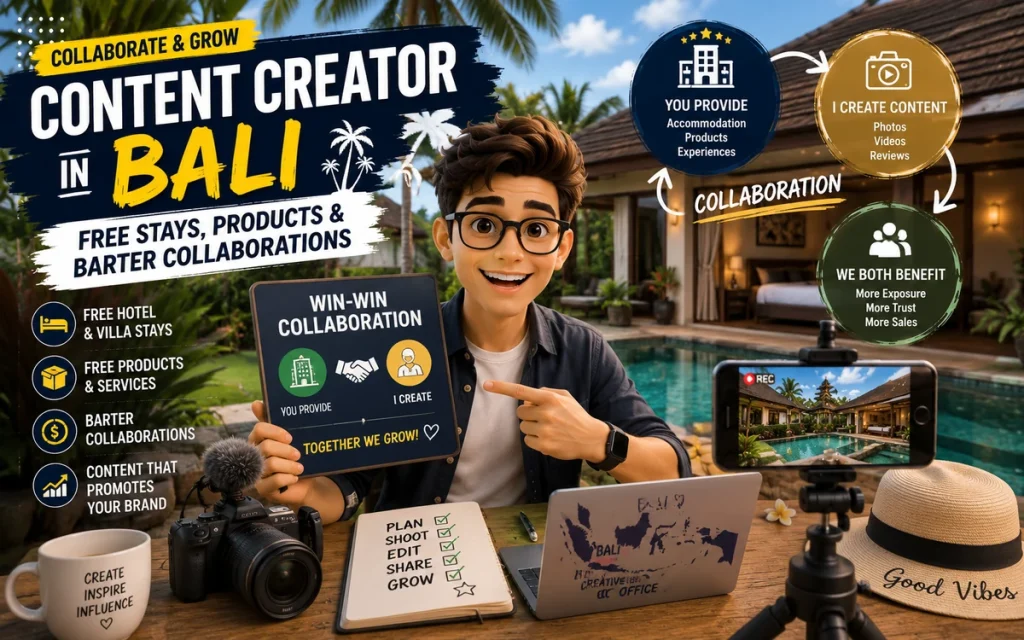
What About Free Hotels, Products, and Barter Collaborations?
A common misunderstanding is that an activity is not commercial if no cash is paid. That is not a safe assumption.
A creator may receive:
- complimentary hotel or villa accommodation;
- free meals or restaurant experiences;
- products;
- flights or transportation;
- tours or activities;
- services or other benefits.
If these benefits are provided in exchange for required promotional content, the arrangement may have economic or commercial value. The creator should therefore assess the full arrangement rather than relying only on whether money was transferred.
The Practical Difference
There is a difference between a creator voluntarily posting about a hotel they personally booked and a hotel providing a complimentary stay on the condition that specific promotional content must be delivered.
No cash payment does not automatically mean there is no commercial arrangement.
This distinction is particularly important in Bali, where hotels, villas, restaurants, tourism businesses, and creators frequently collaborate.
Does C5A Allow Content Creators to Get Paid in Indonesia?
This is one of the questions that should not be answered through assumptions. C5A is listed as a visitor-visa category, not a general work visa, and the complete operational rules for C5A should be verified before claiming that every type of payment or compensation is permitted.
The relevant facts may include:
- who pays the creator;
- where the client or company is based;
- what service or content is being provided;
- whether the activity was arranged before arrival;
- whether an Indonesian business receives the direct benefit;
- whether the creator is performing work-like services in Indonesia;
- the exact immigration permission held by the creator.
A creator earning general platform revenue from an existing overseas audience may present different facts from a creator being paid by an Indonesian company to deliver a specific campaign. Each situation should be assessed individually.
Do not assume that C5A automatically provides blanket authorization for every paid collaboration or professional service.
C5A Visa Indonesia Requirements: What Is Officially Known?
Because C5A is officially listed but its complete public operational framework should be verified, applicants should be cautious about websites publishing a fixed C5A checklist as if every requirement were already confirmed and universally available.
Before relying on a C5A application checklist, the latest official implementation should clarify matters such as:
- passport validity;
- sponsor or guarantor requirements;
- personal and identity documents;
- proof of funds, if required;
- activity plan or itinerary;
- content creation purpose;
- official government fees;
- initial stay period;
- extension availability;
- maximum permitted stay;
- other compliance or reporting requirements.
Until these details are officially available and verifiable for the current C5A application route, applicants should treat unconfirmed checklists with caution.
How Long Can You Stay in Indonesia on C5A?
The exact stay period for C5A should be confirmed from the latest official operational information rather than copied from another visa category.
It is not safe to assume that C5A has the same initial stay, extension, maximum stay, or conversion rules as C5, C14, a tourist visa, or another visitor visa. Each visa category can have its own conditions.
Before making travel arrangements, applicants should verify the current official information for:
- initial permitted stay;
- whether an extension is available;
- how many times an extension may be possible;
- maximum total stay;
- whether conversion to another status is allowed or restricted.
C5A Visa Indonesia Cost and Fees
The same principle applies to C5A visa fees. A price advertised by a private agency should not automatically be treated as the official government fee.
Before paying for a C5A application, ask the provider to clearly explain:
- the official government fee;
- any separate sponsor or service fee;
- what the quoted price includes;
- whether the application route is currently operational;
- whether the fee is refundable if the relevant official route is unavailable.
This is especially important because the current confusion around C5A has created opportunities for unclear marketing claims.
How to Apply for C5A Visa Indonesia
Step 1: Verify Current Official Availability
Do not rely only on the fact that C5A appears on the visa classification list. Confirm that a current application route, procedure, and applicable requirements are officially available.
Step 2: Assess the Actual Content Creation Activity
Clarify whether the trip involves independent travel content, sponsored promotion, a contract with a business, paid services, barter arrangements, media work, or a larger production.
Step 3: Follow the Current Official Procedure
If C5A is operational for the relevant applicant and activity, follow the latest official requirements rather than an outdated or generic checklist.
Step 4: Do Not Invent a C5A Process
If a complete operational procedure is not yet available, a responsible consultant should not invent an application process or simply issue another visa while calling it a “C5A Visa.”
What Should Foreign Content Creators Do Before Coming to Indonesia?
Before travelling to Indonesia or Bali, content creators should prepare a clear explanation of what they plan to do. This can help reduce the risk of choosing a visa based only on a broad online description.
What Content Will You Create?
Travel content, hotel reviews, sponsored advertising, documentary footage, social media campaigns, and professional productions may involve different considerations.
Who Requested the Content?
Are you creating independently, for an overseas company, for an Indonesian company, or under a brand contract?
Are You Receiving Anything in Exchange?
- money;
- accommodation;
- flights;
- products;
- tours;
- services or other benefits.
Do You Have a Written Agreement?
A contract, campaign brief, email confirmation, or deliverables list may be highly relevant when assessing the true purpose of the visit.
Where Is the Client or Employer Based?
The structure of the commercial relationship may matter.
Are You Joining a Larger Production?
If the project involves a larger professional production, a different immigration assessment may be required.
Frequently Asked Questions About C5A Visa Indonesia
Is C5A Visa Indonesia real?
Yes. C5A is officially listed in Indonesia’s visa classification as the Content Creator Visitor Visa.
Is the C5A Content Creator Visa active?
The visa index is officially listed. However, applicants should separately verify whether the current practical application process is operational and available through the official immigration system before claiming that C5A can definitely be applied for.
Can I apply for C5A Visa Indonesia now?
Do not assume so based only on the existence of the visa index. Verify the current official application availability before submitting an application or paying a visa provider.
Does Indonesia have a visa for content creators?
Indonesia’s official visa classification includes C5A, the Content Creator Visitor Visa.
Is there a Bali Content Creator Visa?
There is no separate Bali-only C5A visa. C5A is part of Indonesia’s national visa classification, although Bali is a major destination for creators and a major source of related searches.
Can YouTubers create content in Indonesia?
The answer depends on the actual activities and purpose of the visit. Personal travel content, commercial campaigns, professional productions, and contracted work should not automatically be treated as the same activity.
Can influencers get paid in Bali?
Payment arrangements should be assessed carefully based on the nature of the activity, the relationship with the client, and the immigration permission required for the actual activity.
Can I accept a free hotel stay in exchange for content?
An exchange of accommodation or other benefits for required promotional content can involve a commercial arrangement. Assess the full facts rather than assuming that a non-cash arrangement is automatically permitted.
Is C5A the same as a work visa?
No. C5A is classified as a visitor-visa category and should not automatically be treated as general work authorization.
Is C5A the same as the C5 Media and Press Visa?
No. C5 and C5A are separate categories with different intended purposes.
The Future of the Indonesia Content Creator Visa
The introduction of C5A into Indonesia’s official visa classification is an important development. The creator economy continues to grow, and Indonesia—particularly Bali—remains one of the world’s most visible destinations for international digital creators.
A dedicated Indonesia Content Creator Visa could eventually provide greater clarity for:
- foreign influencers;
- YouTubers;
- TikTok creators;
- travel bloggers;
- social media professionals;
- tourism businesses;
- hotels and villas;
- brands;
- immigration authorities.
However, clarity requires more than the name of a visa category. Applicants and immigration professionals need a practical and transparent framework explaining who qualifies, what activities are allowed, whether sponsorship is required, what documents must be submitted, how long the visa allows the holder to stay, whether extensions are available, how commercial collaborations are treated, and where the boundary lies between content creation and employment.
Until these implementation details are clearly available through the official process, accuracy is more important than speculation.
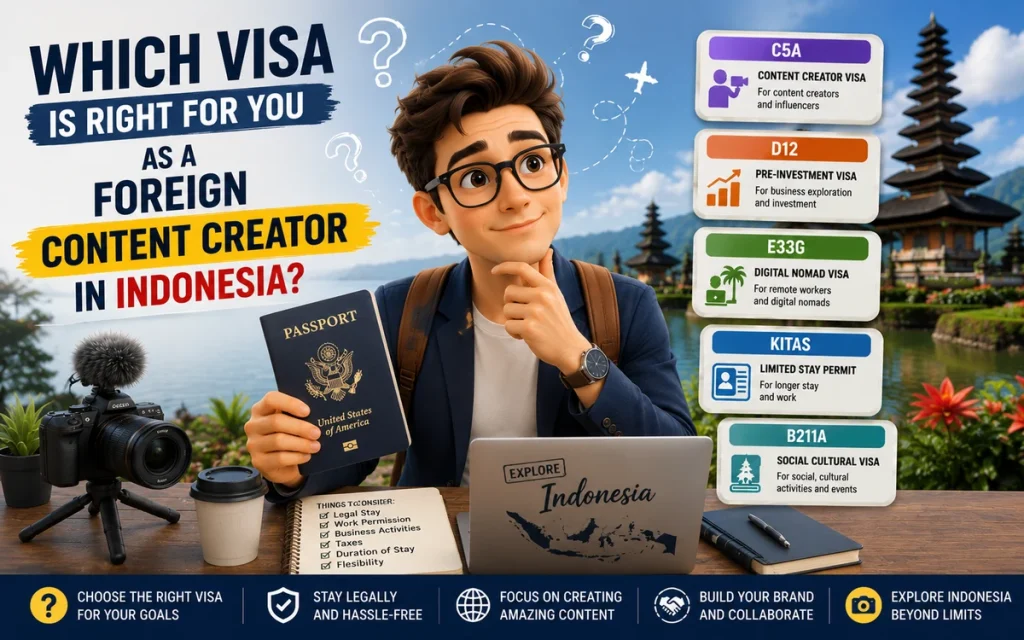
Final Answer: Is the C5A Visa Indonesia Available in 2026?
Here is the most accurate summary:
C5A officially exists as an Indonesian visa index and is listed as the Content Creator Visitor Visa.
However, the existence of the C5A classification should not automatically be treated as proof that a complete, publicly accessible, and fully operational application procedure is currently available for every applicant.
If you are a content creator planning to visit Indonesia or Bali, the correct immigration route should be determined based on your actual activities, including whether you are:
- travelling and documenting your trip;
- creating professional content;
- participating in a brand campaign;
- receiving payment;
- receiving benefits in exchange for content;
- working with an Indonesian company;
- joining a film or larger production.
The C5A visa category is an important development, but until its practical implementation can be clearly verified, foreign creators should avoid relying on unconfirmed claims about guaranteed C5A applications, fixed requirements, or blanket permission to perform commercial work.
Need Help Assessing the Right Visa for Your Content Creation Activities?
If you are a YouTuber, TikTok creator, Instagram influencer, travel blogger, photographer, videographer, or other digital creator planning to come to Indonesia, Azra Solutions can help assess your planned activities and review the most appropriate immigration options based on the latest available regulations and implementation.
We can also monitor developments regarding the C5A Visa Indonesia and provide updated information when an official operational application procedure becomes available.
Contact Azra Solutions before making visa arrangements based on assumptions or unverified online information. Choosing the correct immigration route should always depend on your actual planned activities in Indonesia.
For creators who work remotely and are looking for a longer-term option in Indonesia, you may also want to explore the Indonesia Digital Nomad Visa (E33G).
If Bali is your main destination, you can also explore our complete guide to Bali Visa options to better understand the available visa choices for your trip.