Introduction
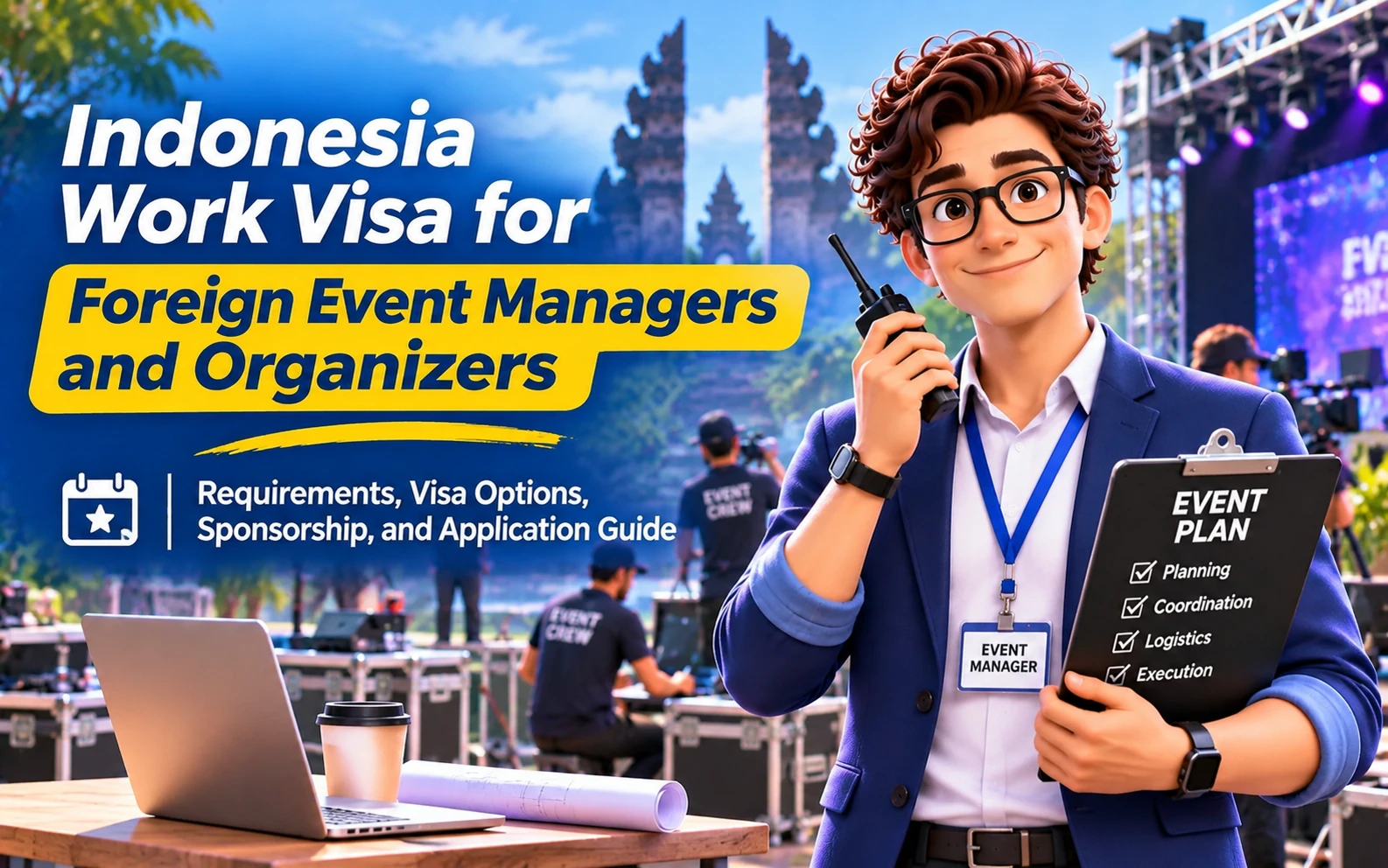
Indonesia hosts conferences, exhibitions, corporate gatherings, festivals, sporting events, cultural programmes, product launches, and international entertainment activities. These projects may involve overseas professionals with experience in event planning, project coordination, technical production, logistics, stakeholder communication, and international touring. For a foreign professional considering an assignment in Indonesia, however, an event-related job title does not itself establish permission to work. The actual duties, the Indonesian host or employer, the employment relationship, the relevant manpower approval, and the immigration permission must be considered together.
The phrase Indonesia Event Manager Work Visa describes a common search need, but it is not the name of a standalone Indonesian visa index. Foreign Event Manager in Indonesia is a broad description rather than a visa category. The official classification lists E23 as a work visa and separately lists visit categories such as C10 and C11 for narrower purposes. A person attending a conference, an invited speaker, an exhibitor, an official crew member, and an employee carrying out an ongoing professional role are not automatically in the same legal position.
A critical distinction concerns independent event organization. On 24 July 2026, the Director General of Immigration publicly stated that foreign nationals are prohibited from acting as event organizers in Indonesia and may be involved as official crew or members of an official team in activities featuring international performers. The statement followed enforcement action involving foreign nationals alleged to have organized an event. It highlights that an ITAS, local guarantor, or business connection does not automatically authorize every event-related activity. The proposed role must be checked against the current immigration position and the actual facts.
This guide explains how foreign event management professionals should assess proposed activities, distinguish employment from event attendance or independent organizing, understand employer and RPTKA considerations, and identify an appropriate immigration route before travelling or beginning an assignment. It is general information, not a guarantee that a particular position or application will be approved.
Understanding the Role of Foreign Event Managers in Indonesia
Event management covers a wide range of functions. A job title may refer to high-level planning, project administration, venue coordination, technical production, vendor liaison, sponsorship, guest management, or on-site execution. Authorities are concerned with the real activity rather than the title printed on a business card. A person described as an event manager may therefore need a different assessment from a speaker, exhibitor, performer, production technician, or visitor attending meetings.

What Does an Event Manager Do?
In a general business context, an event manager helps plan and coordinate an event from concept to completion. Tasks can include defining objectives, preparing timelines, coordinating suppliers, managing budgets, arranging venues, tracking deliverables, communicating with stakeholders, and evaluating results. Larger events divide these functions among project directors, producers, operations managers, logistics leads, stage managers, and specialist contractors. Immigration analysis must identify which tasks the foreign national will personally perform in Indonesia.
Event Planning and Strategic Management
Planning may involve preparing an event concept, defining the audience, setting milestones, evaluating venues, preparing a risk register, and coordinating a project plan. Strategic input may be delivered before an event or remotely. If the professional travels to Indonesia, the purpose and substance of onshore activities must fit the selected visa conditions. A business meeting should not be used as a label to conceal hands-on work outside a visit permission.
Event Coordination and Operational Responsibilities
Operational coordination can include directing schedules, supervising set-up, coordinating access, managing rehearsals, handling suppliers, and making real-time decisions during an event. These activities differ from attending an event as a guest or participant. If an assignment involves operational control or organizing the event itself, the employer and immigration position must be reviewed carefully in light of the authority’s stated restriction on foreign nationals acting as event organizers.
Types of Foreign Event Management Professionals
International Event Managers
An international event manager may coordinate communication between an overseas rights holder, production company, and Indonesian counterpart. The role can involve schedules, project reporting, stakeholder coordination, and cross-border logistics. The parties should establish whether the individual is an employee, official crew member, visitor attending meetings, or independent organizer. These arrangements are not interchangeable.
Event Organizers and Event Planning Professionals
The expression event organizer is used broadly in commercial marketing. It may refer to a company selling event services, an individual planning a private gathering, or a professional managing a project for a local company. For foreign nationals, the label requires particular caution. The Director General of Immigration’s July 2026 statement expressly said foreign nationals are prohibited from acting as event organizers, while allowing involvement as official crew or members of an official team in events featuring international performers. A foreign professional should not assume that incorporating a company, holding investor status, or obtaining a work-related stay permit automatically permits independent event organizing.
Conference and Exhibition Managers
Conference and exhibition projects may involve venue planning, registration, floor plans, exhibitor communication, conference programmes, speaker schedules, and logistics. A foreign national attending an exhibition or participating as an exhibitor may fall within a visit category designed for that limited purpose. A person performing ongoing management or operational work is in a different position. The fact that both activities take place at an exhibition does not make them legally identical.
Corporate Event Managers
Corporate events include internal meetings, product launches, award ceremonies, training events, and client conferences. A foreign employee proposed for a management role must be assessed under foreign-worker and immigration rules. The employer should verify that it is eligible to employ foreign workers, that the position may be held by a foreign national, and that the required approvals are completed. A short visit to attend internal meetings should not be confused with carrying out an ongoing job in Indonesia.
Can Foreigners Work as Event Managers or Event Organizers in Indonesia?
The answer cannot be reduced to a blanket statement that every foreign event manager can work in Indonesia if they obtain an E23 visa. Nor should it be stated that every event-related activity is prohibited. The legal analysis must distinguish lawful employment in an approved position, limited visit activities, official crew participation, and acting as an independent event organizer. The public immigration statement of 24 July 2026 is especially important: it says foreign nationals are prohibited from being event organizers and may participate as official crew or members of an official team in events featuring international performers. Search terms such as Event Management Work Visa Indonesia and Foreign Event Organizer Indonesia should not be mistaken for official visa classifications.

Indonesian Rules on Foreign Workers
Indonesia regulates the use of foreign workers through manpower and immigration rules. Government Regulation No. 34 of 2021 addresses foreign-worker utilization, including employer obligations relating to an approved Foreign Worker Utilization Plan (RPTKA), subject to applicable exceptions. Minister of Manpower Regulation No. 8 of 2021 provides implementing provisions. The Ministry of Manpower’s legal database describes the framework as covering RPTKA approval, employer and foreign-worker documentation, companion-worker arrangements, duration, compensation, reporting, and administrative sanctions.
The statutory framework generally requires foreign workers to be employed in an employment relationship, in specified positions and for a specified period, and to possess competence relevant to the position. Employers must comply with applicable approval, reporting, companion-worker, training, and compensation obligations where required. The precise requirements and exceptions should be checked for the employer and position at the time of application.
Working for an Eligible Indonesian Company
A foreign professional proposed for an employment role should have a genuine Indonesian employer or other legally recognized employing entity. The company should explain why the position requires a foreign worker, identify the actual job duties, and demonstrate that the role is consistent with the approved manpower plan and immigration permission. A local contact, event client, venue, or guarantor is not necessarily the employer. The legal relationship should be documented accurately. The employer should also assess whether the proposed Indonesia Event Organizer Work Permit route is legally available for the specific duties; the phrase itself is not an official permit name.
Restrictions on Independent Event Organizing by Foreign Nationals
On 24 July 2026, the Director General of Immigration publicly stated that foreign nationals are prohibited from acting as event organizers in Indonesia and may participate as official crew or members of an official team in events featuring international performers. This should be reported as the authority’s stated immigration position, not expanded into an invented statutory test. The actual role, official appointment, sponsor, event structure, and stay permission remain relevant. A foreign national should not independently create, market, control, or run an event on the assumption that a visa or local partner makes the activity lawful.
Indonesia Visa Options for Foreign Event Management Professionals
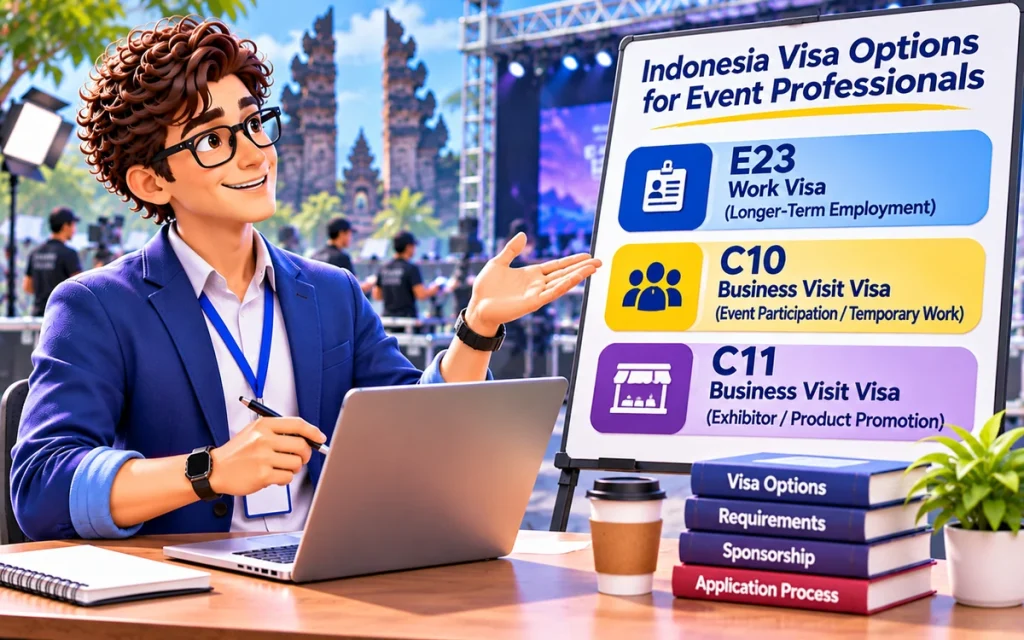
Indonesia classifies visas according to the purpose of the visit or stay. The official immigration list identifies E23 as a work visa and separately lists visit categories such as C10 for a business-event speaker and C11 for promotion of products and services. These labels must be read with detailed activity permissions, prohibitions, sponsor requirements, and the current visa classification decision. A visa index is not a generic job-title category.
E23 Work Visa for Eligible Foreign Employees
E23 is listed by Immigration as a work visa. It may be relevant where a foreign national is genuinely employed in Indonesia and the employer has completed applicable manpower and immigration requirements. It is not an automatic route for every person whose job title contains event manager. Employer, position, RPTKA or applicable approval, duration, and actual duties must be assessed. The immigration authority’s position on foreign nationals acting as event organizers must also be considered before proposing E23 for an event-management role.
An applicant should not proceed based only on a job title, invitation letter, or event schedule. The employer should verify that the role may lawfully be occupied by a foreign worker and that the duties do not amount to prohibited independent event organizing. A work visa does not cure an underlying prohibition on the activity.
C10 Visa for Eligible Event Participants and Temporary Activities
The official visa list describes C10 as a visit visa for a business-event speaker. It is a narrow visit category, not a general event-management work permit. A person invited to speak should check the exact C10 conditions, including permitted activities, sponsor requirements, remuneration rules, and prohibitions. A person managing vendors, supervising operations, or organizing the event should not assume C10 covers those activities simply because they are connected to a conference.
C11 Visa for Foreign Exhibitors
The official visa index describes C11 as a visit visa for promotion of products and services, while the MOLINA guide labels it as an exhibitor category. It may be relevant to qualifying exhibition or product-promotion activities, subject to its exact conditions. It is not a general authorization to manage an exhibition, operate an event-organizing business, or provide services outside the approved purpose.
Need to assess your proposed event role?
Before accepting an assignment, have the duties, employer structure, and immigration route reviewed.
Foreign Event Manager vs Independent Event Organizer
Foreign Employees Working Under an Indonesian Employer
A foreign employee working for an eligible Indonesian employer is conceptually different from a foreign national independently organizing an event. In employment, the Indonesian entity is the employer, holds required approvals, controls the work within the lawful scope, and accepts employer responsibilities. Even then, duties must be permitted for a foreign worker and consistent with the immigration authority’s position. A formal employment contract is important evidence, but it does not override a prohibited activity.
Independent Event Organization and Business Restrictions
An independent organizer may control the event concept, commercial offering, ticketing, suppliers, staffing, venue, and execution. The July 2026 immigration statement warns that foreign nationals are prohibited from acting as event organizers in Indonesia. A foreign-owned company, investment status, local nominee arrangement, or event sponsorship should not be treated as a shortcut around this restriction. Business ownership and permission to carry out a particular activity are separate legal questions.
RPTKA and Indonesian Employer Sponsorship
What Is RPTKA?
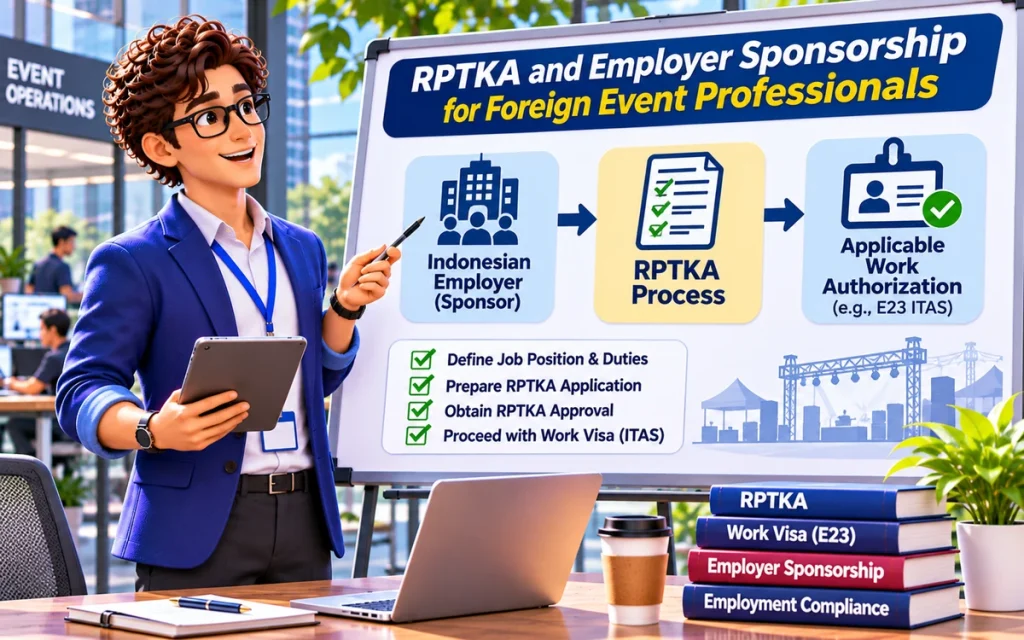
RPTKA is the Foreign Worker Utilization Plan used in Indonesia’s manpower framework. Government Regulation No. 34 of 2021 and Minister of Manpower Regulation No. 8 of 2021 are key instruments governing foreign-worker utilization and implementation. The Ministry of Manpower describes the framework as covering RPTKA approval, employer and foreign-worker documentation, companion-worker arrangements, duration, compensation, reporting, and administrative sanctions. Employers should confirm the current process and any applicable exemption before a foreign national begins work.
Employer Responsibilities and Sponsorship Requirements
The employer may need to prepare and obtain RPTKA approval, provide accurate role and duration information, support the immigration application, meet compensation obligations, appoint an Indonesian companion worker where required, and comply with reporting and training duties. Details depend on the applicable provisions and exceptions. Sponsorship is not simply signing an invitation letter; it involves legal responsibility for the foreign national and declared purpose of stay.
Foreign Worker Compensation Fund and Related Obligations
Foreign-worker utilization may trigger payment of the relevant compensation fund, commonly called DKPTKA, unless a specific exemption applies. Amount, payment method, timing, and exemptions should be checked against current Ministry of Manpower procedures and the employer’s circumstances. This draft does not state a universal amount because calculation and exemptions must be verified for each case.
Requirements for Foreign Event Managers in Indonesia
Applicant Documents
Depending on the route, the applicant may be asked for a passport meeting the required validity period, recent photograph, personal details, curriculum vitae, evidence of qualifications or relevant experience, and other supporting documents. Additional documents may be requested based on nationality, visa category, or the authority’s assessment. Applicants should use the current official checklist rather than an old list copied from another case.
Indonesian Employer and Sponsor Documents
The Indonesian employer may need to provide corporate establishment and registration documents, business identification and licensing information, sponsor details, and approved manpower documentation. The exact list depends on the employer’s legal status and applicable process. Sponsor identity and responsibilities should be consistent throughout the application.
Employment Contract and Job Description
The employment contract or assignment agreement should identify the parties, role, duration, remuneration, reporting line, work location, and responsibilities. For event-related roles, state whether the person attends meetings, serves as official crew, provides a presentation, undertakes technical work, or carries out management activities. Documents should not disguise independent organizing as a different role.
RPTKA Approval and Supporting Documents
Where required, the employer should obtain the relevant RPTKA approval before proceeding with the work-related immigration application. Supporting materials may include the proposed position, justification, foreign-worker information, Indonesian companion-worker details, and other items required by the current system. Procedures can change, so the employer should verify the current submission portal and document requirements with the Ministry of Manpower or a qualified adviser.
How to Apply for an Indonesia Event Manager Work Visa
The safest process begins before the professional books travel, signs an assignment, or starts providing services. The Indonesian host and foreign professional should agree on actual duties, determine whether the activity is legally permitted, and identify the correct manpower and immigration route. If the proposed role amounts to independent event organizing, the parties should not proceed on the assumption that a visa application will make it lawful.
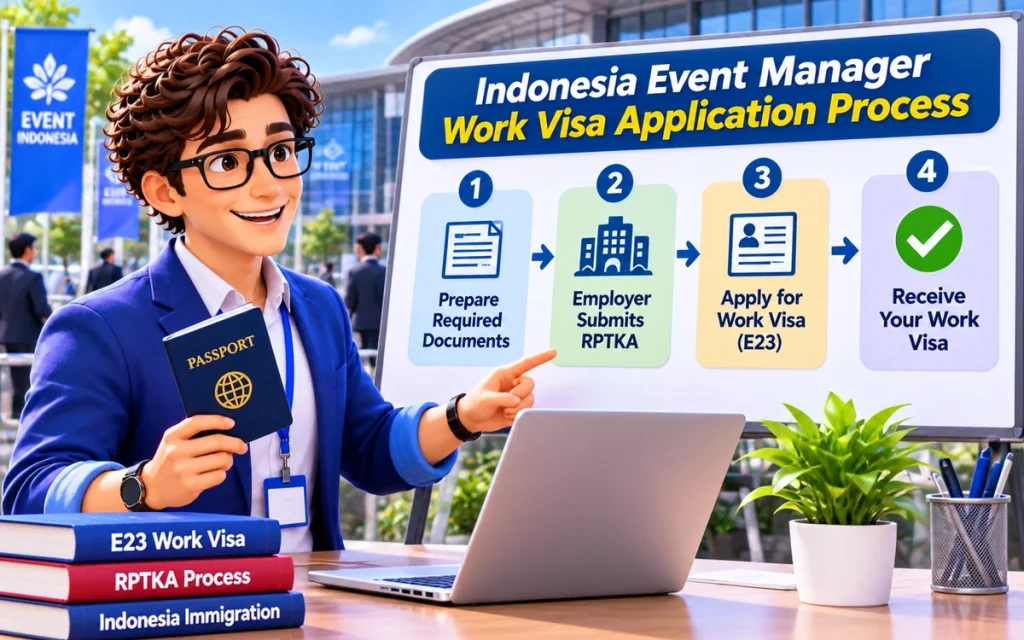
Step 1: Define the Actual Event Management Responsibilities
Prepare a detailed scope covering planning, meetings, vendor contact, supervision, event-day duties, payments, and post-event reporting. Identify tasks performed in Indonesia and overseas. Be explicit about whether the person is an attendee, speaker, exhibitor, official crew member, employee, consultant, or organizer.
Step 2: Identify an Eligible Indonesian Employer
If the arrangement is employment, identify the Indonesian legal entity that will employ the foreign national. Confirm that it is permitted to employ foreign workers and can meet manpower and immigration obligations. A project client or guarantor should not be described as the employer unless that is the genuine legal relationship.
Step 3: Review the Position and RPTKA Requirements
The employer should check whether the proposed position is eligible for a foreign worker, whether RPTKA is required, and whether an exception applies. It should also assess the immigration authority’s restriction on foreign nationals acting as event organizers. If the duties conflict with that position, revise the project arrangement lawfully or do not assign the foreign national to those activities.
Step 4: Obtain the Required Manpower Approval
Where RPTKA approval is required, the employer should submit information through the current Ministry of Manpower process and wait for the necessary approval. Position and duration details should be accurate. The foreign national should not start work merely because an application has been submitted or the event date is approaching.
Step 5: Apply for the Appropriate Work Visa
After manpower requirements have been addressed, the sponsor should proceed with the appropriate immigration application through the official eVisa system. The category should reflect the approved employment and actual duties. Visit categories such as C10 or C11 should not be selected as substitutes for employment authorization.
Step 6: Complete the Immigration Process
The applicant should follow instructions attached to the visa approval, complete required entry and stay-permit steps, and check the permitted period and conditions. Keep copies of the visa, stay permit, employment documents, sponsor details, and approvals. Entry into Indonesia does not itself authorize every activity described in the project proposal.
Step 7: Follow the Approved Employment Conditions
After arrival, the foreign national should perform only activities permitted by the approvals and stay permission. The employer should monitor project changes, keep records, and obtain advice before changing duties, employer, or work location. Compliance continues throughout the assignment, not only when the visa is issued.
Temporary Event Assignments and Short-Term Activities
International Speakers and Presenters
A foreign speaker invited to present at an eligible business event may need to consider C10 and its specific conditions. The invitation should accurately describe the speaker’s role, event, organizer, schedule, and any remuneration. A speaker invitation should not cover event management, vendor supervision, or independent organizing duties.
Exhibition Participation and Exhibitor Activities
A foreign exhibitor promoting products or services may need to assess C11 and its exact scope. The exhibitor’s role should be limited to the permitted activity. Managing the entire exhibition, providing services to an Indonesian organizer, or supervising event operations may fall outside that purpose and requires separate legal analysis.
Immigration and Manpower Compliance for Foreign Event Managers
Working Within the Approved Position
The foreign national should perform only duties and activities authorized by relevant approvals. A broad job title cannot justify work outside the approved scope. If the event evolves and the person is asked to take on additional operational responsibilities, the employer should assess the change before it happens.
Employer and Sponsor Responsibilities
The employer and sponsor should ensure submitted information is accurate, actual activities remain consistent with the approved purpose, and applicable reporting and compensation obligations are met. A sponsor should not lend its name to an arrangement it does not genuinely supervise or understand.
Consequences of Unauthorized Employment
Violations may expose the foreign national, employer, and sponsor to immigration or manpower enforcement, depending on the facts and applicable law. Possible consequences can include administrative action, cancellation of stay permission, deportation, entry restrictions, or sanctions against responsible parties. The actual consequence depends on the legal basis and enforcement decision.
Common Visa and Work Permit Mistakes
Using a Visitor Visa for Employment
A frequent mistake is assuming a visitor visa permits work because the assignment is short or the person is not paid in Indonesia. The activity and visa conditions matter more than the label used by the parties. A visit category should only be used for the activity it authorizes.
Assuming C10 or C11 Is a General Work Permit
C10 and C11 are visit categories with specific purposes. They should not be presented as general work visas for event managers. A speaker or exhibitor should verify the precise conditions and should not extend that permission to operational management or organizing duties.
Working Without the Required Manpower Approval
Another mistake is beginning work while RPTKA or other required approvals are pending. Employers should confirm the necessary approval sequence and wait until requirements are satisfied. An event deadline does not create an exemption.
Organizing Events Independently Without the Appropriate Legal Basis
The July 2026 immigration statement makes this a particularly serious issue. Foreign nationals should not assume they can independently organize events in Indonesia. A local partner, investor status, or existing ITAS does not automatically make the activity permissible. Obtain specific legal advice before taking a role that could be viewed as organizing or controlling an event.
Need help preparing an application?
Azra Solutions can review your documents and help identify the appropriate next steps based on your actual role.
Frequently Asked Questions About the Indonesia Event Manager Work Visa
1. Do foreign event managers need a work visa in Indonesia?
A foreign national who carries out employment or work in Indonesia needs the appropriate legal basis and immigration permission. Whether a work visa is required depends on the actual activity and arrangement. Attending a permitted event or delivering an eligible presentation differs from performing an ongoing management role.
2. Can foreigners work as event organizers in Indonesia?
The Director General of Immigration stated on 24 July 2026 that foreign nationals are prohibited from acting as event organizers in Indonesia and may participate as official crew or members of an official team in events featuring international performers. The exact role should be reviewed before travel or assignment.
3. What is the Indonesia Event Manager Work Visa?
It is a descriptive search term, not a standalone official visa index. E23 is listed as a work visa, but eligibility depends on the employer, approved position, manpower requirements, and permitted duties. Not every event-related role qualifies.
4. Does an Indonesian company need RPTKA to hire a foreign event manager?
Government Regulation No. 34 of 2021 establishes RPTKA requirements for employers using foreign workers, subject to applicable exceptions. The employer should confirm current requirements for its entity, proposed position, and intended work period.
5. Can a foreign event manager use a C10 visa?
C10 is listed as a visit visa for a business-event speaker. It is not a general event-management work permit. A person should use it only if the actual activity fits the detailed C10 conditions.
6. What is the difference between C10 and C11 visas?
The official immigration list describes C10 as a visit visa for a business-event speaker and C11 as a visit visa for promotion of products and services. Their purposes differ, and neither should be treated as a general work visa.
7. Can foreign event managers work independently in Indonesia?
Foreign nationals should not assume they may independently organize events. The immigration authority publicly stated that foreign nationals are prohibited from acting as event organizers. Obtain case-specific advice before undertaking independent event activity.
8. Which Indonesian companies can sponsor foreign event managers?
The Indonesian entity must be legally eligible to employ foreign workers and meet applicable manpower and immigration requirements. Its legal status, business activities, proposed position, and actual role should be checked before sponsorship is accepted.
9. What documents are required for an event manager work visa?
Requirements depend on the route. They may include passport and applicant information, employer and sponsor documents, employment contract, job description, RPTKA approval where required, and category-specific supporting evidence. Use the current official checklist.
10. Can a foreign event manager work on short-term event projects?
Short duration does not automatically remove work-permit requirements. The parties must assess the activity, work relationship, payment, and visa conditions. Some limited visit activities may be permitted, but operational work should not be assumed to qualify.
11. Can a foreign event manager change employers in Indonesia?
A change of employer or position may require new manpower and immigration steps. A foreign national should not begin work for a different company using an existing approval without confirming that it covers the new arrangement.
12. What happens if a foreign event manager works without the correct permit?
Depending on the facts, the foreign national, employer, and sponsor may face immigration or manpower enforcement. Potential consequences can include cancellation of stay permission, deportation, entry restrictions, or administrative sanctions.
Conclusion
Foreign event management work in Indonesia requires more than choosing a visa that appears suitable from its name. The employer and professional must identify the real duties, distinguish employment from permitted event participation, verify whether RPTKA or another manpower approval is required, and select an immigration category that matches the activity. The official classification lists E23 as a work visa, while C10 and C11 are visit categories for narrower purposes. None is a universal solution for every event-related role.
The immigration authority’s July 2026 statement that foreign nationals are prohibited from acting as event organizers is especially important. Foreign professionals should not independently organize events or assume that a local guarantor, investor status, or existing stay permit authorizes that activity. Where a proposed assignment involves official crew participation or employment by an Indonesian entity, the parties should document the role accurately and confirm that the arrangement is permitted before proceeding.
Azra Solutions can help review the proposed role, employer and sponsor structure, supporting documents, and potential immigration route. Each case should be assessed individually against current rules and official requirements.
For assistance, contact Azra Solutions:
Official References
- Directorate General of Immigration – Indonesia Visa List
- Immigration-published MOLINA User Guide (PDF)
- Government Regulation No. 34 of 2021 – Ministry of Manpower JDIH
- Minister of Manpower Regulation No. 8 of 2021 – Ministry of Manpower JDIH
- ANTARA – Director General’s statement on foreign event organizers, 24 July 2026
- Official Indonesian eVisa Portal
Related AzraID guidance: Indonesia Sports & Entertainment Work Visa; Indonesia Temporary Work Visa; and Indonesia Entertainment Consultant Visa