Introduction
Indonesia’s entertainment economy spans music, film, television, live events, talent representation, digital media, and creative production. Foreign professionals may be invited to advise an Indonesian company, develop an artist-management strategy, review a production plan, help design an event programme, or provide specialist business guidance. Although these activities may all be described commercially as consultancy, they do not necessarily fall under the same immigration category. Searchers may use terms such as “Entertainment Consultant Visa Indonesia” or “Entertainment Consultant Work Permit Indonesia”, but neither phrase is the official name of a single visa category.
There is no single visa category that automatically authorises every activity performed by an entertainment consultant. The appropriate route depends on the actual duties in Indonesia, the host or sponsor, the duration and location of the assignment, the recipient of the service, and the payment arrangement. A job title such as consultant, adviser, producer, manager, or creative director does not decide the immigration classification by itself.
This guide explains how foreign entertainment professionals and Indonesian organisations can assess the Indonesia Entertainment Consultant Visa question, distinguish advisory work from business visits, performance and production activities, and prepare for a compliant engagement. The phrase “Indonesia Entertainment Consultant Visa” is a descriptive search term, not the official name of one universal Indonesian visa category. The correct route depends on the actual activities and the relevant classification. This guide is general information; applicants should verify the current rules and their individual circumstances before travel or starting an assignment.
Understanding the Role of an Entertainment Consultant in Indonesia
An entertainment consultant provides specialist analysis, planning, evaluation, or strategic guidance to a business or organisation in the entertainment sector. The engagement may be independent or delivered through a foreign consultancy firm. In practice, however, the term consultant can describe anything from a one-day boardroom presentation to hands-on management of a local project. Immigration assessment therefore needs to examine the substance of the assignment. For a Foreign Entertainment Consultant in Indonesia, the distinction between strategic advice and operational service delivery is especially important. An Entertainment Management Consultant Indonesia engagement should be described by its actual duties, not just its commercial title.

Entertainment strategy and business advisory
A strategy adviser may review a company’s business model, market positioning, revenue streams, distribution arrangements, licensing strategy, audience development, or expansion plans. A limited visit for meetings and negotiations can be different from remaining in Indonesia to implement a business plan or manage local operations. The itinerary, deliverables, counterparties, and payment arrangements help establish the real nature of the work.
Artist and talent management consultancy
A specialist may advise an agency on artist development, talent representation structures, international market entry, brand partnerships, contract administration, or career planning. This should be distinguished from acting as an artist’s day-to-day manager in Indonesia, negotiating local engagements, arranging performances, or delivering ongoing services for a local company.
Film and television production consultancy
Film and television advisers may review production plans, budgets, location strategies, distribution, post-production workflows, or co-production structures. A person attending commercial meetings is not automatically in the same position as a professional participating in filming at an Indonesian location. C14 and D14 are specifically associated with film-making and production activities and have defined conditions.

Music industry and concert management consultancy
Music-sector advisers may provide guidance on concert strategy, touring models, venue operations, sponsorship, artist relations, ticketing, or music-business development. A person advising an organiser is not necessarily performing as a musician or working as concert crew. If the person actually performs or carries out production duties, those activities need separate assessment.
Creative industry and entertainment programme advisory
Other assignments may involve creative campaigns, television formats, content strategy, festival programming, production development, or cultural projects. The host should describe whether the foreign professional will advise, train, speak, direct, produce, perform, or undertake operational tasks. Vague descriptions make it harder to select the correct route.
Types of Foreign Entertainment Consultants
The following profiles are examples of commercial roles, not separate visa categories. One person may perform several functions. The immigration route must be matched to the complete activity rather than a convenient job title.
Entertainment business strategy consultants
These professionals advise studios, agencies, promoters, production houses, broadcasters, and entertainment groups on business planning, partnerships, market development, and commercial strategy. A limited visit for discussions may differ from an assignment to implement a plan or manage local operations.
Music and artist management consultants
These advisers help organisations improve artist-management systems, touring strategy, international representation, brand development, and commercial partnerships. If the assignment includes ongoing local management or direct service delivery, the parties should not assume that a business-visit visa is sufficient.

Film and television industry consultants
This group includes advisers in production planning, financing, distribution, location strategy, format development, and international co-production. Their activities should be separated from actual film-making or production participation.
Live event and concert consultants
Event consultants may advise on event concepts, venue selection, sponsorship, ticketing, operational planning, and audience safety. A consultant attending planning meetings is different from a stage technician, performer, production crew member, or event manager actively delivering the event.
Talent development consultants
Talent-development specialists may review training programmes, recruitment processes, professional development, casting systems, or talent-agency operations. Structured training or a role resembling employment requires closer review.
Creative production and programme consultants
These professionals may advise on creative direction, programme formats, content development, production workflows, and quality standards. If they take operational responsibility for directing or producing a project in Indonesia, the role may go beyond a limited advisory visit.
Do Foreign Entertainment Consultants Need a Visa or Work Permit in Indonesia?
Foreign nationals must hold immigration status matching the activities they intend to carry out in Indonesia. The key questions are whether the visa and stay permit authorise those activities and whether separate manpower or employment requirements apply. Permission to attend meetings is not blanket permission to provide professional services.
Business visits versus professional work
A business visit may cover meetings, discussions, negotiations, or other activities expressly permitted by the relevant category. It does not automatically authorise ongoing consultancy, supervision of local operations, management of staff, or delivery of contracted services. The classification’s specific rights and prohibitions must be checked, including restrictions on receiving Indonesian-source remuneration under C2.
Short consultations and professional assignments
A short presentation or meeting may differ from a multi-week engagement with defined deliverables. An overseas executive discussing a possible partnership is not necessarily in the same position as a consultant retained to implement a business plan or manage local operations on site.
The role of the Indonesian host or sponsor
The Indonesian organisation should identify who invites the professional, who is responsible for the project, where activities take place, and which entity pays the fees. The sponsor or host may need to provide supporting documents and explain the purpose of travel. An invitation letter alone does not resolve the visa question.
Contracts, payments, and actual activities
The contract, invoice, source of payment, work location, reporting line, and deliverables can all be relevant. Payment rules differ by category: for example, C2, C14, and D14 contain prohibitions on receiving remuneration or similar compensation from an Indonesian individual or corporation, while C10 allows remuneration for its defined speaker activity and E23 operates within a qualifying employment framework. Overseas payment does not by itself establish that an activity is permitted. The parties should disclose the real arrangement and avoid describing professional work as a meeting.
Why a tourist visa is not general work authorisation
A tourist visa or visa-on-arrival route is designed for its stated visitor purposes. It should not be used as a shortcut for a professional engagement because the assignment is short, informal, or described as freelance work. If activities go beyond visitor scope, the correct category should be arranged before work begins.
Indonesia Visa Options for Entertainment Consultants
Indonesia’s visa classification contains several categories that may be relevant to entertainment-sector travel. They do not create a universal consultant visa. Each category has a defined activity and restrictions. The following is a starting point for assessment, not a determination that a particular applicant qualifies.
E23 Work Visa for qualifying professional assignments
E23 is a work visa category for a foreign national who will work or serve as a specialist in an employment relationship with the Indonesian sponsor. It may be relevant where an entertainment organisation engages a foreign professional in a qualifying position and the required immigration and manpower approvals are in place. The word consultant, a freelance label, or an overseas service contract does not by itself make someone eligible for E23. The parties must examine the actual employment relationship, sponsor, position, duties, work location, duration, remuneration, and supporting approvals. E23 is not a blanket permit for independent consultants serving any number of Indonesian clients.
C2 Business Visit Visa for permitted business activities
C2 is a business-visit category for activities within its defined scope, including business discussions, meetings, negotiations, signing business agreements, business-related visits, and certain purchasing or site-visit activities. Its limits are important. The classification prohibits, among other things, direct sales of goods or services, continuous supervision of production activities, specified technical work such as operating, repairing, or installing machinery, and receiving remuneration, wages, or similar compensation from an individual or corporation in Indonesia. A foreign consultant should therefore not assume that C2 authorises delivery of a paid consultancy assignment to an Indonesian client. The precise itinerary and every planned activity must fit the current category.
C10 Business Event Speaker Visa
C10 is intended for a foreign national attending a qualifying business event in Indonesia as a speaker, lecturer, or presenter. The classification allows the holder to receive remuneration, wages, or similar compensation from an individual or corporation in Indonesia for the permitted speaker activity. However, it prohibits direct sales of goods or services and entering into an employment relationship with an Indonesian individual or corporation. C10 is therefore not a general permission to undertake ongoing consulting, manage an event, perform operational work, or accept an ordinary local job. The invitation, event agenda, organiser, speaking role, and payment arrangement should match the category.
C14 Film Making and Film Production Visa
C14 is a specific visit category for making films using locations in Indonesia. The 2025 visa classification allows film-making-related activities within the approved purpose, but prohibits direct sales of goods or services and receiving remuneration, wages, or similar compensation from an individual or corporation in Indonesia. It should not be treated as a generic visa for a paid film-industry consultant, a production manager, or any professional who happens to work in the entertainment sector. A consultant attending business meetings, a specialist participating in a shoot, and a professional providing paid advisory services may require different assessments.
D14 Multiple-Entry Film Making and Film Production Visa
D14 is the multiple-entry visit category associated with film-making using locations in Indonesia. Multiple entry is a travel facility; it does not broaden the permitted activity into unrestricted consultancy or employment. The classification retains restrictions including the prohibition on direct sales of goods or services and on receiving remuneration, wages, or similar compensation from an individual or corporation in Indonesia. Each visit must remain connected to the permitted film-making purpose and comply with the stay permit issued for that entry. Applicants should not select D14 merely because they expect to travel to Indonesia more than once.
C7, C7A, C7B, and C7C activity-specific performance categories
The C7 family covers defined performance-related activities, not general entertainment consultancy. C7 concerns arts and cultural performances, with examples such as theatre, dance, or circus; the category permits the specified performance and related remuneration or facilities, subject to its conditions. C7A concerns performing musical works. C7B is for a foreign national supporting foreigners who perform musical works, such as qualifying music-performance support personnel. C7C concerns performing a specified skill or expertise and may include training in that skill, within the activity described in the itinerary. These categories have their own limits, including restrictions on direct sales of goods or services and employment relationships where stated in the classification. They should not be used as a general permit for an adviser reviewing a concert business plan. If the consultant also performs, trains, or works as crew, disclose and assess each activity separately.
How to determine the appropriate route
Prepare a detailed activity statement before choosing a category. Explain what the person will do on each day, where the activity will take place, who receives the service, who pays, whether the person is employed by or contracted to an Indonesian entity, and what deliverables are expected. Compare those facts with the rights and prohibitions in the current official classification. C2 should be assessed only for permitted business-visit activities and does not allow Indonesian-source remuneration. C10 is limited to qualifying speaker, lecturer, or presenter activity and has its own compensation and employment restrictions. C14 and D14 concern defined film-making activities and prohibit Indonesian-source remuneration. E23 requires a qualifying employment relationship with the sponsor. Performance categories apply to their specified performance or skill activities.
Need help assessing your entertainment consultancy visa options?
Azra Solutions can review your proposed duties, Indonesian host, contract, payment arrangement, and itinerary to help identify the immigration route that may fit your circumstances. Eligibility and approval remain subject to the applicable requirements and Indonesian authorities.
Entertainment Consultant vs Performer, Artist, and Production Crew
Immigration categories are activity-based, even when entertainment job titles overlap. A performer appears before an audience; an artist creates or presents artistic work; and production crew carry out technical or production functions. A consultant generally provides advice, analysis, or strategic guidance. If one person performs several roles, each activity must be assessed.
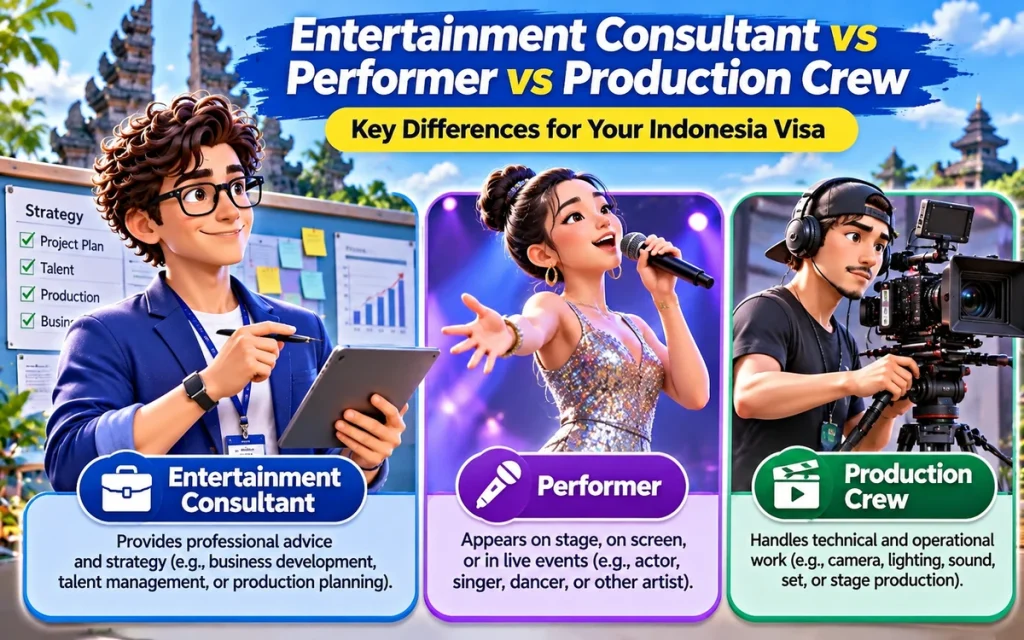
For example, a foreign music-industry adviser invited to review a promoter’s commercial strategy is not necessarily a musician. If that person also performs on stage, the performance must be assessed separately. Similarly, a film strategy consultant is not automatically a crew member, but joining a shoot and performing production duties makes the production rules relevant.
Employers and applicants should avoid using consultant as a catch-all description. A clear scope of work, accurate invitation letter, and consistent supporting documents reduce the risk of a mismatch between the declared purpose and actual activities.
Requirements for Foreign Entertainment Consultants
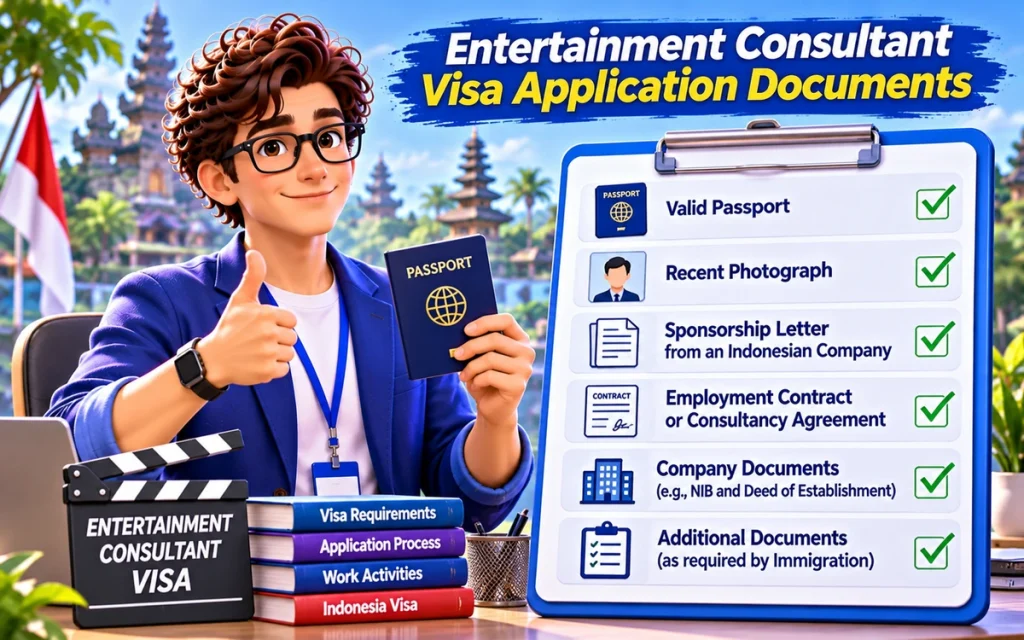
There is no universal document checklist for every entertainment consultant. Requirements depend on the category, sponsor, nationality, assignment, and current application process. The following items are commonly useful for an initial assessment, but are not a complete statutory checklist for every route.
Passport and applicant information
The applicant should have a valid passport meeting the requirements of the intended route, together with accurate personal details and any required photograph or application information. Passport-validity rules can differ, so check the official portal.
Invitation and sponsor documentation
The Indonesian host may need to provide an invitation, sponsor information, company details, or other evidence. Documents should accurately identify the host, purpose, location, expected dates, and relationship between the parties.
Contract, project description, and itinerary
A contract or engagement letter can explain duties, deliverables, fee arrangements, duration, and counterparties. An itinerary helps distinguish meetings from on-site service delivery. List each activity rather than hiding operational duties under a broad phrase.
Professional background and supporting evidence
Depending on the case, a CV, portfolio, credentials, project references, or evidence of experience may be requested. These materials explain why the professional is invited but do not replace the need to select the correct category.
Financial and category-specific evidence
Some visit categories require evidence of financial support, travel arrangements, or other conditions. Work routes may involve different sponsor and employment documents. Follow the current official checklist for the selected category.
Sponsorship and Indonesian Entertainment Organisations
An Indonesian company should determine whether it is hosting a permitted visit or acting as an employer or sponsor for a work-related assignment. These roles are not interchangeable. The organisation should understand its responsibilities before issuing an invitation or signing a contract.
The host should ensure that the project description, contract, event schedule, and visa application are consistent. If the consultant will deliver services in Indonesia, the company should not describe the assignment as meeting attendance merely to simplify the application. It should also check that the role is compatible with its business activities and applicable manpower rules.
Foreign consultancy firms should coordinate with their Indonesian client before travel. A contract signed overseas does not automatically remove Indonesian immigration considerations where services are physically performed in Indonesia. Identify the work location, service recipient, payment chain, and person supervising the assignment.
Regulatory Requirements for Foreign Entertainment Professionals
Immigration is only one part of a professional engagement. Depending on the role and business arrangement, manpower, corporate, tax, licensing, intellectual-property, event, and local operating rules may also apply. The project should be reviewed by appropriately qualified advisers where necessary.
The Ministerial Decision on Visa Classification No. M.IP-08.GR.01.01 of 2025 sets out activity-specific categories and their permitted rights and prohibitions. It replaced the earlier classification decision identified in its transitional provisions. Applicants should use the current classification and current portal information rather than assume an older visa code or description remains unchanged.
Entertainment projects may involve talent representation, music rights, film rights, production services, sponsorship, ticketing, and distribution. Those commercial arrangements should be consistent with the foreign professional’s authorised role. Immigration approval does not settle every contractual or regulatory question.
How to Apply for an Indonesia Entertainment Consultant Visa
The safest process begins before the professional books travel or starts providing services. The Indonesian host and applicant should agree on the real scope of the assignment, then determine the category that matches it.
Step 1: Define the actual activities
Describe each task. Identify whether the person will attend meetings, negotiate, speak at a conference, advise a client, train staff, manage an event, participate in filming, perform, or work as crew. Avoid vague descriptions.
Step 2: Identify the host, sponsor, and service recipient
Confirm the Indonesian entity or organiser, its role, and whether it can act as the required sponsor. Identify who receives the services and who pays. Keep the contract and invitation consistent.
Step 3: Determine the correct visa category
Compare the activities with the official classification. Consider E23 only where the assignment involves a qualifying employment relationship with the sponsor; C2 only for permitted business-visit activities; C10 for qualifying business-event speaking; C14 or D14 for their defined film-making purpose; and C7-series categories for the specified performance or skill activities. Check each category’s payment and employment restrictions. Do not select a route merely because it is familiar or its label sounds similar to the job title.
Step 4: Prepare supporting documents
Collect passport and applicant details, sponsor information, invitation, project description, itinerary, contract or engagement letter, and category-specific evidence. Check that dates, locations, duties, and payment details are accurate.
Step 5: Submit through the official process
Use the official Indonesian eVisa system and follow the instructions for the selected category. Respond accurately to requests for additional information. Do not rely on unofficial websites as the final authority.
Step 6: Review the approval and stay conditions
Before travel, check the approval, permitted stay, entry conditions, sponsor details, and restrictions. Confirm whether any further step is required after arrival. The issued approval and applicable regulations control.
Step 7: Follow the approved scope during the stay
Carry out only activities authorised by the visa and stay permit. If a speaker is asked to manage an event, a consultant is asked to perform, or a meeting visit becomes an on-site production assignment, pause and obtain advice before the new activity begins.
Need assistance preparing your application?
Our team can help review the supporting documents and compare the proposed assignment with the relevant visa conditions before you proceed.
Can a Foreign Entertainment Consultant Work Independently in Indonesia?
Independent can describe a consultant’s business model, but it does not create an immigration exemption or a separate visa category. A foreign national who operates as a freelancer, invoices clients, or provides services through an overseas company must still ensure that every activity physically carried out in Indonesia is permitted by the visa and stay permit. Independent status alone does not qualify the person for E23, because E23 is tied to work or specialist activity in an employment relationship with the sponsor. Conversely, calling an engagement freelance does not make it permissible under C2 or a tourist visa.
A consultant living in Indonesia for an extended period, serving multiple Indonesian clients, or performing recurring assignments may have a different immigration, manpower, corporate, and tax profile from a person attending a short meeting. Review the business structure, source of income, physical work location, service recipient, contractual chain, and actual duties. A contract or payment made overseas does not automatically remove Indonesian immigration considerations where the services are physically performed in Indonesia. An ongoing local business model may require a different lawful structure and specific professional advice.
Entertainment Consultant Visa vs Other Professional Visa Categories
The appropriate visa depends on the work, not simply the entertainment industry label. A consultant advising on business strategy may require a different route from an artist performing at a concert, a crew member supporting a production, a speaker at a business event, or a film professional participating in a shoot.
For related guidance, see our Indonesia Sports Consultant Visa guide, the Indonesia Performer Work Visa guide, and the Sports and Entertainment Work Visa overview. These pages address different roles and should not be treated as interchangeable visa advice.
Common Immigration Mistakes Made by Foreign Entertainment Consultants
A frequent mistake is assuming that the word consultant makes an assignment non-work. Authorities may consider the real activity, duration, host, and services delivered. Another mistake is using a business-visit category for ongoing services or relying on an old visa-code description without checking the current classification.
Other problems include an invitation letter that conflicts with the contract, undisclosed performance or production duties, assuming overseas payment makes an activity permissible, and continuing after the project scope changes. Applicants may also overlook sponsor responsibilities or applicable manpower requirements.
The practical solution is to prepare an accurate activity description before applying, select the route based on current official rules, and keep the documents consistent. If the role is mixed or unusual, obtain a case-specific assessment rather than forcing it into the closest-sounding category.
Immigration and Compliance Considerations
The visa and stay permit should be treated as permission for a defined purpose, not as an unrestricted right to work in every role within the entertainment industry. Monitor validity, comply with applicable sponsor or reporting requirements, and take the required action before the authorised stay expires.
The Indonesian host should retain engagement documents and ensure that activities remain within the approved scope. If a new event, client, location, or responsibility is added, reassess the immigration position. A project extension should not be assumed to extend a visa or stay permit automatically.
Procedures can change. Before making a decision, consult the current official classification, the official immigration portal, and the relevant authority. Professional advice is particularly important where the consultant is paid by an Indonesian entity, works repeatedly in Indonesia, holds a management role, or combines consultancy with performance or production duties.
Frequently Asked Questions
The following answers address common questions from foreign entertainment professionals and Indonesian organisations. The correct outcome in an individual case depends on the actual activities, sponsor, visa conditions, and current immigration rules.
1. Do foreign entertainment consultants need a work visa in Indonesia?
Not every visit requires the same category. A short visit limited to activities expressly permitted for a visitor category may differ from an assignment involving ongoing professional services or operational duties. The actual activities, sponsor, payment arrangement, employment relationship, and duration determine the assessment. E23 may be relevant where the professional works in a qualifying employment relationship with the sponsor and meets the applicable requirements; it is not an automatic route for independent consultants.
2. What is the Indonesia Entertainment Consultant Visa?
The phrase commonly describes the immigration route for a foreign professional advising an Indonesian entertainment business. It is not the name of one universal visa category. The correct route depends on the actual assignment.
3. Can an entertainment consultant use a C2 Business Visa?
C2 may be suitable only when the planned activities fall within its permitted business-visit scope, such as qualifying meetings, discussions, negotiations, or business visits. The classification prohibits receiving remuneration, wages, or similar compensation from an individual or corporation in Indonesia, as well as certain service-delivery and operational activities. It should not be used as a general authorisation for a paid consultancy assignment to an Indonesian client. Check the precise itinerary against the current official rules.
4. Is E23 suitable for foreign entertainment consultants?
E23 may be relevant where the consultant is engaged to work or serve as a specialist in an employment relationship with the Indonesian sponsor and the position meets applicable immigration and manpower requirements. Independent contractor or freelance status alone does not establish eligibility. The sponsor, role, duties, contract, remuneration, and required approvals must be assessed.
5. Can a foreign film consultant use a C14 visa?
C14 is for defined film-making activity using locations in Indonesia. It is not a general visa for every film-industry professional or for paid advisory services. The classification prohibits receiving remuneration, wages, or similar compensation from an individual or corporation in Indonesia and prohibits direct sales of goods or services. A consultant should compare the actual activity and payment arrangement with the category before applying.
6. What is the difference between C14 and D14?
C14 is the single-entry visit category for the specified film-making purpose, while D14 is the corresponding multiple-entry category. Both remain tied to film-making using locations in Indonesia and carry activity restrictions, including the prohibition on receiving remuneration, wages, or similar compensation from an individual or corporation in Indonesia. Multiple entry does not create general work rights.
7. Can a foreign artist manager work in Indonesia?
It depends on the actual duties. Attending permitted business meetings differs from managing artists day to day, negotiating local engagements, supervising operations, providing ongoing services, or performing on stage. C7 and C7A may be relevant to specified cultural or musical performances, while C7B concerns qualifying support for musical performers. A management consultant should not assume those performance categories cover consultancy. Assess each activity and the relevant category separately.
8. Does an entertainment consultant need an Indonesian sponsor?
Sponsor requirements depend on the visa category and application route. The Indonesian host or employer may have a formal role. Confirm the current requirements for the selected category.
9. Can foreign entertainment consultants work independently?
Freelance or independent status does not remove immigration requirements. A foreign national must hold permission matching the activities carried out in Indonesia. Ongoing local client work may also raise corporate, tax, and manpower considerations.
10. Can a foreign consultant receive payment from an Indonesian company?
Payment must be assessed against the exact category and the activity for which it is granted. C2 prohibits receiving remuneration, wages, or similar compensation from an individual or corporation in Indonesia. C10 permits remuneration for the qualifying speaker, lecturer, or presenter activity, but prohibits an employment relationship with an Indonesian individual or corporation and direct sales of goods or services. C14 and D14 prohibit Indonesian-source remuneration for their specified film-making purpose. E23 is a work category with remuneration rights within its qualifying employment framework. Do not assume that overseas payment makes otherwise unauthorised work permissible.
11. What documents are required for an entertainment consultant visa?
Documents vary. They may include passport details, sponsor information, invitation, contract or engagement letter, project description, itinerary, and category-specific evidence. Follow the current official checklist.
12. How can foreign entertainment professionals apply for the correct visa?
Define the actual activities, identify the Indonesian host or sponsor, compare the assignment with the current classification, prepare consistent documents, and apply through the official eVisa process. Obtain a case-specific review for mixed roles.
Conclusion
Foreign entertainment professionals can contribute valuable expertise to Indonesia’s music, film, television, live-event, talent, and creative industries. However, the right immigration route cannot be determined by job title alone. A consultant attending business meetings, a professional delivering an ongoing advisory assignment, a conference speaker, a film-production participant, a performer, and a crew member may fall under different rules.
The reliable approach is to define the actual work, identify the Indonesian host or sponsor, review the current visa classification, and ensure that the application documents accurately describe the engagement. E23, C2, C10, C14, D14, and performance-related categories each have their own purpose and limitations. Selecting the correct route before travel helps reduce avoidable compliance risks.
If your organisation plans to engage a foreign entertainment consultant, or you are preparing for an assignment in Indonesia, Azra Solutions can help review the proposed activities and identify an appropriate immigration pathway. Contact us through WhatsApp or email info@azraid.com for an initial consultation.
Official References
- Ministerial Decree No. M.IP-08.GR.01.01 of 2025 on Visa Classification (official visa-category rights and prohibitions)
- Directorate General of Immigration – Official Indonesia Visa List
- Official Indonesian eVisa Portal
- Directorate General of Immigration