
Buying or leasing a villa in Bali involves more than inspecting the building and agreeing on a price. Before committing funds, buyers should understand the legal status of the land, the seller’s authority, the villa’s approved use, building compliance, contractual obligations and any requirements connected with operating the property as accommodation.
A villa may look complete or generate rental income while still raising questions about its land rights, building approvals, zoning, access or business permissions. One document does not automatically prove that every aspect of a property is compliant. This guide sets out a practical framework for foreign buyers and investors. Requirements depend on the property, location, rights involved, intended use and regulations in force; obtain transaction-specific professional advice.
1. What Is Legal Due Diligence for a Bali Villa?
What Legal Due Diligence Covers
Legal due diligence is a structured review of the property, parties and proposed transaction. It tests what rights are being transferred or granted, whether the seller or lessor has authority, what restrictions apply and whether key claims can be supported by documents or independent checks. For a villa, this may include land title, boundaries, access, encumbrances, spatial planning, building approvals, existing leases, contracts, taxes and licences relevant to the intended use.
Ownership, Building Legality and Rental Compliance Are Different
A land right does not necessarily establish that every structure was approved, that the building may be used for every purpose, or that it may lawfully operate as short-term accommodation. These are separate questions. Check each relevant layer rather than assuming one certificate resolves everything.
When to Start
Start before paying a non-refundable deposit or signing a binding agreement. Early checks can reveal missing documents, contract conditions to negotiate or risks that make the transaction unsuitable. Pressure to pay before reasonable verification is a reason to pause and ask questions.
2. What Documents Should You Request Before Buying a Villa in Bali?
Land and Survey Documents
Request a complete copy of the land certificate or evidence of the right being offered, plus available survey, measurement and parcel information. Compare the stated area, location and holder with the property being marketed. Copies are useful for preliminary review but should not replace formal verification through the appropriate land-registration process.
Seller and Company Documents
Obtain identity details for the registered holder and the person negotiating. If a representative signs, review the power of attorney and its scope. If a company is involved, check its legal identity and signatory authority. Inheritance, marital-property or corporate issues may require specific review.
Planning, Building and Contract Documents
Request available spatial-planning information, applicable KKPR or other relevant records, PBG or legacy IMB documents where applicable, and SLF where required. Ask for approved plans, purchase or lease agreements, management contracts, utility arrangements, tax records and notices of disputes or enforcement. A missing document is not automatically proof of illegality, but it must be identified and resolved before reliance.
3. How to Verify the Land Title and Registered Owner
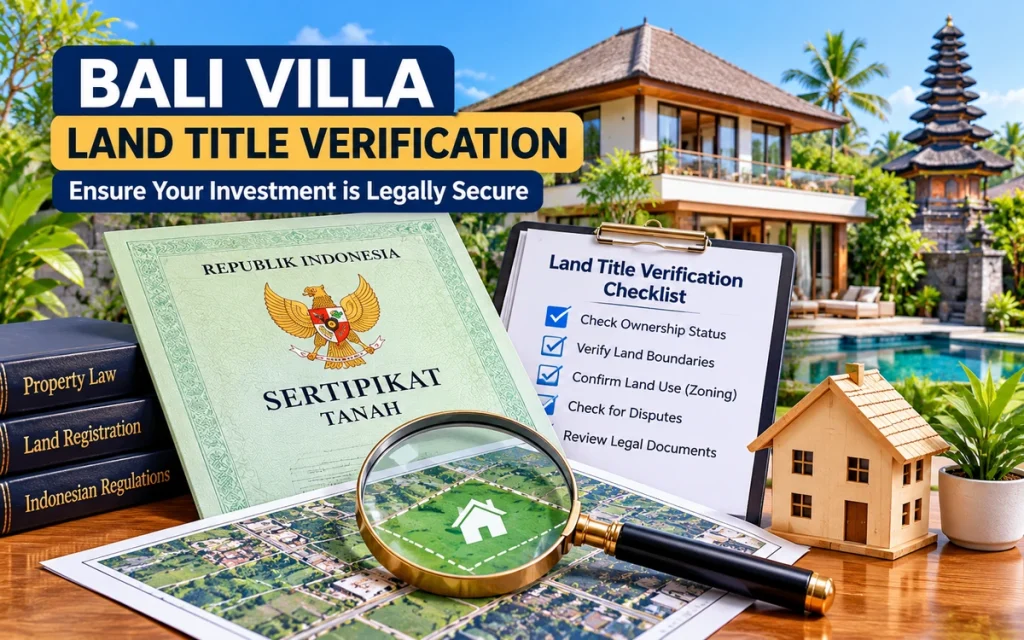
Identify the Exact Right
Hak Milik, HGB, Hak Pakai and contractual leasehold arrangements are not interchangeable. They differ in legal character, eligibility, duration and transfer conditions. Do not rely on broad marketing terms such as “freehold” without identifying the legal right actually offered. Foreign buyers should confirm eligibility under the rules applicable to their intended arrangement.
Verify the Certificate
Arrange an appropriate certificate check through the relevant land-office process and qualified Indonesian professionals. ATR/BPN has procedures for certificate checking and electronic land-registration information services. Review the registered holder, type of right, parcel identity and available information about encumbrances or restrictions. A photo of a certificate, online map or broker’s assurance is not a complete check.
Boundaries, Access and Encumbrances
Compare land area and boundaries with available cadastral information and the physical site. Check the legal basis for road access and any shared access. Investigate encroachments, disputed boundaries, mortgages, registered burdens and third-party rights. If the seller is not the registered holder, obtain independent advice on the legal basis for the proposed transaction before payment.
Related AzraID Guide
Can Foreigners Legally Own Property in Bali?
Before You Commit to a Bali Villa, Verify the Legal Position
A careful review of the land right, registered holder, boundaries and encumbrances can help identify issues before you commit to a transaction.
Create a document register at the beginning of the review. For each item, record the document name, issuing authority or signatory, date, property parcel, whether the original or a certified copy has been seen, and any inconsistency that needs follow-up. This prevents a transaction team from treating a folder of documents as verified simply because it appears complete. Where a document cannot be obtained, record who is responsible for obtaining it and whether the issue must be resolved before signing or completion.
4. How to Check Bali Villa Zoning and Permitted Land Use
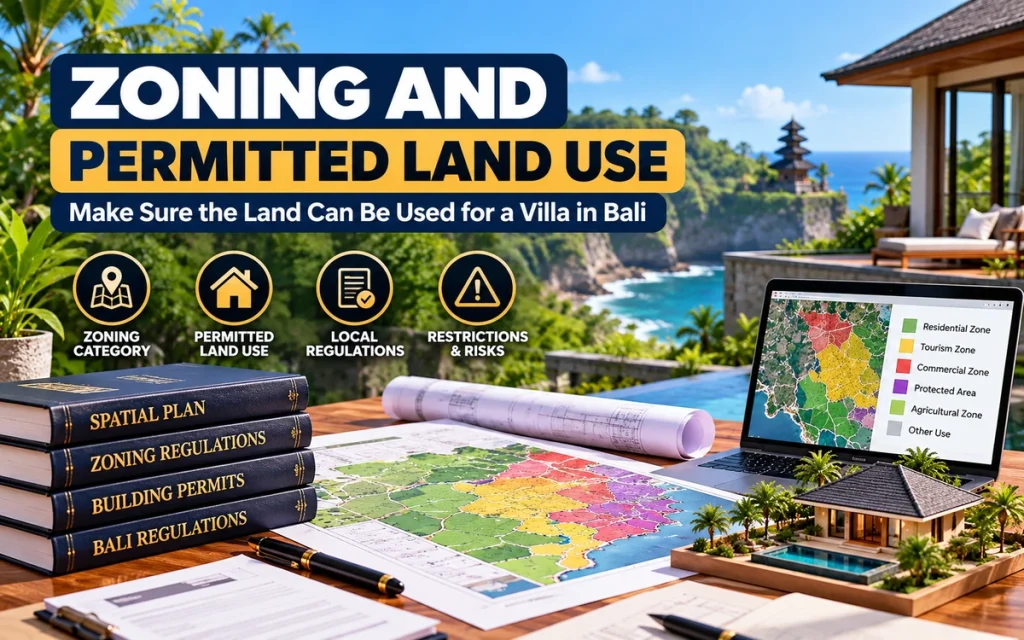
Spatial Planning
Check the applicable spatial-planning framework. Depending on the project and location, relevant records may include regional or detailed spatial plans and KKPR or other applicable spatial-conformity documentation. The correct authority and process depend on the proposed activity and current rules.
Residential Versus Commercial Use
A villa used privately may face different operational requirements from a villa marketed for short-term stays. Confirm that the intended activity is compatible with the land’s designation and applicable business or accommodation rules. An online listing, neighbouring rental villa or history of guest stays does not prove compliance.
Location-Specific Restrictions
Ask whether applicable setbacks, coastal or river restrictions, protected areas, access limitations or other local rules affect the site. Obtain a property-specific check; do not rely on general claims about a village or district. If the intended use appears inconsistent with planning rules, seek written clarification before proceeding.
The zoning check should be tied to a precise parcel and a defined business plan. A broad map screenshot may be useful for initial screening, but it may not resolve parcel-specific conditions or the permitted details of a proposed activity. Ask the relevant professional to identify the source, date and scope of the planning information and to explain any uncertainty. If the villa will be operated by a company or managed by a third party, make sure the review covers the actual operating model rather than only the buyer’s personal residential use.
5. How to Verify PBG, IMB and SLF
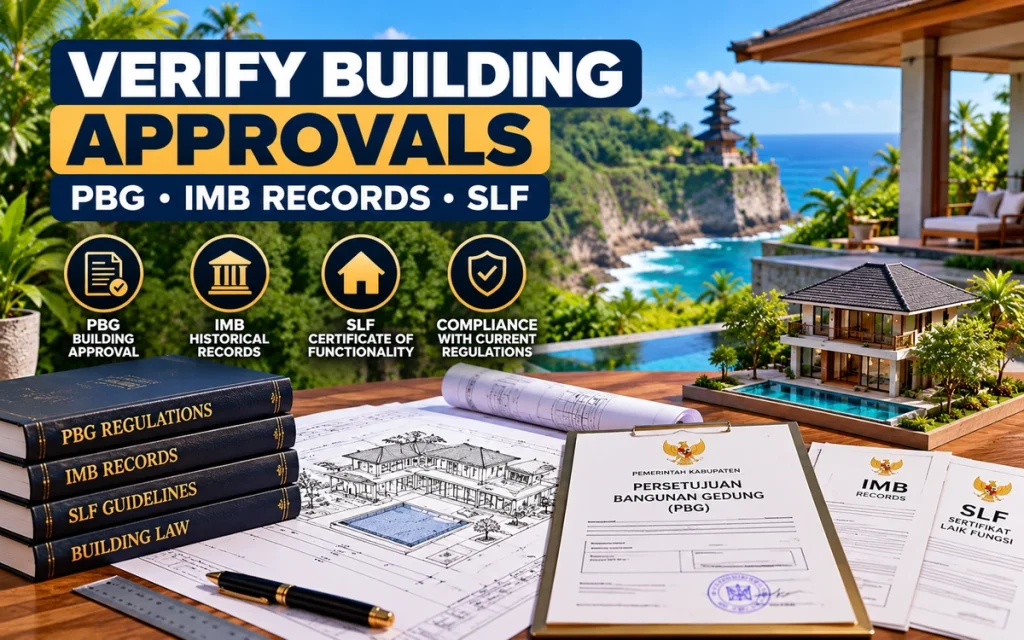
PBG and Legacy IMB
PBG is part of Indonesia’s building-approval framework. Older properties may have documents issued under the former IMB system. Their status and relevance depend on the building’s history, changes, approved function and current requirements. Do not assume every legacy IMB is invalid or that an IMB resolves every current compliance issue.
What an SLF Means
SLF relates to the building’s functional fitness under the applicable framework. Whether an SLF is required or relevant should be assessed for the particular building and intended use. PBG, IMB and SLF are not interchangeable.
Compare Plans With the Building
Compare available approvals and plans with the actual layout, floor area, storeys, pool and extensions. Material differences or unapproved additions may require investigation or corrective action. Government Regulation No. 16 of 2021 is part of the national building framework; verify the current rules and local requirements for the specific property.
When reviewing building documents, keep a written comparison between the approved plans and the current structure. Record any extra bedroom, enclosed terrace, added floor, altered roofline, pool, staff building or other material change. Ask whether the difference affects approval status, safety, permitted function or the ability to obtain or maintain required documentation. A technical inspector can document the physical condition, while a qualified legal or building professional can assess the implications of any discrepancy. Do not assume that a seller’s promise to fix a problem after completion is sufficient without a clear written mechanism and enforceable remedy.
6. Can the Villa Be Legally Operated as a Rental Property?
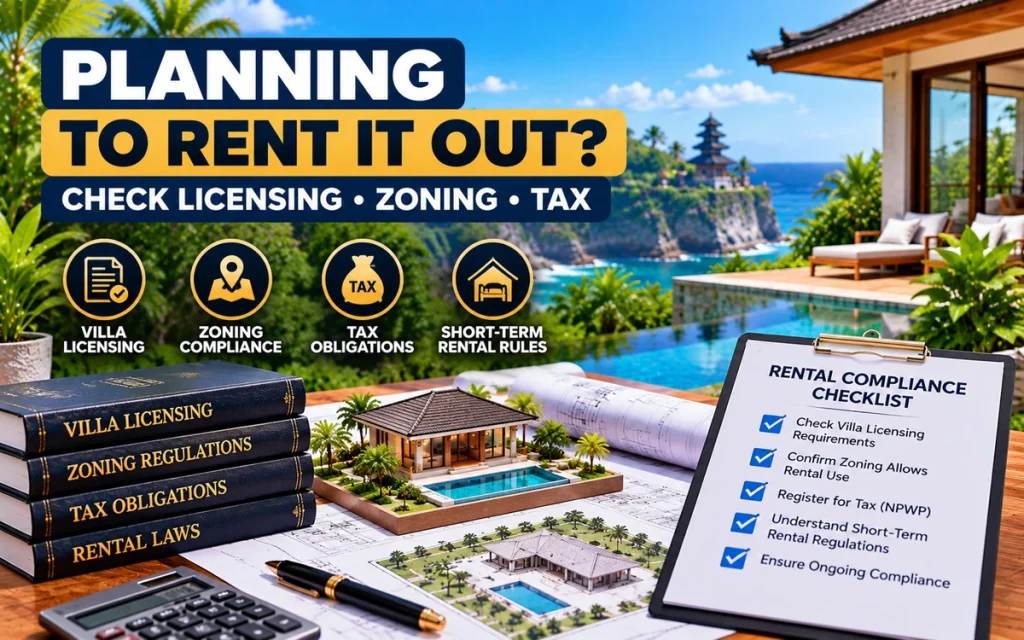
Property Rights Versus Business Licensing
The right to own, hold or lease property differs from permission to operate commercial accommodation. If rental income is part of the investment case, investigate the applicable use, business classifications, licences, local requirements and tax obligations.
NIB, KBLI and Other Requirements
Depending on the activity and operator, requirements may include an NIB, the appropriate KBLI classification and other licences or fulfilment under the current risk-based licensing framework. Government Regulation No. 28 of 2025 replaced Government Regulation No. 5 of 2021 as the general risk-based business-licensing framework. Check the current OSS system and applicable KBLI version, transitional provisions and relevant authorities for the specific activity. Do not assume a licence issued to a different operator covers the proposed activity.
Verify Rental Claims
Ask for records supporting advertised occupancy, revenue or management arrangements. Clarify whether figures are historical, projected or guaranteed. Review management agreements, bookings, existing leases and transfer restrictions. Commercial performance is not proof of legal compliance. Rental compliance should be checked against the precise activity rather than the generic label “villa rental.” Relevant questions may include whether stays are short-term or long-term, whether services are provided, who is the operator, which business classification applies, and what licences or standards are required under the rules in force. The OSS classification and requirements can change, so verify the current KBLI version and applicable licensing output for the actual business. If the seller provides a licence or NIB, confirm the named entity, activity, address and scope, and do not assume it automatically transfers with the property.
7. How to Check a Villa Developer or Seller
Company and Signatory Authority
Check the legal identity of a company seller, developer or contracting party and the authority of the signatory. Establish whether it owns the relevant right, develops the property, leases the land or merely markets it.
Developer and Project Status
For a new-build or off-plan villa, investigate previous projects, land status, approvals, construction arrangements, completion timetable and contractual remedies. Seek evidence rather than relying on promotional material.
Map the Relationships
If the landowner, developer, seller and rental operator are different parties, map the agreements connecting them. Confirm each party has authority and contractual rights for its role. Gaps between the parties can create disputes or uncertainty about what the buyer receives.
For a company or developer transaction, verify more than the company name on the agreement. Ask for evidence that the person signing is authorised and that the company has the right to sell, lease or develop the specific property. Where the developer does not own the land, review the underlying landowner agreement and whether it permits the promised construction, transfer, lease or operation. For off-plan transactions, confirm what happens if approvals are delayed, construction differs from the plans, the developer misses a milestone or the promised property cannot be delivered as described.
8. How to Review the Villa Purchase or Lease Agreement
Purchase Agreements and PPJB
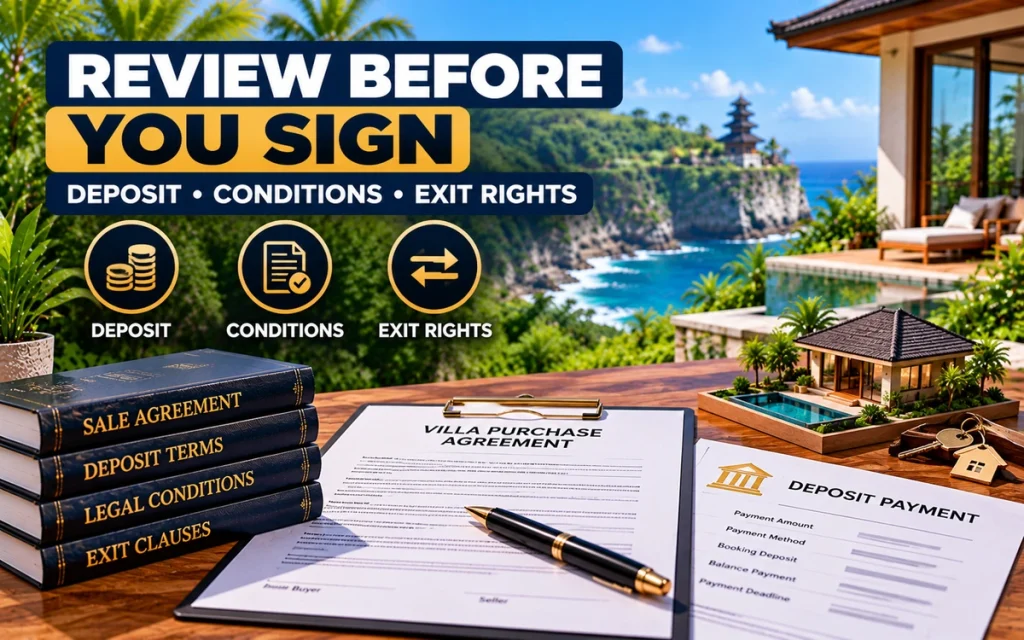
Have the proposed agreement reviewed before signing. Identify the property and right being transferred, parties, price, payment milestones, completion requirements, conditions precedent, default provisions and remedies. A PPJB should not be treated as equivalent to completed transfer and registration of a land right.
Leasehold Terms
Check the start and end dates, how the term is calculated, whether extension is an enforceable right or merely subject to future agreement, how the extension price is set, and whether assignment or subleasing is allowed. Clarify what happens to buildings, improvements, furniture and deposits at expiry.
Deposits and Remedies
Specify when a deposit becomes non-refundable and what happens if due diligence reveals a material problem. Consider making payment or completion conditional on satisfactory title, authority, zoning or building checks. Define who must supply missing documents, by when, and the consequences if conditions are not met.
Completion and Defects
Set out completion deliverables, possession, handover, utilities, outstanding charges, defect responsibilities and documents required. Avoid vague promises that important issues will be fixed later.
Review the Property Documents Before You Sign
The agreement should match the property rights being transferred or leased and clearly address deposits, conditions, completion and remedies if a material issue arises.
Contract review should also address the evidence required at completion. Depending on the structure, this may include execution of the appropriate deed or lease, payment and tax documentation, delivery of original documents, handover records, confirmation of vacant possession where promised, and steps needed for registration or other formalities. If the transaction is conditional on due diligence, the conditions should be specific enough to determine whether they have been met. Avoid vague wording such as “subject to satisfactory documents” without defining the documents, review period and consequences if a material issue is identified.
9. What Should Foreign Buyers Check About Ownership Structure?
Eligibility
Foreign buyers should confirm eligibility for the specific right proposed. Indonesian law regulates which rights foreign nationals may hold and under what conditions; eligibility depends on the property category, documentation and applicable rules.
Leasehold
Leasehold generally creates contractual rights for an agreed period, not the same rights as a registered land title. Review the lessor’s authority, underlying land right, term, renewal, permitted use and enforceability.
PT PMA
A PT PMA is not a universal shortcut to personal ownership. Review the company’s business activities, licensing, land-right eligibility, corporate approvals, tax implications and intended use. The structure should reflect a genuine and lawful purpose.
Nominee Risk
An arrangement that registers property in another person’s name while privately promising control or beneficial ownership to a foreign buyer can create serious legal and practical risks. A private agreement should not be assumed to overcome statutory restrictions. Obtain independent advice about the actual rights and risks.
The foreign buyer’s proposed structure should be reviewed before any contract is signed, not simply after the land and price have been agreed. Confirm whether the buyer intends to use the villa personally, lease it, operate accommodation or hold it through a company, because these purposes may trigger different eligibility, contractual, corporate and licensing questions. Keep the property-right analysis separate from immigration status and business licensing; satisfying one requirement does not automatically satisfy the others. Any structure involving another person as registered holder in place of the intended beneficiary deserves independent, transaction-specific legal scrutiny.
10. What Physical and Technical Checks Should Accompany Legal Due Diligence?
Building Condition
Pair legal review with a technical inspection. Check structural issues, water ingress, roofing, electrical installations, plumbing, pool systems and major equipment. A qualified inspector can identify problems requiring specialist assessment.
Drainage and Water
Inspect drainage, signs of flooding, retaining walls, slope stability, water availability and wastewater arrangements. Verify important claims where possible; infrastructure and environmental conditions can affect usability and maintenance costs.
Access and Shared Facilities
Confirm physical access and the legal basis for shared roads, parking, drainage and utility connections. Clarify maintenance responsibilities and fees in writing. Check whether facilities in marketing material are included or shared under a separate agreement.
Boundaries and Neighbours
Walk the boundaries with appropriate assistance and identify encroachments, fences, shared walls or disputed areas. Ask about known disputes and obtain records where available.
Technical inspection is not a substitute for title and legal checks, but it can reveal facts that require legal follow-up. For example, a fence may not follow the registered boundary, a driveway may cross land controlled by another party, or an added structure may not match the available building plans. Record these observations with photographs and a site plan where appropriate, then ask the relevant professional to determine whether the issue is merely practical or affects legal access, boundaries, approvals or contractual representations.
11. What Are the Biggest Red Flags When Buying a Villa in Bali?
Inconsistent Documents
Differences in land area, names, parcel details or property descriptions require explanation. Do not assume they are harmless clerical errors until checked.
Unclear Authority
A seller who cannot demonstrate authority, refuses reasonable verification or asks for payment to an unrelated person presents a risk that should be resolved before proceeding.
Use or Building Problems
A proposed use inconsistent with planning information, major building changes not reflected in approvals, or unsupported claims about rental legality should trigger further investigation.
Pressure and Unrealistic Returns
Urgency, unusually strong return promises or refusal to document assurances are reasons to slow down. Some issues can be corrected, but material risks should be independently assessed and resolved in writing before commitment.
12. How Much Time and Money Should You Allow for Due Diligence?
Potential Costs
Costs may include legal review, PPAT services where relevant, land-office checks, technical inspections, surveys, translations and administrative charges. The amount depends on the property, transaction structure, document quality and specialists required. Request a written scope and fee estimate.
Timeline
Straightforward transactions with consistent records may need less investigation than properties with missing documents, unclear boundaries, complex ownership, off-plan construction or intended commercial rental use. Allow time for official checks and written responses.
Compare Scope, Not Just Fees
The cheapest review is not necessarily the right one. Compare the scope of work, independence, local expertise and deliverables, not only the quoted price.
13. What Should You Do Before Paying a Property Deposit?
Practical Pre-Deposit Sequence
Request land, seller, planning, building and contract documents; identify the exact right and intended use; arrange title and authority verification; check zoning, building compliance and rental requirements; record discrepancies; review deposit, refund and termination clauses; and use a documented payment process with appropriate safeguards.
Independent Review
Consider advice from an independent Indonesian legal professional before paying a substantial or non-refundable deposit. The review should be proportionate to the transaction’s value and complexity. Do not transfer money based only on a listing, verbal promise or document image sent through a messaging app.
14. How to Make a Final Due Diligence Decision
Proceed
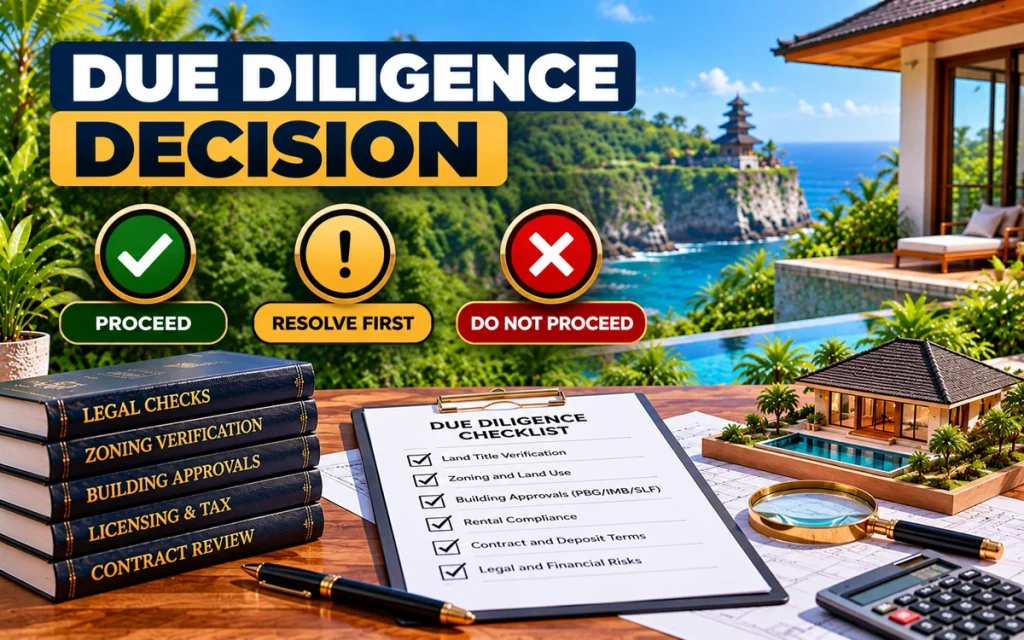
Proceeding may be appropriate when material checks are satisfactory, the parties have authority, the intended use is supportable, key documents are consistent and the contract addresses outstanding obligations. Complete the required transfer and registration steps.
Resolve First
Where documents, terms, approvals or boundaries need clarification, identify the responsible party, required evidence, deadline and contractual consequence. Where appropriate, make resolution a condition of payment or completion.
Do Not Proceed Unless Risks Are Resolved
Consider stopping if there is a material title dispute, no reliable evidence of seller authority, a serious mismatch between intended use and permitted use, or pressure to proceed while significant issues remain unexplained.
Keep a Record
Maintain a due-diligence record listing documents reviewed, verification sources, issues found, advice received and conditions to satisfy before completion. Decision framework: PROCEED if material checks are satisfactory; RESOLVE FIRST if issues may be addressed and documented; DO NOT PROCEED unless material risks are resolved.
Need Professional Guidance on a Bali Villa Transaction?
If material issues remain unresolved or you are unsure whether the proposed structure matches your intended use, seek transaction-specific guidance before completion.
15. FAQs About Bali Villa Legal Due Diligence
What is legal due diligence for a villa in Bali?
It is a structured review of land rights, seller authority, planning status, building documents, contracts, encumbrances and other matters relevant to the purchase or lease.
Can I verify a Bali land certificate online?
Electronic services may support parts of the process, but use the appropriate official procedure and qualified professionals. A screenshot or certificate image alone is not a complete legal check.
Is a land certificate enough to prove a villa is legal?
No. It does not by itself establish building approval, permitted use, rental compliance, access rights or the absence of every possible dispute.
What are PBG and SLF?
PBG relates to building approval under the applicable framework, while SLF relates to functional fitness. Their relevance should be assessed for the particular building and use.
Can a villa be held legally but not rented legally?
Yes. Property rights and permission to conduct commercial accommodation are separate questions.
Should I pay a deposit before checks are complete?
Avoid a substantial or non-refundable deposit before material checks are completed or adequate contractual protections are in place.
Do foreign buyers need an independent Indonesian lawyer?
Independent advice is strongly worth considering, particularly for high-value, complex or cross-border transactions.
How long does due diligence take?
There is no universal timeline. It depends on document availability, official verification, property complexity and whether issues need resolution.
What if the villa has missing permits?
Determine which document is missing, whether it is required for the building and intended use, and whether the issue can lawfully be resolved. Do not assume regularisation is guaranteed.
Can I conduct due diligence on a leasehold villa?
Yes. Review the lessor’s authority, underlying land right, term, extension, permitted use, assignment, sublease, payments and end-of-term arrangements.
16. Need Legal Assistance With a Bali Villa?
How AzraID Can Help
Before committing to a villa purchase or lease, understand what rights are being offered, whether the property and intended use are legally supportable, and what risks remain unresolved. AzraID can assess the nature of a property-related request and coordinate with qualified Indonesian legal professionals where formal legal advice, advocacy or representation is required.
Legal Disclaimer
This article provides general information about legal due diligence for villa transactions in Bali and Indonesian law. Requirements may depend on the property, location, rights involved, buyer, intended use and regulations in force. This article is not legal advice and does not create a lawyer-client relationship. Obtain professional advice based on the facts and documents of your specific matter.