

For foreigners planning to live in Indonesia for the long term, KITAP is one of the most important immigration statuses to understand. Commonly referred to as KITAP, Indonesia’s permanent stay permit is officially known as Izin Tinggal Tetap (ITAP). It allows qualifying foreign nationals to reside and settle in Indonesia under a permanent-stay framework, subject to the applicable immigration rules.
KITAP is not a visa and it does not make a foreign national an Indonesian citizen. Eligibility depends on the applicant’s circumstances and immigration route. Some applicants move from an ITAS (KITAS) to ITAP, while certain qualifying categories can receive ITAP without first changing from ITAS.
This guide explains what KITAP means, who may qualify, how the ITAS-to-ITAP pathway works, when direct ITAP may be possible, what documents and procedures are generally involved, and how KITAP differs from KITAS and Indonesian citizenship.
What Is KITAP in Indonesia?

KITAP is the common term used to refer to Indonesia’s Kartu Izin Tinggal Tetap, while ITAP is the official immigration term for Izin Tinggal Tetap. In English, it is generally described as a Permanent Stay Permit.
The purpose of ITAP is to give qualifying foreign nationals a more permanent immigration status for living in Indonesia. Unlike an ITAS, which is a limited stay permit, ITAP is designed for foreign nationals who qualify for one of the immigration routes that allow permanent stay.
The important point is that KITAP describes an immigration status, not nationality. A person holding KITAP remains a foreign national. KITAP therefore should not be confused with an Indonesian passport, Indonesian citizenship, or a permanent visa.
The route used to obtain KITAP matters. Depending on the applicant’s circumstances, the process may involve changing an existing ITAS to ITAP, or it may be possible to obtain ITAP directly under a category recognized by Indonesian immigration rules.
Is KITAP the Same as Permanent Residency?
KITAP is Indonesia’s permanent stay permit, so it is often described in English as a form of permanent residence. However, KITAP is an immigration status and should not be confused with Indonesian citizenship.
A foreign national who holds KITAP remains a foreign national. The permit gives the holder the right to stay in Indonesia under the applicable permanent-stay framework, but it does not provide an Indonesian passport or automatically change the holder’s nationality.
This distinction is important when comparing KITAP with other long-term immigration options. Permanent stay under ITAP concerns the person’s immigration status in Indonesia, while citizenship concerns nationality and is governed by separate rules.
Who Can Get KITAP in Indonesia?

KITAP is available only to foreign nationals who meet the requirements of a qualifying immigration route. There is no single eligibility test that applies to every applicant. The route may depend on the person’s work, investment, family circumstances, previous Indonesian nationality, or another category recognized by Indonesian immigration regulations.
For applicants who already hold ITAS, official Immigration services currently recognize several routes for changing ITAS to ITAP, including qualifying workers, religious workers, foreign investors, family reunification, repatriation, and certain Second Home categories. The exact requirements depend on the route and the applicant’s circumstances.
Workers
Certain foreign workers may qualify for ITAP through an ITAS-to-ITAP route when they meet the applicable immigration and employment requirements. The requirements are route-specific and may include evidence relating to the employer, position, work authorization, and the applicant’s existing ITAS.
Investors
Qualifying foreign investors may use an investor route to obtain ITAP. The application can require evidence of the investment and the sponsoring or guarantor entity, together with the applicant’s immigration documents.
For detailed investor-specific eligibility and documentation, see the Investor KITAP guide.
Religious Workers
Foreign religious workers may qualify through a recognized religious-worker route. The application is subject to route-specific documentation and requirements, including evidence related to the religious organization or activity where applicable.
Elderly Foreign Residents
Certain elderly foreign residents may qualify for ITAP under the applicable immigration route. Eligibility is not based on age alone; applicants must satisfy the requirements of the relevant stay-permit category and provide the supporting documentation required for that route.
Family and Spouse Routes
Family-based routes can allow qualifying foreign nationals to obtain ITAP through family reunification or a qualifying relationship with an Indonesian citizen or another person who holds the relevant immigration status.
The applicable requirements can include evidence of the family relationship, marriage or other qualifying relationship, sponsorship or guarantor arrangements, and the required period or immigration status for the specific route.
Former Indonesian Citizens and Other Direct-Grant Categories
Some foreign nationals can receive ITAP directly without first changing from ITAS to ITAP. Official Immigration services include direct ITAP categories such as certain former Indonesian citizens, qualifying former dual-nationality children, and children born in Indonesia to a parent who holds ITAP.
Because direct-grant eligibility is category-specific, applicants should determine the correct legal route before preparing an application.
The most important first step is therefore not simply asking whether you have held KITAS for a certain number of years. It is identifying which KITAP route applies to your circumstances and then checking the requirements for that route.
Do You Need KITAS Before Getting KITAP?
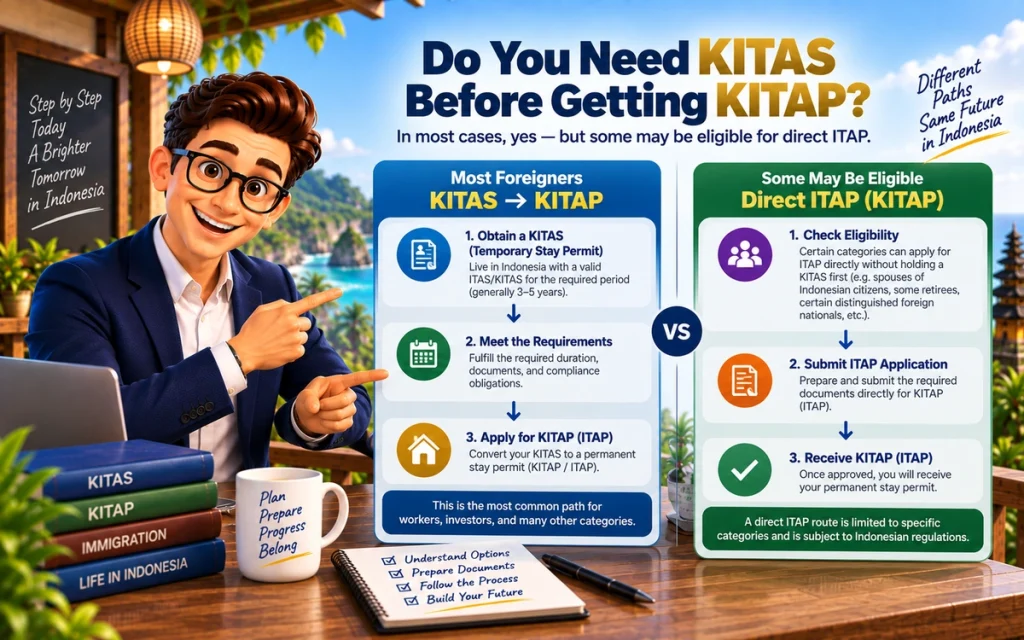
Not always. Whether you need KITAS before obtaining KITAP depends on the immigration route that applies to you. In Indonesia, KITAP can generally be reached through two broad pathways: a change of status from ITAS to ITAP, or a direct grant of ITAP for certain legally defined categories.
For the ITAS-to-ITAP pathway, the applicant must already hold a valid ITAS and meet the requirements of the relevant category. Current Immigration guidance recognizes routes that can include qualifying workers, religious workers, foreign investors, family reunification, repatriation, and certain Second Home categories. The application for a change from ITAS to ITAP is generally submitted no later than 30 days before the ITAS expires.
However, some applicants do not need to go through an ITAS-to-ITAP status change. Indonesian Immigration also provides direct ITAP pathways for certain categories, including specified former Indonesian citizens, qualifying former dual-nationality children, and children born in Indonesia to a parent who holds ITAP.
This means that having KITAS is not, by itself, the universal starting requirement for KITAP. The more important question is which legal KITAP route applies to your circumstances. Once that route is identified, the applicable eligibility rules, documents, timing, and procedure can be determined more accurately.
KITAS to KITAP: How the Status Change Works
For foreigners who qualify through an ITAS-to-ITAP route, changing KITAS to KITAP is a formal change of immigration status. The process is not simply an automatic upgrade of an existing KITAS. The applicant must qualify under the applicable ITAP category and complete the required immigration process.
1. Identify the correct KITAP route
First, determine which ITAP category applies to your situation. The route may be based on employment, investment, family reunification, religious activity, repatriation, Second Home status, or another qualifying category.
2. Confirm your current ITAS and application timing
Check that your current ITAS is valid and that you meet the timing requirements for a status-change application. Current Immigration guidance states that an ITAS-to-ITAP application should be submitted no later than 30 days before the ITAS expires.
3. Prepare the required documents
Prepare the general immigration documents together with evidence specific to your KITAP route. Depending on the category, this may include passport and ITAS documents, sponsor or guarantor information, proof of the relevant relationship or activity, an integration statement, residence evidence, and other supporting documents.
4. Submit the application
The application is submitted by the foreign national, sponsor, or responsible party through the applicable immigration process to the relevant Immigration Office.
5. Complete immigration verification
Immigration will review the application and supporting documents. Depending on the route and circumstances, additional verification or immigration procedures may be required before the application can proceed.
6. Pay the applicable fees
Once the application reaches the relevant payment stage, the applicant must pay the applicable immigration fees under the current tariff.
7. Complete ITAP issuance
After the required approvals and processing are completed, the ITAP is issued and the applicant receives the corresponding KITAP documentation. The exact completion process can vary according to the route and the Immigration Office handling the application.
The key point is that KITAS-to-KITAP is a route-based immigration process. The applicant should not assume that holding KITAS for a particular number of renewals automatically creates an entitlement to KITAP. Eligibility, residence history, timing, and supporting documents must be assessed against the specific ITAP category.
How Long Do You Need to Stay in Indonesia Before KITAP?
There is no single residence-duration rule that applies to every KITAP applicant. The required period depends on the legal route used to obtain ITAP. For certain ITAS-to-ITAP categories, Indonesian Immigration rules require the foreign national to have lived in Indonesia continuously for at least three years from the date the ITAS was granted.
This three-year requirement is particularly relevant to certain work, religious-worker, investor, and elderly foreign-resident routes. Official Immigration guidance describes these categories as requiring at least three consecutive years of residence in Indonesia before the ITAS can be changed to ITAP.
Importantly, three years of continuous residence should not be confused with three KITAS renewals. The legal requirement concerns the applicant’s qualifying period of residence and the applicable ITAS route, not a universal rule that every foreigner must hold exactly three separate KITAS permits before becoming eligible for KITAP.
Other routes follow different rules. For example, Indonesian immigration law provides a specific pathway for a foreign spouse of an Indonesian citizen after the marriage has reached the applicable minimum period, while certain legally defined categories may receive ITAP directly without first completing an ITAS-to-ITAP period.
For this reason, the correct way to assess KITAP eligibility is to start with the applicant’s immigration category rather than simply counting the number of years or KITAS documents held. The relevant route determines whether a three-year continuous residence requirement applies, what supporting documents are needed, and whether a direct ITAP pathway may be available.
KITAP Requirements in Indonesia
KITAP requirements depend on the route through which you qualify. There is no single document checklist that applies identically to every applicant. A person applying through an ITAS-to-ITAP route may have different supporting requirements from someone applying through a family, repatriation, or direct-ITAP pathway.
General Requirements
Common requirements can include a valid national passport or travel document, a valid ITAS where an ITAS-to-ITAP status change is required, sponsor or guarantor documentation where applicable, an integration statement when required, proof of residence or domicile, and immigration forms or other supporting documents requested for the relevant route.
The application may also involve immigration verification, biometric procedures, payment of the applicable government fees, and additional review by the Directorate General of Immigration depending on the category and application.
Route-Specific Requirements
Additional documents depend on why the applicant qualifies for KITAP. A worker may need employment-related documentation and the relevant recommendations or approvals. An investor may need evidence of the qualifying investment and company-related documents. A religious worker may need documentation from the relevant religious or government authority. Family routes may require marriage, birth, or other evidence of the qualifying family relationship.
Applicants using an elderly-resident, repatriation, Second Home, or direct-ITAP pathway may also face requirements that are specific to that category. Because these requirements can change according to the immigration route and current regulations, applicants should use the route-specific checklist rather than relying on a generic KITAP document list.
For a detailed document-by-document breakdown, see our guide to KITAP requirements in Indonesia.
How to Apply for KITAP in Indonesia
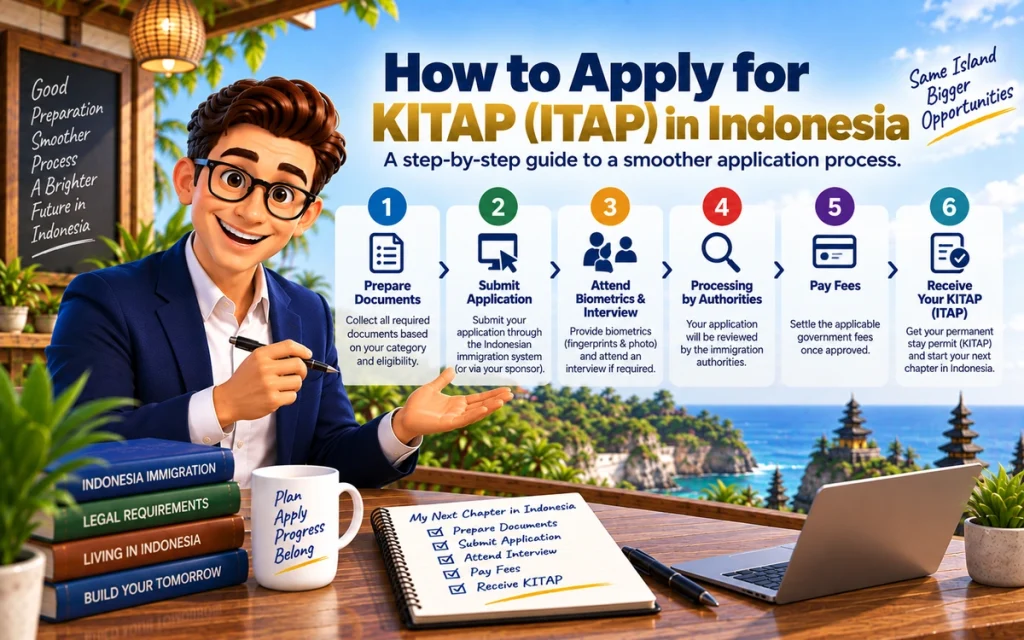
Applying for KITAP in Indonesia is a formal immigration process, and the procedure depends on the route used. For an ITAS-to-ITAP application, the foreign national or the relevant sponsor or guarantor submits the application through the immigration system and completes the required verification before ITAP is issued. The application should be planned around the validity of the existing ITAS, because current Immigration guidance states that an ITAS-to-ITAP application must be submitted no later than 30 days before the ITAS expires.
While the exact documents vary by category, the overall process can be understood as follows:
- Identify the appropriate KITAP route. Determine whether the application is based on employment, investment, family reunification, repatriation, a qualifying Second Home category, or another legally recognized route.
- Confirm eligibility and timing. Check the requirements that apply to the specific route, including any residence period, relationship, employment, investment, age, or other category-specific conditions.
- Prepare the required documents. Typical documents may include a valid passport, current stay-permit documents, sponsor or guarantor documents, proof of residence, an integration statement where required, and route-specific supporting evidence.
- Submit the application. The applicant, sponsor, or responsible party submits the application through the applicable immigration system and uploads the required documents.
- Complete immigration verification. The immigration office reviews the application and may conduct document checks, identity verification, photography, or other required procedures.
- Pay the applicable immigration fees. Payment must be completed according to the current official tariff applicable to the service and permit.
- Complete the ITAP issuance process. After the required immigration review and approval, the ITAP is issued in accordance with the applicable procedure.
The process is not an automatic upgrade from KITAS to KITAP. Approval depends on whether the applicant meets the requirements of the relevant legal route. For applicants using an ITAS-to-ITAP route, it is therefore important to begin the process early enough to meet the applicable filing deadline and avoid problems caused by an expiring ITAS.
How Long Is KITAP Valid?
KITAP, formally ITAP or Izin Tinggal Tetap, is designed as a long-term immigration stay status rather than a short-term visa. Under the Immigration framework, an ITAP is granted for five years and may be extended indefinitely as long as the permit has not been cancelled.
This means that the five-year period should not be understood as a limit on how long a qualifying foreign national can remain a KITAP holder. Instead, it is the validity period of the ITAP grant before the applicable extension process is required. The long-term framework can continue through subsequent extensions, subject to the holder continuing to meet the applicable immigration requirements.
The practical procedure can depend on the type of ITAP and the applicant’s circumstances. Current Immigration service information also distinguishes permanent ITAP extension procedures and requires applicants to follow the applicable application, document, verification, payment, and issuance steps.
KITAP holders should therefore keep track of the validity shown in their immigration documents and confirm the applicable extension and reporting requirements before the current period ends. A KITAP should not be treated as an unrestricted status that removes all immigration obligations.
Can KITAP Be Renewed?
Yes. KITAP can be extended under the applicable immigration rules. The important distinction is that KITAP is not simply a one-time five-year permit that expires permanently after five years. ITAP is granted for a defined period, and the immigration framework provides for extension, including an indefinite-duration ITAP framework for qualifying holders.
The extension process remains an immigration procedure. Applicants may need to submit the required documents, present their existing KITAP, and satisfy any route-specific conditions that apply to the extension. Current Immigration service standards also show that requirements can differ according to the KITAP category, such as investment, certain employment, religious work, family reunification, Second Home, former dual-nationality children, and former Indonesian citizens.
For this reason, KITAP holders should review the applicable extension requirements before the current validity period ends rather than assuming that the permit will continue automatically.
KITAP Reporting Requirements
KITAP holders can have reporting obligations in addition to maintaining a valid stay permit. For an ITAP with an indefinite duration, current Immigration guidance requires the foreign national to report to the immigration office responsible for their place of residence every five years.
The reporting process generally requires a valid passport and the ITAP. Depending on the holder’s circumstances, Immigration may also request supporting evidence confirming the continued purpose of residence, such as company, employment, religious-activity, financial, tax, investment, or other relevant documents.
The five-year reporting requirement should not be confused with an extension of the ITAP itself. Reporting is a separate immigration obligation for indefinite-duration ITAP holders. Current Immigration guidance states that the reporting window can begin three months before the reporting date and must be completed no later than the working day before the reporting deadline.
Because immigration procedures and digital services can change, KITAP holders should confirm the current reporting procedure with the relevant Immigration Office before the reporting deadline.
KITAP vs KITAS
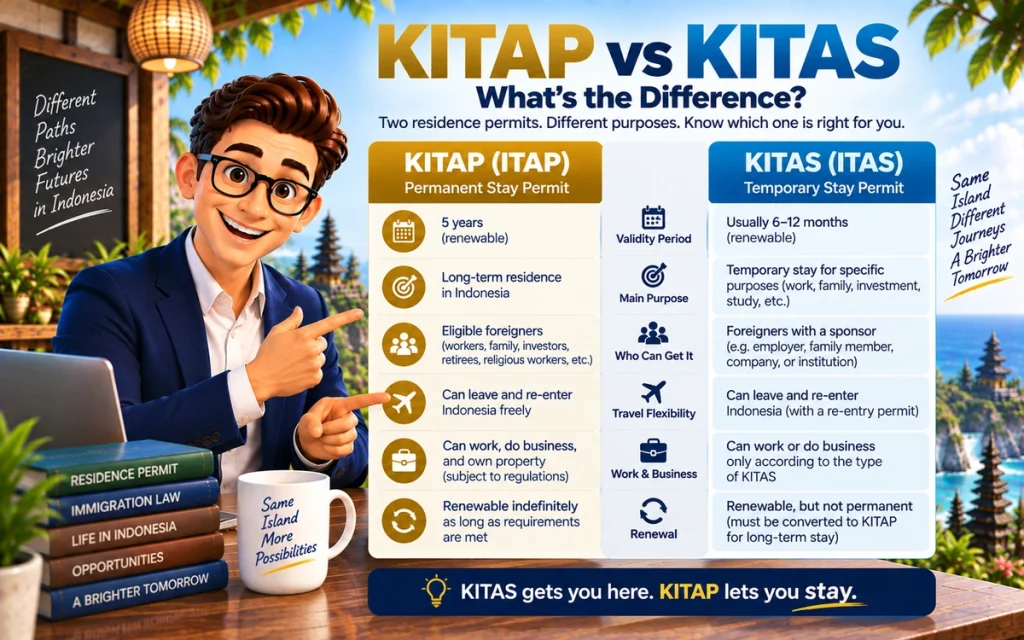
KITAP and KITAS are both Indonesian immigration stay permits, but they serve different purposes. KITAS is the common term for Kartu Izin Tinggal Terbatas, while KITAP is the common term for Kartu Izin Tinggal Tetap. In official terminology, the underlying permits are ITAS (Izin Tinggal Terbatas) and ITAP (Izin Tinggal Tetap).
The simplest distinction is that ITAS provides temporary or limited stay status, while ITAP provides a more permanent long-term stay status for qualifying foreign nationals. Immigration describes ITAP as a higher and more permanent level of stay permit than ITAS.
| Feature | KITAS / ITAS | KITAP / ITAP |
| Meaning | Limited Stay Permit | Permanent Stay Permit |
| Typical role | Temporary or limited-duration residence | Long-term residence for qualifying foreign nationals |
| How it relates to the other status | May be a pathway toward ITAP for eligible routes | May be obtained through an ITAS-to-ITAP status change or directly in qualifying categories |
| Validity framework | Depends on the applicable ITAS category and period granted | Granted for a defined period and may be extended under the applicable rules, including an indefinite extension framework |
| Eligibility | Depends on the visa and stay-permit category | Depends on a specific ITAP route and category |
| Citizenship | Does not confer Indonesian citizenship | Does not confer Indonesian citizenship |
For some foreign nationals, KITAS is part of the pathway to KITAP. Current Immigration guidance recognizes ITAS-to-ITAP routes for categories including workers, religious workers, investors, family reunification, repatriation, and certain Second Home categories. Other legally defined categories can receive ITAP without first completing an ITAS-to-ITAP status change.
It is also important not to assume that every KITAS holder can simply convert to KITAP after a fixed number of renewals. The eligibility requirements depend on the route. For example, current Immigration guidance specifies a minimum three-year continuous residence requirement for certain worker, religious-worker, investor, and elderly foreign-resident ITAS-to-ITAP routes, while other family and direct-grant routes follow different rules.
In practical terms, KITAS is generally the more flexible status for foreigners who are still within a temporary or qualifying limited-stay route, while KITAP is intended for foreigners who qualify for a more permanent stay arrangement under Indonesian immigration law.
KITAP vs Indonesian Citizenship
KITAP is not Indonesian citizenship. A KITAP holder remains a foreign national and holds an Indonesian immigration stay permit rather than Indonesian nationality. This distinction is important because the rights, identity documents, and legal status of a foreign resident are different from those of an Indonesian citizen.
KITAP provides a qualifying foreign national with a permanent stay status under Indonesian immigration law. It does not automatically provide an Indonesian passport, Indonesian nationality, or the full legal status of an Indonesian citizen. Current Immigration services explicitly distinguish ITAP from citizenship, including procedures for former Indonesian citizens who have lost Indonesian nationality and may instead hold or apply for ITAP as foreign nationals.
The distinction can be summarized as follows:
| Status | KITAP / ITAP | Indonesian Citizenship |
| Nationality | Foreign national | Indonesian citizen |
| Main legal function | Permanent stay permission under immigration law | Nationality and membership in the Indonesian state |
| Passport | Generally uses the person’s foreign passport | Indonesian passport may be issued to eligible citizens |
| Immigration status | Requires compliance with applicable immigration rules | Not dependent on an Indonesian stay permit |
| How obtained | Through an eligible immigration route | Through the applicable Indonesian nationality process |
| Does one automatically become the other? | No | No |
Some KITAP routes are specifically available to people with a previous or family connection to Indonesia. For example, current Immigration services provide direct ITAP procedures for certain former Indonesian citizens who have lost Indonesian citizenship, former limited dual-nationality children who choose foreign citizenship, and certain children born in Indonesia to ITAP holders. These categories demonstrate that an immigration stay permit and nationality are separate legal concepts.
If a foreign resident wants to become an Indonesian citizen, obtaining KITAP should therefore not be treated as the final step of an automatic citizenship process. Citizenship is a separate legal matter with its own eligibility requirements and application procedure. A person considering both options should assess the applicable nationality rules separately from their immigration status.
KITAP vs Global Citizenship of Indonesia
KITAP and Global Citizenship of Indonesia (GCI) are both long-term immigration pathways, but they are not the same route. GCI was introduced by Indonesian Immigration in 2026 as a policy for qualifying foreign nationals who have a strong connection with Indonesia through descent, family, history, or other qualifying ties. It provides an unlimited-duration permanent stay permit without changing the holder’s foreign citizenship.
The key difference is the basis for eligibility. KITAP covers a range of immigration routes, including qualifying workers, investors, religious workers, family-related applicants, elderly foreign residents, repatriation categories, and other legally defined routes. GCI is more specifically designed for people with qualifying Indonesian connections, including former Indonesian citizens, certain descendants of former Indonesian citizens, spouses of Indonesian citizens, children of mixed Indonesian-foreign marriages, and certain family members.
| Feature | KITAP / ITAP | GCI |
| Main basis | Various qualifying immigration routes | Qualifying connection or relationship with Indonesia |
| Typical applicants | Workers, investors, family applicants, religious workers, elderly residents, repatriation and other eligible categories | Former Indonesian citizens, qualifying descendants, spouses, mixed-marriage children and qualifying family members |
| Residence framework | Permanent stay permit with applicable grant and extension rules | Unlimited-duration permanent stay permit under the GCI policy |
| Citizenship | Does not automatically change nationality | Does not change the holder’s foreign citizenship |
| Application route | Depends on the applicable ITAP category | Specific GCI visa and immigration process through the eVisa system |
For someone whose main qualification is employment, investment, retirement-related eligibility, or another ordinary KITAP route, KITAP remains the relevant framework. For someone with a qualifying Indonesian family, ancestry, or former-citizen connection, GCI may be a separate route worth evaluating. GCI should therefore be treated as a distinct immigration pathway rather than simply another name for KITAP.
There is also an important terminology point: GCI itself results in an ITAP with an unlimited duration. This does not mean that every ITAP holder is a GCI holder. KITAP remains the common public term associated with the permanent stay permit, while GCI is a specific policy and eligibility pathway within Indonesia’s immigration system.
KITAP Costs in Indonesia
The cost of KITAP in Indonesia depends on the type and duration of the ITAP being requested, as well as any additional immigration services required for the applicant. The safest way to estimate the government cost is to use the current official immigration tariff rather than relying on older agency price lists or fixed third-party estimates.
Current Immigration tariff pages show different ITAP charges according to the validity period. For example, official Immigration offices currently publish tariffs of Rp5,000,000 for ITAP valid for up to five years, Rp10,000,000 for ITAP valid for up to 10 years, and Rp15,000,000 for an ITAP with an unlimited duration. The exact tariff applicable to an application should be confirmed with the Immigration Office handling the case because the service category and applicable tariff can affect the amount.
The government immigration fee is also not necessarily the complete cost of obtaining or maintaining KITAP. Depending on the route and circumstances, an applicant may have additional costs related to a re-entry permit, document preparation, translations, required recommendations, medical or other supporting documents, transportation, or professional immigration assistance.
For example, current official tariff information separately lists re-entry permit fees. A re-entry permit can therefore be an additional government charge when the KITAP holder needs authorization to leave Indonesia and return during the applicable period.
Because Indonesian immigration tariffs can be updated, applicants should verify the current official tariff immediately before payment. A published fee from an older article should not be assumed to remain valid for a new KITAP application.
KITAP Rights and Restrictions
KITAP gives a qualifying foreign national a permanent stay status in Indonesia, but it does not remove the conditions attached to immigration status. A KITAP holder remains subject to Indonesian immigration law and must continue to comply with the conditions of the relevant permit and route.
One important benefit of ITAP is the ability to reside in Indonesia under a permanent stay framework rather than repeatedly relying on a temporary stay permit. Under the Immigration Law framework, ITAP holders are recognized as residents of Indonesia. However, the specific activities a holder may undertake can depend on the legal basis of the ITAP and other applicable regulations.
For example, Indonesian immigration law expressly provides that certain ITAP holders may conduct work and/or business activities to meet their own needs and those of their family. This does not mean that every KITAP holder automatically has unrestricted permission to undertake every type of employment or business activity. Work, business, licensing, professional, and sector-specific requirements may still apply.
KITAP holders should also understand that the status can end or be cancelled in circumstances specified by immigration law. These can include leaving Indonesia for more than one year or not intending to return, failing to complete the applicable ITAP extension after five years, acquiring Indonesian citizenship, cancellation by the Minister or authorized Immigration official, deportation, or death. ITAP can also be cancelled for reasons such as serious violations of Indonesian law, activities that endanger national security, violation of the integration statement, employing foreign workers without the required authorization, or providing false information in the ITAP application.
A KITAP holder who travels outside Indonesia should also pay attention to the re-entry permit. Immigration provides a re-entry permit for ITAS and ITAP holders to return to Indonesia after leaving the country, and the applicable re-entry arrangements should be maintained according to the holder’s circumstances.
In practical terms, KITAP should be viewed as a strong long-term residence status, not as an exemption from Indonesian immigration rules. Maintaining the correct documents, complying with reporting and extension requirements, observing the conditions of the relevant route, and checking work or business permissions where applicable are essential to keeping the status in good standing.
Frequently Asked Questions About KITAP
What is KITAP in Indonesia?
KITAP is the common term for Kartu Izin Tinggal Tetap, while ITAP is the official term for Izin Tinggal Tetap. It is a permanent stay permit for qualifying foreign nationals under Indonesian immigration law.
Is KITAP the same as permanent residency?
KITAP is Indonesia’s permanent stay permit and is commonly explained in English as a permanent residence or permanent residency status. However, it is an immigration status, not Indonesian citizenship.
Do I need KITAS before getting KITAP?
Not always. Some applicants obtain KITAP by changing from ITAS to ITAP, while certain legally defined categories can receive ITAP directly without first holding an ITAS.
Do I need three KITAS to get KITAP?
No. Indonesian immigration rules do not establish a universal requirement to hold three KITAS permits before KITAP. For certain ITAS-to-ITAP routes, the relevant requirement is continuous residence for at least three years, while other routes have different eligibility rules.
How long do I need to stay in Indonesia before getting KITAP?
There is no single residence period for every KITAP applicant. Certain ITAS-to-ITAP categories require at least three years of continuous residence, while other family, repatriation, direct-grant, and special routes follow their own requirements.
How long is KITAP valid?
ITAP is granted for a defined period, including a five-year period under the general framework, and it can be extended under the applicable rules. Qualifying holders may also enter an indefinite-duration ITAP framework.
Can KITAP be renewed?
Yes. KITAP can be extended under the applicable immigration procedure. The exact timing, documents, and process depend on the type of ITAP and the holder’s circumstances.
Is KITAP the same as Indonesian citizenship?
No. A KITAP holder remains a foreign national. KITAP does not automatically provide Indonesian nationality or an Indonesian passport.
Can KITAP holders work in Indonesia?
A KITAP can provide a long-term residence framework, and Indonesian immigration law allows certain ITAP holders to conduct work or business activities under applicable conditions. However, KITAP alone should not be treated as unrestricted authorization for every occupation or business activity.
How much does KITAP cost in Indonesia?
The government fee depends on the type and duration of the ITAP and the applicable immigration tariff. Additional costs may apply for services such as a re-entry permit, supporting documents, or professional assistance. Applicants should confirm the current official tariff before payment.
What happens if I leave Indonesia with KITAP?
A KITAP holder who travels abroad must comply with the applicable re-entry requirements. The appropriate re-entry permit should be maintained when the holder intends to leave Indonesia and return.
What is the difference between KITAP and GCI?
KITAP is the common term for Indonesia’s permanent stay permit and covers multiple immigration routes. GCI, or Global Citizenship of Indonesia, is a specific pathway for qualifying foreign nationals with defined connections to Indonesia and can provide an unlimited-duration ITAP without changing foreign citizenship.
Conclusion
KITAP is one of Indonesia’s most important long-term immigration statuses for foreign nationals who qualify under the applicable rules. It provides a permanent stay framework, but it is not Indonesian citizenship and it is not automatically available to every foreign resident.
The most important point is to identify the correct KITAP route before assuming that a particular timeline or document checklist applies. Some applicants move from ITAS to ITAP after meeting route-specific conditions, including a three-year continuous residence requirement for certain categories. Other applicants may qualify for direct ITAP or follow family, repatriation, Second Home, GCI, or other specific pathways.
For a broader overview of Indonesia’s long-term residence system, see our Indonesia Residency guide.
Because immigration rules, procedures, and fees can change, applicants should confirm their current eligibility, documents, deadlines, and applicable government fees before submitting an application. A route-specific assessment can help determine which KITAP pathway applies and what should be prepared before the application is filed.
Need Help Choosing the Right KITAP Route?
If you are planning to obtain or change to KITAP in Indonesia, the first step is to determine which immigration route applies to your circumstances. This may depend on your current ITAS, employment, investment, family relationship, former Indonesian citizenship, age, or another qualifying category.
AzraID can help you review the applicable route, identify the key requirements, and prepare the next steps based on your individual situation.
Not sure which KITAP route applies to you?
Talk to our team to review your situation, eligibility, and the next steps for obtaining KITAP in Indonesia.