Bali, Yogyakarta or Jakarta—which one is actually the best place to live in Indonesia in 2026?
For many digital nomads, remote workers and foreigners planning a move to Indonesia, choosing the right city can be more difficult than it first appears.
All three destinations offer something very different.
Bali is known for its beaches, international community and established digital nomad lifestyle. It attracts people looking for coworking spaces, cafés, networking opportunities and a more globally connected way of life.
Yogyakarta, often called Jogja, offers something different: a slower rhythm, lower living costs and a stronger connection to Indonesian and Javanese culture. For many foreigners, it is becoming an increasingly attractive alternative to Indonesia’s more expensive international hotspots.
Jakarta, meanwhile, is Indonesia’s fast-moving business capital. It offers major professional opportunities, modern infrastructure, international services and the convenience of life in one of Southeast Asia’s largest urban centres.
But the real question is not simply:
“Which city is the best?”
The better question is:
“Which city is the best for the life you want to build in Indonesia?”
A remote worker looking for peace and lower monthly expenses may make a very different choice from an entrepreneur seeking business connections. Someone planning a short stay may prioritise lifestyle and community, while a foreigner considering a long-term move may care more about housing, healthcare, transportation and immigration options.
That is why this guide goes beyond a simple cost of living comparison.
We will compare Bali vs Yogyakarta vs Jakarta across the things that can genuinely affect your decision:
- cost of living and monthly budget;
- rent, housing and accommodation;
- food and everyday expenses;
- transportation and getting around;
- internet, coworking spaces and remote work;
- lifestyle, culture and international communities;
- healthcare, safety and daily convenience;
- visas, visa extensions and long-term stay options;
- and ultimately, which city may be the right fit for you.
Whether you are a digital nomad, remote employee, entrepreneur, investor, expat or foreigner planning to move to Indonesia, this guide is designed to help you compare the three cities from a practical perspective—not just from a tourist’s point of view.
“By the end, you should have a much clearer idea of whether Bali, Yogyakarta or Jakarta best matches your budget, work, lifestyle and long-term plans in Indonesia.”

1. Quick Answer: Bali vs Yogyakarta vs Jakarta
If you want the short answer before we go deeper:
Choose Bali if you want an international lifestyle
Bali is generally the strongest choice for foreigners who want beaches, an established digital nomad community, international restaurants, coworking spaces and frequent opportunities to meet people from around the world.
It can be an excellent place for remote workers and entrepreneurs who value community and networking, but your monthly budget can vary significantly depending on where and how you live.
Choose Yogyakarta if you want the best balance of affordability and culture
Yogyakarta can be an excellent choice for people who want to reduce their living costs without giving up access to cafés, restaurants, internet, healthcare and everyday services.
It is particularly attractive for those who prefer a slower pace, deeper cultural experience and a more local way of life. For remote workers who value focus over constant networking, Yogyakarta can be one of Indonesia’s most interesting long-term options.
Choose Jakarta if you want business opportunities and big-city convenience
Jakarta is best suited to people who enjoy urban life and want access to major business networks, modern infrastructure, international services and a huge range of restaurants, shopping and professional opportunities.
The trade-off is the pace of life. Jakarta can be more intense, and where you choose to live can have a major impact on your daily commute and overall quality of life.
Bali vs Yogyakarta vs Jakarta at a Glance
| If You Want… | Best Choice |
| The lowest cost of living | Yogyakarta |
| Beach and tropical lifestyle | Bali |
| The largest digital nomad community | Bali |
| A slower pace of life | Yogyakarta |
| Strong Javanese culture and traditions | Yogyakarta |
| Major business opportunities | Jakarta |
| The strongest big-city infrastructure | Jakarta |
| An international lifestyle | Bali |
| The best long-term affordability | Yogyakarta |
| Professional and business networking | Jakarta |
| Coworking and digital nomad networking | Bali |
| A balance between remote work and cultural life | Yogyakarta |
Our Quick Verdict
There is no single winner.
Bali may be the best choice if you want your life in Indonesia to be highly international, social and centred around the digital nomad lifestyle.
Yogyakarta may offer the strongest overall value if you want to live comfortably, control your monthly expenses and experience a quieter, more culturally connected side of Indonesia.
Jakarta may be the right choice if career opportunities, business connections and big-city convenience are more important to you than beaches or a slower lifestyle.
“The best choice depends on what you value most—and the next section starts with one of the biggest factors for almost everyone: how much does it actually cost to live in Bali, Yogyakarta or Jakarta?”
2. Cost of Living: Bali vs Yogyakarta vs Jakarta
For many foreigners, the first question is simple:
“How much money do I actually need to live in Indonesia?”
The answer depends heavily on where you choose to live.
Bali, Yogyakarta and Jakarta can offer very different lifestyles at very different price points. A foreigner living modestly in Yogyakarta may spend significantly less each month than someone renting a modern villa in Canggu or a premium apartment in central Jakarta.
That is why there is no single number that represents the true cost of living in Indonesia.
Your monthly expenses will depend on factors such as:
- where you live;
- the type of accommodation you choose;
- whether you live alone, as a couple or with a family;
- how often you eat at local versus international restaurants;
- whether you own or rent a scooter;
- your healthcare and insurance arrangements;
- your social and entertainment habits;
- and whether you prefer a local, comfortable or premium lifestyle.
As a general comparison, Yogyakarta is usually the most affordable of the three, while Bali can become the most expensive depending on the area and lifestyle you choose. Jakarta sits between them in some categories, although housing and location can have a major impact on your overall monthly budget. Recent 2026 price data also shows clear differences in restaurant and grocery costs between the three destinations.
How Much Do You Need Per Month?
The following estimates are designed to give a practical starting point for a single foreigner.
They are not official government figures, and they should not be treated as a fixed cost. Your actual spending can be considerably lower or higher depending on where and how you live.
| City | Budget Lifestyle | Comfortable Lifestyle | Premium Lifestyle |
| Bali | $900–$1,300 | $1,500–$2,500 | $3,000+ |
| Yogyakarta | $500–$800 | $900–$1,400 | $1,800+ |
| Jakarta | $800–$1,200 | $1,500–$2,500 | $3,000+ |
These estimates generally assume that you are paying for accommodation, food, transportation, internet and ordinary day-to-day expenses.
They do not necessarily include major international travel, private healthcare emergencies, extensive nightlife, expensive shopping, dependants or other high-value personal expenses.
What Does “Budget” Actually Mean?
A budget lifestyle does not necessarily mean an uncomfortable one.
In Indonesia, a foreigner can often live comfortably while spending carefully—particularly in Yogyakarta.
A budget lifestyle may involve:
- choosing a simple kost, guesthouse or modest apartment;
- eating local Indonesian food regularly;
- using ride-hailing services selectively;
- renting or using a scooter;
- limiting expensive nightlife and entertainment;
- and avoiding the most premium international neighbourhoods.
This lifestyle is easiest to achieve in Yogyakarta, where lower housing and everyday food costs can give your budget more flexibility.
What Does a Comfortable Lifestyle Mean?
For most long-term foreigners, this may be the most realistic category.
A comfortable lifestyle could include:
- a private apartment or house;
- regular dining at cafés and restaurants;
- a mix of local and international food;
- reliable home internet;
- frequent ride-hailing or scooter use;
- gym, leisure or social activities;
- and a more convenient location.
This is where the differences between Bali, Yogyakarta and Jakarta become more noticeable.
A comfortable lifestyle in Yogyakarta can potentially provide more space and flexibility for the same budget that might only cover a smaller apartment and a more limited lifestyle in a popular area of Bali.
What Does a Premium Lifestyle Mean?
A premium lifestyle can vary enormously.
In Bali, it may include a private villa, regular dining at international restaurants, beach clubs, wellness services and living in a highly popular area such as Canggu or Seminyak.
In Jakarta, it may mean a premium apartment, private transportation, international dining and frequent use of the city’s high-end shopping, entertainment and lifestyle facilities.
In Yogyakarta, a premium budget can often provide significantly more space and a higher level of day-to-day comfort than in the other two destinations.
However, premium living has no real upper limit. A luxury villa in Bali or a high-end residence in Jakarta can push monthly expenses far beyond the estimates above.
Bali: The Widest Range of Living Costs
Bali can be both surprisingly affordable and surprisingly expensive.
That is one of the biggest mistakes people make when researching the cost of living in Bali. They see low prices for local food and basic services, then assume they can maintain a highly international lifestyle on the same budget.
In reality, your location makes a huge difference.
Living in a quieter or less internationally developed area can be dramatically cheaper than living in a popular foreigner-focused area. Rent, cafés, restaurants and lifestyle spending can increase quickly in destinations with a strong international market.
Recent 2026 price data illustrates this difference. Average prices reported for an inexpensive restaurant meal in Bali were around Rp50,000, while a regular cappuccino was close to Rp40,000. Both figures were higher than the corresponding averages reported for Yogyakarta and, in the case of restaurant meals, Jakarta as well.
“Bali can be a good choice if your budget allows for the lifestyle you want.”
But it is important to budget realistically.
A lifestyle built around:
- imported food;
- Western cafés;
- frequent coworking;
- private villas;
- beach clubs;
- wellness services;
- and constant social activities
can become expensive very quickly.
“The biggest lesson about Bali is simple: you can live cheaply, but living like an international tourist every day is a very different budget.”
Recent 2026 reporting on Bali’s digital-nomad lifestyle similarly highlights how quickly regular café, food and leisure spending can accumulate depending on whether someone lives more locally or follows a more tourism-oriented lifestyle.
Yogyakarta: The Best Value for Long-Term Living
If your main goal is to reduce your monthly expenses without sacrificing everyday comfort, Yogyakarta is likely to be the strongest option of the three.
This is not simply because local food is cheaper.
The advantage of Yogyakarta can extend across several parts of everyday life, including:
- accommodation;
- food;
- cafés;
- local services;
- transportation;
- and, depending on the area, larger living spaces for the same budget.
Recent 2026 price data reported an average inexpensive restaurant meal of around Rp20,000 in Yogyakarta, compared with around Rp50,000 in Bali and Rp35,000 in Jakarta. A regular cappuccino was also reported at a substantially lower average price in Yogyakarta.
Housing can make an even bigger difference.
One 2026 comparison estimated Yogyakarta’s overall living costs below Jakarta’s, with particularly large differences in reported housing costs. However, that source also warns that its comparison is based on limited user-contributed data, so the exact percentages should not be treated as universal for every property or neighbourhood.
The real strength of Yogyakarta is therefore value for money.
With the same monthly budget, you may be able to:
- rent a larger property;
- eat out more frequently;
- spend more on leisure;
- create a dedicated workspace at home;
- or simply save more money each month.
For a remote worker who does not need beaches or a large international networking scene every day, this can make Yogyakarta extremely attractive.
“Yogyakarta is not necessarily the cheapest because you have to compromise—it can be cheaper because your money can simply go further.”
Jakarta: Higher Costs, but Different Advantages
Jakarta is often assumed to be the most expensive city in Indonesia.
The reality is more complicated.
Your monthly cost can vary dramatically depending on where you live and how you structure your daily life. A person who chooses accommodation close to work or regularly uses public transportation may have a very different budget from someone living in a premium central business district and relying heavily on private transport.
For many foreigners, Jakarta’s biggest expenses are likely to be:
- accommodation in desirable areas;
- transportation and commuting choices;
- international dining;
- entertainment;
- and big-city lifestyle spending.
At the same time, some everyday prices can be lower than Bali. Recent 2026 data, for example, reported lower average prices in Jakarta than Bali for inexpensive restaurant meals, mid-range dining, coffee and several grocery items.
This is an important point:
“Jakarta is not automatically more expensive than Bali in every category.”
The bigger financial challenge is often how you choose to live and where you choose to live.
A well-planned Jakarta lifestyle can offer strong value for someone who prioritises:
- business opportunities;
- professional networking;
- public transportation;
- international services;
- and big-city convenience.
But if your priority is simply getting the most space and comfort for the lowest monthly cost, Yogyakarta will usually be more attractive.
What Can Change Your Monthly Budget the Most?
When comparing the cost of living in Bali, Yogyakarta and Jakarta, some expenses matter much more than others.
1. Your Accommodation
This is likely to be your biggest variable.
Choosing a simple long-term room, kost or modest apartment can save hundreds of dollars compared with a private villa or premium apartment.
The difference can be even greater between neighbourhoods.
2. Your Location
Living in a highly popular international area can increase your spending without you immediately noticing.
The same city can feel completely different financially depending on where you live.
3. Local Food vs International Lifestyle
Indonesia can be very affordable if you regularly eat local food.
But imported groceries, Western restaurants, speciality coffee and international lifestyle services can quickly increase your budget.
4. Transportation
A person who lives close to their daily activities may spend far less than someone who travels across the city every day.
This is particularly important in Jakarta, where choosing the wrong location can affect both your budget and your time.
5. Lifestyle Habits
Two foreigners can earn the same income and live in the same city while having completely different monthly expenses.
The difference may come down to:
- how often they go out;
- whether they travel frequently;
- their accommodation standards;
- gym and wellness memberships;
- nightlife;
- shopping;
- and social habits.
Which City Gives You the Best Value for Money?
If your goal is to spend as little as possible while maintaining a comfortable quality of life:
“Yogyakarta wins.”
It offers the strongest potential combination of lower everyday expenses, affordable housing and a slower lifestyle.
If you are willing to spend more for beaches, international networking and a highly developed digital nomad environment:
“Bali may justify the higher cost.”
But you need to choose your location and lifestyle carefully.
If your priority is career, business, infrastructure and big-city opportunities:
“Jakarta may offer value in a different way.”
Your monthly expenses may be higher than in Yogyakarta, but the city can provide access to professional opportunities and services that are difficult to replicate elsewhere.
The Bottom Line
Yogyakarta is generally the easiest place to live well on a lower budget.
Bali offers the widest lifestyle range—from relatively affordable to extremely expensive.
Jakarta can be costly, particularly because of housing and location, but it offers a different level of business and urban convenience.
And this leads to the next major question:
“Your monthly budget is not only about how much you spend—it is also about what that money can buy you.
Next, let’s compare accommodation and rent to see where you actually get the best value for your money.”
3. Accommodation and Rent: Where Do You Get the Best Value?
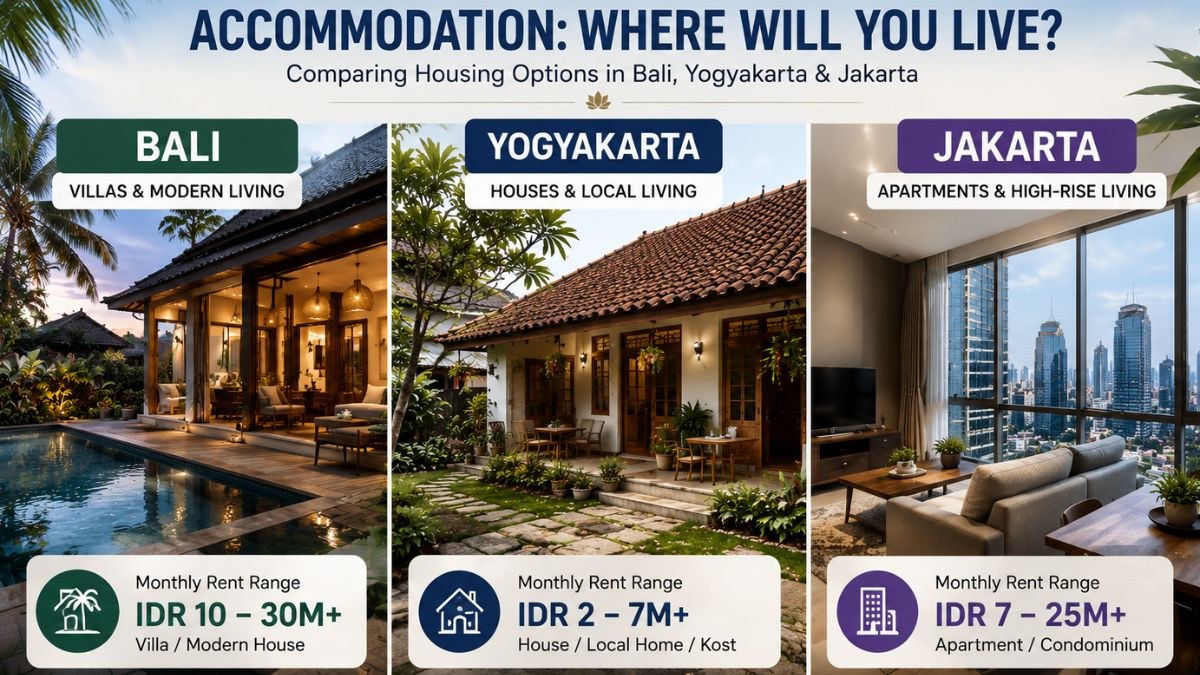
Accommodation is usually the single biggest factor in your monthly cost of living.
You can save a significant amount of money—or spend far more than necessary—simply based on the type of property and neighbourhood you choose.
This is particularly important when comparing Bali vs Yogyakarta vs Jakarta, because the same monthly budget can buy you three completely different lifestyles.
A budget that provides a simple room in a popular area of Bali might give you a larger private house in Yogyakarta. Meanwhile, in Jakarta, the same amount may be spent on a modern apartment with convenient access to business districts and public transportation.
So the question is not simply:
“Which city has the cheapest rent?”
A better question is:
“Which city gives you the best accommodation for the lifestyle and budget you want?”
Bali: Best for Villas, Coliving and International Lifestyle
Bali offers one of the widest ranges of accommodation options for foreigners in Indonesia.
Depending on your budget and location, you may find:
- private villas;
- apartments;
- guesthouses;
- long-term rooms;
- serviced accommodation;
- and coliving spaces.
For digital nomads and newcomers, Bali’s coliving environment can be particularly attractive. These properties may provide more than just a place to sleep—they can offer a ready-made community, shared workspaces and an easier way to meet other foreigners.
However, location can dramatically change your rent.
Popular areas such as Canggu, Seminyak and other internationally popular neighbourhoods generally operate in a very different rental market from quieter parts of the island.
The biggest mistake many newcomers make is seeing an attractive online price and assuming it represents the entire Bali market.
It does not.
Before choosing accommodation, you should consider:
- how close you want to be to beaches and major lifestyle areas;
- whether you need to work from home;
- traffic and daily travel time;
- internet quality;
- the availability of restaurants and supermarkets;
- whether you want a social or quieter environment;
- and whether you are paying for a short-term rental or committing to a longer agreement.
Who Gets the Best Value in Bali?
Bali can offer excellent value if you know exactly what lifestyle you want and choose your location carefully.
A foreigner looking for a quiet long-term base may find better value outside the most internationally competitive areas. Someone who prioritises community, networking and easy access to coworking spaces may decide that paying more is worth the convenience.
Choose Bali for accommodation if you want: villas, coliving, a strong international rental market and a lifestyle-oriented living environment.
The main trade-off: rent can rise quickly in popular foreigner-focused areas.
Yogyakarta: Best for Affordability, Space and Long-Term Value
For many foreigners, Yogyakarta offers the best accommodation value of the three cities.
The range of options can include:
- kost or long-term rooms;
- apartments;
- guesthouses;
- private houses;
- and larger residential properties.
One of Yogyakarta’s biggest advantages is that a moderate monthly budget can potentially give you more living space.
For example, instead of choosing between an expensive apartment and a shared room, you may have more opportunities to rent a private house or find accommodation with enough space for a dedicated home office.
This can be particularly attractive for:
- remote workers;
- couples;
- families;
- writers and creative professionals;
- and foreigners planning to stay for several months or longer.
Understanding Kost in Yogyakarta
For foreigners new to Indonesia, a kost is one accommodation option worth understanding.
A kost generally refers to a rented room or boarding-style accommodation, often designed for longer-term residents. The facilities can vary significantly.
Some kost options are simple and budget-oriented, while others can provide:
- private bathrooms;
- air conditioning;
- Wi-Fi;
- shared kitchens;
- parking;
- housekeeping;
- and more modern facilities.
This makes a kost a potentially practical option for someone who does not need an entire house or apartment.
However, not every kost will be suitable for every foreigner.
Before committing, check:
- the length of the rental agreement;
- whether utilities are included;
- internet quality;
- privacy and house rules;
- parking availability;
- visitor policies;
- and the exact location.
Who Gets the Best Value in Yogyakarta?
Yogyakarta is particularly strong for people who want their accommodation budget to go further.
The same budget may allow you to prioritise:
- more space;
- a quieter residential environment;
- a dedicated workspace;
- or simply lower monthly expenses.
Choose Yogyakarta for accommodation if you want: affordability, more space and strong value for long-term living.
The main trade-off: the rental market may be less internationally standardised than Bali, so viewing the property and understanding local rental arrangements becomes especially important.
Jakarta: Best for Modern Apartments and Urban Convenience
Jakarta offers a completely different accommodation experience.
The city has a large supply of:
- modern apartments;
- serviced apartments;
- condominiums;
- houses;
- and premium residences.
For many foreigners, the biggest advantage is convenience.
You can choose a property based on its proximity to:
- your workplace;
- business districts;
- MRT or other public transportation;
- international restaurants;
- shopping centres;
- hospitals;
- and professional networks.
But in Jakarta, location is often more important than the size of the property itself.
A smaller apartment close to where you work can sometimes provide a much better quality of life than a larger and cheaper property that requires a long daily commute.
This is one of the most important things to understand before moving to Jakarta.
The Cost of a Bad Location
In Bali and Yogyakarta, choosing the wrong location can cost you money.
In Jakarta, it can also cost you time.
Traffic and commuting can have a major impact on everyday life. A cheaper apartment may not actually represent better value if you spend several hours each day travelling.
For that reason, many long-term residents prioritise:
location first, property second.
Who Gets the Best Value in Jakarta?
Jakarta can provide strong value for people who want:
- modern accommodation;
- professional convenience;
- easy access to major services;
- and an urban lifestyle.
Choose Jakarta for accommodation if you want: modern apartments and big-city convenience.
The main trade-off: premium locations can be expensive, while cheaper properties further away may increase your commuting time.
Bali vs Yogyakarta vs Jakarta: Accommodation at a Glance
| City | Best Accommodation For | Biggest Advantage | Main Thing to Consider |
| Bali | Villas, coliving and lifestyle-focused living | International options and variety | Popular areas can be expensive |
| Yogyakarta | Long-term living, space and affordability | Strong value for money | Quality and facilities can vary by property |
| Jakarta | Modern apartments and urban convenience | Access to business and major services | Location and commuting are critical |
Short-Term Rent vs Long-Term Rent
Another important decision is whether you should rent short-term or immediately commit to a long-term property.
Short-Term Accommodation May Be Better If You Are:
- visiting the city for the first time;
- still exploring different neighbourhoods;
- unsure how long you will stay;
- waiting for your immigration arrangements to be finalised;
- or unfamiliar with local rental practices.
Paying more for the first few weeks or months may actually be worthwhile if it gives you time to understand the city before making a larger commitment.
Long-Term Rent May Be Better If You:
- already know the area well;
- have confirmed your visa or stay plans;
- know your daily work or travel routine;
- and are comfortable committing to a longer rental period.
Long-term arrangements can potentially provide better monthly value, but the terms should always be understood clearly before making payment.
“Do not choose a long-term home based only on photos.”
Whenever possible:
- visit the property;
- check the exact neighbourhood;
- test mobile signal and internet availability;
- inspect water, electricity and air conditioning;
- confirm what is included in the rent;
- understand the payment schedule;
- and make sure the rental terms are clear.
So, Where Do You Get the Best Value?
Bali offers the most lifestyle-oriented choice.
It is ideal if accommodation is part of the experience you are looking for—whether that means a villa, a social coliving space or living close to Bali’s major lifestyle destinations.
Yogyakarta offers the strongest value for space and affordability.
If you want to live comfortably while controlling your monthly housing costs, Yogyakarta can be extremely difficult to beat.
Jakarta offers the best value when convenience matters most.
A modern apartment in the right location can save you time and provide access to the professional and urban lifestyle you came to Jakarta for.
The best city for rent is therefore not simply the city with the lowest price.
It is the city where your accommodation budget gives you the lifestyle you actually want.
And once you have a place to live, the next question is equally important:
“How much will everyday life actually cost—from local meals and groceries to coffee, utilities and daily services?”
4. Food and Everyday Expenses
Accommodation may be your biggest monthly expense, but food and everyday spending are where you feel the difference between Bali, Yogyakarta and Jakarta every single day.
A coffee before work, lunch, groceries, a ride across the city, laundry, a mobile data package or dinner with friends may seem like small expenses individually.
Over a month, however, they can have a major impact on your overall cost of living.
For foreigners living in Indonesia, one of the biggest advantages is flexibility.
You can choose a very local lifestyle and keep your daily spending relatively low. Or you can build a more international lifestyle around imported groceries, speciality coffee, Western restaurants and premium services.
The difference between those two lifestyles can be significant—even in the same city.
Food Costs: Local Lifestyle vs International Lifestyle
Indonesia can be extremely affordable for people who enjoy local food.
A simple meal at a warung or local restaurant can cost a fraction of what you might spend at an international café or Western restaurant.
But this is an important distinction:
The cost of living in Indonesia can be low, but an international lifestyle in Indonesia is not always cheap.
Your food budget may increase significantly if you regularly buy:
- imported groceries;
- Western food;
- speciality coffee;
- wine or other imported products;
- premium health foods;
- international brands;
- and frequent restaurant meals.
This difference is especially noticeable in Bali, where the international food and café scene is much more developed—and where it is easy to spend significantly more without thinking about it.
Bali: Great Choice, but Everyday Lifestyle Can Add Up Quickly
Bali offers one of the widest selections of restaurants and food experiences in Indonesia.
You can eat traditional Indonesian food for a relatively low price, but you can also find:
- international restaurants;
- vegan and vegetarian cafés;
- organic food;
- speciality coffee;
- premium brunch venues;
- imported groceries;
- and restaurants serving almost every major international cuisine.
This is one of Bali’s greatest strengths for foreigners.
You do not have to sacrifice familiar food or an international lifestyle.
However, convenience comes at a price.
A person who regularly eats at Western cafés, orders delivery, buys imported products and spends time in popular international areas can build a much higher food budget than someone eating primarily at local restaurants.
A Typical Bali Spending Pattern
Your food and everyday budget may remain relatively manageable if you:
- eat local food regularly;
- shop at local markets and supermarkets;
- cook at home;
- and limit expensive lifestyle venues.
Your monthly spending can rise much faster if you:
- have coffee and breakfast outside every day;
- regularly visit brunch cafés;
- eat international food several times per week;
- use food delivery frequently;
- and buy imported products.
“Bali is not necessarily expensive because basic food is expensive. It can become expensive because there are so many opportunities to spend.”
Best for:
Foreigners who value food variety, international restaurants and a strong café lifestyle.
Main consideration:
Your daily habits can have a bigger impact on your budget than the price of a single local meal.
Yogyakarta: The Strongest Value for Everyday Spending
For many foreigners, Yogyakarta can offer one of the most comfortable combinations of low everyday costs and a high quality of life.
Local food is widely available, and the city has an enormous range of affordable options.
You can find everything from:
- traditional Javanese food;
- street food;
- local restaurants;
- modern cafés;
- coffee shops;
- international restaurants;
- and a growing number of lifestyle-focused venues.
The major difference is that even when you choose cafés and restaurants more frequently, your overall spending may remain more manageable than in many popular areas of Bali.
Living Well Without Spending Like a Tourist
This is one of Yogyakarta’s biggest advantages.
A foreigner can potentially:
- eat out regularly;
- enjoy cafés;
- explore local food;
- use ride-hailing services;
- pay for laundry and everyday services;
- and still maintain a relatively controlled monthly budget.
That does not mean everything in Yogyakarta is cheap.
Imported products, premium cafés and high-end restaurants can still cost significantly more than local alternatives.
But the city generally gives you more flexibility.
You do not have to live an extremely basic lifestyle simply to keep your monthly expenses under control.
Best for:
Foreigners who want to enjoy Indonesian food, café culture and everyday life without a high daily spending level.
Main consideration:
International and imported products may be less convenient or more limited than in Bali or Jakarta, depending on the area and the specific products you want.
Jakarta: The Widest Choice for Urban Convenience
Jakarta offers an enormous range of food and everyday services.
Whatever you want, there is a good chance you can find it somewhere in the city.
The options include:
- traditional Indonesian food;
- street food;
- international restaurants;
- major supermarket chains;
- premium imported groceries;
- luxury dining;
- food delivery;
- and almost every type of everyday service.
For foreigners, Jakarta can be extremely convenient.
But convenience can also increase spending.
The difference between eating local food and regularly using premium restaurants can be enormous.
The Jakarta Advantage: Choice
If you want a specific imported product, international restaurant or specialised service, Jakarta is likely to offer more options than Yogyakarta.
This can make the city attractive for:
- families;
- long-term residents;
- professionals;
- and foreigners who prefer easy access to international products and services.
The Main Challenge: Lifestyle Inflation
Jakarta’s shopping centres, restaurants and entertainment options can make it easy to spend more than planned.
You may not notice the increase through a single large expense. Instead, it often comes from many small decisions:
- premium coffee;
- food delivery;
- shopping;
- restaurants;
- entertainment;
- and transportation.
Jakarta can be affordable if you live strategically—but it can also become expensive very quickly if you adopt a premium big-city lifestyle.
Best for:
Foreigners who prioritise choice, convenience and easy access to international products and services.
Main consideration:
Big-city convenience can easily lead to higher discretionary spending.
Groceries: Where Will You Spend the Most?
Your grocery budget depends heavily on what you buy.
A More Local Shopping Basket
If your groceries mainly include:
- rice;
- fresh vegetables;
- local fruit;
- chicken;
- eggs;
- tofu;
- tempeh;
- and other locally produced food,
your grocery budget can remain relatively manageable in all three cities.
An International Shopping Basket
If you regularly buy:
- imported cheese;
- Western breakfast products;
- imported snacks;
- speciality health foods;
- premium supplements;
- and international brands,
your costs can increase substantially.
Which City Is Best for International Groceries?
Jakarta generally offers the widest choice.
Bali offers strong options, particularly in areas with large international communities.
Yogyakarta can still provide many international products, but the selection may be more limited depending on the area and the type of product you want.
Coffee, Cafés and Daily Social Spending
For many digital nomads and remote workers, cafés are not simply places to drink coffee.
They can become part of the working environment.
If you work from cafés several times a week, even a seemingly small expense can become a meaningful part of your monthly budget.
Consider the difference between:
One coffee occasionally
and:
Coffee + breakfast + lunch at a café several times every week.
The second lifestyle can add hundreds of dollars to your monthly spending over time.
Bali
Best for people who enjoy a highly developed café culture and are comfortable paying more for the experience.
Yogyakarta
Potentially offers the best value for people who enjoy cafés regularly but want to keep their spending under control.
Jakarta
Offers enormous variety, from affordable local coffee shops to premium cafés and luxury hotel venues.
Utilities and Everyday Services
Your everyday expenses may also include:
- electricity;
- water;
- internet;
- mobile data;
- gas;
- laundry;
- cleaning;
- parking;
- and other household services.
These costs can vary based on your accommodation.
For example, electricity usage can increase significantly if you:
- run air conditioning all day;
- work from home;
- live in a larger property;
- or have multiple appliances.
This is why you should always ask what is included in your rent.
A property that appears cheaper may not actually be cheaper if you have to pay separately for:
- electricity;
- water;
- internet;
- cleaning;
- building service charges;
- or other fees.
Everyday Services Can Be Surprisingly Important
One reason Indonesia can offer an attractive quality of life is the availability of everyday services.
Depending on where you live, services such as:
- laundry;
- food delivery;
- ride-hailing;
- home cleaning;
- and other local services
can make daily life more convenient without requiring the same level of spending found in many Western countries.
However, the more frequently you use convenience services, the more they become part of your fixed monthly lifestyle.
“Convenience is affordable only when you use it intentionally.”
Food and Everyday Expenses at a Glance
| Category | Bali | Yogyakarta | Jakarta |
| Local food | Affordable | Generally the most affordable | Affordable |
| International food | Wide choice, often higher lifestyle spending | More affordable options, but less variety | Widest range of choices |
| Groceries | Local items affordable, imported products can add up | Generally strong value for local shopping | Best variety, especially for international products |
| Café culture | Extensive and lifestyle-focused | Strong value and growing café scene | Huge variety across all price levels |
| Food delivery | Convenient and widely used | Affordable and practical | Extremely convenient |
| Everyday services | Convenient, especially in major areas | Generally good value | Extensive but location-dependent |
Which City Is Cheapest for Food and Everyday Life?
Yogyakarta is usually the strongest choice for keeping everyday expenses low.
You can enjoy local food, cafés and everyday services without the same level of spending pressure found in Bali’s most international lifestyle areas or Jakarta’s premium urban environment.
Bali is the easiest place to spend more than you planned.
The variety of cafés, restaurants and lifestyle venues is one of its biggest attractions—but also one of the biggest risks for your budget.
Jakarta offers the most choice.
You can live relatively economically or spend at a premium level depending on the lifestyle you choose.
The Bottom Line
If your goal is:
Maximum affordability → Choose Yogyakarta.
International food and lifestyle variety → Choose Bali.
The widest choice of products and urban services → Choose Jakarta.
But food and everyday spending are only part of the equation.
The next question is equally practical:
“How easy is it to actually get around each city—and how much time and money will transportation add to your daily life?”
5. Transportation and Getting Around
Transportation can completely change your experience of living in a city.
A place may have affordable rent, great cafés and a comfortable lifestyle—but if you spend two hours travelling every day, the location may no longer feel like good value.
This is one of the biggest differences when comparing Bali vs Yogyakarta vs Jakarta.
Each city has its own rhythm.
Bali is largely built around private mobility, especially scooters and ride-hailing services.
Yogyakarta is relatively compact and easy to navigate, with scooters, ride-hailing and public transportation offering practical options for daily life.
Jakarta has Indonesia’s most developed urban public transportation network, but its size and traffic mean that choosing where you live can have a major impact on your quality of life.
So when deciding where to live, you should not only ask:
“How much does transportation cost?”
You should also ask:
“How much time will transportation take from my life?”
Bali: Freedom on a Scooter, but Location Matters
For many long-term foreigners, the scooter is the most practical way to get around Bali.
It offers flexibility and can make everyday travel significantly easier, especially when compared with relying on a private car in areas affected by heavy traffic.
Depending on where you live, daily transportation may include:
- renting a scooter;
- using a ride-hailing app;
- taking a taxi;
- hiring a private driver;
- or combining several options.
Why Location Matters So Much in Bali
One of the biggest mistakes newcomers make is choosing accommodation based only on price or appearance.
A beautiful villa can lose much of its appeal if it is located far from:
- your favourite cafés;
- coworking spaces;
- supermarkets;
- restaurants;
- beaches;
- or your regular social and business activities.
Bali’s traffic can vary significantly depending on the area and time of day.
This means that a journey that looks short on a map may take much longer in reality.
For many long-term residents, the best strategy is:
Choose your lifestyle area first, then find accommodation nearby.
If you regularly work in a coworking space, eat at particular restaurants and spend most of your time in one part of Bali, living closer to those places may improve your daily life more than finding a slightly cheaper property farther away.
Scooter Rental in Bali
Renting a scooter can be an attractive option for people staying longer.
It can provide:
- independence;
- flexibility;
- easier parking;
- and lower day-to-day costs than frequent private car use.
However, a scooter is not automatically the right choice for everyone.
Before riding, foreigners should understand the relevant licensing requirements, local traffic rules and insurance considerations.
If you are not comfortable riding in Indonesian traffic, using ride-hailing services or other transport options may be the better choice.
Saving money is never worth taking unnecessary risks.
Best for:
People who value flexibility and are comfortable with two-wheel transportation.
Main challenge:
Traffic and road conditions can make location one of the most important decisions you make.
Yogyakarta: Affordable, Practical and Easier to Navigate
Yogyakarta offers a very different transportation experience.
The city is generally more compact than Jakarta, and many everyday destinations can be reached relatively easily by scooter or ride-hailing service.
For long-term residents, common options include:
- scooters;
- motorcycle taxis;
- cars and taxis;
- ride-hailing services;
- and public transportation such as Trans Jogja.
Why Yogyakarta Can Feel Easier for Daily Life
One of the advantages of Yogyakarta is that you can often build a relatively local daily routine.
If you choose your accommodation strategically, you may be able to keep your regular destinations reasonably close:
- cafés;
- supermarkets;
- restaurants;
- gyms;
- universities;
- coworking spaces;
- and other everyday services.
This can make daily life feel less dependent on long-distance commuting.
For a remote worker, this can be particularly valuable.
Instead of spending large amounts of time travelling to an office, you may be able to create a lifestyle where most of your regular activities are within a manageable distance.
Ride-Hailing in Yogyakarta
Ride-hailing services can be a practical choice if you do not want to rent or drive a scooter.
This may be especially useful for:
- newcomers;
- short-term residents;
- people who are uncomfortable riding;
- or those who only need transportation occasionally.
Trans Jogja
Yogyakarta also offers Trans Jogja, giving residents another public transportation option for selected routes.
For some foreigners, public transport may not replace the convenience of a scooter or ride-hailing for every journey.
However, it can be useful for certain routes and for people who prefer not to drive themselves.
Best for:
Foreigners who want a practical and generally affordable transportation routine.
Main challenge:
Depending on where you live, a scooter or ride-hailing may still be the most convenient way to move around freely.
Jakarta: The Best Public Transport, but the Biggest Commuting Challenge
Jakarta offers the most developed public transportation options of the three cities.
Depending on your location, you may have access to:
- MRT;
- LRT;
- TransJakarta;
- commuter rail;
- ride-hailing services;
- taxis;
- and other connecting transport options.
This can make Jakarta attractive for foreigners who prefer not to rely on a scooter.
Jakarta’s Biggest Transportation Advantage: Public Transport
Unlike Bali, where a scooter or car may be essential for many lifestyles, Jakarta offers more opportunities to organise your daily life around public transportation.
Living close to an MRT station or another major transport connection can significantly improve your daily routine.
You may be able to:
- commute to business areas;
- access restaurants and shopping centres;
- meet clients;
- and travel across parts of the city
without relying entirely on a private vehicle.
But Jakarta’s Biggest Challenge Is Time
Jakarta is enormous.
A property may look affordable and attractive, but the real question is:
How far is it from the places you need to go every day?
A long commute can affect:
- your quality of life;
- transportation costs;
- working hours;
- social life;
- and even your decision to stay in a particular area.
For this reason, the smartest approach in Jakarta is often:
Choose your daily destination first, then choose your neighbourhood.
If your work, business or regular activities are concentrated in one area, living closer to that area may be worth paying more in rent.
A cheaper property with a difficult commute may not actually be cheaper once you consider your time and daily transportation costs.
Best for:
People who value public transportation, urban convenience and access to major business districts.
Main challenge:
Traffic and commuting distance can have a major impact on everyday life.
Bali vs Yogyakarta vs Jakarta: Transportation Comparison
| Factor | Bali | Yogyakarta | Jakarta |
| Best way to get around | Scooter / ride-hailing | Scooter / ride-hailing | MRT, LRT, TransJakarta and ride-hailing |
| Public transportation | More limited for everyday mobility | Available on selected routes | Most developed of the three |
| Scooter lifestyle | Very common and practical | Very practical | Less essential in many connected areas |
| Ride-hailing convenience | High | High | Very high |
| Traffic impact | Can be significant in popular areas | Generally more manageable, depending on area | Major consideration |
| Importance of location | Extremely high | High | Extremely high |
| Best for car-free living | More challenging | Possible, depending on lifestyle | Strongest option |
Can You Live Without a Scooter?
In Bali: It Can Be Difficult Depending on Where You Live
You can live without a scooter, especially if you use ride-hailing services and choose accommodation close to your regular destinations.
However, your transportation costs and dependence on drivers may increase.
In Yogyakarta: Easier, but Still Less Flexible
Ride-hailing can make it possible to live without your own scooter.
If you choose a central or well-connected location, you may find that you only need transportation for certain trips.
In Jakarta: The Most Realistic Option
For foreigners who do not want to drive or ride a scooter, Jakarta offers the strongest combination of public transportation and ride-hailing.
Your experience will still depend heavily on where you live.
Which City Offers the Best Transportation Experience?
Best for Scooter Freedom → Bali
If you enjoy riding and want flexibility, a scooter can become an important part of your Bali lifestyle.
Best Balance of Simplicity and Affordability → Yogyakarta
Yogyakarta can offer a relatively straightforward daily transportation routine without the same scale of commuting pressure found in Jakarta.
Best for Public Transportation → Jakarta
Jakarta is the strongest choice for foreigners who want access to MRT, rail and major public transportation networks.
The Bottom Line
Bali gives you freedom—but only if you are comfortable with its traffic and road environment.
Yogyakarta offers a simpler and generally more relaxed transportation routine.
Jakarta provides the best public transportation infrastructure, but poor location choices can cost you hours of your day.
That is why transportation should always be considered alongside accommodation.
A cheaper property far away from everything you need may not actually give you the best quality of life.
And for digital nomads and remote workers, there is one more essential question:
Can you actually work efficiently from there?
The next section compares internet, coworking spaces and remote work in Bali, Yogyakarta and Jakarta—including which city may offer the best environment for your productivity, networking and long-term remote lifestyle.
6. Internet, Coworking and Remote Work

For digital nomads and remote workers, choosing where to live is not only about rent, food or lifestyle.
You also need to ask:
“Can I actually work productively from there every day?”
A beautiful beach is not very useful if your connection is unreliable during an important video call.
A cheap apartment may not be good value if you have no comfortable place to work.
And a city with excellent internet may still not be the right choice if you feel isolated, distracted or unable to build the professional connections you need.
When comparing Bali vs Yogyakarta vs Jakarta, all three cities can support remote work—but they offer very different working environments.
Bali is built around the modern digital nomad lifestyle.
Yogyakarta can offer affordability, focus and a more balanced daily routine.
Jakarta provides a professional environment, extensive urban infrastructure and access to one of Indonesia’s largest business networks.
The question is not simply:
“Which city has the fastest internet?”
The more important question is:
“Which city helps you do your best work?”
Bali: The Strongest Digital Nomad Ecosystem
If your ideal remote-working lifestyle includes coworking spaces, work-friendly cafés, international networking and regularly meeting other remote workers, Bali is difficult to beat.
For many years, Bali has attracted:
- digital nomads;
- freelancers;
- entrepreneurs;
- online business owners;
- remote employees;
- content creators;
- and startup founders.
This has created an ecosystem where working remotely feels normal rather than unusual.
In many popular areas, you can find people working from:
- coworking spaces;
- cafés;
- coliving spaces;
- private villas;
- shared offices;
- and community events.
The Biggest Advantage: You Are Surrounded by People Doing Similar Things
For some remote workers, this is one of Bali’s most valuable advantages.
Working online can sometimes be isolating.
You may spend most of your day communicating through:
- Zoom;
- Slack;
- email;
- WhatsApp;
- or other online platforms.
In Bali, however, it can be easier to meet other people who understand this type of lifestyle.
A casual conversation at a coworking space can lead to:
- new friendships;
- business partnerships;
- professional connections;
- client opportunities;
- collaborations;
- or simply a stronger sense of community.
This makes Bali particularly attractive for entrepreneurs and freelancers who believe that networking is part of their work.
Coworking and Work-Friendly Cafés
Bali offers one of Indonesia’s strongest ecosystems for people who do not want to work from home every day.
Depending on the area, you may have access to:
- dedicated coworking spaces;
- private offices;
- meeting rooms;
- high-speed internet;
- networking events;
- workshops;
- and work-friendly cafés.
This gives remote workers flexibility.
You can work from home when you need quiet, visit a café for a change of environment or use a coworking space when you need a more professional setup.
The Hidden Challenge: Bali Can Be Distracting
The same lifestyle that makes Bali attractive can also reduce productivity.
There is always something happening:
- beaches;
- social events;
- networking;
- cafés;
- restaurants;
- wellness activities;
- weekend trips;
- and a constant flow of new people.
For some people, this is perfect.
For others, it can become an expensive and distracting routine.
Bali may be the best place to network, but it is not automatically the best place to focus.
That depends on your personality and the way you work.
Best for:
- digital nomads;
- entrepreneurs;
- freelancers;
- startup founders;
- content creators;
- and remote workers who value international community and networking.
Main consideration:
The social lifestyle can become both financially expensive and mentally distracting if you do not create your own routine.
Yogyakarta: The Best Choice for Focus, Value and Deep Work
Yogyakarta offers a very different remote-working experience.
It does not have the same scale of international digital nomad ecosystem as Bali.
For some people, that is a disadvantage.
For others, it is exactly the reason they choose to live there.
Yogyakarta can offer something increasingly difficult to find in major digital nomad destinations:
“The ability to build a quieter, more focused and more affordable routine.”
Instead of feeling pressure to constantly socialise, network or move between popular lifestyle venues, you may find it easier to create a stable working rhythm.
More Space for the Same Budget
One of Yogyakarta’s biggest advantages for remote workers is that your accommodation budget may go further.
That can mean:
- a larger room;
- a private house;
- a dedicated workspace;
- a quieter neighbourhood;
- or more money available for other parts of your lifestyle.
This matters more than many people realise.
If you work online full-time, your home is not just where you sleep.
It may also be:
- your office;
- your meeting room;
- your creative space;
- and the place where you spend most of your productive hours.
Having enough space to work comfortably can make a major difference to your long-term experience.
Cafés and Alternative Workspaces
Yogyakarta has a strong and growing café culture.
You can find:
- coffee shops,
- modern cafés,
- student-friendly workspaces,
- and places where working with a laptop is part of everyday life.
The overall experience is generally different from Bali.
The focus may be less on building an international digital nomad identity and more on simply finding a comfortable place to work.
For some people, this creates a more natural routine.
A Better City for Deep Work?
For writers, developers, designers, researchers and other remote professionals who need long periods of concentration, Yogyakarta can be extremely attractive.
The potential advantages include:
- lower living costs;
- a slower pace;
- potentially more spacious accommodation;
- fewer lifestyle distractions;
- and a deeper connection with local life and culture.
Of course, your experience will still depend on your neighbourhood, accommodation and work setup.
But if your definition of remote work is:
“I want to live well and get serious work done”
Yogyakarta deserves serious consideration.
Best for:
- remote workers focused on productivity;
- writers and creative professionals;
- developers;
- long-term digital nomads;
- and people who want a more affordable lifestyle.
Main consideration:
The international networking ecosystem is smaller than Bali, and you may need to make more effort to build a foreign professional community.
Jakarta: Best for Professional Networking and Business Connectivity
Jakarta is not usually the first city that comes to mind when people imagine the word digital nomad.
But for remote professionals, entrepreneurs and people working closely with Indonesian companies, Jakarta offers advantages that Bali and Yogyakarta cannot always match.
Jakarta is a major centre for:
- business;
- finance;
- technology;
- startups;
- corporate operations;
- professional services;
- and entrepreneurship.
This makes it particularly interesting for people whose work depends on more than simply having a laptop and internet connection.
The Jakarta Advantage: Business Is Happening Around You
In Bali, you may meet people building online businesses from all over the world.
In Jakarta, you may be closer to:
- Indonesian companies,
- corporate headquarters,
- investors,
- agencies,
- startups,
- professional service providers,
- and major business networks.
For an entrepreneur building relationships in Indonesia, this can be extremely valuable.
A remote-working lifestyle in Jakarta may therefore look different from the typical Bali digital nomad experience.
It may involve:
- working from an apartment;
- using cafés;
- meeting clients;
- attending industry events;
- using professional coworking spaces;
- and building relationships in person.
Strong Urban Work Infrastructure
Jakarta also offers a wide range of working environments.
Depending on your location and budget, you may choose between:
- home offices;
- serviced offices;
- coworking spaces;
- cafés;
- business lounges;
- and professional meeting spaces.
For people who regularly meet clients or business partners, Jakarta can offer a more corporate and professional environment.
The Main Challenge: Work-Life Balance
Jakarta’s energy can be motivating.
But it can also be exhausting.
Traffic, long travel distances and the pace of city life can make it harder to protect your personal time.
A remote worker in Jakarta therefore benefits greatly from choosing accommodation close to their regular activities.
If you spend hours travelling to meetings, the flexibility of remote work can quickly disappear.
Best for:
- entrepreneurs;
- business owners;
- consultants;
- startup professionals;
- remote employees working with Indonesian companies;
- and people who value professional networking.
Main consideration:
Location and commuting can have a major impact on productivity and work-life balance.
Bali vs Yogyakarta vs Jakarta: Remote Work Comparison
| Factor | Bali | Yogyakarta | Jakarta |
| Digital nomad ecosystem | Strongest | Growing but smaller | More professional than nomad-focused |
| International networking | Excellent | More limited | Strong for business and professional networks |
| Coworking culture | Highly developed | Growing | Highly developed |
| Work-friendly cafés | Extensive | Strong and affordable | Extensive |
| Potential for deep focus | Depends heavily on lifestyle | Strong | Depends heavily on location |
| Cost of maintaining a remote lifestyle | Can be high | Generally lower | Moderate to high |
| Business opportunities | Strong for online and international business | More limited | Strongest |
| Work-life balance potential | Strong if managed well | Strongest for a slower routine | Can be challenging |
Working From Home: An Often Overlooked Factor
When choosing between Bali, Yogyakarta and Jakarta, many people focus too much on coworking spaces.
But if you work remotely full-time, your home setup may actually matter more.
Before renting accommodation, ask yourself:
- Is the internet suitable for video calls?
- Is there a desk or enough space to create one?
- Can you work comfortably for eight hours?
- Is the neighbourhood noisy?
- Does the property have reliable electricity?
- Is there enough mobile signal as a backup?
- Can you separate your workspace from your sleeping area?
A beautiful villa or apartment is not automatically a good remote-working home.
The most productive setup is often much simpler:
“Reliable internet, a comfortable desk, a quiet environment and a routine you can maintain.”
This is where Yogyakarta can offer excellent value, while Bali and Jakarta may provide stronger advantages outside the home through networking and professional opportunities.
Which City Is Best for Digital Nomads?
Choose Bali if community is part of your lifestyle.
Bali is the strongest choice for digital nomads who want to meet other remote workers, attend events and combine work with an international social lifestyle.
Choose Yogyakarta if productivity is your priority.
Yogyakarta may be the better choice if you want a quieter environment, lower living costs and more room to build a sustainable long-term routine.
Choose Jakarta if your work is connected to business opportunities.
Jakarta can be the strongest choice if you want professional networking, corporate connections and direct access to Indonesia’s major business ecosystem.
Our Verdict
Bali wins for the classic digital nomad experience.
Yogyakarta may offer the best value for long-term remote work and focused living.
Jakarta wins when remote work and business networking overlap.
But work is only one part of life.
Even the best internet connection cannot tell you what it actually feels like to wake up in a city every day.
The next section looks beyond budgets and work to compare the real lifestyle, community and everyday atmosphere of living in Bali, Yogyakarta and Jakarta.
7. Lifestyle and Community: What Is Daily Life Really Like?
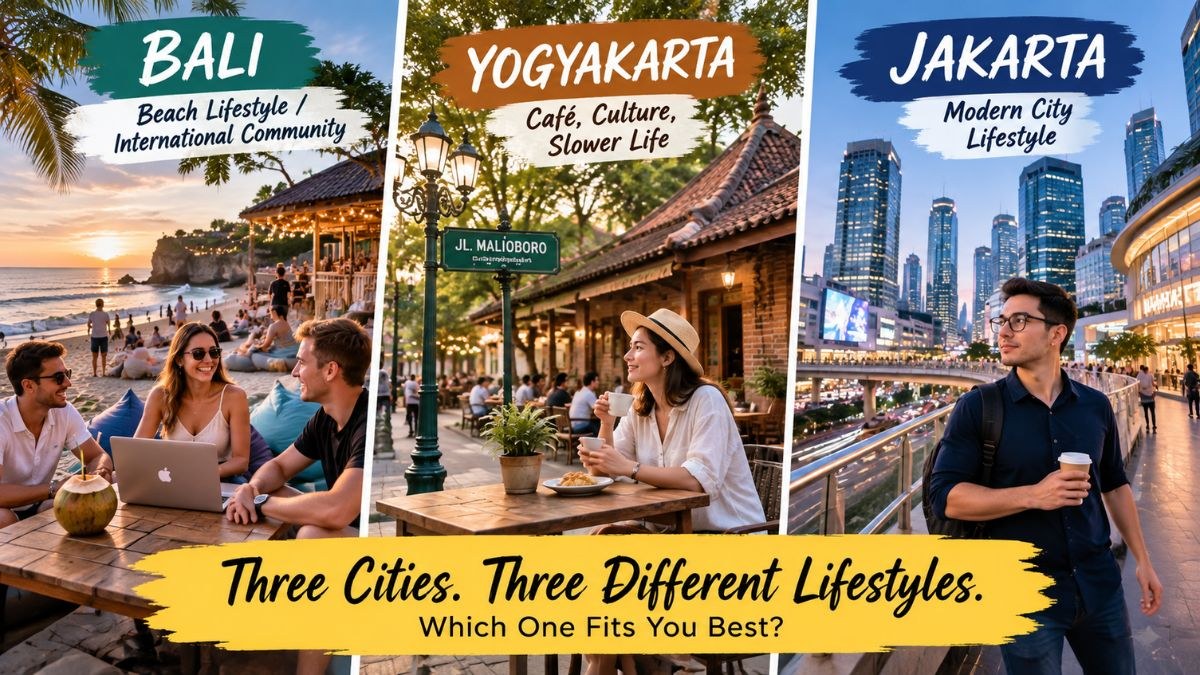
Choosing where to live is about more than rent, internet speed or the price of a meal.
After the first few weeks, the real question becomes:
“What will my everyday life actually look like?”
Where will you have your morning coffee?
Who will you meet?
What will you do on a quiet Tuesday evening?
Will you feel connected to the people around you—or isolated?
Can you imagine building a routine there for six months, one year or even longer?
This is where Bali, Yogyakarta and Jakarta become three very different experiences.
You could earn the same income and have the same visa, but your life may look completely different depending on which city you choose.
Bali offers an international, social and lifestyle-driven environment.
Yogyakarta offers a slower, more culturally connected and community-oriented way of life.
Jakarta offers the energy, convenience and opportunities of a major Asian metropolis.
There is no universal winner.
The best choice depends on the kind of life you want to wake up to every morning.
Living in Bali: International, Social and Lifestyle-Focused
Bali is often the easiest Indonesian destination for a foreigner to enter socially.
You are likely to meet:
- digital nomads;
- entrepreneurs;
- surfers;
- remote workers;
- content creators;
- wellness enthusiasts;
- long-term expats;
- and travellers who unexpectedly decide to stay longer.
For someone arriving alone, this can be one of Bali’s biggest advantages.
There are many opportunities to meet people through:
- coworking spaces;
- cafés;
- fitness communities;
- surfing;
- yoga;
- business events;
- social gatherings;
- and other lifestyle activities.
You Can Build a Social Life Quickly
In some parts of Bali, meeting other foreigners can feel surprisingly easy.
You may arrive without knowing anyone and, within a relatively short time, start recognising familiar faces at your favourite café, gym, coworking space or social venue.
This can be particularly valuable for:
- solo travellers transitioning into long-term living;
- new digital nomads;
- entrepreneurs;
- and foreigners who do not already have an established network in Indonesia.
But there is another side to this lifestyle.
The Community Can Be Constantly Changing
Bali attracts a large number of short-term visitors.
That means your social circle can sometimes feel temporary.
You may meet someone, become friends quickly and then discover that they are leaving the island a few weeks later.
For some people, this is exciting.
There is always someone new to meet.
For others, it can eventually become exhausting or make it harder to build deeper, long-term relationships.
Bali Is a Lifestyle, Not Just a Location
Many people do not choose Bali simply because they need a place to live.
They choose it because they want a particular lifestyle.
That lifestyle may include:
- beaches;
- surfing;
- sunsets;
- fitness;
- yoga;
- wellness;
- international food;
- social events;
- weekend trips;
- and a flexible work-life routine.
For the right person, this can feel almost ideal.
However, it is worth asking yourself:
“Do I genuinely want this lifestyle—or do I simply like the idea of it?”
Living somewhere is different from visiting for two weeks.
The beach eventually becomes part of your normal environment.
You still have deadlines, errands, work problems and ordinary responsibilities.
Bali is at its best for people who want their everyday life to remain active, social and internationally connected.
Living in Yogyakarta: Slower, More Cultural and More Connected to Local Life
Yogyakarta offers a completely different atmosphere.
The city is known for its deep connection to Javanese culture, traditions, arts and local identity.
For foreigners who want more than an international bubble, this can be one of Yogyakarta’s greatest attractions.
Life can feel slower.
Daily routines can feel more grounded.
And instead of constantly moving between internationally designed lifestyle venues, you may find yourself experiencing a more local rhythm of Indonesian life.
A City Where Culture Is Part of Everyday Life
In Yogyakarta, culture is not simply something you visit as a tourist attraction.
It can be part of the environment around you.
You may encounter:
- traditional arts;
- local ceremonies;
- Javanese customs;
- batik;
- gamelan;
- traditional food;
- historical neighbourhoods;
- and community activities.
This can create a very different relationship with the city.
You are not only consuming experiences designed for visitors.
You may have more opportunities to observe and gradually understand the local way of life.
A More Relaxed Pace
For many foreigners, one of Yogyakarta’s biggest attractions is simply how it feels.
Compared with Jakarta’s intensity or Bali’s highly social international lifestyle, Yogyakarta can offer more room to slow down.
This may appeal to people who want to:
- write;
- study;
- work remotely;
- learn Bahasa Indonesia;
- explore Indonesian culture;
- raise a family;
- or simply build a more sustainable routine.
There is less pressure to constantly be somewhere.
A quiet evening can simply be a quiet evening.
And for many long-term residents, that becomes more valuable over time.
Building Community May Take More Effort—but Can Feel More Meaningful
Yogyakarta may not offer the same instant international networking environment as Bali.
You may need to be more intentional about meeting people.
But for some foreigners, this can lead to a different kind of community.
Instead of constantly meeting people who are passing through, you may have more opportunities to build relationships with:
- local residents;
- students;
- long-term expatriates;
- business owners;
- creative communities;
- and people who have a deeper connection to the city.
Of course, building genuine relationships requires respect, patience and a willingness to understand local customs.
But for foreigners who want to feel more connected to Indonesia rather than simply live beside it, Yogyakarta can be extremely rewarding.
Yogyakarta’s Quiet Advantage
Yogyakarta may not have the global image of Bali.
It may not offer Jakarta’s scale.
But that can be exactly its strength.
It can feel like a place to build a life—not just a place to experience one.
Best for:
- foreigners seeking a deeper cultural experience;
- people who enjoy a slower pace of life;
- remote workers who want a sustainable routine;
- families;
- creatives;
- and long-term residents who want to feel more connected to local Indonesian life.
Main consideration:
If you rely heavily on a large international community, constant networking or a highly developed expat lifestyle, you may find Bali or Jakarta easier.
Living in Jakarta: Fast, Ambitious and Full of Possibilities
Jakarta offers an entirely different kind of energy.
This is a city where people come to:
- build businesses;
- develop careers;
- meet clients;
- launch companies;
- create opportunities;
- and connect with one of Southeast Asia’s largest professional ecosystems.
Life in Jakarta can feel intense.
The city is always moving.
There are always meetings, events, restaurants, shopping centres, new businesses and opportunities to explore.
For some people, this is exhausting.
For others, it is exactly what makes Jakarta exciting.
A City for People Who Like Momentum
Jakarta can be particularly attractive if you enjoy being surrounded by activity.
You may have access to:
- international communities;
- business events;
- professional networking;
- cultural activities;
- major concerts and entertainment;
- restaurants from around the world;
- and almost every type of urban service.
You are unlikely to run out of things to do.
The International Community Is Different from Bali’s
Jakarta certainly has an international community, but the atmosphere is generally different.
Bali’s international scene often revolves around lifestyle, tourism, remote work and entrepreneurship.
Jakarta’s international community is more likely to include:
- corporate professionals;
- diplomats;
- business owners;
- investors;
- consultants;
- executives;
- and long-term expatriates working with Indonesian companies.
This can make Jakarta particularly attractive for foreigners who want professional connections rather than a traditional digital nomad scene.
But Jakarta Requires You to Manage Your Energy
The biggest challenge is not finding something to do.
It is finding time to stop.
Long travel distances, meetings, traffic and the general pace of the city can gradually affect your work-life balance.
To enjoy Jakarta long term, you need to build a lifestyle that protects your time.
This usually means:
- choosing the right neighbourhood;
- reducing unnecessary commuting;
- planning your regular activities;
- and creating personal routines away from the city’s constant intensity.
For the right person, Jakarta’s energy can be motivating.
For someone seeking peace and simplicity, it may eventually feel overwhelming.
Best for:
- ambitious professionals;
- entrepreneurs;
- business owners;
- executives;
- investors;
- and foreigners who enjoy a fast-moving urban environment.
Main consideration:
Jakarta can provide endless opportunities, but you may need to work harder to protect your personal time and maintain a balanced lifestyle.
Bali vs Yogyakarta vs Jakarta: Lifestyle at a Glance
| Lifestyle Factor | Bali | Yogyakarta | Jakarta |
| International community | Strongest lifestyle-focused community | Smaller and more locally integrated | Strong professional and expat community |
| Social life | Highly active and easy to enter | More relaxed and relationship-focused | Extremely diverse |
| Local cultural experience | Strong, but can depend heavily on where you live | Deepest everyday cultural connection | Diverse, modern and metropolitan |
| Pace of life | Relaxed but socially active | Slowest and most balanced | Fastest |
| Business networking | Strong for entrepreneurs and online business | More limited | Strongest |
| Lifestyle variety | Beaches, wellness and social life | Culture, food and creativity | Largest urban variety |
| Long-term routine | Depends heavily on your lifestyle habits | Potentially the most sustainable | Requires careful planning |
| Best for | International lifestyle | Culture and balance | Opportunity and ambition |
Which Community Will You Feel Most Comfortable In?
This may be one of the most personal parts of the decision.
Choose Bali if you want to meet people easily.
You may find it easier to enter international social circles, particularly as a digital nomad or entrepreneur.
Choose Yogyakarta if you want to slow down and build deeper connections.
It may take more time to establish your community, but the reward can be a more locally connected and sustainable way of living.
Choose Jakarta if you want access to people and opportunities.
The city offers an enormous range of communities—but you may need to be more intentional about finding the people who fit your lifestyle.
The Question Most People Should Ask Before Moving
Before choosing Bali, Yogyakarta or Jakarta, imagine a completely ordinary week.
Not a holiday.
Not your first exciting month.
A normal week.
Imagine:
- Monday morning;
- your usual work routine;
- grocery shopping;
- meeting friends;
- commuting;
- exercising;
- dealing with everyday problems;
- and spending a quiet weekend with no major travel plans.
Then ask:
“Which city can I realistically imagine enjoying even when nothing special is happening?”
That answer may tell you more than any cost-of-living table.
Our Verdict on Lifestyle and Community
Bali is best for people who want an international, social and lifestyle-driven experience.
Yogyakarta is best for people who value culture, calm, affordability and a more sustainable daily rhythm.
Jakarta is best for people who are energised by opportunity, professional connections and big-city life.
But a good lifestyle also depends on something far more practical:
“Can you access healthcare when you need it, move around safely and handle everyday life without unnecessary stress?”
Next, we compare healthcare, safety and everyday convenience in Bali, Yogyakarta and Jakarta.
8. Healthcare, Safety and Everyday Convenience

When choosing a city to live in, many foreigners focus first on the exciting things:
the beaches, cafés, cost of living, culture and lifestyle.
But when you are planning to stay for several months or years, the more practical questions eventually become just as important.
“Where will I go if I get sick?
How easy is it to find a pharmacy or doctor?
Can I get around without too much stress?
How convenient is everyday life?
What should I realistically consider when it comes to safety?”
This is where Bali, Yogyakarta and Jakarta each offer different advantages.
No city is perfect.
And the best choice often depends on what you value most: access to international-standard services, a calmer daily environment or the convenience of a major metropolitan area.
Healthcare in Bali: Strong Options in Major International Areas
Bali has become increasingly well equipped to serve its large international population.
In major areas, foreigners can find access to:
- private hospitals;
- international-oriented medical services;
- general practitioners;
- dental clinics;
- pharmacies;
- specialist care;
- and private healthcare providers.
This can make everyday healthcare relatively straightforward, particularly in the more developed parts of the island.
For foreigners who are concerned about language barriers, Bali can also feel easier than many other parts of Indonesia because some healthcare providers regularly deal with international patients.
The Main Consideration: Your Location Still Matters
Bali is an island, and healthcare access is not identical everywhere.
Living close to major population centres and established healthcare facilities can provide greater convenience than living in a more remote location.
Before choosing a long-term home, it can be useful to know:
- where the nearest hospital is;
- how long it takes to reach it;
- which clinics are available nearby;
- where the closest pharmacy is;
- and whether your health insurance is accepted.
This is particularly important for:
- families;
- older residents;
- people with regular healthcare needs;
- and anyone planning a long-term stay.
Best for:
Foreigners who want access to private and international-oriented healthcare while maintaining a lifestyle outside a major capital city.
Main consideration:
The convenience and level of access can vary significantly depending on where you live on the island.
Healthcare in Yogyakarta: Good Everyday Access with a More Local Environment
Yogyakarta has a well-established healthcare environment, supported by its large population and important role as an educational centre.
Foreigners can find access to:
- hospitals;
- clinics;
- general practitioners;
- dental services;
- pharmacies;
- and specialist medical care.
For ordinary healthcare needs, many long-term residents can find practical options without needing to travel far.
One advantage of Yogyakarta is that daily life can feel relatively manageable.
Depending on where you live, a hospital, clinic, pharmacy or other essential service may be within a reasonable distance of your regular neighbourhood.
Planning Matters for Long-Term Residents
For someone planning to live in Yogyakarta long term, it is worth doing a little research before choosing a neighbourhood.
Ask yourself:
- Which hospital would I use?
- Is there a 24-hour pharmacy nearby?
- How easy is it to reach medical care without driving myself?
- Are there doctors or clinics where I can communicate comfortably?
- Does my insurance cover the facilities available to me?
The answers may be different for a young remote worker, a family with children or someone who requires regular specialist treatment.
Best for:
Foreigners who want access to everyday healthcare while living in a more relaxed and affordable environment.
Main consideration:
The international orientation and specialist options may be more limited than in Jakarta, depending on your specific medical needs.
Healthcare in Jakarta: The Widest Range of Major Medical Services
Jakarta offers the broadest range of healthcare options of the three cities.
As Indonesia’s largest metropolitan and business centre, the city has access to:
- major private hospitals;
- specialist medical centres;
- international-oriented healthcare providers;
- advanced diagnostic facilities;
- and a wide range of doctors and specialists.
For foreigners with complex or ongoing healthcare needs, this can be an important advantage.
The Advantage of Choice
In Jakarta, you may have more options when choosing:
- hospitals;
- doctors;
- specialists;
- dental providers;
- diagnostic centres;
- and other medical services.
This can be particularly valuable for:
- families;
- long-term expatriates;
- professionals;
- older residents;
- and people who want easier access to specialist care.
However, Jakarta’s size creates its own challenge.
The best hospital may not necessarily be close to where you live.
As with many aspects of life in Jakarta, location and travel time still matter.
Best for:
Foreigners who want the widest range of healthcare providers and specialist services.
Main consideration:
Traffic and distance can affect how quickly and conveniently you can access a particular facility.
Healthcare at a Glance
| Factor | Bali | Yogyakarta | Jakarta |
| Everyday healthcare access | Strong in major areas | Good for everyday needs | Excellent |
| International-oriented services | Strong in popular international areas | More limited | Strongest overall |
| Range of specialists | Good, depending on location | Good for many needs | Widest range |
| Pharmacy access | Generally convenient in developed areas | Generally convenient | Extremely convenient |
| Best for complex medical needs | Depends on the location and provider | May require more planning | Jakarta |
Safety: What Should Foreigners Realistically Consider?
Safety is difficult to reduce to a simple ranking.
A city can feel comfortable and welcoming while still presenting everyday risks that require common sense.
The right question is not:
“Which city is completely safe?”
No major city can honestly be described that way.
A more useful question is:
“What risks are most relevant to the way I will actually live there?”
For foreigners in Bali, Yogyakarta and Jakarta, everyday safety considerations may include:
- traffic and road conditions;
- protecting personal belongings;
- accommodation security;
- avoiding scams;
- choosing reputable service providers;
- understanding local rules;
- and being aware of your surroundings.
Bali: Road Safety Can Be One of the Biggest Everyday Considerations
For many long-term residents, the most significant daily risk is not necessarily crime.
It can be transportation.
Scooters are a major part of everyday mobility, and foreigners should not assume that riding in Indonesia is the same as riding in their home country.
Road conditions, traffic patterns and driving behaviour may require experience and caution.
If you are not comfortable riding, using other transportation options may be safer.
Yogyakarta: A More Relaxed Environment, but Common Sense Still Matters
Yogyakarta may feel calmer than Jakarta and less internationally intense than some parts of Bali.
But foreigners should still:
- secure their accommodation;
- protect valuables;
- remain cautious in traffic;
- and understand local surroundings and customs.
A relaxed environment should never become an excuse to stop paying attention.
Jakarta: Urban Awareness and Location Matter
Jakarta offers big-city convenience, but also big-city realities.
Long-term residents should think about:
- neighbourhood security;
- transportation choices;
- traffic;
- protecting belongings in crowded places;
- and choosing accommodation in a location that fits their daily routine.
The best approach in all three cities is the same:
Do your local research, build good daily habits and avoid assuming that you understand an area simply because you have visited it as a tourist.
Everyday Convenience: Which City Makes Life the Easiest?
Convenience is often underestimated when choosing where to live.
But after six months or a year, small things can matter enormously.
How far is the nearest:
- supermarket?
- pharmacy?
- hospital?
- ATM?
- gym?
- café?
- laundry?
- delivery service?
- public transportation?
- government or immigration office?
The easier these things are to access, the easier it can be to build a sustainable daily life.
Bali: Convenient if You Choose the Right Area
In Bali’s major residential and international lifestyle areas, everyday convenience can be excellent.
You may have easy access to:
- restaurants;
- supermarkets;
- cafés;
- gyms;
- pharmacies;
- delivery services;
- and other everyday needs.
However, convenience can decrease as you move into more remote areas.
A property may offer peace, views and privacy—but require more planning for basic daily activities.
This is why Bali residents often make a major decision based on lifestyle geography.
“Living close to your regular needs can save both time and transportation costs.”
Yogyakarta: Simple, Practical and Easy to Build a Routine Around
One of Yogyakarta’s underrated strengths is the ability to create a practical daily routine.
You can potentially live in a residential area while remaining relatively close to:
- local food;
- cafés;
- supermarkets;
- universities;
- pharmacies;
- clinics;
- and everyday services.
The city may not offer the same scale of international services as Jakarta.
But for many foreigners, it offers something equally valuable:
“Less friction in everyday life.”
If you are not constantly dealing with long commutes or expensive lifestyle choices, daily life can feel simpler.
This is one reason Yogyakarta can be particularly attractive for people planning a sustainable long-term stay.
Jakarta: The Highest Level of Urban Convenience
If something exists in Indonesia, there is a good chance you can find it somewhere in Jakarta.
The city offers an enormous range of:
- supermarkets;
- shopping centres;
- hospitals;
- international schools;
- restaurants;
- pharmacies;
- banks;
- business services;
- delivery options;
- and professional providers.
For foreigners who value choice and immediate access to services, Jakarta is extremely difficult to beat.
But Convenience Depends on Distance
Jakarta’s challenge is not usually the lack of services.
It is getting to them.
A major shopping centre or hospital may be available—but travel time can vary significantly depending on traffic and location.
This is why a convenient Jakarta lifestyle requires good planning.
The ideal location is often not the cheapest property.
It is the place that reduces unnecessary movement across the city.
Bali vs Yogyakarta vs Jakarta: Everyday Convenience
| If You Prioritise… | Best Choice |
| International-oriented lifestyle services | Bali |
| Simple and manageable daily routine | Yogyakarta |
| The widest range of services | Jakarta |
| Major specialist healthcare options | Jakarta |
| Healthcare in a lifestyle destination | Bali |
| Lower-friction, slower daily living | Yogyakarta |
| Big-city convenience and choice | Jakarta |
Which City Is Best for Healthcare, Safety and Everyday Life?
Choose Bali if you want a balance between international-oriented services and lifestyle.
It can offer strong private healthcare access and excellent everyday convenience in the right areas, but your location matters significantly.
Choose Yogyakarta if you want a calmer and more manageable daily routine.
It offers practical access to everyday services while maintaining a slower and potentially less stressful lifestyle.
Choose Jakarta if you want the widest range of healthcare and urban services.
For specialist care, professional services and maximum choice, Jakarta has the strongest overall advantage.
The Bottom Line
Bali offers convenience when you choose the right location.
Yogyakarta offers simplicity and a more manageable everyday rhythm.
Jakarta offers the greatest range of services—but you must manage distance and traffic.
At this point, you may already know which city fits your budget and lifestyle.
But there is one critical issue that applies no matter whether you choose Bali, Yogyakarta or Jakarta:
“Can you legally stay in Indonesia for the lifestyle you are planning?”
The next section compares visas, visa extensions and long-term stay options for foreigners living in Indonesia. 🔥
9. Visas, Visa Extensions and Long-Term Stay in Indonesia
You may find the perfect apartment.
You may decide that Bali has the lifestyle you want, Yogyakarta offers the affordability and culture you prefer, or Jakarta gives you the business opportunities you need.
But before making any long-term plans, there is one question that comes first:
“What is the right visa or residence permit for the way you actually plan to live in Indonesia?”
This is one of the most important parts of moving to Indonesia.
Your visa is not simply an immigration document.
It affects:
- how long you can stay;
- whether you can extend your stay;
- how often you need to leave Indonesia;
- whether you need a sponsor or guarantor;
- what activities you are permitted to carry out;
- and how you should plan your long-term life in the country.
Most importantly:
“The best visa is not necessarily the longest visa. It is the visa that legally matches your purpose in Indonesia.”
Whether you choose Bali, Yogyakarta or Jakarta, Indonesian immigration rules generally apply at the national level. Moving from Bali to Yogyakarta, for example, does not mean you automatically need a different type of visa simply because you changed cities.
What matters is why you are staying in Indonesia and what activities you plan to carry out.
Short-Term Stay: Visiting Indonesia as a Tourist
For foreigners visiting Indonesia for tourism or a relatively short stay, options may include a Visa on Arrival (VOA), Electronic Visa on Arrival (e-VOA) or another appropriate visit visa, depending on nationality and eligibility.
These options can be suitable for people who want to:
- travel around Indonesia;
- visit Bali, Yogyakarta or Jakarta;
- take a holiday;
- visit friends or family;
- or explore Indonesia before deciding whether they want to stay longer.
For someone who is still deciding where to live, a shorter visit can be extremely valuable.
Instead of choosing a city based only on YouTube videos or social media, you can experience:
- the neighbourhoods;
- traffic;
- climate;
- accommodation;
- daily food;
- and the general pace of life
for yourself.
A Smart Approach Before Moving
If you are considering a long-term move, do not treat a short holiday as a complete test of daily life.
Try to experience ordinary routines.
For example:
- visit supermarkets;
- test your internet connection;
- travel during busy hours;
- explore residential neighbourhoods;
- visit coworking spaces;
- and imagine what your normal working week would look like.
A city that feels perfect for a five-day holiday may feel completely different after five months.
Visa Extension in Indonesia: An Important Part of Long-Term Planning
One of the most common mistakes foreigners make is focusing only on:
“How long can I stay when I first enter Indonesia?”
The next question should be:
“Can this visa be extended, how does the extension work, and how long can I legally remain?”
This is why visa extension planning should happen before your current stay is close to expiring.
Depending on the visa or immigration status you hold, the extension process, eligibility, timing and requirements may be different.
Your extension options can depend on:
- your nationality;
- your current visa type;
- the purpose of your stay;
- your immigration history;
- the conditions attached to your visa;
- and the latest immigration regulations and procedures.
Do Not Wait Until the Last Minute
If you know you want to stay longer, it is generally better to review your options early.
You may need to:
- prepare documents;
- contact your sponsor or guarantor;
- submit an application;
- attend an immigration process if required;
- or choose a different immigration pathway for your next stage of living in Indonesia.
The most important rule is simple:
“Always understand your extension eligibility before assuming that you can simply stay longer.”
Do not rely on what worked for another foreigner.
Two people living in the same apartment building can have completely different immigration situations.
One may be eligible for an extension, while another may need a completely different visa or immigration process.
Bali Visa vs Indonesia Visa: An Important Difference
Many foreigners search Google for terms such as:
- Bali visa
- Bali visa extension
- Bali long-term visa
- visa for living in Bali
However, Bali is part of Indonesia.
In practice, foreigners should understand that the relevant immigration framework is generally based on Indonesian immigration rules, rather than a separate immigration system created specifically for Bali.
This is important if you are comparing:
- living in Bali;
- moving to Yogyakarta;
- staying in Jakarta;
- or travelling between different parts of Indonesia.
The key question is generally not:
“What visa do I need for this city?”
Instead, it is:
“What Indonesian visa or residence status matches my purpose of stay?”
This also means that a person planning to move from Bali to Yogyakarta should not automatically assume that they need to start their entire immigration journey again simply because they are changing cities.
Your immigration status and any administrative obligations should still be handled correctly according to the applicable rules and your individual circumstances.
Long-Term Stay in Indonesia: Choose Your Purpose First
For foreigners planning to live in Indonesia for a longer period, there are different immigration pathways depending on the purpose of stay.
Possible long-term situations may include:
- working in Indonesia;
- working remotely where eligible under the appropriate immigration framework;
- investing or conducting business activities;
- joining a spouse or family member;
- studying;
- retirement or another long-term residence purpose;
- or other activities recognised under Indonesian immigration regulations.
The correct option depends on your individual circumstances.
Do Not Choose a Visa Based Only on Its Duration
A visa may allow a longer period of stay, but that does not automatically mean it is suitable for every activity.
For example, before applying, you should consider:
- Why am I living in Indonesia?
- Where does my income come from?
- Am I employed?
- Am I working remotely?
- Am I operating a business?
- Am I investing in an Indonesian company?
- Am I joining my Indonesian spouse?
- Do I need to carry out activities in Indonesia that require a specific immigration status?
These questions are often more important than simply asking for:
“The longest visa available.”
Remote Workers and Digital Nomads: Understand the Legal Side Before Moving
Bali is one of the world’s most recognisable destinations for digital nomads.
Yogyakarta is increasingly attractive to remote workers looking for lower costs and a slower pace.
Jakarta attracts professionals, entrepreneurs and people with business connections in Indonesia.
But regardless of where you choose to live, remote work and immigration status should be considered carefully.
Your situation may depend on factors such as:
- where your employer or clients are based;
- where your income is generated;
- the nature of your work;
- whether you are conducting activities for an Indonesian company;
- and the specific visa or residence permit available for your circumstances.
Do not assume that a tourist-style stay automatically provides permission for every type of professional activity.
If your purpose in Indonesia is to work remotely or stay long term, it is important to choose an immigration pathway that is appropriate for your actual situation.
Planning Your Digital Nomad Life
Before moving to Bali, Yogyakarta or Jakarta, consider both sides of the decision:
Lifestyle:
- internet;
- accommodation;
- community;
- cost of living;
- and your preferred working environment.
Immigration:
- visa eligibility;
- permitted activities;
- length of stay;
- extension possibilities;
- and your longer-term plan.
The strongest move is to plan both at the same time.
Family and Marriage: Long-Term Residence Can Follow a Different Path
For foreigners married to an Indonesian citizen or joining family members in Indonesia, the immigration pathway may be different from that of a tourist, digital nomad or investor.
Your options may depend on:
- your marital status;
- the nationality and immigration status of family members;
- the purpose of your stay;
- and the relevant immigration requirements.
Family-based long-term residence can require different documents and planning from work- or business-related immigration.
For this reason, it is important not to copy another person’s visa strategy simply because they have lived in Indonesia for many years.
Their legal basis for staying may be completely different from yours.
Business, Investment and Professional Activities
Jakarta may be particularly attractive to entrepreneurs and business professionals.
Bali also has a large international business and investment community.
Yogyakarta may appeal to people building a more affordable long-term lifestyle or operating location-independent businesses.
But before conducting business activities in Indonesia, it is important to understand that:
“Having a visa that allows you to stay in Indonesia does not automatically mean you can carry out every type of business or employment activity.”
Your immigration status, business structure and planned activities should be considered together.
This is particularly important if you plan to:
- establish an Indonesian company;
- invest in a business;
- actively manage operations;
- employ people;
- work for an Indonesian company;
- or conduct other activities that may require a specific legal and immigration framework.
For entrepreneurs, immigration planning should therefore be part of the business plan—not something left until after the company is already operating.
A Simple Visa and Long-Term Stay Decision Guide
“I only want to visit Indonesia for a holiday.”
You should review the appropriate short-term visit options available for your nationality and travel purpose.
“I want to stay longer than my initial permitted stay.”
Check whether your current immigration status is eligible for an extension and start planning before your stay expires.
“I want to live in Indonesia for several months or longer.”
First define your actual purpose of stay, then explore the appropriate long-term immigration pathway.
“I work remotely and want to live in Bali or Yogyakarta.”
Do not choose your immigration status based only on what other digital nomads say online. Review the current options and make sure your planned activities are compatible with the appropriate immigration rules.
“I want to work or do business in Indonesia.”
Your immigration status and business activities should be planned together. Do not assume that a general visit status is automatically suitable for employment or active business operations.
“I am married to an Indonesian citizen.”
Your family relationship may create a different long-term immigration pathway, subject to the relevant requirements and your individual circumstances.
Bali vs Yogyakarta vs Jakarta: Does the Visa Change?
For most foreigners, the city itself is not the main issue.
| Your Situation | The Main Question |
| Living in Bali | What Indonesian visa or residence status matches your purpose? |
| Living in Yogyakarta | What Indonesian visa or residence status matches your purpose? |
| Living in Jakarta | What Indonesian visa or residence status matches your purpose? |
The location may change your lifestyle.
Your purpose of stay determines the immigration planning.
This is an important point for anyone searching for the best visa for Bali, Yogyakarta visa, Jakarta visa, Indonesia visa extension or long-term visa Indonesia.
When Should You Start Planning a Visa Extension?
A good rule for long-term residents is:
“Do not make immigration planning an emergency.”
As soon as you know that you want to stay longer, review:
- Your current visa or residence status.
- Your permitted length of stay.
- Whether an extension is available.
- The requirements and documents involved.
- Whether your current immigration status still matches your future plans.
For example, your situation may change over time.
You may arrive as a tourist, then later decide to:
- live with your spouse;
- establish a business;
- invest in Indonesia;
- change your long-term residence plans;
- or move from one city to another.
When your life changes, your immigration strategy may also need to change.
Important: Immigration Rules and Procedures Can Change
Visa rules, extension procedures, eligible nationalities, requirements, fees and immigration processes can change.
For that reason, information should always be checked against the current applicable regulations and official procedures before making a final decision or submitting an application.
This is particularly important for:
- visa extensions;
- long-term residence;
- work-related activities;
- digital nomad arrangements;
- family-based residence;
- business and investment;
- and any situation involving a change in immigration status.
Our Practical Advice Before Choosing Your City
If you are still deciding between Bali, Yogyakarta and Jakarta, do not choose your home first and think about the visa later.
Plan both together.
Step 1 — Define your purpose
Why are you moving to Indonesia?
Step 2 — Define your expected length of stay
Are you planning a few months, one year or a longer-term life in Indonesia?
Step 3 — Review the appropriate immigration pathway
Choose an option based on your actual activities and circumstances—not simply the longest stay period.
Step 4 — Understand your visa extension options
Do this before your current stay becomes urgent.
Step 5 — Choose the city that fits your lifestyle
Only after you understand what type of long-term stay is realistically suitable should you decide whether Bali, Yogyakarta or Jakarta is your best home.
The Bottom Line
Bali may be the lifestyle you dream about.
Yogyakarta may offer the long-term routine and affordability you need.
Jakarta may provide the business opportunities you are looking for.
But no city can become a sustainable long-term home without the right immigration planning.
“Choose your visa based on your purpose. Plan your visa extension early. Then choose the Indonesian city where you can realistically build the life you want.”
10. Bali vs Yogyakarta vs Jakarta: Pros and Cons
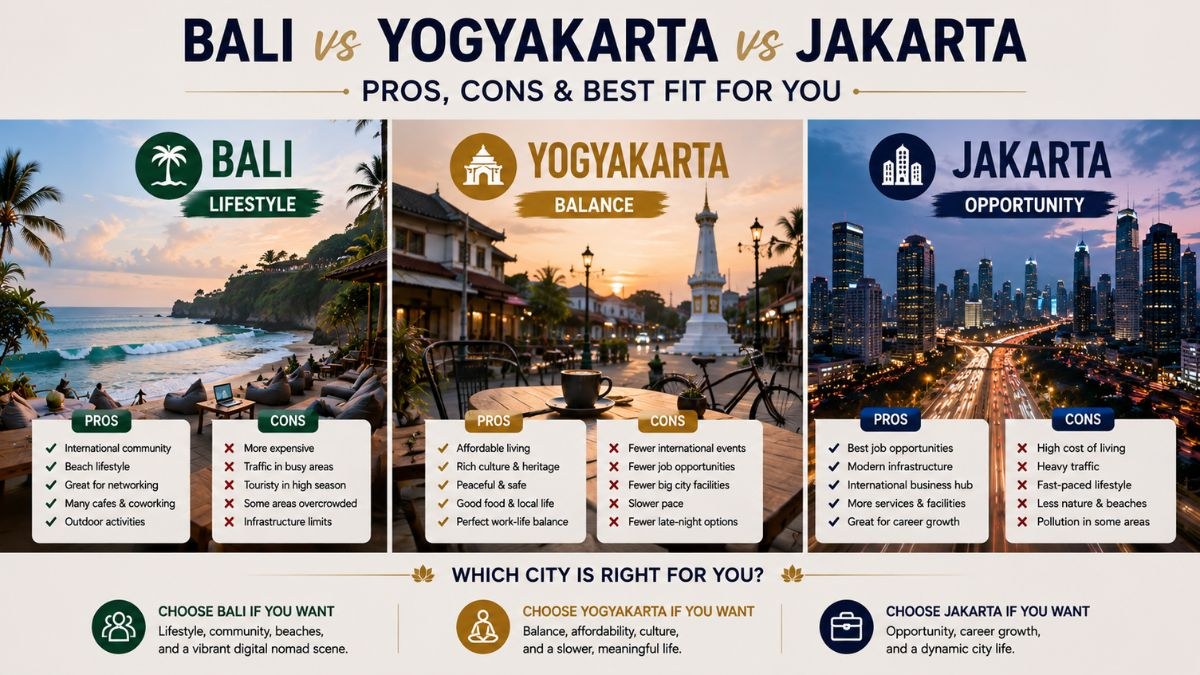
After comparing the cost of living, accommodation, food, transportation, remote work, lifestyle, healthcare and visa considerations, the differences between Bali, Yogyakarta and Jakarta become much clearer.
There is no perfect city.
Every destination involves a trade-off.
Bali may give you the lifestyle and international community you want—but at a higher cost.
Yogyakarta may give you affordability, culture and a slower pace—but with a smaller international ecosystem.
Jakarta may provide the strongest business opportunities and urban convenience—but demand more of your time, energy and budget.
The best choice depends on what you are willing to gain—and what you are willing to give up.
Here is the most practical comparison.
Bali: Pros and Cons
Pros of Living in Bali
1. Strong International Community
One of Bali’s biggest advantages is how easy it can be to meet other foreigners, digital nomads, entrepreneurs and remote workers.
This can make the transition into life in Indonesia easier, especially if you arrive alone.
You may have access to:
- international communities;
- coworking spaces;
- networking events;
- work-friendly cafés;
- fitness and wellness communities;
- and a highly social lifestyle.
For many foreigners, Bali offers the easiest entry point into long-term life in Indonesia.
2. Excellent Digital Nomad Lifestyle
Bali is one of the strongest destinations in Indonesia for people who work online.
The ecosystem is already built around:
- remote work;
- coworking;
- entrepreneurship;
- flexible lifestyles;
- online businesses;
- and international networking.
You do not need to explain why you are sitting in a café with a laptop for several hours.
In many parts of Bali, that is completely normal.
3. Beaches, Nature and Lifestyle
Bali offers something that Yogyakarta and Jakarta cannot provide in the same way:
“A lifestyle where beaches, tropical scenery and outdoor activities can become part of your normal routine.”
You can combine work with:
- surfing;
- beaches;
- hiking;
- gyms;
- yoga;
- wellness activities;
- restaurants;
- and weekend trips around the island.
For people who want their location to actively influence their lifestyle, this is a major advantage.
4. International Services and Amenities
In popular areas, Bali offers many services designed for an international population.
Depending on where you live, you may find relatively easy access to:
- international restaurants;
- private healthcare;
- modern gyms;
- coworking spaces;
- international supermarkets;
- English-speaking services;
- and other expat-friendly facilities.
This can make everyday life easier for foreigners who are still adjusting to Indonesia.
Cons of Living in Bali
1. Higher Cost of Living
Bali is no longer automatically the cheapest choice in Indonesia.
In popular areas, costs for:
- rent;
- restaurants;
- cafés;
- social activities;
- gyms;
- and international lifestyle services
can be significantly higher than in Yogyakarta.
Your budget can disappear quickly if you live in a highly lifestyle-driven area.
2. Traffic and Transportation
Traffic can become a major part of everyday life, particularly in popular and rapidly developing areas.
A relatively short distance may sometimes take much longer than expected.
For people who work from home or spend most of their time within one neighbourhood, this may be manageable.
But if you regularly travel between different parts of Bali, transportation can affect your daily routine.
3. Highly Social and Sometimes Distracting
Bali’s social lifestyle is a major advantage—but it can also be a disadvantage.
There is always something happening.
For some people, this makes life exciting.
For others, it can lead to:
- distractions;
- unnecessary spending;
- difficulty maintaining routines;
- and a feeling that they should always be doing something.
Bali works best when you can enjoy the lifestyle without letting it control your time and budget.
4. Some Communities Can Feel Temporary
You can meet people quickly in Bali.
But people also leave quickly.
A friend you meet today may move to another country next month.
For foreigners looking for deep, long-term relationships, the constantly changing international community can sometimes feel temporary.
Bali at a Glance
Best for:
Digital nomads, entrepreneurs, remote workers, solo foreigners and people who want an international lifestyle.
Biggest strengths:
Lifestyle, beaches, international community and remote-work ecosystem.
Main disadvantages:
Higher costs, traffic and the possibility of a distracting lifestyle.
Yogyakarta: Pros and Cons
Pros of Living in Yogyakarta
1. Lower Cost of Living
Yogyakarta’s biggest advantage is value.
For the same monthly budget, you may be able to afford:
- larger accommodation;
- more local food;
- lower transportation costs;
- a more comfortable workspace;
- and a generally less expensive daily routine.
This can make a significant difference for long-term digital nomads and remote workers.
Instead of constantly managing expenses, you may have more financial flexibility.
2. Deep Culture and Local Character
Yogyakarta offers a stronger sense of local cultural identity than many internationally focused areas of Bali.
For foreigners who want to experience more of Indonesia beyond the expat lifestyle, this can be a major advantage.
The city offers opportunities to experience:
- Javanese traditions;
- local arts;
- historical sites;
- traditional food;
- community life;
- and everyday Indonesian culture.
For many long-term foreigners, this can make living in Yogyakarta feel more meaningful over time.
3. Slower and More Sustainable Daily Life
Yogyakarta can be attractive because life does not always feel like a competition to experience the next thing.
You can build a simpler routine around:
- work;
- local cafés;
- food;
- friends;
- exercise;
- culture;
- and quiet time.
For remote workers who value consistency, this can be one of the city’s strongest advantages.
“Yogyakarta can make it easier to build a life around your work—rather than constantly fitting work around your lifestyle.”
4. Better for Long-Term Budget Planning
If you know that you want to stay in Indonesia for an extended period, controlling monthly expenses becomes increasingly important.
Saving $300 per month may not feel dramatic during your first month.
Over one year, however, it can become a significant difference.
Yogyakarta may therefore offer stronger long-term financial sustainability for foreigners who earn a fixed income or want to maximise the value of their money.
Cons of Living in Yogyakarta
1. Smaller International Community
Compared with Bali, Yogyakarta has a smaller international digital nomad and expat ecosystem.
You can still meet foreigners and international residents, but you may need to make more effort to build your social and professional network.
If you rely heavily on international networking, Bali or Jakarta may feel easier.
2. Fewer International Lifestyle Options
Yogyakarta offers many excellent local services and modern amenities.
However, the range of:
- international restaurants;
- large expat-focused communities;
- specialised coworking options;
- and international lifestyle services
may not feel as extensive as Bali or Jakarta.
For some people, this does not matter.
For others, it can become important over time.
3. Fewer Major Business Opportunities
For location-independent workers, this may not be a problem.
But entrepreneurs whose business depends on frequent meetings, investors, corporate clients or major Indonesian companies may find more opportunities in Jakarta.
Yogyakarta is generally stronger as a place to live and work remotely than as a major corporate business hub.
4. Less “Instant” Social Life
In Bali, you may be able to meet new people almost immediately.
In Yogyakarta, building a social circle may require more patience and intention.
But this can also create a different type of community.
The disadvantage is not necessarily a lack of people.
It is that relationships may take more time to build.
Yogyakarta at a Glance
Best for:
Long-term digital nomads, remote workers, creatives, families and foreigners who value affordability and culture.
Biggest strengths:
Cost of living, local culture, slower pace and long-term sustainability.
Main disadvantages:
Smaller international community, fewer networking opportunities and less international lifestyle infrastructure.
Jakarta: Pros and Cons
Pros of Living in Jakarta
1. Strongest Business and Professional Opportunities
Jakarta is the clear winner if your priority is business.
The city provides access to:
- companies;
- investors;
- startups;
- corporate professionals;
- professional service providers;
- business events;
- and major Indonesian networks.
For entrepreneurs and professionals, being physically close to opportunities can be extremely valuable.
A chance meeting or business event may lead to opportunities that are much harder to access from Bali or Yogyakarta.
2. The Widest Range of Services
Jakarta offers an enormous level of choice.
You can find:
- major hospitals;
- international schools;
- shopping centres;
- professional services;
- restaurants from around the world;
- large supermarkets;
- gyms;
- entertainment;
- and specialist providers.
For foreigners who value convenience and access, Jakarta can be extremely attractive.
3. Better Public Transportation Options
Compared with Bali and Yogyakarta, Jakarta offers a much stronger network of major urban transportation options.
Depending on where you live and work, you may be able to reduce your dependence on a private vehicle.
This can be a significant advantage for foreigners who do not want to ride a scooter.
4. Professional International Community
Jakarta’s international community is often more connected to:
- business;
- corporate careers;
- diplomacy;
- investment;
- technology;
- and professional services.
This can make the city particularly attractive for foreigners looking for professional relationships rather than a typical digital nomad social scene.
Cons of Living in Jakarta
1. Traffic and Long Travel Times
Jakarta’s biggest challenge is often time.
You may have access to almost everything—but it may take significant time to get there.
Long travel times can affect:
- work-life balance;
- meetings;
- social plans;
- and daily energy.
Choosing the right location is therefore extremely important.
2. Higher Cost for a Comfortable Lifestyle
Jakarta can offer excellent value in some areas, but maintaining a comfortable international lifestyle can become expensive.
Your budget may increase through:
- accommodation;
- transportation;
- restaurants;
- entertainment;
- and lifestyle choices.
3. Fast and Sometimes Exhausting Pace
Jakarta can be exciting.
But not everyone wants to live in that level of constant activity.
The city can feel overwhelming for foreigners who prefer:
- quiet;
- nature;
- slower routines;
- or a more relaxed environment.
4. Less of a Traditional Digital Nomad Lifestyle
Jakarta is excellent for business and professional life.
But if your dream is to work from a tropical café, meet other digital nomads and combine work with beaches and wellness, Bali may feel more naturally suited to that lifestyle.
Jakarta at a Glance
Best for:
Entrepreneurs, investors, professionals, executives and foreigners focused on business opportunities.
Biggest strengths:
Business, professional networking, urban services and convenience.
Main disadvantages:
Traffic, higher costs and a fast-paced lifestyle.
Bali vs Yogyakarta vs Jakarta: The Pros and Cons Comparison
| City | Biggest Pros | Main Cons |
| Bali | International lifestyle, beaches, digital nomad community, networking | Higher costs, traffic, distractions |
| Yogyakarta | Affordable living, culture, slower pace, sustainable routine | Smaller international community, fewer major business opportunities |
| Jakarta | Business opportunities, professional networking, healthcare and urban services | Traffic, higher costs and fast-paced daily life |
The Honest Verdict: Every City Requires a Trade-Off
The mistake many foreigners make is searching for the city with:
“Everything.”
The reality is that no city gives you everything at the same time.
If you choose Bali, you may gain lifestyle and community but spend more.
If you choose Yogyakarta, you may gain affordability and calm but give up some international networking opportunities.
If you choose Jakarta, you may gain opportunity and convenience but sacrifice time and energy to big-city life.
The smartest choice is to decide:
“Which disadvantages can I comfortably live with?”
That question is often more useful than asking which city has the most advantages.
Our Final Pros and Cons Verdict
Bali
Choose it if you are willing to pay more for lifestyle, international community and the digital nomad ecosystem.
Yogyakarta
Choose it if you want to maximise value, enjoy a slower pace and build a more sustainable long-term routine in Indonesia.
Jakarta
Choose it if business opportunities, professional networking and access to major urban services are more important to you than a relaxed lifestyle.
“There is no perfect winner between Bali, Yogyakarta and Jakarta. The best city is the one whose advantages match your priorities—and whose disadvantages you can realistically accept.”
11. Which City Is Best for You?
After comparing the cost of living, accommodation, food, transportation, remote work, lifestyle, healthcare, visa considerations and the pros and cons of each destination, the final question is simple:
“Which city is actually the best choice for you?”
The answer depends less on which city is “better” and more on what kind of life you want to build in Indonesia.
A digital nomad earning $3,000 per month may choose Bali for its international community.
Another remote worker earning the same income may choose Yogyakarta because they prefer a quieter life and want their money to go further.
An entrepreneur may find Jakarta more valuable because one business connection can be worth more than the difference in monthly living costs.
That is why the right choice should be based on your priorities—not simply on which destination is the most popular online.
Choose Bali If You Want the Complete Digital Nomad Lifestyle
Bali may be the best choice for you if your ideal life in Indonesia includes a combination of:
- remote work;
- international community;
- networking;
- beaches and outdoor activities;
- cafés and coworking spaces;
- wellness and fitness;
- and an active social lifestyle.
Bali is particularly attractive if you are moving to Indonesia alone and want to meet people quickly.
You can often find communities built around:
- coworking;
- entrepreneurship;
- surfing;
- fitness;
- yoga;
- content creation;
- and other shared interests.
Bali May Be Your Best Choice If You
- want to meet other foreigners and digital nomads easily;
- enjoy a highly international environment;
- value lifestyle as much as affordability;
- work remotely and enjoy networking;
- want beaches and outdoor activities to be part of everyday life;
- or prefer a social and flexible environment.
But Think Twice About Bali If You
- have a strict monthly budget;
- want the lowest possible cost of living;
- are easily distracted by a highly social environment;
- prefer a very quiet routine;
- or do not enjoy traffic and busy tourist areas.
The Best Way to Describe Bali
Bali is best for people who want Indonesia to feel international, social and lifestyle-driven.
Choose Yogyakarta If You Want Balance
Yogyakarta may be the best choice if you are looking for something that can feel more sustainable over the long term.
You may not have Bali’s large international lifestyle ecosystem.
You may not have Jakarta’s enormous business environment.
But you can potentially gain something extremely valuable:
“More space to build a life at your own pace.”
Yogyakarta can be an excellent choice for foreigners who want to control their costs while remaining comfortable.
Your budget may go further.
Your daily routine may feel calmer.
And the city can offer a deeper connection with Indonesian culture and local life.
Yogyakarta May Be Your Best Choice If You:
- want a lower cost of living;
- work remotely and value productivity;
- want more space for your budget;
- prefer a slower and calmer routine;
- are interested in Javanese culture and local traditions;
- plan to stay in Indonesia for the longer term;
- want to focus on work, study or creative projects;
- or want a city that feels more affordable and sustainable.
But Think Twice About Yogyakarta If You:
- need a large international community around you;
- depend heavily on frequent international networking;
- want a highly developed digital nomad ecosystem;
- prefer beaches and island life;
- or need constant access to major corporate opportunities.
The Best Way to Describe Yogyakarta
Yogyakarta is best for people who want Indonesia to feel calmer, more cultural and easier to sustain over the long term.
Choose Jakarta If You Want Opportunity
Jakarta may be the best choice if your main reason for living in Indonesia is connected to:
- business;
- investment;
- professional networking;
- corporate opportunities;
- entrepreneurship;
- or access to a major metropolitan ecosystem.
Jakarta can give you access to people and opportunities that may be more difficult to reach from other cities.
For some foreigners, this can make the higher costs and faster pace worthwhile.
A remote worker may be able to work from anywhere.
But an entrepreneur building a company, meeting clients or developing partnerships may benefit significantly from being close to Indonesia’s major business networks.
Jakarta May Be Your Best Choice If You:
- own or operate a business;
- work with Indonesian companies;
- want professional networking opportunities;
- enjoy major-city life;
- need access to a wide range of urban services;
- want strong healthcare and specialist options;
- prefer a professional international community;
- or are energised by a fast-moving environment.
But Think Twice About Jakarta If You:
- strongly dislike traffic;
- want a quiet or slow lifestyle;
- prioritise beaches and nature;
- want to minimise your monthly expenses;
- or value a relaxed work-life balance above business opportunities.
The Best Way to Describe Jakarta
Jakarta is best for people who want Indonesia to feel connected, ambitious and full of opportunity.
Choose Based on Your Budget
Your budget is often the easiest place to start.
If Your Budget Is Limited
Yogyakarta is likely to give you the greatest flexibility.
You may be able to spend less on:
- accommodation;
- food;
- transportation;
- and everyday life.
This can allow you to maintain a comfortable lifestyle without constantly worrying about expenses.
If You Have a Comfortable Lifestyle Budget
Bali can offer excellent value if you genuinely use the lifestyle and community available there.
The key question is whether you are willing to pay more for:
- location;
- beaches;
- international services;
- social opportunities;
- and the digital nomad ecosystem.
If Your Budget Supports Business and Big-City Living
Jakarta can be worthwhile if access to business opportunities and professional services creates value for your work or company.
The cost may be higher, but the return may also be greater depending on your goals.
Choose Based on Your Work
Fully Remote Worker
Yogyakarta may offer the best combination of affordability and focus.
Bali may be better if community and networking are important to your work.
Digital Nomad
Bali is likely to provide the easiest transition and the strongest established ecosystem.
Entrepreneur or Online Business Owner
Bali can be excellent for international networking and lifestyle.
Jakarta may be stronger if your business depends on Indonesian companies, investors or major professional networks.
Corporate Professional or Consultant
Jakarta is likely to provide the strongest environment.
Writer, Designer, Developer or Creative Professional
Yogyakarta may be particularly attractive if you value focus, lower costs and a calmer daily rhythm.
Choose Based on Your Lifestyle
| If You Want… | Best Choice |
| Beaches and tropical island life | Bali |
| A quieter and slower routine | Yogyakarta |
| Big-city energy | Jakarta |
| An international social life | Bali |
| A deeper cultural experience | Yogyakarta |
| Professional networking | Jakarta |
| Wellness and outdoor lifestyle | Bali |
| Long-term affordability | Yogyakarta |
| Maximum urban convenience | Jakarta |
Our Recommendation for Different Types of Foreigners
For the First-Time Digital Nomad in Indonesia
Bali may be the easiest choice.
The international community, coworking culture and established digital nomad ecosystem can make the transition less intimidating.
For the Long-Term Remote Worker
Yogyakarta may offer the best balance.
You can potentially reduce your monthly costs, build a stable routine and enjoy a deeper connection with Indonesian culture.
For the Entrepreneur
The answer depends on your business.
Choose Bali if international networking and lifestyle-based entrepreneurship are important.
Choose Jakarta if your success depends on Indonesian corporate networks, investors or major business relationships.
For the Foreigner Moving with Family
Yogyakarta may be attractive for a calmer and potentially more affordable long-term lifestyle.
Jakarta may be stronger if access to a wide range of specialist services, international facilities and urban infrastructure is a major priority.
For Someone Who Wants to Experience Indonesia Beyond the Expat Bubble
Yogyakarta deserves serious consideration.
The city can offer a stronger opportunity to experience local culture and build a lifestyle that feels more connected to everyday Indonesian life.
The Three-Question Test
If you are still unsure, ask yourself these three questions.
1. What do I value most: Lifestyle, Balance or Opportunity?
If your answer is:
Lifestyle → Bali
Balance → Yogyakarta
Opportunity → Jakarta
This is not a perfect formula—but it is a very useful starting point.
2. Which Disadvantage Can I Live With?
Every city requires compromise.
Bali
Can you accept higher costs and traffic in exchange for lifestyle and community?
Yogyakarta
Can you accept a smaller international ecosystem in exchange for affordability and calm?
Jakarta
Can you accept traffic and a faster pace in exchange for opportunity and convenience?
The city whose disadvantages bother you the least may be the best city for you.
3. Where Can I Imagine Living After the Excitement Wears Off?
This may be the most important question.
Imagine that you have already been there for six months.
You are no longer a tourist.
The novelty has disappeared.
You still need to:
- work;
- shop;
- manage your budget;
- deal with immigration;
- go to the doctor when necessary;
- meet friends;
- and handle ordinary life.
Which city still feels right?
“That is probably the city you should choose.”
Our Final Recommendation
If we had to make the decision as simple as possible:
🌴 Choose Bali for Lifestyle
The best choice for foreigners who want an international community, beaches, remote-work culture and an active social life.
🏛️ Choose Yogyakarta for Balance
The best choice for foreigners who want lower living costs, a slower pace, rich culture and a more sustainable long-term routine.
🏙️ Choose Jakarta for Opportunity
The best choice for foreigners who prioritise business, professional networking, urban services and access to Indonesia’s largest metropolitan ecosystem.
The Bottom Line
There is no universal winner in the comparison between Bali vs Yogyakarta vs Jakarta.
The best city depends on your definition of a good life.
If you want to enjoy the lifestyle, choose Bali.
If you want to build a balanced life, choose Yogyakarta.
If you want to chase opportunity, choose Jakarta.
“Your budget can tell you what you can afford. Your work can tell you where you can be productive. But your lifestyle will ultimately determine where you will be happiest.”
Before making the move, however, there is one final step:
turning all of this information into a practical plan.
12. Final Verdict: Bali, Yogyakarta or Jakarta?
So, after comparing the cost of living, accommodation, food, transportation, internet, coworking, remote work, lifestyle, community, healthcare, safety, everyday convenience and visa considerations, which city is the best choice?
The honest answer is:
“There is no single winner. There is only the city that best matches the life you want to live.”
Bali, Yogyakarta and Jakarta can all offer an excellent experience for foreigners living in Indonesia.
But they offer three very different versions of that experience.
Bali is about lifestyle.
Yogyakarta is about balance.
Jakarta is about opportunity.
Your decision should not be based only on which city looks best on social media.
The best choice is the city that still works for you after the holiday feeling disappears and everyday life begins.
Bali Wins for Lifestyle and the Digital Nomad Experience
Choose Bali if you want Indonesia to be more than simply the place where you live.
You want your environment to become part of your lifestyle.
You want to wake up in a tropical destination, work remotely, meet people from around the world and have easy access to:
- beaches;
- cafés;
- coworking spaces;
- fitness and wellness;
- international communities;
- networking;
- restaurants;
- and outdoor activities.
Bali remains the strongest choice for the classic digital nomad lifestyle in Indonesia.
It is particularly attractive for:
- remote workers;
- freelancers;
- entrepreneurs;
- content creators;
- solo foreigners;
- and anyone who values international community and social connection.
However, Bali requires a realistic budget.
The lifestyle can be expensive, and popular areas can involve traffic, crowds and distractions.
Choose Bali if your priority is:
“Lifestyle, community and the freedom to combine work with tropical living.”
Yogyakarta Wins for Balance, Culture and Long-Term Living
Choose Yogyakarta if you want a different kind of experience.
You are not necessarily looking for the biggest international community.
You are looking for a place where you can build a life.
A place where your money can go further.
Where your daily routine can feel calmer.
Where culture and tradition are part of the environment around you.
And where you can potentially enjoy a comfortable lifestyle without constantly increasing your monthly budget.
Yogyakarta is particularly attractive for:
- long-term digital nomads;
- remote workers;
- writers;
- designers;
- developers;
- creatives;
- families;
- and foreigners who want to experience more of everyday Indonesian life.
It may not offer Bali’s beaches or Jakarta’s business scale.
But that is not its purpose.
Its strength is the balance between:
- affordability;
- culture;
- comfort;
- productivity;
- and a slower pace of life.
Choose Yogyakarta if your priority is:
“Balance, affordability, culture and building a sustainable long-term life in Indonesia.”
Jakarta Wins for Business, Opportunity and Urban Convenience
Choose Jakarta if your life in Indonesia is connected to opportunity.
For entrepreneurs, investors, professionals and business owners, Jakarta can offer access to an ecosystem that is difficult to match elsewhere in the country.
You may be closer to:
- major companies;
- investors;
- corporate networks;
- business events;
- professional services;
- startups;
- and a wide range of urban facilities.
Jakarta also offers the greatest variety of:
- specialist healthcare;
- shopping;
- restaurants;
- professional services;
- transportation options;
- and big-city entertainment.
The trade-off is clear: Jakarta can demand more from you.
Traffic, distance and the pace of daily life can affect your time and energy.
But if opportunity is your priority, the city may offer rewards that make those challenges worthwhile.
Choose Jakarta if your priority is:
“Business, professional networking, opportunity and access to Indonesia’s largest urban ecosystem.”
The Final Comparison
| If You Want… | Our Recommendation |
| The lowest cost of living | Yogyakarta |
| The best long-term value | Yogyakarta |
| The strongest digital nomad community | Bali |
| Beaches and tropical lifestyle | Bali |
| The best international social environment | Bali |
| The best environment for deep focus | Yogyakarta |
| A slower pace of life | Yogyakarta |
| The deepest everyday cultural experience | Yogyakarta |
| Business and investment opportunities | Jakarta |
| Professional networking | Jakarta |
| The widest range of urban services | Jakarta |
| The strongest specialist healthcare options | Jakarta |
| A balanced long-term lifestyle | Yogyakarta |
If You Are Still Undecided, Start With Your Priorities
The easiest way to make your decision is to choose your top priority.
Choose Bali if you say:
“I want to enjoy my life in Indonesia and be surrounded by an international community.”
Choose Yogyakarta if you say:
“I want a comfortable, affordable and meaningful life that I can sustain over the long term.”
Choose Jakarta if you say:
“I want to be close to business, people and opportunities.”
One Important Point: Your First Choice Does Not Have to Be Permanent
You do not have to choose one city and stay there forever.
Your priorities may change.
You might begin in Bali because you want community and an easy introduction to life in Indonesia.
Later, you may move to Yogyakarta because you want lower costs, more focus and a calmer routine.
Or your work may grow and eventually bring you to Jakarta for business opportunities and professional connections.
Indonesia gives you the opportunity to build your lifestyle around different cities at different stages of your life.
“The best city for you today may not be the best city for you five years from now—and that is completely normal.”
Our Final Verdict
If we had to describe the entire comparison in just three sentences:
Choose Bali for the lifestyle.
Choose Yogyakarta for the balance.
Choose Jakarta for the opportunity.
But before making your final decision, make sure you look beyond the exciting parts.
Consider:
- your realistic monthly budget;
- your accommodation needs;
- the type of work you do;
- your preferred lifestyle;
- your need for community;
- healthcare and everyday convenience;
- your transportation needs;
- and, importantly, the right visa and visa extension options for your actual purpose of staying in Indonesia.
A beautiful destination can be exciting for a few weeks.
A good place to live should still make sense after several months.
The Best Indonesian City Is the One That Works for Your Real Life
Ultimately, the question is not:
“Which city is the best?”
The better question is:
“Which city gives me the life I actually want—and can realistically maintain?”
For some people, that answer will always be Bali.
For others, Yogyakarta may become Indonesia’s best-kept secret.
And for those chasing major opportunities, Jakarta may be impossible to ignore.
Choose based on your priorities, plan your budget carefully, understand your visa options and give yourself enough time to experience everyday life—not just the highlights.
“Because choosing where to live in Indonesia is not simply about finding a beautiful destination. It is about finding a place where you can build your next chapter.”
13. Frequently Asked Questions
Is Bali, Yogyakarta or Jakarta cheaper to live in?
In general, Yogyakarta is often the most affordable option among the three for many foreigners, especially for everyday expenses such as local food, accommodation and transportation.
Jakarta and Bali can both become significantly more expensive depending on your lifestyle and the area where you choose to live.
Bali can be particularly expensive in popular international areas, while Jakarta can require a higher budget for comfortable urban living.
“For overall affordability, Yogyakarta is generally the strongest choice.”
Is Yogyakarta cheaper than Bali?
For many foreigners, yes.
Yogyakarta can offer lower costs for:
- accommodation;
- local food;
- transportation;
- and everyday living.
This is one of the main reasons Yogyakarta is becoming increasingly attractive to remote workers and foreigners looking for a more sustainable long-term lifestyle in Indonesia.
However, your actual monthly expenses will always depend on your accommodation standard and lifestyle.
A luxury lifestyle in Yogyakarta can still cost more than a simple lifestyle in Bali.
Is Bali or Yogyakarta better for digital nomads?
It depends on what you need.
Choose Bali if you want:
- a large digital nomad community;
- international networking;
- coworking spaces;
- beaches;
- and a highly social lifestyle.
Choose Yogyakarta if you want:
- lower living costs;
- a quieter environment;
- more focus;
- Javanese culture;
- and a sustainable long-term routine.
“Bali may offer the stronger digital nomad ecosystem, while Yogyakarta may offer better value for long-term remote workers.”
Is Jakarta a good place for digital nomads?
Yes, particularly for digital nomads whose work involves:
- business;
- entrepreneurship;
- professional networking;
- clients;
- investment;
- or connections with Indonesian companies.
However, Jakarta is not the typical tropical digital nomad destination.
If you are looking for beaches, coworking culture and a relaxed international lifestyle, Bali may be more suitable.
If your priority is affordability and focus, Yogyakarta may be a better option.
What is the best city in Indonesia for foreigners?
There is no single answer.
The best city depends on your priorities.
- Bali is best for lifestyle and international community.
- Yogyakarta is best for affordability, balance and culture.
- Jakarta is best for business and professional opportunities.
The best city for you is the one that matches your budget, work and preferred lifestyle.
What is the cheapest city in Indonesia for digital nomads?
Among Bali, Yogyakarta and Jakarta, Yogyakarta is generally the most affordable choice.
It can be particularly attractive for digital nomads and remote workers who earn a fixed monthly income and want their money to go further.
However, Indonesia has many other cities that may also offer a lower cost of living.
If you are comparing the three destinations in this guide, Yogyakarta is generally the winner for affordability.
How much money do I need to live in Bali?
Your monthly budget depends heavily on where you live and how you spend your money.
A simple lifestyle may cost significantly less than a highly international lifestyle involving:
- premium accommodation;
- frequent restaurant visits;
- coworking memberships;
- fitness and wellness;
- nightlife;
- and regular travel.
For a more detailed breakdown, see the Bali cost of living section above.
The most important advice is to budget for your real lifestyle, rather than the lowest possible price you find online.
How much money do I need to live in Yogyakarta?
Yogyakarta can be one of the more affordable major destinations for foreigners in Indonesia.
Your budget will depend primarily on:
- accommodation;
- food choices;
- transportation;
- working arrangements;
- healthcare;
- and lifestyle.
For many remote workers, Yogyakarta can provide more flexibility because rent and everyday expenses may be lower than in Bali or Jakarta.
See the Yogyakarta cost of living section above for the estimated comparison.
How much money do I need to live in Jakarta?
Jakarta can require a larger budget, particularly if you want:
- a modern apartment;
- frequent access to international restaurants;
- private transportation;
- entertainment;
- and other big-city services.
However, Jakarta can still offer a wide range of lifestyle options.
Your location and housing choice will have a major impact on your total monthly expenses.
For a full comparison, see the Jakarta cost of living section above.
Can foreigners live in Bali long term?
Yes, but foreigners who plan to stay in Bali long term need to have an appropriate Indonesian visa or residence status based on their actual purpose of staying in Indonesia.
Your options may depend on whether you are:
- working;
- working remotely;
- investing;
- running a business;
- joining family;
- or staying in Indonesia for another eligible purpose.
You should also understand your visa extension options and the permitted activities under your immigration status.
Can foreigners live in Yogyakarta long term?
Yes.
Yogyakarta is not only a tourist destination. Foreigners can live there long term, provided they have the appropriate Indonesian visa or residence status for their circumstances.
The city can be particularly attractive for people who want:
- lower monthly expenses;
- a slower pace;
- local culture;
- and a more sustainable routine.
As with Bali and Jakarta, the most important factor is choosing the appropriate immigration pathway for your purpose of stay.
Can foreigners live in Jakarta long term?
Yes.
Jakarta has a large international population, including:
- business owners;
- investors;
- corporate professionals;
- diplomats;
- entrepreneurs;
- and families.
Long-term residence should be based on the appropriate Indonesian immigration status and your individual circumstances.
Can I move from Bali to Yogyakarta or Jakarta without changing my visa?
Changing cities does not automatically mean you need a different Indonesian visa simply because you move from Bali to Yogyakarta or Jakarta.
However, your immigration status, address reporting and other administrative requirements may depend on your individual situation.
If your purpose of stay also changes—for example, from tourism to business, employment or family residence—you may need to review the appropriate immigration pathway.
“Always make sure your current immigration status matches your actual purpose and activities in Indonesia.”
Can I extend my visa while living in Bali, Yogyakarta or Jakarta?
This depends on your current visa or residence status.
Some immigration statuses may have extension options, while others may have different rules or limitations.
Before your stay approaches its expiry date, check:
- whether your current visa is eligible for an extension;
- the applicable requirements;
- the permitted extension period;
- and whether your current immigration status still matches your long-term plans.
“Do not wait until the last minute to plan your Indonesia visa extension.”
Is it better to live in Bali or Yogyakarta?
Choose Bali if you prioritise:
- beaches;
- international community;
- networking;
- digital nomad culture;
- and lifestyle.
Choose Yogyakarta if you prioritise:
- affordability;
- culture;
- a slower pace;
- and long-term sustainability.
Neither city is universally better.
The best choice depends on what you want from your everyday life.
Is Bali or Jakarta better for foreigners?
Both can be excellent, but for different reasons.
Bali is generally better for lifestyle, beaches and international community.
Jakarta is generally better for business, professional networking and access to major urban services.
Your decision should depend on whether you are primarily looking for a lifestyle destination or an opportunity-driven city.
Should I visit before deciding where to live in Indonesia?
Yes—if possible, visiting first can be one of the best decisions you make.
Do not experience the city only as a tourist.
Try to experience ordinary life.
Visit:
- residential areas;
- supermarkets;
- cafés;
- coworking spaces;
- healthcare facilities;
- transportation routes;
- and neighbourhoods where you might realistically live.
Spend enough time to understand how the city feels during a normal work week.
A city that feels exciting for five days may feel very different after five months.
Which city is best for long-term living in Indonesia?
For many foreigners, Yogyakarta offers one of the strongest combinations of affordability, culture and long-term sustainability.
However:
- Bali may be better if community and lifestyle are your top priorities.
- Jakarta may be better if business and opportunity are more important.
- Yogyakarta may be better if you want balance and long-term value.
“The best city for long-term living is the one that fits both your budget and the life you actually want to build.”
Final FAQ Answer: Which City Should I Choose?
If you want the shortest possible answer:
Choose Bali for lifestyle.
Choose Yogyakarta for balance.
Choose Jakarta for opportunity.
But before making your move, consider your budget, work, accommodation, lifestyle and visa plans together.
“The best city is not necessarily the most famous one—it is the city where your everyday life makes the most sense.”
14. Planning to Live in Indonesia?
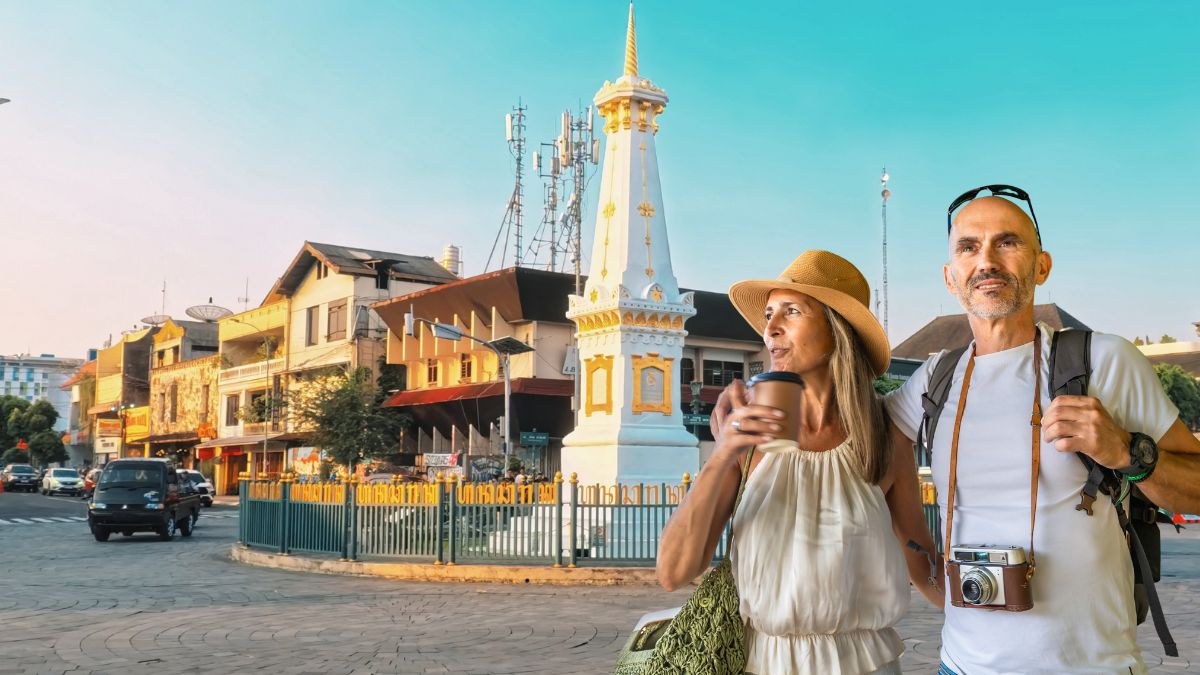
Choosing between Bali, Yogyakarta and Jakarta is an exciting decision.
But before you book a one-way flight or sign a long-term rental agreement, it is important to plan more than just where you want to live.
You also need to consider:
- the right visa for your purpose of stay;
- your long-term residence plans;
- visa extension options;
- whether your current immigration status matches your activities;
- and the requirements that may apply to your individual situation.
Whether you are planning to live in Indonesia as a:
- digital nomad;
- remote worker;
- entrepreneur;
- investor;
- business owner;
- spouse or family member;
- or long-term foreign resident,
Planning to Live in Bali, Yogyakarta or Jakarta?
Our team can assist with Indonesian immigration services, including appropriate visa and stay permit options based on your individual purpose and circumstances.
Not sure which visa is right for you?
Contact Azra Solutions for assistance with:
- Indonesian visa applications;
- Bali and Indonesia visa options;
- visa extensions;
- long-term stay planning;
- ITAS and ITAP;
- investor and business immigration;
- and other immigration-related services.
“Your next chapter in Indonesia starts with choosing the right place to live—but it also starts with making sure you have the right plan to stay.”
Ready to Start Planning Your Life in Indonesia?
Whether you choose the lifestyle of Bali, the balance of Yogyakarta, or the opportunities of Jakarta, our team is ready to help you navigate your immigration journey.
👉 Contact Azra Solutions today to discuss your visa and long-term stay options in Indonesia.
Bali for lifestyle.
Yogyakarta for balance.
Jakarta for opportunity.
Wherever you choose, plan your life—and your stay in Indonesia—the right way.