A practical guide to RPTKA requirements, business licensing, foreign artist engagements, and immigration compliance in Indonesia.
Introduction
Indonesia’s entertainment, music, cultural, and live-event industries regularly involve international talent. Concert promoters may engage overseas singers and musicians; cultural festivals may invite performers; production companies may need foreign specialists; and impresariat businesses may coordinate the arrival, engagement, and return of artists.
These arrangements can involve several legal questions at once: whether the Indonesian company is properly licensed, whether it may act as the employer or sponsor, whether an RPTKA approval is required, and which immigration permission matches the foreign national’s actual activities.
An Indonesian impresariat company should not assume that its business licence alone authorizes a foreign artist or crew member to work in Indonesia. Business licensing, manpower approval, and immigration permission are separate compliance layers. The correct route depends on the company’s legal role, the individual’s duties, the duration and location of the assignment, the contractual arrangement, and the applicable visa classification.
This guide explains the framework at a practical level. It is not a substitute for reviewing the current rules and the facts of a particular engagement. Regulations, implementing procedures, KBLI classifications, and immigration visa indexes can change. Companies should verify the applicable requirements before signing contracts or arranging travel.
1. Understanding the Role of an Indonesian Impresariat Company

What Is an Impresariat Company?
In the Indonesian arts and entertainment context, an impresariat business may arrange or manage performances and entertainment engagements. Its activities can include bringing performers to Indonesia, coordinating performance schedules and venues, arranging engagements, and managing the practical relationship between artists, organizers, venues, and other counterparties.
The exact scope depends on the company’s actual business activities and licensing.
An impresariat may work with foreign singers, musicians, dancers, actors, cultural performers, or other professionals connected with an artistic production. It may also coordinate technical or production personnel, although those roles must be assessed separately rather than automatically treated as artist activities.
Impresariat Companies, Event Organizers, and Talent Agencies Are Not Always the Same
The labels used in commercial proposals do not determine the legal classification. A company described as an impresariat may in practice be producing an event, supplying technical services, representing talent, managing a venue, or providing several services together.
The company should compare its real activities with the scope of its registered business classifications and licences.
This distinction matters because a company’s KBLI and business licensing should accurately reflect its activities. It also matters when identifying which Indonesian entity is actually engaging the foreign national and which entity is responsible for the employment or engagement arrangement.
Identify the Real Contracting and Operating Parties
Before a company sponsors or engages a foreign national, it should identify:
- Who signs the contract.
- Who pays the individual.
- Who controls the work.
- Who provides the venue or production facilities.
- Who is responsible for organizing the event.
A promoter, venue, local production company, and impresariat may all be involved, but they do not automatically share the same legal responsibilities.
2. Can an Indonesian Impresariat Company Sponsor Foreign Workers?
The Company Must Qualify for the Role It Intends to Perform
An Indonesian company may be able to employ or engage foreign workers where the applicable legal requirements are met. The relevant question is not simply whether the company has an Indonesian business registration.
The company must be an eligible employer for the relevant arrangement, its business activities and documents must be consistent with the engagement, and it must complete the manpower and immigration procedures that apply.
Government Regulation No. 34 of 2021 provides the general framework for the use of foreign workers. It regulates employer obligations, RPTKA approval, permitted positions and periods, compensation, reporting, supervision, and administrative consequences.
Minister of Manpower Regulation No. 8 of 2021 provides implementing procedures, including the process for temporary work.
A company should not describe itself as a sponsor merely because it is helping an artist obtain an invitation letter or visa. The legal sponsor, employer, contracting party, and event organizer may be different entities. Their roles must be mapped accurately.
Who Is the Employer or Sponsor?
For manpower purposes, the relevant employer is the party engaging the foreign worker under the applicable legal arrangement.
For immigration purposes, the sponsor or guarantor is the party recorded and accepted under the relevant immigration process. These roles may overlap, but they should not be assumed to be identical in every case.
If a foreign performer is contracted by an overseas management company but performs at an Indonesian event organized by a local promoter, the parties should establish which Indonesian entity is legally responsible for the engagement and whether the proposed sponsorship structure is permitted.
A paper arrangement that does not reflect the actual work can create compliance risks.
Company Documents and Operational Substance
The company should maintain consistent corporate records, business identification and licensing, tax and manpower records where applicable, a genuine business address, and contracts that explain the engagement.
Authorities may assess the substance of the arrangement, not only the company’s name or the wording of a letter.
3. Understanding RPTKA Requirements for Impresariat Companies
What Is an RPTKA?
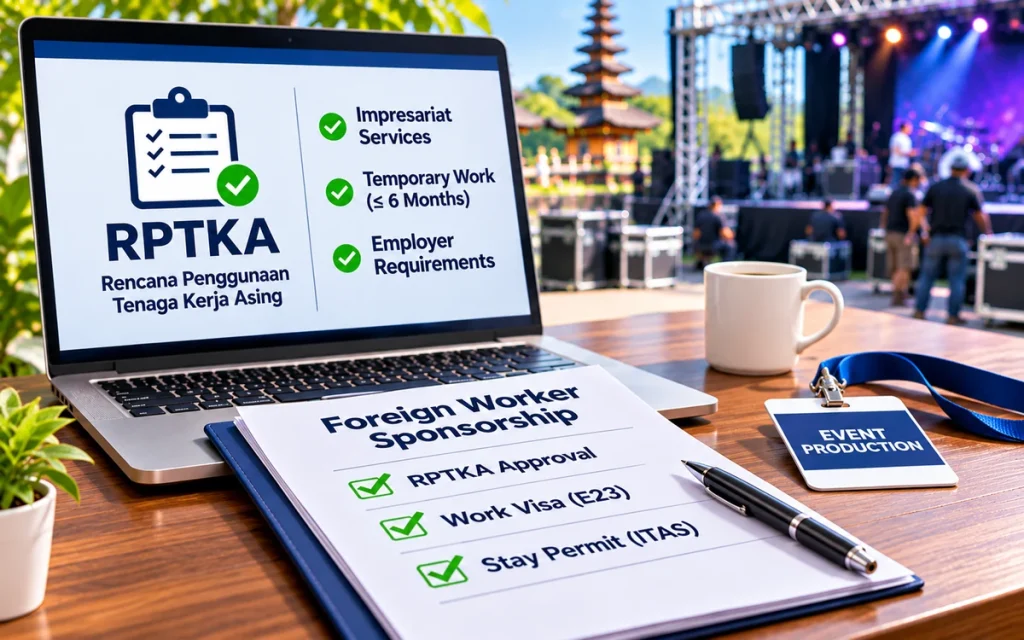
RPTKA means Rencana Penggunaan Tenaga Kerja Asing, or Foreign Worker Utilization Plan.
It is part of Indonesia’s manpower framework for employers using foreign workers. The RPTKA process identifies matters such as the employer, the reason for using foreign expertise, the position, the number of foreign workers, the period, and the work location.
The RPTKA is not a visa and does not by itself grant permission to enter or stay in Indonesia. It belongs to the manpower side of the process. Immigration permission must also be assessed and obtained under the applicable immigration rules.
Temporary Work and the Impresariat Category
Minister of Manpower Regulation No. 8 of 2021 is especially important for this sector.
Article 3(1)(f) expressly includes an usaha jasa impresariat (impresariat services business) among the entities recognised as employers of foreign workers. Article 2 states that an employer employing a foreign worker must have an RPTKA approved by the Minister or an appointed official, subject to the specific exceptions and special provisions in the regulations.
Article 8 then identifies impresariat services as an activity for which temporary-work RPTKA approval may be requested.
This is not an exemption from RPTKA. The structure of the regulation is the opposite: an eligible impresariat services business is recognised as an employer of foreign workers, and the temporary-work provisions provide a specific route to apply for RPTKA approval.
The employer must still submit the application and obtain approval where required.
Assignments of Up to Six Months
For a qualifying temporary assignment, the employer should assess the temporary-work procedure under the applicable regulation. The engagement should be genuinely temporary and accurately documented.
A short event schedule does not automatically settle the legal classification. Preparation, rehearsals, technical work, promotional activity, additional performances, and post-event duties may affect the actual assignment.
The company should define the work period and location carefully and ensure that the proposed position matches the duties the individual will actually perform.
If the scope changes, the company should check whether an amendment or a different approval route is required.
Assignments Exceeding Six Months
Where the engagement exceeds six months, the employer should not rely on the temporary-work provision simply because the work is connected with an event or entertainment.
The company must assess the RPTKA route and other requirements applicable to work exceeding six months. A recurring series of engagements may need to be assessed as a continuing arrangement rather than being artificially divided into short contracts.
Does Every Foreign Artist Require the Same Process?
No. The applicable route depends on the person’s activity and legal status.
A performing artist, a person supporting a music performance, a technical production specialist, a manager, and an employee in an ongoing operational role may fall under different manpower and immigration considerations.
The visa index and the manpower approval should be checked against the actual activity, not selected solely by job title or event duration.
4. Business Licensing and KBLI Requirements
Understanding the Impresariat Business Classification
Under KBLI 2020, code 90030 was titled Aktivitas Impresariat Bidang Seni dan Festival Seni (Impresariat Activities in the Arts and Arts Festivals).
The earlier classification covered activities such as arranging and organizing entertainment performances in the arts sector, including bringing, sending, or returning entertainment and determining the place, time, and type of entertainment.
KBLI 2025: Code 90030 Is Converted to 90391
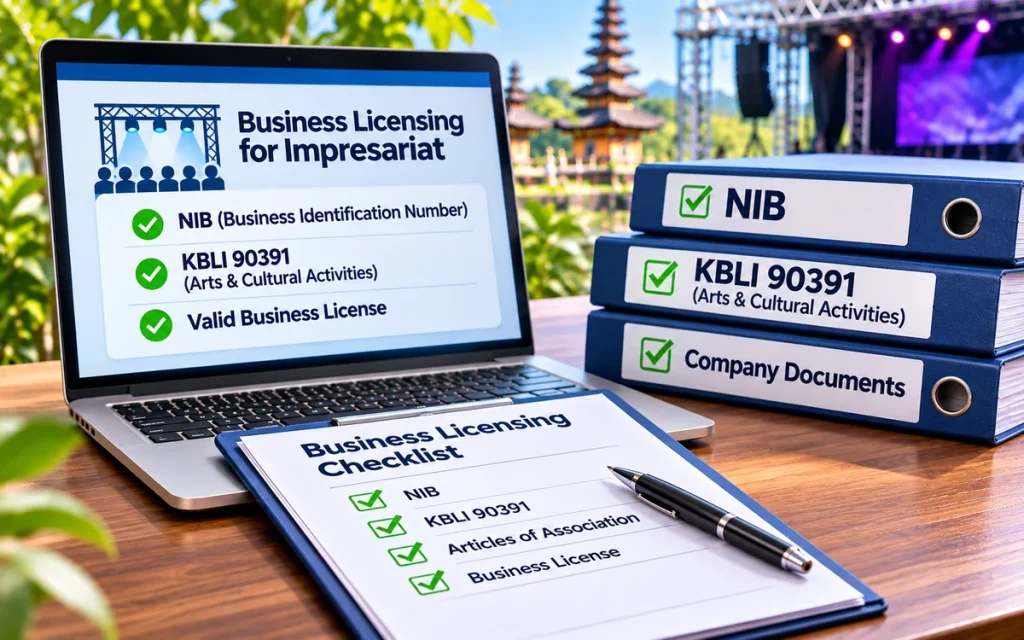
The official OSS conversion record maps KBLI 2020 code 90030 to KBLI 2025 code 90391, Penyelenggaraan Kegiatan Kesenian dan Kebudayaan (Organization of Arts and Cultural Activities).
The conversion is shown as a one-to-one mapping. Companies should check the current code and business scope displayed in OSS rather than relying only on an older KBLI description.
The OSS conversion page also cautions that a code conversion does not automatically establish that every new code fits every company’s actual activity.
An important transition point is that an existing NIB or business licence should not be considered invalid merely because KBLI 2025 introduced a new code.
BKPM’s 30 March 2026 implementation notice states that business licences issued before KBLI 2025 remain valid. Adjustment is required where the substance of the business activities changes. Numeric code adjustments were scheduled to be handled through OSS and AHU no later than 18 June 2026.
As this transition date has passed, companies should inspect their current OSS and AHU records and confirm that the displayed KBLI and licensing scope accurately reflect their actual operations.
A code conversion alone does not prove that every permit or operational approval needed for a particular event activity has been obtained.
Match the Registered Activities with the Actual Business
A company should review whether its NIB and registered KBLI accurately cover the services it provides.
For example, arranging an artistic performance may be different from providing event equipment, operating a venue, producing a commercial exhibition, or supplying technical crew.
Where the business carries out several activities, it may need more than one relevant classification.
NIB and Supporting Company Records
The company should keep its NIB, articles of association and amendments, company approval documents, business address records, and other relevant licences available.
For RPTKA-related applications, Minister of Manpower Regulation No. 8 of 2021 identifies company documents that may include the NIB and/or business licence, company deed and approval, manpower reporting evidence, domicile information, and a draft employment or other agreement.
The precise document list and submission requirements should be confirmed in the current online system.
5. Which Foreign Workers Can an Impresariat Company Engage?
Foreign Singers and Musicians
A company may arrange engagements involving overseas singers, instrumentalists, conductors, DJs, or other musicians.
The relevant immigration classification must match the performance activity and the individual’s role. A performer who appears on stage is not necessarily in the same category as a person supporting the performance behind the scenes.
Actors, Dancers, and Performing Artists
Actors, dancers, and other performers may participate in theatre, dance, cultural productions, festivals, and staged entertainment.
The company should document the type of performance, venue, dates, contractual counterparty, and whether the individual will receive remuneration or facilities.
Technical and Production Crew
Lighting operators, sound engineers, stage managers, riggers, camera operators, and other technical personnel should not automatically be classified as performers.
Their duties may be connected to a music performance, but the company must review the relevant visa category and manpower requirements for the actual support activity.
Managers, Consultants, and Other Professionals
A foreign tour manager, creative director, production consultant, or specialist may have duties that differ from those of an artist or technical crew member.
The company should describe the work precisely and avoid using a performer category where the person’s principal activity is management, consulting, or another professional service.
6. Documents Required to Sponsor Foreign Workers
Indonesian Company Documents
Depending on the route and the current application system, the company may need to prepare:
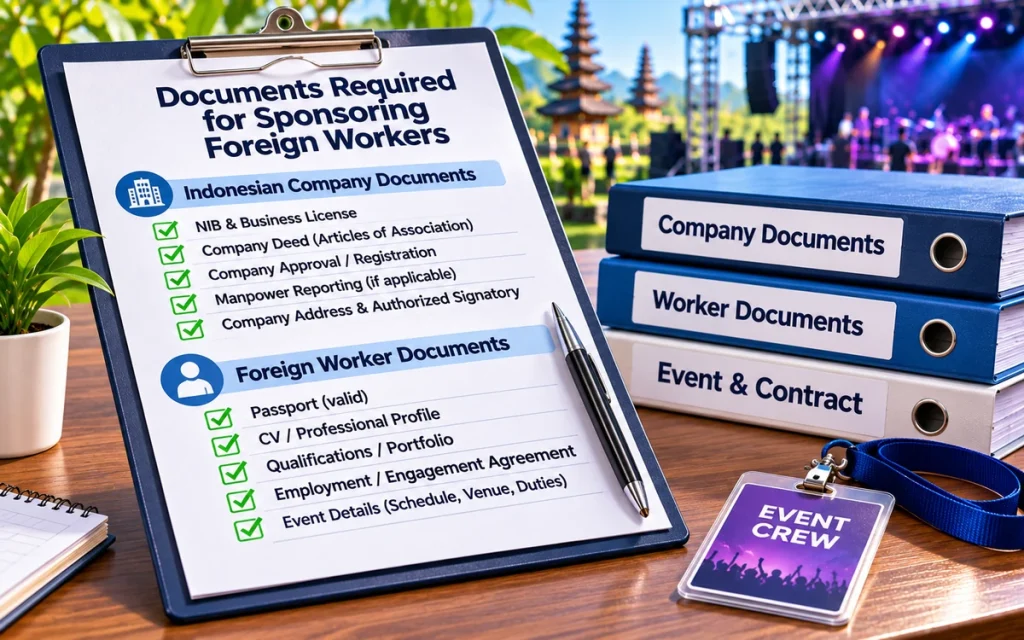
- NIB and relevant business licence.
- Company deed and amendments.
- Company approval or registration evidence.
- Manpower reporting evidence.
- Company address information.
- Authorized signatory details.
- Other documents required by the relevant online platform.
The company should also maintain a clear record of the person responsible for the application.
Foreign Worker Documents
The individual’s documents may include:
- Valid passport.
- Personal details and photograph.
- Curriculum vitae or professional profile.
- Qualifications or portfolio, where relevant.
- Other identity or competency evidence requested for the specific role.
Passport validity and consistency of names and dates across all documents should be checked before filing.
Engagement and Event Documents
Useful supporting records may include the performance or employment agreement, invitation or assignment letter, event proposal, schedule, venue details, work location, description of duties, payment arrangements, and details of the Indonesian contracting party.
Where several companies are involved, the documents should explain the relationship between them.
Why Consistency Matters
The company name, foreign worker’s name, position, work period, location, and activity should be consistent across the corporate, manpower, contractual, and immigration documents.
If a contract says “performer” but the person will operate technical equipment, or if the approved location differs from the actual worksite, the company should resolve the discrepancy before the assignment begins.
7. How the Sponsorship and Work Authorization Process Works
Step 1 – Review the Indonesian Company
Confirm the legal entity that will engage the foreign national.
Review its NIB, KBLI, business licence, corporate records, operational activities, and ability to act in the proposed role. Identify whether another Indonesian company is actually the employer or contracting party.
Step 2 – Define the Foreign Worker’s Actual Duties
Prepare a clear description of the work, position, event, dates, work locations, remuneration or facilities, and reporting relationship.
Do not use a generic job title if it conceals materially different duties.
Step 3 – Determine the Manpower Route
Assess whether the engagement falls within a temporary-work category under Minister of Manpower Regulation No. 8 of 2021, including the specific reference to impresariat services, or whether another RPTKA route applies.
Confirm current procedures and documents through the Ministry of Manpower’s official system.
Step 4 – Complete Applicable Manpower Obligations
Where required, obtain the relevant RPTKA approval and complete associated obligations, including any applicable compensation payment, reporting, or other employer requirements.
Do not treat an application receipt or an event invitation as equivalent to an approval.
Step 5 – Coordinate Immigration Permission
After the manpower route is clarified, identify the appropriate visa and stay-permit process.
The immigration classification must correspond to the actual activity. The official eVisa portal and current visa classification decision should be checked before travel.
The company should confirm the sponsor details, supporting documents, permitted activities, and stay period.
Step 6 – Check the Assignment Before Work Starts
Confirm that the foreign national has the required approvals and immigration permission before undertaking the relevant activity.
Provide the individual and event team with a copy of the approved scope, work dates, location, and restrictions.
Step 7 – Monitor Changes During the Engagement
If the event is postponed, additional dates are added, the worker changes role, the venue changes, or the contracting party changes, review whether the approvals remain valid.
Keep records of the engagement and complete any required reporting or administrative steps.
8. Important Compliance Responsibilities
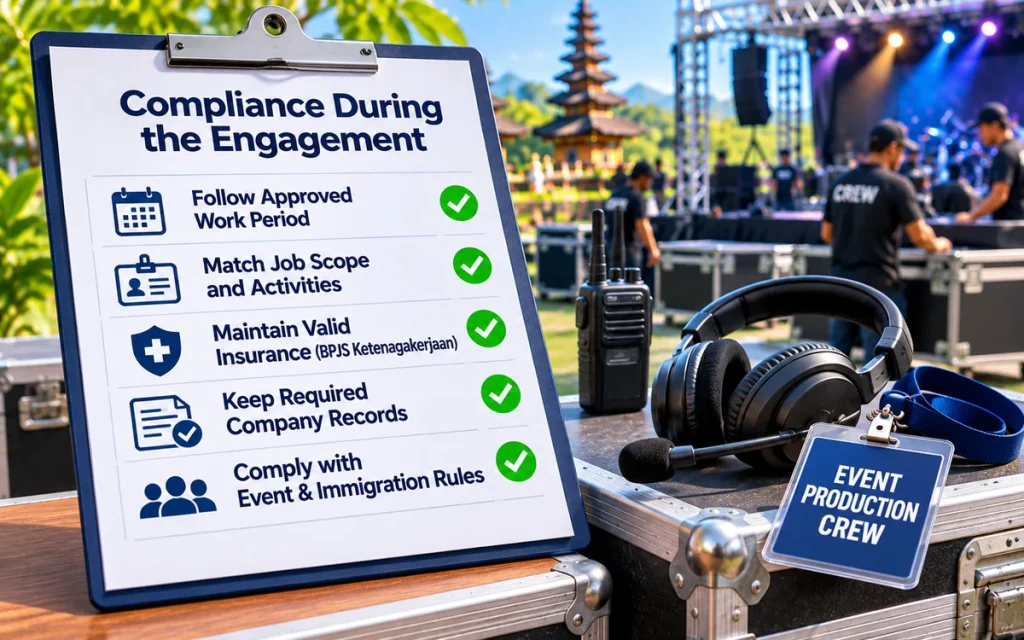
The Work Must Match the Approved Activity
The foreign national should perform only activities permitted by the applicable approvals and immigration status.
A visa that permits a defined performance or support activity should not be treated as general authorization to take unrelated employment or provide services to other clients.
Respect the Approved Period and Location
The company should monitor arrival dates, permitted stay, work dates, and approved locations.
Event schedules can change at short notice, but a schedule change does not automatically extend an immigration stay permit or manpower approval.
Maintain Accurate Contracts and Records
Keep signed contracts, assignment letters, event schedules, proof of approvals, correspondence, payment records, and any required reporting documents.
Accurate records help demonstrate the real nature of the engagement if questions arise.
Do Not Confuse Manpower and Immigration Compliance
An RPTKA approval does not replace a visa or stay permit. Equally, holding a visa does not necessarily resolve every manpower obligation.
The company should check both systems and ensure that the two sets of documents describe compatible activities.
Potential Consequences of Non-Compliance
Incorrect sponsorship, unauthorized work, overstaying, inaccurate declarations, or failure to comply with employer obligations can expose the company and foreign national to administrative or immigration consequences.
The specific consequence depends on the conduct and the applicable provisions. Companies should not rely on informal assurances that a short event or a familiar industry practice removes legal obligations.
9. Common Mistakes When Sponsoring Foreign Artists
Assuming an Event Invitation Is Enough
An invitation letter explains why a person is coming to Indonesia; it does not by itself authorize every activity.
The company must identify the correct immigration and manpower requirements.
Using the Wrong Company as Sponsor
A company may be involved in an event without being the correct employer or immigration sponsor.
The parties should confirm who is legally responsible and whether the proposed sponsor is eligible.
Choosing a Visa Based Only on the Event Duration
A one-day performance may involve weeks of rehearsals, technical preparation, and other work.
The complete activity and relevant legal category must be reviewed rather than choosing a visa solely because the public event is brief.
Ignoring the KBLI Update
Companies relying on older references to KBLI 90030 should review the KBLI 2025 conversion to 90391 and check their current OSS records.
They should not assume that an old code description is sufficient for a new application.
Treating Every Crew Member as an Artist
A performer, sound engineer, stage manager, tour manager, and consultant may have different duties.
Each person should be assessed individually.
Starting Work Before Approvals Are Complete
Travel plans, ticket sales, and event deadlines should not be treated as permission to begin work.
The company should build compliance lead time into the production schedule.
10. Frequently Asked Questions
Can an Indonesian Impresariat Company Sponsor Foreign Artists?
An Indonesian impresariat company may be able to engage or sponsor foreign artists if it is eligible for the proposed role and completes the applicable manpower and immigration procedures.
The company’s licensing, the contractual arrangement, the artist’s duties, and the relevant visa classification must be reviewed.
Does an Impresariat Company Need an RPTKA?
Minister of Manpower Regulation No. 8 of 2021 expressly includes impresariat services among temporary-work categories in Article 8 and provides an application procedure for temporary-work RPTKA approval in Article 9.
This should not be read as a general exemption. The company should confirm the applicable procedure for its facts.
Has KBLI 90030 Changed?
Yes. The KBLI 2025 conversion reference maps KBLI 2020 code 90030, Impresariat Activities in the Arts and Arts Festivals, to KBLI 2025 code 90391, Organization of Arts and Cultural Activities.
Companies should verify their current classification and licensing through OSS.
Can One Company Sponsor Several Foreign Performers?
Potentially, but each individual’s identity, position, activities, period, and location must be properly documented.
The employer should ensure that the relevant application accurately reflects the number of foreign workers and the engagement.
Can an Artist Enter Indonesia on a Business Visa and Perform?
A business visa should not be assumed to authorize a paid performance or other work.
The company must check the current immigration classification and the permitted activities for the specific visa index. The fact that a person is attending meetings or negotiating an engagement does not mean the same permission covers performing.
Does a Short Event Automatically Qualify as Temporary Work?
Not automatically.
The complete assignment, including preparation, rehearsals, technical work, and any additional activities, should be assessed. The company should use the applicable temporary-work procedure where the legal conditions are met.
Can a Foreign Technical Crew Member Use the Same Route as a Performer?
Not necessarily.
Technical crew members support the performance but may have different duties and visa considerations from the artists on stage. Their roles should be reviewed individually.
What If the Event Date or Venue Changes?
The company should review the existing manpower and immigration approvals before the worker performs at a new date or location.
A change may require an update or a new application, depending on the relevant rules and approval conditions.
11. Get Professional Assistance with Foreign Worker Sponsorship in Indonesia
Sponsoring foreign artists and entertainment professionals involves more than arranging an invitation letter.
An Indonesian impresariat company should ensure that its business licensing, manpower arrangements, contracts, and immigration documents are aligned before the foreign worker travels or begins the assignment.
Azra Solutions provides private immigration and business consultation for Indonesian companies and international clients planning to engage foreign professionals in Indonesia.
Our team can help review the company’s circumstances, the proposed role, the assignment period, supporting documents, and the appropriate immigration route.
Azra Solutions is a private consultancy, not an Indonesian government agency or visa-issuing authority. Any application remains subject to the relevant authorities’ requirements and decision.
Discuss your foreign worker sponsorship requirements with Azra Solutions:
Related AzraID Guides
- Indonesia Work Visa for Sports and Entertainment Professionals
- Indonesia Performer Work Visa
- Indonesia Temporary Work Visa
- Indonesia Event Production Work Visa
- Indonesia Event Manager Work Visa
- Indonesia Entertainment Consultant Visa
Official References
- Government Regulation No. 34 of 2021 on the Use of Foreign Workers
- Minister of Manpower Regulation No. 8 of 2021
- Minister of Manpower Regulation No. 8 of 2021 – Official PDF
- KBLI 2025 Conversion Reference – BKPM
- OSS – KBLI 90030 and Conversion Information
- Official Indonesian eVisa Portal
- 2025 Visa Classification Decision
- Joint Ministerial Decision No. 1 of 2026 on OSS, Manpower, and Immigration System Integration for Investment-Related Foreign Worker Applications
- BKPM – KBLI 2025 Implementation and Transition Notice
- OSS – KBLI 90030 to 90391 Conversion Record