
Retirement KITAP Indonesia is the long-term immigration pathway for eligible foreign retirees who want to move from limited stay status to permanent stay status in Indonesia. In Indonesian immigration terminology, KITAP is the card associated with an Izin Tinggal Tetap (ITAP), or Permanent Stay Permit. It is not a visa.
For foreign retirees, the key issue is not simply whether someone is retired. Eligibility depends on the applicant’s immigration category, current ITAS, residence history, supporting documents, and the requirements in force when the application is submitted. Current Immigration information specifically recognizes foreign elderly tourists as a category that may change status from ITAS to ITAP. The current published guidance in Jakarta Central also states that elderly foreign tourists seeking this route must have been in Indonesia for at least three consecutive years from the date their ITAS was granted.
This guide explains the current framework, the difference between retirement ITAS and KITAP, the ITAS-to-ITAP pathway, documents, procedure, costs, and the difference between Retirement KITAP and the E33F/E33E elderly visa routes.
What Is a Retirement KITAP in Indonesia?
For the broader framework, see the Indonesia KITAP guide.
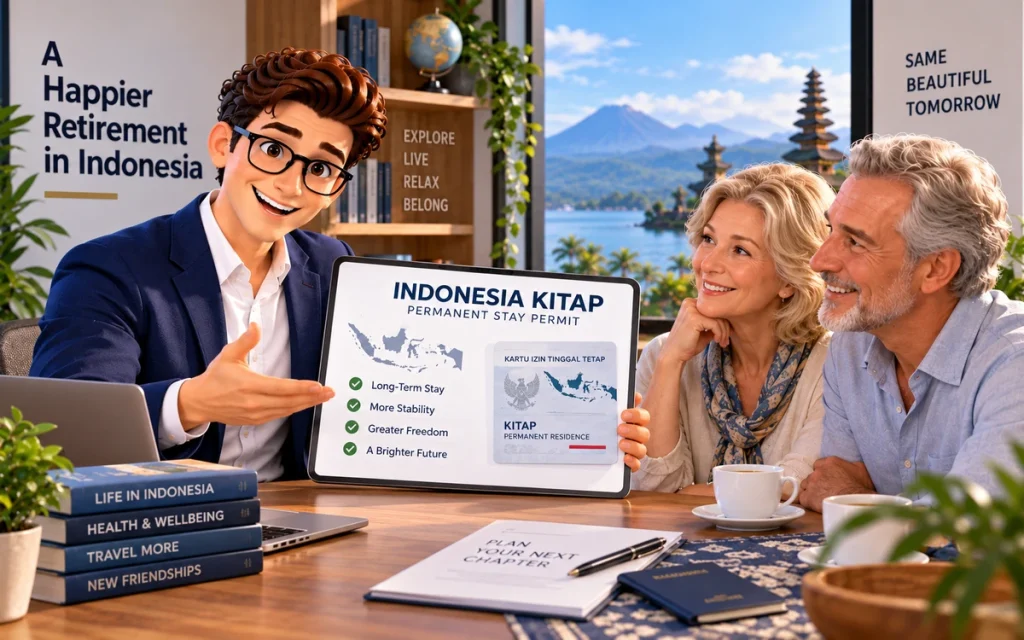
A Retirement KITAP is commonly used to describe an ITAP held through the elderly or retirement pathway. ITAP is an immigration stay status that allows an eligible foreign national to reside permanently in Indonesia, subject to Indonesian immigration law and continuing compliance.
The Directorate General of Immigration and local Immigration Offices list elderly foreign tourists among the categories eligible for ITAS-to-ITAP status conversion. The current Jakarta Central Immigration guidance identifies elderly foreign tourists as one of the categories for ITAS-to-ITAP conversion and states that the application is submitted before the current ITAS expires.
The important distinction is that KITAP is not the same thing as a retirement visa. A visa is used to enter Indonesia and obtain the relevant stay permit; ITAP is the permanent stay status itself.
Who Can Qualify for a Retirement KITAP?
The current immigration framework identifies elderly foreign tourists as an eligible category for ITAS-to-ITAP conversion. Current Immigration guidance also identifies the elderly category within the broader second-home classification and uses an age threshold of 60 or older for that ITAP conversion category.
At the same time, the elderly visa routes have different age rules. For example, the official E33E page describes a five-year Limited Stay Visa for foreigners aged 55 or older. Therefore, the age threshold for an elderly visa should not be copied directly into the eligibility requirements for Retirement KITAP.
In practical terms, an applicant should have Immigration review the complete profile before assuming that a retirement visa automatically leads to KITAP.
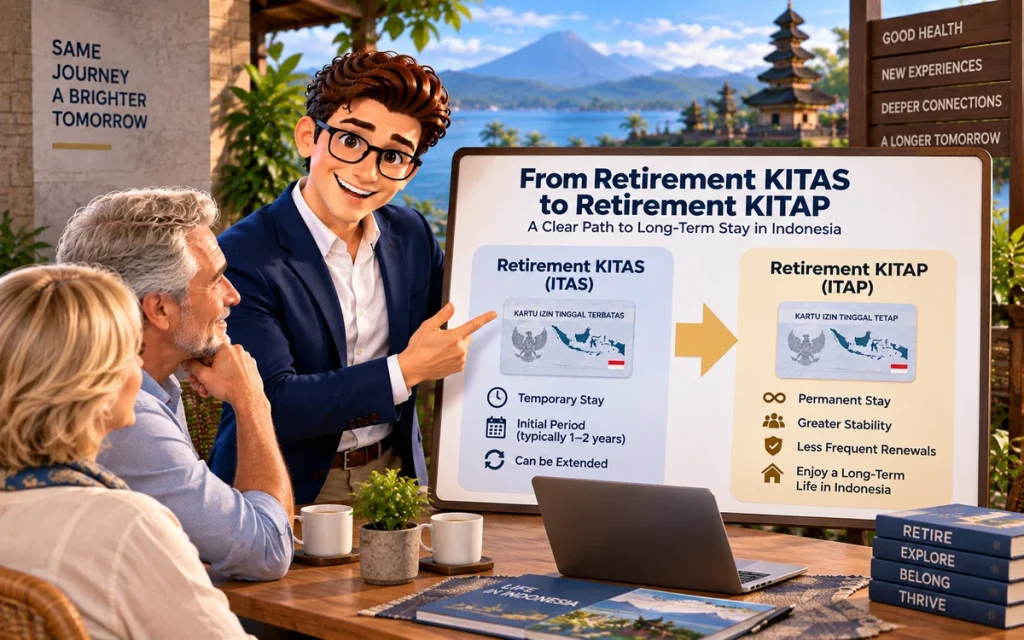
Retirement KITAS vs Retirement KITAP
For the wider residence framework, see the Indonesia Residency guide.
| Item | Retirement KITAS / ITAS | Retirement KITAP / ITAP |
| Immigration status | Limited Stay Permit | Permanent Stay Permit |
| Purpose | Temporary/limited residence under the applicable elderly route | Permanent stay status for an eligible applicant |
| Pathway | Obtained through the applicable elderly visa/ITAS route | May be obtained through eligible ITAS-to-ITAP conversion |
| Residence history | Depends on the underlying ITAS route | Current guidance for elderly foreign tourists states at least 3 consecutive years in Indonesia |
| Document | KITAS / ITAS | KITAP / ITAP |
Can a Retirement KITAS Be Converted to KITAP?
Yes, an eligible retirement or elderly ITAS can be converted to ITAP through the formal ITAS-to-ITAP status conversion process. The conversion is not automatic. It is an application-based immigration process.
Current Immigration guidance states that ITAS-to-ITAP applications must be submitted no later than 30 days before the ITAS expires. The application is submitted by the foreign national, sponsor, or responsible party through the immigration application system to the Head of the Immigration Office.
For elderly foreign tourists, current Jakarta Central Immigration guidance states that the applicant must have been in Indonesia for at least three consecutive years from the date the ITAS was granted. This is the current published rule we use for the article; applicants should still verify their exact category and residence history with Immigration before filing.
Retirement KITAP Requirements
Age and Retirement Category
The applicant must fall within the elderly foreign tourist category recognized for ITAS-to-ITAP conversion. Current Immigration information distinguishes this category from the age rules for E33F/E33E visas, so applicants should not assume that one age threshold applies to every retirement immigration product.
Current ITAS / Immigration Status
The applicant must hold a valid ITAS and meet the conditions for the applicable elderly category. A current, valid immigration status is essential because the ITAS-to-ITAP application has to be filed within the prescribed period before the ITAS expires.
Residence History
Current published Immigration guidance states that elderly foreign tourists seeking ITAS-to-ITAP conversion must have been in Indonesia for at least three consecutive years from the date the ITAS was granted. This should be checked against the applicant’s actual immigration history and the category under which the current ITAS was issued.
Passport and Immigration Documents
- Valid national passport.
- Current ITAS/KITAS and copies.
- Proof of domicile or residence in Indonesia.
- Signed Integration Statement where required.
- Guarantee/sponsorship documents where applicable.
- Other documents requested by the Immigration Office for the specific application route.
Supporting Retirement Documents
Additional evidence may be required depending on the underlying elderly/retirement route, including sponsorship or documents connected with the applicant’s stay category. The exact checklist should be confirmed against the current Immigration Office requirements before submission.
Documents Required for Retirement KITAP
For elderly foreign tourists, current Jakarta Central Immigration guidance lists the following for ITAS-to-ITAP conversion:
- Valid national passport and copy.
- Copy of the valid ITAS.
- Guarantee letter from the sponsor.
- Proof of domicile.
- Signed Integration Statement.
- Sponsorship letter from an appointed travel agency where applicable to the elderly foreign tourist category.
Document requirements can change with the applicant’s category and current administrative system. A professional document review before filing can help identify missing or outdated documents.

How to Apply for Retirement KITAP in Indonesia
Step 1: Check Eligibility
Review the applicant’s age, current ITAS category, residence history, passport validity, sponsorship arrangement, and supporting documents.
Step 2: Review the Current ITAS
Confirm the ITAS is still valid and identify the correct deadline for filing the ITAS-to-ITAP application.
Step 3: Prepare the Documents
Prepare clear scans of the original documents and any required sponsor or guarantee documents. Current Immigration service guidance states that uploaded documents should be scans of the original documents in color.
Step 4: Submit the ITAS-to-ITAP Application
The application is submitted through the immigration system by the applicant, sponsor, or responsible party to the relevant Immigration Office.
Step 5: Immigration Verification and Photo
The Immigration Office checks the application and documents and carries out the required photo/biometric or other verification steps. Immigration may also conduct field supervision when required.
Step 6: Directorate General Review
The process may require review or approval at the Directorate General of Immigration level. The published Yogyakarta 2026 service standard specifically notes that its six-working-day service period does not include Directorate General approval or cases requiring field supervision.
Step 7: ITAP and KITAP Issuance
After approval and payment of the applicable PNBP, Immigration issues the ITAP and KITAP. The process can also include the issuance or endorsement of the applicable re-entry permission.
How Long Does Retirement KITAP Take?
Processing time depends on document completeness, the Immigration Office, the need for field supervision, and whether Directorate General approval is required. The 2026 Yogyakarta service standard lists six working days for the service component, excluding Directorate General approval and field supervision where applicable.
For this reason, AzraID should not promise a universal processing time. The practical timeline should be confirmed after reviewing the applicant’s case and the current Immigration workflow.
How Long Is Retirement KITAP Valid?
ITAP is a permanent stay status, but the physical permit has an administrative validity period and must be extended according to the applicable rules. Current 2026 Immigration service standards list a five-year ITAP issuance and separate extension procedures.
This is why describing KITAP simply as a “five-year retirement visa” is inaccurate. KITAP is the card associated with ITAP, while the underlying status is Permanent Stay Permit.
Can Retirement KITAP Be Extended?
Yes. ITAP has an extension process. The timing and applicable fee depend on the category and the permit involved. Applicants should not wait until the last moment; the current Immigration service standards should be checked before the extension application is filed.
Can Retirement KITAP Holders Travel Outside Indonesia?
Travel outside Indonesia depends on the validity of the applicant’s ITAP and the applicable Izin Masuk Kembali (re-entry permission). A KITAP holder should check the re-entry permission before leaving Indonesia, especially if the passport or immigration status has recently changed.
Current 2026 Yogyakarta service standards list separate PNBP rates for re-entry permissions, including a two-year option and category-specific five-year options. The exact option applicable to a retiree should be confirmed before travel.
Can You Work With a Retirement KITAP?
A Retirement KITAP should not be treated as a general work permit. Permanent stay status and authorization to perform employment or other regulated activities are separate immigration and regulatory questions.
If a KITAP holder plans to work, operate a business, provide professional services, or perform another activity that requires authorization, the activity and applicable work or business requirements should be reviewed separately before it begins.
Retirement KITAP vs E33F vs E33E
For the current E33F and E33E framework, see our Indonesia retirement visa guide.
| E33F | E33E | Retirement KITAP | |
| Nature | Limited Stay Visa | 5-Year Limited Stay Visa | Permanent Stay status / ITAP |
| Elderly age reference | 55+ under the elderly visa framework | 55+ under the official E33E description | 60+ elderly category for the current ITAS-to-ITAP classification |
| Stay status | ITAS | ITAS | ITAP |
| Permanent stay | No | No | Yes |
| Relationship to KITAP | May be part of a retirement residence pathway, subject to the applicable rules | May be part of a retirement residence pathway, subject to the applicable rules | The permanent-stay status itself |
The official E33E page describes E33E as a Limited Stay Visa for foreigners aged 55 or older who want to stay in Indonesia for up to five years. That is different from ITAP/KITAP, which is a permanent stay status. The two should not be presented as interchangeable products.

Retirement KITAP Costs in Indonesia
Government fees and professional service fees should be presented separately.
Government Immigration Fees
The 2026 Yogyakarta Immigration service standard lists Rp5,000,000 for issuance of a five-year ITAP and Rp1,750,000 for an Izin Masuk Kembali with a maximum validity of two years. The same standard lists category-specific rates for other ITAP and re-entry options. Fees can change, so the applicable PNBP should be confirmed before payment.
Professional Assistance Fees
AzraID service fees are separate from government PNBP. A current quotation should be requested based on the applicant’s nationality, current ITAS, residence history, documents, location, and required assistance.
Common Retirement KITAP Mistakes
If your case is employment-based rather than retirement-based, see Working KITAP.
- Assuming being retired automatically qualifies someone for KITAP.
- Confusing a retirement visa or ITAS with KITAP/ITAP.
- Using an outdated “four-year” rule without checking the current official requirements.
- Confusing the 55+ elderly visa threshold with the current 60+ elderly ITAS-to-ITAP classification.
- Waiting until the ITAS is close to expiry before preparing the application.
- Submitting incomplete or unclear documents.
- Assuming KITAP automatically authorizes employment.
- Leaving Indonesia without checking the validity of the applicable re-entry permission.
- Treating third-party immigration websites as the primary legal source instead of checking current Immigration guidance.
Frequently Asked Questions
What is Retirement KITAP in Indonesia?
Retirement KITAP is the common term for ITAP obtained through the applicable elderly/retirement pathway. ITAP is Indonesia’s Permanent Stay Permit; KITAP is the associated stay permit card.
Who can apply for Retirement KITAP?
Eligible foreign elderly tourists who meet the applicable ITAS-to-ITAP requirements may apply. Current Immigration guidance identifies elderly foreign tourists as an eligible category.
Can I convert my Retirement KITAS to KITAP?
An eligible elderly/retirement ITAS can be converted to ITAP through the formal ITAS-to-ITAP application process. The conversion is not automatic.
How old do I need to be for Retirement KITAP?
The current ITAS-to-ITAP classification identifies the elderly category as 60 years or older. This is different from the 55+ threshold shown for E33F/E33E elderly visas.
How long do I need to live in Indonesia before KITAP?
Current Jakarta Central Immigration guidance states at least three consecutive years in Indonesia from the date the ITAS was granted for elderly foreign tourists seeking ITAS-to-ITAP conversion.
Is Retirement KITAP permanent?
ITAP is a permanent stay status, although the permit has administrative validity and extension requirements.
Can I leave Indonesia with KITAP?
Travel is possible subject to valid immigration documents and the applicable Izin Masuk Kembali (re-entry permission).
Can I work with Retirement KITAP?
Do not assume that KITAP itself is a general work authorization. Any employment or regulated activity should be checked separately.
What is the difference between E33E and Retirement KITAP?
E33E is a five-year Limited Stay Visa for eligible elderly foreigners. Retirement KITAP refers to permanent stay status through ITAP.
How much does Retirement KITAP cost?
Government fees depend on the applicable ITAP and re-entry options. The 2026 Yogyakarta standard lists Rp5,000,000 for a five-year ITAP and Rp1,750,000 for a two-year re-entry permit.
How AzraID Can Help With Retirement KITAP
Learn more about our Retirement KITAP service.
Retirement KITAP applications require more than simply completing a form. The correct route depends on the applicant’s current immigration status, residence history, age category, sponsorship, documents, and the rules in force at the time of application.
AzraID can assist with eligibility review, document preparation, application coordination, Immigration processing, and follow-up through the relevant stages.
Before starting, AzraID can review your current ITAS/KITAS and immigration history to determine whether the Retirement KITAP pathway is appropriate for your situation.

Need Help With Your Retirement KITAP Application?
Contact AzraID for an eligibility assessment and current quotation.
Not sure whether you qualify for Retirement KITAP? Contact AzraID for a personalized assessment of your immigration status, residence history, and application requirements.