Foreign professionals are sometimes invited to Indonesia for a short-term assignment, such as a commercial production, artistic engagement, technical installation, sporting event, or another project with a defined scope and duration. Although these engagements may last only a few days or weeks, the Indonesian organizer should assess the applicable immigration and manpower requirements before the foreign professional begins the activity.
The term Indonesia Temporary Work Visa is commonly used when searching for information about short-term professional activities in Indonesia. However, it is not the official name of one universal Indonesian visa. Indonesia has different immigration classifications for specific activities, while manpower regulations separately govern the employment or use of foreign workers and the requirement for an approved Rencana Penggunaan Tenaga Kerja Asing (RPTKA).
Understanding the distinction is important. A visa determines the immigration permission applicable to a foreign national, while an RPTKA approval concerns the employer’s use of foreign workers where required by law. The correct route depends on the actual activity, the Indonesian organization involved, the contractual arrangement, and the relevant legal provisions.
This guide explains the temporary-work RPTKA framework, the types of activities that may qualify, employer responsibilities, required documents, and the relationship between manpower approval and immigration permission.
Understanding Short-Term Work in Indonesia
What Is Temporary Work?
Temporary work generally refers to a professional assignment with a defined scope and limited duration. Examples may include a one-off commercial production, a qualifying installation or after-sales assignment, an impresariat engagement, or work that is completed in one assignment or lasts less than six months.
However, a short duration does not automatically mean that an activity is exempt from manpower requirements. The legal classification depends on the nature of the work and the conditions established by the applicable regulations.
Before arranging a foreign professional’s visit, the Indonesian organization should identify:
- The actual duties the foreign professional will perform.
- The Indonesian company or organization receiving or arranging the services.
- Whether the engagement creates an employment relationship.
- The contractual and payment arrangements.
- The project location and expected duration.
- The immigration category that permits the intended activity.
A performer attending a defined event, a technician installing equipment, an auditor visiting an Indonesian branch, and a foreign professional employed by an Indonesian company may fall under different legal arrangements.
When Does a Foreign Professional Need Work Authorization?
Indonesia regulates the use of foreign workers through Government Regulation No. 34 of 2021 and its implementing regulations, including Minister of Manpower Regulation No. 8 of 2021.
Article 2 of Permenaker 8/2021 generally requires an employer employing a foreign worker to have an approved RPTKA, subject to the exemptions and special provisions established by the regulations.
The assessment should not be based only on whether the assignment is paid or unpaid, or whether it lasts a few days or several months. The employer must determine whether the individual is being employed as a foreign worker and whether the activity falls within a specific temporary-work category or an applicable exemption.
Immigration permission must also be assessed separately. An RPTKA approval is not a visa, entry permission, or stay permit. Likewise, holding a visit visa does not automatically establish that an employer is exempt from manpower requirements.
Indonesia Temporary Work Visa: Understanding the Legal Framework
Temporary RPTKA Under Indonesian Manpower Regulations
Article 8 of Minister of Manpower Regulation No. 8 of 2021 identifies specific activities for which an application for temporary-work RPTKA approval may be submitted.
The listed activities include:
- Commercial film production that has obtained authorization from the competent authority.
- Audit, production quality control, or inspection at an Indonesian branch company for a period of more than one month.
- Work related to machinery installation, electrical installation, after-sales services, or products during a business-exploration period.
- Impresariat services.
- Work that is completed in one assignment or work lasting less than six months.
These categories should be read according to their specific wording and conditions. They do not create a general rule that every foreign professional undertaking a short assignment automatically qualifies for temporary RPTKA approval.
For example, the regulation specifically refers to audit, production quality control, or inspection at an Indonesian branch company for a period of more than one month. An employer should not apply this category to unrelated professional activities simply because the assignment is temporary.
The employer must identify the correct legal basis before submitting an application.
Temporary Work Permit Indonesia: Understanding the RPTKA
The expression Temporary Work Permit Indonesia is sometimes used informally to describe the authorization process for foreign professionals undertaking temporary work.
In the manpower framework, the relevant document is an approved RPTKA for temporary work. It is an approval concerning the employer’s use of a foreign worker for a qualifying activity and period.
An RPTKA should not be confused with an immigration visa or a stay permit. The foreign national must still obtain the appropriate immigration permission for the intended activity and comply with the conditions attached to that permission.
The employer should therefore review the manpower and immigration requirements together, while recognizing that they are separate legal processes.
Temporary RPTKA Application Requirements
Article 9 of Permenaker 8/2021 sets out the information and supporting documents required for an application for temporary-work RPTKA approval.
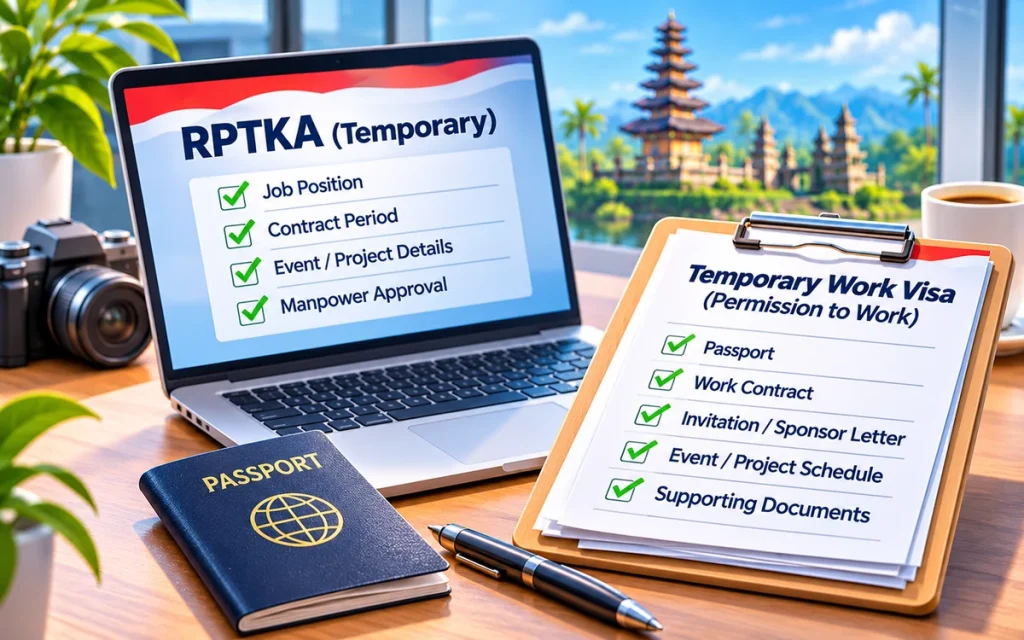
The employer must provide application information covering:
- The identity of the employer.
- The reason for using the foreign worker.
- The position to be occupied.
- The number of foreign workers.
- The period of employment or assignment.
- The work location.
The regulation also identifies supporting documents, including:
- An application letter for RPTKA approval.
- An assignment letter or power of attorney from the employer’s management.
- The employer’s Business Identification Number (NIB) and/or business license.
- The company deed and relevant approval documents, including applicable amendments.
- Evidence of mandatory manpower reporting by the company.
- The employer’s domicile information.
- A draft employment agreement or other relevant agreement.
The exact documents and submission process should be checked against the current Ministry of Manpower application system and the specific activity being proposed. The list above reflects the regulatory framework and should not be treated as a substitute for the current official checklist.
Difference Between Temporary and Regular RPTKA
Temporary-work RPTKA approval is intended for the specific activities identified in the applicable regulation. It should not be treated as interchangeable with the RPTKA route for employment lasting more than six months or other categories governed by different requirements.
The employer must select the appropriate application route based on the actual activity, the position, the work location, and the expected duration.
If the assignment changes materially after approval—for example, the foreign worker’s duties, employer, work location, or project scope changes—the employer should review whether the existing approval remains applicable.
The Six-Month Limitation
Article 20(1) of Permenaker 8/2021 provides that temporary-work RPTKA approval may be granted for a maximum period of six months and cannot be extended.
This limitation applies to the temporary-work RPTKA approval. It should not be interpreted as a universal six-month visa or stay-permit rule.
The validity of the immigration visa and the permitted period of stay are separate matters governed by the applicable immigration classification and the document issued to the foreign national.
The six-month limit is also not an automatic entitlement for every foreign professional to work in Indonesia for six months. The activity must first qualify under the temporary-work provisions, and the employer must meet the applicable requirements.
Temporary RPTKA Indonesia: Understanding the Exemptions
Permenaker 8/2021 also provides specific circumstances in which RPTKA approval does not apply.
Article 30 identifies exemptions covering:
- Certain directors or commissioners with qualifying share ownership, or shareholders, subject to the applicable investment regulations.
- Diplomatic and consular personnel working at foreign diplomatic missions.
- Foreign workers required for certain emergency production activities, vocational activities, technology-based start-up activities, business visits, and research for a specified period.
These exemptions are subject to their respective legal conditions. They should not be interpreted as a general exemption for all foreign visitors, event participants, artists, athletes, or professionals receiving payment from overseas.
For example, the fact that a foreign professional is entering Indonesia for a business visit does not mean that any professional service performed during that visit automatically qualifies as an exempt activity.
The employer should identify the specific exemption that applies and confirm whether any reporting, documentation, or immigration requirements remain applicable.
Who May Need Temporary Work Authorization?
Foreign Artists and Musicians
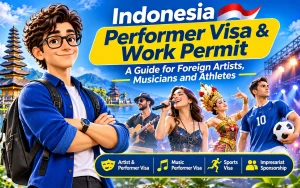
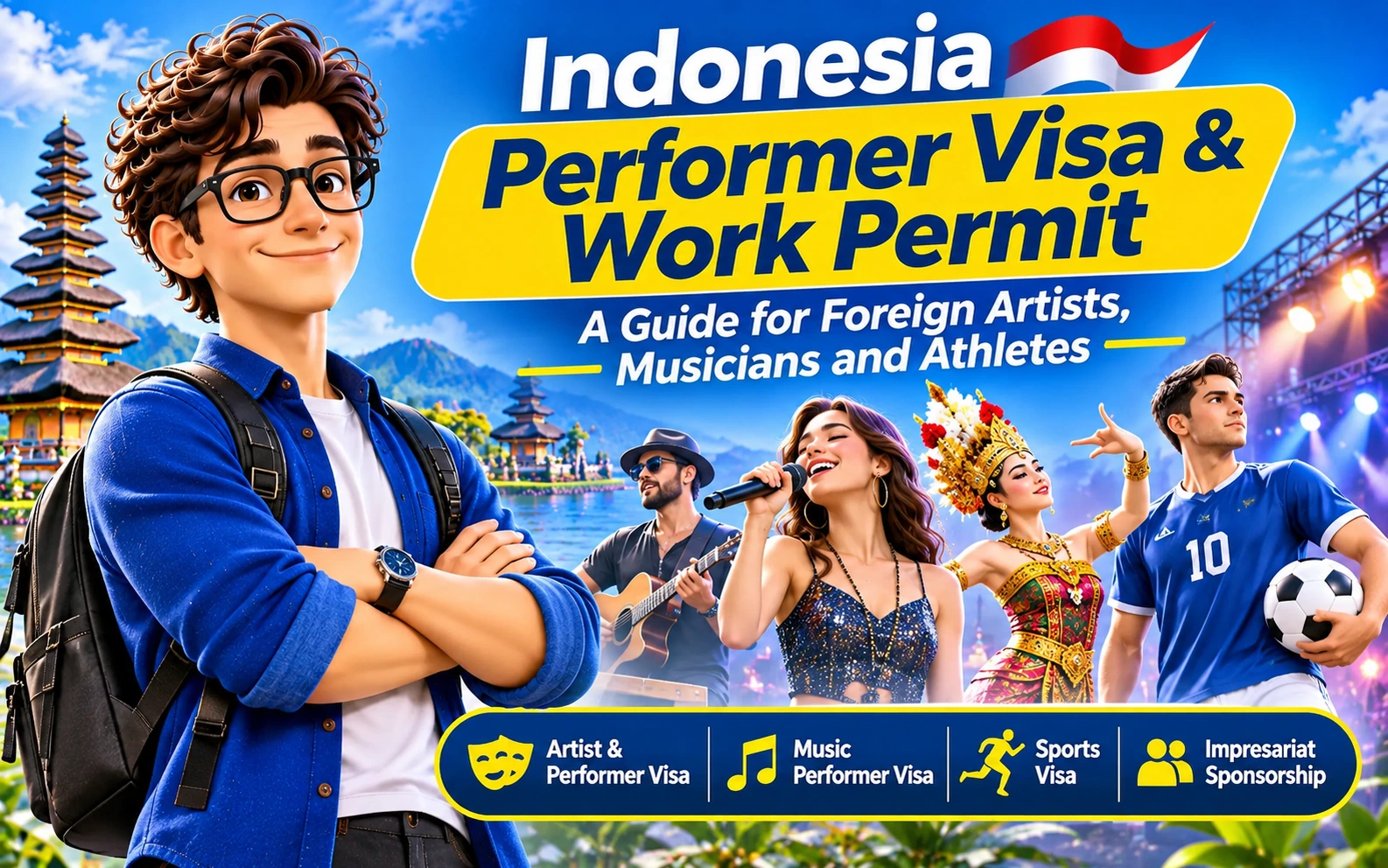
Foreign artists and musicians may travel to Indonesia for concerts, festivals, cultural performances, commercial productions, or other organized engagements.

For readers researching an Indonesia Work Visa for Foreign Artists, it is important to distinguish a temporary performance engagement from an employment arrangement, as each may involve different immigration and manpower requirements.
The appropriate immigration classification depends on the actual activity and the role of each individual. A performer, musician, technician, stage manager, and production coordinator may have different immigration requirements.
Some artistic and music-related activities have specific visit-visa classifications. However, the existence of a visit-visa category does not automatically determine whether an employer must obtain RPTKA approval under manpower regulations.
The Indonesian organizer should assess both requirements before the foreign professional begins the engagement.
Foreign Athletes and Sports Professionals
Foreign athletes and sports professionals may enter Indonesia for competitions, tournaments, sporting events, or other organized activities.

The organizer should distinguish between an athlete participating in a qualifying sporting event and a foreign professional employed by an Indonesian sports organization.
A referee, sports official, coach, trainer, consultant, and technical specialist may also perform different functions. The immigration category and any manpower requirements must be assessed according to the individual’s actual role.
Event and Production Professionals
International events may involve event managers, production coordinators, stage managers, sound and lighting specialists, technical directors, and other production personnel.

These professionals should not automatically be treated as having the same immigration status as the artists or athletes appearing at the event.
For example, a performer participating in a scheduled concert may have a different activity classification from a technician carrying out installation work or a production manager providing professional services to an Indonesian company.
The organizer should prepare a separate role description for each foreign team member and assess the appropriate legal route.
Other Eligible Temporary Professional Activities
The temporary-work provisions also cover certain technical and business-related activities, including qualifying commercial film production, audit, production quality control, inspection, machinery or electrical installation, after-sales services, and impresariat services.
Each category has its own requirements. Employers should avoid assuming that a routine business meeting, inspection visit, technical assignment, or professional service automatically qualifies for temporary RPTKA approval.
Not Sure Which Temporary Work Authorization Applies to Your Activity?
Planning a concert, sporting event, artistic performance, or temporary professional assignment in Indonesia?
Azra Solutions can help you understand the relevant immigration options, temporary RPTKA requirements, and sponsorship procedures based on your planned activities.
Temporary Work Authorization vs. Visit Visa
Understanding Professional Activities Under Visit Visas
Indonesia has specific visit-visa classifications for certain artistic, music, sporting, and event-related activities.
For example, the official immigration classification guide lists C7 for general art performers and crew, C7A for music performers, C7B for music performer crew, C8A for sports, and C8B for sports officials. The guide also lists C10 for certain invited event participants.
These classifications have different permitted activities and conditions. They should not be treated as interchangeable categories or as one universal temporary work visa.
Applicants should check the current activity description, sponsor requirements, permitted stay, and supporting documents through the official Indonesian Immigration eVisa portal before applying.
For a broader explanation of the visa options available to foreign performers, artists, musicians, and athletes, see our Indonesia Work Visa guide for sports and entertainment professionals.
When a Visit Visa May Not Be Sufficient
A visit visa may not be appropriate if the foreign national undertakes activities outside the permitted scope of the selected category.
Examples that may require closer review include:
- Performing duties that are not covered by the selected visa category.
- Entering an employment relationship with an Indonesian company.
- Providing ongoing professional services to an Indonesian organization.
- Undertaking technical or operational work outside the stated event or assignment.
- Changing the actual role or project after the visa application has been submitted.
These circumstances should be assessed against the applicable immigration and manpower provisions. The organizer should not assume that describing an engagement as a performance, meeting, or cultural visit removes other legal obligations.
C10 and Invited Event Participants
C10 is an activity-specific visit-visa category associated with certain meetings, incentives, conventions, exhibitions, and similar events where a foreign national participates as a speaker, lecturer, presenter, or invited public figure.
It should not be treated as a general work visa for all event professionals, performers, production crew, athletes, or consultants.
The applicant and Indonesian organizer should review the official C10 activity description and conditions before relying on this category. A person undertaking activities outside the permitted scope may require a different immigration assessment.
Sponsor and Employer Responsibilities
Indonesian Employer and Sponsoring Entity
The Indonesian organization involved in a temporary professional engagement should clarify its legal role.
Depending on the arrangement, the organization may act as the employer, event organizer, contracting party, immigration guarantor, or payment entity. These roles may be held by different organizations, but the relationship between them should be properly documented.
The organization must also confirm that it is eligible to act in the relevant capacity under the applicable manpower and immigration rules.
RPTKA and Supporting Documentation
Where temporary-work RPTKA approval is required, the employer must submit the information and supporting documents prescribed by the relevant regulations.
The employer should ensure that the proposed position, work location, project duration, contractual arrangement, and identity of the foreign worker are consistent throughout the application documents.
Article 16 of Permenaker 8/2021 also requires an insurance policy for foreign workers covered by temporary-work RPTKA approval. The insurance must provide protection at least for the risk of occupational accidents.
Under Article 21, approved RPTKA documentation is used as a recommendation for obtaining the relevant work visa and stay permit. It is therefore part of the manpower process and does not replace the immigration documents required for the foreign national.
Impresariat Company Responsibilities
Government Regulation No. 34 of 2021 recognizes an impresariat services business as one of the employer categories that may employ foreign workers.
Permenaker 8/2021 also includes impresariat services among the activities for which temporary-work RPTKA approval may be requested.
This is relevant to certain artistic and performance engagements involving foreign professionals. However, it does not mean that every event organizer, talent agency, entertainment company, or production company automatically qualifies as an impresariat employer.
The company should verify its legal business status, registered business activities, licensing, contractual role, and eligibility under the applicable manpower and immigration regulations.
An impresariat company must also ensure that the foreign professional’s actual duties, immigration category, and supporting documents are consistent with the approved arrangement.
Application Process for Temporary Work Arrangements
Step 1: Define the Professional Activity
Prepare a clear description of the proposed assignment. Identify the foreign professional’s duties, the project or event, the work location, the expected duration, and the Indonesian organization involved. The description should distinguish between performers, athletes, officials, technical crew, consultants, and other professional roles.
Step 2: Identify the Employer and Sponsor
Confirm which Indonesian entity is responsible for the engagement and determine whether it will act as the employer, immigration guarantor, or event organizer. Check that the organization is legally eligible for the role it intends to perform.
Step 3: Assess RPTKA Requirements
Compare the proposed activity with Article 8 of Permenaker 8/2021 to determine whether it may qualify for temporary-work RPTKA approval. If an exemption under Article 30 may apply, identify the exact legal basis and confirm the relevant conditions. Do not assume that an assignment is exempt simply because it is short-term or connected with an event.
Step 4: Select the Appropriate Immigration Category
Review the current official immigration classification and confirm that the proposed activity falls within the permitted scope. The immigration category should match the foreign professional’s actual duties, the event or assignment, and the applicable sponsor requirements.
Step 5: Prepare the Required Documents
Prepare the RPTKA application documents if approval is required. Separately prepare the immigration application documents for the selected visa category. Check that the role, dates, work location, sponsor, and contractual information are consistent across all documents.
Step 6: Complete the Relevant Application Process
Submit the required manpower application through the applicable Ministry of Manpower system and complete the immigration application through the official process. The employer and foreign professional should follow the current application instructions and respond to any additional document requests from the relevant authorities.
Step 7: Maintain Compliance During the Assignment
The foreign professional should undertake only the activities permitted by the issued immigration document and applicable manpower approval. If the project, role, work location, employer, or duration changes, the organization should review the legal implications before the foreign professional continues the revised assignment.
Required Documents and Preparation
The exact document checklist depends on the activity, employer, sponsor, RPTKA category, and immigration classification.
For a temporary-work RPTKA application, the regulatory framework identifies documents and information such as:
- Employer identity and corporate information.
- The reason for employing the foreign worker.
- Proposed position and number of foreign workers.
- Assignment period and work location.
- RPTKA application letter.
- Assignment letter or authorization from the employer’s management.
- NIB and/or applicable business license.
- Company deed and relevant approval documents.
- Evidence of mandatory manpower reporting.
- Employer domicile information.
- Draft employment agreement or other relevant agreement.
- Insurance protection covering at least occupational accident risk.
For the immigration application, additional documents may be required depending on the selected visa category. These may include the foreign national’s passport, photograph, invitation or engagement letter, event schedule, role description, and sponsor documentation.
The employer and applicant should always confirm the latest official checklist before submitting an application.
Duration, Extensions and Compliance Limitations
The validity of a temporary-work RPTKA approval and the permitted stay under an immigration document are separate matters.
Under Article 20(1) of Permenaker 8/2021, temporary-work RPTKA approval may be issued for a maximum period of six months and cannot be extended.
The immigration visa and stay permit may have different validity and extension provisions depending on the selected classification.
If a professional engagement is expected to continue beyond the approved temporary-work period, the employer should assess the appropriate legal route before the existing approval expires. It should not assume that temporary-work RPTKA approval can simply be extended.
Employers and sponsors should retain copies of the relevant approvals, contracts, invitations, work schedules, and immigration documents to demonstrate that the actual engagement remains consistent with the approved arrangement.
Common Mistakes Foreign Professionals and Employers Should Avoid
Assuming Every Short-Term Assignment Is Exempt
A short assignment does not automatically remove the need for work-related immigration permission or manpower approval. The applicable legal category and any exemption must be assessed.
Treating RPTKA as a Visa
RPTKA approval is a manpower document. It does not independently authorize a foreign national to enter or remain in Indonesia.
Assuming Every Event Professional Has the Same Visa Requirements
Performers, musicians, athletes, sports officials, event speakers, and production crew may carry out different activities. Their immigration requirements should be assessed individually.
Assuming Every Event Company Qualifies as an Impresariat Employer
The company must meet the relevant legal and business requirements. Simply describing a company as an event organizer or talent agency does not automatically establish eligibility under the foreign-worker regulations.
Using Inconsistent Application Documents
Differences in job titles, event dates, sponsor details, work locations, or contractual information may create problems during the application process. The employer should prepare a consistent description of the engagement and check the supporting documents before submission.
Continuing Work Outside the Approved Scope
A foreign national should not assume that an existing visa or RPTKA approval covers a different role, employer, work location, or professional activity. Any material change should be reviewed before the revised activity begins.
Frequently Asked Questions
Is Indonesia Temporary Work Visa an Official Visa Category?
No. Indonesia Temporary Work Visa is a general search phrase rather than the official name of one universal visa category. The appropriate immigration classification depends on the foreign national’s actual activity, while RPTKA requirements are assessed separately under manpower regulations.
What Is a Temporary Work Permit in Indonesia?
The term is commonly used to describe the authorization process for temporary professional assignments. Under the manpower framework, the relevant document is an approved RPTKA for temporary work, where the activity qualifies and approval is required.
Who Can Apply for Temporary RPTKA Approval?
An eligible Indonesian employer may apply for temporary-work RPTKA approval for activities identified under Article 8 of Permenaker 8/2021. The employer must satisfy the applicable conditions and submit the required information and supporting documents.
Does Every Foreign Artist Need Temporary RPTKA Approval?
Not necessarily. The requirement depends on the actual activity, the employer or organizer, the contractual relationship, and the applicable manpower provisions or exemptions. A specific immigration category for an artistic activity does not automatically settle the RPTKA question.
Can Foreign Athletes Use Temporary RPTKA?
The employer must assess the nature of the athlete’s engagement and the relevant legal provisions. Participation in a qualifying sporting event and employment by an Indonesian sports organization may involve different legal considerations.
How Long Is Temporary RPTKA Approval Valid?
Article 20(1) of Permenaker 8/2021 provides that temporary-work RPTKA approval may be issued for a maximum of six months.
Can Temporary RPTKA Approval Be Extended?
No. Temporary-work RPTKA approval under Article 20(1) cannot be extended. If the assignment will continue, the employer should assess the appropriate legal route before the existing approval ends.
Does RPTKA Approval Automatically Authorize Entry Into Indonesia?
No. RPTKA approval is part of the manpower process. The foreign national must also obtain the appropriate immigration visa and stay permission for the intended activity.
Can an Indonesian Impresariat Company Employ Foreign Artists?
An eligible impresariat services business is recognized within the foreign-worker employer framework. However, the company must meet the applicable legal and business requirements and obtain the relevant approval where required.
Where Can the Current Visa Requirements Be Checked?
Applicants should review the current visa classification, permitted activities, sponsor requirements, and application documents through the official Indonesian Immigration eVisa portal.
Need Help With Temporary Work Arrangements in Indonesia?
Understanding the right immigration and manpower procedures can be challenging, especially when arranging temporary professional engagements involving foreign artists, athletes, performers, and event professionals.
Azra Solutions provides immigration consultation and assistance to help foreign professionals and Indonesian organizations understand the relevant visa options, RPTKA requirements, and sponsorship procedures.
Contact our team to discuss your planned activities and determine the appropriate immigration process.
For broader information about work-related immigration options, read our Indonesia Work Visa guide for sports, entertainment and performing arts professionals.
Official application portal: evisa.imigrasi.go.id.
Official Legal References
Government Regulation No. 34 of 2021 on the Use of Foreign Workers
Minister of Manpower Regulation No. 8 of 2021