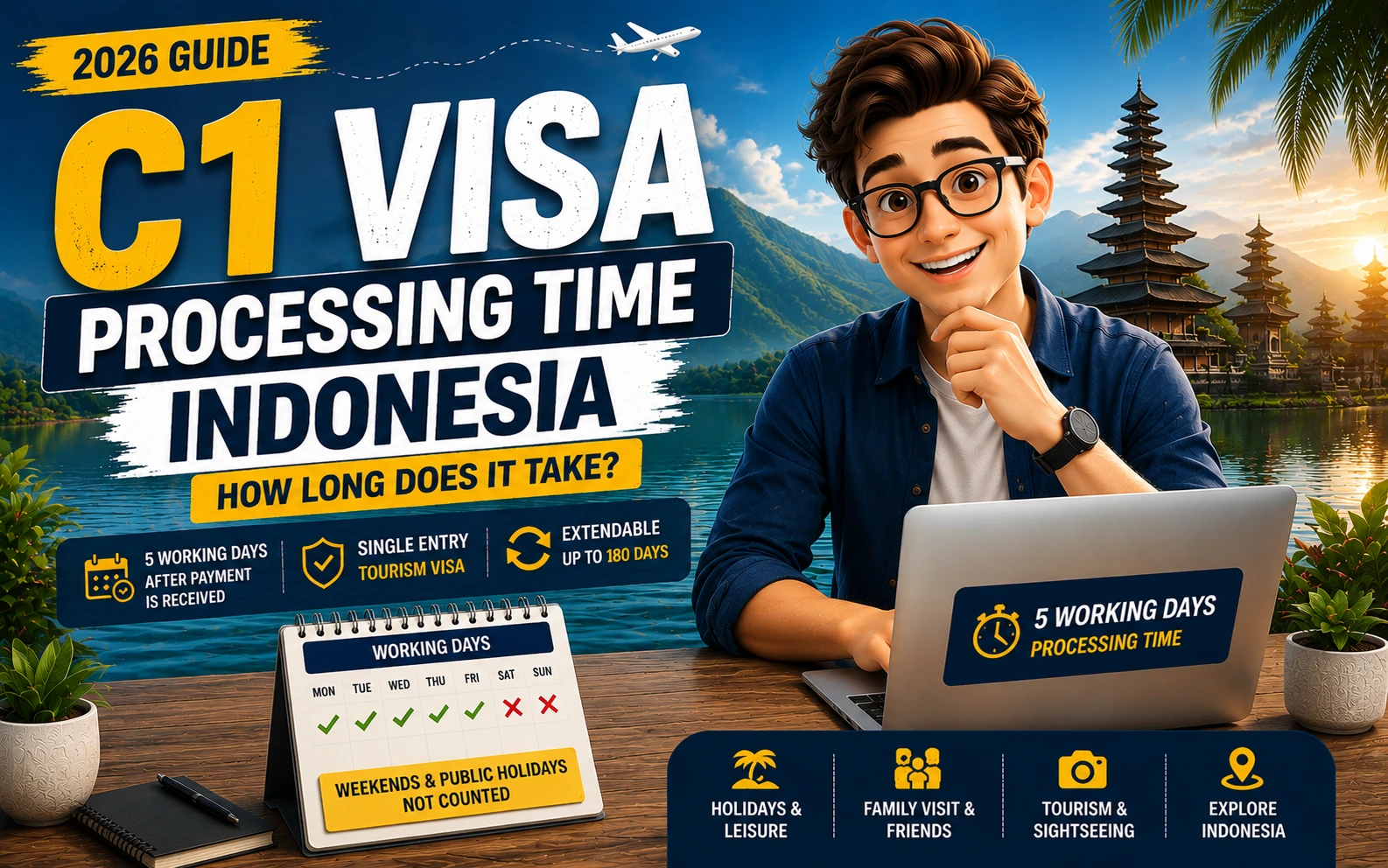
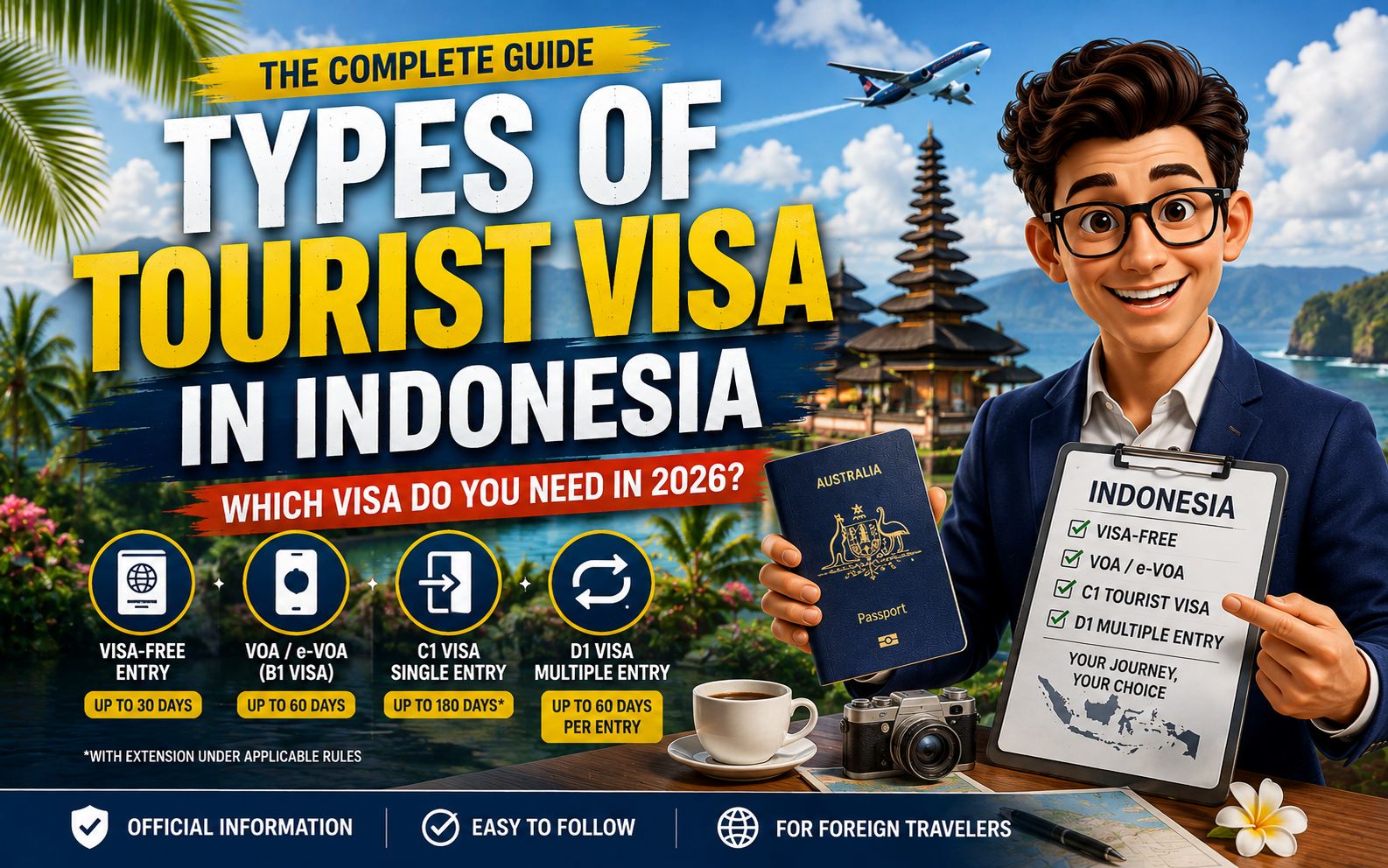
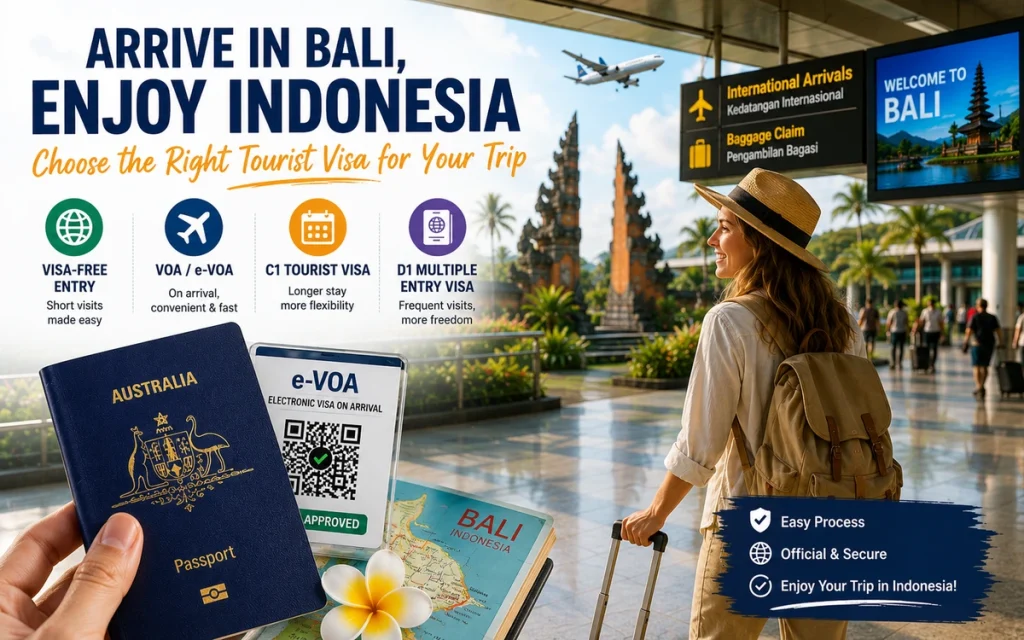
Planning a trip to Indonesia is exciting, but choosing the right visa can be confusing. Depending on your nationality, how long you plan to stay, and how often you intend to visit, you may be able to enter through Visa-Free Entry, apply for a B1 Visa on Arrival (VOA) or e-VOA, or arrange a C1 single-entry tourist visa or D1 multiple-entry tourist visa before travelling.
The right option is not the same for every traveler. A short holiday in Bali may require a different visa strategy from a two-month trip around Indonesia or regular visits throughout the year. It is also important to understand the difference between visa validity, the permitted length of stay, the number of entries allowed, and whether your stay can be extended.
Indonesia’s visitor visa system includes several categories for tourism, with B1 designated as a Visa on Arrival category, C1 as a single-entry tourism visitor visa, and D1 as a multiple-entry tourism visitor visa. Visa-Free Entry may also be available to eligible nationals under Indonesia’s current immigration policy.
In this guide, we explain the main types of tourist visas available for Indonesia, who each option is best suited for, how long you may stay, whether an extension may be available, and how to choose the most suitable visa for your travel plans. Whether you are visiting Bali for a short holiday, planning a longer trip through Indonesia, or returning to the country regularly, this guide will help you understand your options before you travel.
“Because Indonesian immigration rules, eligible nationalities, stay periods, and visa procedures can change, always check the latest applicable requirements before submitting an application or travelling.“
1. Quick Answer: What Types of Tourist Visas Are Available in Indonesia?
Indonesia offers several options for foreign visitors travelling for tourism. The right option depends mainly on your nationality, how long you plan to stay, whether you may need to extend your stay, and whether you plan to visit Indonesia once or return regularly.
In general, the four main options covered in this guide are Visa-Free Entry, the B1 Visa on Arrival (VOA) or e-VOA, the C1 Tourist Visa, and the D1 Multiple Entry Tourist Visa. Not every traveler is eligible for every option, so checking the current requirements before travelling is essential.
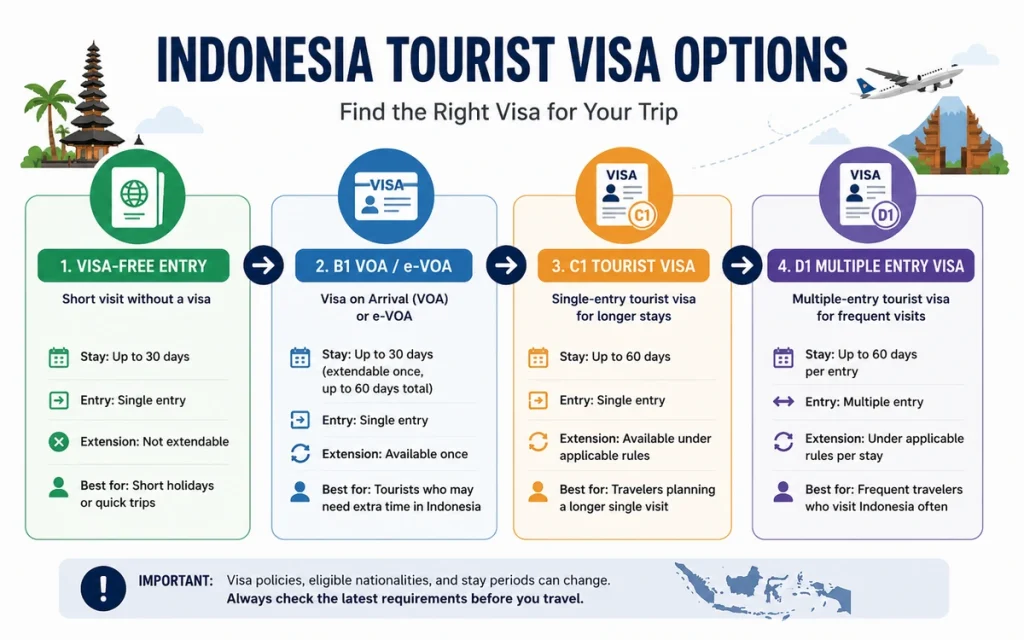
The Main Tourist Visa Options at a Glance
| Option | Best For | Initial Stay | Extension | Entry Type |
| Visa-Free Entry | Eligible travelers taking a short trip | Up to 30 days | Not extendable | Single entry |
| B1 VOA / e-VOA | Eligible travelers visiting for a short stay who may need extra time | Up to 30 days | May be extended once, up to a total stay of 60 days | Single entry |
| C1 Tourist Visa | Travelers planning a longer single visit and arranging a visa before travel | Up to 60 days | May be extended under applicable rules, up to the permitted maximum stay | Single entry |
| D1 Multiple Entry Tourist Visa | Frequent visitors who plan to enter Indonesia multiple times | Up to 60 days per entry | Depends on the applicable stay permit rules | Multiple entry |
Which Option Should You Choose?
For a Short Holiday: Visa-Free Entry or B1 VOA/e-VOA
If you are planning a short holiday in Indonesia, the first step is to check whether your nationality is eligible for Visa-Free Entry. If you qualify, this may be the simplest option for a stay of up to 30 days, but it cannot be extended.
If you are not eligible for Visa-Free Entry but your nationality is included in Indonesia’s Visa on Arrival program, the B1 VOA or e-VOA may be more suitable. It provides an initial stay of up to 30 days and may be extended once, allowing a total stay of up to 60 days under the applicable immigration rules.
For a Longer Single Visit: C1 Tourist Visa
If you plan to stay longer than a typical short holiday, the C1 Tourist Visa may be a more suitable option. It is a single-entry visitor visa with an initial stay of up to 60 days and may be extended subject to the applicable immigration rules and permitted maximum stay.
For Frequent Visits: D1 Multiple Entry Tourist Visa
If you travel to Indonesia regularly, the D1 Multiple Entry Tourist Visa may offer greater flexibility than applying for a new single-entry tourist visa before every trip. However, multiple entry does not mean unlimited time in Indonesia. Each visit remains subject to the visa’s applicable stay conditions and immigration rules.
The Most Important Thing to Remember
Before choosing a visa, do not look only at the visa name or fee. You should also check whether your nationality is eligible, how long you are permitted to stay, whether the visa allows multiple entries, whether an extension is available, and what activities are permitted during your visit.
The following sections explain each option in more detail and help you compare Visa-Free Entry, B1 VOA/e-VOA, C1, and D1 before deciding which tourist visa is most suitable for your trip to Indonesia.
2. How to Choose the Right Tourist Visa for Indonesia
Choosing the right tourist visa for Indonesia should start with your travel plan rather than simply choosing the visa with the lowest fee or the longest possible stay. The best option depends on four main factors: your nationality, how long you intend to remain in Indonesia, whether you expect to leave and return, and whether you may need to extend your stay.
A traveler visiting Bali for two weeks, for example, may have very different visa needs from someone planning a longer trip around Indonesia. Likewise, a person who visits Indonesia once a year may choose a different option from a frequent visitor who enters the country several times during the same visa validity period.
Step 1: Check Your Nationality and Eligibility
Your nationality is one of the first factors to check because eligibility differs between visa categories. Some passport holders may be eligible for Visa-Free Entry, while others may qualify for a B1 Visa on Arrival or e-VOA. Travelers who are not eligible for these options may need to apply for another visitor visa, such as C1, before travelling.
Do not assume that a friend or family member with a different passport has access to the same visa options. Indonesia’s eligible-country lists and immigration policies can change, so always check the current rules for the passport you will use to enter Indonesia.
Step 2: Decide How Long You Plan to Stay
Up to 30 Days
For a short holiday, Visa-Free Entry may be suitable if your nationality is eligible and your trip fits within the permitted stay period. If you are eligible for the B1 VOA or e-VOA, that option may also be appropriate for a short visit, particularly if you want the possibility of extending your stay later under the applicable rules.
More Than 30 Days
If your trip may exceed 30 days, you should consider your extension options before travelling. A B1 VOA/e-VOA may be extended once under the applicable rules, while a C1 Tourist Visa may be more suitable for travelers planning a longer single visit from the beginning.
Longer Tourism Stays
For longer tourism plans, compare the initial stay period and the maximum permitted stay available through the relevant extension process. Do not confuse a visa’s validity period with the amount of time you are permitted to remain in Indonesia during a single stay.
Step 3: Decide Whether You Need Single or Multiple Entry
If you plan to enter Indonesia once and remain until the end of your trip, a single-entry option such as Visa-Free Entry, B1, or C1 may be sufficient, depending on your eligibility and intended stay.
If you expect to leave Indonesia and return several times, a multiple-entry visa such as D1 may be more practical. However, you should check the exact conditions of the visa carefully. A multiple-entry visa does not automatically allow you to remain in Indonesia continuously for the entire period of the visa’s validity.
Step 4: Think About Whether You May Need an Extension
If there is a realistic possibility that your trip will become longer than originally planned, extension eligibility should be part of your decision from the beginning. Visa-Free Entry is generally not extendable, while other visa categories may have extension options subject to current immigration rules and requirements.
It is better to choose an appropriate visa before travelling than to assume that every tourist visa can simply be extended after arrival. Extension procedures, timing, fees, and eligibility can differ depending on the visa and the regulations in force at the time of your application.
Step 5: Make Sure Your Planned Activities Match Your Visa
A tourist visa should be selected not only based on the length of stay but also on the purpose of your visit. Tourism and permitted visitor activities are different from working, receiving employment-related income, or carrying out other activities that require a different immigration status.
Before travelling, make sure that your intended activities are permitted under the visa you choose. If your purpose is not purely tourism, you may need to consider another visa category rather than relying on a tourist visa.
A Simple Way to Choose
As a practical starting point, choose Visa-Free Entry if you are eligible and only need a short, non-extendable visit. Consider the B1 VOA/e-VOA if you are eligible for a short visit and want an option that may allow additional time through an extension. Consider C1 if you are planning a longer single visit and want to arrange the appropriate tourist visa before travelling. Consider D1 if you are a frequent traveler who needs multiple entries rather than a new single-entry visa for every trip.
Once you understand these four factors—nationality, length of stay, number of entries, and extension needs—you can narrow down the tourist visa options that are most relevant to your trip. The next sections explain each visa type in more detail.
3. Visa-Free Entry to Indonesia
Visa-Free Entry is the simplest option for eligible foreign travelers who are planning a short visit to Indonesia. If your passport is covered by Indonesia’s current Visa-Free Visit policy, you can enter without applying for a visa in advance and without paying a visa fee for the entry facility.
However, eligibility for Visa-Free Entry is limited to the nationalities and other subjects covered by the current policy. Indonesia’s list is not fixed permanently and can be updated through changes in immigration regulations. For that reason, travelers should check the latest official list before relying on Visa-Free Entry for their trip.
How Long Can You Stay With Visa-Free Entry?
Eligible travelers can generally stay in Indonesia for up to 30 days from the date of arrival under the Visa-Free Entry facility. This option is designed for a short visit and is not suitable for travelers who already know they will need to remain beyond the permitted stay period.
The permitted stay should not be confused with any broader change to Indonesia’s visa-free policy. Even when additional countries or territories are added to the program, the applicable conditions for each entry category should still be checked before travel.
Can Visa-Free Entry Be Extended?
No. A stay granted through Visa-Free Entry cannot be extended. Travelers who need to remain in Indonesia beyond the permitted period should not assume that they can simply apply for an extension after arrival.
If there is a realistic possibility that you will need more than 30 days, consider a visa category with an applicable extension option, such as the B1 VOA/e-VOA where eligible, or another suitable visitor visa arranged before travelling.
Who Is Visa-Free Entry Best For?
Visa-Free Entry is generally most suitable for travelers who meet all of the following conditions:
- Your nationality or other qualifying status is included in Indonesia’s current Visa-Free Visit policy.
- You are planning a short visit that fits within the permitted stay period.
- You do not expect to need an extension.
- You are entering Indonesia for activities permitted under the Visa-Free Entry facility.
- You are comfortable with the fact that the facility is generally not designed for a longer or flexible stay.
For a straightforward holiday that fits these conditions, Visa-Free Entry can be the most convenient option because there is no separate visa application to complete before arrival.
Who Should Consider Another Visa Instead?
You should consider another visa option if you are not included in the current Visa-Free Entry policy, plan to stay beyond the permitted period, expect that your travel dates may change, or need an entry arrangement that offers greater flexibility.
For example, an eligible traveler who plans to stay for 45 days may find the B1 VOA/e-VOA more suitable than Visa-Free Entry because the B1 route can offer an initial stay of up to 30 days with a possible extension under the applicable rules. A traveler planning a longer single visit from the outset may instead consider whether the C1 Tourist Visa is more appropriate.
Important: Do Not Rely on Old Visa-Free Country Lists
Older articles often state that Indonesia provides Visa-Free Entry to more than 160 countries. That information should not be used as a current guide. Indonesia’s Visa-Free Visit policy has been revised in recent years, and the list of eligible countries and other subjects may change.
In July 2026, the Indonesian government added six additional subjects to the Visa-Free Visit list: Türkiye, Brazil, Peru, Kazakhstan, Macau, and Belarus. The change was made under Regulation of the Minister of Immigration and Corrections No. 10 of 2026, which replaced the previous 2025 regulation. This is a clear example of why travelers should check the current official rules rather than relying on an old list found online.
Visa-Free Entry vs B1 Visa on Arrival
The main practical difference is flexibility. Visa-Free Entry is free and convenient for an eligible short visit, but the stay is not extendable. The B1 VOA/e-VOA, on the other hand, requires eligibility and payment of the applicable fee but may provide a more flexible option for travelers who may need additional time.
The best choice depends on your passport, planned length of stay, and whether there is any chance that you will need to remain in Indonesia longer than the initial 30-day period.
Check Your Eligibility Before Travelling
Before booking a trip based on Visa-Free Entry, confirm that your passport is currently eligible and review the latest entry requirements. Visa-free policies can change, and eligibility should always be checked against the most recent official Indonesian immigration information.
For a complete and regularly updated breakdown of eligible nationalities, see our dedicated guide to Indonesia Visa-Free Countries. You can then compare that option with B1 VOA/e-VOA, C1, and D1 to decide which tourist visa arrangement best fits your trip.
4. B1 Visa on Arrival (VOA and e-VOA)
The B1 Visa on Arrival is one of the most popular options for eligible foreign travelers visiting Indonesia for a short stay. Depending on the way you apply, you can obtain the visa on arrival at an eligible Indonesian immigration checkpoint or apply for an electronic Visa on Arrival (e-VOA) before travelling.
Both options fall under the B1 visa category. The main difference is when and how the visa is obtained. A standard Visa on Arrival is generally arranged after you arrive at an eligible entry point, while an e-VOA allows eligible travelers to complete the application and payment process before departure.
What Can You Do With a B1 Visa?
The B1 Visa is not limited to tourism. Under the current visa classification, permitted activities can include tourism, visiting family, attending meetings, incentives, conventions, exhibitions or similar events, and transiting through Indonesia to another country.
However, a B1 Visa is not a work permit. You should not use it to sell goods or services or receive wages, compensation, or similar remuneration for work or business activities from an individual or company in Indonesia. If your primary purpose is employment or another activity requiring a different immigration status, you should choose the appropriate visa category instead.
Who Is Eligible for B1 VOA or e-VOA?
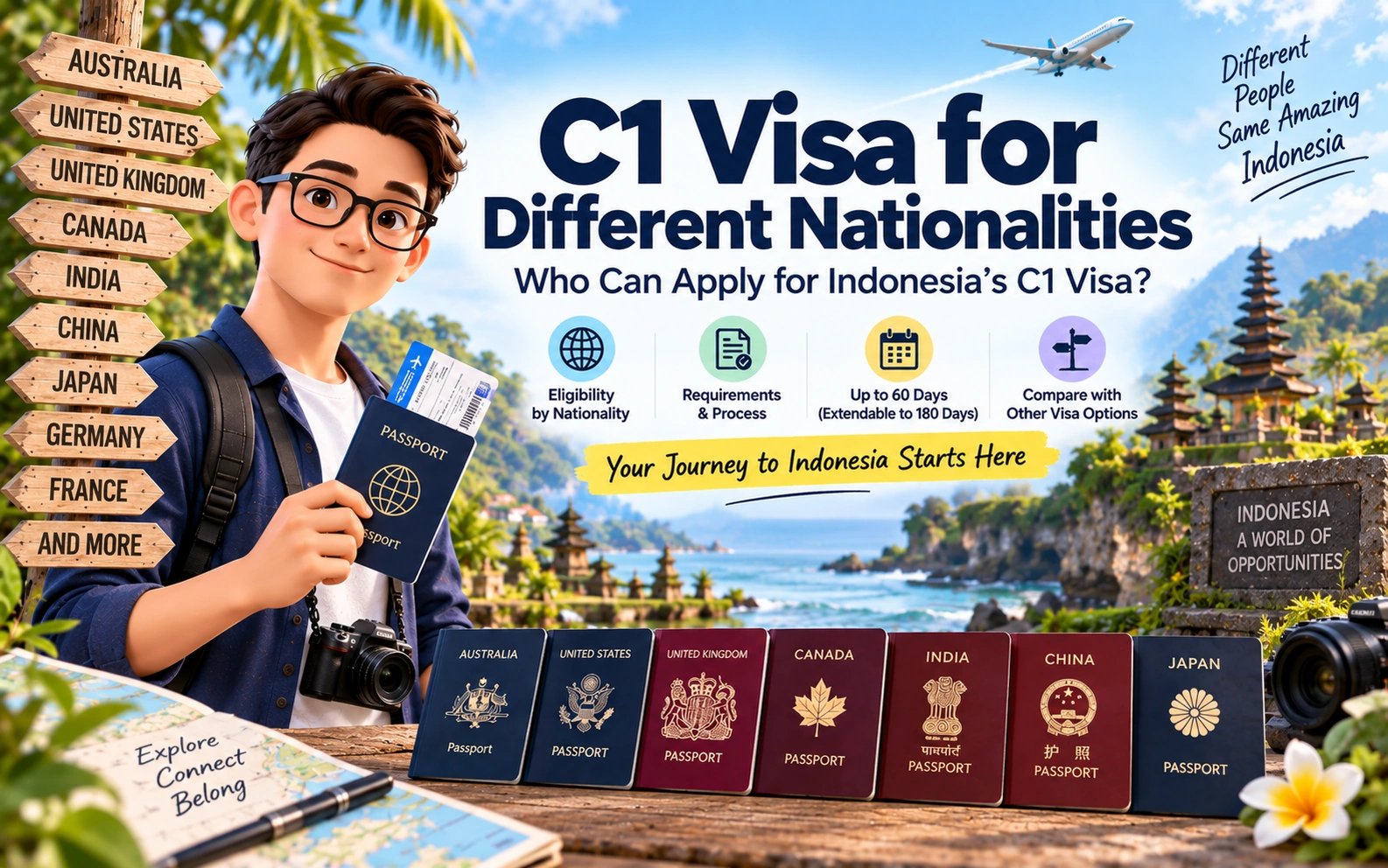
B1 VOA and e-VOA are only available to passport holders and other subjects included in Indonesia’s current Visa on Arrival eligibility list. Not every nationality qualifies, so eligibility should always be checked before travelling.
The eligible-country list can be revised by the Indonesian government. Do not rely on an old list from a travel blog or assume that a nationality is eligible simply because it was included in a previous year.
VOA vs e-VOA: What Is the Difference?
| Feature | VOA | e-VOA |
| When you apply | After arriving at an eligible immigration checkpoint | Before travelling to Indonesia |
| How you pay | At the designated payment counter or bank at the arrival area | Online payment during the electronic application process |
| B1 visa category | Yes | Yes |
| Initial permitted stay | Up to 30 days | Up to 30 days |
| Extension | May be extended once under the applicable rules | May be extended once under the applicable rules |
| Entry | Single entry | Single entry |
For many travelers, the practical advantage of e-VOA is convenience before departure. If you complete the application successfully in advance, you can arrive with the electronic visa already issued instead of arranging the visa payment process after landing.
How Long Can You Stay With B1?
The B1 Visa provides an initial permitted stay of up to 30 days, calculated from the date of arrival in Indonesia. The B1 stay may generally be extended once for an additional period of up to 30 days, allowing a total stay of up to 60 days, subject to the applicable immigration rules.
It is important to distinguish the permitted stay from the validity period of an e-VOA before entry. An e-VOA may have a period within which it must be used to enter Indonesia, but once you arrive, your permitted stay is calculated according to the stay conditions of the B1 visa.
Can You Extend a B1 VOA or e-VOA?
Yes, the B1 stay may generally be extended once, allowing the total permitted stay to reach up to 60 days. The extension should be arranged before your permitted stay expires.
For e-VOA holders, the extension may be available through the official electronic immigration system. Holders of a non-electronic VOA may need to follow the applicable extension process through immigration. Procedures can change, so always check the current official instructions before applying.
How Much Does the B1 Visa Cost?
The official B1 Visa on Arrival fee is Rp500,000. Additional costs may apply if you later extend your stay, depending on the applicable immigration fee and process at that time.
Because government fees and payment procedures can change, travelers should confirm the current amount through the official Indonesian immigration system before applying or travelling.
B1 e-VOA: Applying Before You Travel
Eligible travelers can apply for an e-VOA before travelling through the official Indonesian immigration e-Visa system. The application generally requires accurate passport information and other details required by the system, and the approved e-VOA must be used within its stated validity period.
Make sure that the information in your application matches your passport exactly. An error in passport details can cause problems with the validity or use of the e-VOA. An approved visa also does not guarantee entry, because the final decision to allow entry remains with the immigration officer at the border.
B1 VOA: Applying After Arrival
If you are eligible for a standard VOA, you may apply after arriving at an eligible Indonesian airport, seaport, or other designated immigration checkpoint. The visa is processed through the arrival procedure, including payment of the applicable fee, before you proceed through immigration.
This option can be convenient for travelers who did not apply for an e-VOA in advance. However, applying online before departure may reduce the number of steps you need to complete after landing.
What Documents Should You Prepare?
The exact requirements can depend on the current immigration system and your individual travel circumstances. As a practical starting point, you should prepare a passport that meets Indonesia’s applicable validity requirements, a return or onward travel ticket where required, and any additional information requested during the visa application or arrival process.
Always review the latest requirements before departure. Immigration officers may also assess whether you meet the applicable entry conditions when you arrive in Indonesia.
When Is B1 Better Than Visa-Free Entry?
If you are eligible for both options and your trip will definitely end within 30 days, Visa-Free Entry may be simpler because no visa fee is required. However, the B1 VOA/e-VOA can be a better option if you want the possibility of extending your stay, subject to the current rules.
For example, a traveler planning to stay in Indonesia for around 45 days would generally need an option other than Visa-Free Entry. If eligible, B1 may be suitable because it offers an initial stay of up to 30 days with the possibility of one extension, allowing a total stay of up to 60 days.
Who Should Choose B1 VOA or e-VOA?
The B1 VOA or e-VOA may be a suitable option if:
- Your nationality is included in Indonesia’s current Visa on Arrival eligibility list.
- You are visiting Indonesia for tourism or another activity permitted under the B1 category.
- You plan a short stay of up to 30 days, or you may need the option to extend to a total stay of up to 60 days.
- You only need one entry for the trip.
- You do not plan to carry out employment or other activities that require a different visa or residence status.
The Key Point to Remember
The choice between VOA and e-VOA is mainly about convenience, while both use the B1 visa category and follow the same general stay framework. Your more important decision is whether B1 is the right visa for your nationality, travel purpose, length of stay, and extension needs.
If you already know that you will need a longer single visit from the beginning, the next option to consider is the C1 Tourist Visa.
5. C1 Tourist Visa Indonesia
The C1 Tourist Visa is designed for foreign travelers who need a longer single visit to Indonesia or who are not eligible for Visa-Free Entry or the B1 Visa on Arrival program. Unlike B1, the C1 visa is arranged before you travel and allows a longer initial stay of up to 60 days from the date of arrival.
C1 is a single-entry visitor visa. Once you leave Indonesia, the visa cannot normally be used to enter again, even if you have not used the full permitted stay. If you need to enter Indonesia multiple times, you should consider a multiple-entry option instead.
What Can You Do With a C1 Tourist Visa?
The C1 visa can be used for tourism and other visitor activities permitted under the applicable visa classification. These can include tourism, personal development, learning about Indonesia’s tourist attractions, and cruise travel. Depending on the applicable C1 activity provisions, certain meetings, incentives, conventions, exhibitions, discussions, negotiations, or other specifically permitted visitor activities may also be allowed.
However, C1 is not a work visa. A C1 holder must not sell goods or services or receive wages, compensation, or similar remuneration for work or business activities from an individual or corporation in Indonesia. If your planned activities involve employment or work that requires another immigration status, you should apply for the appropriate visa instead.
How Long Can You Stay With a C1 Visa?
The first stay permit under a C1 visa is valid for up to 60 days from the date of arrival in Indonesia. The stay can be extended under the applicable immigration rules, with the current official C1 information stating that extensions may be granted multiple times up to a maximum total stay of 180 days.
This makes C1 a practical option for travelers planning a longer single stay. However, the visa itself is still single entry, so leaving Indonesia ends that stay. A later return generally requires a new valid visa or another appropriate entry permission.
C1 Visa Validity vs Permitted Stay
One of the most important points to understand is the difference between visa validity and your permitted stay after arrival. Current official C1 information states that the visa may be valid for 90 days from the date of issuance for entry into Indonesia. Once you enter, your first permitted stay is up to 60 days from the date of arrival.
In simple terms, the 90-day period relates to the time available to use the visa for entry, while the 60-day period relates to how long you may initially stay after arriving. Always check the details printed or stated on your own approved visa because the applicable dates are controlling.
Can You Extend a C1 Tourist Visa?
Yes. A C1 stay permit can be extended under the applicable immigration rules. The current official information states that the stay may be extended multiple times, up to a maximum total stay of 180 days.
Do not wait until the final day of your permitted stay to begin planning an extension. The process, required documents, sponsor involvement, and timing should be checked well before your current stay expires.
Who Needs a Sponsor for C1?
The current official C1 visa information states that a guarantor or sponsor is required for the application. The sponsor must generally have a registered account in the official Indonesian e-Visa system and submit the application for the foreign national being sponsored.
This is an important difference from the B1 VOA/e-VOA route. If you are choosing C1, you should arrange the sponsorship and application process before making travel plans that depend on visa approval.
What Are the Main C1 Visa Requirements?
The exact requirements should always be checked in the official e-Visa system before an application is submitted. Based on the current official C1 information, the main documents generally include the following:
- A valid passport with at least the required remaining validity period.
- A sponsor or guarantor application and the required sponsor documents.
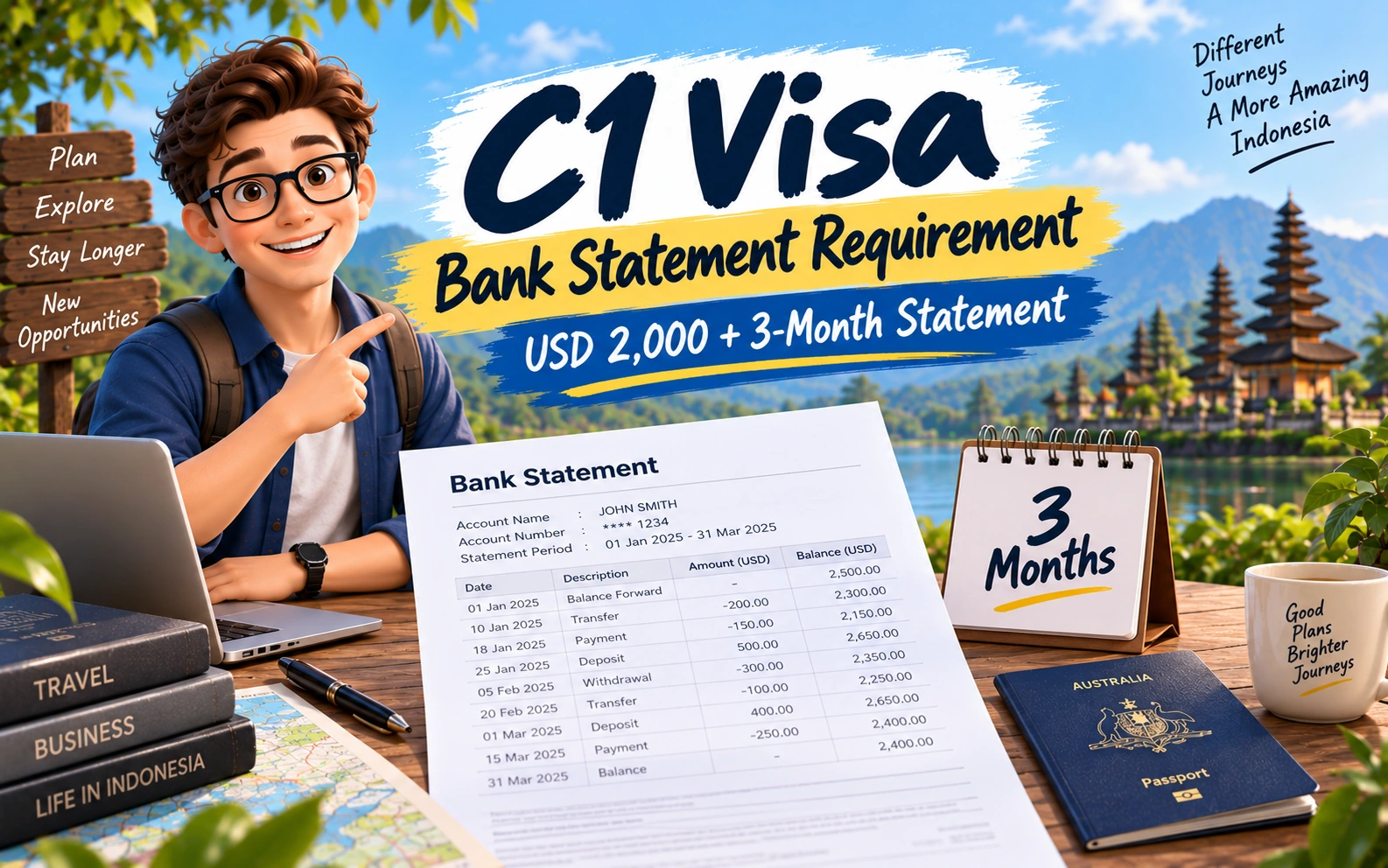
- Proof of sufficient funds, with current official C1 guidance referring to bank statements for the previous three months showing at least the equivalent of USD2,000.
- A recent color photograph that meets the required specifications.
- Additional travel or supporting documents where required for the applicant’s circumstances.
Requirements can vary depending on the applicant and the current immigration system. Always follow the document list and specifications shown during the official application process.
How Much Does the C1 Tourist Visa Cost?
The current official C1 visa information lists the government visa fee at Rp1,000,000. This is the visa fee itself and should not automatically be treated as the total cost of the entire process, because other expenses may arise depending on sponsorship or professional assistance.
Government fees can be revised, so applicants should confirm the current amount in the official immigration system before submitting an application.
How to Apply for a C1 Visa
The C1 application is handled through Indonesia’s official e-Visa process. In the standard sponsored route, the sponsor first uses a registered account in the official system and submits the application together with the required electronic documents.
After the application is submitted, the applicable immigration fees are paid and the application is processed by the authorities. Once approved, the visa is issued electronically and can be used to enter Indonesia within its stated validity period.
Current official information lists a processing time of four working days after payment is received. Processing times can vary in practice, so it is sensible to apply well before your planned departure and avoid booking a non-refundable itinerary that depends on an unissued visa.
When Is C1 Better Than B1 VOA or e-VOA?
C1 can be a better choice when you already know that your visit will require more than the normal short-stay framework of B1, or when you are not eligible for Visa-Free Entry or Visa on Arrival. It is also useful for travelers who prefer to arrange their visitor visa before departure rather than deciding at the airport.
For example, a traveler planning a single extended trip through Indonesia may prefer C1 because the initial permitted stay is up to 60 days and the stay can be extended under the applicable rules. By comparison, B1 starts with up to 30 days and generally allows only one extension.
Who Should Choose the C1 Tourist Visa?
The C1 Tourist Visa may be suitable if:
- You need a longer single stay in Indonesia than a standard 30-day short visit.
- You are not eligible for Visa-Free Entry or B1 Visa on Arrival.
- You want to arrange the appropriate visitor visa before travelling.
- You have an eligible sponsor or guarantor who can support the application.
- Your planned activities fall within the activities permitted under the applicable C1 visa classification.
- You understand that C1 is single entry and that leaving Indonesia ends that stay.
The Key Point to Remember
The C1 Tourist Visa is mainly about giving eligible travelers more time for a single visit. Its biggest advantages are the initial stay of up to 60 days and the possibility of extensions up to the applicable maximum total stay, but it also requires advance planning and sponsorship.
If your main need is not a longer single stay but the ability to enter Indonesia repeatedly, the next option to consider is the D1 Multiple Entry Tourist Visa.
6. D1 Multiple Entry Tourist Visa
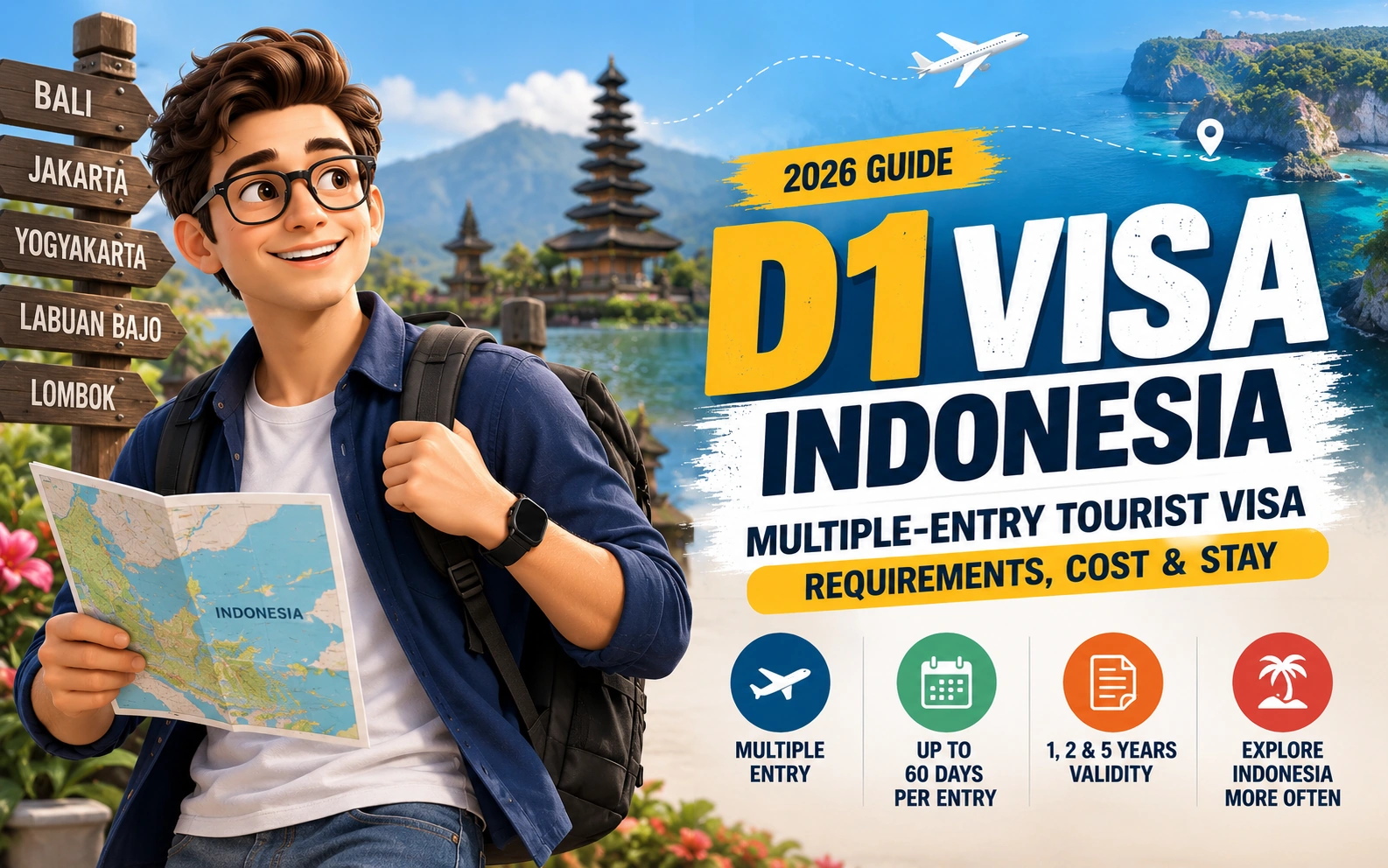
The D1 Multiple Entry Tourist Visa is designed for foreign travelers who need to visit Indonesia repeatedly for tourism or other activities permitted under the D1 category. Unlike Visa-Free Entry, B1, and C1, which are primarily used for a single entry, D1 allows multiple entries during the visa’s validity period.
This makes D1 particularly useful for frequent travelers who regularly enter Indonesia, leave the country, and return again. However, multiple entry does not mean that you can stay in Indonesia continuously for the entire validity period of the visa. Each arrival is subject to its own permitted stay period.
What Can You Do With a D1 Visa?
Under the current D1 visa classification, permitted activities include tourism, visiting family, attending meetings, incentives, conventions, exhibitions or similar events, and transiting through Indonesia to another country.
D1 is still a visitor visa and should not be treated as a work permit. It does not authorize employment or the receipt of wages or similar remuneration for work or business activities from an individual or company in Indonesia. If your primary purpose is to work in Indonesia, you should use the appropriate work or residence visa instead.
How Long Can You Stay on Each Visit?
A D1 holder can receive a permitted stay of up to 60 days for each arrival in Indonesia, calculated from the date of arrival. This is one of the most important differences between the visa’s overall validity and the stay period granted for each individual visit.
For example, a traveler may hold a D1 visa that remains valid for multiple entries over a longer period, but each time they enter Indonesia, they must still comply with the maximum stay permitted for that particular visit.
Can a D1 Stay Be Extended?
Yes. Current Indonesian immigration information states that a stay granted under a multiple-entry visitor visa such as D1 can be extended under the applicable rules, with the general framework allowing extensions up to a maximum total stay of 180 days for the relevant visit.
This extension framework should not be confused with the validity period of the D1 visa itself. A visa may be valid for multiple entries over a longer period, while each individual stay and any extension remain subject to separate immigration conditions.
How Long Is the D1 Visa Valid?
D1 Multiple Entry Tourist Visas are available with different validity periods under Indonesia’s visa framework. The appropriate validity option should be confirmed when applying because the available period and government fee can vary.
Indonesia has also offered a five-year D1 multiple-entry visa for tourism. The important practical rule remains the same: a longer visa validity period does not mean that the holder may remain continuously in Indonesia for five years. The permitted stay is assessed separately for each arrival.
D1 Visa Validity vs Stay Per Entry
| Term | What It Means | Why It Matters |
| Visa validity | The period during which the D1 visa may be used for multiple entries | A longer validity period gives more flexibility for future trips |
| Stay per entry | The permitted period granted after each arrival, generally up to 60 days before any applicable extension | You cannot remain continuously for the full visa validity period |
| Extension | Additional stay that may be requested under the applicable immigration rules | An extension is linked to the conditions of the individual stay |
Understanding this distinction is essential. A five-year multiple-entry visa and a five-year permission to continuously live in Indonesia are not the same thing.
Who Needs a D1 Visa?
The D1 visa may be particularly suitable for travelers who:
- Visit Indonesia regularly for tourism or other permitted visitor activities.
- Need to leave Indonesia and return several times during the visa’s validity period.
- Want to avoid applying for a new single-entry tourist visa before every trip.
- Have travel plans that require repeated entries rather than one continuous stay.
- Understand and can comply with the permitted stay rules for each individual arrival.
What Are the Main D1 Visa Requirements?
The exact requirements should be checked in the official Indonesian e-Visa system at the time of application because requirements can change. As a practical starting point, applicants should expect to provide a valid passport, the information and supporting documents required for the relevant D1 application, and any guarantor or financial documents required under the current rules.
Because D1 is a multiple-entry visa, your passport should have sufficient validity to support the visa period you are applying for. The official application requirements should always take priority over general guidance.
How Much Does the D1 Visa Cost?
Government fees for multiple-entry visitor visas depend on the selected visa validity period. Current official immigration fee information lists different tariffs for multiple-entry visitor visas, ranging from shorter validity periods to one-, two-, five-, and ten-year options.
Because the available D1 validity options and the applicable government tariff should be confirmed in the official application system, travelers should not rely on an old fee quoted by a travel blog or previous visa applicant.
How to Apply for a D1 Multiple Entry Tourist Visa
The D1 application is generally handled online through Indonesia’s official e-Visa system. Applicants or their eligible sponsors should select the correct D1 tourism category, submit the required documents, complete the required payment, and wait for the visa to be processed.
Apply well before your first planned trip. Once the visa is approved, check the validity period, number of permitted entries, and any other conditions shown on the visa before making travel arrangements.
When Is D1 Better Than B1 or C1?
D1 is most useful when the main challenge is the number of trips rather than the length of one continuous stay. If you only plan one holiday, B1 or C1 may be more suitable depending on your nationality and how long you want to stay.
For example, someone who plans to visit Indonesia four or five times over the coming years may benefit from a multiple-entry D1 visa if eligible and if the cost and validity period make sense for their travel pattern. A traveler planning one 45-day holiday, however, would normally focus on a suitable single-entry option instead.
The Key Point to Remember
The biggest advantage of D1 is flexibility for repeated travel. It can reduce the need to obtain a new single-entry visitor visa before every trip, but each arrival remains subject to its own permitted stay period and immigration rules.
Before applying, compare D1 with the cost and practical convenience of B1 and C1. If you travel only once, a multiple-entry visa may be unnecessary. If you visit Indonesia regularly, D1 can be the more practical long-term option.
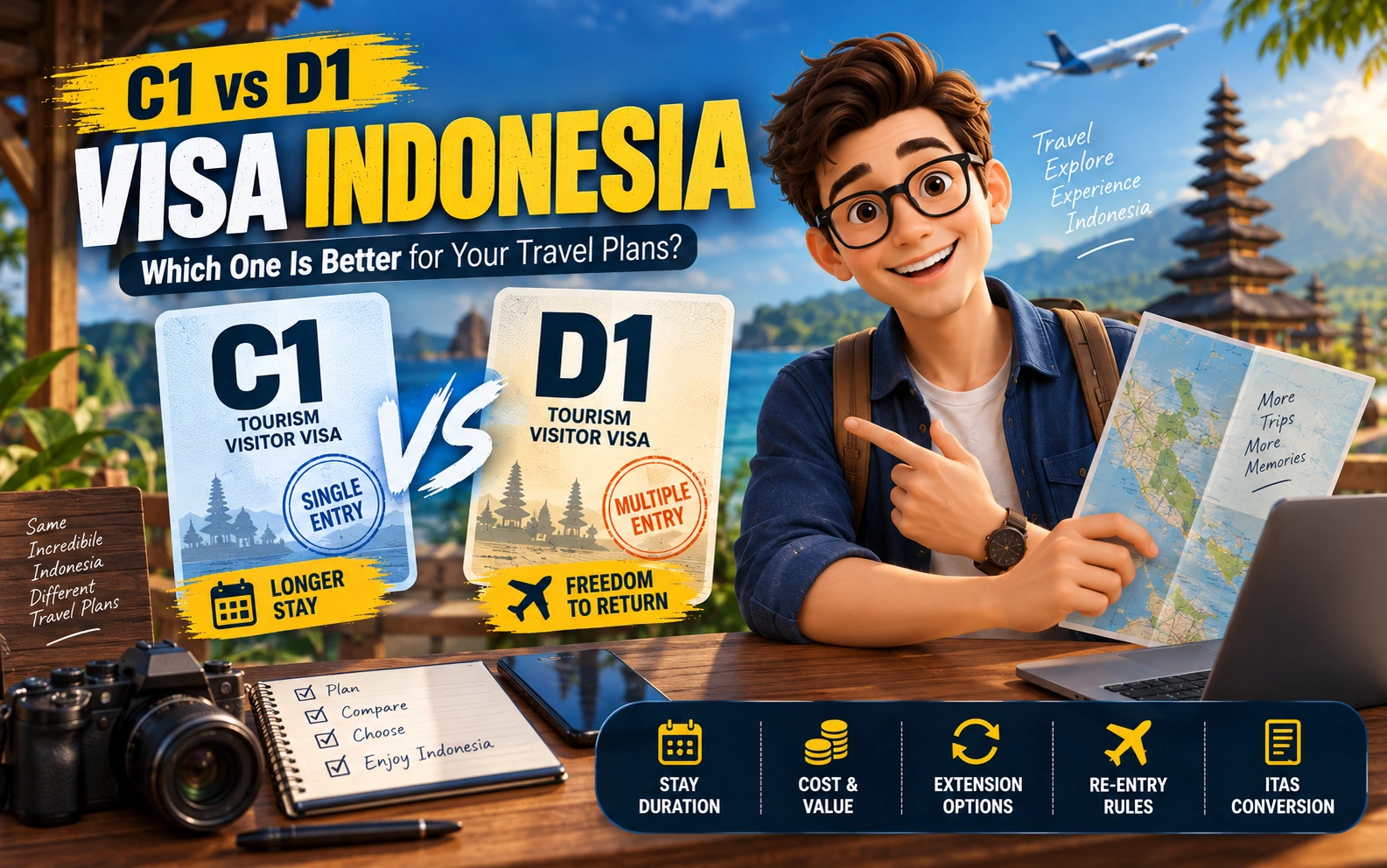
7. Indonesia Tourist Visa Comparison: Visa-Free vs VOA vs C1 vs D1
Choosing between Indonesia’s main tourist entry options becomes much easier when you compare them side by side. The biggest differences are eligibility, how long you can stay, whether an extension is available, how many times you can enter, and whether the visa must be arranged before travelling.
The table below provides a practical overview. However, travelers should always confirm the latest eligibility rules and visa conditions before applying or travelling because Indonesian immigration policies and procedures can change.
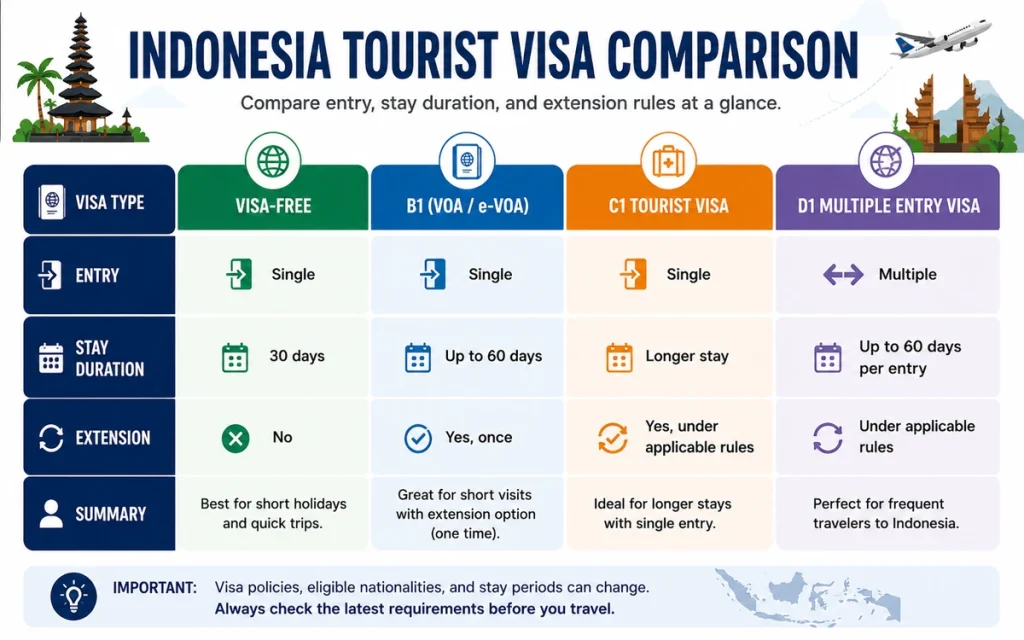
Tourist Visa Comparison at a Glance
| Option | Best For | Initial Stay | Extension | Entries | Main Limitation |
| Visa-Free Entry | Eligible travelers on a short trip | Up to 30 days | Not extendable | Single entry | Limited eligibility and no extension |
| B1 VOA / e-VOA | Eligible short-term visitors who may need extra flexibility | Up to 30 days | Generally one extension, up to a total stay of 60 days | Single entry | Only available to eligible nationalities or subjects |
| C1 Tourist Visa | Travelers planning a longer single visit | Up to 60 days | May be extended under applicable rules, up to the permitted maximum stay | Single entry | Must be arranged before travel and may require sponsorship |
| D1 Multiple Entry Tourist Visa | Frequent travelers who need to enter Indonesia repeatedly | Up to 60 days per arrival | May be extended under applicable rules for the relevant stay | Multiple entry | Visa validity does not mean continuous stay for the full validity period |
1. Best Option for a Short Holiday of Up to 30 Days
If you are eligible for Visa-Free Entry and your trip will definitely end within the permitted 30-day stay, this can be the simplest option because there is no separate visa fee and no advance visa application.
However, if you are eligible for both Visa-Free Entry and B1 and there is a realistic chance that your trip could become longer, B1 may provide more flexibility because the stay can generally be extended once under the applicable rules.
2. Best Option if You May Stay for Up to 60 Days
For travelers who may need up to 60 days in Indonesia, B1 can be a practical choice when the traveler is eligible and is comfortable starting with an initial stay of up to 30 days and then arranging an extension if needed.
C1 may be more suitable when you already know before travelling that you need a longer single stay. It starts with an initial stay of up to 60 days and can provide a clearer framework for a longer trip from the beginning.
3. Best Option for a Longer Single Visit
For a longer single trip, C1 is generally the more relevant option among the categories compared in this guide. The initial stay can be up to 60 days, with extensions available under the applicable immigration rules and within the permitted maximum total stay.
The main point to remember is that C1 is still a single-entry visa. If you leave Indonesia, you should not assume that you can return using the same C1 visa unless the immigration conditions specifically allow it.
4. Best Option for Frequent Travel to Indonesia
D1 is designed for travelers whose main need is repeated entry. Instead of arranging a new single-entry visa for every trip, an eligible traveler can use the multiple-entry framework during the visa’s validity period.
This can be useful for people who regularly visit Indonesia for holidays, family visits, or other activities permitted under the D1 category. Each arrival, however, has its own permitted stay period, generally up to 60 days before any applicable extension.
5. The Most Important Comparison: Visa Validity vs Length of Stay
One of the most common mistakes is assuming that the visa validity period is the same as the amount of time you can continuously stay in Indonesia. These are different concepts.
| Term | Meaning | Example |
| Visa validity | The period during which an approved visa may be used according to its conditions | A multiple-entry D1 may remain valid for repeated travel over its stated validity period |
| Permitted stay | The amount of time you may remain in Indonesia after entering | A D1 stay is generally granted for up to 60 days per arrival |
| Extension | Additional stay that may be granted under the applicable immigration rules | The availability and maximum extension period depend on the visa category and current rules |
Before choosing any visa, check all three: how long the visa is valid, how long you may stay after each entry, and whether an extension is available.
6. Do You Need to Apply Before Travelling?
Visa-Free Entry does not require a visa application in advance, provided you meet the applicable eligibility conditions. A standard VOA is obtained after arriving at an eligible entry point, while an e-VOA is applied for before departure.
C1 and D1 should be arranged before travelling through the applicable official visa process. This means travelers should allow enough time for sponsorship, document preparation, payment, and visa processing before booking a trip that depends on visa approval.
7. Quick Decision Guide
Choose Visa-Free Entry if:
- You are eligible under Indonesia’s current Visa-Free Visit policy.
- Your trip is short and fits within the permitted stay period.
- You do not expect to need an extension.
Choose B1 VOA or e-VOA if:
- You are eligible for Indonesia’s Visa on Arrival program.
- You need a short stay with the possibility of extending to a total stay of up to 60 days under the applicable rules.
- You only need one entry for the trip.
Choose C1 if:
- You are planning a longer single visit from the beginning.
- You need an initial stay of up to 60 days.
- You are prepared to arrange the visa before travelling and meet the applicable sponsorship and document requirements.
Choose D1 if:
- You visit Indonesia regularly and need multiple entries.
- You want a visa framework that can be used for repeated trips during its validity period.
- You understand that each arrival still has a separate permitted stay limit.
Which Tourist Visa Is the Best Overall?
There is no single best tourist visa for every traveler. Visa-Free Entry is often the easiest choice for an eligible short trip. B1 offers useful flexibility for eligible travelers who may need additional time. C1 is more suitable for a longer single stay, while D1 is the strongest option for frequent visitors who need repeated entries.
The best visa is the one that matches your nationality, travel purpose, expected length of stay, and travel pattern. Choosing the correct category before travelling can help you avoid unnecessary extensions, repeated visa applications, or immigration problems later.
8. Which Tourist Visa Is Best for Bali?
Bali is one of the most popular destinations for foreign visitors to Indonesia, but there is no separate tourist visa category that applies only to Bali. The visa you need depends on your nationality, the length of your stay, your travel activities, and whether you plan to leave and re-enter Indonesia during your trip.
In other words, the same Indonesian tourist visa framework applies when you travel to Bali. A visitor arriving at I Gusti Ngurah Rai International Airport may use Visa-Free Entry, B1 Visa on Arrival or e-VOA, C1, or D1 if they meet the eligibility and other requirements of the relevant category.
The Best Visa for a Short Bali Holiday
For a short holiday of up to 30 days, eligible travelers should first check whether they can use Indonesia’s Visa-Free Entry facility. If eligible and if there is no need to stay longer, this can be the simplest option.
The B1 VOA or e-VOA is another popular option for eligible visitors arriving in Bali. It is particularly useful for travelers who want more flexibility because the initial stay of up to 30 days may generally be extended once, allowing a total stay of up to 60 days under the applicable immigration rules.
The Best Visa for a Bali Stay of More Than 30 Days
If you already know that your Bali trip will last longer than 30 days, do not rely on Visa-Free Entry because that stay cannot be extended. Instead, compare B1 and C1 based on your eligibility and the length of stay you need.
B1 may be suitable for an eligible traveler who needs up to 60 days and is comfortable starting with an initial 30-day stay and extending later. C1 may be more suitable when you are planning a longer single visit from the beginning because it provides an initial stay of up to 60 days and can be extended under the applicable rules, up to the permitted maximum stay.
The Best Visa for Long-Term Tourism in Bali
For travelers planning an extended holiday or a long period of tourism in Bali, C1 is generally more relevant than a standard short-stay entry option. Its initial stay is longer than B1, and the stay may be extended several times within the applicable maximum total stay.
However, long-term tourism does not automatically mean that a tourist visa is suitable for every lifestyle or activity. If your real purpose is employment, running day-to-day business activities in Indonesia, or another activity outside the permitted visitor scope, you should review a more appropriate visa category.
The Best Visa for Frequent Trips to Bali
If Bali is a destination you visit repeatedly rather than a place where you plan one continuous holiday, the D1 Multiple Entry Tourist Visa may be worth considering. It is designed for repeated entries during its validity period, subject to the applicable conditions for each arrival.
For example, someone who visits Bali several times a year may find a multiple-entry visa more practical than applying for a new single-entry visa before every trip. The key point is that D1 visa validity and the permitted stay after each arrival are different: each visit remains subject to its own stay limit and any applicable extension rules.
Bali Tourist Visa Comparison
| Your Bali Travel Plan | Most Relevant Option | Why | Important Point |
| Short holiday of up to 30 days | Visa-Free Entry, if eligible | Simple entry for an eligible short visit | Cannot be extended |
| Short holiday with possible extra time | B1 VOA / e-VOA, if eligible | Initial stay up to 30 days with possible extension to a total of up to 60 days | Eligibility is limited to the current VOA list |
| Longer single stay | C1 Tourist Visa | Initial stay up to 60 days with extensions under the applicable rules | Single entry and advance planning are required |
| Regular visits to Bali | D1 Multiple Entry Tourist Visa | Designed for repeated entries | Each arrival has a separate permitted stay period |
Arriving Through Bali: Ngurah Rai Is an Eligible Entry Point
I Gusti Ngurah Rai International Airport in Bali is one of Indonesia’s designated immigration checkpoints for eligible e-VOA holders. This means travelers who have successfully obtained an e-VOA before departure can use the visa when arriving through Bali, subject to the applicable entry conditions.
Bali’s high volume of international arrivals can make advance preparation useful. Before flying, check that your passport details, visa information, and other required arrival information are complete and consistent. An approved visa does not remove the need to comply with immigration requirements at the border.
Do Not Confuse Your Tourist Visa With Bali-Specific Entry Requirements
A valid Indonesian visa is only one part of preparing for a trip to Bali. Bali may also have separate local or national travel requirements that are not part of the tourist visa itself. These requirements can change independently of visa policy.
For that reason, travelers should check both their Indonesian visa requirements and any separate Bali arrival, tourism, customs, health, or local administrative requirements that may apply at the time of travel. Do not assume that having an approved visa means that every other arrival requirement has automatically been completed.
What If You Visit Other Parts of Indonesia After Bali?
You do not need a different tourist visa simply because you plan to travel from Bali to Jakarta, Yogyakarta, Lombok, Komodo, or another destination within Indonesia. Once you have entered Indonesia legally with the appropriate visa or visa exemption, you can generally continue domestic travel for activities permitted under your immigration status.
The important issue is not which Indonesian island you visit but whether your activities and total period of stay remain within the conditions of your visa or stay permit.
The Key Point for Bali Travelers
For most Bali tourists, the decision can be simplified. Choose Visa-Free Entry if you are eligible and your trip is short and fixed. Choose B1 VOA or e-VOA if you are eligible and want the option of staying longer through one applicable extension. Choose C1 if you need a longer single stay from the beginning, and consider D1 if Bali is a destination you visit repeatedly.
The best Bali visa is therefore not a special Bali visa—it is the Indonesian visa category that best matches your passport, length of stay, and travel pattern.
9. Can You Extend a Tourist Visa in Indonesia?
Whether you can extend a tourist stay in Indonesia depends entirely on the visa or entry facility you used. This is one of the most important points to understand before travelling because not every tourist entry option can be extended.
Visa-Free Entry generally cannot be extended. B1 Visa on Arrival can generally be extended once, allowing a total stay of up to 60 days. C1 and D1 follow a different framework: their initial stay is generally up to 60 days and the stay may be extended under the applicable immigration rules, up to a maximum total stay of 180 days for the relevant visit.
Tourist Visa Extension Rules at a Glance
| Visa or Entry Option | Initial Stay | Can It Be Extended? | General Extension Framework | Maximum Total Stay |
| Visa-Free Entry | Up to 30 days | No | Not extendable | Up to 30 days |
| B1 VOA / e-VOA | Up to 30 days | Yes | One extension of up to 30 days | Up to 60 days |
| C1 Tourist Visa | Up to 60 days | Yes | Extensions available under the applicable rules | Up to 180 days |
| D1 Multiple Entry Tourist Visa | Up to 60 days per arrival | Yes | Extensions available under the applicable rules for each relevant stay | Up to 180 days per relevant stay framework |
The table above is a practical summary. The final extension process, timing, documents, and eligibility should always be checked against the current official immigration rules for your exact visa category.
1. Can You Extend Visa-Free Entry?
No. Visa-Free Entry is generally not extendable. If you entered Indonesia using the Visa-Free Visit facility, you should plan to leave Indonesia before the permitted stay expires.
This is why Visa-Free Entry is best for a short trip with fixed dates. If there is a realistic possibility that you will need more time, it may be safer to choose an eligible visa option with an extension facility before travelling rather than assuming you can change your status after arrival.
2. Can You Extend a B1 Visa on Arrival or e-VOA?
Yes. A B1 Visa on Arrival provides an initial stay of up to 30 days and can generally be extended once for an additional period of up to 30 days. This allows a maximum total stay of up to 60 days.
For e-VOA holders, the extension can be completed online through the official Indonesian immigration e-Visa system under the applicable process. Holders of a non-electronic VOA generally follow the extension procedure through the immigration office responsible for their place of stay or domicile.
When Should You Apply for a B1 Extension?
Do not wait until your permitted stay has expired. Official immigration guidance may set a specific application window, and processing requirements can vary depending on whether you hold an e-VOA or a non-electronic VOA.
As a practical rule, check the extension procedure early and submit your application while your current stay is still valid. For example, one official immigration office currently states that a VOA extension may be submitted as early as 14 days before expiry and no later than the working day before the current stay ends.
3. Can You Extend a C1 Tourist Visa?
Yes. The C1 Tourist Visa provides an initial stay of up to 60 days and can be extended multiple times under the applicable immigration rules, up to a maximum total stay of 180 days.
The extension is therefore significantly more flexible than the B1 framework. This is one of the main reasons C1 can be suitable for travelers who already know they want to spend an extended period in Indonesia rather than taking a short holiday.
How Is a C1 Extension Processed?
Current official C1 guidance states that the extension can be submitted online by the sponsor through the sponsor’s registered account in Indonesia’s official e-Visa system. The sponsor and applicant should make sure that the required information and documents are ready before the current stay expires.
Because immigration procedures can change, do not assume that the same technical steps or document requirements will apply to every future extension. Always follow the instructions shown in the official system at the time of the application.
4. Can You Extend a D1 Multiple Entry Tourist Visa?
Yes, the stay granted after a D1 arrival can generally be extended under the applicable immigration rules. The standard multiple-entry visitor visa framework provides an initial stay of up to 60 days and allows extensions up to a maximum total stay of 180 days for the relevant stay.
The most important point is that an extension applies to your current stay, not automatically to the entire validity period of the D1 visa. If you leave Indonesia and later return under the still-valid D1 visa, the immigration conditions for the new arrival are assessed separately.
Extension of Stay vs Visa Validity
A visa extension and visa validity are not the same thing. This distinction is especially important for D1, but it also matters for other visitor visas.
| Term | What It Means | Example |
| Visa validity | The period during which the visa may be used according to its conditions | A multiple-entry D1 may remain valid for future entries during its stated validity period |
| Permitted stay | The time you are allowed to remain in Indonesia after entering | A B1 holder may initially receive up to 30 days |
| Extension of stay | Additional time granted under the applicable immigration rules | A B1 stay may generally be extended once for up to 30 additional days |
What Documents Are Needed for a Tourist Visa Extension?
The exact documents depend on the visa category and the current immigration procedure. Common requirements for a visitor stay extension can include a valid passport, the current visa or stay permit information, sponsor or guarantor documents where a sponsor is required, and information explaining the purpose of your continued stay.
For sponsored visas such as C1, the sponsor normally plays an important role in the extension process. For B1, the process differs depending on whether you hold an e-VOA or a non-electronic VOA.
How Much Does a Tourist Visa Extension Cost?
Extension fees and procedures can vary depending on the visa category and the regulations in force at the time of application. Always check the current official immigration requirements before applying.
What Happens If You Do Not Extend Before Your Stay Expires?
If you remain in Indonesia after your permitted stay expires without a valid extension or other lawful immigration status, you may be considered to have overstayed. Overstay can result in immigration consequences, including financial penalties and other enforcement action depending on the length and circumstances of the overstay.
Do not assume that filing an extension application after your permitted stay has expired will automatically solve the problem. Check your expiry date carefully and take action before the current stay ends.
Can You Leave Indonesia Instead of Extending?
Leaving Indonesia may be an alternative to extending a current stay, but whether you can return and under what conditions depends on your visa category. A single-entry visa such as C1 is generally used for one entry, so leaving ends that stay and you may need a new visa to return.
A multiple-entry D1 visa can provide more flexibility for eligible holders who leave and later return during the visa’s validity period, subject to the stay conditions for each new entry. A visa run should not be treated as a universal substitute for complying with the correct visa and stay rules.
The Key Point to Remember
Before entering Indonesia, check not only how long your initial stay will be but also whether the visa can be extended. Visa-Free Entry is generally not extendable. B1 can generally be extended once to a total stay of up to 60 days, while C1 and D1 can provide a longer extension framework up to the applicable maximum total stay of 180 days.
If you already know your travel dates may change, choosing the correct visa from the beginning can be easier and safer than trying to solve an extension problem at the end of your permitted stay.
10. Common Tourist Visa Mistakes to Avoid
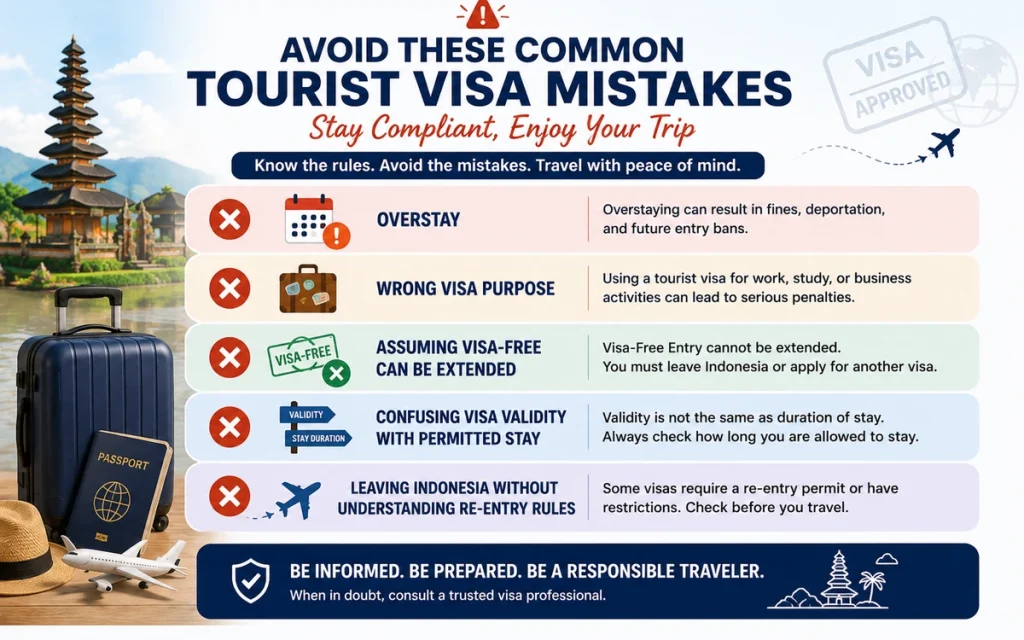
Indonesia’s tourist visa options can look simple at first, but many immigration problems happen because travelers choose the wrong entry option, misunderstand how long they can stay, or leave important visa checks until the last minute.
The safest approach is to treat your visa as a set of conditions, not just a document that allows you to enter Indonesia. Before travelling, understand your permitted activities, length of stay, number of entries, extension options, and the exact expiry date of your current stay.
1. Choosing a Visa Based Only on the Cheapest Option
A common mistake is choosing Visa-Free Entry simply because it has no visa fee, without considering whether the trip may last longer than the permitted stay. Visa-Free Entry may be convenient for an eligible short holiday, but it is generally not extendable.
If there is a realistic possibility that your plans will change, choosing an eligible B1 option or another suitable visa from the beginning may be more practical than entering visa-free and later discovering that you need more time.
2. Assuming All Tourist Visas Have the Same Stay Period
Different tourist entry options have different initial stay periods. B1 generally provides up to 30 days from arrival, while C1 and the standard D visitor visa framework generally provide up to 60 days for the relevant stay. Visa-Free Entry also follows its own rules.
Do not rely on what a friend, hotel, social media post, or old blog says about a different visa category. Always check the conditions of your exact visa or entry facility.
3. Confusing Visa Validity With Your Permitted Stay
This is especially important for multiple-entry visas. A visa can remain valid for repeated travel over a stated period, but that does not mean you may stay continuously in Indonesia for the entire visa validity period.
For example, a D1 visa may allow multiple entries during its validity period, while each arrival has its own permitted stay period. Always look separately at the visa validity date, the number of entries, and the maximum stay allowed after each entry.
4. Waiting Until the Last Minute to Apply for an Extension
Do not assume that an extension can be completed instantly on the final day of your stay. Immigration offices and the official online process have their own application windows and processing requirements.
Official immigration guidance for visit-stay extensions generally allows applications to be prepared before expiry, and some offices state that Visa on Arrival extensions can be submitted as early as 14 days before the current stay ends. Start checking your extension process early rather than waiting until your visa is about to expire.
5. Assuming Every Tourist Entry Option Can Be Extended
Not every tourist entry option has the same extension rights. Visa-Free Entry is generally not extendable. B1 can generally be extended once, while C1 and eligible D visitor visa stays can follow a longer extension framework under the applicable rules.
Before entering Indonesia, check whether your chosen option can be extended and what the maximum total stay may be. This is much easier than trying to change your plans after you have already arrived.
6. Using a Tourist Visa for Activities That Are Not Permitted
A tourist or visitor visa is not automatically permission to work in Indonesia. The permitted activities depend on the visa index and the conditions attached to that visa.
For example, official C1 information states that holders are not allowed to sell goods or services or receive wages, compensation, or similar remuneration for work or business activities from an individual or corporation in Indonesia. If your actual purpose is employment or another activity outside your visitor permission, you should review the appropriate visa before travelling.
7. Booking Non-Refundable Travel Before Checking Visa Eligibility
Do not assume that every passport holder is eligible for Visa-Free Entry or B1 Visa on Arrival. Eligibility lists and visa requirements can change, and some travelers need to arrange a different visa before departure.
Before paying for non-refundable flights or accommodation, check whether your nationality is eligible for your preferred entry option and whether you need to apply for a visa in advance.
8. Ignoring Passport Validity Requirements
Your passport must meet the validity requirement for the visa or entry option you are using. A passport that is close to expiry can create problems even when you otherwise qualify for the visa.
Check passport validity early in your travel planning. If you may need a longer-stay or multiple-entry visa, pay particular attention to whether your remaining passport validity is sufficient for the visa you are applying for.
9. Providing Inconsistent Information in Your Application
Simple data errors can cause unnecessary problems. Your name, passport number, date of birth, nationality, and other key information should match your passport and supporting documents exactly.
Before submitting an online application or making payment, review every field carefully. A small typo in a passport number or date can be much easier to correct before a visa is issued than after approval.
10. Forgetting That a Single-Entry Visa Ends When You Leave Indonesia
A single-entry visa is intended for one entry. Travelers sometimes assume that they can take a short trip to Singapore, Malaysia, or another country and then return to Indonesia using the same single-entry visa.
Before leaving Indonesia, check your visa’s entry conditions. If your visa is single entry, leaving Indonesia generally ends that stay and you may need a new visa to return.
11. Treating a Visa Run as a Guaranteed Solution
Leaving Indonesia and returning is not a universal replacement for a proper visa extension. Whether you can re-enter depends on your nationality, visa eligibility, current immigration rules, and the visa you use for the new arrival.
If your travel pattern requires frequent entries, consider whether a suitable multiple-entry option such as D1 is more appropriate than repeatedly relying on short departures and new entry permissions.
12. Overstaying Because You Miscalculated the Expiry Date
Never estimate your expiry date casually. Count your permitted stay based on the rules and dates shown in your immigration documents, and keep a reminder well before the deadline.
Overstaying can lead to financial penalties and other immigration consequences. If you need an extension, begin the process while your current stay is still valid and do not assume that a late application will automatically remove an overstay problem.
13. Assuming the Visa Alone Covers Every Travel Requirement
An approved visa does not necessarily mean that every other travel requirement has been completed. Depending on the current rules, you may also need to comply with passport, customs, health, arrival declaration, or destination-specific requirements.
Before departure, review the complete arrival process rather than checking only the visa. This is particularly important for Bali travelers, who may need to consider separate local or national requirements in addition to immigration rules.
14. Relying on Old or Unofficial Information
Visa rules, eligible-country lists, fees, application systems, and extension procedures can change. A video or article that was correct several years ago may no longer match the current system.
Use up-to-date official Indonesian immigration information for the final check before applying or travelling. Third-party guides can be useful for planning, but the official rules and the conditions of the visa actually issued to you should take priority.
Quick Tourist Visa Mistake Checklist
| Before You Travel | While in Indonesia | Before You Leave |
| Confirm your nationality’s visa eligibility | Check your permitted stay date | Confirm whether your visa is single or multiple entry |
| Check passport validity | Start any extension process early | Make sure you have the correct visa for a future return |
| Choose a visa that matches your real purpose and travel length | Stay within your permitted activities | Avoid overstaying |
The Key Point to Remember
Most tourist visa problems can be avoided with three simple checks: choose the correct visa before travelling, understand exactly how long you are allowed to stay, and take action before your current permission expires.
If you are unsure which option matches your plans, compare your expected length of stay, travel purpose, and number of planned entries before applying. The correct visa is usually easier to arrange before a problem occurs than to fix after you arrive.
11. Indonesia Tourist Visa FAQ
Below are answers to some of the most common questions foreign travelers ask before visiting Indonesia. The correct answer can depend on your nationality, visa category, length of stay, and travel purpose, so always check the conditions of your exact visa before travelling.
Do I Need a Tourist Visa to Visit Indonesia?
Not always. Some foreign nationals may be eligible for Indonesia’s Visa-Free Visit facility, while others may be eligible for B1 Visa on Arrival (VOA) or e-VOA. Travelers who are not eligible for these facilities, or who need a longer or multiple-entry option, may need to apply for another visitor visa such as C1 or D1 before travelling.
Your passport nationality is therefore one of the first things to check when choosing an Indonesia tourist visa.
How Long Can I Stay in Indonesia as a Tourist?
The permitted stay depends on the entry option you use. Visa-Free Entry generally allows a stay of up to 30 days and is not extendable. B1 VOA or e-VOA generally starts with up to 30 days and can be extended once for up to 30 additional days, giving a maximum total stay of up to 60 days.
C1 and the standard D multiple-entry visitor visa framework generally provide an initial stay of up to 60 days, with extensions available under the applicable rules up to the relevant maximum total stay.
Can I Extend My Tourist Visa in Indonesia?
It depends on your visa. Visa-Free Entry generally cannot be extended. B1 can generally be extended once to a maximum total stay of 60 days. C1 and eligible D visitor visa stays can generally be extended under the applicable immigration framework, subject to the requirements and maximum stay rules for the relevant category.
Always start checking the extension process before your current stay expires. Do not assume that every tourist entry option has the same extension rights.
What Is the Difference Between VOA and e-VOA?
The main difference is when and how you obtain the visa. A regular VOA is obtained after arriving at an eligible Indonesian immigration checkpoint, while an e-VOA is applied for and paid online before travelling.
For eligible travelers, e-VOA can reduce the arrival process because the visa payment is completed in advance. The information on the e-VOA must match the passport details exactly.
Can I Get a Visa on Arrival in Bali?
Yes, eligible travelers can obtain a Visa on Arrival when arriving through an eligible immigration checkpoint in Bali, including I Gusti Ngurah Rai International Airport. Eligible travelers may also use an approved e-VOA when arriving through designated entry points.
However, VOA eligibility depends on your nationality or other eligibility criteria. Check the current official list before travelling.
How Much Does a Tourist Visa for Indonesia Cost?
The cost depends on the visa category. Current official immigration information lists the government fee for a B1 Visa on Arrival at Rp500,000. Longer-stay and multiple-entry visas have different government fees depending on the visa type and validity period.
If you use a visa agent or other professional assistance, that service fee is separate from the official government visa fee.
Do I Need a Return Ticket to Enter Indonesia?
A return ticket or onward ticket is commonly required for tourist entry. Official guidance for Visa-Free Entry and Visa on Arrival requires a passport with the applicable validity and a return or onward ticket.
Make sure your travel plans are consistent with your permitted stay and any valid extension plan. Your visa or entry permission does not remove the need to meet the relevant entry requirements.
How Long Should My Passport Be Valid?
For Visa-Free Entry and B1 VOA/e-VOA, official immigration guidance generally requires a passport valid for at least six months. Other visa categories can have different passport-validity requirements depending on the requested stay period and the travel document used.
Check the requirement for your exact visa before applying. If your passport is close to expiry, renewing it before submitting a longer-stay or multiple-entry visa application may be the safer option.
Can I Work in Indonesia on a Tourist Visa?
A tourist or visitor visa is not a general work permit. The activities you are allowed to carry out depend on the specific visa index and its conditions.
For example, the current official C1 tourism information states that holders are not permitted to sell goods or services or receive wages, compensation, or similar remuneration for work or business activities from an individual or corporation in Indonesia. If your purpose is employment, you should review the appropriate work or residence visa before travelling.
Can I Leave Indonesia and Come Back on the Same Tourist Visa?
That depends on whether your visa is single entry or multiple entry. A single-entry visa such as C1 is generally used for one entry, so leaving Indonesia normally ends that stay. You may need a new visa before returning.
A multiple-entry visa such as D1 can provide greater flexibility for repeated travel during its validity period, but each new arrival remains subject to the applicable permitted stay conditions.
Can I Change My Tourist Visa to Another Visa in Indonesia?
Do not assume that every tourist visa can be converted into another immigration status. Whether a stay permit can be converted depends on the exact visa index and the current immigration rules.
If you expect your purpose of stay to change, check the conversion rules for your specific visa before entering Indonesia. In some situations, leaving Indonesia and applying for the correct visa may be required instead.
Can I Apply for an Indonesia Tourist Visa Online?
Yes, some Indonesia visitor visas can be applied for through the official e-Visa system. The e-VOA is an example of a visa that eligible travelers can arrange online before departure.
C1 and D1 applications also use the applicable official electronic visa process, subject to the requirements for the specific visa category and, where required, sponsorship or guarantor arrangements.
How Long Does an Indonesia Tourist Visa Take to Process?
Processing time depends on the visa category, application completeness, payment, immigration review, and current system conditions. A VOA is obtained at arrival, while an e-VOA must be approved through the online process before departure.
For longer visitor visas such as C1 or D1, do not wait until the last minute. Apply early enough to allow time for document preparation, sponsorship where required, payment, and processing.
What Happens If I Overstay My Tourist Visa?
Remaining in Indonesia after your permitted stay expires can result in immigration penalties and other consequences. Current official immigration guidance has stated that overstaying can result in a fine of Rp1,000,000 per day, subject to the applicable legal and administrative rules.
Check your stay expiry date carefully and begin any eligible extension process before your current permission ends.
Can I Use Visa-Free Entry and Then Extend It Later?
Generally, no. Visa-Free Entry is not the same as B1 VOA or e-VOA and is generally not extendable.
If you may need more than the permitted visa-free stay, choose the correct eligible visa option before or upon entry rather than relying on a later extension.
What Is the Best Tourist Visa for Bali?
There is no separate tourist visa that applies only to Bali. The best option depends on your nationality, expected length of stay, and travel pattern.
For an eligible short trip, Visa-Free Entry may be the simplest option. B1 can provide additional flexibility for an eligible visitor who may stay up to a total of 60 days. C1 is generally more suitable for a longer single visit, while D1 may be useful for frequent travelers who need multiple entries.
Can I Use My Tourist Visa to Travel Around Indonesia?
Yes, your immigration status is not limited to one tourist destination simply because you entered through Bali, Jakarta, or another international gateway. Once lawfully admitted to Indonesia, you can generally travel domestically for activities permitted under your visa or stay permission.
You do not need a new tourist visa simply to travel from Bali to Jakarta, Yogyakarta, Lombok, Komodo, or another destination within Indonesia.
What Is the Safest Way to Choose the Right Tourist Visa?
Start with four questions: What is your nationality? How long will you stay? What activities will you do in Indonesia? How many times do you plan to enter?
Once you have those answers, compare Visa-Free Entry, B1, C1, and D1 based on eligibility, permitted stay, extension options, and number of entries. The best visa is the one that matches your actual travel plans—not simply the cheapest or fastest option.
The Key Point to Remember
Indonesia’s tourist visa rules are easier to understand when you focus on four factors: eligibility, permitted stay, extension rights, and number of entries. Before travelling, verify your exact visa conditions through the official immigration system because requirements, fees, and procedures can change.
Conclusion: Choosing the Right Tourist Visa for Indonesia
Indonesia offers several tourist entry options, but there is no single visa that is automatically the best choice for every traveler. The right option depends on your nationality, how long you plan to stay, what activities you intend to do, and whether you need one entry or multiple entries.
For an eligible traveler taking a short and fixed trip, Visa-Free Entry may be the simplest choice. If you are eligible for B1 Visa on Arrival or e-VOA and want the flexibility to extend your stay once, B1 can be a practical option. For a longer single visit, C1 provides an initial stay of up to 60 days and can be extended under the applicable immigration rules. For frequent visitors who need to enter Indonesia repeatedly, D1 may offer a more suitable multiple-entry framework.
The Simplest Way to Choose Your Indonesia Tourist Visa
Before booking your trip, answer these four questions:
- What passport do I hold, and which Indonesian visa facilities am I eligible for?
- How long do I realistically plan to stay in Indonesia?
- What activities will I carry out while I am in Indonesia?
- Will I enter Indonesia once, or do I expect to leave and return multiple times?
Once you know the answers, choosing the right category becomes much easier. A short one-time holiday may only require a simple entry option, while a longer stay or repeated travel may require a different visa from the beginning.
Do Not Choose a Visa Only Based on Price or Convenience
The cheapest or fastest option is not always the right one. A visa-free facility may save money, but it is generally not extendable. A multiple-entry visa may offer more flexibility, but it can be unnecessary for someone making only one short trip.
The better approach is to choose the visa that matches your real travel plans. This can help you avoid unnecessary extensions, repeated visa applications, problems caused by leaving Indonesia on a single-entry visa, or more serious issues such as overstaying.
Always Check the Current Rules Before Travelling
Indonesia’s immigration rules, eligible-country lists, government fees, application procedures, and electronic visa systems can change. For that reason, this guide should be used as a practical starting point, while your final decision should always be confirmed against the current official immigration information and the conditions of the visa issued to you.
Pay particular attention to the difference between visa validity and permitted stay. For example, an e-VOA may have a period during which it must be used for entry, while the stay granted after arrival follows separate rules. The same principle is especially important for multiple-entry visas, where a long visa validity period does not mean you may stay continuously in Indonesia for that entire period.
Final Tourist Visa Checklist
| Before You Travel | Before Your Stay Ends |
| Confirm your nationality’s eligibility for the visa you want | Check the exact expiry date of your permitted stay |
| Check that your passport has sufficient validity | Apply for an eligible extension early if you need more time |
| Make sure your planned activities are permitted under your visa | Do not overstay while waiting for plans to change |
| Confirm whether your visa is single entry or multiple entry | Check whether you need a new visa before leaving and returning |
| Prepare return or onward travel and other required documents | Keep your immigration documents and passport information available |
Need Help Choosing the Right Indonesia Visa?
If you are unsure whether Visa-Free Entry, B1 VOA/e-VOA, C1, D1, or another Indonesian visa category is right for your plans, getting advice before travelling can help you choose the correct option from the beginning.
Azra Solutions can assist foreign travelers and visitors with understanding Indonesian visa options, preparing visa applications, arranging eligible visa sponsorship where required, and planning the appropriate immigration route based on the purpose and expected length of stay.
Contact our team before you travel so you can enter Indonesia with a visa that matches your actual plans and avoid unnecessary immigration problems later.